Explainer
Is Scraping for AI Training Legal? Three Cases, No One Rule
Is scraping for AI training legal? Bartz, Kadrey and ROSS each turned on their own facts. What they decided, and what EU and Indian rules add.

A finding that one training use is fair does not authorize every way of acquiring, retaining or distributing the training material. I would assess those steps separately and start with owned or appropriately licensed material where the rights actually cover the proposed use. The contrasting Bartz, Kadrey and ROSS decisions are why I would reject a universal answer. Bartz training order, Kadrey order, ROSS appellate opinion.
This is public-source research, not legal advice. Get qualified rights and privacy review for the actual corpus, model, acquisition method and intended outputs.
Short on time?
Here's my take
- Rights review
- Separate every copying step
- Acquisition, library retention, training and outputs need their own answers.
- US case law
- Read the record-specific holding
- ROSS is non-generative; Bartz and Kadrey do not establish blanket permission.
- My starting choice
- Owned or appropriately licensed inputs
- Review the actual licence scope and personal-data questions before collection.
Prices verified . Sponsors cannot buy a verdict or a position.
Which part of the pipeline needs permission? #
I would review acquisition → retained library → training copies → outputs → later reuse as separate steps. In Bartz, the court distinguished the training use from pirated copies accumulated in a central library; a short headline about fair use loses that distinction. ECF 231, conclusion at pp. 30–32.
| Step | Question I would put in the rights record | Why a training ruling is insufficient |
|---|---|---|
| Acquire | Where did each item come from, with what access and rights? | A training-purpose argument does not answer access-control or acquisition questions |
| Retain | What library copies are kept, and for how long? | Retention can be analyzed separately from training |
| Train | What use, copying and market effects are at issue? | US fair use depends on the particular record |
| Generate or retrieve | What protected material can outputs or retrieval expose? | Training and downstream content use are different questions |
| Distribute | What model, corpus or output rights actually permit release? | A licence must be read for its own scope |
This is my proposed review worksheet, drawn from the Bartz distinctions, US fair-use factors and anti-circumvention statute. It is not a compliance certificate or a statement that every pipeline has the same legal outcome.
What did Bartz v. Anthropic actually decide? #
The June 23, 2025 order found the training use and specified print-to-digital replacement fair, but denied Anthropic summary judgment for pirated central-library copies. The acquisition and retention issue cannot be erased by describing the entire pipeline as training. Bartz ECF 231, pp. 30–32.
On July 20, 2026, the court granted final approval of a $1.5 billion settlement fund. That updates the older “proposed settlement” description; it does not convert the agreement into a merits judgment that all AI training is lawful or unlawful. Final approval, ECF 680.
I did not certify the complete later docket, appeal status, enforcement or individual payment eligibility. “Final approval” describes the read order, rather than a promise that every further procedural question is over.
What did Kadrey v. Meta decide? #
The June 25, 2025 fair-use ruling addressed thirteen authors and the evidence they presented. The court explicitly warned against treating its conclusion as a general licence to train AI on copyrighted works; the separate torrent-distribution issue also should not be collapsed into the training finding. Kadrey ECF 598, pp. 4–5 and 39–40.
The public index I reviewed on October 16 still contained October 2026 proceedings. Its latest observed entry then, ECF 872 on October 15, described striking an exhibit to a discovery letter, not a new general ruling on training legality. On November 11 I searched the public RECAP index for the same case (N.D. Cal. 3:23-cv-03417) and found only case-management activity: an October 29, 2026 conference in which the court revoked one firm’s status as interim class counsel and related newer author suits against Meta. I found no new ruling on whether training is fair use, though a search is not a full docket read.
My practical reading is to preserve the opinion’s limits. A fair-use finding on these plaintiffs’ record does not decide another corpus, a different distribution act or every later claim.
What did the ROSS appeal change? #
In September 2026, a Third Circuit panel affirmed partial summary judgment in Reuters v. ROSS: the headnotes at issue were copyrightable and ROSS’s use was not fair. ROSS involved a non-generative system, and direct competition with the plaintiff mattered; calling it a ruling against every generative training project would overstate the holding. Panel opinion, pp. 2, 5 and 14–32.
The opinion was first filed under seal on September 29 and ordered publicly unsealed on September 30 because the parties sought no redactions. That explains the two dates you may encounter; they are not two separate merits decisions. September 30 unsealing order.
ROSS asked the Third Circuit to rehear the case, in front of the original panel or the full court, in a petition filed on November 3, 2026 (docket 25-2153, entry 225). An amicus motion supporting the petition followed on November 9 (entry 226), and the docket I read on November 11 shows no order on the petition yet. I would not treat the appeal as finished. Law360 report.
| Record reviewed | What it establishes | What I would not infer |
|---|---|---|
| Bartz, June 2025 | Specified training/replacement uses fair; pirated-library issue treated separately | Every acquisition is lawful |
| Bartz, July 2026 | Court approved the settlement fund | A universal training rule or verified individual payout |
| Kadrey, June 2025 | A record-specific fair-use win involving thirteen authors | All claims or all AI training resolved |
| ROSS, September 2026 | Panel upheld the adverse fair-use result for this competing non-generative system | Every generative system loses or rehearing is finished |
Sources: Bartz fair-use order, Bartz approval, Kadrey order, ROSS opinion, rehearing-petition report. Status checked 2026-11-11, subject to the docket limits stated above.
Does US fair use cover commercial AI training? #
There is no categorical answer in the sources I read. Section 107 sets out four factors, including purpose and character, the work’s nature, amount used and market effect; the cases above depend on their actual records. 17 USC §107. New suits keep testing the question: the New York Times lawsuit against Brave, filed November 2, accuses Brave’s search API of supplying index content for “training and grounding”.
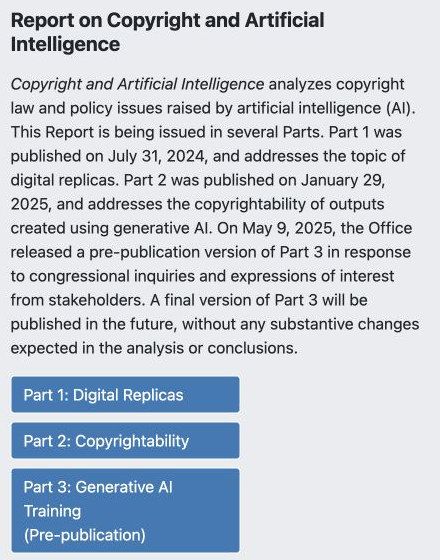
The US Copyright Office’s Part 3 report discusses context-dependent fair use and licensing. The Office still labels the available document pre-publication; it is agency analysis, not a new statute or a court judgment deciding your project. Report publication page, Part 3, pp. 49–85 and 107–109.
Effective access controls raise a separate anti-circumvention question. I would not use a copyright argument as permission to get around one. 17 USC §1201. Google’s DMCA claims against SerpApi are a current example of that question being litigated; my Google v. SerpApi guide keeps its own dated status.
What do the EU’s data-mining exceptions allow? #
Article 3 of the DSM Directive provides a qualified scientific-research route for specified organizations with lawful access. Article 4 provides a broader TDM exception with lawful-access and appropriate express rights-reservation conditions. Those are not interchangeable routes, and national implementation still needs review. Directive 2019/790, Articles 3–4.
Article 7’s protection against contrary contracts does not list Article 4. Separately, a publicly accessible database can retain database-right protection, as the CJEU’s CV-Online analysis shows. Article 7, CV-Online judgment.
The Commission describes the GPAI Code as a voluntary compliance tool for underlying AI Act duties. Its copyright chapter commits signatories to lawful access, effective access restrictions, RFC 9309 and other appropriate rights-reservation protocols; a voluntary code does not make the underlying law voluntary. Commission Code page, Copyright chapter, Measures 1.2–1.3.
I did not separately audit the complete current consolidated AI Act. These statements describe the Commission materials I could read, rather than certify every obligation or implementation date for your model.
Is public personal data free to train on? #
Public availability does not remove data-protection analysis. The EDPB says model anonymity and legitimate interest require case-specific assessment; its July 2026 announcement also addresses lawful basis, transparency and sensitive data in scraping. Opinion 28/2024 announcement, July scraping announcement.
Guidelines 03/2026 remain a version 1 consultation draft: feedback closed on October 30, 2026, and I found no adopted final version on November 11. Their draft analysis says that missing robots restrictions do not equal GDPR consent and that legitimate interest requires three cumulative tests. I would treat this as relevant draft regulatory guidance, not a final new statute. Consultation status, Version 1, paragraphs 25–30 and 43–47.
A robots file is itself a crawler protocol, not access authorization. That is why I would not equate an allowed path with a personal-data or copyright permission. RFC 9309. My explainer on whether robots.txt is legally binding covers the protocol’s legal weight in more detail.

Is scraping for AI training legal in India? #
The Indian IT Act requires its own permission analysis: section 43 covers specified acts without permission, and section 66 adds dishonest or fraudulent conduct. A US fair-use result does not decide those elements. IT Act, sections 43 and 66. The India section of my general scraping guide covers the same provisions for collection that isn’t about training.
The enacted DPDP text has a limited public-data exclusion for specified publication by the data principal or a legally obliged person. But the November 2025 commencement notification phases the Act, with the main sections 3–17 generally eighteen months after publication; I am not calling those provisions fully operative before that point. DPDP section 3, Gazette notification.
DPIIT’s December 2025 working paper discusses purpose-specific fair dealing and proposes mandatory licensing for AI training. The accompanying government announcement identifies a proposal open for feedback. I could not verify the current full Copyright Act or subsequent reform status, so this is not evidence of an enacted blanket permission. Working paper, Publication announcement.
What would I check before training a model? #
I would start with owned or appropriately licensed material and document what the rights actually cover: acquisition, copies, retention, training, retrieval, outputs and distribution. That reduces unanswered rights questions in the review record; it does not guarantee that any particular licence covers every use. I would also check whether a target’s network treats training crawlers differently from search crawlers; Cloudflare’s AI crawler categories, live since September 15, are one example.
For an exception-based route, I would ask counsel to assess the exact corpus, beneficiary, jurisdiction, reservations and market effects before collection. I would keep personal-data review separate and preserve the basis for every admitted source. These are my process recommendations, not legal conclusions about your project.
The data hub, general scraping legal guide, robots explainer, RAG collection guide, crawl API pillar and search API pillar cover related decisions. A retrieval tool or a vendor subscription does not itself supply the missing content rights.
FAQ #
Is training AI on copyrighted work always fair use? #
No universal rule follows from the cases reviewed. Fair use depends on the particular use and evidence; Bartz, Kadrey and ROSS address materially different records. Fair-use statute, Bartz, Kadrey, ROSS.
Did the Bartz ruling say pirated training libraries are OK? #
No. The June 2025 order treated specified training uses separately and denied summary judgment for pirated central-library copies. ECF 231.
Is the Bartz settlement still just a proposal? #
No. The court granted final approval of a $1.5 billion settlement fund on July 20, 2026. Later appeals, enforcement and individual payment questions were not comprehensively verified here. ECF 680.
Does the ROSS ruling apply to generative AI? #
No. The panel addressed a competing non-generative system using copyrighted headnotes and upheld the adverse fair-use result. Law360 reported on November 4, 2026 that ROSS has asked the full court to rehear the case. Panel opinion, Law360 report.
If robots.txt allows crawling, is that GDPR consent to train? #
No. The EDPB’s consultation draft says absent robots restrictions do not equal GDPR consent. An assessment of your project remains case-specific, and this guidance is still a draft. Consultation status, draft guidelines.
Can I rely on India’s proposed AI training licence yet? #
The dated working paper and government announcement establish a proposal, not enacted permission. This research did not certify the current full Copyright Act or subsequent reform status. DPIIT paper, announcement.
Sources
25 sources, accessed to .
Official pricing, docs, changelogs and status pages 20
- Reuters v ROSS, ThirdCircuit panel opinion ECF214
- Reuters v ROSS unsealing order ECF213
- Bartz fair-use order ECF231
- Bartz final settlement approval ECF680
- US Copyright Office AI report index
- USCO Part3 AI-training report
- EU DSM Directive2019/790
- CJEU CV-Online Latvia C762/19 judgment
- EDPB Opinion28/2024 AI-models announcement
- EDPB July2026 scraping announcement
- EDPB03/2026 consultation status
- EDPB03/2026 version1 PDF
- European Commission GPAI Code current page
- GPAI Code Copyright chapter
- India ITAct2000 official text
- India DPDPAct2023 enacted text
- DPDP commencement Gazette GSR843E
- DPIIT AI-copyright Working Paper Part1
- PIB DPIIT publication announcement
- RFC9309 Robots Exclusion Protocol


