Explainer
The New York Times sued Brave on Nov 2: what it means
The NYT and three other papers sued Brave on Nov 2, 2026 over its search index, API and paywall blocker. What's alleged, and what API buyers should do.

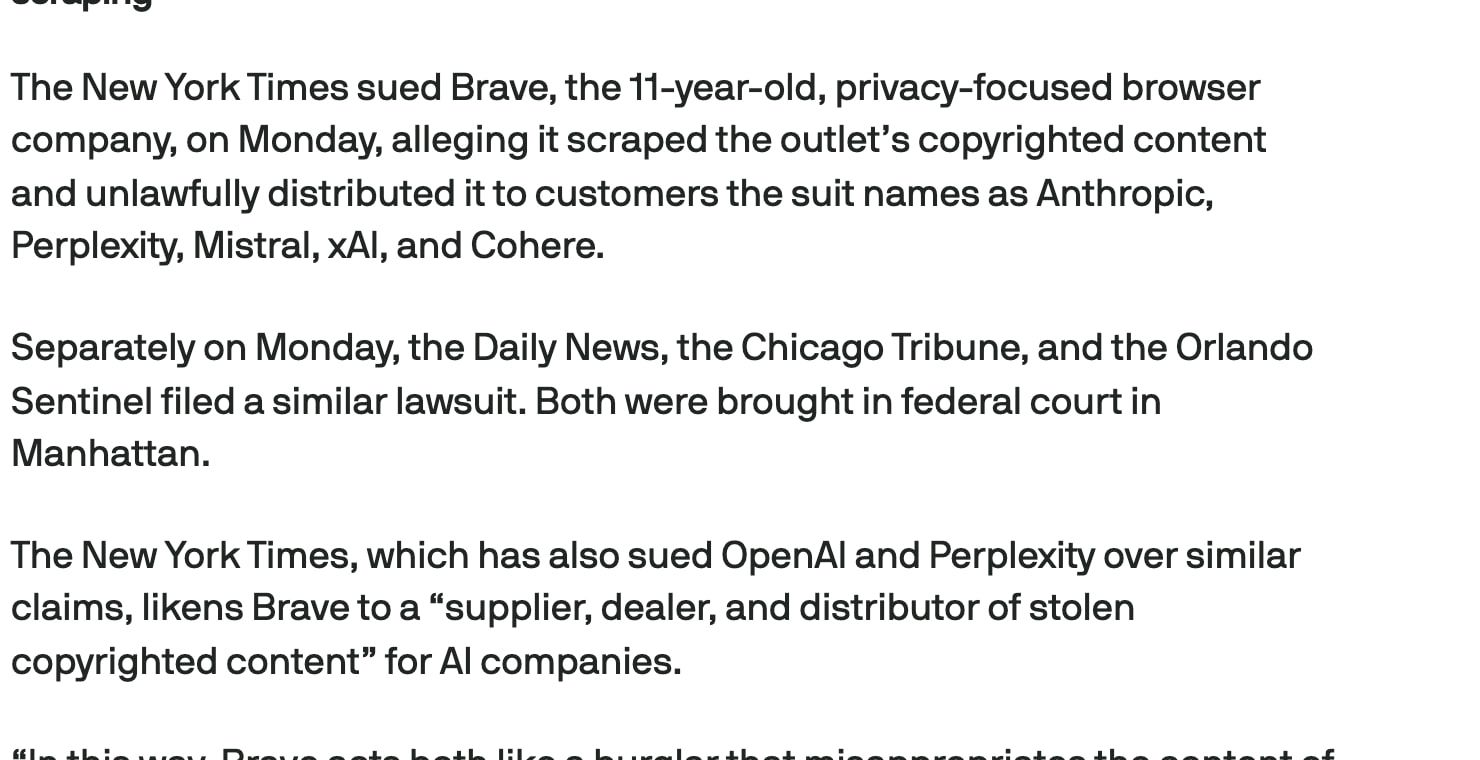
The New York Times sued Brave Software on November 2, 2026, and the Daily News, Chicago Tribune and Orlando Sentinel filed a near-identical suit the same day. Both say Brave’s search index, its Search API, its Ask Brave answers and its browser’s paywall blocker infringe their copyrights. Brave is the only defendant.
I read both complaints in full, both dockets, and Brave’s own crawler page and API terms, as of November 12, 2026. If you build on Brave’s results, here’s the short version: nothing in these filings is aimed at you, but they’re a good reason to check your rights and your fallback this week.
Allegations, not findings, and not legal advice
Everything the newspapers say on this page is what their complaints allege. No court has ruled on any of it, and I don’t predict how either case ends. Docket facts are dated November 12, 2026. This is general information, not legal advice; if your product depends on Brave data, have a lawyer read your own contract.
Short on time?
What I'd do now
- You call the Brave Search API directly
- Keep it, check your rights, add a fallback
- The complaints plead no claim against customers and no court has ordered anything. Confirm your plan allows what you do with results, and keep a second provider ready, because Brave can end the agreement on 10 days' notice.
- You buy Brave results through a SERP vendor
- Ask the vendor how it gets them, in writing
- Brave's terms bind Brave's own customers. Ask how your vendor sources Brave results and what rights pass to you; don't assume Brave's terms answer that.
- You build on any third-party search index
- Get rights and an exit in your contract
- These suits target how an index was built and how it is sold. Brave's indemnity excludes claims about search results, so check what your provider covers.
- You run a publisher site
- Use noindex, per Brave's own help page
- Brave says robots.txt doesn't keep a page out of its index and noindex does. Its crawler also skips anything Googlebot can't fetch.
- You build crawlers or AI agents
- Publish a crawler name and an opt-out
- Both complaints cite Brave's refusal to name its crawler as a ground for willfulness. A documented user agent gives sites a way to say no.
Prices verified . Based on the complaints, dockets and Brave's own pages as of 12 Nov 2026. These are actions for your situation, not a prediction of the outcome. Not legal advice.
This explainer sits in the search APIs hub. For the other big search-scraping case of the year, see Google v. SerpApi.
So what is this lawsuit about? #
It’s two federal copyright suits, filed November 2, 2026 in the Southern District of New York, in Manhattan:
- The New York Times Co. v. Brave Software, Inc., 1:26-cv-09549, assigned to Judge Lewis A. Kaplan, with Magistrate Judge Valerie Figueredo designated for referred matters.
- Daily News, LP et al. v. Brave Software, Inc., 1:26-cv-09554, brought by the Daily News, the Chicago Tribune and the Orlando Sentinel. The docket feed shows a reassignment notice on November 5 but doesn’t name the judge, so I don’t either.
A third number with the same caption, 1:26-cv-09551, was an administrative duplicate that the court terminated on November 10. It isn’t a third lawsuit.
Both suits come from the same firm, Rothwell, Figg, Ernst & Manbeck, and plead the same five counts. The line that closes their first paragraph sets the tone: “Brave acts both like a burglar that misappropriates the content of publishers, and an AI ‘fence’ that sells stolen content to third parties” (NYT complaint ¶1). That’s the plaintiffs’ language, not a finding.
How do the two complaints compare? #
They’re nearly twins. The real differences are the plaintiffs, the size of the catalog, and the pre-suit letters only the Times pleads.
| New York Times case | Daily News case | |
|---|---|---|
| Case number | 1:26-cv-09549 | 1:26-cv-09554 |
| Plaintiffs | The New York Times Company | Daily News, LP; Chicago Tribune Company, LLC; Orlando Sentinel Communications Company, LLC |
| Works claimed | "over 10 million registered, copyrighted works" (¶¶19, 113) | "over 2 million articles" in registered issues (¶88) |
| Judge | Lewis A. Kaplan | Reassigned Nov 5; not shown in the public feed |
| Counts | 5 (¶¶111–162) | Same 5 (¶¶86–137) |
| Pre-suit letters | Aug 11, 2025 and Apr 13, 2026; the Times says Brave "ignored" both (¶¶49–50) | None pleaded |
| Relief asked | Statutory and actual damages, profits, permanent injunction, fees; no dollar figure | Same |
| Jury | Demanded | Demanded |
| Service and answer | Served Nov 4; answer due Nov 25, 2026 | Summons returned executed Nov 4; no service or answer date in the feed |
Source: Both ECF 1 complaints and public docket feeds, read 12 Nov 2026. Allegations are not findings. Scroll sideways for more columns.
What’s alleged against each Brave product? #
Most coverage blurs these together, but the complaints go after five distinct things Brave runs. If you only use one of them, this is the table to read.
| Brave product | What the complaints allege | Counts | Where (NYT / Daily News) |
|---|---|---|---|
| Search index and crawler | An index of "over 30 billion webpages" crawled "without permission and without identifying its crawlers" | I, II | ¶¶2, 77 / ¶¶2, 52 |
| Ask Brave (AI answers) | Answers that reproduce long verbatim passages, including "over 1,200 words" of one Tribune article | I, III | ¶¶79–90 / ¶¶54–62 |
| Search API (News Search, LLM Context, Web Search, Answers) | Sells copies of index content to AI companies for "training and grounding" | I, II, III | ¶¶61–68, 94–97 / ¶¶36, 43, 67–70 |
| Browser "Paywall blocker" | Gets behind paywalls; promoted as "Bypass Paywalls" | I, II, IV | ¶¶6, 70–74, 99 / ¶¶6, 45–49, 72–74 |
| Brave News, ad blocking and Brave Ads | Strips publishers' ads and replaces them with Brave's own | V | ¶¶102–105 / ¶¶77–80 |
Source: NYT and Daily News complaints (ECF 1), read in full 12 Nov 2026. Paragraph numbers are the complaints' own. Scroll sideways for more columns.
The five counts are the same in both: direct copyright infringement, contributory infringement, vicarious infringement, DMCA §1201 circumvention and trafficking (aimed at the paywall blocker), and unjust enrichment under New York law (aimed at the ad replacement).
What do the newspapers say Brave’s crawler did? #
This is the allegation I’d watch if you crawl anything yourself. Both complaints say Brave “has never disclosed the name of its ‘bot’” and built its index “without identifying itself or providing website owners with any mechanism to block its crawler” (NYT ¶2; Daily News ¶2).
They repeat it later, alleging Brave crawled their sites “without permission and without identifying its crawlers” (NYT ¶77; Daily News ¶52). And they use it to plead willfulness, citing Brave’s “refusal to release the name of its web crawler bot so that owners of copyrighted content can prevent the copying” (NYT ¶125; Daily News ¶100).
What surprised me is what’s missing. Neither complaint mentions Googlebot, robots.txt or user-agent strings; I searched both texts for each term. They cite Brave’s crawler help page in a footnote (“last visited Oct. 30, 2026”) without discussing what it says.
What does Brave say about its own crawler? #
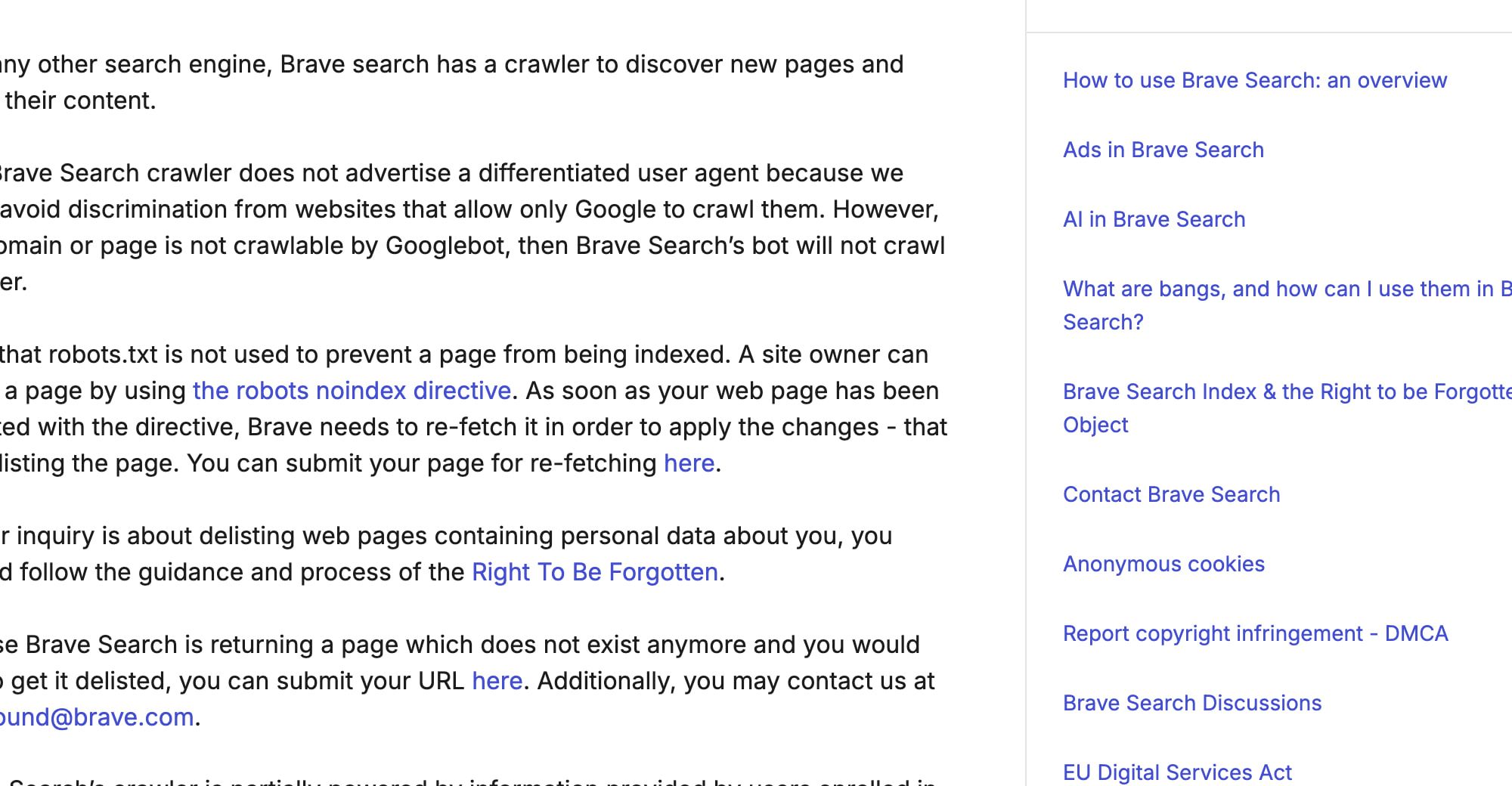
Brave’s crawler help page says its crawler “does not advertise a differentiated user agent”. The reason it gives is to “avoid discrimination from websites that allow only Google to crawl them”. The page also says that if Googlebot can’t crawl a page, Brave’s crawler won’t either.
On indexing, the page is blunt: “Note that robots.txt is not used to prevent a page from being indexed.” To get a page out of Brave’s index, it says to use a noindex directive and request a re-fetch through its Submit URL tool. The page is undated; this is how it read on November 12.
Reading the complaints and the help page together, here’s where I land. Per Brave’s page, a site can keep Brave’s crawler out by blocking Googlebot, but it can’t block Brave alone, because there’s no Brave name to write a rule for. That’s my reading of the page, not a finding, and whether it adds up to “any mechanism to block” is a question for the court.
Why does a name matter so much? The robots.txt standard, RFC 9309, has each crawler follow the group of rules addressed to its user-agent name. My robots.txt explainer covers whether those rules bind anyone legally.
What do they say the API returned? #
Both complaints show queries sent to Brave’s API endpoints, with each response set beside the original article. The Times says one LLM Context response “provided 1,291 out of 1,295 words in the article, verbatim” (NYT ¶97), and that Web Search and News Search responses each returned over a third of another Times article (¶¶95–96).
The Daily News complaint says an LLM Context response returned the “entire article text” of an Orlando Sentinel story (¶67), and that News Search returned roughly 250 to 350 words of others (¶¶68–70). Both say the Answers endpoint is “the same service that powers the Ask Brave product” (NYT ¶68; Daily News ¶43).
To support the contributory count, both quote a 2023 Brave API guide saying the most common uses are “training and grounding” (NYT ¶61; Daily News ¶36). The papers call the API an “illicit source of unlicensed copyrighted material” (¶5 in both).
Why are Anthropic and Perplexity named? #
Because the complaints allege they’re Brave API customers; they aren’t being sued. The Times’ complaint calls Brave the “supplier, dealer, and distributor of stolen copyrighted content” for AI companies “including Anthropic, Perplexity, Mistral, xAI, and Cohere” (NYT ¶1). Both complaints call those customers “knowing receivers” of the content.
None of them is a defendant, and neither complaint pleads a claim against any customer. Instead, the papers say each copy a customer makes is “a separate instance of unlawful infringement for which Brave is contributorily liable” (NYT ¶135; Daily News ¶110).
Being named in a complaint isn’t a finding that anyone did anything wrong. Brave’s own API page says it is “Trusted by the world’s top AI labs (including ones we can’t name)” and shows logos including Cohere and Mistral AI. The complaints’ footnoted sources mention Cohere, Mistral, Perplexity, You.com and Anthropic, but not xAI, so I treat xAI as named in the complaint and nothing more.
What about the paywall blocker and the ads? #
The paywall theory is the DMCA count. The complaints describe “a default setting that, when activated,” takes the browser behind paywalls; they say it’s called “Paywall blocker” and promoted as “Bypass Paywalls” (NYT ¶6; Daily News ¶6). That wording doesn’t settle whether it’s on by default, and secondary reports conflict, so I don’t say either way.
Count IV calls the feature circumvention and trafficking under §1201(a)(1)(A) and (a)(2) (NYT ¶149; Daily News ¶124). Its remedies paragraph asks for, among other things, “destruction of any device involved” (NYT ¶152).
The ad claim is separate. The complaints say the browser strips publishers’ ads, including the Times’ “$1/week” subscribe banner (NYT ¶104), and replaces them with Brave Ads and Rewards (NYT ¶105; Daily News ¶80). They stress that this count “does not depend on any copying” (NYT ¶161; Daily News ¶136).
What do the papers want? #
Statutory damages, actual damages and restitution of profits; a permanent injunction “enjoining Brave from engaging in the unlawful conduct alleged herein”; disgorgement of ad revenue on the unjust-enrichment count; and costs and fees. Neither complaint pleads a dollar amount.
These are requests. Nothing has been awarded, and the injunction wording doesn’t say what it would cover in practice. The Times’ April 2026 letter, as quoted in its complaint, mentioned “enhanced statutory damages up to $150,000 per infringement” (¶50); that’s the letter’s position, not a figure any court has applied.
Has Brave said anything? #
Not publicly, as far as I could find on November 12, 2026. TechCrunch and TheWrap both reported on November 2 that Brave did not immediately respond, and PPC Land reported the next day that Brave had not issued a public response on the day the suits were filed.
Brave’s blog has no post about the suits, and no answer is on either docket.
The plaintiffs’ side has spoken. Their lawyer, Steven Lieberman, told TheWrap: “Buying stolen goods secondhand doesn’t make them legitimate.”
On Brave’s past position, TheWrap says Brave “has previously defended its search practices as fair use”. I’m not attributing any statement about this case to Brave, because I couldn’t find one.
How did we get here? #
The dates below come from the complaints, the dockets and Brave’s own pages. Rows marked “alleged” are the plaintiffs’ account.
| Date | What happened | Source |
|---|---|---|
| 2023-09-22 | A Brave API guide says the most common uses are "training and grounding" (as quoted) | NYT ¶61 |
| 2025-03-12 | Brave sues News Corp in N.D. Cal. (3:25-cv-02503), asking for a declaration that its indexing isn't infringement | Docket feed |
| 2025-06-10 | That case is dismissed without prejudice by stipulation | Docket feed |
| 2025-08-11 | First Times letter to Brave CEO Brendan Eich (alleged) | NYT ¶49 |
| 2026-04-13 | Second Times letter from outside counsel (alleged) | NYT ¶50 |
| 2026-07-21 | News Corp, Dow Jones and NYP Holdings answer Brave's renewed suit (4:26-cv-04758, N.D. Cal.); Dow Jones and NYP Holdings counterclaim, per the filing copy's caption | Copyright Alliance copy |
| 2026-09-01 | Brave Search API terms last updated | Brave API terms |
| 2026-11-02 | Both complaints filed in S.D.N.Y. | Both dockets |
| 2026-11-04 | Brave served in the Times case, answer due Nov 25; summons also returned executed in the Daily News case | NYT docket feed |
| 2026-11-05 | Daily News case reassigned (judge not shown) | Daily News docket feed |
| 2026-11-06 | Judge Kaplan deems the Times' exhibits part of the complaint (ECF 14) | NYT docket feed |
| 2026-11-10 | Duplicate case 1:26-cv-09551 terminated | Court docket |
| 2026-11-11 | Brave announces encrypted search-result links, a separate anti-scraping change | Brave blog |
| 2026-11-25 | Brave's answer due in the Times case, unless extended | NYT docket feed |
Source: Complaints, docket feeds and Brave pages read 12 Nov 2026; Brave v. News Corp history from the 2025 case's docket feed and the caption of a 2026 filing copy. Scroll sideways for more columns.
The November 11 change is covered in Brave’s encrypted result links. It’s the same week, but nothing I read connects it to these suits.
What should you do if you use the Brave Search API? #
Keep using it if it works for you, but check three things this week. None of them depends on how the case turns out.
1. Your rights match your use. Brave’s API terms bar storing results beyond “transient storage required for operation of Customer Applications”, bar using them to “create, evaluate, train, re-train, fine-tune, benchmark or otherwise improve” AI models, and bar resale. Brave’s API page answers the storage-and-training question with “Yes, with a custom plan”, and an Order Form takes precedence over the general terms.
If you cache results or train on them without that custom plan, fix that first. It’s a contract problem with or without a lawsuit.
2. The indemnity doesn’t reach this. Brave’s IP indemnity covers the API and its documentation, but its exclusions carve out claims relating to “Search Results”. Third-party content comes as is, your use of it “may be subject to the intellectual property rights” of its owners, and the terms bar you from using the API or results in any way that infringes.
3. You have an exit. Brave can end the agreement “for any reason upon 10 days prior written notice”, and can suspend immediately in listed cases, including legal exposure. I’d keep a second provider integrated and ready to switch on; Brave Search API alternatives compares who grants which rights.
For budgeting, Brave lists Search at $5 per 1,000 requests and Answers at $4 per 1,000 plus $5 per million tokens, each with $5 of free credits a month (verified November 12, 2026). My Brave Search API pricing breakdown has the detail.
Buying Brave results through someone else? #
Brave’s terms bind Brave’s own customers. Whether any of them reach you through a reseller isn’t stated on any page I read, so ask your vendor two questions in writing: how it sources Brave results, and what rights pass to you.
One example: apiserpent.com sells an engine=brave route for web, news, images and videos, with Web priced from $0.60 per 1,000 units on its default tier down to $0.03 on Enterprise Plus (apiserpent.com, verified November 12, 2026). Its page doesn’t say how the Brave results are collected and makes no data-rights statement, so the same two questions apply.
What if you build on any search index? #
The lesson goes beyond Brave. These complaints target how an index was built (the crawler) and how it’s sold (the API), and they name customers without suing them. Any index you rent could face the same theory.
So for any provider, I’d ask four things: how its crawler identifies itself, what storage and training rights you get, whether its indemnity covers claims about the results themselves, and how much notice it must give before cutting you off. For Brave’s general terms, the last two answers are “no” and “10 days”.
What should crawler builders take from this? #
Name your crawler. Both complaints list Brave’s refusal to name its bot as a ground for willfulness (NYT ¶125; Daily News ¶100), alongside the paywall feature and, in the Times case, the ignored letters.
Brave’s stated reason for staying unnamed is that some sites allow only Google. That’s a real problem for a new crawler, but these complaints show the cost of solving it that way. A published user agent and a documented opt-out give site owners exactly the “mechanism to block” both complaints say was missing.
What can publishers do today? #
Go by Brave’s own help page. To keep a page out of Brave’s index, add noindex and request a re-fetch through Submit URL; robots.txt alone won’t de-index it, according to Brave.
Blocking Googlebot in robots.txt also keeps Brave’s crawler out, by Brave’s account, but it costs you Google. There’s no Brave-specific user agent to block, which is the gap the complaints describe.
If your site is on Cloudflare, my explainer on Cloudflare’s AI crawler rules covers the controls it offers for other AI bots.
How does this fit with other AI-scraping cases? #
The Times has also sued OpenAI and Perplexity over similar claims, as TechCrunch notes. Those cases are about AI companies; this one targets the search index those companies allegedly buy from.
Brave and News Corp have been in court since March 2025, when Brave asked for a declaration that its indexing isn’t infringement. That case was dismissed without prejudice in June 2025, and Brave sued again in May 2026 (4:26-cv-04758).
A filing copy filed July 21, 2026 is News Corp, Dow Jones and NYP Holdings’ answer, with counterclaims by Dow Jones and NYP Holdings. I found no ruling in that case.
For the training-data rulings so far, see is scraping for AI training legal?, and the web scraping lawsuits tracker for other active cases.
What happens next? #
The first fixed date is November 25, 2026, when Brave’s answer is due in the Times case unless the deadline moves. Check the dockets before relying on anything below.
| Item | New York Times case | Daily News case |
|---|---|---|
| Case number | 1:26-cv-09549 | 1:26-cv-09554 |
| Judge | Lewis A. Kaplan (Magistrate Judge Valerie Figueredo for referred matters) | Reassigned Nov 5; not shown in the public feed |
| Last filing listed | Nov 9, 2026 | Nov 5, 2026 |
| Notable entries | Summons served Nov 4; ECF 14 (Nov 6) deems exhibits part of the complaint | Summons returned executed Nov 4; Statement of Relatedness (ECF 9), contents not shown |
| Next date | Answer due Nov 25, 2026 | No date in what I read |
Source: Public CourtListener docket pages and RECAP feeds, read 12 Nov 2026. RECAP can lag PACER. Scroll sideways for more columns.
What we don't know yet (as of November 12, 2026)
- Whether Brave answers, moves to dismiss or gets more time by November 25.
- Who presides over the Daily News case, and whether the two cases are formally related or consolidated.
- Whether Brave says anything publicly about the suits.
- Whether any API customer receives a subpoena.
- Whether Brave changes its API terms or its crawler page.
- What has happened in the News Corp case since July.
The methodology explains how I handle court documents; the editorial policy covers corrections.
FAQ
Why is the New York Times suing Brave?
The Times alleges that Brave copied its journalism into a search index using a crawler with no published name, sold that content to AI companies through the Brave Search API, reproduced it in Ask Brave answers, helped browser users get past its paywall and replaced its ads with Brave's. Those are allegations in a complaint filed November 2, 2026; no court has ruled on them.
Are Anthropic and Perplexity being sued in this case?
No. Both complaints name Anthropic, Perplexity, Mistral, xAI and Cohere as alleged Brave API customers, but Brave Software, Inc. is the only defendant and no claim is pleaded against any customer.
Is the Brave Search API legal to use?
No court has said it isn't, and the complaints make no claim against API customers. What you may do with results is set by your contract: Brave's general terms bar storing results beyond transient use, AI training and resale, and Brave says storage and training need a custom plan. This is general information, not legal advice.
Does Brave's crawler respect robots.txt?
Brave's help page says its crawler won't fetch a page Googlebot can't crawl, and that it doesn't advertise a user agent of its own. The same page says robots.txt doesn't stop a page from being indexed; a noindex directive does.
Can I block Brave's crawler?
Not by name, because Brave doesn't publish a distinct user agent. Brave's help page says its crawler skips what Googlebot can't crawl, and that noindex plus a re-fetch request through its Submit URL tool takes a page out of its index. The complaints allege there is no mechanism to block Brave's crawler; how those two accounts fit together is for the court.
What is Brave's paywall blocker?
A Brave browser setting that the complaints say is called “Paywall blocker” and promoted as letting users “Bypass Paywalls”. The papers allege it circumvents their paywalls in violation of the DMCA. The complaints call it “a default setting that, when activated”, which doesn't settle whether it is on by default.
Has Brave responded to the lawsuit?
Not publicly that I could find as of November 12, 2026. TechCrunch and TheWrap reported that Brave did not immediately respond, Brave's blog has no post about the suits, and no answer was on the docket. Brave's answer in the Times case is due November 25, 2026, unless the deadline moves.
Sources
18 sources, accessed to .
Official pricing, docs, changelogs and status pages 6
News and press 3
Other sources 9
- Complaint (ECF 1), The New York Times Co. v. Brave Software, Inc., 1:26-cv-09549 (S.D.N.Y. Nov 2, 2026)
- Complaint (ECF 1), Daily News, LP et al. v. Brave Software, Inc., 1:26-cv-09554 (S.D.N.Y. Nov 2, 2026)
- Docket: The New York Times Co. v. Brave Software, Inc., 1:26-cv-09549
- Public RECAP docket feed, 1:26-cv-09549
- Docket: Daily News, LP v. Brave Software, Inc., 1:26-cv-09554
- Public RECAP docket feed, 1:26-cv-09554
- Public RECAP docket feed, Brave Software, Inc. v. News Corporation, 3:25-cv-02503 (N.D. Cal.)
- Legal tracker: Brave Software v. News Corp
- Filing copy: answer and counterclaims (ECF 25), Brave Software, Inc. v. News Corporation, 4:26-cv-04758-JST (N.D. Cal., filed Jul 21, 2026), hosted by the Copyright Alliance


