Research area
Best Web Search APIs for AI Agents (2026)
Pick your route first, then your vendor. What each of the four routes costs per 1,000 searches, what you're allowed to store, and who carries the legal risk.

The best web search API for an AI agent depends on which of four routes you need: model-input search, a Google SERP API, self-hosted metasearch or a model provider’s built-in search tool. I choose the route before the vendor because response shape, billing unit and data rights differ. The primary sources retained below were checked October 31, 2026; this is documentary research.
Microsoft retired its Bing Search APIs on August 11, 2025. Google closed Custom Search JSON API to new customers, with existing customers required to transition by January 1, 2027. Neither event makes another company’s Google scraper an official Google API.
Short on time?
My pick by route
- Model-input retrieval
- Exa or Parallel
- Exa Lite (and legacy Instant) starts at $4/1K, Auto (and legacy Fast) at $7; Parallel Fast/Turbo at $1. Compare the selected response and optional content costs.
- Google SERP collection
- apiserpent.com or SearchApi
- apiserpent.com has low usage rates with substantial deposits for discounted tiers (rechecked 3 Nov 2026; check the live rates before depositing). SearchApi has conditional legal-protection terms on eligible plans; neither establishes blanket permission.
- Operate your own service
- SearXNG
- AGPL-3.0 metasearch software without a licence fee. Servers, maintenance and upstream access remain your responsibility.
- Fewer integration steps
- Built-in model search
- Keep search within the model API, but distinguish tool calls, grounded prompts and executed search queries. Model tokens can add cost.
Prices verified . Workflow recommendations from documentation, not measured accuracy, speed or account-level pricing.
Do you need Google’s own results? #
Choose a SERP service for Google’s ranking and result-page features. For finding pages to feed a model, shortlist retrieval APIs by the content they document and the rights you need. A SERP JSON response is not automatically a full-page fetch; output contracts vary.
| Route | What you integrate | Budgeting unit | Main check |
|---|---|---|---|
| Model-input search | Ranked sources, excerpts, optional content or answers | Requests, retrieved items or credits by endpoint | Result depth, content add-ons and storage permissions |
| Google SERP API | Structured representation of a Google results page | Search request, SERP page or requested depth | Collection terms, feature provenance and conditional legal cover |
| Self-hosted metasearch | Software that queries upstream engines | Infrastructure and maintenance, not a vendor search tariff | Engine access, licence and upstream terms |
| Built-in model tool | Search inside a model request | Tool calls, grounded prompts or executed queries, plus tokens | Model/channel-specific allowances and display rules |
Source: Selected primary pricing and documentation linked below; these units are not automatically comparable. Scroll sideways for more columns.
How much does web search cost an AI agent? #
Use configured scenarios rather than a single market average. The historical image below preserves its September 27 caption; its $10 lower-bound example is consumed prepaid usage, not the deposit required, and the Gemini figure is only the search component of a particular paid model channel.

| Selected configuration | 1K units | 100K units | 1M units | Assumptions and cash |
|---|---|---|---|---|
| Parallel Fast/Turbo | $1 | $100 | $1,000 | Gross requests; promotional allowances excluded |
| Exa Lite (or legacy Instant) | $4 | $400 | $4,000 | Base up-to-ten results; free credit and optional charges excluded |
| Brave Search / You.com base Search | $5 | $500 | $5,000 | Gross calls, credits and optional full-page retrieval excluded |
| apiserpent.com Quick Web | $0.60 | $10 | $30 | Consumed new-credit usage at rates shown 3 Nov 2026; qualifying deposits $10/$500/$1,250 respectively; best-effort depth |
| SearchApi eligible subscription | $100 | $250 | $1,500 | Selected published capacity plans; legal terms and speed mode apply |
| Browserbase default Search | $0 on Free | $515 | $5,015 | $20 Developer fee plus overage beyond 1K calls, Parallel Advanced |
| OpenAI / Anthropic standard search | $10 | $1,000 | $10,000 | Tool component only; tokens extra, response contracts differ |
| Gemini 3+ Developer API grounding | $0 search component | $1,330 | $13,930 | Paid Tier, shared 5K monthly executed search queries; model tokens extra; 100K and 1M exceed the default 1,500 requests/day cap unless it is raised |
Source: Arithmetic from the linked vendor prices checked October 31; the apiserpent.com row was rechecked November 3. Rows price different explicitly named units, exclude taxes, and are not a universal cheapest-vendor ranking or observed invoices. Scroll sideways for more columns.
The SERP cost study explains deposit and expiry assumptions. Withheld prices are unavailable, not zero.
Browserbase’s billing-plans documentation still lists $7 per 1,000 Search calls, while its current pricing and Search overview distinguish provider rates of $1/$5/$7. The examples here use the provider-specific schedule; the actual account tariff remains unverified.
Which AI search API should your agent use? #
I would shortlist Exa or Parallel when the task is retrieval for a model, then compare the response against your permitted workload. Low price alone does not establish relevant sources, adequate freshness or usable data rights.
This Exa screenshot is a historical September 27 snapshot. The current modes below replace its unqualified $7 headline; the licensed image and dated caption are preserved.
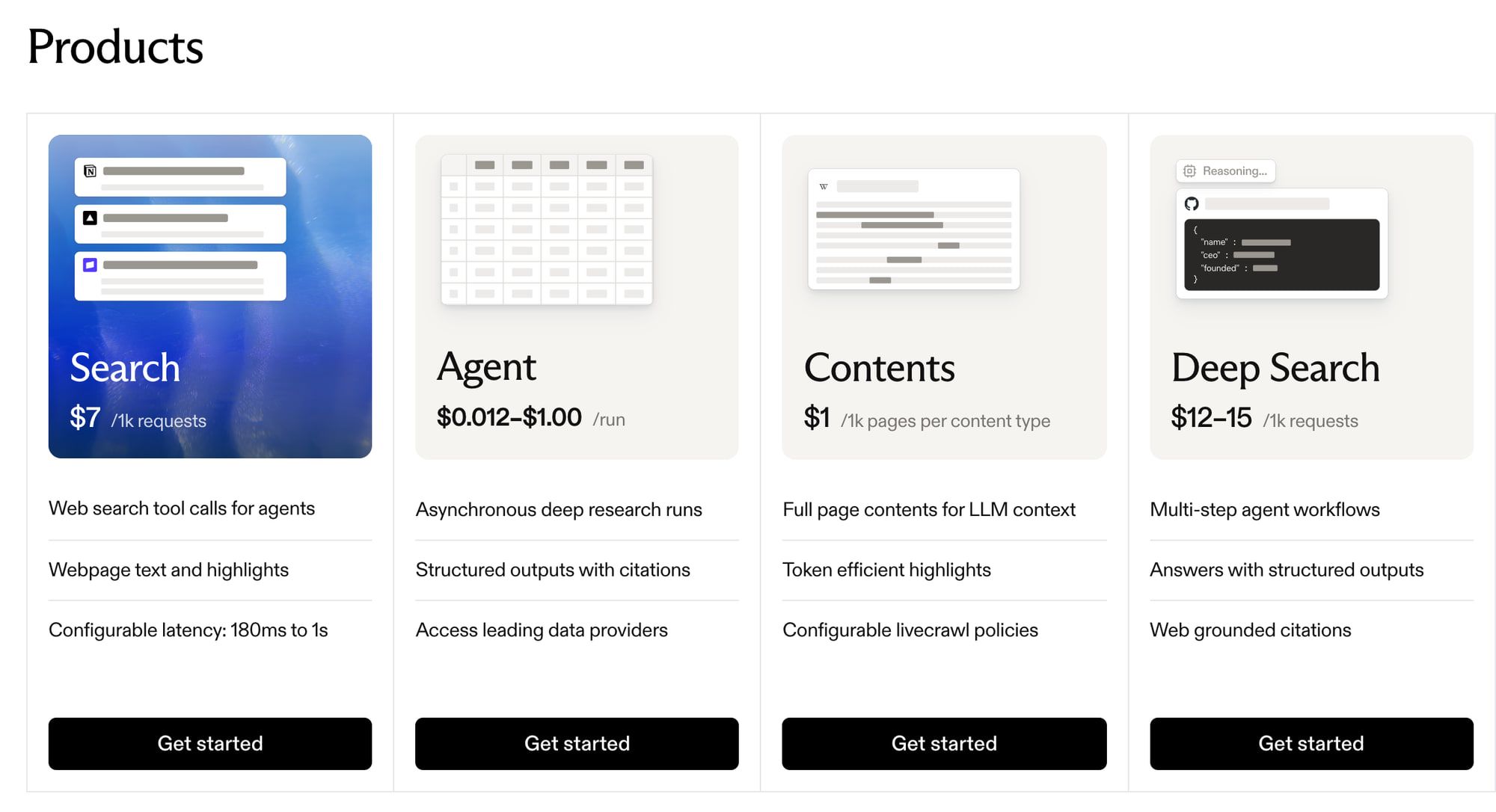
- Exa: Lite costs $4/1K and Auto $7, for the base up-to-ten results. Its changelog added the cache-only Lite type on October 19, 2026 and made Instant ($4) and Fast ($7) legacy types at unchanged prices. Extra results and summaries can add cost; standalone Contents is separately priced. The billing guide limits both the $10 monthly credit and the one-time $10 onboarding bonus to a user’s first team; both are excluded from the gross table.
- Parallel: Fast/Turbo costs $1/1K, Basic/Advanced $5. The page advertises 5K free requests and a separate $5 monthly promotion; stacking is unconfirmed. Its quickstart documents source URLs, excerpts and dates. I cover Parallel from documentation only.
- Brave: base Search is $5/1K with a $5 monthly credit and card requirement. The same page’s banner says “Up to $20 in free calls every month” without explaining how that relates to the $5 plan credit, so I use $5 for Search. The API terms limit storage absent granted rights and restrict AI training/evaluation. Pricing marketing is not contractual permission.
- Tavily: basic/fast/ultra-fast Search costs one credit; advanced two. PAYG is $0.008/credit; 1K credits/month are free. Keyless Search and Extract also work through REST/MCP without an account, with unpublished numeric caps. Its terms restrict publishing performance analysis; coverage here is documentary.
- You.com: base Search costs $5/1K calls. The free allowance is 100 daily queries through the free MCP profile, not a 100-query daily REST entitlement. On October 31 the pricing page listed a separate “$10 free credit = 2,000 searches”; its recurrence and eligibility are unstated, so I deduct no grant. The quickstart prices live full-page extraction separately at $1/1K pages.
- Linkup: standard search is $5/1K, or $6 with a sourced answer. Its credit documentation makes recurring $20 top-ups conditional on account eligibility; do not assume a permanent allowance for every account.
- Perplexity: standard Search is $5/1K successful requests, Fast $1, with “no additional token-based charges” for Search. Its Sonar migration guide says support ended September 27, with gradual synchronous/streaming reformulation by model and asynchronous calls moving to background mode. That is documentation, not a live migration result.
Other tools have different units.
Browserbase includes 1K calls on Free and its $20 Developer plan, then defaults to Parallel Advanced $5/1K; Fast is $1 and Exa $7 by provider selection. Firecrawl Search uses two credits per block of up to ten results, with scraping additional.
Valyu’s website prices retrievals per 1,000 results by source, from about $0.31 (arXiv/PubMed) and $0.63 (web) to $30 (licensed journals). Its pricing docs bill the same retrievals in credits, at 1,600 credits per $10 top-up, and its Search reference does not state the unit of max_price. One query is not automatically one retrieval, so I withhold a per-query price.
The focused comparisons are Tavily vs Exa, Tavily alternatives and free search APIs.
When is a Google SERP API the right choice? #
Use this route when the selected Google results-page features are the output you need. Compare the exact endpoint, requested depth and optional AI blocks; a cheap organic-search billing unit does not price every feature.
apiserpent.com (SerpentAPI) publishes new-credit Web rates of $0.60/1K Default, $0.30 Growth after one $100 deposit, $0.10 Scale after $500, $0.05 Enterprise after $1,000 and $0.03 Enterprise Plus after $1,250. Existing credit keeps its old schedule. On October 31, 2026 the same page said “Prices to increase 10x after October 31”; when I checked it on November 3 that notice was gone, the lower tiers were unchanged and the $0.03 rate had moved to the new $1,250 tier. Check the live page before you deposit. Quick charges one unit per call with best-effort depth; Deep charges each requested page. Its optional AI Mode surcharge is $4/1K calls on top of Deep charges, and that label does not independently establish Google UI provenance.
The FAQ lists a $10 minimum and no public PAYG SLA. Terms distinguish free-call inactivity, nonexpiring purchased credit and expiring bonuses; credits are generally nonrefundable subject to law, with customer obligations. I did not establish comparable vendor-funded legal cover. Introductory calls are not a monthly free tier.
SearchApi publishes capacity plans, including $100 Production, $250 for 100K and $1,500 at 1M, with optional speed modes separate. Its terms describe protection for eligible plans and uses; this does not guarantee every use is covered.
SerpApi has a larger plan ladder than the first visible cards: selected Best Effort tiers include Searcher $725/100K and Cloud 1M $3,750/1M; larger Cloud tiers can have lower per-unit rates. Its legal contract offers up to $2M protection on eligible recurring plans, limited to specified lawful collection and U.S.-court claims, excluding downstream illegal use.
Serper advertises 2,500 introductory queries and $50/50K packs, with six-month credit expiry. DataForSEO prices one ten-result Google Organic SERP at $0.60/1K Standard-queue units or $2/1K Live, with depth and optional parameters additional. The Standard timing is an average, not a request-latency guarantee. See Serper vs SerpApi and SerpApi alternatives.
Is self-hosted search (SearXNG, OpenSERP) really free? #
The SearXNG repository supplies AGPL-3.0 metasearch software. Its API documentation requires a supported output format, and many public instances disable JSON. Your own service still needs infrastructure, maintenance and access to upstream engines.
Self-hosting removes a hosted vendor fee, not the upstream terms or the risk of blocked requests. I withhold a fixed hosting budget and do not infer performance from source availability. Review the chosen project’s current licence and engine support before operating it.
Should you use your LLM’s built-in search tool? #
Choose a built-in tool when integrating another service adds more work than its benefit. Its fee is only part of the model bill, and one turn can invoke search more than once.
- OpenAI: standard web search costs $10/1K tool calls plus content tokens. Non-reasoning preview search is $25/1K with content tokens free. Its display guidance requires visible, clickable citations.
- Anthropic: web search is $10/1K searches plus standard tokens, with search errors unbilled and citations enabled. I do not claim an unavailable deployment channel without checking it.
- Gemini Developer API: Gemini 3 and newer share 5K monthly search queries on Paid Tier, then $14/1K queries plus tokens. Gemini 2.5 Flash/Flash-Lite share a 500/day Free-Tier allowance, and their paid shared allowance is 1,500 grounded prompts/day, then $35/1K prompts. A model-run query differs from a grounded prompt. Terms effective March 23 require Search Suggestions and constrain reuse with narrow storage exceptions.
- Perplexity Agent API: standard web-search invocations are $2.50/1K, Fast $1, plus tokens under the pricing source above; that differs from standalone Search request billing.
These are the selected model/channel rules, not universal Google Cloud prices. Model availability, quotas and account eligibility remain separate from the tariff.
Google’s official API is closing #
The Custom Search notice directs existing customers to transition by January 1, 2027. Its suggested search alternative covers configured sites rather than recreating the Google consumer SERP.
Agent Search General Pricing lists $1.50/1K Standard or $4/1K Enterprise, with Core Generative Answers included in Enterprise; only Advanced Generative Answers adds another $4. Its 10K-query offer is explicitly a Free Trial, not a proven permanent allowance; storage and separate configurable subscription pricing also exist.
Is using a SERP API legal? #
An endpoint being available for purchase is not a legal ruling. In Google’s case, ECF 60 vacated the former October 13 hearing because of the trial schedule; it permits a later hearing or a written decision and does not decide SerpApi’s motion to dismiss (ECF 49). ECF 61, filed October 12, is Google’s notice of another decision, not a ruling here.
When I checked on November 3, 2026, ECF 61 was still the latest entry on the public docket and no ruling on ECF 49 was available there. The RECAP search index refused my unauthenticated request and I could not review the full PACER record, so a newer filing or outcome cannot be ruled out.
Read the conditional protection contracts above. This is a source summary, not legal advice.
How do you choose a web search API for your agent? #
- Decide whether you need Google rankings or retrieval for a model.
- Specify snippets, full page content, requested depth or a synthesized answer.
- Match the endpoint, engine and region to that requirement.
- Budget its actual unit, plan fee, deposit, expiry and optional token/content charges.
- Check storage, display and legal terms, then run permitted quality checks before production.
For known-page retrieval, start with crawl APIs. For clicks and sessions you need a browser-automation tool, which is a different workload from search and outside this hub.
FAQ
What are the best search tools for AI agents?
Choose the route first. I would shortlist Exa or Parallel for model-input retrieval, a configured SERP API when Google's results matter, SearXNG when you can operate metasearch, or the model provider's tool for fewer integration steps. These are documented workflow fits, not a quality ranking.
How do I add web search to an AI agent?
Choose a separate search API, Google SERP API, self-hosted metasearch service or built-in model tool. Define the output, billing unit and storage rights first. Then connect the selected API or tool and validate it on permitted queries; this hub does not claim that connection was executed.
Which AI model is best for web searching?
I have not measured models on search quality. OpenAI and Anthropic publish standard search-tool fees of $10 per 1K calls/searches plus tokens. Gemini Developer API billing depends on model: applicable Gemini 3 and newer models share 5K monthly search queries on Paid Tier, then $14 per 1K queries plus tokens. This is a billing comparison, not evidence of accuracy.
What is the best AI API to use?
For retrieval, shortlist by whether you need Google's ranking, snippets, full page content or a synthesized answer. Exa Lite ($4/1K, the same as legacy Instant) and Auto ($7/1K, the same as legacy Fast) are different modes; SERP page depth, content retrieval and model tokens can change the bill. Avoid selecting a vendor on a headline per-1K rate alone.
Which AI agent is the best for web browsing?
Search and browser control are different tasks. If the task needs clicks, forms or sessions, you need a browser-automation tool, which this hub does not cover. This hub does not rank browsing agents or claim first-hand browser testing.
What is the most accurate web search API for LLMs?
I have not measured relevance and withhold an accuracy winner. The comparison uses public prices, documented features and contract limitations. Run permitted checks on a representative query set before selecting on quality; free-tier size and price do not establish relevance.
Is using a SERP API legal?
No general permission follows from an API being sold. Google's ECF 60 vacated the former October 13 hearing and did not decide the dismissal motion; ECF 61 (12 October) is a party notice. When I checked on 3 November 2026, the public docket showed no ruling on that motion, and I could not review the full PACER record. SerpApi and SearchApi advertise conditional legal protection on eligible plans. Check scope, exclusions and your intended use; these sources are not a complete docket review or legal advice.
Sources
46 sources, accessed to .
Official pricing, docs, changelogs and status pages 42
- Perplexity Sonar support end and Agent API migration
- Microsoft: Bing Search API retirement notice
- Google: Custom Search JSON API overview and closure notice
- Tavily docs: API credits and plans
- Tavily terms of service
- Exa pricing
- Exa changelog: Lite search type added, Instant and Fast made legacy (19 Oct 2026)
- Exa billing guide: first-team monthly credit and onboarding bonus
- Brave Search API plans and pricing
- Brave Search API terms of service
- Parallel pricing
- Linkup pricing
- You.com API pricing
- Perplexity API pricing
- OpenAI API pricing
- OpenAI docs: web search tool
- Anthropic docs: web search tool
- Gemini API pricing
- Gemini API docs: grounding with Google Search
- Gemini API additional terms of service
- apiserpent.com (SerpentAPI) pricing
- apiserpent.com (SerpentAPI) FAQ
- apiserpent.com (SerpentAPI) terms of service
- SerpApi pricing
- SearchApi pricing
- Serper home and pricing
- Browserbase pricing
- SearXNG docs: search API
- cloud.google.com/generative-ai-app-builder/pricing
- dataforseo.com/pricing/google-serp/google-organic-serp-api
- docs.firecrawl.dev/billing
- docs.linkup.so/pages/documentation/platform/pricing
- docs.parallel.ai/search/search-quickstart
- docs.tavily.com/documentation/keyless
- docs.valyu.ai/api-reference/endpoint/search
- docs.valyu.ai/pricing
- serpapi.com/legal
- www.searchapi.io/legal/terms
- www.valyu.ai/pricing
- you.com/docs/agents/mcp-server
- you.com/docs/quickstart
- Browserbase plans: conflicting flat Search overage