Alternatives
ScraperAPI Alternatives: Match the Reason to Switch
Compare ScraperAPI alternatives for rendering costs, variable usage and structured output. See tradeoffs, current free offers and reasons to stay.

I would choose a ScraperAPI alternative from the reason to switch: ScrapingBee or ZenRows for comparable known-page fetching, Zyte for target-tier/extraction billing, and Bright Data Unlocker for request-based managed delivery. Scrapingdog belongs in a price-and-feature shortlist; Firecrawl or open-source code changes the requirement rather than supplying an automatic drop-in replacement. Bee, ZenRows, Zyte, Unlocker, Scrapingdog, Firecrawl.
I would stay when ScraperAPI’s authorized request path already fits. The new shortlist below replaces older dataset-wide ranking claims; it does not imply every provider in the historical comparison was freshly checked or that any alternative succeeds more often. ScraperAPI, credit definitions.
Short on time?
Here's my take
- Close page-fetch shortlist
- ScrapingBee or ZenRows
- Compare total weights and output/billing scope; ordinary JS is five credits versus ScraperAPI ten.
- Variable target/output needs
- Zyte API
- Target tiers and extraction extras replace the assumption of a universal page rate.
- Before migrating
- Keep what already fits
- Preserve needed Async, geography and output behavior rather than move for a headline alone.
Prices verified . Sponsors cannot buy a verdict or a position.
Which ScraperAPI alternative fits your reason to switch? #
For known-page fetching, I would start with ScrapingBee or ZenRows; for target-tier extraction, Zyte; for site ingestion, Firecrawl. Prices and specifications verified: 2026-10-31. The table is a conditional buying framework, not a measured cost/success ranking; each option’s current source is attached.
| Reason to reconsider | Option I would inspect | What to verify before switching |
|---|---|---|
| Generic JS weight is too high | ScrapingBee, ZenRows, Scrapingdog | Actual target/protection total, quality and required features |
| Monthly bundle mismatches variable work | Zyte, Unlocker | Actual target tier, extras, ceilings and product scope |
| Need standard/custom entity output | Zyte extraction | Data type, source, extra cost and field validation |
| Need Markdown or whole-site ingestion | Firecrawl | Scrape versus crawl scope and separate endpoint costs |
| Need owned code/control | Crawlee, Scrapy | Hosting, queue, parser, proxies, storage and operating work |
| Existing workflow fits | Stay on ScraperAPI | Async/pipeline requirements and the actual applicable bill |
When would I stay on ScraperAPI? #
I would stay if the required targets, output and geography already fit and the migration does not buy a concrete benefit. The monthly entry is $49/100,000 credits; generic plain is one, JS ten, premium ten and premium-plus-JS 25, so compare the workload mix rather than the raw credit count. Pricing, costs, JS FAQ.
Hobby/Startup standard targeting is US/EU regions rather than arbitrary country selection. I would identify the exact geography and plan requirement before treating any competitor’s lower monthly fee as a replacement for that scope. Standard geography.

ScraperAPI’s Async documentation supports jobs lasting up to 24 hours and batches up to 50,000 URLs. A synchronous alternative may not preserve that behavior, so I would put result collection and job lifetime in the migration checklist. Async.
max_cost provides request-level over-limit rejection, while ordinary credits do not roll over and growth PAYG rates/full commercial terms were not obtained here. DataPipeline also publishes a generic premium-plus-JS figure of 20 against the standard table’s 25, so I would confirm the applicable endpoint rather than promise universal parity. Cost controls, billing, DataPipeline, standard costs.
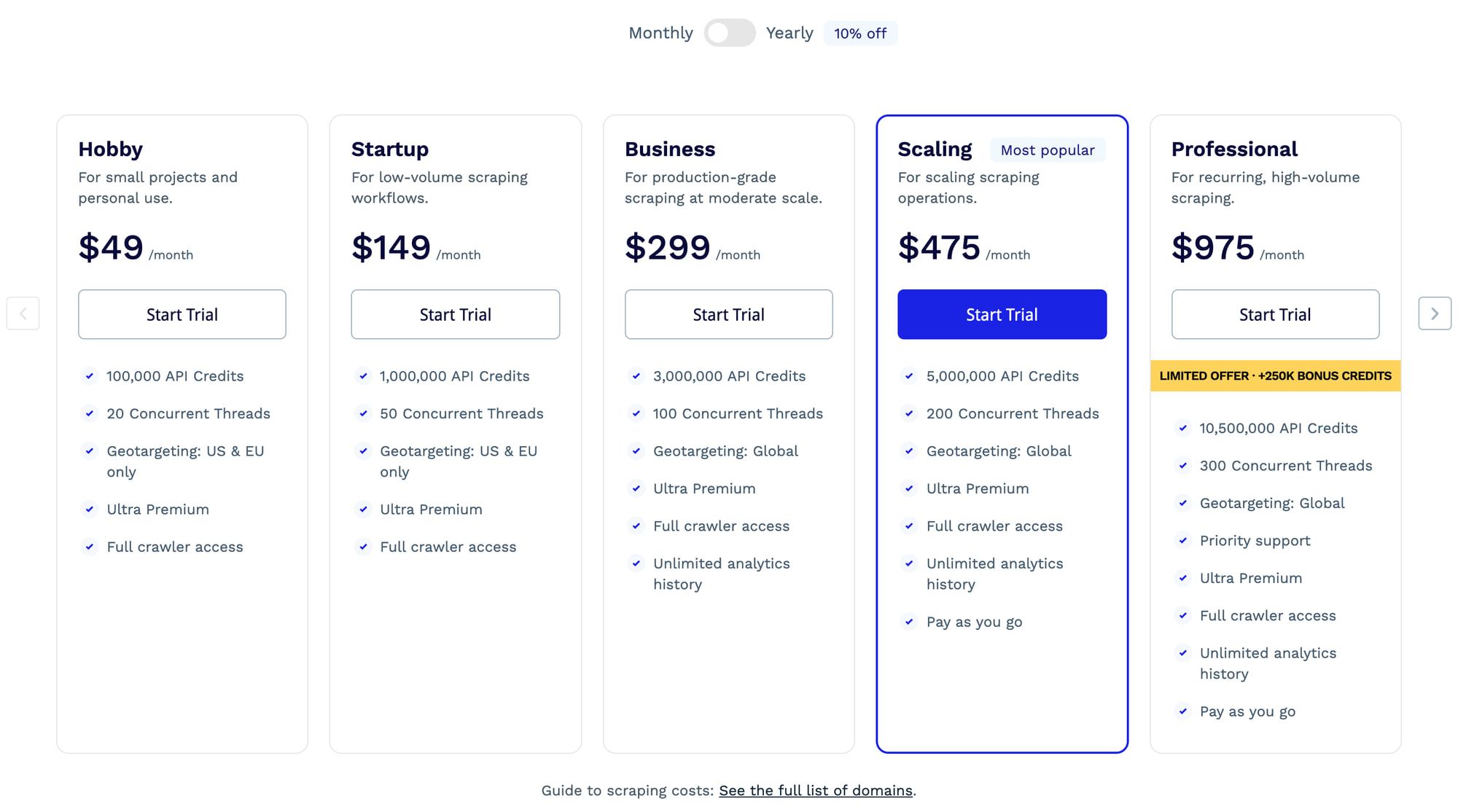
The screenshot above is historical September 27 context, not a current screenshot or a promise that its promotional bonus still applies. The dated current pricing sources drive this refresh’s shortlist.
ScrapingBee for a close page-fetch substitute #
ScrapingBee is my first comparison when the job is known-page HTML fetching. Its current Hobby plan is $19/75,000 credits/25 concurrency, and ordinary JS is five credits by default, plain one with rendering off, premium ten or premium-plus-JS 25. Pricing, HTML API.
What you give up or change is the request configuration, endpoint coverage and billing behavior, not merely a plan label. Normal billable statuses include 404/410/413, while transparent status mode bills target statuses below 500 and disables automatic retry; I would validate outputs rather than assume every chargeable response contains useful data. HTML API.
I would also review the target authorization and service terms before an evaluation. A subscription and a lower rendering weight do not establish permission or a measured reliability advantage. Terms.
ZenRows for a Fetch wallet with other product paths #
ZenRows fits my shortlist when generic Fetch and its other product paths align with the application. It lists 5,000 monthly Free credits and $19 Build B1/45,000; Fetch totals are one/five/ten/25 for plain/JS/premium/both. Pricing, Fetch reference.
What changes is the product/interface mix: the shared wallet also has browser/proxy paths with different units. Top-up eligibility and key caps matter; the cap documentation says default-off, start-checked limits can overshoot or temporarily fail open, so I would not promise a hard no-overspend boundary. Pricing, key caps.
I would quote explicit monthly prices and eligible packs rather than quietly reuse an annual equivalent or an older four-pack rule. A bigger credit headline still needs the selected target/features and actual usable output to justify switching.
Zyte for target-tier and extraction billing #
Zyte API is a different budgeting model: PAYG HTTP spans $0.13–$1.27 per 1,000 and browser $1.01–$16.08 across five target tiers. The standard PAYG spend ceiling is $100; commitments bring floors, discounts and their own ceilings, so it is not unlimited PAYG without plan considerations. Pricing, pricing rules.
What you give up is a single generic request weight across all targets. I would price the actual website/mode and extras, then select standard/custom extraction only when required; the JSON envelope alone is not structured entities. HTTP output, extraction.
This is useful when the target/output mix makes a bundle awkward, but I cannot award a cheapest or best-success verdict without the actual tier and validated results. The separate pricing guide shows why those inputs change the decision.
Bright Data Unlocker for managed request delivery #
Unlocker advertises 5,000 free monthly requests and $1.50 per 1,000 successful requests on PAYG. Its managed request delivery returns raw HTML or a JSON envelope, not an automatic structured-record schema or click-control workflow. Pricing, introduction.
What changes is the selected product’s output and billing contract. I would inspect whether Unlocker is sufficient or a different structured-data/browser product is needed; I have no matched-target success or invoice evidence that makes it universally cheaper than a credit bundle.
Scrapingdog for a smaller credit-plan shortlist #
Scrapingdog’s current table lists 100 free credits/one concurrency, Lite $40/200,000 credits/five concurrency and Standard $90/one million/50 concurrency. The table puts the free 100 in a “Monthly credits” row, while its FAQ says every account “starts with 100 free credits”, so I would not count on a monthly renewal. Its generic JS/premium/both totals are five/ten/25. Prices and specifications verified: 2026-10-31. Pricing.
I would include it when those allowance and simultaneous-work limits fit. What you give up depends on the required API paths and operational behavior; this research does not establish an Async/pipeline or field-quality equivalent, and it does not rank Scrapingdog by measured popularity or target success.
Firecrawl and open source change the requirement #
Firecrawl is the adjacent choice when the output goal is Markdown or structured ingestion from a page/site. Its Free plan lists 1,000 monthly credits and Hobby $19/5,000; selected endpoint/features still matter, so I would not label it a universal replacement for every ScraperAPI request path. Pricing, scrape output.
Crawlee is an Apache-2.0 JavaScript/TypeScript library and Scrapy a BSD-3-Clause Python framework. I would choose owned code when control and maintenance are deliberate, budgeting hosting, parsing/rendering, proxies, queues, storage and scheduling rather than call the collected data free. Crawlee, Scrapy.
For ready-made platform jobs rather than page-fetch replacement, the separate Apify guide helps define the migration boundary. I have not inserted an unresearched Actor invoice into this shortlist.
What if you use ScraperAPI for search results? #
If the ScraperAPI job is search discovery, I would compare purpose-built SERP output rather than only generic page fetching. apiserpent.com documents new-credit Web rates of $0.60/1,000 units Default, $0.30 after one $100 Growth deposit, $0.10 after $500 Scale, $0.05 after $1,000 Enterprise and $0.03 after a single $1,250 Enterprise Plus deposit; a Quick Search call bills one unit, deposited credit does not expire, and existing credit keeps its original schedule, so deposit/cohort matters. An October 31 notice of a “10x” increase was gone when I rechecked on November 3, and the Default, Growth and Scale rates were unchanged. Prices verified: 2026-11-03. Documentation, pricing.
That is a supported search-discovery option, not a known-URL scraping, browser or Actor-platform substitute. I would review its actual service terms and permitted search scope before selecting a key or workflow; no search request was executed here. Terms.
What about the older Scrape.do recommendation? #
This update does not reverify Scrape.do’s prices, country coverage or plan rules. I am withholding its earlier recommendation until that source check is complete. The vendor’s own site is the starting point for that check; the older hub link is preserved here so it does not silently point to another vendor.
Which alternative would I choose? #
For generic rendered pages, I would compare Bee/ZenRows/Scrapingdog weights against the required features and monthly allowance. For variable target-tier or structured-output work, I would inspect Zyte; for managed raw-page request delivery, Unlocker; for site ingestion, Firecrawl; for full control, owned Crawlee/Scrapy code.
I would keep ScraperAPI when its actual configuration and Async/pipeline/geography scope already fit. There is no independent community sample here that establishes a reason to migrate on reliability, and the old dataset-wide price winners are not fresh claims in this revision.
The scraping API pillar connects the access choices.
FAQ #
Which alternative is closest for known pages? #
I would start with Bee or ZenRows and match output, rendering, geography and billing rules. This research does not establish a measured reliability winner. Bee docs, ZenRows Fetch.
Which free offers repeat? #
ZenRows lists 5,000 monthly credits, Unlocker advertises 5,000 monthly requests and Firecrawl 1,000 monthly credits. Scrapingdog shows 100 free credits in a monthly-credits row, but its FAQ calls them a starting allowance, so renewal is unclear. Features, units and eligibility differ. ZenRows, Unlocker, Firecrawl, Scrapingdog.
Is Zyte unlimited PAYG? #
Its standard PAYG ceiling is $100, and target tier/extras affect the bill. Larger eligible plans have floors and ceilings. Pricing rules.
Can I own the implementation instead? #
Crawlee and Scrapy supply open-source code with separate licences, while hosting, proxies, parsing and maintenance remain your budget. Crawlee, Scrapy.
When is staying sensible? #
When the existing authorized request/output/geography and job behavior fit, and switching would not buy a verified needed improvement. Confirm uncertain pipeline costs and terms before procurement.
Sources
28 sources, accessed to .
Official pricing, docs, changelogs and status pages 26
- ScraperAPI plans
- Request credit costs
- Plans and billing
- JS rendering FAQ
- Cost control
- Async API
- Standard geo
- DataPipeline credit table
- ScrapingBee plans
- HTML API
- Service terms
- Zenrows monthly pricing
- Fetch API reference
- Key credit caps
- Zyte pricing
- Zyte API billing
- HTTP
- Automatic extraction
- Web Unlocker pricing
- Web Unlocker
- Scrapingdog pricing
- Firecrawl pricing
- Firecrawl scrape
- apiserpent.com documentation
- apiserpent.com pricing
- apiserpent.com terms
Last updated: 2026-10-31. Researched and drafted with AI assistance; human review of this substantive revision is required before publishing. The original publication date and historical image credits are preserved.