Alternatives
Firecrawl Alternatives (2026): Compare by Use Case
Compare Firecrawl alternatives for cost, JSON, hard sites and self-hosting, with pricing models and trade-offs verified 31 Oct 2026.

You’re on Firecrawl, or close to signing up, and something doesn’t fit: the bill at your volume, the price of JSON output, the license, or sites that won’t load. Your reason for leaving decides which alternatives to compare, so I matched each reason to options with relevant documented features.
The tables model selected plans at 10K, 100K and 1M pages a month where the billing units allow it. Token, bandwidth, compute and request prices remain qualified rather than forced into equivalent per-page figures. If you’re choosing a crawler for the first time rather than leaving one, start with my guide to crawl APIs for LLM work.
Short on time?
Here's my take, by reason for leaving
- Cost at around 10K pages a month
- Crawl4AI Cloud
- Starter is $10 monthly, enough for 20K plain pages. At 10K pages the plan minimum is $1/1K, against Firecrawl $4.40. It now documents site crawling and URL discovery; account availability is untested.
- Cost at 1M pages a month
- context.dev
- $0.50 per 1K on its $500 plan vs $0.75 on Firecrawl's monthly Scale, with JS rendering included per its docs. The normal crawl call has a 500-page limit; its separate Batches crawl mode supports larger jobs.
- Blocked or hard sites
- Bright Data Crawl API
- A $1.50/1K pay-as-you-go rate; its pages use request/record wording that needs reconciliation, where Zyte prices by site tier and ZenRows by multiplier. Markdown, JSON or HTML out.
- Running it yourself
- Crawl4AI (library)
- Apache-2.0 with an attribution requirement instead of Firecrawl's AGPL-3.0, with deep crawling built in. You run the browsers.
- Ready-made scrapers, no-code teams
- Apify
- Website Content Crawler at about $0.20 per 1K pages over plain HTTP (Apify's estimate), plus Store Actors for site-specific data.
- One URL at a time
- Jina Reader
- Prefix a URL and get markdown back, with 10M free tokens per new key for non-commercial use. Paid tokens are $50 per 1B, shared across Jina's APIs.
- You need search, not crawling
- Exa or Tavily
- Both return page content for search results. Exa Contents is $1 per 1K pages; Tavily's basic Extract bills 1 credit per 5 URLs.
Prices verified . Current primary pricing refreshed 31 Oct 2026. Rows use different billing units and assumptions; they are not a normalized performance benchmark or a median-price ranking.
Quick picks by reason for leaving #
Find the row that matches your reason for leaving. Prices are list prices per 1,000 plain pages, verified 31 Oct 2026, set against Firecrawl’s at the same volume; the sections below show the math and what each switch costs you.
| Why you're leaving | Where to look | Cost per 1K pages (vs Firecrawl where comparable) |
|---|---|---|
| The bill at about 10K pages a month | Crawl4AI Cloud or Nimble | Crawl4AI $1.00; Nimble ≈$0.50 after its free allowance; Firecrawl $4.40 |
| The bill at about 1M plain pages a month | Crawl4AI Cloud, Olostep or context.dev | ≈$0.395 / $0.40 / $0.50 vs Firecrawl ≈$0.75 monthly; different assumptions apply |
| JSON output at 5 credits a page | Firecrawl markdown plus your own LLM, or the Crawl4AI library's selector extraction | $0.99 markdown vs $4.95 JSON on Standard, before model costs |
| Blocked or hard sites | Bright Data Crawl API, Zyte API or ZenRows, after trying Firecrawl's enhanced proxy (+0 credits) | Bright Data $1.50 pay-as-you-go; Zyte and ZenRows vary by site tier or multiplier |
| The AGPL, or gaps in self-hosted Firecrawl | The Crawl4AI library (Apache-2.0 + attribution requirement) | Free software; you pay for servers, browsers and proxies |
| Ready-made scrapers, or a no-code team | Apify (Website Content Crawler and Store Actors) | ≈$0.20 raw HTTP, $0.50–$5 with a browser (Apify's estimate) |
| Only single URLs | Jina Reader | Token-billed: $50 per 1B tokens across Jina's APIs, 10M free per key, non-commercial only |
| You need search, then page content | Exa Contents or Tavily Extract | Exa $1 per 1K pages; Tavily basic Extract 1 credit per 5 URLs ($0.008 per credit) |
Source: Vendor pricing pages and docs, rechecked 31 Oct 2026. Firecrawl's baseline is its cheapest plan covering the volume on monthly billing. Scroll sideways for more columns.
Why do teams look for Firecrawl alternatives? #
Mostly for cost at low volume and for structured (JSON) output, and second for the gaps in self-hosted Firecrawl. The evidence that blocking drives people away is thin, and at 100K pages and up its plain-markdown price is competitive.
1. Cost at low volume, or for JSON output #
Firecrawl’s plans jump from Hobby ($19 for 5,000 credits) to Standard ($99 for 100,000), per its pricing page (verified 31 Oct 2026). In between, extra credits on Hobby cost $5 per 1,000, so 10,000 pages a month is about $44, or $4.40 per 1,000.
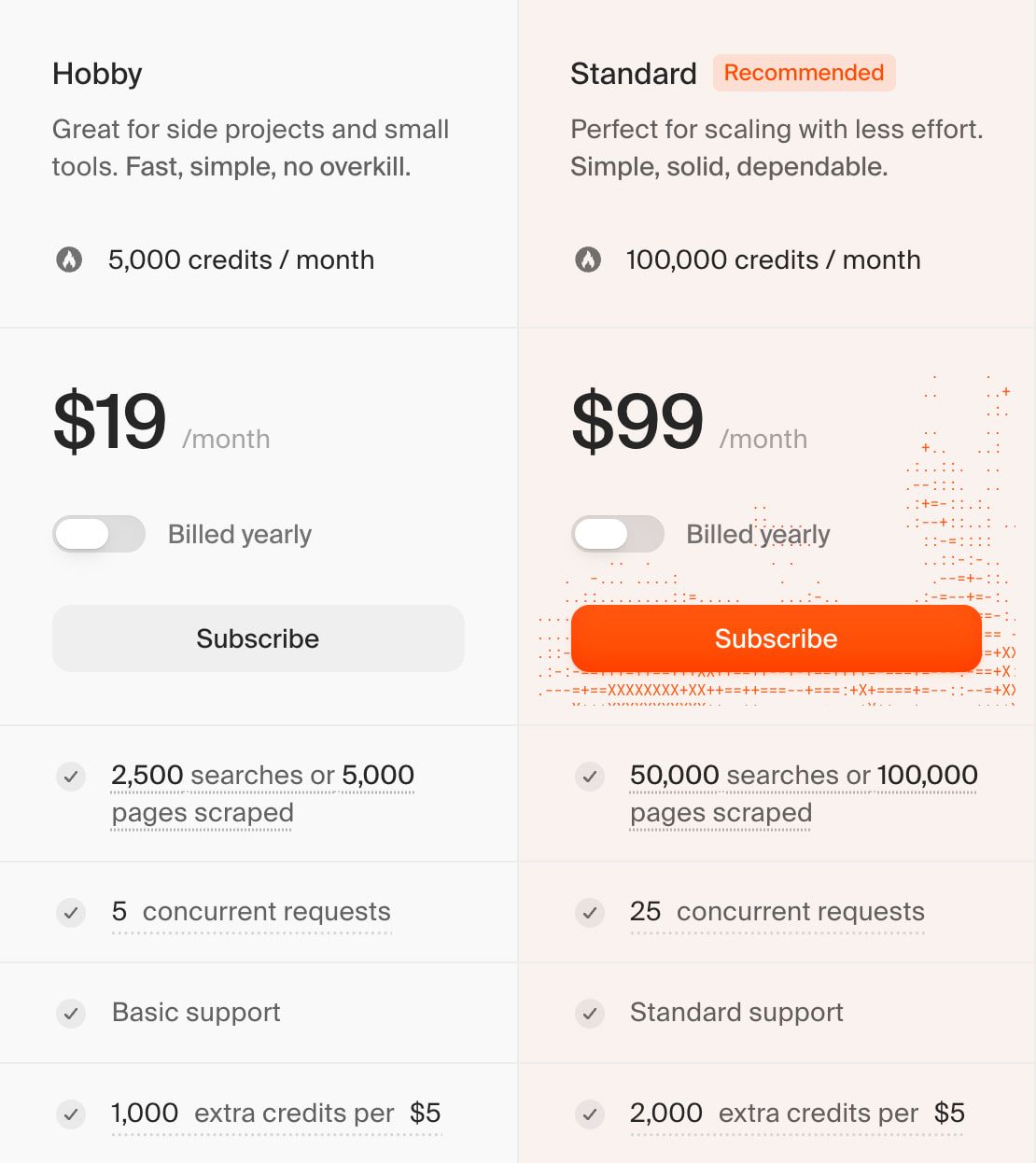
Extra credits get cheaper as you move up: $5 buys 2,000 on Standard, 2,500 on Growth and 5,000 on Scale (billing docs). The bigger surprise is format pricing: “Advanced formats (JSON, Question, Highlight)” add 4 credits per page, so a JSON page costs 5 credits, and PDFs add 1 credit per page.
The basic-page models exclude Firecrawl provider-routed LinkedIn URLs and X URLs, which have separate charges in its billing docs.
On Standard that makes JSON output about $4.95 per 1,000 pages instead of $0.99. One Hacker News commenter summed up the mood as “Firecrawl is egregiously expensive” (September 2025).
Firecrawl’s pricing page says the current prices are “Effective September 4, 2026” (pricing). I couldn’t find a changelog entry saying what changed that day.
2. Self-hosting gaps and the AGPL #
Firecrawl’s core is AGPL-3.0, with MIT-licensed SDKs (GitHub). If your legal team won’t accept AGPL, that alone rules out self-hosting it, though I found no Hacker News complaints about the license itself.
The bigger issue is what self-hosting leaves out. Firecrawl’s self-host docs say the self-hosted version lacks Fire-engine and its advanced anti-bot behavior, screenshots and page actions, and the Agent, Browser and interact features. They also say you own upgrades, secrets, storage, monitoring, recovery and incident response.
GitHub issues match that list. Issue #1028 (“Screenshots are not supported”) and issue #2350, about a self-hosted instance getting “stuck in an infinite loop” when blocked by anti-bot systems, were both closed as not planned.
3. Rate limits and billing surprises #
Hobby allows 5 concurrent browsers and 20 crawl requests a minute, and requests over the limit get a 429 error (rate limits). That’s fine for a side project and tight for a batch job.
On billing, issue #2189 reported a no-limit crawl preflight problem in 2025. Current billing docs, checked 31 October, explicitly say omitting a limit requires an initial one-credit check, not 10,000 prepaid credits. Set an explicit page limit to cap work. Issue #4212 remains an open report about failed Python batch jobs not being flagged.
4. Blocked sites #
This is the weakest reason in the evidence I found. The clearest GitHub report, “Firecrawl is blocked by Cloudflare”, dates from 2024.
The opposite pattern shows up too. One Hacker News user runs SearXNG and Crawl4AI locally and keeps hosted Firecrawl in the setup, with instructions “to use Firecrawl as last resort”.
5. Needing site-specific data, or search #
Some teams don’t want a general crawler at all. They want ready-made scrapers for specific sites, or they want to search the web and read the top results. Both are better served by a different kind of product, covered in the last three sections below.
What about Reddit? #
The #2 Google result for this search on 26 Sep 2026 was a Reddit thread titled “What is the best scraper tool right now? Firecrawl is great …”. Reddit was unreachable from my research tools, so I haven’t read it and I won’t guess what it says.
Why do many teams stay on Firecrawl? #
Mostly because it’s one API with no surcharge for harder pages, and a fair plain-markdown price at volume. The full list:
- One API for everything. Scrape, crawl, map and search sit behind one key, with newer endpoints such as /interact, /parse and /monitor (changelog).
- No surcharge for harder pages. The enhanced proxy costs “+0” credits, and “An escalated retry is not charged separately” (billing docs).
- Ordinary no-document failures are free. Returned 403/404 documents cost the base credit plus modifiers; safety checks, monitor work and browser sessions have documented exceptions (billing docs).
- Tooling. Official SDKs plus the
firecrawl-mcpserver (GitHub). - A free tier with no card. 1,000 credits a month (pricing).
- A predictable base unit for ordinary pages. One scrape/crawl credit per basic page is easier to model than a bandwidth or compute estimate; that does not make it cheapest at every volume.
If your pain is JSON pricing or the jump to $99, the sections below can save you real money. If you crawl 100K+ plain pages a month, check the table before you move.
Firecrawl alternatives compared #
The table compares selected published plans and modeled consumption. A token, compute unit, billed request and scraped page are not interchangeable, so I no longer calculate a median across these rows or treat the result as a quality ranking.
| Tool | Fixes | Output | JS rendering | Crawl / map | Run it yourself | Free tier |
|---|---|---|---|---|---|---|
| Firecrawl Baseline | Baseline | Markdown, HTML, JSON, screenshot, links | Yes (cloud) | /crawl, /map, /search | AGPL-3.0; no Fire-engine, screenshots or actions | 1,000 credits/mo, no card |
| Crawl4AI | Low-volume cost; running it yourself | Markdown, HTML, typed JSON | Cloud: yes; library: Playwright | Library: deep crawl; Cloud: /site (500 pages/job), /scan (50K URLs), account availability untested | Apache-2.0 + attribution requirement | 20 guest credits; 1,000 monthly after email verification |
| Nimble | Low-volume cost | HTML, markdown (Extract) | Not confirmed | Extract, Crawl and Map APIs | No | 5,000 requests/mo, no card |
| context.dev | Cost at 1M pages | HTML, markdown, screenshot, images | Included | Normal crawl up to 500 pages; larger Batches mode | No | 1,000 credits/mo |
| Olostep | Cost at 1M pages | Markdown, HTML, JSON | Trial terms say all requests are JS-rendered | Crawl, map, batch up to 10K | No | 500 trial requests |
| ScrapeGraphAI | JSON extraction | Markdown or structured extraction | Not listed | Crawl | MIT library (bring your own LLM) | 500 credits, once |
| Spider | Usage-billed crawling | Markdown, text, raw, XML, bytes | "Smart" mode switches to Chrome when needed | Crawl with limit and depth | MIT Rust crate; the cloud is separate | 25 keyless runs a day |
| Bright Data Crawl API | Blocked or hard sites | Markdown, text, HTML, JSON, ld_json | "Dynamic content" | Maps site structure in one request | No | Deposit match up to $500 (promo) |
| Zyte API | Blocked or hard sites | HTML, browser HTML, screenshots | Opt-in browser | Not confirmed | No | $5 credit for 30 days |
| ZenRows | Blocked or hard sites | Check selected Fetch output | Opt-in (5× credits) | Crawl; each opened page bills its Fetch weight | No | 5,000 credits/mo |
| Apify Website Content Crawler | Ready-made scrapers, no-code | Text, markdown, HTML, screenshot | You choose the crawler type | Full-site crawl and sitemaps | Hosted platform | $5 of usage/mo |
| Jina Reader | One URL at a time | Markdown, JSON, HTML | Headless browser by default | Single URL | Apache-2.0 repo with a Docker image | 10M tokens per new key |
Source: Each vendor's pricing page, docs and GitHub repo, rechecked 31 Oct 2026. 'Not confirmed' means the vendor's pages didn't say and I couldn't verify it. Exa and Tavily are search-first APIs, so they appear in the cost table and in their own section instead. Scroll sideways for more columns.
Cost per 1,000 pages at three monthly volumes
Verified
| Option | At 10K pages/mo | At 100K pages/mo | At 1M pages/mo | Billing unit |
|---|---|---|---|---|
| Firecrawl Baseline | $4.40 | $0.99 ($0.83 annual) | $0.75 ($0.60 annual) | Credits: 1 per page; JSON +4, PDF +1 per page |
| Crawl4AI Cloud | $1.00 | $0.50 | ≈$0.395 | Monthly plan + consumed extras: plain 0.5, browser 1, hard 2 credits |
| Nimble | $0.50 | $0.95 | $1.00 | Per request: Extract, Crawl, Map $1 per 1K |
| context.dev | $2.00 | $0.90 | $0.50 | Credits: 1 per scrape call, 1 per crawled page |
| Olostep | $2.90 | $0.99 | $0.40 | Per successful request |
| ScrapeGraphAI | $2.00 | $1.00 | $1.25 (Pro + five 50K packs) | Credits: markdown 1, extract 5 |
| Spider (my estimate) | ≈$0.04–$2.56 | ≈$0.04–$2.56 | ≈$0.04–$2.56, or $40/mo flat | $1 per GB + $0.0001 per CPU minute; failures free |
| Bright Data Crawl API | $1.50/1K billing units | $1.50/1K units PAYG | $1.50/1K units PAYG | Pricing page says requests, other product wording says records; not normalized to pages |
| Zyte API (HTTP) | $0.13–$1.27 | $0.13–$1.00 | $0.10–$0.61 ($100–$500/mo minimum) | Per request, by site tier 1–5 |
| ZenRows | $1.90 ($2.55 with JS top-up) | $0.39 ($0.99 with JS) | $0.20 ($0.55 with JS) | Credits: JS 5, premium proxy 10, both 25 |
| Apify WCC (Apify's estimate) | $0.00 (fits the Free plan's $5) | $0.20 (browser $0.50–$5) | ≈$0.20 (browser $0.50–$5) | Compute units, $0.13–$0.20 each by plan |
| Jina Reader | Not published per page | Not published per page | Not published per page | Output tokens: $50 per 1B, shared across Jina APIs; 10M free per key, non-commercial only |
| Tavily Extract (basic) | $1.60 | $1.40 | $1.30 | Credits: 5 URLs per credit, $0.008 each |
| Exa Contents | $0.00 | $0.90 | $0.99 | Per page, per content type |
Source: Each vendor's pricing page, rechecked 31 Oct 2026, Selected regular-account monthly plans and published top-ups, not a global cheapest-price guarantee. Free grants are netted only where documented, without assuming they stack on paid plans. Crawl4AI models consumed extras before top-up cash timing, scan/site job overhead or free credits. ZenRows uses whole top-up blocks. Spider is a page-weight scenario plus CPU; Apify figures are vendor estimates. Bright Data units need reconciliation, so its row is not page-normalized. Agent storefronts, enterprise quotes and actual workload results are excluded. Primary prices checked 31 Oct 2026.
Which Firecrawl alternatives cost less? #
At 10K plain pages, Crawl4AI Starter is $10 ($1/1K) and Nimble models $5 after its 5K free requests, against Firecrawl $44. At 1M, Crawl4AI plain-read consumption models $395.25, Olostep lists $399 and context.dev $500, against Firecrawl $749. Those prices depend on the selected engine, billing unit and plan; no performance equivalence is established.
ZenRows without JS rendering, Zyte on easy sites and Apify’s raw-HTTP estimate can be lower still, but they price by site or by compute, which I cover further down.
So the cost case for leaving is strongest if you’re stuck between Hobby and Standard, or if you pay for JSON output. For plan-by-plan detail on Firecrawl itself, see what Firecrawl costs at 10K, 100K and 1M pages.
Crawl4AI Cloud #
Crawl4AI Cloud is the hosted version of its open-source library. Its homepage and live price API, checked 31 October 2026, now price plain/browser/hard pages at 0.5/1/2 credits and use subscriptions: Starter $10 for 10K monthly credits, Builder $99 for 125K and Scale $499 for 750K.
The current offer is 20 guest credits and 1,000 monthly credits after email verification. Extras cost $1/$0.79/$0.67 per 1K credits on the three paid plans, bought from $10 and without expiry; plan credits reset monthly. The plain-read models are $10 at 10K pages, $50 at 100K and $395.25 at 1M, before cash top-up timing, free credits or discovery/job overhead. Monthly usage caps in the API still apply; these are soft-launch prices, not observed invoices.
Its current docs document /site for whole-site crawling (max 500 pages, depth 5 and one hour per job) and /scan for discovery (up to 50,000 URLs). Those operations add job/discovery usage; batches accept 50 known URLs and jobs up to 10,000. I have not verified which account can access every endpoint. My head-to-head models the engine mix and limits.
What stands out
- $1 per 1K at 10K plain pages after the $10 plan minimum, vs Firecrawl $4.40
- Bought extra credits never expire; 20 guest credits and 1,000 monthly credits after email verification
- The same project's Apache-2.0 library if you later want to run it yourself
What gives me pause
- /site is limited to 500 pages and one hour per job; verify account availability
- Browser pages use 1 credit and hard pages 2; Firecrawl basic pages use 1, including enhanced proxy
- Plain-page price models exclude discovery overhead, cash top-up timing and untested engine selection
- Starter allows 10 concurrent requests and 120 a minute; higher plans raise limits
What you give up vs Firecrawl: the same flat page-credit rate across its engine choices. Crawl4AI now documents discovery and crawling; check the smaller /site job limits, monthly caps and actual account availability.
Nimble #
Nimble’s Extract, Crawl and Map APIs cost $1 per 1,000 requests, and 5,000 requests a month are free with no card (pricing, verified 31 Oct 2026). That works out to about $0.50 per 1,000 at 10K, $0.95 at 100K and $1.00 at 1M.
The same page says Extract returns page contents as HTML or markdown, but I couldn’t confirm whether JavaScript rendering is included at that price. Its larger platform plans are billed annually and start at $2,500 a month.
What you give up vs Firecrawl: documented clarity on rendering, and a lower price at 1M pages.
context.dev #
context.dev’s plans run from 1,000 free credits a month (no overage) to Scale at $500 for 1M credits; I use the monthly prices, as yearly billing gives two months free (pricing, verified 31 Oct 2026). The pricing page lists Developer $20, Pro $90, Growth $300 and Scale $500, and the billing docs give their credits as 10K, 100K, 500K and 1M. That’s $0.90 per 1,000 at 100K, below Firecrawl’s $0.99, and $0.50 at 1M.
Its homepage says basic successful scrapes cost one credit with JS rendering and premium proxies included. At 10K pages, Developer’s 10,000 credits cover the volume exactly: $20, or $2.00 per 1K. Top-ups come in 1K-credit blocks, at $3.00 on Developer for new subscriptions (pricing, checked 31 October 2026). Its Free plan currently allows 2 concurrent requests, with no per-minute cap by default.
What you give up vs Firecrawl: the ordinary crawl call has a 500-page limit; larger jobs use its separate Batches mode (crawl docs). Match that workflow and the selected top-up rules to your project.
Spider #
Spider doesn’t charge per page. It bills “$1 per GB of pre-transformation content” plus “$0.0001 per minute of CPU”, and “Failed requests cost $0” (pricing, verified 31 Oct 2026).
That makes the price depend on bytes, so the table is an illustration, not a vendor quote or bound: at hypothetical pre-transformation payloads of 35 KB or 2.56 MB per page, 1,000 pages consume about $0.035 or $2.56 of bandwidth, plus CPU. Those assumptions were informed by Web Almanac page-weight data; neither a median nor a full-page weight proves what Spider meters for your job.
The alternative is its Unlimited plan, which its FAQ prices from $40 a month for 2 concurrent requests; its plan card on 31 Oct 2026 showed $350 a month for 25. By my arithmetic, fitting 1M pages into 30 days on 2 slots needs an average of about 5 seconds per page or less.
What stands out
- Failed requests cost $0
- Crawls with limit and depth settings (default depth 25), in markdown or plain text
- Unlimited plan from $40 a month for 2 concurrent requests (per its FAQ)
- MIT-licensed Rust crawler on GitHub; CLI, JS, Python and Rust clients
What gives me pause
- No per-page price: my estimate spans $0.04 to $2.56 per 1K, plus CPU
- Top-up cash and bandwidth consumption are different; check the amount selected at purchase
- Verify the chosen proxy route and its current price before assuming base bandwidth pricing
Spider’s API docs list a “smart” default mode that uses plain HTTP and switches to Chrome when needed. Its open-source crawler is a separate MIT-licensed crate.
What you give up vs Firecrawl: a price you can predict per page before you run the job.
How do you cut the cost of JSON output? #
The cheapest fix is often not a new vendor: ask for markdown at 1 credit and run the extraction with the LLM you already pay for (model costs aren’t priced here). A JSON page on Firecrawl costs 5 credits against 1 for markdown, so about $4.95 per 1,000 on Standard and $3.75 on Scale.
The Crawl4AI library can also extract with CSS or XPath selectors, without an LLM, or with one (GitHub). Don’t expect ScrapeGraphAI to be cheaper for this: its Extract costs 5 credits too, so about $5.00 per 1,000 on its $100 Growth plan (pricing).
If you need the same fields from the same few sites every day, a ready-made scraper usually fits better than general extraction. That’s the Apify route below.
Olostep, ScrapeGraphAI and WaterCrawl #
These show up in searches for Firecrawl alternatives, and I’d shortlist them only for a specific need.
- Olostep: a low monthly subscription price at 1M pages, $399 for its Scale plan ($0.40 per 1,000), with $99 for 200,000 on Standard (pricing). It bills per successful request, and extra packs are valid for six months; I couldn’t confirm the credit cost of each operation.
- ScrapeGraphAI: $20 for 10,000 credits up to $500 for 750,000, with a markdown scrape at 1 credit and Extract at 5 (pricing). The underlying library is MIT-licensed and works with your own LLM.
- WaterCrawl: promo prices in euros with a yearly credit pool and a cap of 1,000 pages a day on its Startup plan (pricing). Its license is MIT plus a clause that bars using it to run a service similar to watercrawl.dev, or any other commercial service, without permission, so read it before you self-host.
For scraping APIs priced like-for-like beyond this Firecrawl shortlist, see my cheapest web scraping API comparison.
Which Firecrawl alternative handles blocked or hard sites? #
Bright Data’s Crawl API, Zyte API and ZenRows are built for sites with bot protection, per their docs, and they differ mostly in how they charge for hard pages. Before you switch for this reason, note that Firecrawl’s own enhanced proxy costs no extra credits. Its current proxy docs recommend auto routing and deprecate the explicit proxy parameter; check a permitted sample before switching.

This is desk research, so I have no success-rate numbers for any of these, Firecrawl included. What I can compare is the pricing model, which decides how predictable your bill is when a crawl hits difficult sites.
Bright Data Crawl API #
Bright Data lists $1.50 per 1,000 pay-as-you-go units, or $499/380K, $999/900K and $1,999/2M on its pricing page, checked 31 October 2026. That page labels them requests, while other product wording uses records. I have not confirmed how either maps to complete pages or retries, so I do not normalize these units to pages. Its product page also advertises different promotional tiers; confirm your selected offer.
It outputs “Markdown, Text, HTML, or JSON”, handles dynamic content, and says it can “Map entire site structures in one request”. The pricing page also advertises a match of your first deposit up to $500, which is a promotion, so don’t budget around it.
What stands out
- One published rate per 1K billing units, with no site tiers or multipliers on its pricing page
- Markdown, text, HTML, JSON and ld_json output
- Maps a site's structure in one request, per its product page
- Falls to $1.00 per 1K on the $1,999 plan
What gives me pause
- Request/record units need clarification before comparison with Firecrawl page credits
- Monthly plans start at $499
- Overage above a plan's volume isn't published where I looked
- The deposit match is a promotion
What you give up vs Firecrawl: a directly comparable page-credit unit, plus the documented no-card monthly Free allowance. Check the actual billing unit and offer before budgeting.
Zyte API #
Zyte prices each request by how hard the site is, in tiers 1 to 5 (pricing, verified 31 Oct 2026). Pay-as-you-go HTTP requests cost $0.13 to $1.27 per 1,000, and browser-rendered ones $1.01 to $16.08, with a $5 free credit for 30 days.
Committing $500 a month lowers that to $0.06 to $0.61 (HTTP) and $0.48 to $7.68 (browser), but commitments are monthly minimums: 1M easy pages at $0.06 would be $60, and you still pay $500. The upside is paying less for easy sites; the downside is that a crawl across unfamiliar sites is hard to budget in advance.
What you give up vs Firecrawl: a single per-page price, and a crawl endpoint I could confirm.
ZenRows #
ZenRows sells credits: 5,000 free monthly, then regular-account monthly plans from Build B1 $19/45K credits to Scale S5 $2,999/45M (current pricing docs, checked 31 October 2026). Fetch uses 1 credit for standard, 5 for JS, 10 for premium proxy or 25 for both. Crawl now exists and bills each opened page at its selected Fetch weight.
At 10K JS pages, Build B1 plus one 11K-credit top-up costs $25.50 rather than jumping to the $29 plan. At 1M JS pages, Scale S1 is $549/5M credits. At 1M protected pages, 25M credits fit Scale S4 at $1,999/28M. The table uses regular accounts; its separate agent storefront has different PAYG terms and is not included in that comparison.
What you give up vs Firecrawl: a flat price when pages need a browser or premium proxies.
ScrapFly also has a Crawler API, with plans from $30 for 200,000 credits (pricing). Its pricing page says credits per request depend on the features you enable and doesn’t say how the Crawler API bills per page, so I couldn’t price it per page. For the wider field of scraping APIs, see my scraping API comparison and my notes on per-request scraping APIs such as ScraperAPI and its rivals.
Not legal advice
Whether you may crawl a given site depends on its terms, the kind of data, and where you operate. This page compares products and prices; it isn’t legal advice.
Want to run the crawler yourself? #
If the AGPL or the self-host gaps are your reason for leaving, the Crawl4AI library is the usual answer. It’s Apache-2.0 with an added attribution requirement, and it has deep crawling (breadth-first, depth-first and best-first), Playwright for JavaScript, CSS/XPath or LLM extraction, and a Docker REST server (GitHub, v0.9.5 released 14 Oct 2026).
Self-hosted Firecrawl is AGPL-3.0 and, per its own docs, runs without Fire-engine, screenshots, page actions or the Agent features. Either way, you run the browsers, proxies and upkeep yourself. My Crawl4AI vs Firecrawl comparison goes through that trade-off in detail.
Would a platform suit you better than an API? #
If you want ready-made scrapers, or your team doesn’t write code, Apify is the platform route. Its Website Content Crawler crawls whole sites (including sitemaps) into text, markdown or HTML, and Apify estimates it at “approximately $0.2 per 1,000 web pages” with raw HTTP and “$0.5 - $5” with a headless browser.
Apify bills compute units: $0.20 each on the Free and Starter plans, $0.16 on Scale and $0.13 on Business (pricing, verified 31 Oct 2026). The Free plan includes $5 of usage a month, and Starter is $19.
For site-specific data, Apify’s Store sells ready-made scrapers (Actors), which can replace JSON extraction on sites you scrape often. For Firecrawl and Apify priced on the same crawl, see my head-to-head.
What stands out
- About $0.20 per 1K pages with the raw-HTTP crawler (Apify's estimate)
- Text, markdown, HTML and screenshot output, with LangChain, LlamaIndex and Pinecone integrations
- Store Actors for site-specific data
- Store ratings are individual feedback, not a measured reliability guarantee
What gives me pause
- Browser crawling is estimated at $0.50 to $5 per 1K pages
- You pay for compute, so the per-page cost depends on the pages, not a fixed rate
- The Free plan's $5 covers only about 25K pages even at the raw-HTTP estimate
What you give up vs Firecrawl: one API with a fixed price per page, and the simplicity of calling it from code.
Just need clean markdown from one URL? #
Then Jina Reader may be all you need: you put its prefix in front of a URL and get markdown, JSON or HTML back, rendered in a headless browser by default (Jina Reader). Every new API key comes with 10M free tokens for non-commercial use, and Reader bills output tokens.
Paid tokens cost $50 for 1B ($0.050 per 1M) or $500 for 11B ($0.045 per 1M), shared across all of Jina’s APIs, per its pricing page (verified 31 Oct 2026). Jina doesn’t publish how many tokens a typical page uses, so the cost table shows Reader as not priced per page.
Rate limits are 20 requests a minute without a key, 500 with a free or paid key, and 5,000 on premium.
Jina is now part of Elastic, which completed the acquisition in October 2025. The Reader repo is Apache-2.0 with a Docker image, but the ReaderLM models are CC-BY-NC 4.0, and commercial production use needs a license.
What stands out
- 10M free tokens per new key for non-commercial use
- Headless browser by default, with markdown, JSON or HTML output
- Apache-2.0 repo with a Docker image
What gives me pause
- One URL at a time: no crawl or map
- Billed per output token, so the cost per page depends on page length
- ReaderLM models are non-commercial without a license
What you give up vs Firecrawl: crawling, mapping, and a fixed price per page. For a side-by-side, see Firecrawl vs Jina Reader; for the wider set of tools, see my guide to converting websites to markdown for LLMs.
Need search, not a crawler? #
If your agent really needs “search the web, then read the top pages”, a search API with content extraction fits better than a crawler. Exa Contents costs $1 per 1,000 pages per content type, with $10 of free usage that resets on the first of each month (pricing). Tavily’s basic Extract bills 1 credit per 5 successful URLs, at $0.008 per pay-as-you-go credit, with 1,000 free credits a month and Map at 1 credit per 10 pages (docs, pricing).
I compare the search-first route in Firecrawl vs Tavily, and the search APIs themselves in my search API guide, my notes on choosing between Exa and Tavily, and Tavily alternatives.
Which one should you pick? #
Match your situation to a line below. If you’re choosing a crawler for the first time rather than leaving Firecrawl, my guide on how to choose a web scraper for LLMs starts from there.
- RAG over 50K plain docs pages a month: Firecrawl Standard is $99; Crawl4AI Starter models $25 of consumed usage (25K credits at 0.5/page, $10 plan plus $15 extras), before discovery jobs or cash top-up timing. Apify estimates about $10 raw-HTTP usage, above its $5 Free allowance. Check actual output and engine selection before switching.
- E-commerce pages that block you: first evaluate Firecrawl’s recommended auto routing; enhanced proxy adds no page-credit surcharge. If you still need to move, Bright Data lists $1.50 per 1K pay-as-you-go units, with request/record wording to reconcile; Zyte suits you if you’d rather pay less on the easy sites.
- It must run in your VPC: the Crawl4AI library, under Apache-2.0 with an attribution requirement. Self-hosted Firecrawl works too if AGPL is acceptable and you can live without Fire-engine.
- A no-code team that needs data from 20 sites: Apify. Check the Store for a ready-made Actor per site, and use Website Content Crawler for the rest.
- Around 1M plain pages a month: Crawl4AI models about $0.395 per 1K plain known-URL reads; Olostep lists about $0.40 and context.dev $0.50. Their engine, job and operation rules differ. Compare your permitted sample and migration cost before switching.
- Single pages on demand: Jina Reader; use its free 10M-token grant only for non-commercial use, or budget for a paid pack.
- An agent that searches, then reads: Exa or Tavily.
If I were paying Firecrawl Hobby plus extra credits for about 10K pages a month today, I’d move the pages I already have URLs for to Crawl4AI Cloud. I’d keep Firecrawl’s free tier for discovery, since its billing docs charge map at 1 credit per call, and I’d drop the paid plan.
FAQ
Is Firecrawl expensive?
Firecrawl is more expensive than several alternatives for selected plain-page workloads, especially around 10K pages, but there is no universal ranking across compute, bandwidth, token and request billing. Standard is $99 for 100K credits ($0.99/1K basic pages) and monthly Scale $749 for 1M (about $0.75/1K), with extra formats charged separately.
At 10K pages a month it's about $4.40 per 1,000 (Hobby plus extra credits), above several plain-page scenarios here. JSON, Question and Highlight formats add 4 credits per page, so a JSON page costs 5 credits, about $4.95 per 1,000 on Standard. PDFs add 1 credit per page.
Which Firecrawl alternative is best for LLM and RAG work?
It depends on your constraint. For feeding pages to an LLM or a RAG pipeline: Apify's Website Content Crawler if you need whole-site crawling from one API (or stay on Firecrawl), Crawl4AI if you want to run it yourself, Jina Reader for single URLs, and Bright Data, Zyte or ZenRows if hard sites are the problem.
My guide to crawl APIs covers the first-time choice for LLM work, and my scraping API comparison covers general-purpose scraping.
What are the key differences between Crawl4AI and Firecrawl?
Three matter most. Crawl4AI is mainly a Python library you run, while Firecrawl is mainly a hosted API. Crawl4AI is Apache-2.0 with an added attribution requirement, while Firecrawl's core is AGPL-3.0. And with Crawl4AI you run the browsers yourself, while Firecrawl runs them for you.
Crawl4AI Cloud now uses monthly plans from $10, with 0.5/1/2 credits for plain/browser/hard pages. It documents /site crawling and /scan discovery, with limits and account availability to check. My Crawl4AI vs Firecrawl comparison goes through the current plans.
Can Firecrawl be self-hosted?
Yes. Its core is AGPL-3.0 and its SDKs are MIT. Firecrawl's self-host docs list what the self-hosted version lacks: Fire-engine and its advanced anti-bot behavior, screenshots and page actions, and the Agent, Browser and interact features. They also say you own upgrades, secrets, storage, monitoring, recovery and incident response.
Two self-host issues on GitHub, one about screenshots and one about a retry loop on bot-protected sites, were closed as not planned.
Is there a free alternative to Firecrawl?
Several have free allowances that renew every month: Nimble (5,000 requests), ZenRows (5,000 credits), Crawl4AI Cloud (1,000 credits after email verification, about 2,000 plain pages), Exa ($10 of usage), Apify ($5 of usage) and context.dev (1,000 credits). Jina Reader gives 10M tokens per new key for non-commercial use.
For free software, the Crawl4AI library is Apache-2.0 with an attribution requirement. You pay for the servers, browsers and proxies instead.
Sources
50 sources, accessed .
Official pricing, docs, changelogs and status pages 35
- Firecrawl proxy routing and deprecated parameter
- Firecrawl pricing (Markdown version of the pricing page)
- Firecrawl pricing page ("Effective September 4, 2026")
- Firecrawl docs: billing and credit costs
- Firecrawl docs: rate limits
- Firecrawl docs: self-hosting
- Firecrawl changelog
- Firecrawl's own alternatives hub (vendor page)
- Crawl4AI Cloud pricing and credits
- Crawl4AI Cloud docs: endpoints and limits
- Spider pricing
- Spider API docs: formats, modes and crawl settings
- Nimble pricing
- context.dev pricing
- context.dev homepage (credits, crawl limit, SDKs)
- context.dev docs: plans, monthly credits and concurrency
- context.dev docs: crawl limit and Batches for larger jobs
- Bright Data Crawl API pricing
- Bright Data Crawl API product page
- Zyte API pricing
- ZenRows pricing (opens on annual billing; monthly list prices used here)
- Apify pricing
- Apify Website Content Crawler (Store page)
- Jina Reader
- Jina API pricing (token packs shared across Jina APIs)
- Elastic: acquisition of Jina AI completed (9 Oct 2025)
- Tavily docs: API credits
- Tavily pricing
- Exa pricing
- ScrapeGraphAI pricing
- Olostep pricing
- WaterCrawl pricing (EUR)
- ScrapFly pricing
- Crawl4AI current plans and metering API
- ZenRows plan rungs and top-up pack pricing
GitHub code, issues and releases 11
- Firecrawl on GitHub (AGPL-3.0 core, MIT SDKs)
- Crawl4AI on GitHub
- Spider crawler crate on GitHub (MIT)
- Jina Reader on GitHub (Apache-2.0)
- ScrapeGraphAI library on GitHub (MIT)
- WaterCrawl license and commercial-service restriction
- Firecrawl issue #1028: self-host screenshots not supported
- Firecrawl issue #2350: self-host retry loop when blocked by anti-bot
- Firecrawl issue #2189: 402 when the crawl page limit is not set
- Firecrawl issue #4212: Python SDK and failed batch jobs
- Firecrawl issue #495: blocked by Cloudflare (2024)