Roundup
Free Web Search APIs for LLMs and Agents (2026)
Free web search API allowances checked 31 Oct 2026: card and key requirements, rate limits, billing units and conditions for Exa, Parallel and Tavily.

You need web search for an agent, a RAG prototype or a local model, and you’d like it to cost $0 until the project proves itself. I rechecked the cited pricing pages, documentation and terms for these search APIs and free routes on 31 October 2026 and put every free allowance I could verify in one dated table.
The table is sorted by what each option asks of you: nothing, an API key, or a card. Each row also shows whether the allowance renews monthly, daily or only once, and what you pay per 1,000 searches after it runs out.
Short on time?
The best free option for your situation
- Low paid rate and an advertised free allowance
- Parallel Search API
- 5,000 advertised monthly requests and a separate $5 credit promotion; stacking is unconfirmed. Fast costs $1 per 1K.
- No card, with full page text
- Exa
- $10 monthly credit for your first team with no payment method: 2,500 Lite searches or about 1,428 Auto searches, before extra results or content charges.
- No API key at all
- You.com keyless
- 100 queries a day with no key, the only keyless cap I found published. Firecrawl Keyless, Parallel Search MCP and Tavily Keyless also work without keys; their numeric caps are unpublished.
- Free inside your LLM
- Gemini grounding
- Gemini 2.5 Flash and Flash-Lite share up to 500 grounded requests a day on the Free Tier. Gemini 3 and newer share a paid-tier 5,000-query monthly allowance.
- Need Google's own results
- A free SERP API tier
- Bright Data includes 5K records a month with no card, and SerpApi 250 searches. Base SERP responses provide links and snippets; full page retrieval is a separate capability.
- $0 and self-hosted
- SearXNG
- AGPL-3.0, no vendor and no key. You run the server, turn on JSON output, and deal with upstream engines blocking you.
Prices verified . Allowances and prices verified 31 Oct 2026. The picks rest on published allowances, prices and terms only, not on result quality.
Which web search API is free? #
Several are, and none is unlimited. By free searches a month, the top three I could verify on 31 October 2026 are Diffbot (10,000 credits at 1 credit per search), Parallel (5,000 advertised requests; separate $5 credit promotion) and Nimble (5,000 requests).
The best free options at a glance, verified 31 October 2026 and sorted by free searches a month:
| Web search API | Free allowance | ≈ Searches a month | Card? | Paid after, per 1K |
|---|---|---|---|---|
| Diffbot | 10,000 credits a month (1 per search) | 10,000 | No | Startup plan $299/mo for 250,000 credits |
| Parallel Search API | 5,000 requests and separate $5 monthly promotion | 5,000; another ~5,000 Fast calls only if promotions stack | Only for the $5 credit, per Parallel’s article | $1 on Fast or Turbo |
| Nimble | 5,000 requests a month | 5,000 | No | $1.10 |
| Linkup | $20 credit with a work email, topped up monthly for “eligible accounts” | ~4,000 | Not stated | $5 |
| You.com keyless | 100 queries a day, no key (MCP) | ~3,000 | No | $5 |
| Exa | $10 credit a month (first team) | 2,500 Lite or ~1,428 Auto, before extras | No | $4 Lite; $7 Auto |
| Tavily | 1,000 API credits a month | 1,000 basic | No | $8 |
| Brave Search API | $5 credit a month | ~1,000 | Yes | $5 |
| Firecrawl | 1,000 credits a month | 500 searches of up to 10 results, without scraping | No | Hobby $19/mo for 5,000 credits |
Exa offers $10 monthly credit without a payment method. At its published rates that buys 2,500 Lite searches or about 1,428 Auto searches, before extra results or content. Tavily gives 1,000 credits, while Brave gives $5 monthly credit, enough for 1,000 base Search requests, with a card required.
I’d still point most agents at Parallel or Exa before Diffbot. I couldn’t read what Diffbot’s search returns, and past the free credits its cheapest plan is $299 a month (250,000 credits), a big step up from pay-as-you-go.
Free web search API tiers compared #
| Option | Free allowance | Renews | ≈ Searches a month | Card? | API key? | Rate limit (free) | What a result contains | Storage and commercial-use terms | Paid after, per 1K | Verified |
|---|---|---|---|---|---|---|---|---|---|---|
| Firecrawl Keyless No key | Daily IP request and credit caps; numbers not published | Daily | Not published | No | No | Daily IP caps, then HTTP 429 | Hosted MCP: Search, Scrape, Parse; Interact through supported clients | Commercial use needs express authorization under its terms; storage rights not established | Keyed plans below | 31 Oct 2026 |
| Parallel Search MCP No key | Free; anonymous requests run in fast mode | Not stated | No cap published | No | No (MCP only) | Not published | URL, title, LLM-optimized excerpts, publish date | API data permissions not established | $1 on Fast, with a key | 31 Oct 2026 |
| You.com keyless No key | 100 queries a day via ?profile=free (MCP) | Daily | ~3,000 (100 × 30) | No | No | 100 a day | Snippets; highlights or full page via extraction | Data/storage terms not established | $5 | 31 Oct 2026 |
| Tavily Keyless No key | Free Search and Extract; numeric cap unpublished | Not published | Not published | No | No account or key | Rate-limited; numeric caps unpublished | Documented same success schema as keyed calls | Same platform terms; data permissions need review | Optional free key: 1,000 monthly credits | 31 Oct 2026 |
| Diffbot Key, monthly | 10,000 credits (1 per search) | Monthly | 10,000 | No | Yes | 5 a minute | Not checked | Not read | Startup plan $299/mo for 250,000 credits; overage $1 ($0.001 per credit) | 31 Oct 2026 |
| Parallel Search API Key, monthly | 5,000 advertised requests; $5/month credit promotion; up to $80 signup promotion | Monthly promotions | 5,000; another ~5,000 Fast calls only if credits stack (vendor article ties $5 to up to 5,000 Fast searches) | Pricing silent; vendor article says card only for monthly credit | Yes | 600 a minute | URL, title, excerpts, publish date | API data permissions not established | $1 Fast/Turbo; $5 Basic/Advanced | 31 Oct 2026 |
| Nimble Key, monthly | 5,000 requests | Monthly | 5,000 | No | Yes | Not published | Not checked | Not read | $1.10 | 31 Oct 2026 |
| Linkup Key, monthly | $20 credit with a work email (pricing page: 4,000 queries) | Monthly top-up for 'eligible accounts' | ~4,000 standard | Not stated | Yes | Not published | Search results or a sourced answer | Data/storage terms not established | $5 results; $6 answer | 31 Oct 2026 |
| Exa Key, monthly | $10 monthly credit for the first team; one-time $10 onboarding bonus | Monthly reset on the 1st | 2,500 Lite or ~1,428 Auto, before extras | No | Yes | 10 QPS on free Search, team-wide | Title, URL; optional text/highlights through contents | Broad reuse restrictions with contractual exceptions; Search Engine input/output licence is not an API retention guarantee | $4 Lite (legacy Instant also $4); $7 Auto (legacy Fast also $7); contents/extra results add cost | 31 Oct 2026 |
| Tavily Key, monthly | 1,000 API credits | Monthly | 1,000 basic/fast/ultra-fast or 500 advanced | No | Yes (development key) | 100 a minute | Snippets; optional raw content; ultra-fast has a summary per URL | AI Functionality input/output has training provisions (§6.5); general storage rights not established | $8 PAYG per 1K one-credit searches | 31 Oct 2026 |
| Browserbase Search Key, monthly | 1,000 Search calls | Monthly | 1,000 | Not established | Yes | 2 a second per project | Links and metadata; detailed response not checked | Not reviewed | $20 Developer fee plus default $5/1K beyond included calls; Fast $1/Exa $7 options | 31 Oct 2026 |
| Firecrawl (with a key) Key, monthly | 1,000 credits | Monthly | 500 searches of up to 10 results, without scraping | No | Yes | 10 Search requests/min; 2 concurrent browsers | Search results; optional scraping costs extra | Commercial authorization and storage permissions need review | Hobby $19/month, 5,000 credits; top-ups extra | 31 Oct 2026 |
| Gemini 2.5 Flash / Flash-Lite grounding Key, daily | Up to 500 grounded requests/day, shared by both on Free Tier | Daily | Up to 15,000 if quota available every day | No billing on Free Tier | Yes | 500/day shared; model quotas also apply | Grounded model answer; show Search Suggestions | Use restrictions with narrow display/history storage exceptions; review unpaid-service data use | $35/1K grounded prompts after shared 1,500/day on paid tier, plus model costs | 31 Oct 2026 |
| LangSearch Key, daily | Daily web search token allowance; size not published | Daily (00:00 UTC) | Not published | No | Yes | 5 a second (new accounts) | Titles, links, snippets, full page text; up to 50 results | Contracting entity not established from reviewed pages; licence is limited | None published | 31 Oct 2026 |
| You.com credit Key, sign-up | $10 API credit (pricing page: 2,000 searches) | Not stated; eligibility unverified | 2,000 at $5/1K, not shown as monthly | Not stated for API credit | Yes | Not checked | Snippets; extraction can return highlights/page content | Data/storage terms not established | $5/1K Search calls; Contents separate | 31 Oct 2026 |
| Jina search (s.jina.ai) Key, one-time | 10M tokens per new key | One-time | At most 1,000 total at 10K minimum tokens/search | Not established | Yes | 100 a minute | Results with page content; minimum 10,000 tokens/request | Not reviewed | Current paid token-pack tariff not established; no fixed per-search price | 31 Oct 2026 |
| Brave Search API Card | $5 credit | Monthly | 1,000 base Search requests | Required ('to prevent abuse'); paid use is prepaid credits | Yes | 50 a second | Title, URL, description, up to 5 extra snippets | Transient storage unless order grants rights; AI training/evaluation restrictions | $5 | 31 Oct 2026 |
| Gemini 3 and newer grounding Billing | 5,000 search queries shared across applicable models on Paid Tier | Monthly | 5,000 search queries, not necessarily model prompts | Billing account required | Yes | 1,500 requests/day default cap; model quotas apply | Grounded model answer; show Search Suggestions | Same Gemini terms | $14/1K search queries beyond allowance, plus model tokens | 31 Oct 2026 |
| SearXNG (self-hosted) Self-hosted | $0 licence (AGPL-3.0) | Not applicable | Bound by your server and upstream engines | No | No (your own instance) | Upstream engines' limits | Links and snippets from upstream engines | Upstream engines' terms apply; AGPL obligations | Your server (cost not published) | 31 Oct 2026 |
| TinyFish Unclear | Search free within rate caps; $8 starting wallet for billed products | Rate-capped | No monthly quota published | No card to start; $10 minimum to add funds | Not established for Search | 30/min; 500/hour | Response not checked | Terms identify Tiny Fish, Inc.; search data permissions not established | Search stays free when wallet is empty | 31 Oct 2026 |
| Perplexity Search API No free tier | None on its pricing page | Not applicable | 0 | Not applicable | Yes | Not applicable | Ranked results | Data/storage terms not established | $5; Fast $1 | 31 Oct 2026 |
Source: Current retained pricing and specification claims rechecked against cited public sources on 31 Oct 2026. Arithmetic assumes the stated mode and no optional extras. Conditional promotions are not confirmed entitlements. Not checked or not reviewed identifies a gap, not an assurance. Scroll sideways for more columns.
Rows run from “you give nothing” to “you give a card or a server”, and within each group from the biggest allowance to the smallest.
Which AI search APIs have a free tier? #
Parallel, Exa, Brave, Tavily, Linkup and You.com all do, while Perplexity has no free tier and Mojeek offers only an unquantified sign-up credit that needs a card. These vendors sell search built for model input, from their own index or retrieval pipeline. My guide to web search APIs for AI agents compares them on paid price and route; here I’m only looking at what you get for free.
Parallel #
Parallel’s pricing page advertises 5,000 free requests per month and a separate $5 monthly credit promotion, plus up to $80 of signup incentives. I have not established whether the two recurring offers stack. Fast and Turbo cost $1 per 1K requests; Basic and Advanced cost $5, with a 600-request/minute limit.
Its own comparison article says a card is needed only for the monthly credit, which goes to “eligible organizations with a card on file”, and describes that $5 as “enough for up to 5,000 Turbo or Fast searches”. That reads as one allowance described two ways, while the pricing page lists the two offers side by side without saying. Confirm the actual entitlement before budgeting both.
The Search MCP allows anonymous, keyless use in fast mode “at lower rate limits”, without a published numeric cap. The quickstart documents URL, title, excerpts and publication date fields. These are documented capabilities; I made no API calls.
Exa #
Exa provides $10 monthly credit without a payment method, plus a one-time $10 onboarding bonus; its billing documentation says only a user’s first team receives the monthly grant and the bonus. Monthly credit resets on the first and does not accumulate; the onboarding bonus does not expire. Lite costs $4 per 1K searches and Auto $7 before optional charges; Instant ($4) and Fast ($7) are now listed as legacy types at unchanged prices. My division of $10 by those rates gives 2,500 Lite or about 1,428 Auto searches.
The same billing page lists a team-wide 10-QPS Search limit for free accounts. The search reference documents optional text, highlights and summaries through contents. Result limits vary by search type; extra results beyond the base allowance and content retrieval can add charges. I compare the options in Tavily vs Exa.
What stands out
- $10 monthly credit without a payment method for the first team
- A separate one-time $10 onboarding bonus
- Optional full text and highlights through contents
What gives me pause
- The $4 Lite and $7 Auto rates cover different search modes
- Extra results and content retrieval can consume more credit
- Confirm API retention and reuse permissions against the applicable agreement
Brave Search API #
Brave’s API page lists “$5 in free credits every month” on each self-serve plan, applied automatically, and asks for a card “to prevent abuse”. Its FAQ now says Brave “uses prepaid credits, not subscriptions, so you’re only charged for credits you choose to buy”. The same page’s headline promises “Up to $20 in free calls every month”, which I could not reconcile with the $5 per plan it lists (Search and Answers together make $10), so I budget on the $5 Search credit.
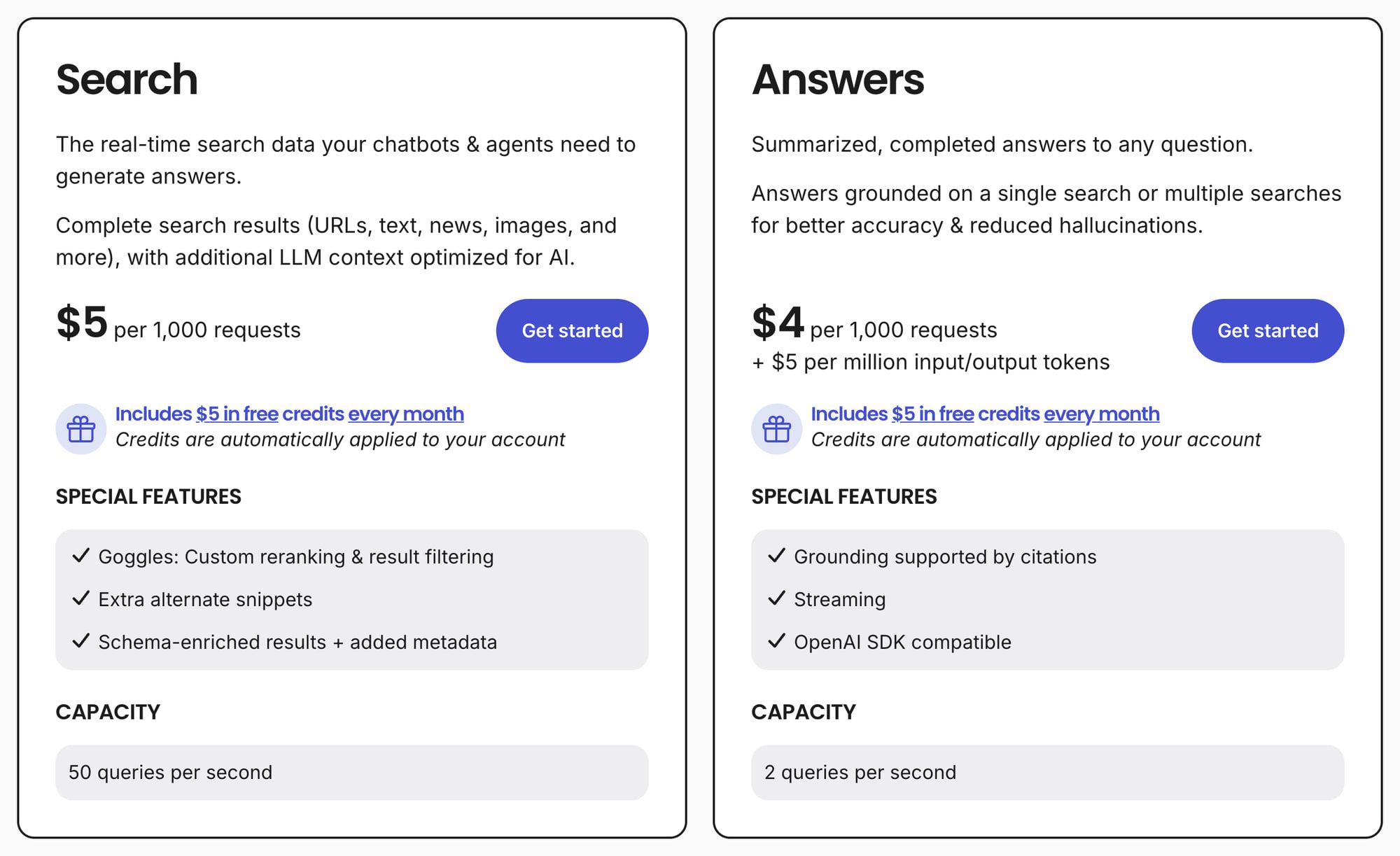
At $5 per 1,000 requests, the credit covers about 1,000 searches a month, at up to 50 queries a second. A web result has a title, URL, description and “up to 5 additional excerpts”, and Brave also lists a separate LLM Context endpoint.
Whether you must credit Brave depends on which page you read. Brave’s announcement says that to get the credit you must “attribute the Brave Search API in your project’s website / about pages”. Its terms, last updated 1 September 2026, say “Customer may provide attribution”, and the pricing page doesn’t mention it.
If you take the credit, I’d add the attribution anyway. It costs you one line on an about page and satisfies both readings.
What stands out
- $5 of credit every month, applied automatically
- Up to 50 queries a second on Search
- Each result can carry up to 5 extra snippets, and there's a separate LLM Context endpoint
What gives me pause
- A card is required, which Brave says is to prevent abuse
- The page's 'Up to $20' headline doesn't match the $5 listed per plan
- Transient storage only, unless your plan explicitly grants storage rights
- The terms bar using results to 'create, evaluate, train, re-train, fine-tune, benchmark' AI models or services
- Conflicting attribution rules between the announcement and the terms
Tavily #
Tavily’s docs say: “1,000 free API Credits every month. No credit card required.” A basic, fast or ultra-fast search costs 1 credit and an advanced search 2, and pay-as-you-go is $0.008 per credit, or $8 per 1K basic searches.
Free keys are development keys limited to 100 requests a minute, and production keys (1,000 a minute) need “an active Paid Plan or PAYGO enabled”, per the rate-limits page. Results carry snippets per URL, with parsed page content through include_raw_content and up to 20 results, per the search reference.
Its Keyless documentation also offers Search and Extract without an account or key through REST and MCP, using X-Tavily-Access-Mode: keyless. Numeric limits are unpublished; this is a separate route from a keyed account’s 1,000-credit allowance.
Tavily’s terms (§3.2(x)) restrict sharing performance analysis, so I cover it from its docs and pricing only. If you’re comparing it with other options, see my Tavily alternatives and Firecrawl vs Tavily.
Linkup #
Linkup’s pricing page says “Run 4,000 queries for free.” Its docs give the mechanics: a sign-up “with a professional email address” gets $20, and Linkup will “top up eligible accounts back to $20 each month”.
At $0.005 per standard search, $20 is 4,000 searches, so the two pages agree. The recurring top-up is conditional: I did not establish what makes an account eligible.
After eligible credit, standard search is $5 per 1K, or $6 with a sourced answer. Deep search is $0.05 per request and basic fetch $0.001, according to the linked pricing pages. Storage and commercial-use permissions remain unestablished in this pass.
You.com #
You.com’s pricing page advertises “$10 free credit = 2,000 searches” for the Web Search API, alongside 100 keyless daily MCP queries. Captures on 16 October differed between $10 and $100; on 31 October the page showed $10. The MCP documentation describes the free profile at ?profile=free, without account credentials, for you-search and you-discover. Whether the $10 credit is one-time, and its eligibility, expiry and card rules, are not stated on the pages I read.
The paid examples below exclude the API credit. The keyless 100 a day adds up to about 3,000 queries over 30 days if you use it every day.
The quickstart documents snippets by default, with highlights or full-page content through extraction. Live full-page retrieval adds $1 per 1K pages to base Search charges; Contents has its own $1-per-1K-page price. I did not establish its storage and commercial-use permissions in this pass.
Perplexity and Mojeek: no recurring free tier #
Perplexity’s pricing page, rechecked 31 October 2026, lists no free allowance: Search is $5 per 1K successful requests or $1 with Fast Search, with “no additional token-based charges”. Its Agent API web-search tool costs $2.50 per 1K standard invocations or $1 per 1K Fast invocations, plus model tokens; those are different billing units from Search API calls.
The migration guide now explicitly says Sonar Chat Completions support ended on 27 September 2026. It says synchronous and streaming calls keep working through gradual reformulation into Agent API requests, by model; asynchronous Sonar calls are unsupported and must move to background mode. I checked the documentation, not a live account or API response.
Mojeek runs its own index and lists Startup at £2 per 1K requests. Its FAQ now says you can “sign up to our Startup Plan and claim a free credit”, but a bank card is required to open an account and the page gives no credit amount. That is a sign-up credit, not a recurring free tier; do not budget it without confirmation.
Which crawl and browser APIs include free search? #
Firecrawl, Browserbase, Jina, Nimble and Diffbot all cover search in their free allowances, and so do two newer services, LangSearch and TinyFish. Some return page content with the result, which saves you a separate fetch step. If you already have the URLs and only need the text, my guide to crawl APIs that return page content for LLMs compares that step on its own.
Firecrawl #
Firecrawl offers 1,000 monthly free credits without a card. Base Search costs two credits per block of up to ten results, rounded up; scraping results and optional features add cost. That means 500 base searches of at most ten results each, not 500 search-and-fetch workflows. The free plan has two concurrent browsers and ten Search requests/minute.
Its Keyless launch post describes access without an API key. Current rate-limit docs distinguish supported clients: the hosted MCP exposes Search, Scrape and Parse; Interact is available through supported official clients. Daily IP request and credit caps return HTTP 429 when exhausted, but numeric limits are not published. The launch post likewise says keyless use is “capped per IP address each day” and resets daily, without numbers.
Monthly paid plans start at Hobby $19 for 5,000 credits and Standard $99 for 100,000. The billing guide sells manual top-ups in $5 increments: 1,000 credits on Hobby and 2,000 on Standard. The cost examples below use those monthly plans and top-ups, with no annual commitment. They exclude optional scraping and add-ons.
What stands out
- 1,000 monthly free credits without a card
- Keyless access through supported clients
- Optional scraping can retrieve content alongside search results, at extra cost
What gives me pause
- The free allowance covers 500 base searches of up to ten results
- Numeric daily keyless caps are not published
- The terms require express authorization for commercial use; confirm applicable permission
Browserbase Search #
Browserbase’s billing-plans documentation still lists $7 per 1,000 Search calls, while its current pricing and Search overview distinguish provider rates of $1/$5/$7. The examples here use the provider-specific schedule; the actual account tariff remains unverified.
Browserbase includes 1,000 monthly Search calls on Free and Developer. Developer costs $20/month, then defaults to Parallel Advanced at $5 per 1K additional calls. Provider selection changes the rate: Parallel Fast is $1 and Exa $7 per 1K. Search is limited to two requests/second per project.
My paid example includes the Developer fee and the default provider, without other usage.
Jina search #
Jina’s search endpoint, s.jina.ai, needs a key: search without one is blocked, per its Reader page, whose footer now carries an Elastic copyright. Each new key comes with 10M free tokens, once, and every search costs “a fixed number of tokens, starting from 10,000 tokens”.
That makes the free allowance at most about 1,000 searches (10M ÷ 10,000), by my math. Keys get 100 requests a minute. I could not establish the current paid token-pack tariff from its public pricing page, so I withhold exact paid prices and a normalized per-search rate.
If you’d use Jina for reading pages rather than searching, I cover Jina Reader’s token billing and licence next to Firecrawl’s.
Nimble and Diffbot #
Two data vendors have bigger monthly allowances. Nimble lists “5,000 free requests per month” with “No credit card required” and a Search API at $1.1 per 1K. Diffbot lists “10,000 credits / month”, no card and “5 requests / min”, with web search at 1 credit per search.
I didn’t read what either returns for a search or their data terms. Past the free credits, Diffbot’s cheapest plan is Startup at $299 a month for 250,000 credits, with overage at $0.001 per credit. At 5 requests a minute, Diffbot’s cap works out to 7,200 a day, so the rate limit isn’t what stops you.
LangSearch and TinyFish: check the allowance and contracting party #
LangSearch advertises zero API fees, five requests/second for new accounts and a daily web-search token allowance of unpublished size. It documents titles, links, snippets and full text, with up to 50 results. The daily token limits apply across keys and MCP use and reset at 00:00 UTC. Its terms and company page did not establish a contracting legal entity in my review; that is a research gap, not proof that none exists.
TinyFish lists free Search capped at 30 requests/minute and 500/hour. Search stays free even when the wallet is empty; the initial $8 wallet is for billed products, and adding funds has a $10 minimum. Its terms, effective 17 August 2026, identify Tiny Fish, Inc., a Delaware corporation. My earlier uncertainty about its operator was incorrect.
I have not confirmed Search authentication or data permissions, so assess those before sending sensitive queries.
Which LLM APIs include free web search? #
Among the three model APIs compared here, Gemini publishes free grounding allowances; OpenAI and Anthropic publish per-search charges. These are model tools, not interchangeable standalone Search APIs.
On the Gemini Developer API pricing page, Gemini 2.5 Flash and Flash-Lite share up to 500 grounded requests/day on the Free Tier. On the paid tier they share 1,500/day, then $35 per 1K grounded prompts, with model charges separate. Gemini 2.5 Pro has no Free-Tier grounding. Model quotas and availability still apply.
Gemini 3 and newer have no Free-Tier grounding. Their Paid Tier shares 5,000 search queries/month across applicable models, then charges $14 per 1K search queries plus model tokens, subject to a default cap of 1,500 requests a day. One prompt can trigger multiple search queries; 5,000 queries is not a promise of 5,000 model answers. These figures describe the Developer API channel, not every Google Cloud product.
The Gemini API terms are effective 23 March 2026. Display the required Search Suggestions with grounded results. Reuse and training restrictions have narrow storage exceptions for specified app display, evaluation and chat-history uses, potentially up to two years; do not turn that exception into a general caching licence. Review the unpaid-service data-use conditions before choosing the Free Tier.
- OpenAI: standard web search is $10 per 1K tool calls plus search-content tokens at model rates. Non-reasoning preview search is $25 per 1K, with search-content tokens free. No general free search allowance is published on that page.
- Anthropic: web search costs $10 per 1K searches plus standard tokens. Search errors are not billed and citations are always enabled. No general free allowance is listed; preserve citations when presenting answers.
- Perplexity Agent API: standard web-search invocations are $2.50 per 1K, or $1 per 1K with Fast, plus model tokens. These invocations differ from standalone Search API request billing.
I weigh built-in search against a separate API in the built-in search section of my agent search guide.
Can an agent get Google’s own results for free? #
Yes, in small amounts, but it’s a different kind of API. If your agent needs Google’s own ranking, you want a SERP API, and those have their own free tiers: Bright Data includes “5K records per month” with no card, and SerpApi 250 searches a month (50 an hour). apiserpent.com gives new users 10 free searches to evaluate it, per its terms, then a $10 minimum at $0.60 per 1K on Default for new credit (pricing, rechecked 3 November 2026).
Its current deposit tiers are Growth $0.30 after $100, Scale $0.10 after $500, Enterprise $0.05 after $1,000 and Enterprise Plus $0.03 after $1,250; existing credit keeps its old schedule. On 31 October 2026 the pricing page carried a “Prices to increase 10x after October 31” banner; on 3 November it was gone and only the top tiers had changed, so recheck before depositing. The 10 free calls are one allowance shared across eligible endpoints (Web Search, News, Images, Maps and others) and, per the terms, expire after 12 months of account inactivity. Deposited credit never expires, while promotional bonus credits expire 30 days after they’re granted. A Quick query can request up to 100 organic results for one Web unit, though its docs call that number “a ceiling you request, not a count we guarantee”; Deep charges one unit per page requested, up to 10, so one call is not necessarily one search credit.
The catch for agents is the output. A base SERP response represents the results page as structured links and snippets. Full page content needs a separate retrieval capability or optional endpoint; check whether that is included before comparing it with search-and-fetch products.
I list every paid rate in the cheapest SERP API breakdown.
Free self-hosted search: SearXNG and DuckDuckGo libraries #
SearXNG has no hosted API vendor fee. DuckDuckGo’s Instant Answer API is a separate, limited interface. Both depend on other search engines, which can block you.
SearXNG is an AGPL-3.0 metasearch engine. JSON output is off by default: formats defaults to html, you add json in the search settings, and the search API docs warn that “many public instances have these formats disabled”.
Plan on running your own instance. A SearXNG issue reported DuckDuckGo CAPTCHA responses in August 2026; it was closed as completed on 4 September 2026. It is one self-selected report, not a measured failure rate, and upstream engines can change again.
DuckDuckGo’s published Instant Answer API page source explains that this interface is not a full search-results API and does not confer rights to redistribute the complete results. It requires attribution.
The unofficial ddgs library is MIT-licensed metasearch software. Its package page labels it educational; that label does not grant upstream search-result rights or a service guarantee.
Self-hosting doesn’t remove the upstream engines’ terms, which still apply to the queries your server sends. My agent search guide covers self-hosting in more depth, including OpenSERP.
What’s the catch with free web search APIs? #
The allowance is the headline, and the conditions sit on other pages: a card on file, burst rate limits, attribution rules, commercial-use limits, and storage and AI-use clauses. These are the ones that changed my picks.

Free tiers and your data: storage and AI-use clauses
Brave’s API terms limit storage to transient use unless the applicable order grants more rights. They restrict training, evaluation and benchmarking of AI models or services using results. A marketing capability is not contractual permission.
Exa’s terms contain broad reuse restrictions in §4.2, with contractual and written-permission exceptions. Its §1.2 input/output licence concerns the Search Engine; I would not apply that clause automatically to every API payload. Check the agreement governing your API use.
Tavily’s terms, §6.5, permit certain training uses of input submitted to AI Functionality and its output. That scope does not establish the handling of every ordinary Search query. Gemini’s terms have grounding-use restrictions with specific storage exceptions. Mojeek’s API FAQ limits Startup result storage to one hour; Business and Enterprise have different rights.
- A card on file: Brave requires one for its credit; applicable Gemini paid-tier allowances require billing. Parallel’s promotion eligibility needs confirmation.
- Burst limits: Diffbot permits five requests/minute, Browserbase Search two/second per project, Firecrawl Free Search ten/minute and Tavily development keys 100/minute. Their sources appear in the vendor sections.
- Attribution and display: Brave’s announcement and terms differ; DuckDuckGo’s limited interface requires attribution. Preserve model citations and Gemini Search Suggestions.
- Commercial permission: Firecrawl’s terms restrict commercial use except where expressly authorized. Confirm the applicable authorization and data rights; a free price does not settle either.
When should you move off the free tier? #
Choose a paid plan when the recurring quota no longer covers your permitted workload. Compare the selected search mode, included results, content retrieval, plan fee and promotion eligibility before treating a free-tier calculation as a bill.
| Option (paid rate per 1K) | 1K a month | 10K a month | 100K a month | What's assumed |
|---|---|---|---|---|
| Parallel Fast/Turbo ($1) | $0 if eligible | $5; $0 if both offers stack | $95; $90 if both offers stack | 5K request offer retained; second figure also applies the $5 credit, which Parallel's article equates with up to 5K Fast searches, so stacking is doubtful. Gross: $1/$10/$100 |
| Nimble ($1.10) | $0 on Free | $11 gross; $5.50 if allowance retained | $110 gross; $104.50 if retained | 5K free/paid stacking not established |
| Perplexity Search Fast ($1) | $1 | $10 | $100 | Successful Search API requests; not Agent tool invocations |
| Linkup standard ($5) | $0 if eligible; $5 gross | $30 if eligible; $50 gross | $480 if eligible; $500 gross | $20 monthly credit requires eligible account |
| Brave Search ($5) | $0 | $45 | $495 | $5 monthly credit; card required; base Search only |
| You.com Search ($5) | $0 via free MCP if spread over days | $50 | $500 | Paid columns are gross API calls; $10 API credit (2,000 calls) not applied because its recurrence and eligibility are unstated |
| Exa Lite ($4) | $0 | $30 | $390 | $10 recurring credit; base results only, contents and extras excluded |
| Browserbase default Search ($5) | $0 on Free | $65 | $515 | $20 Developer plus 9K/99K overage, Parallel Advanced; no other usage |
| Gemini 3+ grounding ($14) | $0 search component | $70 | $1,330 | Paid Developer API; shared 5K search-query allowance; model tokens extra. 100K exceeds the default 1,500/day cap (about 45K in 30 days) unless raised |
| Tavily basic PAYG ($8) | $0 on Free | $80 gross; $72 if free credits retained | $800 gross; $792 if retained | One-credit search; stacking unconfirmed; subscriptions can cost less, including Growth $500/100K credits |
| Firecrawl monthly plans + top-ups | $19 | $94 | $349 | Hobby $19 + $0/$75 top-ups; Standard $99 + $250 top-ups at 100K. Two credits/search, up to 10 results, no scraping |
| OpenAI or Anthropic standard ($10) | $10 | $100 | $1,000 | Search component only; model/content tokens extra; different response contracts |
Source: My arithmetic from cited prices checked 31 Oct 2026, not observed invoices or guaranteed cheapest configurations. Conditional net totals are separated from gross charges; no assumed universal free/paid stacking. Taxes and optional extras excluded. Scroll sideways for more columns.
The table is a set of configured examples, not a quality ranking or a universal minimum-cost result. Diffbot’s published free quota can cover 10K one-credit searches, while Parallel’s zero-dollar 10K scenario depends on promotion stacking that I have not confirmed.
If I were building something that will pass 10K searches a month, I’d choose the vendor for its paid rate and its storage terms now, and treat the free tier as a trial.
Which free web search API should you pick? #
Pick by what you’re building: a keyless route for an MCP tool, a tier that returns page text for RAG, and the lowest paid rate for anything with users.
- A local LLM hobby project: SearXNG if you already run a home server and can live with engines blocking you. If not, Exa’s no-card $10 a month renews on its own, and You.com’s 100 keyless queries a day need no account set-up at all.
- An MCP tool for a coding agent: Parallel Search MCP, Firecrawl Keyless or Tavily Keyless need no key. Numeric caps are unpublished; add a key (Parallel’s 5,000 requests a month, or Firecrawl’s 1,000 credits) once you start seeing refusals such as Firecrawl’s
429. - A RAG prototype: you need page text, not just links. Exa (full text via contents), Firecrawl (search plus scrape) and You.com (extraction) all return it; You.com’s $10 API credit has unstated eligibility, and content extraction has its own cost.
- A startup MVP with users: pick on the paid rate and the terms. Parallel Fast/Turbo ($1 per 1K) and Nimble ($1.10) have low published base rates, but verify promotion eligibility and the response you need. Confirm storage and reuse rights before caching results. LangSearch’s contracting entity remains unestablished here; TinyFish’s terms do identify its operator.
The refresh policy is to review pricing at least every 90 days and when a vendor change is identified; that is an editorial schedule, not evidence of continuous monitoring. How I gather and check these facts is on my methodology page.
FAQ
Which AI API is totally free?
None of these search options promises unlimited free use. Checked 31 October 2026: Diffbot lists 10,000 monthly credits at one per search, Parallel advertises 5,000 requests and a separate $5 credit promotion, and Nimble lists 5,000 monthly requests. Whether Parallel's promotions stack is not established here. Exa's $10 monthly credit covers 2,500 Lite searches or about 1,428 Auto searches before optional charges.
Firecrawl Keyless, Parallel Search MCP, Tavily Keyless and You.com's free MCP profile need no API key. You.com publishes 100 daily queries; the other two numeric caps are not published. SearXNG has no licence fee but needs a server. Gemini's free allowances depend on model and billing tier.
Is Tavily free to use?
Tavily offers 1,000 monthly API credits with no card. Basic, fast and ultra-fast search use one credit each; advanced uses two. Development keys allow 100 requests a minute. PAYG costs $0.008 per credit, checked 31 October 2026; I have not confirmed whether a paying account also retains the free allowance.
Is the Tavily API key free?
Yes. A development key includes the free monthly allowance. Production keys allow 1,000 requests a minute and require an active paid plan or enabled PAYGO, according to Tavily's rate-limit documentation.
Is there a free web search API without an API key?
Yes: Firecrawl Keyless, Parallel Search MCP, Tavily Keyless and You.com's free MCP profile. You.com permits 100 daily queries without an account or key. Firecrawl describes daily IP-based request and credit caps without numeric values; Parallel and Tavily publish no numeric anonymous-search cap.
Is SERP API free to use?
SerpApi lists 250 monthly free searches and Bright Data lists 5,000 monthly records, checked 31 October 2026. These are separate providers. apiserpent.com also offers ten introductory eligible searches, with its own inactivity rules. See the Google-results section for sources and distinctions.
What is the most accurate web search API for LLMs?
I have not measured relevance and do not rank these providers on accuracy. This comparison checks published allowances, billing units and terms. Evaluate permitted candidates against your own dated query set before choosing on quality; a larger free allowance does not establish better answers.
Sources
56 sources, accessed to .
Official pricing, docs, changelogs and status pages 51
- Parallel pricing
- Parallel docs: Search MCP
- Parallel docs: Search quickstart
- Exa pricing
- Exa docs: billing and limits
- Exa docs: search reference
- Exa terms of service
- Brave Search API plans and pricing
- Brave blog: new Search API plans
- Brave Search API terms of service (last updated 1 Sep 2026)
- Brave Search API docs: web search
- Tavily docs: API credits
- Tavily docs: search endpoint
- Tavily docs: billing and limits
- Tavily terms of service (last updated 4 May 2026)
- Linkup pricing
- Linkup docs: pricing and free credit
- You.com API pricing
- You.com docs: MCP server and keyless access
- Perplexity API pricing
- Perplexity docs: migrate from Sonar to the Agent API
- Mojeek web search API
- Firecrawl pricing
- Firecrawl docs: rate limits and keyless caps
- Firecrawl blog: Keyless launch (16 Jun 2026)
- Firecrawl terms of service
- Browserbase pricing
- Jina Reader and search (s.jina.ai)
- Jina API dashboard
- Jina API pricing (token packs)
- Nimble pricing
- Diffbot pricing
- LangSearch home and free plan
- LangSearch terms of service
- TinyFish pricing
- Gemini API pricing
- Gemini API additional terms of service (effective 23 Mar 2026)
- OpenAI API pricing
- Anthropic docs: web search tool
- SerpApi pricing
- Bright Data SERP API pricing
- apiserpent.com (SerpentAPI) terms of service (last updated 31 Oct 2026)
- apiserpent.com (SerpentAPI) pricing
- SearXNG docs: search API
- SearXNG docs: search settings (formats)
- Firecrawl billing and credit top-ups
- TinyFish terms (effective 17 Aug 2026)
- LangSearch company page
- Tavily docs: keyless Search and Extract
- You.com quickstart and extraction billing
- Browserbase plans: conflicting flat Search overage