Alternatives
Tavily Alternatives: Cheaper and Open Options (2026)
Tavily alternatives by job: AI search, Google SERP APIs and self-hosting. Current prices, free-offer eligibility, billing units and data-contract limits.

You use Tavily for agent or RAG search, or you’re about to, and something has you looking around: the bill at your volume, the Nebius acquisition, the data terms, or a job Tavily isn’t built for. The right alternative depends on that job, so I grouped the options by job and priced each at 1K, 100K and 1M searches a month next to Tavily’s list price.
The data-terms section distinguishes public licences from account-specific contract rights, with unread scopes marked explicitly. It’s part of my wider guide to web search APIs for AI agents.
Short on time?
My quick picks, by the job you need done
- Low-cost AI search mode
- Parallel (Fast or Turbo)
- $1 per 1K requests with ten results. It advertises up to 5K free monthly requests; other credits are not assumed additive. Standard terms permit training on Customer IP and restrict reusing outputs.
- Search plus full page content
- Exa
- $4/1K Lite (or legacy Instant) or $7/1K Auto (or legacy Fast), with text/highlights for ten results. Firecrawl offers different scrape formats; its credit cost rises when each result is scraped.
- Google SERPs at low unit prices
- apiserpent.com (SerpentAPI)
- $0.60 per 1K on Default, $0.30 after $100, $0.10 after $500, $0.05 after $1,000 and $0.03 after $1,250. SERP JSON only; no public SLA. New-credit pricing rechecked 3 Nov 2026; deposits and per-page units matter.
- Google's results with legal cover
- SearchApi
- $2.50 per 1K at 100K a month, conditional $2M aggregate legal cover per 12 months on active Production+, and a stated 99.9% SLA.
- Best open-source option
- SearXNG
- AGPL-3.0 metasearch you host yourself. No vendor bill, but no index of its own, and you handle upstream blocks.
- Documented free offers
- Parallel or Nimble (5,000 a month)
- Nimble lists 5K free requests/month; Parallel advertises up to 5K, with credit/eligibility rules to confirm. Tavily also documents keyless Search/Extract.
Prices verified . Current public prices and terms reviewed 31 Oct 2026. No API or account tests, no performance winner. Selected price scenarios are not an exhaustive optimization of every contract or optional add-on.
Why do people look beyond Tavily? #
Mostly for four reasons: cost at volume, a change of owner, data terms, or a job that needs something Tavily doesn’t sell, such as Google’s own results or self-hosting. None of these says anything about Tavily’s results, and I don’t make claims about those here (see the note below).
A new owner #
Nebius’s Q1 2026 filing records its acquisition of 100% of Tavily on 19 February 2026. Tavily’s terms name AlphaAI Technologies Inc. dba Tavily. I do not treat acquisition or fundraising as service-quality evidence.
Cost per search #
Basic, fast and ultra-fast searches cost one credit and advanced two, per Tavily’s docs. At the $0.008 pay-as-you-go rate that’s $8 per 1K basic searches and $16 per 1K advanced; on the $500 Growth plan (100,000 credits) the rate falls to $0.005 per credit, or $5 per 1K basic searches.
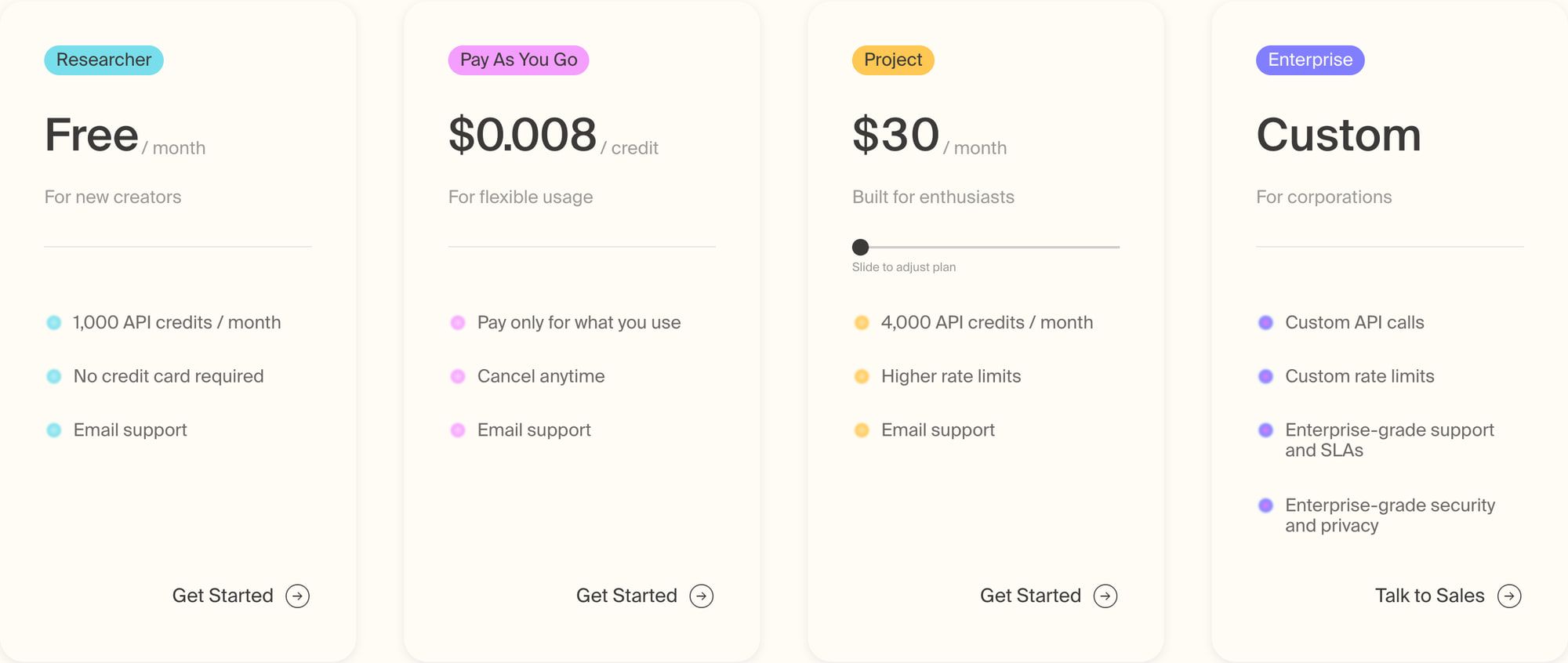
Automatic depth selection can choose advanced and double search credits; the Search reference documents that behavior.
Several alternatives list $1 to $5 per 1K, and Google SERP APIs go far lower. Whether that saving is worth a switch depends on what you give up, which the rest of this page sets out.
Data terms #
Tavily’s terms, §6.5, permit AI-input/output training and improvement use, while §9.2 grants a broad input licence. Its privacy policy permits some query-improvement use unless a contract overrides it, and describes limited query sharing with third-party index providers.
That does not establish a negotiated account’s rights. The data-terms table separates public terms from customer-contract scope. I removed old community quotes and search-result ranking claims, rather than presenting them as current evidence.
Tavily alternatives compared #
Tavily is the baseline. These are selected gross list-price scenarios per 1,000 requests at each volume, before free offers, tax, model tokens or optional features. Valyu’s retrieval unit cannot be normalized to a query without assumptions.
| Option | Output / scenario | Per 1K at 1K/month | Per 1K at 100K/month | Per 1K at 1M/month | Free offer / qualification |
|---|---|---|---|---|---|
| Tavily Baseline | Basic/fast/ultra-fast; advanced doubles credits | $8 | $5 | $7.70 | 1K credits/month; keyless Search/Extract separately rate-limited |
| Exa | Lite-Instant / Auto-Fast, ≤10 results with text/highlights | $4 / $7 | $4 / $7 | $4 / $7 | First team $10/month + $10 once after onboarding |
| Brave | Search; separate paid Answers | $5 | $5 | $5 | $5/month with card |
| Parallel | Fast/Turbo / Basic-Advanced, ten results | $1 / $5 | $1 / $5 | $1 / $5 | Up to 5K/month advertised; credits not assumed additive |
| Linkup | Flash/fast/standard results / sourced answer | $5 / $6 | $5 / $6 | $5 / $6 | Eligible professional-email accounts topped back to $20/month |
| You.com | Standard REST Web Search | $5 | $5 | $5 | 100/day via keyless MCP, not unrestricted REST |
| Perplexity | Successful Search request, up to five queries; Fast / standard | $1 / $5 | $1 / $5 | $1 / $5 | No recurring free Search grant established |
| Valyu | Per retrieval by source; not per query | Not listed | Not listed | Not listed | $10 initial / $20 work-email offer; plan/catalog eligibility |
| Firecrawl | Ten basic pages scraped per search; selected annual plans | $51 | $7.99 | $11.599 | 1K monthly credits: ≤83 such calls or 500 search-only |
| Nimble | Listed Search entry; do not assume deep mode has same tariff | $1.10 | $1.10 | $1.10 | 5K/month advertised |
| Jina | Token-billed search; no fixed query cost | Not listed | Not listed | Not listed | 10M initial tokens; number of searches depends on tokens |
| apiserpent.com | One-page Web units; selected Default/Growth/Scale | $0.60 | $0.30 | $0.10 | 10 initial calls; $10 minimum deposit; tier deposits $100/$500/$1K |
| Serper | One-page credits, pack amortization within six months | $8.33 | $0.75 | $0.50 | 2.5K initial; prepaid cash purchase required |
| DataForSEO | Google organic standard queue / live | $0.60 / $2 | $0.60 / $2 | $0.60 / $2 | $1 trial; $50 deposit |
| SearchApi | Chosen monthly Developer / BigData / Octo1M | $40 | $2.50 | $1.50 | 100 initial requests |
| SerpApi | Best Effort Starter / Searcher / Cloud 1M | $25 | $7.25 | $3.75 | 250/month; optional speed/add-ons excluded |
| SearXNG | Self-hosted upstream metasearch | $0 + operations | $0 + operations | $0 + operations | AGPL-3.0 software; hosting/engine restrictions apply |
Source: Current official prices/docs, 31 Oct 2026. Tavily 1M: Growth $500 + 900K×$0.008 (Tavily's credits docs apply the PAYG rate once a plan's limit is reached). Firecrawl selected annual Hobby $16/5K + 1K/$5 top-ups, Scale $599/1M + 5K/$5 top-ups; twelve base credits per ten-page call. Annual equivalents are not first-month cash prices. apiserpent selected deposits are not the lowest possible unit rate; $1K Enterprise lowers Web units to $0.05/1K and $1,250 Enterprise Plus to $0.03/1K (apiserpent rates rechecked 3 Nov 2026). Serper 1K uses a $50 minimum pack over six months, so $50 is paid upfront. These different outputs, modes and commitments are not measured equivalents. Scroll sideways for more columns.
How I cover Tavily
Tavily’s terms, §3.2(x), restrict third-party performance disclosures. Parallel’s customer terms restricted sharing benchmarks/evaluations without consent when I read them on 27 Sep 2026; the version I read on 31 Oct 2026 no longer contains that clause. I compare documents, with no performance figures for any vendor and no API calls.
Which AI search APIs are the closest swap for Tavily? #
Exa, Brave, Parallel, Linkup, You.com, Perplexity and Valyu work the way Tavily does: you send a query, you get ranked results ready for a model, and most add an endpoint for page text or answers. Modes, output and units differ: Perplexity bills successful requests, Exa by search type and Valyu by source retrieval. Their free offers also have different eligibility rules.
The hub has a shorter take on picking an AI search API if you haven’t settled on this route yet.
Exa #
Exa is my pick to evaluate when an agent needs page text with search: Lite is $4/1K and Auto $7/1K, up to ten results. Exa’s changelog added the cache-only Lite type on 19 Oct 2026 and made Instant ($4) and Fast ($7) legacy types at unchanged prices; Lite accepts fewer parameters and has no AI summaries. The current Contents guide explicitly includes text/highlights for those results. AI summaries and results beyond ten add cost; standalone Contents is $1/1K pages per content type. These are documented features, not a quality result.
The billing guide limits the recurring $10 grant to a user’s first team, reset to $10 on the calendar first without carryover. Onboarding adds a separate one-time $10 bonus that never expires. $10 covers up to 2,500 Lite/Instant or about 1,428 Auto/Fast base calls before extras.
Answer is $5/1K, Deep-lite/Deep $12, legacy Deep-reasoning $15 and Monitors $15. Agent fixed efforts are $0.012–$1/run; auto/ultra add metered compute, search tools and optional enrichment/Connect charges. Enterprise ZDR is per-team for Search, Contents, Agent and Answer; Websets is unsupported. See Exa vs Tavily for contract scope.
What stands out
- Text/highlights for ten results included in Search
- First eligible team receives monthly and onboarding credit
- Published dollar rates and Enterprise ZDR endpoint scope
What gives me pause
- Extra results and AI summaries add charges
- Lite/Instant and Auto/Fast are different modes, not proven quality equivalents
- Business-customer contracts govern processor data; public policies do not establish your account rights
Brave Search API #
Brave’s pricing lists Search at $5/1K, $5 in monthly credits and a card requirement; the Search plan states up to 50 QPS. Answers has separate search/token charges and its own $5 monthly credit. The same page’s banner says “Up to $20 in free calls every month” without explaining how that relates to the $5 plan credits, so I use $5 for Search. I have not verified an account’s grant or throughput.
Its API terms restrict persistent result storage beyond transient operational use unless separately permitted, and restrict using results to train/evaluate/benchmark AI models or services. Those are customer-use restrictions, not a guarantee about every enterprise agreement. Check the plan/order form for any storage or data-processing rights.
Parallel #
Parallel’s pricing lists Fast/Turbo at $1/1K requests, Basic/Advanced at $5, each with ten results; Extract is $1/1K results. It advertises up to 5K free requests/month alongside $5 monthly credit and signup bonuses. I do not add those offers together or guarantee which APIs/account qualify.
Its Search MCP documents keyless access. The customer terms permit training with Customer IP and restrict caching/reusing outputs across customers or for data-selling/training products. A benchmark/evaluation-sharing restriction I read on 27 Sep 2026 is absent from the undated version I read on 31 Oct 2026; confirm the version you sign. Low unit prices do not establish suitable reuse rights.
Linkup #
Linkup’s current pricing docs distinguish depth and output: flash/fast/standard searchResults $0.005/call; sourcedAnswer or structured $0.006. Deep is $0.05/results or $0.055/answer/structured. Requests using x402 have a separate $0.01 minimum, so these keyed rates are not universal.
Professional-email signup gets $20, and eligible accounts are topped back up to $20 monthly; that is not a promise for every address. Errors and no-relevant-result calls are not deducted. Enterprise pricing advertises ZDR; its standard terms permit training/improvement with Client Data, including prompts, and give specific terms precedence. Confirm your agreement rather than treating a pricing card as activated ZDR.
You.com #
You.com’s current pricing makes 100 daily free Web Search queries available through keyless MCP, without account/card. Standard REST Search costs $5/1K calls; Contents bills $1/1K returned pages. On 31 Oct 2026 the page listed a separate “$10 free credit = 2,000 searches”; 16 Oct public captures had disagreed ($10 versus $100). Eligibility remains unverified, and the paid examples exclude that grant.
Enterprise advertises ZDR and a customer agreement. The old general website terms do not establish all API data rights; I have not verified a private MSA or activated account settings.
Perplexity Search API #
Perplexity’s Search pricing is $5/1K successful standard requests or $1/1K Fast requests. One successful POST /search containing up to five queries is one billing unit, including successful empty results. Invalid, rate-limited and upstream-failure requests are not billed, and the page states there are no additional token-based charges for Search. Agent tool invocations and model tokens use separate tariffs; no recurring free Search grant was established.
Its migration guide records Sonar support ending 27 September 2026. Synchronous/streaming requests are gradually reformulated into Agent calls; async Sonar is unsupported and requires background migration. That is a documentation report, not tested continuity. I could not verify API-contract data rights from the public terms response.
Valyu #
Valyu’s current pricing docs bill retrievals in credits, not a flat query: per 1,000 results, 50 credits for open databases such as arXiv/PubMed, 100 for web/news, 960 for stock prices, 1,920 for SEC filings and 4,800 for Wiley publications. Pay-as-you-go top-ups buy 1,600 credits per $10, so ten web results use one credit, about $0.006 at that rate before plan bonuses; one query is not automatically one retrieval.
The same page offers $10 of free credits ($20 with a company email), expiring 12 months after signup, and $29–$499 monthly plans with source-family eligibility. Its Search reference does not state the unit of max_price, so I withhold query-normalized totals rather than translating it into a token or request price. Plan credit discounts, source selection and response cost reporting require separate verification.
Is a Google SERP API a cheaper Tavily alternative? #
Some selected SERP scenarios are cheaper: at 100K one-page calls, apiserpent Growth uses $30 of Web units after a $100 deposit, while SearchApi’s monthly BigData plan is $250 and Tavily Growth $500. Different deposits and tiers change the result. The catch is what comes back.
These APIs return Google’s results page as JSON: titles, links, snippets and SERP features such as AI Overviews or People Also Ask, but base SERP JSON is not full-page extraction. Some vendors sell separate extraction products; compare the whole workflow rather than assuming those are included.
The payoff is price and Google’s own ranking. My hub explains when a Google SERP API is the right choice, and my cheapest SERP API comparison prices more than 20 of them the same way.
apiserpent.com (SerpentAPI) #
apiserpent.com (SerpentAPI, distinct from serpentapi.com) has new-credit Web rates of $0.60/1K Default, $0.30 after one qualifying $100 deposit, $0.10 after $500, $0.05 after $1K and $0.03 after $1,250 (Enterprise Plus). Minimum deposit is $10. Larger tiers mean more cash prepaid; existing credit retains its original schedule, so a new tier does not reprice old balances. On 31 Oct 2026 the pricing page carried a banner reading “Prices to increase 10x after October 31”; when I checked it on 3 Nov 2026 the banner was gone and only the top tiers had changed. The figures here are the rates shown on 3 November, so recheck them before you deposit.
The FAQ describes five engines at the Web-unit rate and AI Overviews on eligible paid Deep calls with opt-in. Quick bills one Web unit/call; Deep bills requested pages up to ten, regardless of how many results actually appear. Purchased credit does not expire, promotional bonuses expire after 30 days, and the 12-month inactivity rule only concerns unused free calls. Refund/chargeback and credit exceptions apply.
AI Mode adds $0.004/call plus requested-page Web units; I did not verify Google-UI answer provenance. The FAQ and docs now agree on a daily allowance of at least 10,000 requests per account, or 100,000 after $500 of verified net deposits; concurrency and minute/hour limits follow the live credit balance and are published as “up to” figures. Low nominal unit prices alone do not establish a working production connection.
The terms and FAQ describe no public PAYG SLA or provider scraping indemnity, customer indemnity, generally non-refundable purchased credit and Indian-law AS IS service. The FAQ distinguishes nonretention of ordinary SERP payloads from seven-day async job results and limited query logging. I have no independent account, field-coverage or performance proof; no SDK/MCP integration was verified from the docs.
What stands out
- Low documented new-credit Web rates, with no subscription
- Purchased credit does not expire
- Five engines and eligible paid Deep AI Overviews documented
What gives me pause
- Low tiers require $100/$500/$1K/$1,250 qualifying single deposits
- No public PAYG SLA/provider scraping indemnity verified
- Deep bills requested pages; 10K/day allowance until $500 of net deposits; AI Mode provenance needs account verification
- Top-tier pricing changed between 31 Oct and 3 Nov 2026 without a stated effective date
- Promotional bonus expiry differs from purchased credit
SearchApi #
SearchApi runs monthly plans from Developer ($40 for 10,000 searches) to BigData ($250 for 100,000) and Octo 1M ($1,500), per its pricing page. From the $100 Production plan it offers conditional collection cover of up to $2M aggregate per twelve months, and it states a 99.9% SLA on all plans; the sign-up offer is 100 free requests.
That makes it the pick if you need Google’s results and written cover. Its terms exclude downstream use/storage/redistribution and impose eligibility/notification conditions. My SerpApi alternatives comparison discusses both contracts.
Serper, DataForSEO, SerpApi and Bright Data #
- Serper: 2,500 free searches with no card, then prepaid packs from $50 for 50,000 ($1.00 per 1K) down to $3,750 for 12.5 million ($0.30 per 1K); “Credits valid for 6 months” (homepage). These are prepaid packs, not recurring free credit; expiry applies even if capacity is unused.
- DataForSEO: $0.60 per 1K on its standard queue (about five minutes, per its page), $1.20 priority and $2.00 live (pricing), after a $50 minimum payment; new users get $1 for testing (help centre). That suits batch jobs better than an agent waiting on an answer.
- SerpApi: 250 free searches a month, selected Best Effort monthly plans include $25/1K, $725/100K and $3,750/1M; the full 62-plan configuration extends to $106,050/54M (pricing), with conditional US-law/US-court collection cover up to $2M from Production+ (Legal Shield). My Serper vs SerpApi comparison goes deeper on those two.
- Bright Data: 5,000 free requests a month, then $1.50/1K PAYG. The Scale card shows $499/month for 380K plus $1.30/1K, so 1M gross calls cost $499+620×$1.30=$1,305, or $1.305/1K (pricing, verified 31 Oct 2026). On 16 Oct the slider also showed $999/900K+$1.10 and $1,999/2M+$1.00, which would make 1M $1,109; those stops did not appear in my 31 Oct read, so check the slider before budgeting.
The cited procedural order is not a merits decision: the court vacated the planned 13 Oct hearing on 5 Oct; ECF 60 allows a replacement hearing date or a decision on the papers. On 3 Nov 2026 the public docket feed listed no entry after ECF 61 (12 Oct) and no ruling; I have not reviewed the full PACER record. This is document research, not legal advice.
The hub summarizes the legal question.
Which crawl vendors also search? #
Firecrawl, Jina, Nimble and Browserbase document search products. Scraping, content modes and billing are separate choices; a public entry price does not cover every one. That’s the job Tavily’s include_raw_content and Extract cover; among the AI search APIs, Exa does it too.
Firecrawl search #
Firecrawl charges 2 credits per 10 search results, and its Keyless launch post describes search as “live results with full-page content”. Page content isn’t free, though: its search docs say that with scrapeOptions “the standard scraping costs apply to each search result”, so a search scraping ten basic pages uses 12 base credits. JSON, Question and Highlight formats add four credits/page (billing docs); other advanced options also change consumption.
The free plan is 1,000 credits a month with no card (about 83 such searches, or 500 without page content). Keyless lets you search, scrape and interact with no API key at all, across its MCP server, CLI and API; it is free but “capped per IP address each day” rather than given a credit allotment, and neither the post nor the billing docs publishes the number.
On annual-billed plans (pricing), 100K searches with all 10 results scraped (1.2M credits) cost $799 on Scale plus pay-as-you-go top-ups, or $7.99 per 1K, and 1M (12M credits) about $11,599, or $11.599 per 1K, using the selected 1M-credit Scale plan plus top-ups. Without page content, 100K searches (200K credits) fit the $333 Growth plan and 1M cost about $1,599. My Firecrawl pricing breakdown explains the credit maths.
On these selected basic-scrape scenarios, Firecrawl costs more than Exa Lite/Instant or Auto/Fast base search. Formats, extraction and render behavior differ; JSON extraction is not included in the twelve-credit example. Firecrawl is scrape-and-crawl-first, which is why my Firecrawl vs Tavily comparison treats them as tools for different jobs.
Its terms, §8.d, grant rights over user-posted content and feedback; I do not infer that this is a universal licence over every target site’s pages. Third-party data terms and enterprise agreements can add separate conditions.
Jina, Nimble and Browserbase #
Browserbase’s billing-plans documentation still lists $7 per 1,000 Search calls, while its current pricing and Search overview distinguish provider rates of $1/$5/$7/$12. The examples here use the provider-specific schedule; the actual account tariff remains unverified.
- Jina (
s.jina.ai): each search costs “a fixed number of tokens, starting from 10,000 tokens”, and each new API key gets 10M free tokens, or about 1,000 searches at the minimum (Reader page); the pricing page labels that free package non-commercial. Search needs a key, and paid tokens cost $50 for 1B, or $0.050 per 1M (pricing page, verified 31 Oct 2026); because a search’s token count isn’t fixed, I don’t publish a per-1K figure. For Reader itself, see how Jina’s token billing compares with Firecrawl. - Nimble: Search’s visible entry rate is $1.10/1K with 5K free monthly requests. The site lists Lite/Standard and deep content options; I did not establish that every mode costs the entry rate (pricing).
- Browserbase Search: 1,000 Search calls are included on listed Free/Developer/Startup plans; paid overage is $1/1K Parallel Fast, $5/1K Parallel Advanced (default), $7/1K Exa Fast or $12/1K Exa Deep. Paid plans themselves start at $20/month, so overage is not the whole bill (pricing, verified 31 Oct 2026).
For crawling at scale rather than search, see my crawl API comparison, or, if you’re already on Firecrawl, my Firecrawl alternatives for crawling whole sites.
Are there open-source, self-hosted Tavily alternatives? #
Yes: SearXNG (AGPL-3.0) and OpenSERP (MIT) let you run search yourself with no vendor bill. The software is free; the server, upkeep and blocks from upstream engines are not.

SearXNG #
SearXNG is AGPL-3.0 metasearch that “aggregates results from various search services”, so it has no index of its own. I did not use a star count or repository-update date as service-quality evidence.
For a JSON client you need that format enabled: its docs say “Requesting an unset format will return a 403 Forbidden error” and “many public instances have these formats disabled”, so plan on running your own. Upstream engines may block requests; I did not establish a current success rate or quote old issues as present behavior.
What stands out
- Free, open-source software (AGPL-3.0) under active development
- No vendor account; results land on your own server
- Merges several engines behind one API
What gives me pause
- No index of its own; it depends on upstream engines that can block it
- JSON output must be enabled, and many public instances disable it
- Links and snippets only, no page text
- Hosting cost unknown; you run and fix it yourself
OpenSERP #
OpenSERP (MIT) describes itself as “Self-hosted web search for AI agents and SEO”, rendering Google, Bing, Yandex, Baidu, DuckDuckGo and Ecosia in a real browser and returning ranked results and page Markdown over API, CLI and MCP. Its hosted Cloud option listed $0.009 per credit on 31 Oct 2026, with web search using one credit per ten result positions and 60 one-time starter credits.
My hub covers what self-hosted search really costs, including hosting and upstream-engine constraints.
Which alternatives have an official MCP server? #
These current official entry points document integrations; I did not connect them or call a tool:
- Tavily: keyless REST/MCP Search and Extract, with the required
X-Tavily-Access-Mode: keylessheader. Numeric caps are unpublished; Crawl/Map/Research still need a key. - Exa: official MCP guide.
- Parallel: keyless Search MCP.
- You.com: MCP configuration; pricing scopes the 100 daily free queries to MCP.
- Nimble: official MCP guide, replacing the older “not found” entry.
- Brave, Firecrawl, Jina, SerpApi and DataForSEO: vendor-owned MCP repositories are linked in the source list. Repository existence does not prove authentication, entitlement or a working connection here.
I did not establish a current official MCP integration for every remaining vendor. That is a research gap, not proof the feature does not exist.
What do their data terms say? #
I compare the documents’ scopes rather than treating every licence as a promise about every account. Negotiated customer terms can override public defaults.
| Vendor | Documented issue | What remains account-specific |
|---|---|---|
| Tavily | AI Functionality training clause; broad input licence; limited third-party index sharing | FAQ ZDR scope and any negotiated override |
| Exa | Public privacy policy permits training but excludes business processor data; Search Engine terms have input/output licence | Enterprise per-team ZDR activation for Search/Contents/Agent/Answer; Websets unsupported |
| Brave | Transient storage default; customer result-training/evaluation restrictions | Order-form storage, processing and enterprise rights |
| Parallel | Customer IP training licence; cross-customer output/reuse restrictions; evaluation-sharing clause seen 27 Sep absent on 31 Oct | Specific order/DPA and the terms version you sign |
| Linkup | Client Data training licence; specific terms take precedence | Eligible monthly grant, Enterprise ZDR and agreed data rights |
| You.com | Current pricing links enterprise agreements and ZDR | API MSA/DPA and activated retention settings not reviewed |
| Firecrawl | User-posted-content/feedback licence and provider-specific data terms | Target-data rights and applicable enterprise contract |
| apiserpent.com | Ordinary SERP payloads vs seven-day async results and limited query logs | Actual account retention/limits; no blanket ZDR assertion |
| Other vendors | No complete account-level data-contract review here | Do not assume a price card grants storage/training/redistribution rights |
| Self-hosting | Your server still sends queries to upstream engines | Software licence, engine policies and your own logging/security |
Source: Current official terms/privacy/retention sources, read 31 Oct 2026: Tavily, Exa, Brave, Parallel, Linkup, Firecrawl and apiserpent; You.com pricing. These are scoped document summaries, not account verification or legal advice. Scroll sideways for more columns.
Exa’s ZDR guide now includes Answer. Its privacy policy excludes customer processor data governed by business agreements, while the terms PDF puts the input/output licence in the Search Engine section and gives Additional Terms precedence. I do not label every API query as training data.
ZDR also does not mean every operational field disappears: the Search reference says opaque user identifiers may be retained.
Self-hosting gives control over your own logs, not upstream providers’ data use or permission to collect any target. Read the exact agreement before submitting sensitive information.
Cost at 1K, 100K and 1M searches a month #
At 100K, gross list examples include Tavily Growth $500, Parallel Fast/Turbo or Perplexity Fast $100, Exa Lite/Instant $400 or Auto/Fast $700, and the selected Firecrawl annual Scale scenario $799. These have different outputs and billing units.
| Option | 1K requests | 100K | 1M | Commitment / unit |
|---|---|---|---|---|
| Tavily basic Baseline | $8 | $500 | $7,700 | Growth plus PAYG overage at 1M; advanced doubles credits |
| Parallel Fast/Turbo | $1 | $100 | $1,000 | Ten results; no additive free offers assumed |
| Perplexity Fast | $1 | $100 | $1,000 | Successful requests, up to five queries/request |
| Nimble listed entry | $1.10 | $110 | $1,100 | Do not assume deep mode uses the same rate |
| Valyu | Not listed | Not listed | Not listed | Retrievals, source families and credits; query normalization withheld |
| Brave / You.com REST / Linkup results | $5 | $500 | $5,000 | Free eligibility/channels differ; Linkup deep costs more |
| Exa Lite-Instant / Auto-Fast | $4 / $7 | $400 / $700 | $4,000 / $7,000 | ≤10 results, text/highlights; summaries extra |
| Firecrawl ten basic pages/search | $51 | $799 | $11,599 | Selected annual Hobby/Scale equivalents + top-ups; no advanced formats |
| apiserpent selected deposits | $0.60 | $30 | $100 | Default / $100 Growth / $500 Scale; larger deposits lower unit cost |
| DataForSEO standard queue | $0.60 | $60 | $600 | $50 prepaid minimum; live is $2/1K |
| Serper | $8.33 | $75 | $500 | Pack amortization within six-month expiry; upfront cash differs |
| Bright Data | $1.50 | $150 | $1,305 | PAYG at lower volumes; $499/380K + $806 overage at 1M ($1,109 via a 16 Oct $999/900K slider stop not visible on 31 Oct) |
| SearchApi | $40 | $250 | $1,500 | Selected monthly plans; collection cover has conditions |
| SerpApi Best Effort | $25 | $725 | $3,750 | Selected monthly plans, speed/add-ons excluded |
| SearXNG / OpenSERP | $0 + operations | $0 + operations | $0 + operations | No hosting/maintenance price established |
Source: Gross arithmetic from current official tariffs checked 31 Oct 2026; recurring/initial grants excluded throughout. Firecrawl annual base commitments: Hobby $190/year or Scale $7,190/year, before top-ups. apiserpent rates were rechecked on 3 Nov 2026. Serper minimum purchase $50; apiserpent $10 minimum or qualifying tier deposits. Different result counts, modes, extraction, contracts and units are not performance equivalents. No exhaustive quote optimization is claimed. Scroll sideways for more columns.
A cheaper search can still cost more overall if you then fetch and clean every page yourself. The dated AI search rows are below.
| Vendor | Per 1K searches, entry (USD) | Free tier | Verified | Source |
|---|---|---|---|---|
| Parallel | $1 | Advertises up to 5K free requests/month, $5 monthly credits and up to $80 signup credit; stacking and eligibility unverified | parallel.ai | |
| Exa | $4 | First team only: $10 monthly credit, plus a one-time $10 onboarding bonus; no card | exa.ai | |
| Brave Search API | $5 | $5/mo in credits (about 1,000 searches; card required) | brave.com | |
| Linkup | $5 | Professional email: $20 at signup ('Run 4,000 queries for free'); eligible accounts topped back up to $20 monthly, not an accumulating grant | docs.linkup.so | |
| You.com APIs | $5 | 100 keyless Web Search queries/day via MCP; pricing page also lists '$10 free credit = 2,000 searches' (recurrence and eligibility unstated) | you.com | |
| Perplexity API | $5 | None listed on pricing page | docs.perplexity.ai | |
| Tavily | $7.50 | 1,000 credits/mo, no card | docs.tavily.com |
- Parallel: 2026-10-31 pricing (also checked in the free-web-search-api and tavily-alternatives fact-checks): Search costs $1 per 1K on Turbo and Fast and $5 per 1K on Basic and Advanced, 10 results per request (16 Oct reading: extra results $1 per 1K). Extract costs $1 per 1K. Up to 600 requests a minute. Parallel's own free-search article says a card is needed only for the $5 monthly credit and describes it as 'enough for up to 5,000 Turbo or Fast searches', so the 5K requests and $5 credit may be one allowance described two ways. The Search MCP allows anonymous keyless use in fast mode without a published cap. No account check.
- Exa: 2026-10-31 pricing, changelog and billing docs (also checked in the tavily-alternatives and tavily-vs-exa fact-checks): the Lite search type ($4/1K, cache-only, fewer parameters, no AI summaries) was added on 19 Oct 2026; Instant ($4) and Fast ($7) are now legacy types at unchanged prices. Auto is $7/1K, Deep-lite/Deep $12, legacy Deep-reasoning $15. The first 10 results include text/highlights; additional results cost $1/1K and AI summaries $1/1K pages. Standalone Contents costs $1/1K pages per content type; Answer costs $5/1K. Only a user's first team gets the $10 monthly grant (resets on the 1st, no carryover) and the one-time $10 onboarding bonus (does not expire). No API usage was executed.
- Brave Search API: 2026-10-31 public pricing (also checked in the free-web-search-api and tavily-alternatives fact-checks): Search $5/1K, up to 50 QPS, with $5 in monthly credits and a card required 'to prevent abuse'. Answers is priced separately with token charges and its own $5 monthly credit (16 Oct reading: $4/1K plus $5 per million tokens, 2 QPS). The same page's banner says 'Up to $20 in free calls every month', which it does not reconcile with the $5 per-plan credit; this row uses $5. Brave's announcement asks for attribution to get the credit, while its API terms make attribution optional. Terms permit transient storage only unless an agreement grants more, and restrict using results to train or evaluate AI models. No account entitlement or API behavior checked.
- Linkup: 2026-10-31 pricing docs (also checked in the free-web-search-api and tavily-alternatives fact-checks): flash/fast/standard searchResults $0.005 per request; sourcedAnswer/structured $0.006. Deep searchResults $0.05, answer/structured $0.055. Basic fetch $0.001 (16 Oct reading of the other fetch tiers: standard with JS or pro without JS $0.005, pro with JS $0.01; schema adds $0.001). Requests paid via x402 have a separate $0.01 minimum. Errors and no-relevant-result calls are not deducted. Entry $5/1K is searchResults, not an answer or Deep rate. Account eligibility was not checked.
- You.com APIs: 2026-10-31 public prices (also checked in the free-web-search-api and tavily-alternatives fact-checks): Web Search $5/1K calls; Contents $1/1K pages; live full-page retrieval adds $1/1K pages to Search. The free MCP profile (?profile=free) needs no account or key. The pricing page showed '$10 free credit = 2,000 searches' on 31 Oct; 16 Oct captures had differed ($10 versus $100); whether it is one-time, and its card rules, are unstated, so it is not subtracted from paid examples. 16 Oct reading: Answer $5/1K; Research Lite $12/1K, Standard $50, Deep $100, Exhaustive $450, Frontier $1,200 (different product modes). No live billing or entitlement check.
- Perplexity API: 2026-10-31 public pricing (also checked in the free-web-search-api and tavily-alternatives fact-checks): Search $5/1K successful requests or Fast $1, with 'no additional token-based charges'. One successful Search request may contain up to five queries; successful empty results are billed; invalid, rate-limited and upstream-failure requests are not. Agent API web_search is $2.50/1K standard or $1 Fast, plus model tokens (16 Oct reading: fetch_url $0.50/1K). The migration guide says Sonar support ended 27 Sep 2026; synchronous/streaming calls are gradually reformulated into Agent requests and asynchronous Sonar must move to background mode. No free allowance is listed. Documentation only; no account/API checks.
- Tavily: 2026-10-31 credits docs (also checked in the tavily-alternatives and tavily-vs-exa fact-checks): basic, fast and ultra-fast searches cost 1 credit, advanced 2; automatic depth selection can choose advanced. Pay-as-you-go is $0.008 per credit ($8 per 1K basic searches), and the docs apply that PAYG rate once a plan's credit limit is reached. Plans: Project $30 (4,000 credits), Bootstrap $100 (15,000), Startup $220 (38,000), Growth $500 (100,000, $0.005 per credit); Enterprise is custom. Keyless Search/Extract over REST and MCP is documented separately with numeric caps unpublished: https://docs.tavily.com/documentation/keyless . No account, invoice or keyless request was made.
7 of 45 rows from Search API pricing tracker. Download CSV (CC BY 4.0). Scroll sideways for more columns.
Which one should you pick? #
- You want the same kind of API for less money: Parallel Fast or Turbo ($100 at 100K a month) or Perplexity Fast (same price; no recurring free grant established). Read Parallel’s terms first: it may train on your inputs and restricts reusing outputs.
- Your agent needs page text with each result: evaluate Exa Lite at $4/1K or Auto $7/1K, with first-ten text/highlights documented as included. Pick Firecrawl search ($799 at 100K and $11,599 at 1M for ten basic pages/search) if you need its scraping workflow. JSON extraction and other advanced formats add credits beyond these examples.
- You need Google’s own results, and price comes first: apiserpent.com Growth, at $30 a month for 100K after one $100 deposit; Scale is $10 after $500, Enterprise $5 after $1,000 and Enterprise Plus $3 after $1,250 (rates rechecked 3 Nov 2026). Choose the cash commitment you can accept, with no SLA, indemnity or page text.
- You need Google’s results and written cover: SearchApi from its $100 Production plan.
- Training use of your queries is the dealbreaker: ask about ZDR at Exa, Brave, Linkup or You.com, or review self-hosted logging and upstream terms.
- You want an agent tool with no key at all: Tavily’s newly documented keyless Search/Extract, You.com’s free MCP, Parallel Search MCP or Firecrawl Keyless. Each has separate limits.
- You’d stay on Tavily if: you use Extract, Map, Crawl or Research from the same credit balance, your volume fits the free 1,000 credits or a plan down to $0.005 per credit, and its terms suit you. Its Search reference documents automatic depth selection and up to twenty results; those capabilities may already meet your needs.
If cost at 100K a month is your reason for looking, I’d price Parallel Fast first, because at $100 against Tavily’s $500 the gap is large and the output shape (URLs, titles, excerpts) is close. I’d then run my own evaluation on my own queries before switching, with consent where the terms require it. No performance result from such an evaluation is claimed here.
FAQ
Is Tavily free to use?
Tavily offers 1,000 account credits/month without a card: up to 1,000 one-credit or 500 advanced searches. It now also documents rate-limited keyless Search and Extract over REST/MCP, without published numeric caps. PAYG is $0.008/credit; automatic advanced depth can use two credits.
What are some free alternatives to Tavily?
Exa gives the first eligible team $10 monthly plus a one-time $10 onboarding bonus. Brave gives $5/month with a card; Linkup tops eligible professional-email accounts back to $20 monthly; You.com offers 100 daily queries through keyless MCP. Parallel advertises up to 5K monthly requests, and Nimble 5K. Firecrawl’s 1K monthly credits cover up to 500 search-only calls or 83 calls scraping ten basic pages. Eligibility and output differ.
Is Tavily better than Firecrawl?
They serve different jobs. Tavily combines agent search with extraction, mapping, crawling and research. Firecrawl emphasizes scraping/crawling and adds search; scraping search results consumes extra credits. I make no independent performance claim.
Is Tavily search better than Exa search?
I have no independent quality evidence. Tavily bills one credit for basic/fast/ultra-fast or two for advanced, with up to twenty results. Exa Lite (or legacy Instant) is $4/1K, Auto (or legacy Fast) $7/1K, with text/highlights for ten results included; extra results and AI summaries add cost. Account contracts govern data handling.
How much does Exa Search cost?
Lite and legacy Instant $4/1K; Auto and legacy Fast $7/1K; Deep-lite/Deep $12/1K; legacy Deep-reasoning $15/1K. Base search covers ten results with text/highlights. Standalone Contents costs $1/1K pages per content type; additional results and summaries have separate charges.
Sources
63 sources, accessed to .
Official pricing, docs, changelogs and status pages 55
- Perplexity Sonar support end and Agent API migration
- Tavily docs: API credits and plans
- Tavily docs: Search endpoint reference
- Tavily pricing
- Tavily terms of service (last updated 4 May 2026)
- Tavily privacy policy
- Exa pricing
- Exa privacy policy
- Brave Search API plans and pricing
- Brave Search API terms of service
- Parallel pricing
- Parallel docs: Search MCP
- Parallel customer terms
- Linkup pricing
- Linkup terms of use
- You.com API pricing
- Perplexity API pricing
- Nimble pricing
- Firecrawl pricing
- Firecrawl docs: Search (credits and scrapeOptions)
- Firecrawl blog: Keyless launch (16 Jun 2026), free daily per-IP cap
- Firecrawl terms of service
- Jina Reader and s.jina.ai search
- Jina API pricing
- Browserbase pricing
- apiserpent.com (SerpentAPI) pricing
- apiserpent.com (SerpentAPI) FAQ
- apiserpent.com (SerpentAPI) terms of service
- apiserpent.com (SerpentAPI) docs
- Serper home and credit packs
- SearchApi pricing
- SerpApi pricing
- DataForSEO Google Organic SERP API pricing
- Bright Data SERP API pricing
- SearXNG docs: search API
- Current primary product, pricing, contract or project source
- Current primary product, pricing, contract or project source
- Current primary product, pricing, contract or project source
- Current primary product, pricing, contract or project source
- Current primary product, pricing, contract or project source
- Current primary product, pricing, contract or project source
- Current primary product, pricing, contract or project source
- Current primary product, pricing, contract or project source
- Current primary product, pricing, contract or project source
- Current primary product, pricing, contract or project source
- Current primary product, pricing, contract or project source
- Current primary product, pricing, contract or project source
- Current primary product, pricing, contract or project source
- Current primary product, pricing, contract or project source
- Browserbase plans: conflicting flat Search overage
- Exa changelog: Lite search type and legacy Instant/Fast (19 Oct 2026)
- Firecrawl docs: billing, format surcharges and Keyless daily cap
- OpenSERP Cloud pricing
- DataForSEO help: $50 minimum payment and $1 trial
- SerpApi U.S. Legal Shield conditions