Comparison
Tavily vs Exa: Search APIs for Agents Compared (2026)
Tavily vs Exa from each vendor's own docs: what one call returns, cost at 1K, 100K and 1M searches, free tiers and data terms. No vendor benchmarks.

You’ve narrowed your agent’s search API down to Tavily or Exa, and you want to know which one fits your use, your volume and your data rules. This page lines the two up on what each vendor’s own docs, pricing and terms say, with a date and a link on every row.
There are no speed or accuracy scores here, for either side, and I explain why below. For the wider choice of search routes, start with my guide to web search APIs for agents.
Short on time?
Short on time? Here's my take, from the docs
- Pick Tavily if…
- Tavily
- You want one call that returns up to 20 results with short text chunks and an optional LLM answer, plus Extract, Crawl and Map on the same credit balance. At 100K basic searches/month Growth is $500: below Exa Auto’s $700, above Lite’s $400.
- Pick Exa if…
- Exa
- You want Exa's own index with categories such as people, companies and financial reports, up to 100 results a call with page contents, and separate Deep, Answer and Agent endpoints. It also documents which plan and endpoints its zero data retention covers.
- Pick neither if…
- A Google SERP API
- You need Google's own results page, as rank trackers and SEO tools do. That's the job of a SERP API, not an AI search API.
Prices verified . Built from each vendor's docs, pricing and terms, verified 31 Oct 2026. No winner on quality: see why below.
Tavily vs Exa at a glance: what’s the difference? #
Both sell web search built for AI agents, with different modes and billing units. They differ most in what one call returns, how far past search each API goes, and how they bill.
| What I compared | Tavily (from docs) | Exa (from docs) |
|---|---|---|
| Owner | Nebius (acquired 19 Feb 2026) | Exa Labs, Inc. (contract counterparty) |
| Where results come from | “our own search index”, plus third-party index providers “in limited situations”; no index size published | Its own crawl/index, per Exa; no independent index-size verification |
| Endpoints | Search, Extract, Crawl, Map, Research, Usage | Search (incl. deep types), Contents, Answer, Agent, Monitors, Websets, Connect |
| Search modes | ultra-fast, fast, basic (1 credit); advanced (2 credits) | lite ($4/1K), auto ($7/1K); deep-lite, deep ($12/1K); legacy instant ($4), fast ($7) and deep-reasoning ($15) keep their prices |
| Results per call | 0 to 20 (default 10) | 1 to 100 publicly; Enterprise advertises up to 1,000; base covers 10, then $1/1K extra results |
| What one call returns | 1–3 chunks: about 500 characters basic/fast, 800 advanced; ultra-fast returns one summary, optional raw page content, optional LLM answer, images | Page text, highlights or AI summaries per result; optional structured output; the cost of the call in dollars |
| Filters | Up to 300 include / 150 exclude domains; topic (general, news, finance); dates; country; language; exact match; safe search | Up to 1,200 include / exclude domains; published dates; categories (company, people, publication, news, personal site, financial report); user location |
| Research / agent option | Research endpoint (async), 4 to 250 credits a task | Deep types, Answer ($5/1K), fixed Agent efforts $0.012–$1/run; auto/ultra metered plus tool/enrichment charges |
| Free tier | 1,000 credits a month, no card | $10/month on first team plus $10 one-time onboarding bonus |
| Billing unit | Credits: $0.008 pay-as-you-go, or monthly plans from $30 to $500 | Dollars per 1K requests, pages or results; Agent per request |
| Cost at 1K / 100K / 1M searches a month | $8 / $500 / $7,700 (basic; Growth plus overage at 1M) | $4 / $400 / $4,000 Lite or legacy Instant; $7 / $700 / $7,000 Auto or legacy Fast (≤10 results) |
| Rate limits | Development key 100 RPM; production key 1,000 RPM; Research 20 RPM | Search and Answer 10 QPS; deep types 5 QPS; Contents 100 QPS |
| Zero data retention | FAQ says “zero data retention”; I found no plan or scope | Enterprise per-team; Search, Contents, Agent and Answer; Websets unsupported |
| Query data and model training (privacy policy) | Policy permits query improvement use unless contract overrides; AI-input terms also apply | Public privacy policy permits query training, but excludes business-processor data governed by customer contracts |
| Clause on publishing performance analysis | Yes, ToS §3.2(x) | None found in the ToS |
| Governing law | New York; AAA arbitration, hearings in Manhattan | California; JAMS arbitration; San Francisco courts if arbitration doesn't apply |
Source: Current official pricing, endpoint, billing, retention and contract pages, read 31 Oct 2026; Nebius acquisition filing checked separately. Costs are gross list-price examples before free grants and account-specific discounts. Scroll sideways for more columns.
Is Tavily better than Exa? Why there are no benchmark numbers #
Not in any way I can show you with numbers. Tavily’s terms restrict sharing performance analysis, so for both vendors I compared only what they publish about themselves: endpoints, parameters, prices, limits and terms. Every row above traces to a vendor page, or to Nebius’s own filing for ownership.
Why this page has no speed or accuracy numbers
Tavily’s terms, §3.2(x), restrict disclosing performance information or analysis to third parties. This comparison uses documented features and prices, with no latency, accuracy or benchmark figures for either vendor.
I found no equivalent express benchmark clause in the Exa terms PDF, but its API use remains subject to contract and documentation. Vendor-written competitor pages do not substitute for independent evidence. See the methodology.
Where do Tavily and Exa get their results? #
The vendors describe different sourcing arrangements; neither description is an independent coverage audit.

Tavily’s privacy policy describes an internal index and limited sharing of queries with third-party search index providers when its own index cannot retrieve the requested content. I did not verify the providers or coverage.
Exa describes its own crawlers and index in its company post. Historical URL totals from different dates are vendor claims, not a like-for-like quality or freshness measurement.
Endpoints and output: what does one call return? #
A Tavily search returns ranked results with short text chunks, and can add the raw page and an LLM-written answer in the same call. An Exa search returns results with page contents attached, and Exa sells answers, deep research and agent runs as separate endpoints.
Tavily Search #
The search reference allows 0 to 20 results per call (default 10). chunks_per_source allows 1–3 snippets: about 500 characters each on basic/fast, 800 on advanced. Those are target lengths; adjacent chunks may join into longer passages. Ultra-fast instead returns one NLP summary per URL.
Add include_raw_content for the page as markdown or text, include_answer (basic or advanced) for an LLM answer, and include_images. The credits page lists no extra credit for any of these, so I read them as included; that’s inferred from the absence of a charge.
Basic, fast and ultra-fast modes use one credit; advanced uses two. auto_parameters=true can choose advanced automatically and therefore change the bill. These are vendor mode names, not measured speed or relevance results.
Filters: include_domains (up to 300), exclude_domains (up to 150), and restrict/prefer behavior for the include list, topic (general, news or finance), time_range or start and end dates, country, language, exact_match and safe_search.
Exa Search #
The search reference allows 1 to 100 results (“maximum public limit is 100”). Its type can be auto, lite, deep-lite or deep, with instant, fast and deep-reasoning kept as legacy types. Exa’s changelog dates Lite to 19 October 2026: $4 per 1K, content served from Exa’s cache only, and a limited parameter set where an unsupported parameter returns a 400. The legacy types keep their prices. Public requests cap at 100; the Enterprise pricing page advertises up to 1,000 under that plan.
Results come back with page text, highlights or AI summaries, and outputSchema asks for a structured result. The documented response includes costDollars as an estimated request cost; Tavily’s equivalent is its include_usage option and Usage endpoint (changelog).
Filters: include and exclude lists of up to 1,200 domains each, published-date ranges, userLocation, moderation, and a category of company, publication, news, personal site, financial report or people. Company/people do not support published-date filters, and people also excludes excludeDomains; unsupported combinations return 400 (reference).
Beyond search: Tavily’s extra endpoints #
- Extract: “Every 5 successful URL extractions cost 1 API credit” on basic, 2 on advanced, up to 20 URLs a request (docs). At $0.008 a credit, that’s $1.60 per 1K pages on basic.
- Map: “Every 10 successful pages returned cost 1 API credit”, 2 with
instructions(docs). - Crawl: “Crawl Cost = Mapping Cost + Extraction Cost”, per the credits page. My crawl API comparison puts that next to crawl-first tools.
- Research: async (you get a task id), with
modelmini, pro or auto, anoutput_schemaand streaming (docs). A task costs 4 to 110 credits on mini and 15 to 250 on pro, which is $0.03 to $0.88 and $0.12 to $2.00 at pay-as-you-go rates.
Beyond search: Exa’s extra endpoints #
- Contents: page text, highlights or summaries for URLs you already have, at $1 per 1K pages per content type (pricing). If clean text from known URLs is all you need, I compare other tools for turning web pages into LLM-ready markdown.
- Answer: an answer plus citations, with models exa, exa-pro, exa-research and exa-fast, at $5 per 1K (docs, pricing).
- Agent: fixed effort levels are $0.012 minimal, $0.025 low, $0.10 medium, $0.50 high and $1 x-high per run. Auto/ultra are metered at $0.10/ACU plus $0.005/search; contact enrichment and Connect data add charges. A per-run budget is available for metered efforts (pricing, run reference). A fixed effort price is not a cap on all enrichment.
- Monitors, Websets and Connect: Monitors is $15/1K requests; Websets has separate billing, and Connect data-provider charges sit on top of Agent usage. I did not establish a single price covering every Websets or Connect task.
Rate limits #
Tavily’s limits are per minute and Exa’s per second, so convert before you compare. Tavily gives development keys 100 requests a minute and production keys 1,000, with Crawl at 100 and Research task creation at 20; production keys need a paid plan or pay-as-you-go (rate limits).
Exa allows 10 QPS on Search and Answer (600 a minute), 5 QPS on deep types and 100 QPS on Contents. Pay-as-you-go accounts get “25 QPS for 90 days” after buying $1,000 of credits in 30 days (rate limits), and both vendors offer custom limits on Enterprise.
SDKs and integrations #
Both ship Python and JavaScript SDKs, Vercel AI SDK packages (Tavily, Exa) and a remote MCP server (Tavily, Exa). Both list LangChain and LlamaIndex; Tavily’s docs index adds n8n and Zapier, and Exa’s adds CrewAI and Pydantic AI.
Tavily vs Exa pricing: what does each cost at 1K, 100K and 1M searches? #
At list prices verified 31 Oct 2026, Tavily basic is $8/1K pay-as-you-go or $5/1K on Growth. Exa Lite (and legacy Instant) is $4/1K and Auto (and legacy Fast) $7/1K. Both mode and requested extras matter.
Tavily plans and documented credit costs
Verified
| Plan | Per month | Credits | Per credit | Per 1K basic searches | Per 1K advanced searches |
|---|---|---|---|---|---|
| Free | $0 | 1,000 | Not applicable | $0 (up to 1,000) | $0 (up to 500) |
| Pay-as-you-go | As used | As needed | $0.008 | $8.00 | $16.00 |
| Project | $30 | 4,000 | $0.0075 | $7.50 | $15.00 |
| Bootstrap | $100 | 15,000 | $0.0067 | $6.67 | $13.33 |
| Startup | $220 | 38,000 | $0.0058 | $5.79 | $11.58 |
| Growth | $500 | 100,000 | $0.005 | $5.00 | $10.00 |
| Enterprise | Custom | Custom | Not published | Not published | Not published |
Source: Tavily docs: API credits, Basic, fast and ultra-fast searches cost 1 credit; advanced 2. The public FAQ says calendar-month reset; confirm paid-plan renewal/reset behavior in your account. Per-1K figures divide plan price by its included credits.
Exa prices by endpoint
Verified
| Plan | Price | Billed per | Notes |
|---|---|---|---|
| Search Lite (legacy Instant) | $4 | 1K requests | Up to 10 results; text/highlights included; Lite added 19 Oct 2026, cache-only |
| Search Auto (legacy Fast) | $7 | 1K requests | Up to 10 results; text and highlights included, per the changelog |
| Extra results | $1 | 1K results | Each result above 10 |
| AI page summaries | $1 | 1K pages | Separate add-on where supported |
| Contents | $1 | 1K pages, per content type | Text and highlights on one page count as two |
| Deep-lite / Deep | $12 | 1K requests | Search types |
| Deep-reasoning | $15 | 1K requests | Replaced /research in Apr 2026; legacy type since 19 Oct 2026 |
| Answer | $5 | 1K requests | Answer plus citations |
| Monitors | $15 | 1K | Launched Mar 2026 |
| Agent | $0.012–$1 fixed efforts | Run, before enrichment | Auto/ultra: $0.10/ACU + $0.005/search + extras |
| Free credit | $10 monthly + $10 once | First eligible team | Monthly resets on 1st; onboarding bonus never expires |
Source: Exa pricing page
Monthly cost at three volumes #
| Option | 1K a month | 100K a month | 1M a month | How I got it |
|---|---|---|---|---|
| Tavily basic (1 credit) | $8 | $500 | $7,700 | Pay-as-you-go at 1K; Growth at 100K; Growth plus 900K overage credits at 1M |
| Tavily advanced (2 credits) | $16 | $1,300 | $15,700 | Growth plus $0.008 per overage credit at 100K and 1M |
| Exa Lite or legacy Instant, text/highlights included | $4 | $400 | $4,000 | Up to ten results, no AI summaries |
| Exa Auto or legacy Fast, text/highlights included | $7 | $700 | $7,000 | Up to ten results, no AI summaries |
| Exa Auto + AI summaries (10 results) | $17 | $1,700 | $17,000 | +10 pages × $1 per 1K pages |
| Exa deep-lite or deep | $12 | $1,200 | $12,000 | $12 per 1K requests |
| Exa deep-reasoning (legacy) | $15 | $1,500 | $15,000 | $15 per 1K requests |
Source: Tavily and Exa current official credit/pricing pages read 31 Oct 2026. Both vendors offer unpublished Enterprise or volume pricing, so the 1M column is list price, not what a large customer would pay. Scroll sideways for more columns.
Here’s the math behind the Tavily rows:
- Basic at 1K: 1,000 credits × $0.008 = $8, or $0 inside the free 1,000 credits. The $30 Project plan costs more.
- Basic at 100K: 100,000 credits fits the Growth plan exactly: $500, or $5 per 1K. Pay-as-you-go would be $800.
- Basic at 1M: Growth covers the first 100,000 credits for $500, then 900,000 × $0.008 = $7,200 of overage, for $7,700 total. The credit docs, rechecked 31 October 2026, explicitly allow pay-as-you-go after a plan reaches its credit limit.
- Advanced: double the credits. At 100K, Growth $500 plus 100,000 × $0.008 = $1,300; at 1M, Growth plus 1.9M × $0.008 = $15,700. These are documented plan-plus-overage calculations before free credits or an Enterprise quote.
For Exa, 100K base requests cost $400 on Lite (or legacy Instant) or $700 on Auto (or legacy Fast); 1M cost $4,000 or $7,000. Twenty results per call adds ten extra-result units, or $10/1K requests: $14/1K on Lite, $17 on Auto. AI summaries for ten pages add $10/1K requests separately; the pricing page lists them for Instant, Fast and Auto, not Lite (pricing). These are different output/mode scenarios, not measured equivalent quality.
Does Exa charge for page contents inside a search? #
The current Contents guide explicitly includes page contents for the first ten Search results. Text and highlights are not an extra standalone Contents call. AI summaries remain a priced add-on on the pricing page; the separate Contents endpoint bills per page and content type. The former speculative $17–$27 base-search readings are not supported by that inclusion rule.
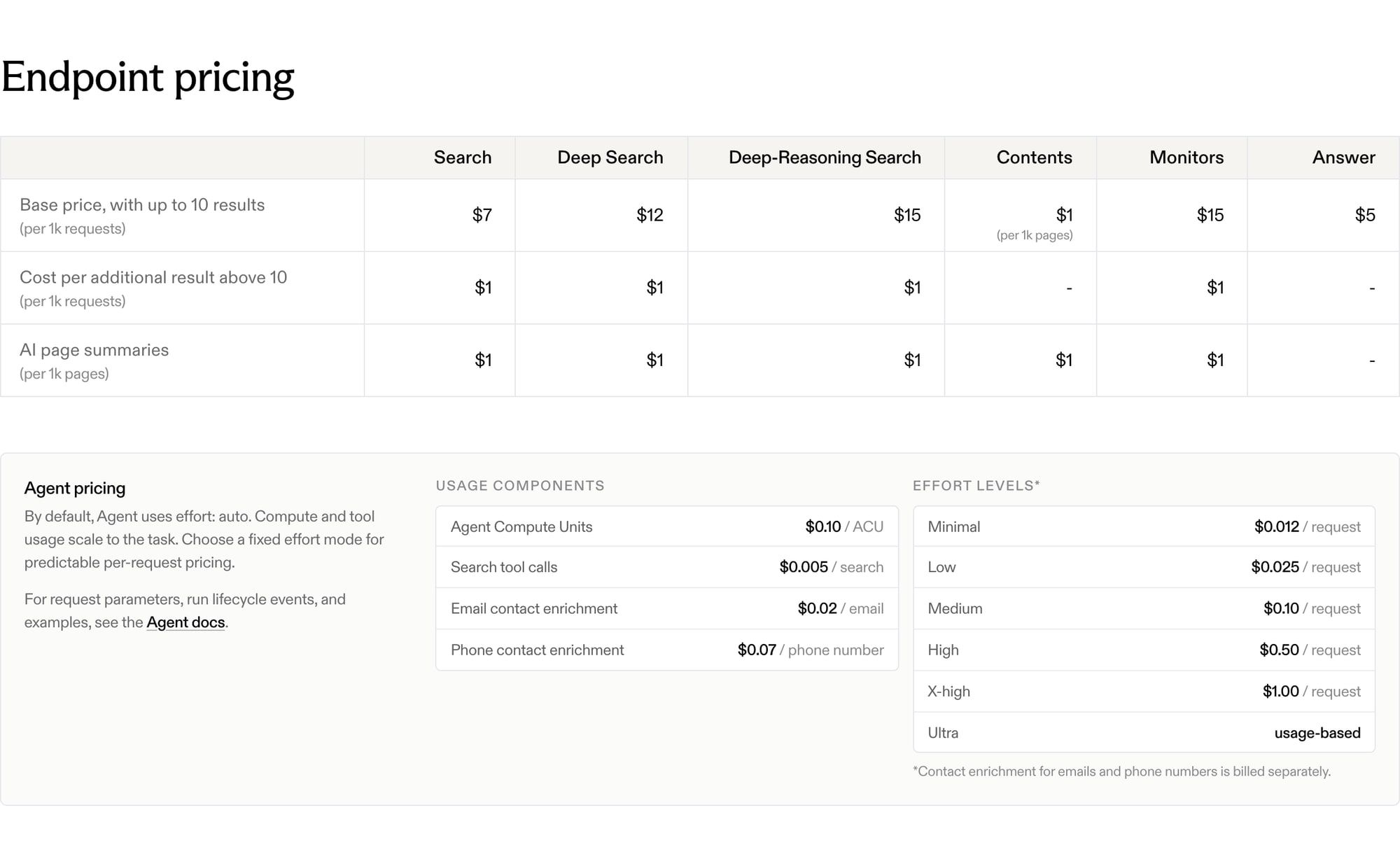
That image shows the September table, not the current Lite and Instant prices. The current prices above come from the live October pages.
At 100K, Exa Lite’s $400 is below Tavily Growth’s $500, while Exa Auto costs $700. I cannot infer equal result quality from their mode names.
Are Tavily and Exa free? 1,000 credits vs $10 a month #
Tavily gives 1,000 monthly credits without a card: up to 1,000 basic/fast/ultra-fast or 500 advanced searches (credits). Automatic depth selection and other endpoints draw from that credit budget. Its FAQ says credits reset on the first of the month; I have not checked an account’s paid renewal cycle.
Exa’s billing guide limits the monthly $10 grant to a user’s first team. It resets to $10 on the calendar first and unused grant does not accumulate.
Completing onboarding adds a separate one-time $10 bonus that does not expire. At current base prices, $10 covers up to 2,500 Lite (or legacy Instant) or about 1,428 Auto requests; extras consume it sooner. This is arithmetic, not an account test.
See the free web search API guide for other documented offers.
Data terms: can Tavily and Exa train on your queries? #
Both advertise retention protections, but the source and account scope matter. I read public standard terms and privacy pages, not either customer’s negotiated agreement.
| Question | Tavily | Exa |
|---|---|---|
| ZDR scope | FAQ advertises ZDR without specifying a plan/endpoint contract | Enterprise, enabled per team: Search, Contents, Agent, Answer; Websets unsupported |
| Query use | Privacy policy permits response-improvement use unless contract overrides | Public policy permits training, but excludes business data processed under customer agreements |
| Input/output licence | AI-input/output training clause §6.5; broad input licence §9.2 | Terms §1.2(c) describes Search Engine input/output; Additional Terms control conflicts |
Source: Tavily FAQ, terms and privacy policy; Exa ZDR guide, privacy policy and terms PDF, reread 31 Oct 2026. Contract and endpoint scope must be confirmed before sending sensitive data. Scroll sideways for more columns.
Tavily’s FAQ advertises ZDR. Its terms, §6.5, permit training/improvement using inputs and outputs of its AI Functionality; §9.2 grants a broad input-processing licence. Its privacy policy permits some query use for response improvement unless the contract says otherwise. None of that proves what a negotiated enterprise agreement permits.
Exa’s ZDR guide now includes Answer alongside Search, Contents and Agent on Enterprise teams. Websets is unsupported. Agent ZDR excludes previousRunId and limits Connect to eligible providers. The Search and Agent references also say an opaque userIdentifier, if provided, is retained even with ZDR; do not put personal data in it (Search reference).
Exa’s privacy policy permits query training but expressly excludes business-offering data it processes for customers under their agreements. The terms PDF, §1.2(c), gives input/output rights within its Search Engine section and says Additional Terms govern conflicts. I do not extend that wording into a universal API training claim. Confirm the applicable service agreement, endpoint and activated ZDR settings before using either vendor with confidential queries.
Who owns Tavily and Exa? #
Nebius’s Q1 2026 filing records its acquisition of 100% of Tavily on 19 February 2026. Tavily’s terms name AlphaAI Technologies Inc. dba Tavily; Exa’s contract names Exa Labs, Inc. These identities do not establish service quality or account-level data terms.
I removed historical community quotes and search-result ranking claims. There is no independently measured developer verdict on this page.
Which one should you pick? #
Pick by what your agent needs back from one call, how you want to be billed, and which data terms you can accept. Quality is for your own queries to decide, on the free tiers.
Pick Tavily if… #
- You want ranked results with short chunks and an optional LLM answer in one call, with no extra charge listed for the answer or raw page.
- You also need to extract, map or crawl sites, and want it on the same key and credit balance.
- You are around 100K basic searches/month and prefer Growth’s $500 plan; it is below Exa Auto’s $700, but above Lite’s $400.
- You’re fine with a credit model where depth changes the price (advanced costs double).
Pick Exa if… #
- You want page contents with each result, or more than 20 results a call (up to 100).
- You search for entities: people, companies, publications or financial reports have their own categories.
- You want separate endpoints for answers, deep research and agent runs, each with its own dollar price and a per-call
costDollars. - You need zero data retention in writing: Exa’s docs say which plan and endpoints it covers.
If I were building a research agent that needs page text for every result, I’d start with Exa, because its docs include text/highlights for the first ten results at $4/1K Lite (cached content only) or $7/1K Auto, with public requests up to 100 results and charges beyond ten. Tavily also returns full pages, via include_raw_content, but on a 20-result cap. If I needed search plus site crawling at around 100K calls a month on one bill, I’d start with Tavily’s Growth plan.
Other options: Brave, Parallel, Linkup and more #
If neither fits, these are the names people add to this comparison. Prices were verified 31 Oct 2026; my Tavily alternatives guide covers them in depth, and my hub has a short rundown of AI search APIs.
- Tavily vs Exa vs Brave: Brave Search API is $5 per 1K, with $5 in monthly credits; new accounts need a card.
- Exa vs Tavily vs Parallel: Parallel is $1 per 1K on its Turbo and Fast modes and $5 per 1K otherwise, with up to 5,000 free requests/month advertised; eligibility and other credit offers are not assumed additive.
- Tavily vs Exa vs Linkup: Linkup lists search at $0.005 to $0.006 per request, so $5 to $6 per 1K.
- Firecrawl: a scraping and crawling API with search added. It’s a different job, covered in my Firecrawl vs Tavily comparison, and if a crawler turns out to be what you need, I list the crawlers to consider besides Firecrawl.
- Google’s own results: use a SERP API. apiserpent.com (SerpentAPI) has low list prices: $0.60 per 1K on Default, $0.30 after $100, $0.10 after $500, $0.05 after $1,000 and $0.03 after $1,250, rechecked 3 November 2026. Old credit keeps its schedule and new credit uses the earned tier; there is no public SLA for pay-as-you-go accounts (FAQ), and its terms have you indemnify it.
On 31 October 2026 the pricing page carried a banner reading “Prices to increase 10x after October 31”. When I checked it on 3 November the banner was gone and only the top tiers had changed; the rates above are the ones it showed that day, so check the page before you budget.
Quick bills one Web unit/call; Deep bills requested pages up to ten. Paid credit does not expire; promotional bonuses expire after 30 days, while the 12-month inactivity rule in the terms affects only unused free calls.
Optional AI Mode adds $0.004/call plus page units, but Google-UI answer provenance is unverified. It is not a demonstrated replacement for Tavily/Exa page extraction.
For Google results, my cheapest SERP API comparison prices them like for like, and my Serper vs SerpApi comparison puts two of them head to head.
FAQ
Who does Exa AI compete with?
Tavily is a direct alternative for agent web search. Brave, Parallel and Linkup are other documented options. Google SERP APIs serve a different need: observations of Google result pages.
How good is Exa AI?
I do not assign a quality score. This is a public-document comparison with no API tests. Exa documents its own crawl, content extraction and entity categories, which are features rather than independent quality proof.
Is Tavily better than Firecrawl?
They suit different jobs. Tavily combines search with Extract, Map, Crawl and Research. Firecrawl emphasizes page scraping and crawling with search added; compare the required output and credit cost.
What are some free alternatives to Tavily?
Exa gives the first eligible team $10 monthly plus a one-time $10 onboarding bonus. The monthly amount covers up to 2,500 Lite (or legacy Instant) or about 1,428 Auto base searches. Brave offers $5 monthly with a card; Parallel advertises up to 5K monthly requests, subject to its offer rules.
Is Tavily search better than Exa search?
I have no independent performance evidence for either. Tavily caps Search at 20 results and bills 1 or 2 credits by depth. Exa publicly allows 100 results and bills Lite (and legacy Instant) at $4/1K or Auto (and legacy Fast) at $7/1K, with extra-result and summary charges.
How much does Exa search cost?
Lite is $4/1K and Auto $7/1K; the legacy Instant ($4), Fast ($7) and Deep-reasoning ($15) types keep their prices; Deep-lite/Deep are $12/1K. Base search covers ten results with text and highlights; additional results and AI summaries cost extra. Standalone Contents is $1/1K pages per content type.
Sources
36 sources, accessed to .
Official pricing, docs, changelogs and status pages 36
- Tavily docs: API credits, plans and free tier
- Tavily docs: Search endpoint
- Tavily docs: Extract endpoint
- Tavily docs: Map endpoint
- Tavily docs: Research endpoint
- Tavily docs: rate limits
- Tavily pricing
- Tavily terms of service (last updated 4 May 2026)
- Tavily privacy policy (last updated 24 Nov 2025)
- Tavily FAQ
- Tavily changelog
- Tavily docs: MCP server
- Tavily docs index (llms.txt): integrations
- Tavily docs: Vercel AI SDK integration
- Nebius Q1 2026 interim financial statements (6-K exhibit, filed 20 May 2026)
- Exa pricing
- Exa changelog
- Exa docs: Contents
- Exa docs: Search reference
- Exa docs: Answer reference
- Exa docs: Agent API, create a run
- Exa docs: rate limits
- Exa docs: zero data retention
- Exa privacy policy (last updated 29 Jun 2026)
- Exa Labs terms of service (PDF, undated)
- Exa blog: announcing its Series C (20 May 2026)
- Exa docs: Exa MCP
- Exa docs index (llms.txt): integrations
- Exa docs: Vercel AI SDK integration
- Brave Search API pricing
- Parallel pricing
- Linkup pricing
- apiserpent.com (SerpentAPI) pricing
- apiserpent.com FAQ (SLA)
- apiserpent.com terms of service
- Exa docs: billing and free credits