Comparison
Brave Search API or SerpApi? What each really costs
Brave sells its own index at $5 per 1,000 requests. SerpApi sells Google results from $25 a month. Where each wins, and who ran the speed tests.


Brave Search API sells results from Brave’s own index at $5 per 1,000 requests. SerpApi collects what Google and other engines show and sells it as JSON, from $25 a month for 1,000 searches to $3,750 for 1,000,000.
So the first decision is whose results you need, and the price follows from it. On list prices Brave is cheaper than every SerpApi plan up to 500,000 searches a month, SerpApi’s 1,000,000 plan matches it at 750,000, and only above that is SerpApi cheaper per search.
I read both vendors’ pricing pages, docs and terms on 24 November 2026, plus the benchmarks and comparisons that turned up when I searched this pair. The top comparison is SerpApi’s own post, so I also check which of its claims have aged. I made no API calls, so every speed figure below belongs to whoever published it, and I name them and what they sell.
Each price list has its own guide: SerpApi pricing and Brave Search API pricing. Brave against Tavily is a different decision, covered in Tavily or Brave Search API, and this page sits in my search APIs hub.
Short on time?
Short answer: pick by whose results you need
- You need Google's actual results, with a written SLA and legal cover
- SerpApi, from the Production plan ($150 for 15,000 searches)
- The Legal Shield starts at that plan, and SerpApi's terms carry a 99.95% SLA clause next to a no-guarantee clause. Both clauses have limits I spell out below. Confidence: high on what the pages say, low on how any of them performs in practice.
- You need Google's results at the lowest list price and can live without an SLA or indemnity
- apiserpent.com (I have a business connection to it)
- $0.60 per 1,000 calls at its default tier, $0.03 only with a $1,250 deposit, and its pricing page notes that prices may rise from December 2026. Serper is the other low-price lane. Confidence: high on list prices, none on quality, because I found no speed or accuracy test of it.
- You are grounding an LLM or agent and do not need Google's ranking
- Brave Search API
- $5 per 1,000 requests, LLM Context chunks at the same price, and 50 queries per second on its card. Confidence: high on price, medium on speed (vendor and rival figures), low on accuracy.
- You search more than 750,000 times a month
- SerpApi Cloud 1M ($3.75 per 1,000), if you need Google's results
- It undercuts Brave's $5 list price above 750,000 a month, but the two return different things. Ask Brave about its custom enterprise terms before you decide. Confidence: high on the arithmetic.
- You must store or cache results
- None of the three, until you have a written answer
- Brave bars storage and points to a custom plan with no price I could find. SerpApi bars copying any portion of its service and is silent on your copies. apiserpent.com ties storing to third-party terms. Confidence: medium.
- A prototype with no spend
- SerpApi Free (250 searches a month) for Google, Brave's $5 credit for an index
- Brave's credit needs a card on file. apiserpent.com's free allowance (one run a day plus 10 free calls on an account) is smaller. Confidence: high.
Prices verified . List prices verified 2026-11-24 from each vendor's own pages. I made no calls of my own, so every benchmark figure belongs to its publisher. Overall: choose by what you need back. Brave if an index that is not Google's and LLM-ready chunks are enough; SerpApi if you need Google's rich results with an SLA and a legal-cover clause; apiserpent.com or Serper if Google results at the lowest list price matter more than an SLA.
Are these even the same kind of product? #
No. Brave answers from its own crawler and index, while SerpApi fetches what search engines show and hands it back as JSON. Brave’s FAQ says “There is no fallback to another search engine for any query”, so you never get Google’s ranking from it (Brave).
SerpApi’s Ludicrous Speed page names Google, Baidu and Bing among its engines, and its own comparison post says 50+. Since mid-November it also lists Brave, as a scraped engine rather than a partnership, which I cover below.
| Criterion | Brave Search API | SerpApi | apiserpent.com (connected party) |
|---|---|---|---|
| Where results come from | Brave's own index, per Brave; no fallback to Google or Bing | Scrapes search engines: Google, Bing, Baidu and more (50+ per its own post), plus Brave since November 2026 | Engines google, bing, yahoo, ddg and brave in its docs; its FAQ does not say how results are collected |
| Price unit | $5 per 1,000 Search requests, prepaid credits, no subscription | Monthly plans: $25 for 1,000 searches up to $3,750 for 1,000,000; only successful searches count | Per 1,000 calls by deposit tier, $0.60 down to $0.03; deposits do not expire |
| Output | Web results JSON, plus LLM Context text chunks | JSON by default, html or md (Markdown) on request | JSON only; raw SERP HTML is not available |
| Free tier | $5 credit a month, card on file | 250 searches a month, 50 an hour | One free run a day, plus 10 free calls on an account |
| SLA | None in the terms, which say as is | A 99.95% SLA clause in the terms, with credits up to 100% of the monthly price, beside a no-guarantee clause | None published for pay-as-you-go accounts |
| Legal cover | No cover for your use; the terms give a narrow indemnity for IP claims against the API itself, excluding Search Results | Legal Shield up to $2 million, Production plan and above, with limits | None; its terms make you indemnify it |
| Client tooling | No SDK named; 23 listed integrations; an MCP server | Nine client libraries listed: Ruby, Python, JavaScript, PHP, Go, Java, .NET, Swift and C++ | An MCP endpoint; code examples in JavaScript, Python and cURL; no SDK package named |
Source: Vendor pricing pages, docs, FAQs and terms, read 2026-11-24. SerpApi's pricing page says all prices are in USD; the other vendors show $ with no currency named, and I read them as USD. Scroll sideways for more columns.
SerpApi’s argument for itself is coverage. Its post puts Google at about 90 percent of search traffic and Brave under 1 percent, citing StatCounter. That is a statistic about where people search, not about how much of the web Brave’s index covers, and I could not check the 2026 figures behind it.
Brave’s own pitch is that its index is one of only three independent, global-scale search indexes in the western world, per its blog. That is Brave describing itself, and I could not audit it.
What this means in practice: for a rank tracker, a price monitor or a local-results feature that must match what Google shows, Brave is the wrong product at any price. For an agent that needs relevant pages to read, Google’s exact ranking may not matter, and that is where Brave’s lower list price counts.
What will 1K, 10K, 100K and 1M searches cost? #
At 1,000 searches a month Brave lists $5 and SerpApi $25, and at 1,000,000 Brave lists $5,000 against SerpApi’s $3,750. By my arithmetic the lines cross at about 750,000 searches, because $3,750 buys 750,000 requests at $5 per 1,000.
I note up front that I have a business connection to apiserpent.com, so its row below uses only its own pricing page.
What one request each costs a month (list prices, before free credit)
Verified
| Route | Per 1,000 | 1,000 a month | 10,000 a month | 100,000 a month | 1,000,000 a month |
|---|---|---|---|---|---|
| Brave Search or LLM Context | $5 | $5 | $50 | $500 | $5,000 |
| Brave after its $5 monthly credit | $5 | $0 | $45 | $495 | $4,995 |
| SerpApi, cheapest plan that covers the volume | $3.75 to $25 | $25 (Starter, 1,000) | $150 (Production, 15,000) | $725 (Searcher, 100,000) | $3,750 (Cloud 1M, 1,000,000) |
| SerpApi, dollars per 1,000 searches used | $3.75 to $25.00 | $25.00 | $15.00 | $7.25 | $3.75 |
| apiserpent.com Google SERP, Default tier (prices may rise from December 2026) | $0.60 | $0.60 | $6 | $60 | $600 |
| apiserpent.com Google SERP, $0.03 tier (needs a $1,250 deposit) | $0.03 | $0.03 | $0.30 | $3 | $30 |
Source: My arithmetic from vendor list prices verified 2026-11-24, one request each, before free credit, tax and model tokens; SerpApi's page says USD and the others show $ with no currency named, read as USD; SerpApi plans assumed fully used, and its overage rate is not on its pricing page; apiserpent.com rows show credit consumed at that tier's rate, not the deposit that unlocks it
Here is how I got the numbers, all from SerpApi’s pricing page, Brave’s pricing cards and apiserpent.com’s pricing page, verified 2026-11-24:
- Brave: $5 per 1,000 requests. Brave’s blog puts web, LLM Context, images, news and videos under that same Search price.
- SerpApi: the plan price divided by the searches it includes, for example $150 for 15,000 is $10.00 per 1,000. Only successful searches are counted, and cached, errored and failed searches are not.
- At 10,000 searches: Developer’s 5,000 is too small and the page describes no overage rate, so I priced Production at $150, which is $15.00 per 1,000 used and $10.00 only if you use all 15,000.
- apiserpent.com: $0.60 per 1,000 at Default. The $0.03 tier needs a $1,250 deposit in the month.
The full SerpApi ladder is worth seeing once, because none of the comparison pages I read prints the per-1,000 figure at each plan.
| Plan | Monthly price | Searches included | Per 1,000 if fully used | Legal Shield |
|---|---|---|---|---|
| Free | $0 | 250 | $0 | No |
| Starter | $25 | 1,000 | $25.00 | No |
| Developer | $75 | 5,000 | $15.00 | No |
| Production | $150 | 15,000 | $10.00 | Yes |
| Big Data | $275 | 30,000 | $9.17 | Yes |
| Searcher | $725 | 100,000 | $7.25 | Yes |
| Volume | $1,475 | 250,000 | $5.90 | Yes |
| Infrastructure | $2,750 | 500,000 | $5.50 | Yes |
| Cloud 1M | $3,750 | 1,000,000 | $3.75 | Yes, plus ZeroTrace and priority support |
Source: SerpApi pricing page and Legal Shield page, read 2026-11-24; per-1,000 column is my arithmetic. The ladder continues above Cloud 1M, to $106,050 for Cloud 54M. Scroll sideways for more columns.
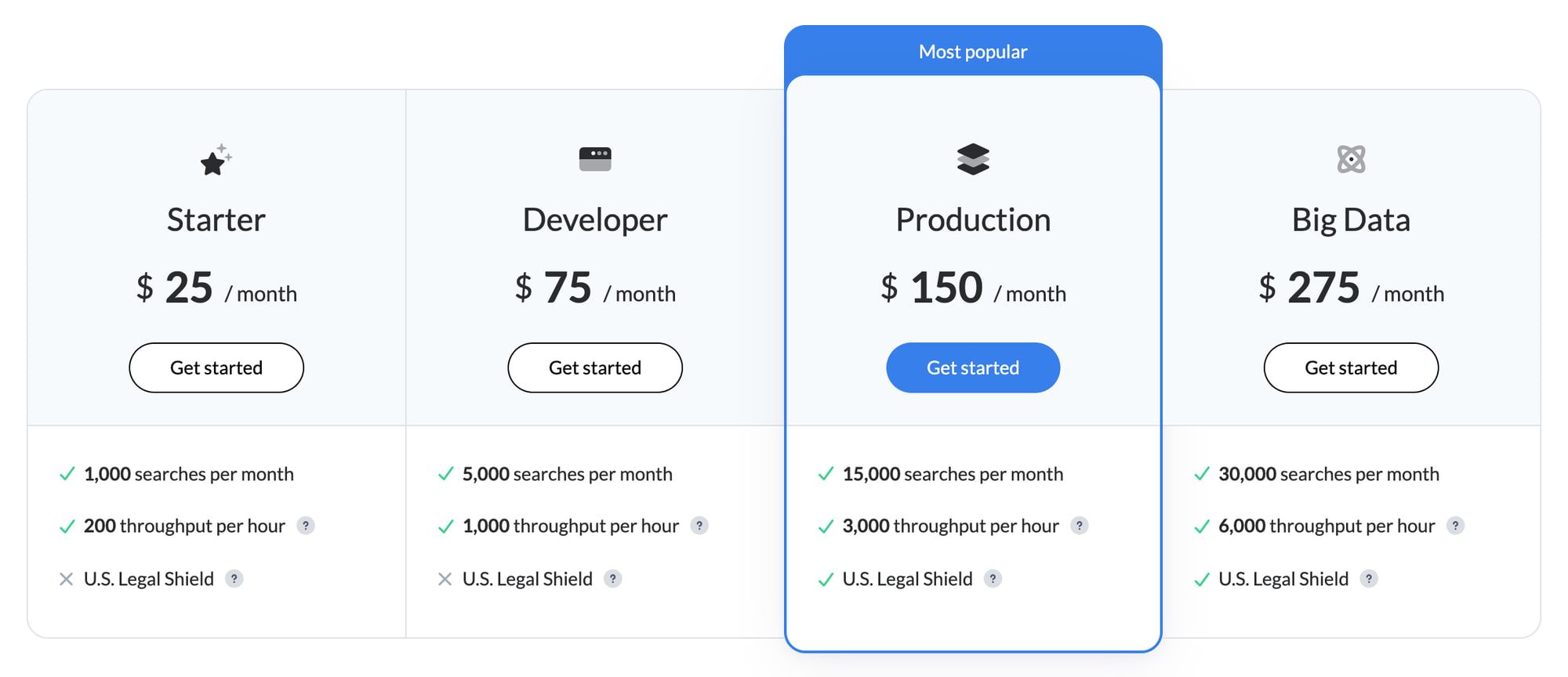
Three things follow from the table. Brave’s $5 is cheaper than every SerpApi plan up to Infrastructure, which is $5.50 per 1,000 at 500,000 searches. SerpApi’s $3,750 Cloud 1M plan buys the same as 750,000 Brave requests, and at 1,000,000 it is 25 percent below Brave’s $5,000.
The third is the price of cover. At 1,000 searches a month, Starter is $25 and has no Legal Shield, while the cheapest plan with it is Production at $150, six times the price. SerpApi’s own alternatives post says it is not the cheapest option at volume, which fits.
A few caveats belong next to those numbers:
- Partial use costs more per search. If you use 5,000 of Production’s 15,000 searches, you pay $30.00 per 1,000 used, not $10.00.
- Ludicrous Speed doubles the price. SerpApi’s page prices that mode at twice the standard “Best Effort” price, and the ladder above is the standard price.
- A request is not the same unit. SerpApi’s Google search returns feature blocks, while a Brave request returns web results, so one is not a like-for-like swap for the other.
- Brave’s enterprise terms are custom. Its landing page shows no volume tier, so a large buyer could pay less than $5, and I could not see by how much.
- SerpApi refunds are narrow. Its page offers a 7-day refund unless more than 20 percent of the plan is used, and when your searches run out you can renew early.
Could apiserpent.com’s prices change? #
Yes. apiserpent’s pricing page notes that prices may rise from December 2026. It does not say by how much. I would recheck the page before budgeting.
Who gets the better free tier? #
SerpApi gives 250 searches a month on its Free plan, with 50 an hour. Brave gives a $5 monthly credit, about 1,000 Search requests, but needs a card on file.
Brave’s headline reads “Up to $20 in free calls every month”, while the Search card says it includes $5 in free credits. Brave’s blog says every plan gets $5 of free credit, which it totals at $20 across its four plans (Search, Answers, Spellcheck and Autocomplete). I read that as $5 per plan, so only the $5 on Search counts toward Search requests, though Brave does not say so in those words. I count $5.
Brave’s FAQ gives its reason for asking for a card as “To prevent abuse”, and says it sells prepaid credits, not subscriptions. I found one more wrinkle: the blog says attributing the API on your site or about page is what you need to do, while the terms read as if attribution is optional. I cannot settle that, so ask Brave before you build a budget on the credit. My Tavily-vs-Brave guide goes further into that question.
The other two lanes are small. apiserpent.com offers one free run a day and adds 10 free calls on a free account, per its pricing page. Serper’s page says 2,500 free queries and no credit card (Serper), but I did not read its terms.
SerpApi’s Free plan has a catch if legal cover matters: the Legal Shield is not available on Free, Starter or Developer. For a wider list of no-cost options, see my free web search API guide.
How many searches can you run? #
Brave lists 50 queries per second, which is 3,000 a minute. SerpApi’s Production plan lists 3,000 successful searches an hour, which is 50 a minute, so the two headline numbers differ by a factor of 60 in the unit alone.
That gap needs reading carefully, because the promises differ. SerpApi describes each plan’s hourly throughput as a guaranteed number of successful searches. Brave’s 50 queries per second is a ceiling on its landing card, and apiserpent.com says its limits are standard allocations, not guaranteed throughput.
| Service or plan | Listed limit | Per minute at a steady rate | What the vendor says |
|---|---|---|---|
| Brave Search | 50 queries per second (180,000 an hour) | 3,000 (my arithmetic) | A ceiling on the card; a sliding 1-second window, with 429 when exceeded; plan-level limits beyond the card were not readable |
| Brave Answers | 2 queries per second | 120 (my arithmetic) | Listed on the Answers card |
| SerpApi Free | 50 an hour | 0.8 (my arithmetic) | Guaranteed successful searches per hour for the plan |
| SerpApi Starter | 200 an hour | 3.3 | Same wording |
| SerpApi Developer | 1,000 an hour | 16.7 | Same wording |
| SerpApi Production | 3,000 an hour | 50 | Same wording; Legal Shield starts here |
| SerpApi Searcher | 20,000 an hour | 333 | Same wording |
| SerpApi Cloud 1M | 110,000 an hour | 1,833 | Same wording |
| apiserpent.com Default (balance under $100) | 100 a minute, 1,000 an hour, 10,000 a day; 10 concurrent | 100 | Standard allocations, not guaranteed throughput; a 429 carries a 60-second Retry-After |
| apiserpent.com $100 to $499 balance | 500 a minute, 5,000 an hour; 50 concurrent | 500 | Same wording |
| apiserpent.com $1,250 and up | 5,000 a minute, 250,000 an hour; 1,000 concurrent | 5,000 | Same wording |
Source: Brave landing page and rate-limiting guide; SerpApi pricing page; apiserpent.com pricing page and FAQ; read 2026-11-24. Per-minute figures are my arithmetic. Scroll sideways for more columns.
Brave’s rate-limiting guide says only successful requests count and are billed, and its response headers show your remaining quota. Its worked example is a plan of 1 request a second and 15,000 a month, which tells you plans differ from the landing card.
For most apps the practical question is burstiness. A per-second window suits agents that fire many searches at once, while SerpApi’s hourly guarantee suits a steady nightly job. My rate-limits guide covers retries and queueing.
What comes back from one call? #
Brave returns web results or text chunks for a model, SerpApi returns Google’s feature blocks, and apiserpent.com returns organic rows from a quick call or more fields from a per-page call. The differences matter more than the price gap.
| Need | Brave Search API | SerpApi Google Search API | apiserpent.com |
|---|---|---|---|
| Plain organic results | web.results with title, url and description; count up to 20, offset up to 9; extra_snippets adds up to 5 more excerpts | organic_results; paging with start; the num parameter is not documented on the page I read | Organic rows; num 1 to 100 on a standard call, which the docs call a ceiling, not a promise; per-page calls take pages 1 to 10 |
| Google features | Not described: the docs list web results, locations and rich data, and I could not confirm infobox, discussions, news, videos or FAQ blocks | Sample blocks: local_results, knowledge_graph, immersive_products, related_questions, perspectives, related_searches and local_map. I could not confirm ads or an AI Overview from that page, though the changelog mentions a Google Ads API | Per-page calls add ads, People Also Ask, an AI Overview (opt-in, with include_aio=true), local pack, knowledge panel, related searches, featured snippet, rich snippets, videos and shopping. A standard call is organic-only |
| Text for a model | LLM Context returns grounding chunks per URL: token budget default 8,192 (1,024 to 32,768), up to 50 URLs (default 20) | output=md gives a Markdown version of the results, which the docs describe as meant for LLMs and agents | None seen; JSON only |
| Local results | A second call is needed, and the point-of-interest ids expire after about 8 hours | local_results and local_map blocks | A localPack field on per-page calls |
| Other engines | Brave only | 50+ per its own post, including Brave since November 2026 | Google, Bing, Yahoo, DuckDuckGo and Brave; also AI rank checks, maps, shopping, news, images, videos, YouTube and Instagram |
Source: Brave Web Search and LLM Context docs; SerpApi Google Search API docs and changelog; apiserpent.com docs; read 2026-11-24. Scroll sideways for more columns.
Only Brave’s LLM Context returns text taken from the pages behind the results. SerpApi’s md output is, as I read its docs, a Markdown rendering of the results page, not page content, and apiserpent.com says raw SERP HTML is not available.
That makes the old line that SerpApi only returns raw SERP data out of date, since Parallel reports that SerpApi added Markdown output in August 2026. It does not make SerpApi a page-reading tool, and I have not confirmed what that output contains.
One unit caution on apiserpent.com. A quick call is one charge for up to 100 organic rows, while a per-page call bills per page of 10 and returns the richer fields at the same $0.60 rate. To compare it with a SerpApi search fairly, you would price its per-page call, and I have not confirmed that a per-page response equals a SerpApi response.
Is either one faster, and who says so? #
SerpApi’s speed figures run from 0.73 seconds to 7 seconds depending on who measured them, and no test I found covers both Brave and SerpApi. Every figure below belongs to the party named, and I list what each one sells.
| Who, and when | Their stake | Sample | What it says |
|---|---|---|---|
| SerpApi latency test, 30 Jul 2025 | Written by a SerpApi Customer Success Engineer, who says they work for SerpApi, a product in the test | At least 100 searches per provider, all with one query ("google search api"), Google only, each vendor's fastest API; SerpApi plan not named | SerpApi 0.73 s average, 1.45 s p99; its Ludicrous Speed Max 0.64 s and 1.11 s; Serper 0.83 s and 2.10 s. No Brave row |
| SerpApi Ludicrous Speed page | SerpApi; the page does not say who ran the comparison or on which queries | n = 10,000 per the page | 2.2x faster on average and 4.2x faster at p99, at twice the price; I did not capture the baseline |
| SerpApi roadmap issue 74, 11 Nov 2026 | A SerpApi account closing a feature request | No conditions given | 0.8 s for its new Brave engine |
| SerpApi comparison post, 1 Mar 2026 | SerpApi, bylined by its VP of Marketing and Developer Relations | No method given | Brave typically under 500 ms; SerpApi Ludicrous Speed Max about 1 to 2 seconds |
| HackerNoon SERP benchmark, 24 Feb 2026 | Author Web Intelligence Hub; Bright Data, a SerpApi competitor, comes out on top and the page names no sponsor, so I read it as a competitor's test | Nine providers, Google only, thousands of calls over 30 days | SerpApi 99.71% success, P50 2.53 s, P95 5.27 s; P50 0.93 s through a premium dedicated setup. No Brave row |
| AIMultiple SERP benchmark, updated 2 Nov 2026 | A review site that lists SerpApi among subscribers of its benchmarking services; the page carries affiliate parameters | Five providers, 7,000 live requests, 500 queries per engine, one request at a time | SerpApi completion time 7 s on Google, 12 s on Bing, 3 s on Yandex; success 98%, 100%, 100%. Brave not included |
| Brave blog, updated 17 Sep 2026 | Brave | Vendor-observed calls to LLM Context | Total latency under 500 ms at p90; an earlier wording said 600 ms |
| Telnyx web search benchmark | Telnyx sells a rival search API | 20 queries, one run each, one machine; region and plan not stated | Brave 561 ms average (361 to 908 ms), no errors. No SerpApi row |
| AIMultiple agentic search, updated 10 Nov 2026 | A review site; funder not stated, and the page says it mentions no subscribers of its benchmarking services | 70 answer questions, public tariffs at 100,000 requests a month | Brave LLM Context at 8,192 tokens: 77.9% correct (interval 67.6 to 86.8), p50 0.95 s, $0.0178 per correct answer. No SerpApi row |
| apiserpent.com docs | apiserpent.com, a party I am connected to | Example responses in the docs, not measurements | Examples show 1,200 ms for a standard call and 8,500 ms for a per-page call, beside a note that response time varies |
Source: Each publisher's page, read 2026-11-24. Every figure is the publisher's; I reproduced none. Scroll sideways for more columns.
Start with SerpApi’s own numbers. A SerpApi staff member’s test gives 0.73 seconds on average, a competitor-linked benchmark gives a 2.53-second median, and AIMultiple, which counts SerpApi as a subscriber, gives 7 seconds for completion on Google. The definitions, queries, regions and plans differ, so they do not contradict each other so much as measure different things.
Brave’s numbers are thinner and no more neutral. Brave says under 500 ms at p90 for LLM Context, Telnyx measured 561 ms on 20 queries, and AIMultiple measured a 0.95-second median for LLM Context. Parallel, a rival seller, quotes 523 ms for Brave from Openbenchmarks and gives no SerpApi figure, and I could not find that number on Openbenchmarks’ own page, which today shows times for tasks and lookups without defining the metric.
Accuracy is thinner still. AIMultiple scored Brave’s LLM Context at 77.9 percent at 8,192 tokens, but the interval runs from 67.6 to 86.8, and the page itself says “This selection favors known challenges and limits generalization to routine search workloads”. Artificial Analysis lists a Brave LLM Context row with an index of 75, but no SerpApi row in the 12 of 26 products I could see, and Openbenchmarks does not list SerpApi or Serper.
My conclusion is narrow. Nobody with no stake has measured both on the same queries, so I would not call either one fast or slow. Run 100 of your own queries from your own region before you commit, and my guide to evaluating a search API shows how.
What does the legal cover really cover? #
SerpApi offers a written legal-cover clause and an SLA clause. Brave offers only a narrow indemnity for IP claims against its API, and apiserpent.com offers neither. Each has limits, and the lawsuit against SerpApi is not over.
What does the Legal Shield promise? #
SerpApi’s Legal Shield page says it covers up to $2 million for the scraping and parsing of search engine data, as long as your use of the data or service is not illegal. It says it does not cover how that data is ultimately used.
The conditions are the part to read twice:
- Which plans: Production and higher. Free, Starter and Developer are excluded.
- Which claims: those brought under U.S. state or federal law in a U.S. court.
- What is excluded: illegal use, which the page says includes copyright infringement and DMCA violations.
- Who can have it: U.S. and international customers, subject to the terms of your agreement with SerpApi.
SerpApi’s terms repeat the $2 million figure and the U.S.-court limit. I found nothing on whether the Shield has ever paid a claim, and the page is undated.
What about the SLA? #
Two clauses in SerpApi’s terms point in opposite directions, and both exist. One says SerpApi provides a 99.95% SLA guarantee with all plans, and another says it does not guarantee uninterrupted service. The SLA section also offers credits of up to 100% of your plan’s monthly price on your next invoice.
The section also says the guarantee “comes with a 100% penalty”, which I read as that same credit cap. I read section 21 in full in a browser on 24 November 2026: it does not define downtime, set out a claim process or list exclusions.
The pricing page adds a separate promise: hourly throughput is described as a guaranteed number of successful searches. That is a different claim from uptime, and it is the clearest written commitment in this comparison.
What do Brave and apiserpent.com offer? #
Brave’s terms provide the service as is, with no SLA, and name California law. Section 11 does have Brave defend and indemnify you, but only against third-party claims that the API or its documentation infringes intellectual property rights, and it excludes claims relating to Search Results. Its liability is capped at the fees you paid in the prior 12 months. That is a different protection from SerpApi’s Legal Shield, which is aimed at claims over scraping and parsing search data.
Brave’s Nov 11 post presents its API as the same results you get on Brave Search, delivered through the front door, in contrast to scrapers that collect results in bulk and resell them. That is positioning, not a clause that covers your use.
Brave’s learn page calls APIs that scrape Google a “tenuous legal grey area”. It is a rival’s view of a product category, and it does not make Brave’s own terms a legal shield.
apiserpent.com’s FAQ says no public SLA is published for pay-as-you-go accounts and its terms provide the service as is, name India as the governing law with arbitration seated there, and make you indemnify it. Its FAQ also says Google’s terms technically restrict automated access and tells you to consult your own counsel. I do not read that as a defect for a vendor to admit, but it means the risk sits with you.
Where does Google v. SerpApi stand? #
Not over, on SerpApi’s account. SerpApi’s General Counsel wrote on 10 November that on 9 November the court granted SerpApi’s motion to dismiss Google’s amended complaint with leave to amend, only to cure the deficiencies, and that Google has 21 days to refile or the dismissal becomes with prejudice (SerpApi). That is my arithmetic, not a date from the post: 9 November plus 21 days is 30 November, after this page’s date, if the days run from the order. I did not read the docket for this page.
That is a party’s account of a pleading-stage order, not a finding on the merits. Parallel’s page, from a rival seller, stops at the July dismissal, the August amended complaint and a pending second motion, so it predates the order. My Google v. SerpApi explainer has the docket read, and I make no legal call on SerpApi or on using it.
What can you keep, and what do they keep? #
Brave bars storing results, SerpApi is silent on your copies, and apiserpent.com ties storage to third-party terms. None of the three gives a clean right to keep results without a written answer.
| Question | Brave Search API | SerpApi | apiserpent.com |
|---|---|---|---|
| May you store results? | No, under section 3(b)(i): no storing, caching or building a database of results beyond transient storage needed to run your application. Its FAQ says Yes, with a custom plan, and I found no price | Section 2 bars copying, reselling or exploiting any portion of the service; it is silent on your own copies | Section 4.2 bars scraping, copying or storing data in violation of third-party terms, and reselling without authorization |
| May you train models on them? | No, under section 3(b)(xiii): results may not be used to build, evaluate, train, fine-tune or benchmark AI models. Read it before you score Brave results with a model | No clause found on training | No caching or AI-training clause found |
| How long do they keep queries? | Its blog says no queries are stored or linked to identities (a vendor claim); section 9(b) licenses Brave to use query data to run the API | Search data is kept for 31 days after the search completes, per its privacy section; Cloud 1M lists a ZeroTrace feature, and I did not find what it covers | API key, time, endpoint, status and the first 200 characters of each query, deleted on a 90-day cycle; it says it keeps no results (bulk and async jobs, 7 days) |
| SLA | None; as is and as available | A 99.95% SLA clause, with credits up to 100% of the monthly price, plus a no-guarantee clause | None published for pay-as-you-go; terms say as is |
| Indemnity | Section 11(a): Brave defends you against third-party IP claims about the API or its documentation, excluding Search Results; you indemnify Brave for claims tied to your application | Legal Shield up to $2 million with conditions (SerpApi calls it coverage); you indemnify SerpApi for claims from your breach of the terms or violation of law (section 14) | None; you indemnify it |
| Governing law | California | Texas | India, with arbitration seated in India |
Source: Brave API terms (last updated 1 Sep 2026), FAQ and blog; SerpApi terms (last updated 27 Aug 2026); apiserpent.com terms (31 Oct 2026) and FAQ; read 2026-11-24. Clause summaries are my paraphrases from fetch summaries, not legal advice. Scroll sideways for more columns.
The storage row is the one most likely to change your pick. If you plan to cache results to cut cost or to keep an archive, Brave’s standard terms stand in the way, and its blog says Brave does not use your queries to train its own models, which I could not check.
SerpApi’s clause is about the service, not your copies, and silence in a contract is not permission. For a ten-vendor read of these clauses, see my search API storage rights guide.
What did SerpApi’s new Brave engine change? #
It added Brave as a scraped engine inside SerpApi, which is a different thing from Brave’s own $5 API. SerpApi’s engine page describes engine=brave as scraping results from Brave Search’s web results page, and states no link to Brave.
It returns up to 20 results per page and up to 6 pages, with organic results, ads, a knowledge graph, local and news in the JSON. It also offers html and md output, and cached searches are free and not counted, with a one-hour cache.
SerpApi’s changelog for 9 to 15 November added the Brave engine along with a Brave Images API, and it points to a Brave AI Mode API for Brave’s AI answers. The roadmap issue asking for it was opened in March 2022 and closed on 11 November 2026.
I found no price for a Brave-engine search, so I cannot say what one costs against Brave’s $5. Brave’s own 11 November post says scrapers collect results in bulk and resell them, that scraping has moved toward Brave after Google got harder to scrape, and that it has seen traffic spikes of several thousand requests per second. It names no scraper, and I draw no link between that post and SerpApi’s engine.
On whether scraping Brave is allowed, Brave’s website terms, last updated in May 2023, have no explicit bar on scraping, but bar unreasonable load and bypassing access restrictions. They do not name the Search API, and I make no legal call. My explainer on the engine covers what I could confirm.
Is there a cheaper way to get Google’s results? #
Yes, for Google organic rows: apiserpent.com and Serper both list lower per-1,000 prices than any SerpApi plan, with less in writing. They are lanes for cost-led buyers, not substitutes for an SLA.
Disclosure again: I have a business connection to apiserpent.com, one of the services covered here. Its figures below are its own, from a party I am connected to, so weigh them accordingly.
| Lane and tier | Price per 1,000 | What unlocks it | Credit used at 100,000 searches |
|---|---|---|---|
| apiserpent.com Default | $0.60 | No deposit tier to unlock; the Default card says $0 to start, the pricing-page FAQ gives a $10 smallest deposit | $60 |
| apiserpent.com $100 tier | $0.30 | A $100 deposit in the month | $30 |
| apiserpent.com $500 tier | $0.20 | A $500 deposit in the month | $20 |
| apiserpent.com $1,000 tier | $0.15 | A $1,000 deposit in the month | $15 |
| apiserpent.com $1,250 tier | $0.03 | A $1,250 deposit in the month | $3 |
| Serper Starter | $1.00 | $50 for 50,000 credits, valid 6 months | $100 (two packs, my arithmetic) |
| Serper Standard | $0.75 | $375 for 500,000 credits | $75 |
| Serper Scale | $0.50 | $1,250 for 2,500,000 credits | $50 |
| Serper Ultimate | $0.30 | $3,750 for 12,500,000 credits | $30 |
Source: apiserpent.com pricing page and Serper home page, read 2026-11-24. Serper figures assume one credit per search, which is my reading of its table; its prices exclude tax. Scroll sideways for more columns.
On this table, apiserpent.com has the lowest list price among the three services I compare, but only at the right tier. Its Default price of $0.60 is below Serper’s Starter and Standard packs and above its Scale and Ultimate packs, and its $0.03 tier needs a $1,250 deposit.
The pricing mechanics are specific. A quick call is one charge for up to 100 results, a per-page search is billed per page up to 10 pages, and setting engine= never changes the price. Your best deposit in a calendar month sets the price for all that month’s deposits. An AI Mode add-on is $4.00 per 1,000 with include_ai_mode=true.
On the plus side, its FAQ says deposits do not expire, failed calls are refunded, and every call hits Google fresh with no cached responses. It also says it does not retain the results it returns.
Its limits are real:
- No public SLA for pay-as-you-go accounts, and no indemnity.
- Terms favour the vendor. You indemnify it, India law applies and arbitration is seated in India.
- No stated collection method. Its pages do not say how Google results are collected.
- No outside speed or accuracy test. The docs examples run from 1.2 to 8.5 seconds with a note that times vary.
- Purchases are generally non-refundable, with a 7-day request window, and completed searches that return nothing are still charged.
- A confusing minimum. The Default card says “$0 to start”, while the pricing-page FAQ says you can try the API free before any deposit and the smallest deposit is $10. That may simply mean a free trial and then a $10 first deposit, but the page does not say so. The same FAQ says that once your lifetime deposits reach $50, any further top-up must be at least $100.
- A possible price change. Its pricing page notes that prices may rise from December 2026, without saying by how much.
I do not rank it above SerpApi on quality, because I have no evidence on quality. For a wider comparison of cheap Google lanes, see my cheapest SERP API guide and Serper vs SerpApi. Serper’s terms, SLA and indemnity I did not read.
Did the top comparison page age well? #
Parts of it did not, and a vendor writing about a rival will lean its own way. The page that came up first when I searched this pair is SerpApi’s own post from 1 March 2026, bylined by Hilman Ramadhan, whose listed title is VP of Marketing and Developer Relations. It carries trial calls to action and is repeated on SerpApi’s dev.to account.
That is not a charge of dishonesty. It is a reason to check its numbers against the pages that exist today.
| Line in the post | What I found today |
|---|---|
| SerpApi starts at $75 a month for 5,000 searches | Its pricing page now shows a Free plan with 250 searches and a $25 Starter plan with 1,000, with $75 being Developer. I cannot say when Starter appeared, because the Wayback Machine was refused |
| Supported engines: 50+ versus Brave only | Brave's own API does serve only Brave's index, but the post's framing of SerpApi as the alternative to Brave predates SerpApi adding Brave as one of its own engines the week of 9 November |
| Market coverage: about 90 percent versus under 1 percent | These are shares of search traffic, per the post's StatCounter citation, not how much of the web each index covers. One number is used for two ideas, and I could not check the 2026 figures |
| Brave's index is approximately 20 billion pages | Brave's own page says over 40 billion (27 May 2026), and Parallel says 30B+ per Brave. All three figures are unaudited |
| Legal: $2 million indemnification for SerpApi versus standard terms for Brave | Brave's customers do not scrape, so in my reading the row answers a different question, and it leaves out Brave's storage and AI-training bars that apply to the customer |
Source: SerpApi comparison post (1 Mar 2026) against the vendor pages named, read 2026-11-24. Scroll sideways for more columns.
The row I would weigh most is the first, because anyone planning around $75 as the entry point would overpay. The Starter plan at $25 changes the small-volume case, though I do not know when it was added.
What do developers say? #
I found no practitioner thread comparing the pair, and Reddit, G2 and TrustRadius were not readable to my tools. The only voice I read is one Hacker News comment, from 13 November 2026, on a story about Brave’s agent payments: “If you want Google results, SerpApi gives 5000 searches for $75.” (HN).
That matches today’s Developer plan, and it states the choice in one line. A 2023 comment calling Brave’s API overpriced turned up in a comment search, but it is a listing fragment I did not open, and it predates Brave’s current plan. I would not draw a trend from either.
Which one should you pick? #
Pick by what you need back, then by what you must keep. Here is how I would split it, with my reasoning.
- Google’s own results, a written SLA and legal cover: SerpApi, from Production at $150. It is the only one of the three with a Legal Shield and an SLA clause, so its premium buys something you can point to, but read the limits first.
- Google’s results at the lowest list price: apiserpent.com, if you accept no SLA, no indemnity and a warned price rise, or Serper if you want a prepaid pack and are comfortable that I did not read its terms. I would not put it above SerpApi on quality, because I have no evidence on quality.
- An LLM or agent that needs relevant pages, not Google’s ranking: Brave at $5 per 1,000, with LLM Context at the same price. It is cheaper than SerpApi below about 750,000 searches a month and returns text chunks designed for models.
- More than 750,000 searches a month and you need Google’s results: SerpApi Cloud 1M at $3.75 per 1,000, after asking whether apiserpent.com’s or Serper’s terms are enough for you.
- More than 750,000 and an index is enough: ask Brave about Enterprise first, because its list price is above SerpApi’s at that volume and its custom terms are unknown.
- You must cache or store results: none of the three without a written answer. Brave bars it and points to a custom plan, SerpApi’s terms are silent on your copies, and apiserpent.com ties storage to third-party terms.
- A prototype with no spend: SerpApi Free for Google results, or Brave’s $5 credit if you can put a card on file.
If I were choosing for an agent, I would start with Brave and write 100 queries with an answer key before paying for anything else. If I were building a rank tracker or a shopping or local feature, I would buy SerpApi Production for the SLA clause and the Legal Shield, and I would read both before I paid.
Where cost beats those, I would look at apiserpent.com or Serper and accept the gap in writing. That is a method for you to follow, not a result I produced. If neither vendor fits, my guides to SerpApi alternatives and Brave Search API alternatives cover more options, and my search APIs hub has the rest.
What I could not verify #
I could not verify any speed or accuracy figure from a party with no stake in either vendor, because I found none that covers both. The full list is in the box near the top, and four gaps would change my picks.
- SerpApi publishes its overage rate and what a Brave-engine search costs. That would settle the small-volume and Brave-engine cases.
- A definition of downtime and a claim process for SerpApi’s SLA credits. The terms offer credits up to 100% of the monthly price but do not say what counts, so the clause’s worth to you is unclear.
- Brave publishes volume tiers or its custom-plan price. That would settle both the storage question and the 750,000-search crossover.
- apiserpent.com publishes an SLA, a date for its price change, or how it collects results. A price change from December 2026, which its pricing page says may happen, is the likeliest early trigger for a rewrite of this page.
Prices should be rechecked within 90 days, or sooner if a vendor changes them.
FAQ
Is Brave Search API cheaper than SerpApi?
On list price, yes at most volumes. Brave lists $5 per 1,000 requests, while SerpApi's plans run from $25.00 per 1,000 at Starter down to $5.50 at 500,000 and $3.75 at its 1,000,000 plan, if you use the whole allowance, so Brave is cheaper per search than every SerpApi plan up to 500,000 a month ([Brave](https://brave.com/search/api/), [SerpApi](https://serpapi.com/pricing), verified 2026-11-24).
SerpApi's $3,750 Cloud 1M plan equals Brave's list price for 750,000 requests (my arithmetic: $3,750 divided by $5 per 1,000), so Brave costs less in total below that and SerpApi costs less above it. The two return different things, so the cheaper one is not always the right one; Brave's enterprise terms are custom and I could not see them.
Does SerpApi use Brave's API for its Brave engine?
SerpApi's own page describes its Brave engine as scraping results from Brave Search's web results page, and it states no link to Brave ([SerpApi Brave page](https://serpapi.com/brave-search-api)). So it is not Brave's $5 API under another name, as far as SerpApi says.
It lists up to 20 results a page and up to 6 pages, and I could not find how a Brave-engine search is billed. My [explainer on the engine](/serpapi-brave-search-api/) goes through what I could confirm.
Does Brave return Google results?
No. Brave's FAQ says its results come from its own index and that there is no fallback to another search engine for any query ([Brave](https://brave.com/search/api/)). If you need what Google shows, you need a service that collects Google's results, such as SerpApi, apiserpent.com or Serper.
Is SerpApi's Legal Shield real protection?
It is a written clause with limits, and I could not find whether it has ever paid a claim. SerpApi's page calls it "coverage" and says it covers up to $2 million for the scraping and parsing of search engine data, as long as your use is not illegal, but not for how the data is ultimately used ([Legal Shield page](https://serpapi.com/us-legal-shield), undated).
It starts at the $150 Production plan, covers claims under U.S. law in a U.S. court, and its excluded uses include copyright infringement and DMCA violations. For the litigation context, see my [Google v. SerpApi explainer](/google-v-serpapi/).
Can I store results from Brave or SerpApi?
Brave's standard terms bar storing, caching or building a database of results beyond transient storage, and its FAQ says storage is possible "with a custom plan" ([terms](https://api-dashboard.search.brave.com/documentation/resources/terms-of-service), [FAQ](https://brave.com/search/api/)). I found no price for that plan.
SerpApi's terms bar copying or reselling any portion of its service and, in the summary I read, say nothing about what you may keep or train on ([terms](https://serpapi.com/legal)). Silence is not permission, so ask each vendor in writing; my [storage rights guide](/search-api-storage-rights/) compares ten vendors.
Which one has the better free tier?
SerpApi's Free plan gives 250 searches a month at up to 50 an hour ([pricing](https://serpapi.com/pricing)). Brave gives a $5 credit each month on its Search plan, about 1,000 requests, and asks for a card to prevent abuse ([Brave](https://brave.com/search/api/)).
Brave's headline says "Up to $20 in free calls every month", but $5 is the figure on the Search card, so I count $5, as Brave's blog says each plan gets $5. SerpApi's Free plan is excluded from its Legal Shield.
Do I need Google's own results?
If you are building a rank tracker, a shopping or local feature, or anything that must match what Google shows, yes, and Brave cannot provide it. I have a business connection to apiserpent.com, one of the services covered here, and it lists Google SERP calls from $0.60 per 1,000 at its default tier, down to $0.03 with a $1,250 deposit ([pricing](https://apiserpent.com/pricing), verified 2026-11-24).
It has no published SLA for pay-as-you-go accounts and no indemnity, and its pricing page notes that prices may rise from December 2026. Serper is another low-price lane ([Serper](https://serper.dev/)).
How many requests a minute can I make?
Brave's Search card lists 50 queries per second, which is 3,000 a minute at a steady rate ([Brave](https://brave.com/search/api/)). SerpApi's Production plan lists 3,000 successful searches an hour, which is 50 a minute ([pricing](https://serpapi.com/pricing)).
apiserpent.com sets limits by balance, from 100 a minute on its default tier to 5,000 a minute at $1,250 and above, and says they are not guaranteed throughput ([pricing](https://apiserpent.com/pricing)). My [rate-limits guide](/search-api-rate-limits/) covers retries and queueing.
Sources
38 sources, accessed .
Official pricing, docs, changelogs and status pages 23
- SerpApi pricing page
- SerpApi U.S. Legal Shield page (undated)
- SerpApi terms and privacy policy (last updated 27 Aug 2026)
- SerpApi Ludicrous Speed page
- SerpApi Brave Search API engine page
- SerpApi weekly changelog, 9 to 15 Nov 2026
- SerpApi Google Search API docs
- SerpApi client libraries
- Brave Search API landing page, pricing cards and FAQ
- Brave blog: plans, free credit and zero data retention (vendor)
- Brave Search API terms of service (last updated 1 Sep 2026)
- Brave docs: rate-limiting guide
- Brave docs: Web Search endpoint
- Brave docs: LLM Context endpoint
- Brave Search API integrations page
- Brave blog: Google goto and scraping (vendor, 11 Nov 2026)
- Brave website terms of use (last updated 11 May 2023)
- Brave learn page: best search API (vendor, 27 May 2026)
- apiserpent.com pricing (connected party)
- apiserpent.com docs (connected party)
- apiserpent.com FAQ (connected party)
- apiserpent.com terms, 31 Oct 2026 (connected party)
- Serper home page with pricing
GitHub code, issues and releases 1
Independent benchmarks and published studies 3
Community discussions 2
Other blogs 9
- SerpApi's own comparison post, 1 Mar 2026 (a party)
- dev.to repost of SerpApi's comparison, on SerpApi's account
- SerpApi alternatives post, 22 Feb 2026 (a party)
- SerpApi latency test, 30 Jul 2025 (run by SerpApi staff)
- SerpApi General Counsel on the 9 Nov 2026 order (a party)
- Parallel comparison article (a rival seller)
- Telnyx web search API benchmark (a rival seller)
- HackerNoon SERP benchmark, 24 Feb 2026 (competitor-linked, no sponsor named)
- AIMultiple SERP scraper benchmark (SerpApi is a listed subscriber)
Last updated 24 November 2026; prices verified 2026-11-24. This page was researched and drafted with AI tools, and the owner’s page-by-page review is still pending. It is desk research of public pages, and I made no API calls.


