Pricing
Brave Search API Pricing: What $5 per 1,000 Really Buys
Brave Search costs $5 per 1,000 requests with a $5 monthly credit and a required card. Answers adds token charges. Here are three budgets.

I would use $5 per 1,000 Search requests as Brave’s current gross budget input, then apply one eligible $5 monthly credit for a Search-only estimate. Answers needs a different calculation because its $4-per-1,000 request fee also has input and output token charges. API plans, pricing documentation.
Short on time?
Here's my take
- Links and snippets
- Budget Search at $5 per 1,000
- An eligible $5 monthly grant corresponds to 1,000 ordinary Search calls.
- Generated answers
- Add input and output tokens
- Answers is $4 per 1,000 calls plus $5 per million tokens in each direction.
- Saved result corpus
- Confirm storage rights first
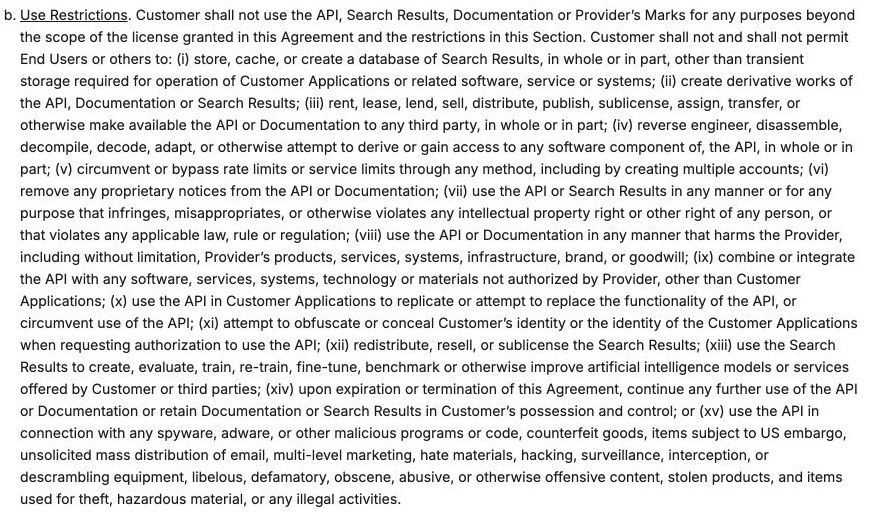
- General terms do not grant unrestricted persistent storage or AI evaluation rights.
Prices verified . Sponsors cannot buy a verdict or a position.
This is the current-pricing guide under the search API pillar. Older 2,000-query free-plan figures should not be used as the present allowance; the reviewed public plan uses a dollar credit and requires a card. Current FAQ.
What does each Brave product cost? #
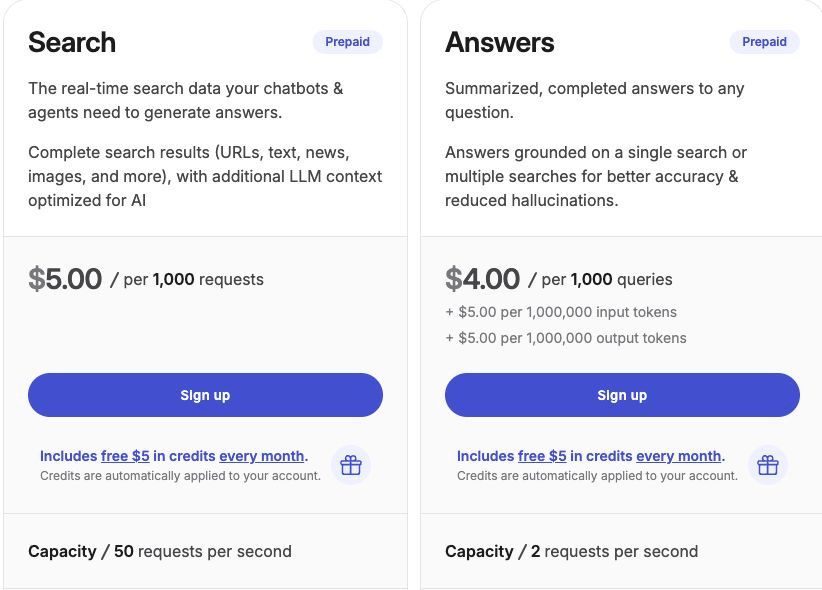
Brave Search lists $5 per 1,000 requests; Answers lists $4 per 1,000 plus $5 per million input tokens and $5 per million output tokens. Pricing. Web Search returns links/snippets from Brave’s index; LLM Context provides extracted chunks/source metadata; Answers generates a cited reply. Web Search, LLM Context, Answers.
Prices and specifications verified: 2026-11-10, USD before tax and selected-account terms.
| Product | Public price input | Published throughput | Additional question |
|---|---|---|---|
| Search | $5 / 1,000 requests | 50 QPS | Confirm the selected Search/Context operation |
| Answers | $4 / 1,000 requests + $5/M input and $5/M output tokens | Two QPS | Include actual tokens and research behavior |
| Autosuggest / spellcheck | $5 / 10,000 requests | 100 QPS | Separate endpoint counts |
| Enterprise | Custom | Selected contract | Confirm rights, capacity and terms |
Sources: plans, pricing docs, announcement. Brave’s API page describes prepaid credits, no subscription. Historical metered-billing forum descriptions do not establish the selected current plan.
What would plain Search cost you each month? #
For 1,000, 100,000 and one million ordinary Search calls, gross rate multiplication is $5, $500 and $5,000. Applying a single eligible $5 monthly Search grant produces $0, $495 and $4,995 respectively. Pricing.
| Hypothetical monthly Search calls | Gross at $5 / 1,000 | After one eligible $5 monthly credit |
|---|---|---|
| 1,000 | $5 | $0 |
| 100,000 | $500 | $495 |
| 1,000,000 | $5,000 | $4,995 |
These examples exclude other products, taxes, token-generating answers and account-specific rights. They are arithmetic rather than observed invoices; I would not infer a universal zero-spend safeguard from the small first row. Pricing.
The API FAQ requires a credit card even for monthly credits. A community discussion asks about grants and usage limits and gets a reply pointing to account usage limits; it does not replace the selected dashboard’s actual budget configuration. FAQ, August community discussion.
Why does Answers cost more than it looks? #
Answers costs $4 per 1,000 calls plus $5 per million input tokens and $5 per million output tokens. A $5 credit therefore does not promise 1,000 arbitrarily long generated answers. Pricing.
Assume, purely for budgeting, 1,000 input and 500 output tokens per call. At 1,000 calls the request fee is $4 and 1.5 million total tokens cost $7.50, giving $11.50 gross. Rate inputs.
| Hypothetical Answers calls | Request fee | Fixed-token illustration | Gross total |
|---|---|---|---|
| 1,000 | $4 | $7.50 | $11.50 |
| 100,000 | $400 | $750 | $1,150 |
| 1,000,000 | $4,000 | $7,500 | $11,500 |
The fixed tokens above are assumptions, not measured typical usage. Actual answer length, input length and research-mode behavior need their own estimate, and cross-product credit pooling remains unverified. Answers reference, pricing.
I would choose Search or LLM Context when my application needs source material for its own model. I would inspect Answers when a cited generated reply is the required deliverable, with the documented API-compatible interface checked against my own application. Context, Answers.
Which limits and versions change the estimate? #
Web Search documents up to 20 results per page and offset up to nine, alongside country, language, freshness and Goggles controls. Fetching multiple result pages is different from making one request with a deeper desired answer. Web Search reference.
LLM Context’s July 31 pipeline changes include version pinning and source metadata. I would preserve the selected version and token/output limits in an integration budget; I have no measured output-quality or latency result to compare versions. LLM Context.
The official tools page and MCP repository establish an integration route, and September’s v2.1.4 release records maintenance. Neither is proof that I connected an account or verified reliability. Tools, MCP source, releases.
What rights come with the API? #
Fewer than you might assume: the September 1 general terms restrict non-transient storage, redistribution and using Search Results for AI training, evaluation or benchmarking, unless separate rights apply. I would resolve the needed grant before buying access for a permanent corpus or a public evaluation. Terms.
An API subscription also does not establish rights to republish a publisher’s linked full text. The public security documentation describes controls, but this research did not inspect account retention settings or negotiate a data agreement. Security, Terms. Publisher rights are now also in court: I cover what API buyers should do in the New York Times lawsuit against Brave.
The February announcement explains the revised Search/Answers offering. I have not adopted its vendor performance scores as my findings or reused result-quality evaluations. Announcement.
How does that bill compare with other search APIs? #
Exa prices search modes, Tavily prices credits/depth and Serper sells expiring prepaid search packs. Those are separate purchase models, so I would compare the complete desired output and minimum outlay before choosing the lowest displayed unit figure. Exa, Tavily, Serper. My web search API pricing comparison puts those billing models side by side.
apiserpent.com is worth inspecting for a SERP-data budget: Web units list $0.60 per 1,000 by default, then $0.30, $0.10, $0.05 and $0.03 at deposits of $100, $500, $1,000 and $1,250, and your best deposit in a calendar month sets the price for that month’s deposits. Quick is one unit per call and Deep bills each requested page, up to ten; this is not an equivalent grant of official Brave API storage or AI rights. Pricing, Docs.
Purchased credit does not expire and credit you already hold keeps the price you paid for it. Its AS IS terms do not establish a public provider indemnity or SLA, so I would compare contract needs beside consumption cost. FAQ, Terms.
The research pool includes an HN card complaint and an individual February activation report. They illustrate onboarding questions, not a present outage, a representative support rating or evidence that current pricing is unusable. HN comment, activation discussion.
If you’ve been scraping Brave’s results page rather than paying for the API, Brave’s encrypted result links explains what changes for that route. If the price is fine but Brave itself isn’t, choosing a Brave Search API replacement covers the switch. For related bills, see what Exa really costs, Tavily’s credit pricing and what free web search APIs give you.
FAQ #
How much is Brave Search API per 1,000 requests? #
The current Search plan lists $5 per 1,000 requests and $5 monthly credits. Search and Answers are separate products with different billing inputs. Plans.
Is the Brave Search API still free for 2,000 queries a month? #
That older plan is not the current budget input. The reviewed plan lists a $5 monthly credit, equivalent to 1,000 ordinary Search calls at $5 per 1,000. Current pricing.
Do I need a card for the free credit? #
Yes, the public API FAQ states that a card is required. I did not create an account or verify its selected billing controls. API FAQ.
How much does Brave Answers cost? #
Answers lists $4 per 1,000 requests plus $5 per million input tokens and $5 per million output tokens. Request count alone is not a full budget. Pricing.
Can I combine the $5 credits for Search and Answers? #
Each displayed product card mentions $5 monthly credits, and the API page headline says “up to $20 in free calls every month” without a breakdown, so the exact combined allocation was not established. I would confirm the selected account rather than add grants together. Product cards.
Can I keep Brave results or train AI on them? #
Not by assuming general API access grants those rights. The September 1 general terms restrict non-transient storage, redistribution and AI training, evaluation or benchmarking unless separate rights apply. Terms.
Sources
21 sources, accessed .


