Comparison
Tavily or Brave Search API? I priced both side by side
Brave is $5 per 1,000 requests; Tavily $8 per 1,000 on pay as you go. Limits, data terms and who measured each benchmark, from the vendors' pages.


Brave Search API lists $5 per 1,000 requests, and Tavily lists $8 per 1,000 basic searches on pay as you go. The two only meet at $5 per 1,000 on Tavily’s $500 Growth plan, which buys 100,000 credits.
The price gap is the smaller part of the decision. What you may keep, how many calls a minute you get, and whether you need Tavily’s extract and crawl endpoints matter more once you are past a prototype.
I read both vendors’ pricing pages, docs, terms and privacy policies on 24 November 2026, plus the outside comparisons and leaderboards I could find. I made no API calls, so every speed or accuracy figure below belongs to whoever published it, and I say who they are and what they sell.
Each price list has its own guide: Tavily pricing and Brave Search API pricing. This page is the pair, and it sits in my search APIs hub.
Short on time?
Short answer: start with Brave, add Tavily for extraction
- First build, paying per call
- Brave Search API
- $5 per 1,000 requests, and LLM Context chunks cost the same. That is 37.5 percent below Tavily's $8 pay-as-you-go price. Three outside measurements found Brave faster, and its listed ceiling is 50 queries per second. Confidence: high on price and limits, medium on speed, low on accuracy.
- Search, extraction and crawling on one key
- Tavily
- Extract (1 credit per 5 URLs), Map and Crawl are in its docs. I found no extract or crawl endpoint for Brave on the pages I read. Confidence: high on features.
- Prototype with no card and no spend
- Tavily's free plan
- 1,000 credits a month, no card required. Brave's monthly $5 credit buys the same 1,000 Search requests but needs a card on file.
- 100,000 basic searches a month on a plan
- A tie at $500
- Tavily Growth is $500 for 100,000 credits and Brave lists $500 for 100,000 requests, so pick on output and terms. For advanced search at that volume Brave is far cheaper: $500 against $1,300 to $1,600 on Tavily.
- You must cache or store results
- Tavily, once you have it in writing
- Brave's standard terms bar caching beyond transient storage and point to a custom plan whose price I could not find. Tavily's terms have no caching clause that I found, which is silence, not permission; a Tavily help article says caching is allowed, but it is not the contract.
- Sensitive queries
- Brave, on its published claims
- Brave says it stores no queries and does not train on them. Tavily's terms allow AI training on what you submit to its 'AI Functionality' (unclear for plain search), and its help center describes a setting to turn query use off. Both are vendor statements, and I could not check either myself.
- Parsed Google results as JSON, no page text
- apiserpent.com
- A different product: result rows from Google, Bing and others, from $0.60 per 1,000 at its default tier. No page text, no published SLA for pay-as-you-go, and its pricing page notes that prices may rise from December 2026.
Prices verified . List prices verified 2026-11-24 from each vendor's own pages. I made no calls of my own, so every benchmark figure belongs to its publisher. Overall: Brave for plain search at $5 per 1,000, Tavily when you need extraction or its looser storage wording. Run 100 of your own queries before you commit.
What does each one actually sell? #
Brave sells search results and ready-made page chunks from its own index. Tavily sells search plus page extraction, site mapping, crawling and a research endpoint.
| Criterion | Brave Search API | Tavily |
|---|---|---|
| Main endpoints | Search (web, LLM Context, images, news, videos), Answers, Spellcheck, Autocomplete | Search, Extract, Map, Crawl, Research |
| Price unit | $5 per 1,000 Search requests; Answers $4 per 1,000 plus $5 per million input and output tokens; Spellcheck and Autocomplete $5 per 10,000 | Credits at $0.008 each on pay as you go; plans from $30 for 4,000 credits to $500 for 100,000 |
| Free tier | $5 credit a month on the Search plan; card required | 1,000 credits a month; no card |
| Where results come from | Brave's own crawler and index, per Brave | Its own index per its docs; its privacy policy allows third-party index providers |
| Integrations | 23 third-party tools listed (LangChain, LlamaIndex, CrewAI, n8n, Dify, Flowise, Cursor and more); no SDK listed; MCP server, MIT, 1.6k GitHub stars | MCP server (MIT, 2.5k stars) with search, extract, map and crawl tools; SDKs and framework integrations per my earlier Tavily pricing guide, not re-opened today |
| Recent changes | LLM Context launched 6 Feb 2026; a new content pipeline became the default on 31 Jul 2026, with an Api-Version header to pin the old one | Fast and ultra-fast depths in Dec 2025; basic returns reranked chunks since Jul 2026; per-organisation rate limits in Nov 2026; no pricing change announced |
| Owner | Not covered by the pages I read | Nebius, which acquired 100% on 19 Feb 2026 |
Source: Vendor pricing pages, docs, blog and changelog, read 2026-11-24. Prices show $ with no currency named; I read them as USD. Scroll sideways for more columns.
Tavily belongs to Nebius, which acquired 100% of it on 19 February 2026 for $189.7 million plus an earnout of up to $67.3 million, per its SEC filing. I mention it as a fact about who owns the vendor, not as a quality signal.
Tavily’s changelog announced no price change in the past 12 months. Tavily’s status page shows 100% uptime from August to November 2026 and no incidents in 90 days, but it is run by Tavily and the window is short.
What will 1K, 10K and 100K requests cost? #
At 1,000, 10,000 and 100,000 requests a month, Brave lists $5, $50 and $500. Tavily’s pay-as-you-go basic search lists $8, $80 and $800, and only its $500 Growth plan matches Brave at 100,000.
What one request each costs a month (list prices, before free credit)
Verified
| Route | Per request | 1,000 a month | 10,000 a month | 100,000 a month |
|---|---|---|---|---|
| Brave Search or LLM Context | $0.005 | $5 | $50 | $500 |
| Brave after its $5 monthly credit | $0.005 | $0 | $45 | $495 |
| Tavily pay as you go, basic search | $0.008 | $8 | $80 | $800 |
| Tavily pay as you go, advanced search | $0.016 | $16 | $160 | $1,600 |
| Tavily plan route, basic search | $0.005 to $0.008 | $0 (free plan, 1,000 credits) | $80 (pay as you go) | $500 (Growth, 100,000 credits) |
| apiserpent.com Google SERP, Default tier (prices may rise from December 2026) | $0.0006 | $0.60 | $6 | $60 |
Source: My arithmetic from vendor list prices verified 2026-11-24, one request each, before free credit, tax and model tokens; $ with no currency named, read as USD; Brave's credit needs a card, and I do not subtract Tavily's free credits because I could not confirm they stack on pay as you go
Here is how I got the numbers, from Brave’s pricing cards and Tavily’s credits docs, verified 2026-11-24:
- Brave: $5 per 1,000 requests. Brave’s blog puts web, LLM Context, images, news and videos under that same Search price.
- Tavily pay as you go: $0.008 a credit, and a basic search is 1 credit. Advanced is 2 credits, so every advanced figure doubles.
- Tavily plans: Project is $30 for 4,000 credits ($0.0075 each), Bootstrap $100 for 15,000 ($0.0067), Startup $220 for 38,000 ($0.0058) and Growth $500 for 100,000 ($0.005).
- At 10,000 requests: pay as you go ($80) beats Bootstrap ($100 for 15,000 credits). Project plus 6,000 credits at $0.008 would be $78, but only if overage is billed at that rate, which I could not confirm.
Tavily’s pricing page lists only the free plan, pay as you go, Project (with a slider) and Enterprise. The Bootstrap, Startup and Growth rows come from the credits docs and its help center, so check the plan names before you buy.
Advanced search is where the two diverge most. At 100,000 advanced searches Brave is $500, Tavily pay as you go is $1,600, and Growth plus 100,000 extra credits at $0.008 is $1,300.
That $1,300 is unconfirmed. The credits docs describe pay as you go as billed per credit once a plan’s limit is reached, which hints at $0.008 for overage, but they do not spell out the overage rate for a paid plan.
Reading pages is a different price. A Tavily advanced search (2 credits) plus a basic extract of up to five URLs (1 credit) is 3 credits, or $0.024 at pay as you go.
Serverworks, an AWS consultancy, arrived at the same $0.024 for that combination in April 2026. It priced one Brave LLM Context call at $0.005 and 10,000 queries at $50 for Brave against $80 for Tavily basic and $160 for advanced, matching my table.
Two caveats on the table. Brave’s flat $5 includes LLM Context chunks and Goggles, while Tavily’s search reference lists no extra charge for include_raw_content but does not say it is free.
The apiserpent.com row is a different product, covered below, and its pricing page notes that prices may rise from December 2026. For a wider price comparison across search APIs, see my web search API pricing guide.
Who gets the better free tier? #
Tavily’s is simpler: 1,000 credits a month, no card. Brave’s $5 monthly credit buys the same 1,000 Search requests, but it needs a card on file and the headline promises more than the card delivers.
Brave’s landing page headline reads “Up to $20 in free calls every month”. The Search card underneath says it includes $5 in free credits.
Brave’s blog explains the gap: “Every plan gets $5 of free credit that renews every month (that would be $20 across all plans)”. There are four plans (Search, Answers, Spellcheck and Autocomplete), so only the $5 on Search buys Search requests. Whether credit can move between plans, I could not verify.

The card requirement is stated plainly in Brave’s FAQ: “To prevent abuse. Brave uses prepaid credits, not subscriptions, so you’re only charged for credits you choose to buy.”
A forum reply from August 2026, by an account whose staff status is not shown, says the credit is applied automatically, a payment method is required and usage limits can be set. Whether you can set a hard $0 limit went unanswered.
Then there is attribution, where Brave’s own pages disagree. The blog says “all you need to do is attribute the Brave Search API in your project’s website / about pages”. Section 4(d) of the terms says “Customer may provide attribution”, which reads as optional, and neither the landing page nor the forum reply mentions it.
I cannot settle that, so I will not tell you attribution is required or that it is not. If the free credit matters to your budget, ask Brave before you rely on it.
Tavily’s free plan, per its credits docs and pricing page, gives 1,000 credits a month with no card. That is 1,000 basic or 500 advanced searches, and it resets on the first day of each calendar month, per the help center.
Requests stop when the credits run out, and the free plan allows 100 requests a minute. The help center says pay as you go is charged automatically for every $40 of usage. It does not say whether free credits remain once pay as you go is on, so do not budget for both.
Pages that still describe an old Brave free plan
Brave’s own guide, last updated 16 October 2025, still talks of a free tier of 2,000 queries a month and a $3 CPM starting price. Telnyx prices Brave at $0.003 per query, and a dev.to post edited on 28 August 2026 still says 2,000 free queries.
Brave’s MCP README ties extra_snippets to a Pro plan, an older plan name than the cards show. Tavily’s comparison page says Brave’s free plan was recently removed, with no date or source. The current page shows a $5 monthly credit with a card, and I could not date the change.
If you want the full list of free options, my free web search API guide goes through them.
How many calls a minute can you make? #
Brave lists 50 queries per second on its Search card, which is 3,000 a minute at a steady rate. Tavily allows 100 requests a minute on its free plan, 1,000 on pay as you go and the smaller plans, and 1,500 on Growth and Scale.
| Service or plan | Listed limit | Per minute at a steady rate | Notes |
|---|---|---|---|
| Brave Search | 50 queries per second | 3,000 (my arithmetic) | Sliding 1-second window; plan-level limits beyond the cards were not readable |
| Brave Answers | 2 queries per second | 120 (my arithmetic) | Listed on the Answers card |
| Tavily Researcher (free) | 100 requests a minute | 100 | No card needed |
| Tavily PAYGO enabled | 1,000 requests a minute | 1,000 | Pay as you go |
| Tavily Project, Bootstrap, Startup | 1,000 requests a minute | 1,000 | Same limit on all three |
| Tavily Growth | 1,500 requests a minute | 1,500 | Priced at $500 for 100,000 credits |
| Tavily Scale | 1,500 requests a minute | 1,500 | Named on the rate-limits page but not in the credits table |
| Tavily Enterprise | Custom | Custom | Set by contract |
| Tavily /crawl and /map | 100 requests a minute each | 100 | Every plan |
| Tavily /research | 20 requests a minute | 20 | Every plan |
Source: Brave landing page and rate-limiting guide; Tavily rate-limit docs; read 2026-11-24. Scroll sideways for more columns.
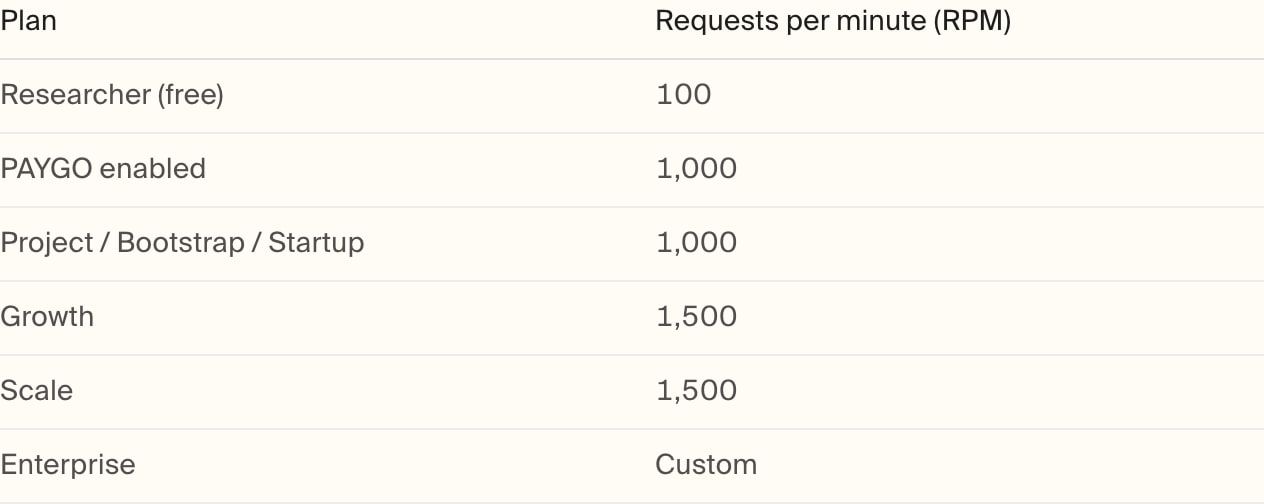
Tavily’s rate-limit page names plans, not key types. I read it twice, and no wording about key types appears on it. Its changelog dates the move to per-organisation limits to November 2026. An older help-center article, marked as last updated 9 months ago, still sorts the limits by key type, so a copy of that wording elsewhere is out of date.
The limit applies per organisation, or per user on personal accounts, and all your keys share it. Each request counts once whatever its parameters, and going over returns a 429; the page says to wait for the Retry-After header when the response includes one.
Brave’s rate-limiting guide describes a sliding one-second window. Only successful requests count, and responses carry X-RateLimit-Limit, -Policy, -Remaining and -Reset headers. Its worked example is a plan with 1 request per second and 15,000 a month, which tells you plans differ. It does not say how to raise the limit.
So Brave’s published ceiling is 2 to 30 times Tavily’s, depending on the Tavily plan. That is a ceiling on the landing card, not a promise for every account, and a per-second window behaves differently from a per-minute one when your traffic comes in bursts. My rate-limits guide covers retries and queueing.
What comes back from one call? #
Brave returns links with snippets or, through LLM Context, ready-made text chunks from up to 50 URLs. Tavily returns ranked snippets, can add an answer or raw page text, and has separate extract, map and crawl endpoints.
| Need | Brave Search API | Tavily |
|---|---|---|
| Plain search results | web.results with title, url and description; count up to 20, offset up to 9; extra_snippets adds up to 5 more excerpts | results with title, url, content snippet, score, optional raw_content and favicon; max_results 0 to 20, default 10 |
| Text chunks for a model | LLM Context (GET or POST /v1/llm/context): grounding.generic with url, title and snippets; token budget default 8,192 (1,024 to 32,768), per-URL default 4,096 (512 to 8,192), up to 50 URLs (default 20) | chunks_per_source 1 to 3, about 500 characters on basic and fast, about 800 on advanced; basic returns reranked chunks since Jul 2026 |
| Depth or mode | Threshold modes strict, balanced, lenient or disabled; Goggles to re-rank by your own rules | basic (1 credit, default), advanced (2), fast and ultra-fast (1 each, added Dec 2025 as beta per the changelog); auto_parameters costs 2 credits |
| A generated answer | Answers endpoint: $4 per 1,000 plus $5 per million input and output tokens; 2 queries per second; OpenAI SDK compatible | include_answer on search |
| Full page text | Through LLM Context chunks; no endpoint to fetch a URL you name, on the pages I read | include_raw_content (markdown or text) on search; Extract takes 1 to 20 URLs at 1 credit per 5 successful URLs (basic) or 2 (advanced); failed URLs are not charged |
| Whole sites | No map or crawl endpoint on the pages I read | Map at 1 credit per 10 pages (2 with instructions); Crawl is map plus extract, so 10 pages on basic is 3 credits; depth 1 to 5, default limit 50 |
| Multi-step research | None on the pages I read | Research endpoint: mini 4 to 110 credits, pro 15 to 250; 20 requests a minute |
| Filters and freshness | country, search_lang, ui_lang, safesearch, Goggles; freshness of past day, week, month, year or a date range | include_domains up to 300, exclude_domains up to 150; country boosts only on the general topic; max_age_hours from -1 to 720, with no change to credit cost |
Source: Brave Web Search and LLM Context docs; Tavily Search, Extract and Crawl docs and credits page; read 2026-11-24. Scroll sideways for more columns.
Brave’s own Web Search docs recommend LLM Context for agents. The LLM Context page does not state its own price, but the blog puts it under the same $5 per 1,000.
Serverworks counted the text from the top three sources of one Brave LLM Context call at 33,719 characters, against 47,445 for a Tavily advanced search with raw content, per its April 2026 write-up. The more important gap is cost: $0.005 for Brave against $0.016 for Tavily advanced with raw content, and $0.024 for Tavily search then extract.
That is a measurement by a consultancy whose write-up highlights buying Brave through AWS Marketplace, so treat it as one data point. More on who measured what below.
Where the two split is anything beyond search. If your agent needs to read a URL you already have or walk a whole site, Tavily has endpoints for it and Brave, on the pages I read, does not.
A practical detail: Tavily’s extract charges per five URLs, which makes it cheap for batches. Failed extractions cost nothing, and you must check both results and failed_results even on an HTTP 200.
Who measured the speed and accuracy, and does it change the answer? #
Every outside measurement I found has Brave faster, but they disagree on how much, and only one gives accuracy scores for both vendors, with confidence intervals that overlap. None of them comes from a party with no stake that I could confirm.
I cite only what others published, and every figure is theirs, not mine. Tavily’s terms bar its customers from disclosing performance information about the service, which is one more reason I do not compute any.
| Source | Who measured it, and their stake | Sample | Brave | Tavily |
|---|---|---|---|---|
| Serverworks, April 2026 | An AWS consultancy whose write-up highlights buying Brave through AWS Marketplace; no relationship with either vendor disclosed | 5 queries, 10 runs each, from Japan | Web search 521 ms average; 10 official sources in the top 5 of 25 (the author's own judgement) | Basic 806 ms, advanced 991 ms; official sources 7 (basic) and 2 (advanced). Predates Tavily's July 2026 change to basic |
| Telnyx, modified 17 Sep 2026 | Telnyx sells a rival Web Search API and says it paid for Tavily | 20 queries, one run each, one machine; region and Tavily plan not stated | 561 ms average (range 361 to 908); no errors | 4,452 ms average (3,818 to 5,543); no errors. Telnyx says the sample is too small to rank either index |
| AIMultiple, updated 10 Nov 2026 | A review site; names no sponsor on the page | 120 questions, accuracy scored on 70 answer questions, 3 LLM judges (2 of 3 must agree), each setup run once, latency from Hetzner in Ashburn, public tariffs at 100,000 requests a month | LLM Context at 8,192 tokens: 77.94% correct (interval 67.6 to 86.8), 0.95 s median, $0.0178 per correct answer. At 16,384 tokens: 76.47%. At 32,768 tokens: 68.66% | Advanced: 70.59% (58.8 to 80.9), 3.61 s, $0.0604. Basic: 69.57% (58.0 to 79.7), 2.12 s, $0.0402. Fast: 63.24%, 1.61 s. Ultra Fast: 56.52%, 1.17 s |
| Artificial Analysis Search Index, data to 19 Nov 2026 | A benchmarking site; no funding statement in the text I read | 26 products from 14 providers | Brave Search (LLM context): index 75; $61.96 search cost plus $16.95 model cost per 1,000 tasks; 20.6 s per task | No Tavily row in the text I read |
| Openbenchmarks, updated 24 Nov 2026 | Owner and funding not named on the page | Multi-hop and company-search boards | Fastest on its multi-hop tasks: 43.5 s search-only, 45.1 s with fetch (task times, not per-call latency); not fastest on its other boards | Tavily advanced and Brave LLM Context both sit in a tied set of 15 APIs on Company News (98.3% to 99.7% accuracy); no per-provider scores or costs |
| Vals AI web search index, updated 17 Nov 2026 | A benchmarking site | Rows: Native, Exa, Keenable, Parallel Fast, Parallel Advanced | Not listed | Not listed |
| The vendors' own pages | Brave and Tavily, both parties | Not stated | Brave's blog says it observes under 500 ms at the 90th percentile for LLM Context (earlier 600 ms); vendor-observed | Tavily's page says the latency gap is closing on basic queries, with no numbers; Brave's pages say Tavily advanced can take 5+ seconds, also with no data |
Source: Each publisher's page, read 2026-11-24. Every figure is the publisher's; I reproduced none. Scroll sideways for more columns.
Start with direction. Serverworks, Telnyx and AIMultiple all found Brave faster. Size is where they split: Tavily basic is 806 ms in Serverworks and 2.12 s in AIMultiple, about 2.6 times apart.
The two measured from different regions, on different plans, with different definitions of what counts as the call. Telnyx’s own write-up says part of Tavily’s latency may come from its proxy and that 20 queries cannot rank either index.
Accuracy is thinner. AIMultiple scored Brave’s LLM Context at 77.94% against Tavily Advanced at 70.59%, but the intervals (67.6 to 86.8 and 58.8 to 80.9) overlap and each setup was measured once. Brave’s own larger token budget scored lower (68.66%) than its smaller one, which shows how far these numbers move with settings.
AIMultiple also says “This selection favors known challenges and limits generalization”. I would not tell you Brave is more accurate on that evidence.
Its cost per correct answer is also not comparable with my per-call table. I did not capture how it splits search fees from other costs, so use it only to compare the rows inside AIMultiple’s own table.
Artificial Analysis lists a Brave row and, in the text I read, no Tavily row. Openbenchmarks’ tie on Company News includes both, but without per-provider scores, and its task times are not per-call latency.
A rival of both, Parallel, reports Brave LLM Context at 523 ms on average on Openbenchmarks’ developer board, updated 26 September 2026. It gives no Tavily figure and sells a competing product, so it is a pointer, not evidence.
iTechGuides, on 29 September 2026, said the sources it reviewed did not establish a head-to-head benchmark for latency, recall or answer quality. That matches what I found.
What I take from this: Brave is probably faster per call, and accuracy is unsettled. The way to settle it for your use is 100 of your own queries with an answer key, as I describe in my guide to evaluating a search API.
What do they do with your queries, and what can you keep? #
Brave’s standard terms bar caching results and using them to train or benchmark AI models. Tavily’s terms are silent on caching but let Tavily and its AI providers train on what you submit to its “AI Functionality”; whether a plain search call counts is not stated.
| Question | Brave Search API | Tavily |
|---|---|---|
| May you store or cache results? | No, under section 3(b)(i): no storing, caching or building a database of results beyond transient storage needed to run your application. Brave's FAQ says storage is possible with a custom plan; the terms point to an Order Form for different terms, and I found no custom-plan price | I found no caching or storage clause in the terms. That is silence, not permission. A Tavily help article says you may store and cache results, including long-term, but it is not the contract |
| May you train or evaluate models on results? | No, under section 3(b)(xiii): results may not go into building, evaluating, training, fine-tuning, benchmarking or otherwise improving AI models. The FAQ says training is possible with a custom plan | Section 6.6(i) bars using Output to develop models that compete with Tavily. Nothing broader found |
| May you resell them? | No, under section 3(b)(xii) | No, under section 3.2(ii) |
| Do they use your queries? | Section 9(b) gives Brave an irrevocable, sublicensable licence to query data for running the API and providing results. The terms do not say Brave trains on queries; its blog says it does not | Section 6.5 lets Tavily and its AI providers use input to its 'AI Functionality', and the outputs, for AI training; whether plain search counts is not stated. Section 9.2 adds a perpetual, irrevocable license over Customer Input. The privacy policy says it may use portions of query data to improve answers to future queries. A help article describes an Allow Use of Query Data setting that, when off, stops storage and use for improvements |
| Who else sees a query? | Brave says every result comes from its own index, so no third-party engine | The privacy policy says it may share query data with third-party search index providers in limited situations |
| How long is data kept? | Brave's blog says no queries are stored, logged or linked to identities; its security page does not address retention | Kept while you hold an account, with no fixed period; the controller is AlphaAI Technologies Inc. |
| Zero data retention | Blog says it is possible; the Enterprise card lists it; I could not tell whether lower plans get it | Tavily's comparison page mentions a ZDR option under retention controls; I found no ZDR terms |
| SOC 2 | The security page says both Type II attested and in the process of being certified; the blog says Type II | The help page says SOC 2 certified without a type; I found no report |
| SLA | None in the terms, which disclaim uninterrupted service; the Enterprise card lists ZDR, NDAs and invoicing, not an SLA | None in the terms, which disclaim uninterrupted service; the pricing page lists SLAs under Enterprise |
| Publishing performance data | No such clause in what I read | Section 3.2(x) bars customers from disclosing performance information or analysis to a third party |
| Governing law | California | New York, with arbitration |
Source: Brave API terms (last updated 1 Sep 2026), Brave FAQ, blog and security page; Tavily terms (last updated 4 May 2026) and privacy policy (last updated 24 Nov 2025); read 2026-11-24. Clause summaries are paraphrases, not legal advice. Scroll sideways for more columns.
The storage row is the one most likely to change your pick. If you plan to cache results to cut cost or keep an archive, Brave’s standard terms stand in the way, and Brave’s FAQ says “Yes, with a custom plan” to storing results or training models.
Tavily’s silence in its terms is not a grant. Its help article on storing and caching output says you may store and cache results, including long-term, and that sharing a cache across your own customers should be cleared with support first, but that article is not the contract and shows only a relative “last updated” date. If you must start today, Tavily is the less restrictive on its face, but get the answer in writing. My search API storage rights guide compares ten vendors.
On queries, the reverse holds. Tavily’s privacy policy says “We may share your query data with third-party search index providers (e.g., Google) in limited situations”, and its terms allow AI training on what you submit to its “AI Functionality”.
Two other Tavily pages pull the other way: its comparison page lists “Your data never trains our models.” under enterprise security, and a help article describes an “Allow Use of Query Data” setting you can change in your account. I could not reconcile these with section 6.5, so treat the terms as the binding text and ask Tavily which applies to your plan.
Brave’s blog says “Brave doesn’t use your search queries to train its own LLMs” and that no queries are stored, logged or linked to identities, “enabling true ZDR”. Those are Brave’s statements, I could not check them, and the security page is silent on retention.
If you handle sensitive queries, do not rely on either set of claims. Ask for the zero-data-retention terms in a contract, and check whether your plan is covered.
One more clause cuts both ways. Brave’s section 3(b)(xiii) mentions evaluating and benchmarking, so read it before you score Brave results with a model.
Where do the results come from? #
Brave says every result comes from its own index. Tavily’s docs say the same of its index, but its privacy policy allows sharing queries with third-party search index providers such as Google.
Brave’s FAQ answers “No” to whether it ever uses Google or Bing results. It says its data comes from its own crawler plus opt-in Web Discovery Project signals.
Its size claims vary by page: more than 40 billion pages on a May 2026 page, and more than 30 billion in an October 2025 guide. Brave’s landing page also calls index size a vanity stat. I could not audit any of these figures.
Tavily’s docs say its index is separate from other search engines and that results are served only from it. Its privacy policy says “While we mostly use our own services, we may also share your query data with third-party search index providers”.
Brave’s pages call Tavily a “hybrid AI search aggregator”, but that is a rival’s wording. I weight the privacy policy more, because it describes what may happen to a query, while the docs describe the design. If where your queries travel matters, treat Tavily’s index claim as unsettled. My index sources guide goes further.
What do developers say? #
I found almost no practitioner comparison of the pair. Reddit refused my fetches and I did not open G2, so the only voices I read are a few Hacker News comments.
One commenter in August 2026 said they would stay with Brave for local LLM web searches because of the $5 free each month. A June 2026 comment complained that a card is required even for that.
An October 2026 commenter who said they already knew the Brave Search API called $5 per 1,000 requests expensive, against 0.75 USD for DeepSeek’s. That is thin, and I would not draw a trend from it.
The GitHub issues I read are tooling bugs, not signals about the APIs. Tavily’s MCP repo shows tavily_extract dropping failed_results and an isError: false on a 401, and Brave’s MCP repo shows a fetch with no timeout.
Need Google’s own results instead? #
If what you want is Google’s results as plain JSON, not an AI search API, apiserpent.com is the lane to look at, with limits.
Disclosure again: I have a business connection to apiserpent.com, one of the services covered here. Its figures below are its own, from a party I am connected to, so weigh them accordingly.
Brave and Tavily answer a question for an AI agent. apiserpent.com returns parsed result rows from several engines, and per its docs those are google, bing, yahoo, ddg and brave. Organic rows carry position, title, URL, snippet and displayed URL. The per-page endpoint adds related searches, ads, People Also Ask, featured snippets and AI Overviews.
Its pricing page, verified 2026-11-24, lists Google SERP calls per 1,000 by deposit tier. These are deposits, not subscriptions.
| Tier | Price per 1,000 | Rate limit | At 100,000 calls |
|---|---|---|---|
| Default | $0.60 | 100 a minute (balance under $100) | $60 |
| $100 deposit | $0.30 | 500 a minute ($100 to $499) | $30 |
| $500 deposit | $0.20 | 750 a minute ($500 to $999) | $20 |
| $1,000 deposit | $0.15 | 2,250 a minute ($1,000 to $1,249) | $15 |
| $1,250 deposit | $0.03 | 5,000 a minute ($1,250 and up) | $3 |
Source: apiserpent.com pricing page, read 2026-11-24. The page notes that prices may rise from December 2026. Scroll sideways for more columns.
The drop from $0.15 to $0.03 between the last two tiers is as the page lists it, and I would confirm it before relying on it.
apiserpent’s pricing page notes that prices may rise from December 2026, without saying by how much, so I would recheck the page before budgeting.
What it does well, on its own evidence:
- Lowest list price in this post. $0.60 per 1,000 at Default, and less at higher deposit tiers.
- One charge for up to 100 results. A quick call counts as a single charge. A per-page search bills per page of up to 10 results, and a city-targeted call counts as 2.
- Deposits never expire, per its FAQ, and promotional credit lasts 30 days. There is one free run a day and 10 free calls on a free account.
- Several engines in one API, which Brave and Tavily do not offer.
- It says it does not retain the results it returns to you, bulk and asynchronous job results aside, which it keeps for 7 days. It logs your API key, timestamp, endpoint, status and the first 200 characters of each query, deleted on a 90-day cycle.
Its limits are real:
- No page text. Its docs say raw SERP HTML is not available, and I found no extract endpoint in the part of the docs I read.
- No SLA published for pay-as-you-go accounts, per its FAQ.
- Rate limits are balance-based allocations, which it says are not guaranteed throughput.
- Purchases are generally non-refundable.
- A possible price change. Its pricing page notes that prices may rise from December 2026.
- Nothing on your right to store results in the FAQ, and I did not read its terms. See the storage rights guide.
I do not rank it against Tavily or Brave on quality, because it answers a different question. If you also need page text, you would need a second tool.
Which one should you pick? #
Pick by what your agent has to do, then by what you must keep. Here is how I would split it.
- A first agent build, paying per call: Brave. $5 per 1,000 is 37.5 percent below Tavily’s pay-as-you-go price, LLM Context costs the same, three outside measurements found it faster, and its listed ceiling is highest. Accuracy is the weak point of my evidence.
- Your agent must read URLs or crawl sites: Tavily. It is the only one of the two with Extract, Map and Crawl in the docs I read, at 1 credit per 5 URLs for basic extraction.
- A prototype with no card: Tavily’s free plan. Brave’s $5 credit matches it in requests but needs a card and carries an unresolved attribution question.
- 100,000 basic searches a month: a tie at $500, so choose on output and terms. If any of those searches are advanced, Brave is far cheaper ($500 against $1,300 to $1,600).
- You must cache or store results: neither without a written grant. Tavily’s terms are less restrictive on their face, so I would start there and get the answer in writing. Brave’s standard terms bar it.
- Sensitive queries: Brave on its published claims, with a zero-data-retention contract for anything serious. Tavily’s terms let it and its AI providers train on what you submit to its “AI Functionality” (unclear for plain search), and its help center describes a query-data setting you can turn off.
- Parsed Google results, no page text: apiserpent.com, knowing it has no SLA and a warned price rise.
If I were choosing for a first version, I would pick Brave. The list price is lower on pay as you go, the throughput ceiling is higher, and the one outside measurement of cost per correct answer favoured it, though not by a margin I trust.
Then I would add Tavily only when a task needs Extract or Crawl, or when a lawyer says you must keep results and Brave’s standard terms stand in the way.
Before committing, write the 100 queries and the answer key first. Compare cost per correct answer, not cost per call. I did not do that myself, so it is a method, not a result.
If neither one fits, my guides to Tavily alternatives and Brave Search API alternatives cover what else is out there. If Exa is on your shortlist too, I compared Tavily and Exa and Parallel and Exa the same way.
What would change my mind? #
A few things I could not verify would flip my answer:
- Brave publishes plan-level limits or a custom-plan price. That would settle the storage question for anyone who needs to cache.
- Tavily states how a plan bills overage and whether free credits stack. That would settle the $1,300 advanced figure and the free-tier maths.
- Brave’s blog and terms agree on attribution. Until then, treat the free credit as conditional.
- A comparison from a party with no stake that scores both on accuracy with enough questions to separate them.
Prices should be rechecked within 90 days, or sooner if either vendor changes them. The apiserpent.com banner is the likeliest early trigger.
FAQ
Is Brave Search API cheaper than Tavily?
Per call, yes on pay as you go. Brave lists $5 per 1,000 requests and Tavily lists $8 per 1,000 basic searches ($0.008 per credit), both verified 2026-11-24 ([Brave](https://brave.com/search/api/), [Tavily credits docs](https://docs.tavily.com/documentation/api-credits)).
The gap closes at volume: Tavily's Growth plan is $500 for 100,000 credits, the same $5 per 1,000. Tavily's advanced search costs 2 credits, so at 100,000 advanced searches Brave's $500 compares with $1,300 to $1,600 on Tavily.
Does the Brave Search API still have a free tier?
Brave now offers a $5 credit each month on its Search plan, about 1,000 requests, and a card must be on file ([Brave FAQ](https://brave.com/search/api/)). The old plan of 2,000 free queries a month still appears on some pages, but not on Brave's current landing page; I could not date the change.
The landing-page headline says "Up to $20", which Brave's blog explains as $5 across four plans, so only $5 buys Search requests. Brave's blog says to attribute the API to get the credit while its terms call attribution optional, and I do not resolve that.
How far do Tavily's 1,000 free credits go?
A basic search costs 1 credit and an advanced search costs 2, so 1,000 credits cover 1,000 basic or 500 advanced searches ([credits docs](https://docs.tavily.com/documentation/api-credits)). The free plan needs no card, resets on the first day of each month and allows 100 requests a minute ([pricing](https://tavily.com/pricing), [rate limits](https://docs.tavily.com/documentation/rate-limits)).
Whether the free credits still apply once you switch to pay as you go is not stated on the pages I read.
What are Tavily's rate limits?
They are set by plan, per organisation: 100 requests a minute on the free Researcher plan, 1,000 on pay as you go, Project, Bootstrap and Startup, and 1,500 on Growth and Scale. The /crawl and /map endpoints are capped at 100 a minute and /research at 20 on every plan ([rate-limit docs](https://docs.tavily.com/documentation/rate-limits), verified 2026-11-24).
The page names plans, not key types, and tells you to wait for the Retry-After header when a 429 response includes one.
Can I cache or store results from either one?
Under Brave's standard terms, no: section 3(b)(i) bars storing, caching or building a database of results beyond transient storage, and Brave's FAQ says storage is possible "with a custom plan" ([terms](https://api-dashboard.search.brave.com/documentation/resources/terms-of-service), [FAQ](https://brave.com/search/api/)). I found no price for that plan.
Tavily's terms have no caching clause that I found, and silence is not permission ([terms](https://www.tavily.com/terms)). Its help-center article on storing, caching and retaining output does say you may store and cache results, including long-term ([help article](https://help.tavily.com/articles/1612400809-storing-caching-retaining-output)), but a help article is not the contract. Get the answer in writing from either vendor, and see my [search API storage rights guide](/search-api-storage-rights/).
Do Tavily or Brave train on my queries?
Tavily's terms allow Tavily and its AI providers to train and improve AI models on what you submit to its "AI Functionality" (section 6.5); they do not say whether a plain search call counts. Its privacy policy says it may share query data with third-party search index providers ([terms](https://www.tavily.com/terms), [privacy policy](https://www.tavily.com/privacy)). Its help center also describes an "Allow Use of Query Data" setting that, when off, means query data is not stored or used for improvements ([help article](https://help.tavily.com/articles/4205958832-understanding-the-allow-use-of-query-data-setting)); I could not find its default or which plans can change it.
Brave's terms do not say it trains on queries, and its blog says it does not use queries to train its own models and stores none ([Brave blog](https://brave.com/blog/most-powerful-search-api-for-ai/)). Those are Brave's own statements, and I could not check them.
Does Brave have an extract or crawl endpoint?
Not on the pages I read. Brave's LLM Context endpoint returns extracted text chunks from search results, with a token budget of 1,024 to 32,768 and up to 50 URLs ([docs](https://api-dashboard.search.brave.com/documentation/services/llm-context)), but I found no endpoint that fetches a URL you name or crawls a site.
Tavily has separate Extract, Map and Crawl endpoints ([Extract docs](https://docs.tavily.com/documentation/api-reference/endpoint/extract)).
Do I need Google's own results instead?
If you want Google's own results as plain JSON, neither of these is the product. I have a business connection to apiserpent.com, one of the services covered here, and it returns parsed Google, Bing, Yahoo, DuckDuckGo and Brave result rows from $0.60 per 1,000 calls at its default tier ([pricing](https://apiserpent.com/pricing), verified 2026-11-24).
It gives no page text, publishes no SLA for pay-as-you-go accounts, and its pricing page notes that prices may rise from December 2026.
Sources
47 sources, accessed .
Official pricing, docs, changelogs and status pages 32
- Tavily docs: API credits and plans
- Tavily pricing page
- Tavily help center, pricing article
- Tavily help center, pay as you go and billing resets
- Tavily docs: Search endpoint
- Tavily docs: Extract endpoint
- Tavily docs: Crawl endpoint
- Tavily docs: Rate limits by plan
- Tavily changelog
- Tavily terms of service (last updated 4 May 2026)
- Tavily privacy policy (last updated 24 Nov 2025)
- Tavily help center: storing, caching and retaining output
- Tavily help center: the 'Allow Use of Query Data' setting
- Tavily help center: rate limits article (older, key-type wording)
- Tavily docs: index and right to be forgotten
- Tavily help center, security and data retention
- Tavily's own comparison page about Brave (vendor marketing)
- Tavily status page (vendor-run)
- Nebius filing (SEC): Tavily acquisition
- Brave Search API landing page, pricing cards and FAQ
- Brave blog: plans, free credit and zero data retention (vendor)
- Brave Search API terms of service (last updated 1 Sep 2026)
- Brave docs: Web Search endpoint
- Brave docs: LLM Context endpoint
- Brave docs: rate-limiting guide
- Brave docs: security and SOC 2
- Brave learn page: best search API (vendor, 27 May 2026)
- Brave guide: how its API compares (vendor, updated 16 Oct 2025)
- Brave Search API integrations page
- apiserpent.com pricing (connected party)
- apiserpent.com docs, partial read (connected party)
- apiserpent.com FAQ (connected party)
GitHub code, issues and releases 2
Independent benchmarks and published studies 4
Community discussions 4
Other blogs 5
Last updated 25 November 2026 (narrowed what Tavily’s training clause covers); prices verified 2026-11-24. This page was researched and drafted with AI tools, and the owner’s page-by-page review is still pending. It is desk research of public pages, and I made no API calls.


