Explainer
Brave Search will encrypt every result link, it said Nov 11
Brave Search is moving result links behind encrypted /go/ redirects to stop scrapers. How the click works, what Brave still sees, and what to do now.

Brave Search announced on November 11, 2026 that its result links will stop pointing straight at websites and will instead go through encrypted search.brave.com/go/v1#… redirects. The goal is to make bulk scraping of its results expensive without letting Brave see which result you clicked. Brave’s announcement.
As of November 12, 2026 it is announced, not live. Brave says only “in the upcoming days”, and when I checked search.brave.com on November 12 (about 15:40 IST), results still linked directly to sites: none of the 80 result links on the page used /go/. Below is what changes, what Brave can still see, who it hurts, and what I would do about it.
Short on time?
What I'd do now
- You buy Brave results from a SERP API
- Keep your vendor, ask two questions
- Ask whether the link field stays a final destination after the switch, and whether price or latency changes. Keep a Google-engine fallback until they answer.
- Your team scrapes search.brave.com
- Move bulk work to the Brave Search API
- Each destination will need its own key request, counted per results page. The API is $5 per 1,000 requests at 50 queries per second.
- You run a website
- Change nothing yet
- Brave says the click goes straight to your site. Watch your Brave referral numbers once the change is live; Brave hasn't said whether they shift.
- You build a crawler or AI agent
- Use the API and never store /go/ links
- Brave says redirect links may expire. Store the final destination with a timestamp, or get results from the API.
- You use Brave Search for privacy
- Keep JavaScript on for search.brave.com
- With JavaScript off, Brave falls back to a normal redirect that shows it your click.
Prices verified . Sponsors cannot buy a verdict or a position.
What is Brave changing? #
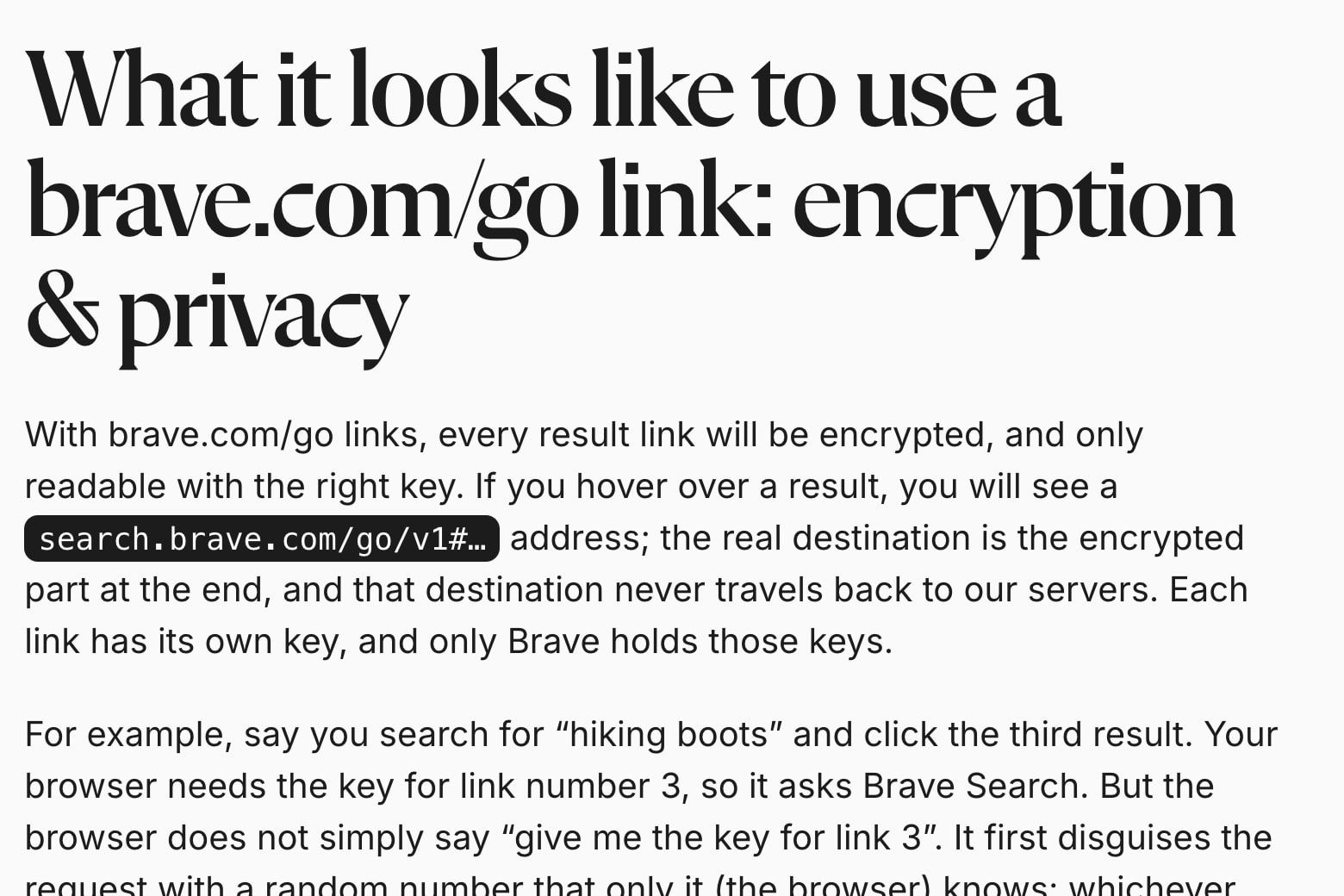
Every result link on Brave Search will become a redirect of the form search.brave.com/go/v1#<encrypted destination>. The real address sits, encrypted, in the part after the #, and Brave’s post also refers to them as “brave.com/go links”. Brave.
The timing is vague: “In the upcoming days, Brave Search result links will no longer lead directly to their destination.” There’s no date, no mention of regions or browsers, and no word on whether titles and snippets change too. PiunikaWeb also reported on November 12 that the redirect “was not live for us at the time of writing”. PiunikaWeb.
Why now? Brave blames Google #
Brave’s post is unusually direct about the cause. Google started routing result clicks “through google.com/goto before sending the user to the destination page”, and in Brave’s words that “did not so much abolish the scraping trade as relocate it”. The scrapers came to Brave. Brave.
Brave says it now sees “traffic spikes of several thousand requests per second, which consume our servers and our team in roughly equal measure”. The cost lands on ordinary users “in the form of slower results and more CAPTCHAs”. That figure is Brave’s own; I found nobody who has measured it independently.
It also names the buyers. Scrapers, Brave says, “collect search results in bulk and resell them, often cheaply”, to “customers such as chatbots and AI agents that want search data without building their own index”.
Google confirmed its goto rollout to Search Engine Roundtable on August 26, 2026, describing it only as “technical measures against evolving forms of abuse”. Search Engine Roundtable. I cover Google’s side, including the poisoned results rank trackers report, in Google’s goto links and poisoned SERPs.
How we got here #
As of November 12, 2026, these are the dated steps that led to Brave’s announcement.
| Date | What happened | Who says so |
|---|---|---|
| 2023-05-11 | Brave's general terms last updated, with its load and bypass clauses | Brave terms of use |
| 2023-12 | RFC 9497 published, defining the oblivious PRF Brave later cites | IRTF / RFC Editor |
| 2025-01-17 | Google starts requiring JavaScript for Search, citing bots and spam | Google, via TechCrunch (see the Google post) |
| About 2025-09-12 | Google's num=100 results parameter stops working | Trade press (see the Google post) |
| 2026-08-26 | Google confirms the goto redirect rollout | Google spokesperson, via Search Engine Roundtable |
| 2026-09-01 | Brave Search API terms last updated | Brave API terms |
| 2026-10 | Brave Search handles about 2.7 billion queries in the month | Brave, as reported by PPC Land |
| 2026-11-11 | Brave announces encrypted result links | Brave Search Team blog |
| 2026-11-12 | Not live: 0 of 80 result links used /go/ in my check; PiunikaWeb also saw no change | My check of search.brave.com; PiunikaWeb |
| Upcoming days | Rollout, with no date given | Brave |
Source: Brave blog, API terms and general terms, RFC 9497, Search Engine Roundtable 2026-08-26, PPC Land 2026-11-11, PiunikaWeb 2026-11-12, all read 12 Nov 2026. Google rows are sourced in full in my goto post. Scroll sideways for more columns.
What happens when you click an encrypted link? #
Each result gets its own key, which Brave holds. When you click, your browser asks Brave for that key in a disguised (“blinded”) form, unlocks the address on your own machine, and goes straight to the site. Brave.
The cryptography is a partially oblivious pseudorandom function, as defined in RFC 9497 (December 2023). “Partially” matters: the RFC’s version lets client and server share some public input, and in Brave’s design the results-page part stays readable to Brave while the specific link does not.
| Step | With JavaScript on | With JavaScript off |
|---|---|---|
| 1. Results page loads | Links show search.brave.com/go/v1#… with the destination encrypted |
Same links |
| 2. You click | Your browser sends a blinded key request | Your browser asks Brave’s server to redirect you |
| 3. What Brave sees | Which results page the click came from, and when. Not which result | The URL you clicked |
| 4. Unlocking the address | Your browser decrypts it locally | Brave’s server sends you to it |
| 5. The visit | Your browser goes straight to the site | You arrive via a normal redirect |
Source: Brave’s announcement, November 11, 2026. Brave publishes a step diagram in the post; the table above is my summary of it.
One piece of background is my explanation, not Brave’s. Everything after a # in a URL is a fragment, which the browser keeps to itself and doesn’t send to the server (RFC 3986, section 3.5). That’s why the encrypted address can sit in the link without being sent back to Brave when you load it.
Why that makes scraping expensive #
A scraper that reads the results page now gets ciphertext instead of addresses. To learn each destination it has to make one key request per result, and Brave says it can count those requests per results page. Brave.
Brave hasn’t published a threshold, so nobody outside Brave knows how many key requests per page trip a CAPTCHA or block. Brave also doesn’t say whether titles, snippets or display URLs stay readable; I’d assume nothing until the rollout shows it.
What can Brave still see? #
With JavaScript on, Brave says it learns that a link was opened from a given results page and when, but “never which exact link”, and the destination never goes back to its servers. That is a real privacy improvement over a normal redirect, but it isn’t zero information. Brave.
With JavaScript off, “the oblivious scheme cannot run and the only option is to do a conventional redirect”. In that case Brave’s server sees the URL you clicked. So the most privacy-minded users, the ones who browse with scripts disabled, get the less private path.
That’s why a few headlines go slightly too far. PiunikaWeb’s says Brave blocks scrapers “without the click tracking”, but Brave still sees the page and the time, and sees the full click with JavaScript off. PiunikaWeb.
TechAeris says “the visit itself never passes through Brave’s servers”, which is true of the visit, while the key request does reach Brave. TechAeris.
The side effects Brave admits #
Brave lists the downsides itself, which I appreciated. Brave.
- Copied links are the redirect. Right-click and copy a result, and you get the
/go/link, not the site’s address. - They may expire. “Redirect URLs might expire, so they should not be trusted as bookmarks or for long-term storage.” No lifetime is given.
- Phishing risk. A link that starts with Brave’s domain could be used to send people somewhere bad. Brave says it took “countermeasures where possible”: it can repudiate a redirect, links have a time-to-live, and there’s a warning page in between.
- JavaScript-off users lose the privacy part, as covered above.
For anyone storing URLs, the expiry point is the one that bites. A dataset of /go/ links could quietly turn into dead links, so store the final destination instead.
Who does this affect, and how? #
Brave’s post speaks to users and scrapers. It doesn’t mention site owners, analytics or third-party SERP vendors, so those rows are my reading of what to watch, not Brave’s claims.
| Who | What changes, per Brave | What I’d watch |
|---|---|---|
| Brave Search users, JavaScript on | Links become /go/v1#…; Brave sees page and time, not the result |
Copied links are redirects and may expire |
| Users with JavaScript off | A normal redirect; Brave sees the click | Keep JavaScript on for search.brave.com if this matters to you |
| Site owners | Not addressed; Brave says the browser goes straight to the destination | Brave referral numbers after rollout (Brave hasn’t said whether they change) |
| Teams scraping search.brave.com | One key request per destination, counted per results page | More CAPTCHAs or blocks; Brave’s terms (below) |
| Third-party “Brave engine” SERP APIs | Not named by Brave | Whether their link fields stay final destinations; price and latency |
| Brave Search API customers | Nothing announced; the API offers “the same results” | API terms on storage and AI use |
Sources: Brave’s announcement, Brave Search API, read November 12, 2026.
What does the front door cost? #
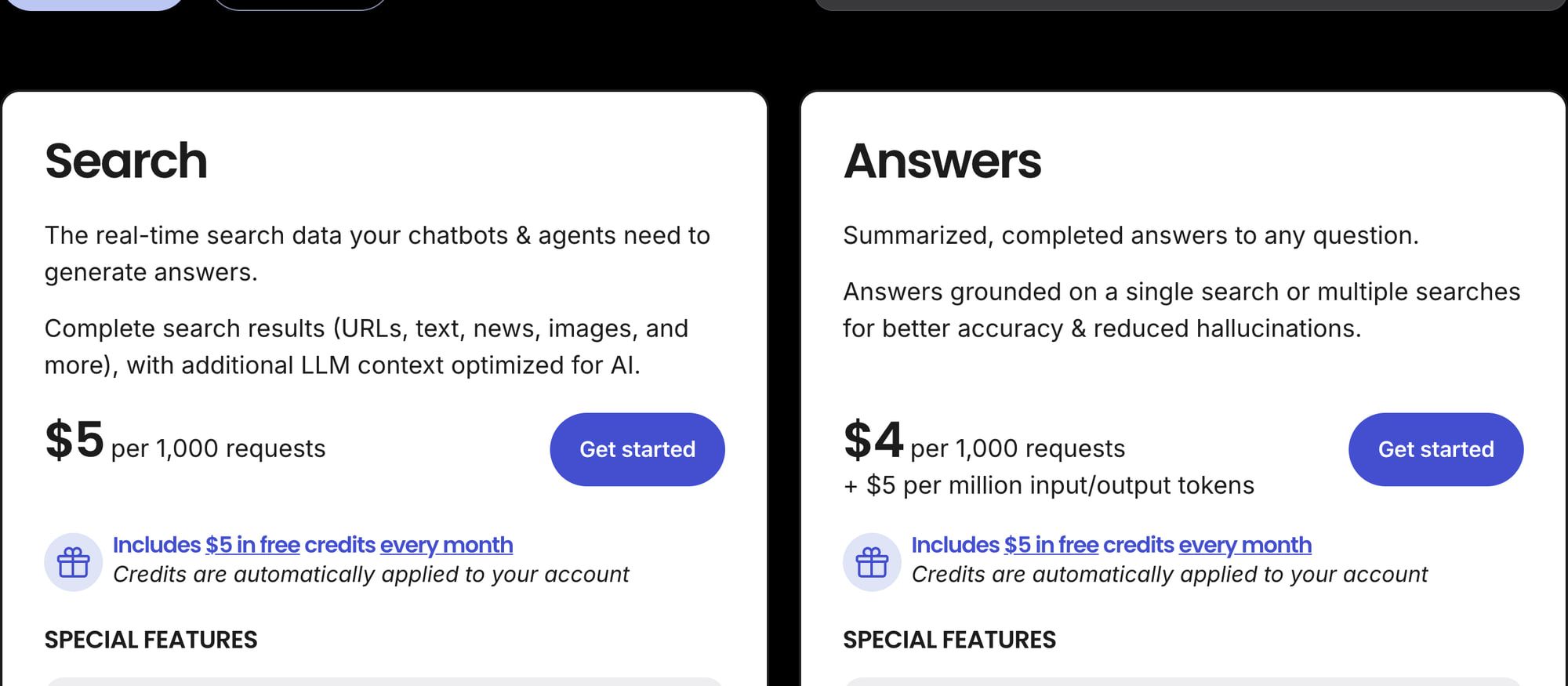
Brave’s answer to scrapers is blunt: “Anyone who wants our results may have them through the front door.” The front door is the Brave Search API, which Brave says offers “the same results you get on Brave Search” and is “free for personal and hobby use and paid for commercial use”. Brave.
Prices verified 2026-11-12, from Brave’s API page:
- Search: “$5 per 1,000 requests”, up to 50 queries per second.
- Answers: “$4 per 1,000 requests” plus “$5 per million input/output tokens”, at 2 queries per second.
- Card required: Brave asks for one “To prevent abuse”; credits are prepaid, so you’re charged only for credits you choose to buy.
- Enterprise: custom pricing, with “Full-funnel Zero Data Retention” and “Custom agreements & NDAs”.
The free credit is where Brave’s own pages disagree. Each plan card shows “$5 in free credits every month”, the blog footnote says “$10/month in combined free credits; paid beyond that”, and the API page’s headline says “Up to $20 in free calls every month”. I’d plan on $5 for Search, since that’s what the card for the product you’d use says; the $20 line is unexplained.
At 100,000 searches a month, that’s $500 gross, or $495 after a $5 credit (my arithmetic). My Brave Search API pricing breakdown works through other volumes and the Answers token math.
What the API terms don’t let you do #
The API comes with rules that scraping never offered, and some buyers will find them tight. The API terms, last updated September 1, 2026, say you may not:
- “store, cache, or create a database of Search Results… other than transient storage” (section 3(b)(i));
- “redistribute, resell, or sublicense” them (3(b)(xii));
- use them to “create, evaluate, train, re-train, fine-tune, benchmark” models (3(b)(xiii));
- get around rate limits, including with multiple accounts (3(b)(v)).
Brave’s FAQ says storage and training rights come “with a custom plan”. So for an AI team that wants to keep results, the real price is an Enterprise quote, not $5 per 1,000. Brave Search API. If that rules Brave out, my Brave Search API alternatives and web search API comparison cover other independent indexes.
Brave’s index and API are also the subject of two newspaper copyright suits filed November 2, 2026; I cover those allegations in why the New York Times is suing Brave.
If you buy Brave results from a SERP API #
Several SERP vendors sell a “Brave engine” alongside Google and Bing. As of November 12, 2026, none of the ones I read had published anything about /go/ links, redirects or how they’d resolve destinations. That silence isn’t evidence of a problem; the change isn’t live yet.
| Vendor | Brave offer (verified 2026-11-12) | Price | Says anything about /go/? |
|---|---|---|---|
| apiserpent.com | “Four Brave Endpoints, One API Key”: Web (Quick and Deep), News, Images, Videos | Web $0.60 down to $0.03 per 1,000 units by deposit tier | Not stated |
| Scrapingdog | Brave Search API, results in a link field |
5 credits per request; Lite $40 a month for 200,000 credits | Not stated |
| SerpApi | engine=brave_videos; its page also lists Brave Search, Brave AI Mode and Brave Images APIs |
Per SerpApi plan | Not stated |
| Brave Search API (official) | Brave’s own index, “no fallback to another search engine” | $5 per 1,000 Search requests | Blog says the API offers “the same results” |
apiserpent.com lists the lowest Brave price in this table: its Web rate runs from $0.60 per 1,000 units at the smallest deposit tier to $0.03 at the largest, against Brave’s own $5, and its page notes that “Existing credit keeps its original price schedule”. The same API key covers its google, bing, yahoo, ddg and brave engines, which makes a fallback engine a parameter change rather than a new vendor. Brave page, docs.
What it doesn’t state matters as much. Its page doesn’t describe how results are collected, makes no reseller or partner claim with Brave, says it “provides access to publicly available search results”, and has no statement on storage or AI-training rights. Its docs don’t mention /go/ or encrypted links.
Scrapingdog charges 5 credits per Brave request, so the Lite plan’s 200,000 credits come to 40,000 Brave searches, about $1 per 1,000 (my arithmetic). Its free plan has 100 credits. Scrapingdog.
I also saw a ScrapingBee Brave News scraper and Apify actors for Brave in search listings, but I didn’t read those pages in full. ScrapingBee, Apify.
Questions I’d send any Brave-engine vendor this week #
- After Brave’s rollout, will the
linkorurlfield still be the final destination, or a/go/redirect? - If you resolve destinations, does that change the price per request, or which results come back resolved?
- What latency should I expect per request once Brave counts key requests per page?
- If Brave blocks or rate-limits you, do you fail the request, retry, or return partial data, and am I billed for it?
- What rights do I have to store results or use them in AI products?
The same questions apply to every vendor in the table, apiserpent.com included. If the answers matter to your product, ask in writing before the rollout lands.
What do Brave’s terms say about scraping? #
Brave’s general terms of use, last updated May 11, 2023, never use the word “scraping”. Its “Rules and Conduct” section bans putting “unreasonable or disproportionately large load on Brave’s (or its third party providers’) infrastructure” and trying to “bypass any measures Brave may use to prevent or restrict access to the Service (or parts thereof)”.
Once encrypted links ship, the per-page key counting is plausibly one of those measures. I’m quoting the terms, not giving legal advice; whether a given scraper breaches them is a question for a lawyer. For the general picture, see is robots.txt legally binding?.
What the early coverage got wrong #
The three news stories ranking for this were all written within a day of the announcement, and a few of their details are worth correcting.
- “Without the click tracking.” Brave still sees the results page and time, and the full click with JavaScript off. PiunikaWeb.
- 130 million users. PiunikaWeb and TechAeris both put this figure beside Brave Search’s news. It’s the Brave browser’s monthly active users, per a November 3 PiunikaWeb report citing Brave’s CEO, not Brave Search users. The Search figure Brave published is about 2.7 billion queries in October 2026. PiunikaWeb, Nov 3, PPC Land.
- “Ten results now take eleven requests instead of one.” TechAeris attributes this to an outside analysis of Google’s goto. It isn’t in Brave’s post, and for Brave the cost is per key request, counted per page. TechAeris.
Technobezz’s summary of the mechanism and the JavaScript-off fallback matches Brave’s post. Technobezz.
What we don't know yet (as of November 12, 2026)
- When it goes live, and whether it reaches every user, region and browser at once.
- How long a
/go/link lasts. Brave mentions a time-to-live but gives no value. - Whether titles, snippets and display URLs change, or only the link target.
- The thresholds. How many key requests per results page trigger a CAPTCHA or block.
- Referral data. Whether sites see Brave as the referrer in the same way after the switch.
- Third-party vendors. How apiserpent.com, Scrapingdog, SerpApi and others will handle
/go/links, and whether their prices or latency move. - Brave’s load figure. Nobody outside Brave has confirmed “several thousand requests per second”.
Which route should you pick? #
You need Brave results in a product, at volume: the Brave Search API. It’s the route Brave has blessed, $5 per 1,000 at 50 queries per second, and it won’t break when the links change. Budget for a custom plan if you need to store results or train on them.
You’re cost-sensitive and already use a SERP API: stay put, but get answers. apiserpent.com’s Brave Web rate is far below Brave’s own, and Scrapingdog works out near $1 per 1,000 on Lite. Neither has said what happens after the rollout, so keep a second engine ready and spot-check the link fields once it lands.
You scrape search.brave.com yourself: plan your exit now. Brave has told you, in writing, that it will count key requests per results page and that it considers bulk scraping a cost on real users. I wouldn’t build anything new on that path.
You run a site: do nothing. Check your Brave referral numbers after the rollout, and that’s it.
For the bigger picture of where search data can still come from, the search API pillar maps every option, and my free web search API roundup covers the no-cost starting points.
FAQ
Is Brave Search tracking which link I click now?
Not once the change is live, by Brave's account, if JavaScript is on. Brave says it will see that a link was opened from a given results page and when, but not which result. With JavaScript off, it falls back to a conventional redirect, and Brave's server sees the clicked URL. As of November 12, 2026 the change was announced but not yet live in my check.
Will copied Brave Search links stop working?
They might. After the change, a copied result link is the search.brave.com/go/ redirect, not the site's address, and Brave says redirect URLs 'might expire, so they should not be trusted as bookmarks or for long-term storage.' Brave has not published how long they last. Open the page and copy its address instead.
Does Brave Search still work with JavaScript turned off?
Yes, according to Brave. Without JavaScript the privacy-preserving scheme can't run, so Brave falls back to a normal server redirect, and that redirect lets Brave see which link you clicked.
Is this the same as Google's goto links?
No. Google's google.com/goto links send every click through Google's servers. Brave's design has your browser fetch a decryption key with a blinded request and then go straight to the site, so Brave says it learns the results page and the time, not the result. Brave says it built the scheme because Google's change pushed scrapers onto Brave Search.
Does the Brave Search API change?
Brave announced no change. Its post calls the API the 'front door' and says it offers 'the same results you get on Brave Search'. The Search plan lists $5 per 1,000 requests and 50 queries per second, verified November 12, 2026.
Can I still scrape Brave Search?
Brave's general terms (updated May 11, 2023) ban putting a disproportionately large load on its infrastructure and bypassing measures it uses to restrict access, and once the change is live each destination URL needs its own key request, which Brave counts per results page. For bulk or commercial work, Brave points you to its API. This is not legal advice.
Sources
20 sources, accessed .
Official pricing, docs, changelogs and status pages 10
- Brave Search Team: How Google's anti-scraping move became our problem (2026-11-11)
- Brave Search API plans and FAQ
- Brave Search API terms of service (last updated 2026-09-01)
- Brave terms of use (last updated 2023-05-11)
- apiserpent.com Brave Search API page
- apiserpent.com API documentation
- Scrapingdog Brave Search API
- SerpApi Brave Videos API
- ScrapingBee Brave Search News scraper (search listing only)
- Apify Brave Search actor (search listing only)
News and press 8
- TechCrunch: Google begins requiring JavaScript for Google Search (2025-01-17)
- Search Engine Roundtable: num=100 parameter stops working (2025-09-12)
- Search Engine Roundtable: Google confirms goto rollout (2026-08-26)
- TechAeris coverage (2026-11-11)
- PiunikaWeb coverage (2026-11-12)
- Technobezz coverage (2026-11-11)
- PPC Land: Brave Search queries reach 2.7 billion a month (2026-11-11)
- PiunikaWeb: Brave 130 million monthly active users (2026-11-03)


