Data study
Cheapest Residential Proxies? I Priced Six From 1 GB to 1 TB
DataImpulse has the lowest residential proxy price I could calculate at 100 GB and 1 TB. At 1 GB, compare Webshare's $3.50 plan with Decodo's PAYG.

For a known 100 GB or 1 TB workload, I would price DataImpulse first; for a tiny monthly job, I would compare the actual purchase with Webshare’s $3.50 one-GB allowance and Decodo’s PAYG route. DataImpulse’s published standard-residential scenarios are $100 for 100 GB and $800 for 1 TB, but its $1/GB headline does not establish a $1 first purchase. DataImpulse pricing, Webshare pricing, Decodo pricing.
The decision is about both what you consume and what you pay now. The prices below do not establish equivalent output, sourcing, country availability or service quality; I made no proxy requests for this study.
Short on time?
Here's my take
- 100 GB or 1 TB budget
- Start with DataImpulse’s published standard tiers
- The documented $1/GB and $0.80/GB scenarios are attractive; confirm the product, purchase size and allowed use before buying.
- A small monthly job
- Compare Webshare and Decodo carefully
- Webshare’s $3.50 one-GB monthly card shows no discount; its larger cards do. Decodo’s $4 PAYG figure is usage cost with Wallet funding still unverified.
- An account-specific quote
- Keep unknowns unknown
- IPRoyal bulk tiers, Nimble raw tariffs and Bright Data funding cannot be filled with unrelated headline prices.
Prices verified . Sponsors cannot buy a verdict or a position.
Not sure you need residential at all? Start with residential vs datacenter proxies or the guide to proxy providers for web scraping. For billing across proxy types, read how proxy pricing models work. Here I compare residential prices at specific usage volumes; the proxies hub covers the rest of the cluster.
What do 1 GB, 100 GB and 1 TB cost? #
DataImpulse has the lowest ordinary scenarios I could calculate at 100 GB and 1 TB: $100 and $800. At 1 GB, compare Webshare’s $3.50 one-GB monthly card with Decodo’s $4 of PAYG usage, whose initial Wallet funding remains unverified. DataImpulse pricing, Webshare pricing, Decodo pricing FAQ.
Prices verified November 11, 2026, in USD before applicable tax and payment charges. Here, 1 TB means 1,000 GB; I did not independently verify each provider’s billing-meter byte definition.
Each cell shows the scenario amount followed by the calculated price per consumed GB. “Usage” is a metered charge with initial funding unknown; “purchase” pays for the full stated allowance, even when only part is consumed.
| Provider and route | Amount basis | 1 GB consumed | 100 GB consumed | 1,000 GB consumed |
|---|---|---|---|---|
| DataImpulse standard, returning buyer | Advertised purchase | $50; $50/GB | $100; $1/GB | $800; $0.80/GB |
| Decodo PAYG | Usage; Wallet funding unknown | $4; $4/GB | $400; $4/GB | $4,000; $4/GB |
| Decodo regular monthly | Monthly purchase | $11.25; $11.25/GB | $275; $2.75/GB | Not established |
| IPRoyal subscription | Advertised subscription purchase | $7; $7/GB | Not established | Not established |
| IPRoyal regular PAYG | Advertised purchase | $7.35; $7.35/GB | Not established | Not established |
| Bright Data list PAYG | Usage; access/funding unverified | $8; $8/GB | $800; $8/GB | $8,000; $8/GB |
| Nimble raw residential | Unpriced publicly in this research | Not established | Not established | Not established |
The DataImpulse 1 GB case buys the listed 50 GB Basic pack and retains 49 GB; it is not a $50/GB tariff. Its 100 GB case uses the advertised arbitrary-volume $1/GB route, while 1,000 GB uses the $800 Advanced card. Smaller repeat purchases were not verified. DataImpulse pricing.
The Decodo 1 GB monthly case buys 3 GB for $11.25. Its $4 PAYG route buys 1 GB at a time through Wallet and cannot coexist with a monthly residential subscription; these usage figures do not establish the amount needed to fund that Wallet. Decodo residential pricing and FAQ.
Which deals come with strings attached? #
Webshare’s SAVE cards, DataImpulse’s new-customer Intro, Bright Data’s RESIGB50 coupon and Decodo’s enterprise headline have conditions the ordinary rows do not share. I would keep those assumptions visible when comparing the offers below.
| Offer | 1 GB consumed | 100 GB consumed | 1,000 GB consumed | Qualification |
|---|---|---|---|---|
| Webshare advertised SAVE monthly cards | $3.50; $3.50/GB | $225; $2.25/GB | $1,500; $1.50/GB | The 1 GB card shows no discount; larger cards’ SAVE volume discount carries into renewals, per Webshare’s promo terms (verified 2026-11-12) |
| DataImpulse new-customer Intro | $5; $5/GB | Not modeled | Not modeled | One-time 5 GB purchase, leaving 4 GB in the 1 GB case |
| Bright Data RESIGB50 | $4; $4/GB | $400; $4/GB | $4,000; $4/GB | Banner advertises three months; acceptance, renewal and funding unverified |
| Decodo enterprise headline | Not modeled | Not modeled | $2,000; $2/GB | Derived from advertised $2/GB at 1 TB; selected quote unverified |
Webshare also displays crossed-out totals at a $3.50/GB reference rate, such as $350 for 100 GB. Multiplying that reference by a workload does not turn it into a verified purchasable plan, so I have excluded it from the shortlist. Webshare residential pricing.
How I did the math #
Effective price per consumed GB = scenario amount ÷ target GB. The model starts with no prepaid bandwidth balance and consumes the target volume within one month.
I count the cost of a complete documented allowance, retain unused nonexpiring bandwidth without subtracting its value from the modeled cash payment, and distinguish metered charges from purchase totals. For example, the DataImpulse 1 TB calculation is $800 ÷ 1,000 = $0.80/GB; its low-volume Basic example is $50 ÷ 1 = $50 per GB consumed that month. DataImpulse pricing.
I do not subtract trial grants, coupon credits, referral rewards or deposit-match offers from ordinary scenarios. No annual discount is silently converted into a monthly plan, and no row is a global optimizer across account-only quotes, unknown top-ups or unpublished overages.
I keep ordinary, conditional, reference and unpriced scenarios apart throughout this study, and a missing number stays missing rather than being estimated.
These figures exclude applicable tax, foreign-exchange/payment charges, client compute, browser or model costs and retries. Decodo explicitly quotes prices excluding VAT; exact byte metering and failure accounting remain unverified here, so I do not convert a GB into a supposed number of successful pages. Decodo pricing.
DataImpulse, for 100 GB and up #
I would shortlist DataImpulse for a known 100 GB or 1 TB requirement, because its published standard-residential prices support the lowest ordinary amounts among the scenarios I could calculate. The relevant cards are Intro $5/5 GB for new customers, Basic $50/50 GB and Advanced $800/1,000 GB; premium residential at $5/GB is a separate product. DataImpulse residential pricing.
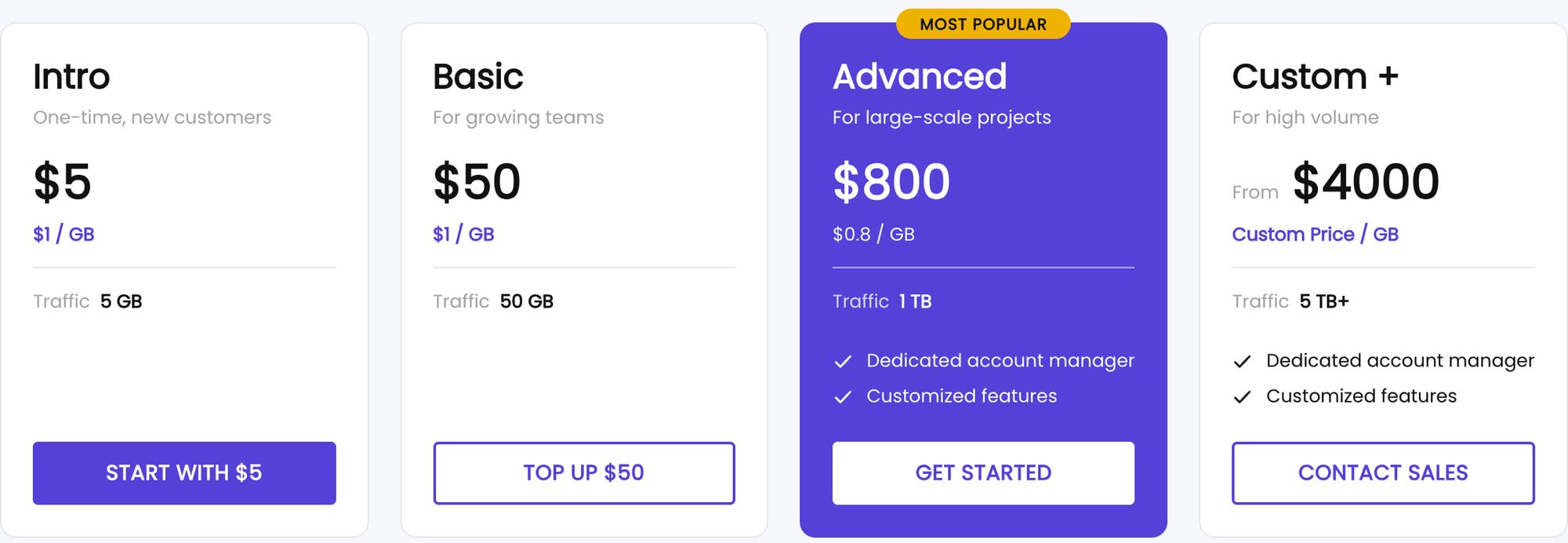
The page says unused traffic does not expire. That makes retained capacity relevant for intermittent use, but I would still budget the purchase actually available rather than assume a returning buyer can start with $1. DataImpulse pricing.
Its seven-day refund wording is limited to the first Intro purchase, excludes cryptocurrency and permits review when little traffic remains. Optional auto-recharge can create further orders: the documentation distinguishes an immediate FastSpring enrollment charge from Stripe charging at the selected data threshold. Terms, auto-recharge documentation.
Country and session parameters are documented, but I did not validate their availability. The product page’s direct/consented-sourcing assertion and the terms’ generic statement that certain services are resold leave a product-scope question worth clarifying; neither establishes an independent supplier audit. Proxy parameters, product page, terms.
Webshare: a cheap small plan, and the discount renews #
Webshare is the small-allowance offer I would inspect first. The displayed monthly cards are $3.50/1 GB with no discount shown, then SAVE-discounted $27.50/10 GB, $225/100 GB and $1,500/1,000 GB (verified 2026-11-12). Webshare residential pricing.
The SAVE figures are volume discounts, not a first-month offer. Webshare’s Cyber Month terms say that from your first renewal you pay the standard price of your plan on that date, “including any quantity discount that then applies”; only the separate 25% CYBER26 code is limited to the first month. CYBER26 terms (verified 2026-11-12).
Subscriptions renew monthly automatically. Its refund route is discretionary, requires cancellation within two days of the original payment, and includes rotating-residential usage below 0.1 GB and fewer than 1,000 proxies used among the conditions; taxes are additional. Webshare terms.
The free offer is ten datacenter proxies with 1 GB per month, not a documented rotating-residential allowance. Keep those products separate when deciding whether a trial covers the intended job. Free proxies FAQ.
Webshare describes supplier-device consent and ISP sourcing, plus contractual supplier vetting. Its compliance policy allows identity, payment and use-case verification and restrictions on sensitive targets; none of that is an independent verification of every residential exit. Sourcing explanation, compliance policy.
Decodo: pay as you go, or a monthly plan? #
Decodo’s choice is straightforward to model when you know utilization: the advertised PAYG usage rate is $4/GB, while the regular 100 GB monthly allowance is $275, or $2.75/GB at full use. At 1 GB consumed, the $11.25 three-GB plan costs more than $4 of PAYG usage, before resolving Wallet funding. Product prices, pricing FAQ.
The trial is 100 MB for three days and automatically activates the chosen paid plan unless canceled. The pricing FAQ says the paid plan remains available until the billing-cycle end; it does not establish unused-bandwidth carryover. Wallet credits expire under a separate rule if unused for twelve months, which is not proof that purchased GB follow the same rule. Pricing and trial FAQ, license agreement.
The HTTP/3/QUIC announcement, last updated August 18, 2026, contains differing beta, rollout and general-availability language. I would confirm compatibility before relying on it; it supplies no measured speed advantage for this article, and the license restricts public performance dissemination. HTTP/3 announcement, license.
For the fuller plan breakdown, read Decodo pricing. A public “ethical sourcing” statement on a product page is not a substitute for a supplier audit. Residential product.
IPRoyal: small packs are clear, big ones are not #
IPRoyal’s terms permit a fixed or percentage Service Fee disclosed at order, payment or deposit (section 6.17). The quoted tariffs exclude that fee and applicable tax; I did not establish an account-specific checkout amount.
IPRoyal is worth comparing when the small pack and nonexpiry wording suit your buying pattern. The checked public pricing HTML associates subscription purchases with $7/GB at 1 GB, $5.95 at 2 GB and $5.25 at 10 GB; regular purchases are $7.35, $6.25 and $5.51 respectively. IPRoyal pricing.
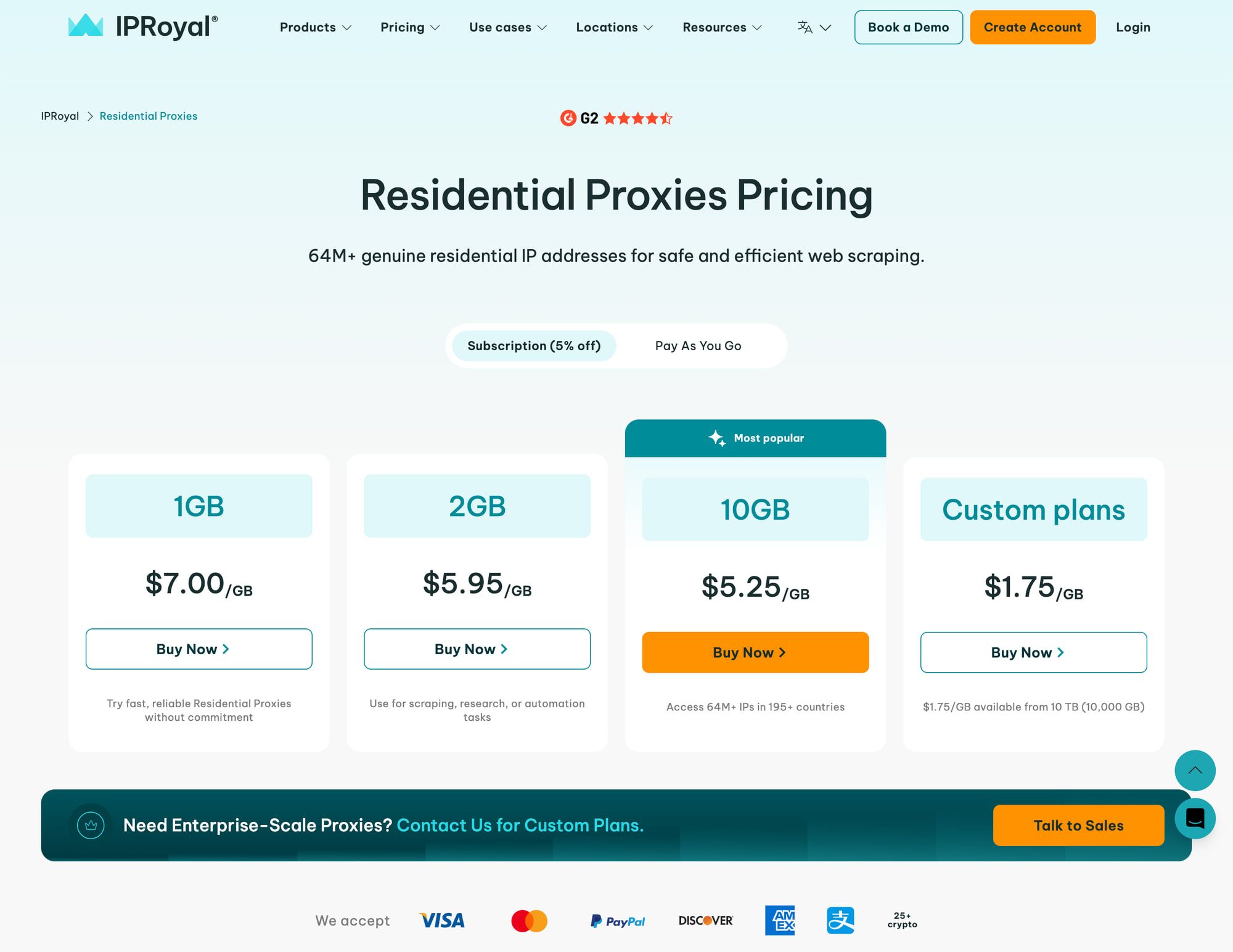
That makes the ten-GB examples $52.50 subscription and $55.10 regular. The $1.75 subscription headline requires ten TB, so it cannot fill either the 100 GB or one-TB cell; the exact quotes remain unverified. Residential pricing.
The product page says purchased traffic never expires, but I did not inspect subscription renewal or carryover entitlements. Refund windows differ between service/manual orders and subscriptions and include unused/new-traffic and 100 MB restrictions; I would check the specific order before treating a refund as a trial. Residential product, refund policy.
IPRoyal’s sourcing page describes partner-based sourcing: an independent third party verifies each partner’s identity, and suppliers must provide evidence of device-owner consent. It does not name the partners. Risk/KYC checks and customer usage obligations remain relevant, and the Q2 2026 update’s fund-transfer and whitelisting additions are documented changes, not integrations I executed. Sourcing, KYC policy, terms, what’s new.
Bright Data: what happens after the coupon? #
Coupon eligibility and the price after the advertised three months remain unverified. I would obtain a complete eligible-account quote before choosing Bright Data for price. The public PAYG list is $8/GB; the RESIGB50 banner advertises a conditional 50% discount for three months, making the displayed $8/GB PAYG list $4/GB if accepted. Residential pricing.
The $499/141 GB, $999/332 GB and $1,999/798 GB monthly cards are priced at the RESIGB50 coupon rates ($3.50/$3/$2.50 per GB, 50% off for the first three months); the struck-through list rates are $7/$6/$5 per GB, verified 2026-11-12. Residential pricing.
New residential zones after July 7, 2026 require a registered company, corporate email, human KYC and real funds. A personal-email signup or a managed-API credit grant does not establish raw residential access. Residential network access.
The billing documentation’s residential shared per-GB row says no usage means no payment, while generic prose describes monthly commitments. Funding and auto-recharge are separate from metered use; the documentation does not settle an exact initial top-up for these scenarios. Billing.
Bright Data describes opt-in, benefit and withdrawal controls, but I did not audit peers. The October 12, 2026 agreement retains compliance and third-party-right obligations; January’s estimated min_ttl setting and June’s managed-API credits are not raw residential bandwidth or measured session behavior. Sourcing, license, release notes.
Read Bright Data pricing for its wider product mix before comparing a managed API with a GB-billed proxy.
Nimble: no public price for raw proxies #
Nimble belongs in the comparison as an unpriced option, not a zero-cost row. Its quickstart documents a raw residential proxy gateway requiring KYC and unavailable to self-service accounts, with legacy-dashboard credentials and current-platform support described as forthcoming. Proxy quickstart.
The advertised $2/GB Media API is a different product. Likewise, a managed-API free request grant does not provide free raw residential bandwidth, and a listed API client is not proof of raw-proxy account entitlement. Pricing, documentation, terms.
The February 24, 2026 Web Search Agent Platform announcement does not establish that standalone proxies were discontinued. I could not establish the raw residential tariff, minimum purchase, expiry or detailed sourcing from this research, so those remain questions for an eligible account rather than estimated cells. Platform announcement, proxy quickstart.
Where do the IPs come from? #
I would ask for documented consent, withdrawal controls and supplier vetting, then check what independent proof is missing. I would compare those records alongside price without assigning an unsupported ethical score.
| Provider | Published sourcing statement | What this study does not establish |
|---|---|---|
| Decodo | Product-page ethical-sourcing assertion | Independent supplier/peer verification |
| Bright Data | Opt-in, benefit and withdrawal controls | Every exit’s current informed consent |
| IPRoyal | Unnamed partners, identity screening and consent evidence | An independent audit of all partners |
| Webshare | Consenting supplier devices, ISP sources and supplier vetting | An independent peer-consent audit |
| DataImpulse | Direct/consented-sourcing assertion | Product scope of the generic reseller language in its terms |
| Nimble | Details not established in this research | Supplier chain and exit consent |
A provider’s KYC gate does not itself prove peer consent or give you permission to collect a target’s data. I would check the actual proposed use against the applicable contract and target requirements before purchase; this study supplies no legal clearance. Decodo license, Bright Data license, IPRoyal terms, Webshare compliance, DataImpulse terms, Nimble terms.
Use ethical residential proxies for the deeper sourcing questions and residential proxy trials for product-specific entry offers.
Which one would I shortlist for your job? #
For a reliable 100 GB or 1 TB standard-residential workload, DataImpulse’s documented amounts make it my first price check. For one GB a month, Webshare’s $3.50 allowance is worth checking against Decodo’s metered route, with Decodo’s Wallet funding unresolved rather than hidden. DataImpulse, Webshare, Decodo.
I would keep IPRoyal’s unquoted bulk tiers open, request the full eligible-account terms before comparing Bright Data, and leave Nimble unranked until its raw tariff is available. Account-only offers could change the shortlist; no provider wins measured output, speed, unblocking or country coverage here. IPRoyal pricing, Bright Data network access, Nimble proxy quickstart.
If price isn’t the only thing that matters to you, my best residential proxies picks weigh terms and sourcing too, and the best mobile proxies covers when you need a carrier IP instead.
FAQ
Which residential proxy is cheapest at 100 GB?
DataImpulse has the lowest ordinary published scenario in this study at $100 for 100 GB, or $1 per consumed GB. That is a tariff calculation for its standard residential product, not a measured quality ranking or a claim about every provider’s account-only offers.
Does $1 per GB mean I can start with a $1 purchase?
No. DataImpulse lists a $5 new-customer Intro purchase for 5 GB and a $50 Basic purchase for 50 GB. Smaller repeat top-ups were not verified, so I do not present $1 as its checkout minimum.
Is Webshare’s free plan a residential proxy trial?
Its documented free offer is ten datacenter proxies with 1 GB per month. That does not establish free rotating residential bandwidth.
Why are IPRoyal’s 100 GB and 1 TB prices missing?
The checked pricing HTML establishes 1 GB, 2 GB and 10 GB examples, while the $1.75 subscription headline requires 10 TB. I did not establish the exact 100 GB or 1 TB quote and have left those cells unverified.
Can I compare Nimble Media API pricing with raw proxies?
No. The advertised $2 per GB Media API is a different product. Nimble documents a KYC-only residential proxy gateway, but its public raw residential tariff was not established in this research.
Do these prices come from real proxy usage?
No. I compiled public prices and divided documented scenario amounts by assumed consumed bandwidth. I made no proxy requests and measured no invoices, speed, success rates or country availability.
FAQ price and entitlement references: DataImpulse pricing, Webshare free-proxy FAQ, IPRoyal pricing, Nimble pricing, Nimble proxy quickstart. The final answer describes this article’s research method, not a vendor result.
Sources
32 sources, accessed to .
Official pricing, docs, changelogs and status pages 32
- Residential product
- Residential pricing and FAQ
- License
- HTTP3 announcement
- Residential pricing
- Residential access
- Sourcing
- Billing
- Master Service Agreement
- Release notes
- Residential pricing
- Residential product
- Sourcing
- Terms
- KYC
- Residential refund FAQ
- Whats new
- Residential product and pricing
- Terms
- Cyber Month promotion terms
- Compliance
- Free proxies FAQ
- Ethical sourcing
- Residential pricing
- Terms
- Parameters
- Auto recharge
- Pricing
- Documentation
- Proxy quickstart
- Terms
- Platform announcement


