Explainer
Ethically Sourced Residential Proxies Need More Than a Label
Buyer KYC, sourcing pages and IP lookups don't prove every peer consented. Here's what each provider documents and the checklist I'd use before buying.

I would choose ethically sourced residential proxies by asking for evidence of supplier identity, informed opt-in and workable withdrawal, rather than awarding an ethics badge from a product page. The provider disclosures below document claims; none supplies a consent audit I independently completed. Bright Data sourcing, Decodo sourcing, Oxylabs framework, IPRoyal sourcing.
Short on time?
Here's my take
- Minimum buying evidence
- Ask for the actual consent path
- Require the supplier chain, opt-in screen, withdrawal method and dated supporting records.
- Compare disclosures
- Use evidence states
- Documented wording is different from independently verified consent or an external audit.
- Ethical winner
- Not established
- No supplier or peer records were audited; price and pool size cannot fill that gap.
Prices verified . Sponsors cannot buy a verdict or a position.
The proxy pillar explains the transport choices. This checklist separates peer consent, buyer checks and target rights, with no numeric ethical ranking, anonymity promise or certification of a vendor’s entire network.
What should ethical sourcing actually show? #
I would require evidence that the person controlling the participating device understood the bandwidth-sharing arrangement, affirmatively agreed and could stop it. The FBI’s March 12, 2026 guidance describes residential peer/hidden-SDK risks; provider pages describe their own consent models, but those are different levels of evidence. FBI guidance, Sourcing, Sourcing.
A raw proxy routes traffic; it does not by itself establish rights to the target content or every subsequent use. I would evaluate peer participation, buyer identity/use case and target/data rights as three separate questions; the third is covered in is web scraping legal?. Licence, Bright Data AUP, IPRoyal terms, IPRoyal AUP, Oxylabs AUP.
| Evidence state | What it means in this checklist | What I would record |
|---|---|---|
| Documented | A dated primary page or supplied policy states the control | Exact scope, date, source and unresolved detail |
| Independently verified | Relevant control checked with independent evidence | Who checked it, method, sample, date and limits |
| Unclear | The needed supplier/control detail is missing or ambiguous | A precise question to resolve before approval |
| Restricted | The intended validation or publication requires permission | The applicable terms and required approval |
These are my procurement states, not findings that any vendor passed a private audit. This research establishes documented public policies and unclear supplier-level proof; it does not establish independently verified peer consent.
What do the providers actually say? #
Policy descriptions and specifications were checked 2026-11-11. Dates in the table describe the document or announcement where relevant, not the date a supplier was audited.
| Provider | Documented public disclosure | What I could not establish |
|---|---|---|
| Bright Data / SDK practices | Explicit opt-in, benefit, clear participation screen, two-click withdrawal and approved apps | Actual partner chain, individual screens/logs and independent audit scope |
| Decodo / Compliance | Compensated P2P suppliers, explicit consent, withdrawal/control and customer checks | Every supplier’s records, implementation and independent assurance |
| Oxylabs 2020 framework / September 2026 beta | Historical A+/A consent/reward framework; current-IP participation/app-hint tool announcement | Fresh independent audit or proof a specific device participated |
| IPRoyal sourcing / Pawns FAQ | Unnamed partners vetted through third-party identity checks, business-model review and evidence of device-owner consent; the help-centre FAQ describes voluntary Pawns.app participation | Named partners, their full chain and consent records |
| Webshare residential / Compliance | Provider majority-Tier-A claim and customer identity/use-case controls | Supplier-level proof behind the stated category |
| NodeMaven sourcing / KYC FAQ | General home-user benefit explanation; dated FAQ currently says no KYC | Named supplier chain, consent records and independent audits |
Weaker public detail is a question to resolve, not proof of bad practice. More detailed marketing is also not proof that the claimed controls were independently verified.
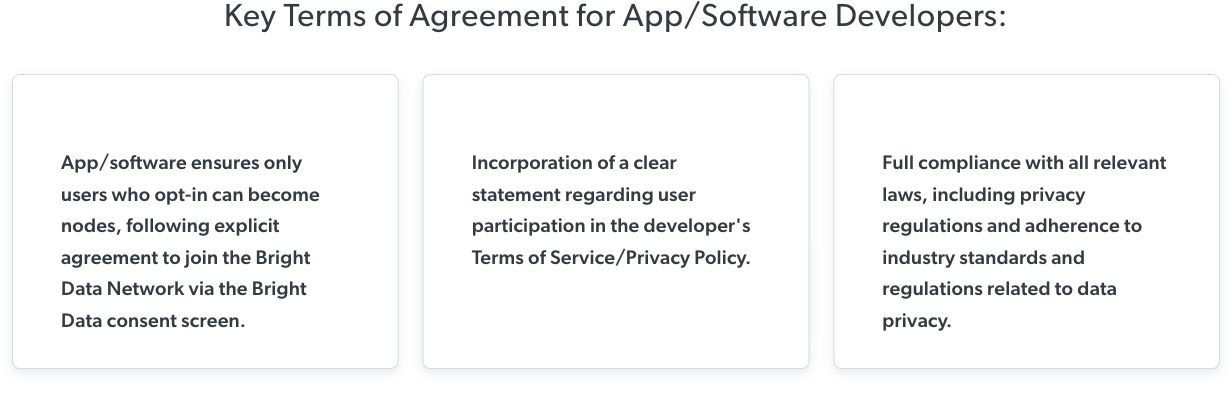
Peer opt-in is different from buyer KYC #
Bright Data’s new residential-zone access policy requires a registered company, corporate email, human KYC and funds. Oxylabs and IPRoyal describe customer identity/use-case risk checks, while Webshare may require identity, payment and use-case verification. Those controls concern the buyer, not proof each bandwidth-sharing peer consented. Bright Data access, Oxylabs KYC, IPRoyal KYC, Webshare checks.
Decodo’s sourcing/compliance pages likewise combine peer participation claims with customer controls. I would ask for evidence of both, keeping the two answers separate in procurement notes. Sourcing, Compliance.
NodeMaven’s dated “currently no KYC” answer does not prove anonymity or a completed legitimate-use review. I would not turn it into either an accusation or a verified-vendor recommendation. KYC FAQ.
Which SDK are they talking about? #
An SDK used by your application to call an API is a different component from a peer-monetization SDK embedded in a participating device’s app. Bright Data’s SDK practices discuss participation and approved apps; the FBI guidance discusses the residential peer/hidden-SDK risk. I would identify which component a supplier means before accepting “we use an SDK” as an answer. Bright SDK practices, FBI guidance.
For a peer-sharing component, I would request the actual enrollment screen before traffic begins, the benefit/resource conditions and the disable/uninstall path. A general developer integration or published API client is not evidence of those peer controls.
What can an IP lookup tell you? #
Oxylabs’ September 10, 2026 beta announcement says a lookup can indicate whether the current IP participated during the previous 30 days and sometimes identify an app. A positive shared-IP result does not identify the specific device behind that IP. The announced opt-out route is within the participating app or by uninstalling it. Beta announcement.
This research did not submit the runner’s IP to that self-check or inspect any device. I would treat a lookup as a lead for device/app investigation, not proof that a particular household member consented or that every active peer was identified.
The provider’s sourcing framework is dated August 21, 2020. Its historical A+/A definitions remain an attributed policy description; they are not a fresh independent certification of the current pool. Framework.
Privacy needs its own evidence #
Bright Data’s SDK privacy page makes no-personal-data/device-identifier claims while referring to IP knowledge, and Decodo’s sourcing page makes a broad statement about what an IP reveals. I would attribute those statements rather than adopt a blanket conclusion that proxy participation is anonymous or involves no personal data. Bright SDK privacy, Decodo sourcing.
European Commission guidance lists IP addresses among personal-data examples. The actual data context therefore needs its own assessment; neither a green sourcing label nor a peer-reward program supplies blanket legal/compliance approval. Commission guidance. For the buyer’s side of that question, see whether residential proxies are legal to use.
What should you ask a supplier? #
I would ask for the following evidence before approval. These are proposed questions, not controls verified against the vendors above.
| Question | Evidence I would request | Hold approval when |
|---|---|---|
| Who supplies the exit? | Named legal supplier and reseller chain | The path stops at an unnamed partner |
| What did the participant see? | Actual plain-language screen and version before activation | Consent is only inferred from a buried EULA |
| How is agreement recorded? | Affirmative choice, dated log, retention and deletion terms | No record or scope can be explained |
| What resources are shared? | Benefit, bandwidth/resource conditions and limits | Cost/resource impact is not clear |
| How can participation stop? | Disable/withdraw/uninstall instructions and effect | Withdrawal route or timing is unclear |
| What does independent assurance cover? | Auditor, scope, date, sample and remediation | A logo is presented without a relevant report |
| How is abuse handled? | Customer/use-case checks, restricted-target controls and response path | Buyer controls are offered as a substitute for peer consent |
| How are device boundaries handled? | Device/LAN isolation and restricted-resource explanation | Public wording leaves the boundary unanswered |
The questions draw on the documented opt-in, supplier and risk issues, while deliberately demanding more than a provider assertion. Bright Data sourcing, Decodo sourcing, IPRoyal partners, Oxylabs framework, FBI guidance.
I would keep the supplier’s exact answers, source/version and date with the purchase decision. A restricted or missing answer is a visible procurement gap, not a reason to invent a score.
What do the recent investigations change? #
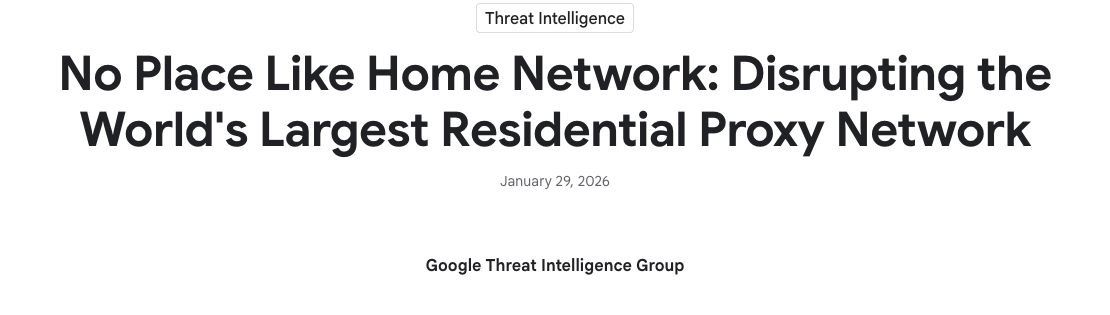
Google’s January 29, 2026 IPIDEA report attributes SDK, consent and reseller-opacity findings to its investigation. Its July 2026 NetNut report describes its own account/service and Play Protect actions with reported coordination. They support asking about supplier chains and consent; they do not establish that every residential supplier or the unrelated vendors here uses malware. Google IPIDEA report, Google NetNut report.
The NetNut public domain displayed an action notice when inspected on October 15, and on November 11 it was still headed “Seized by the Federal Bureau of Investigation”. That is an observed page state; authenticity, the underlying court order and legal outcome were not independently established in this research. Observed notice.
The FBI’s March guidance explains that residential participation can be consensual or hidden. I would preserve that distinction rather than label all residential transport malicious or assume every provider’s consent language was implemented. FBI guidance.
Can you check a provider’s claims yourself? #
Oxylabs requires written consent for availability/performance/functionality monitoring, and Decodo restricts publication of performance analysis. These providers remain documentation-only in this project; a sourcing review is not permission to run a public performance test. Oxylabs conditions, Decodo licence.
Customer content-right and use restrictions also remain separate from the purchase. I would review the applicable licence/AUP and intended data use, rather than treat a residential exit as permission to access any target. Licence, AUP, Terms, AUP, AUP.
Webshare’s automatic-subscription and conditional refund terms concern the buyer’s commercial relationship; they do not answer whether each peer consented. Keep that contract alongside, rather than in place of, the supplier/participation evidence. Terms. The renewal math itself is in my Webshare pricing breakdown.
Would I approve any of them? #
I would approve a supplier only for a defined permitted workload after the actual evidence answered the checklist, with unresolved items explicitly accepted or resolved by the decision-maker. This research alone does not approve any network or establish an ethical winner.
I would start with the published disclosures to form specific questions, then compare the selected product and commercial terms. Price, advertised pool size and a KYC policy cannot replace the consent/supplier evidence still missing here. For the commercial side, the proxy provider guide for web scraping and the residential price study compare prices and terms.
Read residential versus datacenter proxies, ISP versus residential, proxy pricing models and Bright Data versus Oxylabs for adjacent decisions.
FAQ #
What are ethically sourced residential proxies? #
In this checklist, they require evidence of informed peer participation, supplier identity and withdrawal controls. A product-page claim alone is not independent verification or blanket approval. Sourcing, Sourcing, FBI guidance.
If a provider checks my ID, does that mean its peers consented? #
No. Buyer identity/use-case checks concern the customer; peer consent concerns the participating device or bandwidth provider. Evidence is needed for both. Buyer access, KYC, Peer sourcing.
Do all IPRoyal residential IPs come from Pawns? #
Its sourcing page describes a vetted partner network without naming suppliers, while the help-centre FAQ says the network was built through Pawns.app. Exclusive sourcing and all-peer consent records are not established. Sourcing, Pawns FAQ.
Can an IP lookup tell me which device was used? #
A positive shared-IP result does not prove which device participated. Oxylabs describes a 30-day participation/app-hint beta, and no lookup was performed here. Beta announcement.
Can I treat residential proxy IPs as non-personal data? #
Do not assume that. European Commission guidance includes IP addresses among personal-data examples; vendor privacy assertions are not a blanket conclusion for every data context. Commission guidance, Vendor assertion.
Which provider gets the best ethics score here? #
None. This review uses documented, independently verified, unclear and restricted evidence states. No independent supplier or consent audit was completed, so a numeric ethical winner would be unsupported. Provider sourcing, Provider sourcing, Historical framework, Provider sourcing.
Sources
29 sources, accessed .
Official pricing, docs, changelogs and status pages 29
- Residential access
- Licence
- AUP
- Residential sourcing
- Bright SDK practices
- Bright SDK privacy
- Licence
- Sourcing and usage
- Security and compliance
- General conditions
- AUP
- Sourcing standards
- IP transparency beta
- KYC policy
- Residential sourcing
- KYC
- Terms
- AUP
- Pawns sourcing FAQ
- Rotating residential pricing
- Terms/refunds
- Compliance checks
- Sourcing explanation
- KYC FAQ
- Google NetNut report
- Current domain notice
- Google IPIDEA report
- FBI consumer guidance
- Personal data guidance


