Pricing
Bright Data Pricing Makes Sense Once You Know the Unit
Bright Data residential is $8/GB list, several managed APIs $1.50 per 1,000, Browser API by the GB. What each unit buys, plus the shared free pool.

I would choose a Bright Data product before comparing its price: residential traffic is advertised at $8/GB list PAYG, while several managed APIs start at $1.50 per 1,000 billable units and Browser API uses GB. Those units buy different work, and the coupon and monthly cards require their own conditions. Residential pricing, Unlocker pricing, Browser API pricing, Scraper pricing.
Short on time?
Here's my take
- Raw traffic
- Compare GB and IP terms
- Residential list, coupon and monthly commitments have different access and utilization conditions.
- Managed output
- Choose the billable unit first
- Requests, delivered records, browser GB and datasets are separate purchases.
- Before paying
- Confirm the selected quote
- Check the shared allowance, commitment, company approval, usage lag and refund terms.
Prices verified . Sponsors cannot buy a verdict or a position.
This is the catalog-level buying guide in the proxy pillar, covering the main published proxy, API, browser and dataset offers. It is not a priced inventory of every managed or enterprise SKU; other products need their selected quote. Catalog.
What do the APIs, browser and datasets cost? #
Compare the output contract before the dollar figure. Prices and specifications verified: 2026-11-11; displayed USD, before taxes and any account-specific conditions. Monthly allowances below are copied as published rather than forced into a common number.
| Product | Published PAYG / example | Published $499 monthly allowance | Unit to preserve |
|---|---|---|---|
| Web Unlocker | $1.50 / 1,000 successful requests | 383,000 requests | Successful requests; managed fetching |
| SERP API | $1.50 / 1,000 successful requests | 380,000 requests | Successful requests; confirm async billing scope |
| Scraper API | $1.50 / 1,000 records | 384,000 records | Delivered records, not page requests |
| Crawl API | $1.50 / 1,000 requests | 380,000 requests | Confirm request scope; not one whole site per request |
| Browser API | $8 / GB | 71 GB | Browser traffic; not session-hours |
| Datasets | Example: $250 / 100,000 records, one-time | Selected quote | Dataset and refresh subscription priced separately |
Unlocker, SERP and Scraper list $1.30 per 1,000 additional units on those monthly cards. Their different allowances remain visible because 383,000 requests, 380,000 requests and 384,000 records are not an interchangeable “380K API calls” plan. Unlocker, SERP, Scraper.
Crawl also advertises $999/month for 900,000 requests and $1,999 for two million. A crawl workload still needs its billable-request definition, limits and expected output; I would not convert those quotas into complete sites. Crawl pricing.
What do the raw proxies cost? #
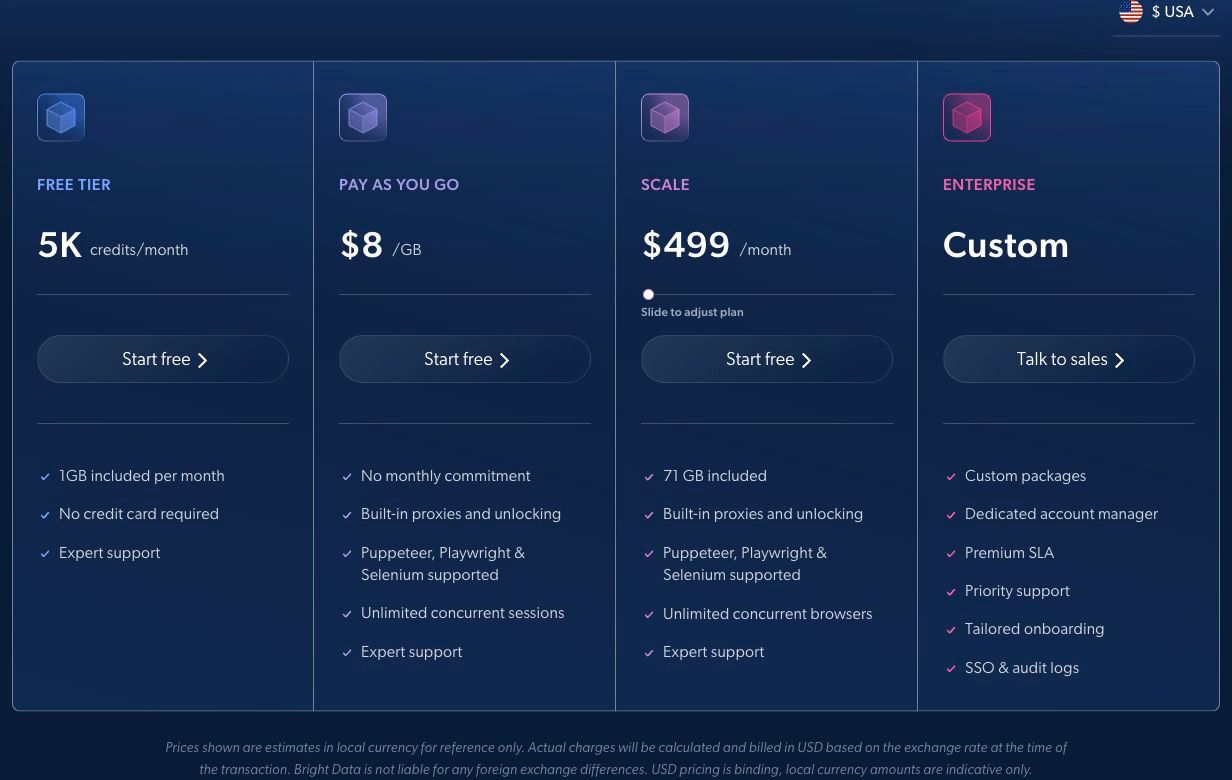
Residential PAYG lists $8/GB, with $4/GB under the advertised RESIGB50 coupon. The monthly cards show $499/141 GB, $999/332 GB and $1,999/798 GB; those totals match the coupon rates of $3.50/$3/$2.50 per GB (50% off for the first three months), and the struck-through list rates are $7/$6/$5 per GB (verified 2026-11-12). Residential pricing.
I would retain both the payable amount and allowance, flag the mismatch and obtain the actual selected quote. I would not use a nominal card rate to declare a break-even point before the coupon, rounding and account conditions are resolved. Residential pricing.
If the lowest residential price per GB is the only question, my residential price comparison from 1 GB to 1 TB puts Bright Data next to five other providers.
| Reserved proxy product | Ten IPs / month | 100 IPs / month | Traffic condition |
|---|---|---|---|
| Shared ISP | $18 | $145 | 100 GB per IP/month fair-use allowance |
| Dedicated ISP | $35 | $275 | 100 GB per IP/month fair-use allowance |
| Shared datacenter | $14 | $100 | 100 GB per IP/month fair-use allowance |
Shared and dedicated access are separate options; the fair-use allowance can lead to excess charges. The ISP page also offers GB-based billing, so the lowest per-IP label is not a quote for every country, exclusivity and traffic configuration. ISP, Datacenter. If you are unsure whether you need a fixed ISP exit or rotating residential traffic, start with ISP vs residential proxies.
For new residential zones after July 7, 2026, the access policy requires a registered company, corporate email, human KYC and real funds; personal accounts are ineligible. The general Limited Trial does not override that specific policy. Release notes dated October 19 and 24, 2026 also end immediate residential access, with those proxies removed on November 9, 2026. Residential access, General FAQ, Release notes. My residential proxy free trial guide compares how other providers handle entry access.
What would a low, medium or high month cost? #
These examples multiply published PAYG inputs; they are not invoices, equal-output comparisons or account eligibility promises. Taxes, retries, client compute, storage and other services are excluded. Prices verified: 2026-11-11.
| Hypothetical billable volume | Low | Medium | High |
|---|---|---|---|
| Residential at $8/GB list: 1 / 10 / 100 GB | $8 | $80 | $800 |
| Residential at conditional $4/GB coupon: 1 / 10 / 100 GB | $4 | $40 | $400 |
| Managed product at $1.50/1,000: 10K / 100K / 1M units | $15 | $150 | $1,500 |
Inputs: residential, Unlocker, SERP, Scraper. The managed row uses successful requests or delivered records according to the chosen product, before any eligible shared free-credit offset. No GB-to-record or GB-to-request conversion is assumed.
At one million managed units, a monthly commitment may deserve a quote comparison, but I would calculate it only for the exact product allowance and additional-unit rule. Utilization and the chosen billing period matter as much as the headline unit rate. Unlocker, SERP, Scraper, Billing.
The 5,000 free credits are one shared pool #
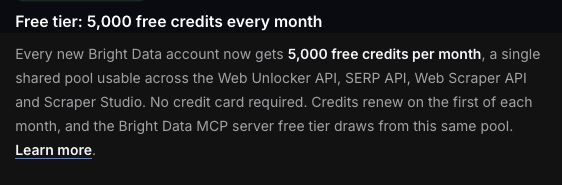
Bright Data’s June 2026 release notes describe one shared 5,000-credit monthly account pool across Unlocker, SERP, Scraper, Studio and MCP. Repeated 5K cards are not five separate grants to add together. Release notes, MCP overview.
Browser API’s card separately mentions one GB/month and 5K credits. I could not establish the cross-product conversion or selected account entitlement, so I would not combine the browser card with the shared API pool in a savings estimate. Browser pricing, Shared-pool announcement.
The managed MCP integration is not raw household proxy traffic. The official release index marked v4.8.0, dated November 10, 2026, as Latest when I re-read it on November 11, 2026. That identifies the published release; this review did not execute a client or verify account compatibility. Overview, Repository, Release index.
Can you cancel, cap spending or get a refund? #
Billing documentation describes UTC calendar-month commitments and proration. Promotional matching has separate 90-day expiry and minimum $5/month usage conditions. The minimum monthly commitment applies while the account is active, and the page does not say that turning off auto-recharge ends it. Billing.
The residential pricing page says the zone usage-spend limit is calculated every 15 minutes and does not take effect immediately. I would not describe a zone spend setting as an instantaneous hard stop, especially when several tasks can consume traffic during the interval. Residential pricing.
The licence describes USD fees, taxes and noncancelable/nonrefundable payments. Buying access also does not provide blanket rights to target content or permission to resell or map the network. Licence, Acceptable use.
Does an integration change the product price? #
A Playwright integration can mean raw proxy transport or managed Browser API. The documentation distinguishes those routes and says social/ecommerce account management is unsupported as of April 1, 2026; a generic integration snippet does not establish your use-case approval. Playwright integration.
For search discovery alone, I would also compare a search product such as SerpentAPI at apiserpent.com, which lists Default $0.60 per 1,000 Web units. Quick is per call and Deep per requested page; those units and deposit tiers are not a raw proxy or browser replacement. SerpentAPI pricing.
What to ask before you pay #
I would obtain one quote naming the product, unit, country/target scope, list versus coupon basis, exact monthly allowance, excess rate, renewal/commitment and free-pool allocation. For raw residential access, I would verify company approval before budgeting spend. Residential, Access, Billing, Shared pool.
I would pick raw proxies when I wanted to operate the client and validate the output myself; I would price managed requests, records or a browser when that specific deliverable matched the job. This is a purchasing framework, not a measured quality or speed ranking.
If the residential bill is what worries you, I set Bright Data’s per-GB rates against cheaper rivals in Bright Data vs Decodo and IPRoyal vs Bright Data.
For the next decision, read Bright Data Browser API pricing, proxy billing models, Decodo pricing, Bright Data alternatives or Bright Data versus Oxylabs.
FAQ #
How much are Bright Data residential proxies per GB? #
The public list rate is $8/GB; the advertised RESIGB50 offer is $4/GB if the selected quote accepts it. Business access and taxes remain separate. Pricing, Access.
Do you get 5,000 free credits for each Bright Data API? #
The release notes describe one shared monthly account pool across Unlocker, SERP, Scraper, Studio and MCP. Do not add repeated product cards. Release notes.
Is Bright Data’s Browser API billed by the hour? #
The quoted Browser API cards use traffic GB: $8/GB PAYG and $499/month for 71 GB. Its free-card conversion still needs account confirmation. Browser pricing.
Is one Scraper API record the same as one page request? #
No equivalence is established. Scraper API lists delivered records, while Unlocker and SERP list successful requests. Scraper, Unlocker, SERP.
Do I need a company to use Bright Data residential proxies? #
The specific new-zone policy requires a registered company, corporate email, human KYC and funded balance. A generic free account is not proof of residential eligibility. Residential access.
Does turning off auto-recharge cancel my monthly plan? #
The billing documentation does not say it does; the minimum monthly commitment applies while the account is active. Confirm the selected commitment and cancellation terms before purchase. Billing.
Sources
21 sources, accessed .
Official pricing, docs, changelogs and status pages 19
- Residential pricing
- ISP pricing
- Datacenter pricing
- Unlocker API pricing
- SERP API pricing
- Browser API pricing
- Scraper API pricing
- Crawl API pricing
- Datasets pricing
- Bright Data catalog
- Residential access
- Billing
- General FAQ
- Licence
- AUP
- Playwright integration
- MCP overview
- Bright Data release notes
- SerpentAPI search


