Roundup
Best residential proxies? Here's who I'd pick, and why
Decodo for value, Oxylabs for scale, Byteful for speed: my residential proxy picks from Proxyway's 2026 test data, official prices and refund terms.

For most people buying rotating residential IPs, I’d pick Decodo. At large volumes I’d pick Oxylabs, and if speed and traffic that never expires matter most, Byteful. Those picks come from Proxyway’s published 2026 test results set against each provider’s own prices and terms, all read on November 12, 2026.
Almost every page ranking for this query is a vendor ranking itself. Here you get independent numbers next to vendor claims, the terms that bite, and which providers are still standing after 2026’s crackdown on proxy networks.
Short on time?
Here's who I'd pick
- Best overall value
- Decodo
- 99.92% success and 0.53 s in Proxyway's test, the most unique US IPs, $275 for 100 GB and a 14-day money-back window.
- Large volumes
- Oxylabs
- Top success rate (99.93%) and the most unique IPs Proxyway saw. $4/GB on the $500 plan, $2.5/GB from 1,000 GB; no self-service refunds.
- Speed, and GB that never expire
- Byteful
- Fastest (0.41 s), highest average residential share and best real-target score in Proxyway's test. $275 for 100 GB.
- Lowest price per GB, measured pool
- DataImpulse
- $1/GB with no expiry, so 100 GB is $100. Its standard pool had the lowest average residential share among my picks.
- Small monthly plans
- Webshare
- 1 GB for $3.50 a month and 100 GB for $225, from a pool Proxyway rated 98.67% residential on average.
- Tightest monthly budget
- Evomi
- Core is $49 for 100 GB a month. Proxyway measured Evomi's Premium pool, not Core, so treat Core as untested.
- Cheaper exit countries
- SOAX
- Priced by country tier, from $5/GB in the US on pay-as-you-go down to $0.35/GB in Tier 3 on its largest plan.
- A company that wants vetted supply
- Bright Data
- New residential zones go to verified companies only. $8/GB list, $4 with its 3-month coupon.
Prices verified . Sponsors cannot buy a verdict or a position.
How do the 10 providers compare? #
Prices are USD before tax, verified 2026-11-12. “100 GB” is the cash you pay at checkout to get at least 100 GB of residential traffic.
| Provider | Best for | Price to start | Cash for 100 GB | Pool (vendor) | Sticky cap | Targeting extras | Concurrency | Refund |
|---|---|---|---|---|---|---|---|---|
| Decodo Top pick | Best overall value | PAYG $4/GB, or 3 GB for $11.25 | $275 | 115M+ | 24 h | Down to ZIP and ASN, included | Not stated | 14 days, 20% use cap |
| Oxylabs At scale | Large volumes | $15 Starter (up to 2 GB) | $500 (up to 125 GB) | 175M+ | 24 h | KYC for some filters | Unlimited sessions | None on self-service |
| Byteful Fastest | Speed, never expires | 10 GB for $32.50 | $275 | 35M+ | 24 h | Carrier and ASN listed | Not stated | Not stated |
| DataImpulse | Lowest price per GB (measured pools) | $5 for 5 GB (new users) | $100 | 90M+ | Not stated | City, ZIP, ASN cost extra | Not stated | 7 days, first Intro only |
| Webshare | Small monthly plans | 1 GB for $3.50 a month | $225 | 80M+ | Not stated | Down to ZIP and ASN | Not stated | 2 days, under 0.1 GB used |
| Evomi | Tightest budget | Core $49 a month for 100 GB | $49 (Core) | 54M+ | 24 h | ZIP, ISP, ASN use more bandwidth | Not stated | 30 days, not PAYG |
| SOAX | Cheaper exit countries | $5/$4/$2 per GB by tier | $500 (US/DE) | 12M or 191M (pages conflict) | Not stated | ISP and ASN listed | Not stated | Generally non-refundable |
| Bright Data | Vetted company access | PAYG $8/GB ($4 with coupon) | $800 list; $400 with the 3-month coupon | 400M+ monthly | Not stated | $0.42/GB or free (page conflicts) | Unlimited sessions | Not stated on pages read |
| Rayobyte | Free trial, volume tiers | $3.50/GB (1 to 49 GB) | $200 | Not stated | 120 min | Country to ASN, included | Not stated | Not stated |
| IPRoyal | Small non-expiring packs | 1 GB for $7 (subscription) | Not published | 64M+ | 7 days | Not stated | Not stated | 24 h, defects only |
Source: Each provider's pricing, product and terms pages, read 12 Nov 2026. Exact cash at 1 GB, 100 GB and 1 TB is in the price study linked below. Scroll sideways for more columns.
Exact cash at 1 GB, 100 GB and 1 TB lives in my residential price study, so this page stays on quality, terms and sourcing.
What do the independent tests show? #
The only large public test I found is Proxyway’s 2026 market research. For residential, it sent 3.6 million requests per provider to each global pool over 21 days, hitting a small (about 6 KB) CDN-hosted page, with most data collected in March and April 2026.
Read it with two caveats. Providers saw the method in advance, and Proxyway says to treat results as the “best rather than default configuration”.
Proxyway also earns affiliate fees from providers, and its page says so: “We use affiliate links.” I quote its figures as its own and name the column each comes from.
| Provider | Success rate (global pool) | Response time |
|---|---|---|
| Oxylabs | 99.93% | 0.60 s |
| Decodo | 99.92% | 0.53 s |
| DataImpulse Premium | 99.82% | 0.66 s |
| SOAX | 99.78% | 0.89 s |
| DataImpulse (standard, $1/GB) | 99.74% | 0.97 s |
| Byteful | 99.69% | 0.41 s |
| Evomi Premium | 99.58% | 0.79 s |
| Webshare | 99.28% | 0.86 s |
| Rayobyte | 98.02% | 1.86 s |
| IPRoyal | 96.11% | 1.24 s |
| NetNut (seized, reference only) | 95.28% | 1.66 s |
Source: Proxyway Proxy Market Research 2026, read 2026-11-12. The median global success rate was 99.28%. Bright Data wasn’t in this round; Proxyway’s best-residential list files it under options it hasn’t tested recently.
Unique IPs matter if you need many distinct addresses. Oxylabs returned 3,241,404 unique IPs from 3.6 million requests, the most, with Decodo second. In the US test, Decodo returned the most (961,218 of 1.2 million), and SOAX posted the best US success rate at 99.92%.
Is the IP really residential? #
Proxyway checked the exit IPs it received against IP2Location’s usage type and counted ISP or mobile addresses as residential. It reports two columns, and they don’t always agree, so I’ve shown both.
| Provider | Residential share, avg of 7 locations | Residential share, global pool |
|---|---|---|
| Byteful | 98.68% | 98.58% |
| Webshare | 98.67% | 98.88% |
| Decodo | 98.29% | 98.97% |
| Rayobyte | 98.23% | 98.16% |
| Oxylabs | 98.21% | 99.01% |
| SOAX | 98.08% | 97.39% |
| IPRoyal | 97.93% | 86.77% |
| DataImpulse Premium | 97.59% | 96.69% |
| Evomi Premium | 97.30% | 97.62% |
| NetNut (seized) | 94.84% | 95.90% |
| DataImpulse (standard) | 93.26% | 91.77% |
The column changes IPRoyal’s story most: 97.93% averaged by location, but 86.77% on the global pool. Proxyway’s write-up also flags over 900,000 US IPs in IPRoyal’s unfiltered pool tied to little-known Comcast ASNs, some of which Comcast had already deactivated.
Why 99% success doesn’t mean 99% of pages #
The 99% figures above come from a plain test page. When Proxyway pointed the same pools at Amazon, Google and Instagram, the median success rate fell to 74.43%. Byteful did best at 81.23%, and Proxyway notes that “Byteful, Evomi, Decodo, and Oxylabs all hovered around 80%”.
That gap is the most useful number in the whole study. If your targets are heavily protected, buying more GB from a better pool won’t close it; you need an unblocker or a scraping API that handles retries and fingerprints for you. My guides to web unblockers and scraping APIs vs proxies cover that step.
Decodo: the best all-round value #
Best for most buyers: strong independent numbers, fair prices at every size and a refund window. Proxyway measured 99.92% success and 0.53 s, with 98.29% residential share on average and the most unique US IPs.
Its pricing page lists pay-as-you-go at $4/GB, bought 1 GB at a time through a Wallet, and monthly plans from 3 GB for $11.25 and 10 GB for $35 to 100 GB for $275 ($2.75/GB) (verified 2026-11-12). Enterprise tiers run from $2.50/GB at 250 GB down to $2/GB at 1 TB.
The pool claim is 115M+ IPs in 195+ locations, with targeting by continent, country, state, city, ZIP and ASN included. Its quick-start docs say sessions last up to 24 hours, and it supports HTTP(S) and SOCKS5. Worked costs at 1, 10 and 100 GB are in my Decodo pricing guide.
Terms: a 3-day, 100 MB trial turns into the paid plan unless you cancel, and a 14-day money-back window applies to a first purchase if you skipped the trial and used no more than 20%. The drawback is in the licence: Wallet credits expire after 12 unused months, and one recent Trustpilot review says, “I had no idea that funds could expire if unused”.
Decodo, Oxylabs and Webshare are sister companies in the Source group, announced on October 13, 2026. Source says each brand runs independently; if you want two suppliers from different companies, pick your fallback outside that group.
Oxylabs: built for large volumes #
Best for teams buying 100 GB or more a month that want the deepest pool. Proxyway measured the top success rate (99.93%), 0.60 s, and 99.01% residential share on the global pool, plus the most unique IPs.
Its pricing page lists $6/GB on the $15 Starter plan, $5/GB up to 20 GB on the $100 Basic plan, $4/GB up to 125 GB on the $500 Flexible plan and $2.5/GB from 1,000 GB on Enterprise, from $2,500 (verified 2026-11-12). Starter shows “up to 2 GB” even though $15 at $6/GB is 2.5 GB, and the FAQ on its product page still says plans “start at $30 per month”.
The pool claim is 175M+ IPs in 195 countries, including 10,353,360 in the US. You get 24-hour sticky sessions, unlimited concurrent sessions, and HTTP(S), HTTP/3 (MASQUE) and SOCKS5; some filters need KYC.
The drawback is cash flow. Self-service purchases are non-refundable, unused credits lapse at the end of each cycle, and traffic is billed regardless of HTTP status, so 100 GB means buying the $500 plan. On Trustpilot, complaints focus on support speed: “it takes weeks for them to close support tickets”. How the shared wallet bills is in Oxylabs pricing, explained.
Byteful: the fastest pool, and the GB never expire #
Best for buyers who want speed and don’t want traffic to lapse. Proxyway measured the fastest response (0.41 s), the highest residential share on average (98.68%) and the best real-target score (81.23%), with 99.69% success.
Its residential page lists 10 GB for $32.50, 25 GB for $75 and 100 GB for $275 ($2.75/GB), plus custom deals (verified 2026-11-12). Traffic never expires, and there’s a 1 GB free trial whose terms aren’t shown. The title and schema advertise “$1.75/GB”, which matches no visible tier.
The pool claim is 35M+ IPs, with 586,161 monthly active US IPs, 326,045 UK and 296,049 German. Targeting runs to region, city, ISP and ASN across 10,000+ networks, sessions stick for 24 hours, and it supports HTTP and SOCKS5.
The drawback: I couldn’t find a refund policy, and its US count is the smallest published among my picks. Byteful was formerly called Ping.
DataImpulse: the lowest price per GB, with a caveat #
Best for large budgets where cost per GB matters more than squeezing out the last percent of quality. Its residential page charges $1/GB with “Unused GBs never expire” (verified 2026-11-12).
The cards show an Intro pack of 5 GB for $5 (once, new customers), Basic at $50 for 50 GB, Advanced at $800 for 1 TB and Custom from $4,000 for 5 TB+. The page says “Buy any volume you like”, so 100 GB comes to $100. A separate Premium pool costs $5/GB.
Below 1 TB, that’s the lowest per-GB price among the pools Proxyway measured; Rayobyte’s $0.70 tier undercuts it from 1,000 GB, and Evomi’s Core is cheaper but unmeasured.
Proxyway’s numbers split by pool. The standard $1/GB pool scored 99.74% success and 0.97 s but only 93.26% residential share on average (91.77% global), the lowest average of my picks; the Premium pool scored 99.82%, 0.66 s and 97.59%. Targeting by city, ZIP or ASN costs extra.
The drawbacks: the 7-day refund in its terms covers only a first Intro purchase, and Trustpilot has withheld its TrustScore over a guideline breach.
Reviews there cut both ways. One calls it not bad “for 1$/1GB”, while another says “the full 18 GB was consumed in less than a week”, so watch your usage early.
Webshare: small monthly plans that renew #
Best for small, steady monthly needs. Proxyway measured 99.28% success, 0.86 s and 98.67% residential share on average, among the highest.
Its residential page lists 1 GB for $3.50 a month, 10 GB for $27.50, 25 GB for $65, 100 GB for $225 ($2.25/GB) and up to 3,000 GB for $4,200 (verified 2026-11-12). A “CYBER26” banner offered “up to 70% off” on the day I checked; the page doesn’t say how it relates to those prices, so I haven’t used it.
The pool claim is 80M+ IPs in 195 countries, with country, state, city, ZIP and ASN targeting over HTTP or SOCKS5. Its sourcing page describes “Tier A model proxies and ISP providers”, using its own grading.
The drawback is the renewal. Plans auto-renew monthly, the refund window is 2 days with under 0.1 GB used, and I couldn’t find the renewal price after a discount. Its free plan is 10 datacenter proxies, not residential.
Evomi: the tightest budget, if you accept an unmeasured pool #
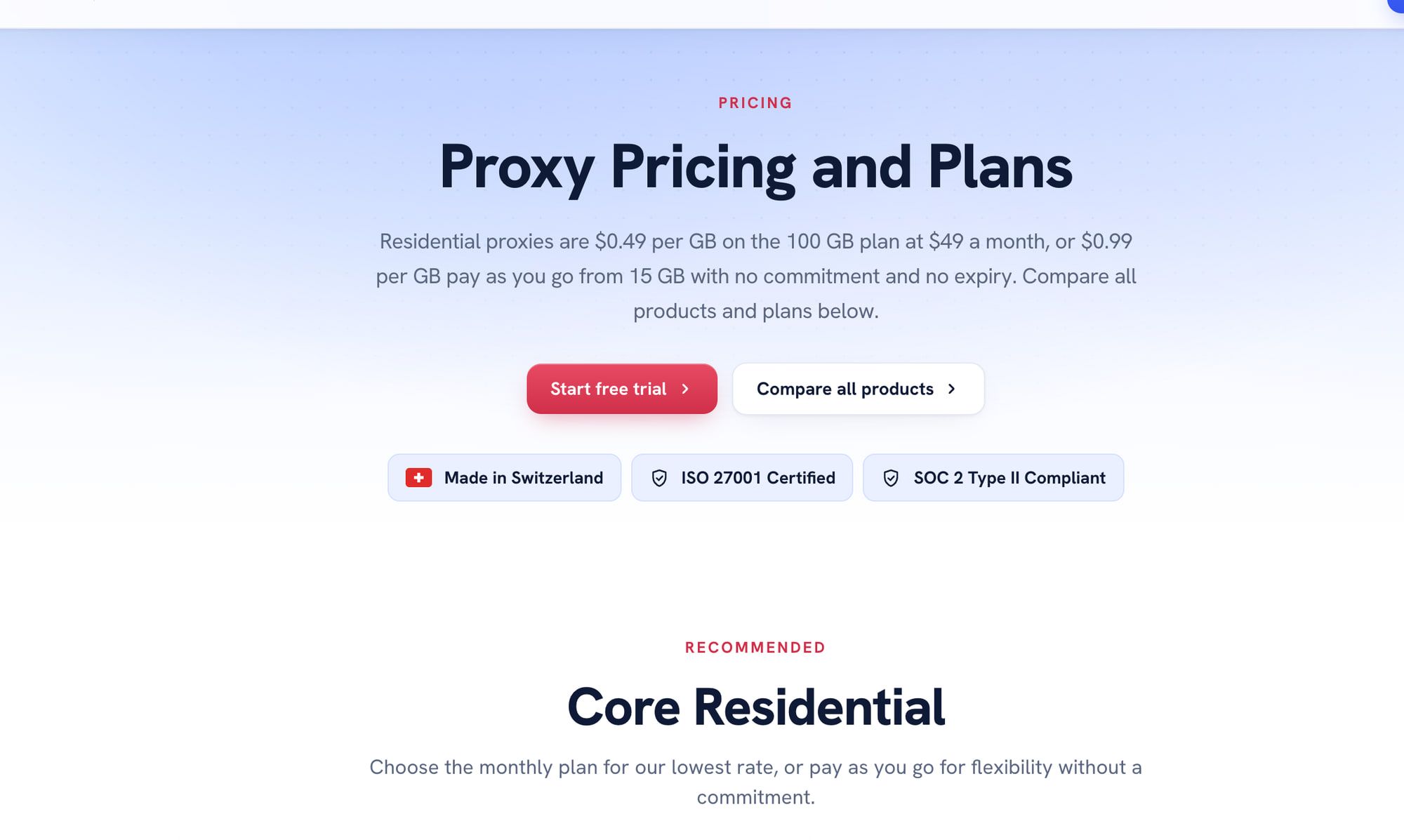
Best for the smallest monthly bill, if you can live without independent data on the pool you’re buying. Evomi’s Core plan is 100 GB for $49 a month ($0.49/GB, extra GB at $0.49), per its pricing page (verified 2026-11-12). Pay-as-you-go Core is $0.99/GB with a 15 GB minimum, and Premium is $3.98/GB pay-as-you-go.
Proxyway measured Evomi Premium, not Core: 99.58% success, 0.79 s and 97.30% residential share on average. The $0.49 Core pool has no independent data I could find, and Premium costs eight times as much per GB.
Its product page claims 54M+ IPs (9,986,584+ in the US), country, region and city targeting at no charge, and sessions of up to 1,440 minutes. ZIP, ISP and ASN targeting use extra bandwidth, and IPs are “ethically sourced from a global network of volunteer nodes”.
The refund policy gives 30 days on a first purchase while you’ve used under 1 GB or 10%, excluding pay-as-you-go.
One practitioner, the founder of ScrapeCreators, wrote in 2025 that Evomi was “Not worth the headache, no matter how cheap”, which is one person’s account rather than data.
SOAX: priced by the country you exit from #
Best for traffic that exits in lower-cost countries. Proxyway measured 99.78% success, 0.89 s and 98.08% residential share on average, and SOAX had the best US success rate in the test (99.92%).
SOAX pricing sells credits priced by geo tier (verified 2026-11-12). Pay-as-you-go Sandbox is $5, $4 or $2 per GB for Tier 1, 2 or 3; Builder is $200 a month ($3/$2.25/$1.20), Team $500 ($2.20/$1.65/$0.90), Scale $1,500 ($1.50/$1.15/$0.60) and Enterprise $3,000 (from $0.85/$0.55/$0.35). The US and Germany are Tier 1, so 100 GB there costs $500 on Sandbox, or $500 on Team for about 227 GB.
Its residential page lists country, region, city, ISP and ASN targeting over HTTP, HTTPS or SOCKS5. The pool claim conflicts: “over 12 million residential and mobile IPs” there, “over 191 million” on its mobile page.
The drawback is the terms. There’s no free trial, credits expire after 60 days, and payments are “generally non-refundable”.
Bright Data: for companies that want vetted access #
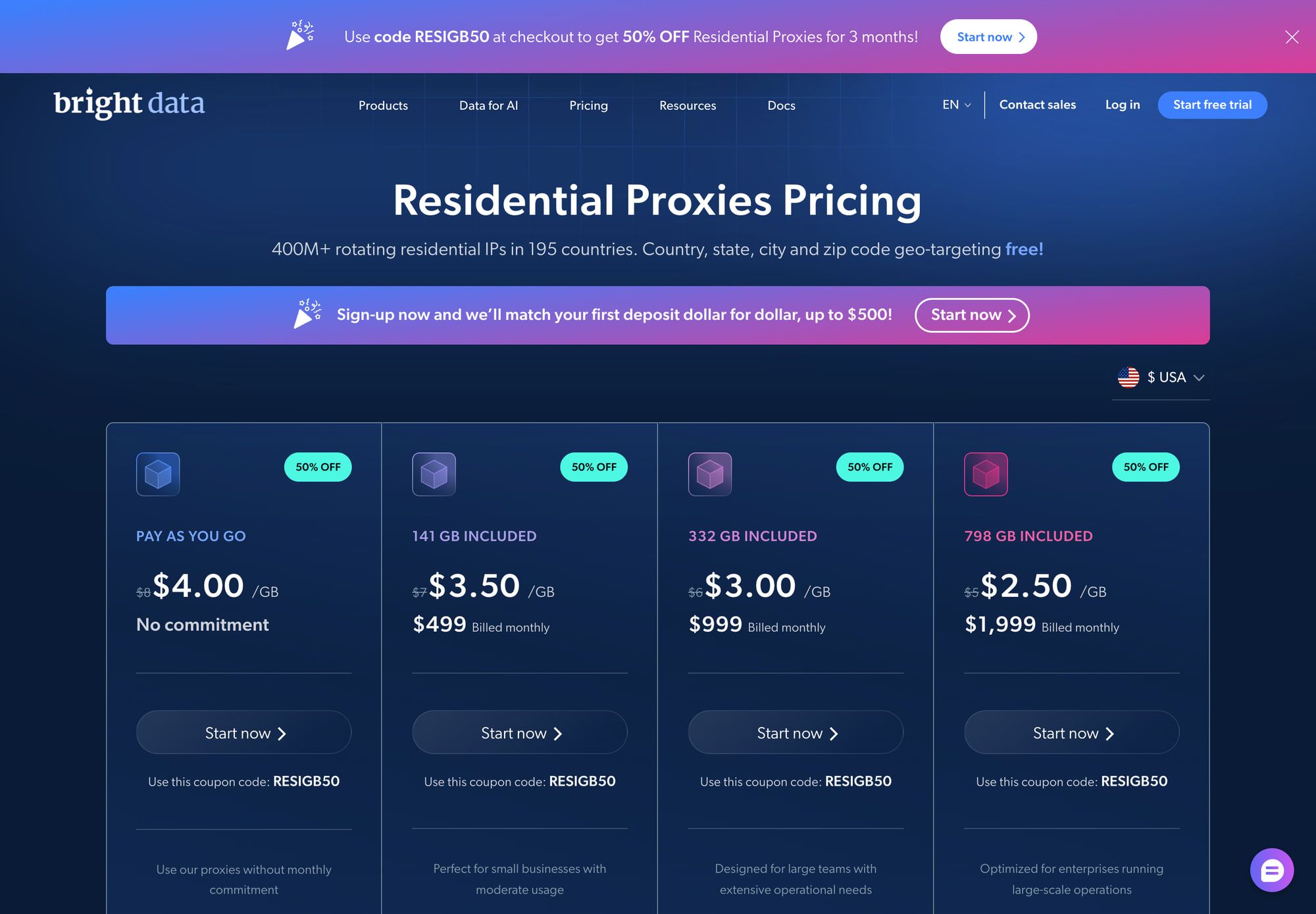
Best for registered companies that want a provider gating access with KYC. Since July 7, 2026, new residential zones are “available only to verified companies”, personal email addresses aren’t eligible, and you add funds first, per its access docs.
Pricing is $8/GB pay-as-you-go, or $4 with the RESIGB50 coupon “for 3 months” (verified 2026-11-12). The monthly cards show 141 GB for $499, 332 GB for $999 and 798 GB for $1,999, but those are coupon prices for the first 3 months: the struck-through list rates are $7, $6 and $5 per GB.
A sign-up offer also matches a first deposit up to $500. So 100 GB is $800 at list, or $400 with the coupon while it lasts.
The product page claims “400M+ monthly” IPs (3,727,713 in the US), unlimited concurrent sessions, HTTP/S, SOCKS5 and QUIC/HTTP3. It also sells geo-targeting at “$0.42/GB” while another section calls targeting “completely free”, so ask which applies.
Its release notes show October changes: on October 19 it deleted unused residential proxies on accounts that “didn’t get thru KYC”, and on October 24 it retired immediate-access residential and mobile proxies, deleted on November 9. The other drawback is the lack of current independent data: Proxyway hasn’t tested it recently.
Rayobyte: measured mid-pack, with a free trial #
Best for buyers who want to try before paying and scale on clear volume tiers. Proxyway measured 98.02% success, 1.86 s (the slowest of the providers listed here) and 98.23% residential share on average.
Premium Residential on its pricing page is pay-as-you-go: $3.50/GB for 1 to 49 GB, $2 for 50 to 249 GB, $1.50 for 250 to 999 GB and $0.70 for 1,000 to 4,999 GB, so 100 GB costs $200 (verified 2026-11-12). Country, city, ZIP and ASN targeting and sticky sessions are included, and the page offers a free trial on most products with no credit card.
The headline “from $0.0095/GB” belongs to a different product, Scale Residential: monthly plans for verified businesses after a compliance review, with no geo-targeting and one concurrent request per $1 of plan. That isn’t comparable to targeted per-GB plans, so I’ve left it out of the table.
The drawback is speed, and I couldn’t find refund terms. Rayobyte’s product page says “Every residential IP comes from a device whose owner opted in.”
IPRoyal: also worth a look, with caveats #
Best for small packs that never expire, if you accept the weakest independent numbers here. Proxyway measured 96.11% success, the lowest among providers still operating, plus 1.24 s and 86.77% residential share on the global pool.
Its pricing cards show 1 GB for $7, 2 GB at $5.95/GB and 10 GB at $5.25/GB on subscription, or $7.35, $6.25 and $5.51 pay-as-you-go (verified 2026-11-12). The $1.75/GB headline applies only from 10 TB, and the card tiers stop at 10 GB, so there’s no published price at 100 GB. Traffic never expires, sticky sessions run up to 7 days, and it claims 64M+ IPs.
The terms (version 10, effective October 15, 2026) refund only defects reported within 24 hours (§6.9.1), never refund crypto (§6.9.4) and allow a disclosed service fee at payment (§6.17). Trustpilot has withheld its TrustScore over a guideline breach.
PCMag’s comparison prefers Decodo and notes IPRoyal sources IPs through its own Pawns.app; that’s PCMag’s view. I’d buy IPRoyal only for a small, occasional job where non-expiring traffic beats everything else.
What happened to NetNut? #
NetNut still appears in some rankings, including the top vendor list for this query. I wouldn’t buy from it; if you were a customer, NetNut alternatives covers where to move.
The NetNut public domain, netnut.io, was still headed “Seized by the Federal Bureau of Investigation” when I checked on November 12, 2026. That is an observed page state; authenticity, the underlying court order and legal outcome were not independently established in this research.
KrebsOnSecurity reported on July 2, 2026 that the FBI and IRS-CI had seized NetNut domains tied to the Popa botnet of at least two million devices, and that Alarum said it would “fully cooperate”. Google’s threat intelligence team said it disabled NetNut’s command accounts and that Play Protect disabled apps carrying NetNut SDKs.
Where do residential IPs come from, after 2026’s crackdown? #
Most residential IPs come from software on real devices: an SDK inside an app, a “passive income” app, or a smart-TV app shares the device’s connection. The FBI’s March 2026 notice warns that devices can join with or without the owner knowing, and that SDK makers pay app developers to carry them.
The scale is real. Per KrebsOnSecurity’s July 21 report, researchers at Spur found residential-proxy SDKs in more than 42% of LG webOS apps and over 25% of Samsung Tizen apps, with Bright Data’s the majority; Bright Data says its network is consent-based, and LG says it will suspend non-compliant apps.
Here’s what each provider says about consent, quoted as their claim:
| Provider | What it says |
|---|---|
| Oxylabs | IPs come from “consenting, informed users” |
| Bright Data | “Every residential IP opts in. Verified customers only. Independently audited.” (no auditor named) |
| Decodo | “our peers have full control over whether they want to participate”; peers paid per GB |
| Byteful | Partners through “SDK programs and peer payment applications”, unnamed |
| Evomi | “volunteer nodes” |
| Webshare | “Tier A model proxies and ISP providers” |
| IPRoyal | “Suppliers must provide evidence that they acquire IP addresses with consent from device owners.” |
| Rayobyte | “Every residential IP comes from a device whose owner opted in.” |
None of these providers publishes an independent audit report. Before buying, I’d ask four questions: which apps or programs carry the SDK, what the user sees when opting in, what they’re paid, and how they opt out. My ethical residential proxies guide has the full checklist.
Trials, refunds and expiry, side by side #
These are the terms that decide whether a bad fit costs you money. Verified 2026-11-12; free-trial details are compared in more depth in my residential proxy free trial guide.
| Provider | Trial | Refund | Traffic expiry | KYC |
|---|---|---|---|---|
| Decodo | 3 days, 100 MB; becomes the paid plan | 14 days, first purchase, 20% use cap, no trial used | Wallet credits after 12 unused months | Customer KYC (per its sourcing page) |
| Oxylabs | $5 welcome credit | Self-service non-refundable | End of each cycle | For some filters |
| Byteful | 1 GB free | Not stated | Never | Not stated |
| DataImpulse | $5 Intro pack | 7 days, first Intro only; not crypto | Never | Not stated |
| Webshare | None for residential | 2 days, under 0.1 GB used | Monthly plan; renews | Not stated |
| Evomi | 1-day Core trial | 30 days, under 1 GB or 10%; not PAYG | PAYG never expires | Not stated |
| SOAX | None | Generally non-refundable | 60 days | Business check for Enterprise Annual |
| Bright Data | Not stated for new zones | Not stated on pages read | Coupon lasts 3 months | Verified companies only |
| Rayobyte | Free on most products, no card | Not stated | Not stated | For Scale plans |
| IPRoyal | At its discretion | 24 h, defects only; not crypto | Never | Not stated |
My read: if you can’t afford a mistake, start with Byteful’s 1 GB trial, Rayobyte’s free trial or Decodo’s first-purchase refund. Avoid buying a big SOAX or Oxylabs plan before a small one has proved itself, because neither gives money back.
Headline pools vs the country you need #
A 175M or 400M headline tells you little about the country you’ll exit from, and vendors count differently: total, monthly, or “active”. Here are the per-country numbers they publish (vendor claims, verified 2026-11-12).
| Provider | Headline pool | US | UK | Germany |
|---|---|---|---|---|
| Oxylabs | 175M+ | 10,353,360 | 3,502,538 | 3,537,899 |
| Evomi | 54M+ | 9,986,584+ | Not extracted | Not extracted |
| Bright Data | 400M+ monthly | 3,727,713 | Not stated | Not stated |
| DataImpulse | 90M+ | 853,793 | Not stated | Not stated |
| Byteful | 35M+ | 586,161 monthly active | 326,045 | 296,049 |
| Decodo | 115M+ | Not published; most unique US IPs in Proxyway’s test (961,218) |
The one comparable number is Proxyway’s, because it measured the same way for everyone. On that basis Decodo surfaced the most distinct US IPs, whatever the headlines say.
Rotating, sticky or static? #
Rotating residential gives you a new IP per request or on a timer, which suits broad scraping. Sticky keeps one IP for a session: 24 hours at Decodo, Oxylabs, Byteful and Evomi, 120 minutes at Rayobyte and up to 7 days at IPRoyal. Static residential, usually sold as ISP proxies, gives you a fixed IP for logins and long sessions; my ISP vs residential guide explains when that’s the better buy.
For protocols, Decodo, Oxylabs, Byteful, DataImpulse, Webshare, SOAX and Bright Data all list SOCKS5 alongside HTTP(S). Oxylabs adds HTTP/3 over MASQUE and Bright Data a QUIC/HTTP3 option, useful if your client already speaks HTTP/3.
Residential, datacenter, or a VPN? #
Datacenter IPs are far cheaper and fine for sites that don’t block hosting ranges; residential costs more because it looks like home broadband. A VPN gives one shared exit for your whole device, which isn’t built for rotating across thousands of requests. My residential vs datacenter guide has the decision rule, and residential proxy vs VPN covers the VPN side.
Can sites tell it’s a proxy, and is the IP really residential? #
A site sees a home-broadband IP, so the address alone rarely gives you away; the residential-share table above shows how often that’s true for each provider. What gives you away is behaviour, which is why success on Amazon, Google and Instagram drops to a 74.43% median in Proxyway’s test.
If you’re being blocked despite a good pool, change your request rate, headers and browser fingerprint before changing providers. If that doesn’t work, a web unblocker is usually the next step.
Are residential proxies legal and safe? #
Buying and routing traffic through a residential proxy isn’t usually the legal question. What you collect, from which site and under whose terms is; a proxy reduces blocks, but it doesn’t grant permission. My guide to whether web scraping is legal covers that side.
Safety is mostly about sourcing. After the FBI’s March 2026 notice and the NetNut seizure, I’d only buy from a provider that explains how its peers consent and lets you ask questions about it.
What will it cost you? #
Here’s the price to start and the cash for 100 GB for each pick, verified 2026-11-12. For 1 GB, 100 GB and 1 TB side by side with the arithmetic, see my residential price study.
- Decodo: $4 pay-as-you-go or $11.25 for 3 GB; $275 for 100 GB.
- Oxylabs: $15 Starter; $500 for 100 GB (the plan covers up to 125 GB).
- Byteful: $32.50 for 10 GB; $275 for 100 GB.
- DataImpulse: $5 Intro once, then $50; $100 for 100 GB.
- Webshare: $3.50 for 1 GB; $225 for 100 GB.
- Evomi Core: $49 for 100 GB a month.
- SOAX (US): $5/GB pay-as-you-go; $500 for 100 GB.
- Bright Data: $8/GB list; $800, or $400 with the coupon.
- Rayobyte: $3.50/GB; $200 for 100 GB.
What other lists get wrong #
| Claim on a ranking page | What the official page shows (2026-11-12) |
|---|---|
| IPRoyal at “$1.00/GB” (Roundproxies) | $7 at 1 GB; $1.75 only from 10 TB (IPRoyal) |
| NetNut ranked as a live option (same page) | netnut.io shows an FBI seizure notice |
| Byteful “$1.75/GB” (its own title) | Lowest visible tier is $2.75/GB (Byteful) |
| Oxylabs residential “start at $30 per month” (its own FAQ) | Starter plan is $15 a month (Oxylabs) |
Which one should you pick? #
- Most buyers: Decodo, for its independent numbers, prices at every size and refund window.
- 100 GB a month and up: Oxylabs, if non-refundable plans and lapsing credits are acceptable. Runner-up: Decodo.
- Speed and traffic that never expires: Byteful, starting with its 1 GB trial.
- Lowest price per GB from a measured pool: DataImpulse, accepting a lower residential share; its Premium pool closes the gap at $5/GB.
- A small monthly allowance: Webshare, with an eye on renewal.
- The tightest budget: Evomi Core, knowing nobody has published data on that pool.
- Traffic in cheaper countries: SOAX, if you’ll use the credits within 60 days.
- A registered company that wants vetted supply: Bright Data.
- Try before paying: Rayobyte’s free trial.
- Small occasional packs that never expire: IPRoyal, with the caveats above.
Need mobile or datacenter IPs instead? My mobile proxy picks and proxy providers for web scraping cover those, and the proxies hub maps the rest.
FAQ
Which residential proxy provider is best?
For most buyers I'd pick Decodo: 99.92% success and 0.53 s in Proxyway's 2026 test, $275 for 100 GB and a 14-day money-back window. Oxylabs is my pick at large volumes, and Byteful if speed and traffic that never expires matter most.
Is the IP really residential?
Mostly, for the leading providers. Proxyway checked each exit IP against IP2Location's usage type and found 98% or more residential on average for Byteful, Webshare, Decodo, Rayobyte, Oxylabs and SOAX. DataImpulse's standard pool averaged 93.26%, and IPRoyal fell to 86.77% on its global pool.
Do residential proxies expire?
It depends on the provider. Byteful, DataImpulse, IPRoyal and Evomi pay-as-you-go traffic never expires. Oxylabs credits lapse at the end of each billing cycle, SOAX credits after 60 days, and Decodo wallet credits after 12 unused months.
Is there a free trial or refund?
Some. Byteful lists a 1 GB free trial, Rayobyte a free trial on most products with no card, and Decodo a 3-day, 100 MB trial that turns into the paid plan unless you cancel. Evomi gives 30 days to ask for a refund on monthly plans, Decodo 14 days, while Oxylabs and SOAX are effectively non-refundable.
Rotating, sticky or static residential proxies?
Rotating suits broad scraping. Sticky keeps one IP for a session, usually up to 24 hours here, with IPRoyal offering up to 7 days. Static residential, sold as ISP proxies, gives you a fixed IP for logins and long sessions.
Are residential proxies legal and safe?
The proxy itself isn't usually the legal issue; what you collect and under whose terms is. Safety depends on sourcing: the FBI warned in March 2026 that some devices join proxy networks without their owners' consent, so ask a provider how its peers opt in.
Can websites detect residential proxies?
Often they can't tell from the IP alone, but they block on behaviour. Proxyway's providers scored about 99% against a plain test endpoint, yet the median success on Amazon, Google and Instagram was 74.43%.
Is NetNut still working?
On November 12, 2026, netnut.io was still headed with an FBI seizure notice. KrebsOnSecurity reported the FBI and IRS-CI seized NetNut domains on July 2, 2026. I would not buy from it.
FAQ sources: Proxyway Market Research 2026, FBI notice, KrebsOnSecurity, and the pricing and terms pages linked in each provider section.
Sources
44 sources, accessed .
Official pricing, docs, changelogs and status pages 30
- Decodo residential pricing, trial and money-back terms
- Decodo residential quick start (session length)
- Decodo licence agreement (credit expiry, benchmark clause)
- Decodo sourcing statement
- Oxylabs residential product page
- Oxylabs residential pricing
- Byteful residential proxies
- DataImpulse residential pricing
- DataImpulse terms (refund scope)
- Webshare residential pricing and terms
- Webshare sourcing statement
- Evomi pricing (Core, PAYG, Premium)
- Evomi residential proxies
- Evomi refund policy
- SOAX pricing (geo tiers, expiry, refunds)
- SOAX residential proxies
- SOAX mobile proxies (pool claim)
- Bright Data residential pricing
- Bright Data residential product page
- Bright Data residential network access (company KYC)
- Bright Data sourcing
- Bright Data release notes (October 2026)
- Rayobyte pricing (Premium and Scale residential)
- Rayobyte residential proxies
- IPRoyal residential pricing cards
- IPRoyal terms of service v10
- IPRoyal sourcing statement
- netnut.io (observed page state)
- FBI public service announcement I-031226-PSA
- Source group announcement


