Comparison
Firecrawl vs Jina Reader: Markdown Output and Cost
Firecrawl vs Jina Reader: page credits vs output tokens, whole-site crawling vs single-URL reads, and commercial licenses. Verified 31 Oct 2026.

You’ve seen both: put https://r.jina.ai/ in front of a URL and get markdown back, or call Firecrawl’s /scrape and get the same page as markdown, HTML or JSON. The decision is whether a one-URL reader billed by output tokens covers your job, or whether you need a crawl API billed by the page.
I refreshed both vendors’ pricing, docs and repositories, Elastic’s filings and announcements on Jina, and the retained cited issue/comment records on 15 October 2026, following my original September 27 research, and rechecked every price, limit and license against the live pages on 31 October 2026. Both tools sit in my wider crawl API guide; this page is only about choosing between these two.
Short on time?
Short on time? Here's my take.
- Pick Jina Reader if…
- Jina Reader
- You read single URLs on demand: prefix https://r.jina.ai/ and get markdown back. It bills output tokens ($0.050 per 1M on the $50 pack), which works out to $0.05 to $0.40 per 1,000 pages in my scenarios. There's no crawl.
- Pick Firecrawl if…
- Firecrawl
- You need whole sites (crawl and map), JSON extraction or browser actions like clicks. Ordinary scraping is 1 credit per page; JSON extraction adds 4. Plans run $19 to $749 a month, and the free plan gives 1,000 credits a month.
- Use both if…
- Jina for reads, Firecrawl for crawls
- Your agent reads whatever URLs users paste while a scheduled job crawls sites you know. The two bill in different units, so each one handles the job its billing suits.
- Check the license first if…
- Your use is commercial
- Jina's free 10M tokens are labeled 'Non-commercial use only (CC-BY-NC)', and running its Reader models on your own hardware for commercial production needs a license that Elastic sells.
Prices verified . Sponsors cannot buy a verdict or a position.
What’s the difference between Firecrawl and Jina Reader? #
Jina Reader turns one URL into LLM-friendly text and bills you for the tokens it returns. Firecrawl is a web data API that scrapes, crawls, maps and searches, and bills a credit per page.

That one difference drives everything else here. Jina’s cost moves with page length, and Firecrawl’s moves with page count. I found no crawl or sitemap feature on Jina’s Reader page, while Firecrawl’s billing docs price /crawl at 1 credit per page and /map at 1 credit per call.
| Feature | Jina Reader | Firecrawl |
|---|---|---|
| What it is | A URL prefix: r.jina.ai/<url> returns markdown; s.jina.ai runs a search | A web data API for scraping, crawling, mapping and search |
| Endpoints | r.jina.ai (read), s.jina.ai (search) | /scrape, /crawl, /map, /search, /agent, /interact, /parse, /monitor |
| Billing unit | Output tokens per read; a search costs at least 10,000 tokens | Credits: 1 per page scraped or crawled, +1 per PDF page, +4 for JSON; map 1 per call; search 2 per 10 results |
| Paid price | $50 for 1B tokens ($0.050 per 1M); $500 for 11B ($0.045 per 1M) | $19, $99, $399 or $749 a month (Hobby to Scale); $16, $83, $333 or $599 a month billed annually |
| Free tier | 10M tokens per new key, 'Non-commercial use only (CC-BY-NC)'; keyless reads at 20 RPM | 1,000 credits a month, no card; keyless mode with unpublished per-IP caps |
| Read rate limits | 20 RPM keyless, 500 with a free or paid key, 5,000 with a premium key | Scrape: 10 RPM (Free) to 10,000 (Scale). Crawl: 2 to 2,000 |
| JavaScript rendering | Headless browser by default; X-Engine: direct or cf-browser-rendering; wait-for-selector and timeout headers | Browser rendering; waitFor in ms; actions such as click, write, scroll and executeJavascript |
| PDFs and documents | 'natively supports PDF'; Office files and POST uploads per the README | PDF parsers fast, auto and ocr; +1 credit per PDF page |
| Output formats | markdown, html, text, screenshot, frontmatter; link and image summaries; generated alt text; readerlm-v2 mode; jina-ocr-v1 mode (40× tokens) | markdown, summary, html, rawHtml, links, images, screenshot, json, changeTracking, branding and others |
| How you set options | HTTP headers (X-Engine, X-Target-Selector and others) | JSON parameters (formats, onlyMainContent, waitFor and others) |
| Main-content control | CSS selector headers to keep or remove parts of the page | onlyMainContent, on by default; includeTags and excludeTags |
| Caching | Same URL within 5 minutes returns cached content | maxAge, default 2 days |
| Whole-site crawl | None documented | /crawl and /map |
| MCP server | Official: mcp.jina.ai (Apache-2.0 repo) | Official: firecrawl-mcp-server (MIT) |
| Open source | Reader repo Apache-2.0, an 'open source branch' without the SaaS storage layer; Reader models CC-BY-NC 4.0 | Core AGPL-3.0; SDKs MIT |
| Owner | Jina AI GmbH, owned by Elastic since October 2025 | Firecrawl; $75M Series B on 22 September 2026 |
Source: Jina's Reader page, pricing page and jina-ai/reader README; Firecrawl's pricing.md, billing, scrape and rate-limit docs. All rechecked 31 Oct 2026. Scroll sideways for more columns.
Which one gives better markdown? #
I have not measured either tool’s Markdown quality and cannot give a supported quality ranking. For a wider set of documented controls, see my comparison of website-to-markdown tools for LLMs.
fastCRW’s canonical benchmark page links a result-of-record file, but that artifact returned 404 through both the raw URL and GitHub contents API on 15 October, and the contents API still returned 404 on 31 October. I have withdrawn the numerical comparison rather than use an unauditable run to rank these tools. Firecrawl’s comparison page is vendor material, not a head-to-head I reproduced.
A Hacker News comment from PageMap’s author describes an agent-task comparison. Its author builds a competing tool, it supplies no inspectable result set, and task success does not establish Markdown fidelity. I use neither that comment nor the unavailable artifact to recommend an output-quality winner.
What each vendor documents about its output #
Jina Reader renders the page in a headless browser by default and returns markdown. You shape the result with headers: X-Target-Selector and X-Remove-Selector keep or drop parts of the page, X-With-Links-Summary and X-With-Images-Summary add summaries of the page’s links and images, and X-With-Generated-Alt writes captions for images (Reader page).
There’s also a model option. X-Respond-With: readerlm-v2 converts the page with ReaderLM-v2, Jina’s 1.54B-parameter HTML-to-markdown model, whose model card lists 29 languages and up to 512K tokens of input plus output.
Jina’s paper says the model “outperforms GPT-4o-2024-08-06 and other larger models by 15-20% on carefully curated benchmarks”. That’s Jina grading its own model against LLMs, not against Firecrawl. It also costs more: the model card says readerlm-v2 requests through Reader “consume 3x the normal token count”, so budget three times the tokens for that mode. The Reader page also now offers a jina-ocr-v1 option that converts page images to markdown and “Costs 40× more tokens” (checked 31 October 2026), while its FAQ still documents the readerlm-v2 header.
Firecrawl filters by default. Its scrape docs set onlyMainContent, blockAds and removeBase64Images to true, so you get the main content without ads or inline base64 images unless you turn those off.
You can ask for several formats in one call, including markdown, html, rawHtml, links, images, screenshot and json (fields you define with a schema or prompt, at 4 extra credits a page).
What the GitHub issues say about output #
Both repos have output complaints. On Jina’s: #1166, “Links are not showing up in the content”, closed as completed in March 2025, and #1251, a report of pages rendering oddly that was opened in June 2026 and is still open.
On Firecrawl’s: #3968, “[Bug] Cached PDF scrape returns markdown for a different URL”, opened 8 July 2026 and still open, and #4663, “Scrape Markdown conversion corrupts application/vnd.api+json responses”, now closed.
Most of the Firecrawl markdown complaints I found were about the self-hosted version, such as #1297, “[Self-Host] Markdown is empty, HTML works fine”. I wouldn’t read much into issue counts, because Firecrawl’s repo is far bigger and collects more of everything.
A small-sample check is planned
I haven’t measured either tool’s markdown yet, so this page has no quality, speed or success numbers of mine. A small-sample check against pages with known content is planned as a later update, with its raw results on my evidence page. Until then, treat any single score you see for these two as a vendor’s claim.
How do they handle tables, code and JavaScript-heavy pages? #
Neither vendor’s docs that I read spell out how tables or code blocks are converted, so I can only tell you what controls each one gives you. Jina has markdown-formatting headers (X-Md-*); Firecrawl has browser actions that run before the page is captured.
For JavaScript-heavy pages, Jina’s X-Wait-For-Selector and X-Timeout let you wait for content to appear, and the repo README puts the maximum timeout at 180 seconds. X-Engine: direct skips the browser for a plain HTTP fetch, and X-With-Iframe and X-With-Shadow-Dom pull in content those structures hide.
Firecrawl’s scrape docs list waitFor (milliseconds, default 0), a timeout of up to 300,000 ms, and actions: wait, click, write, press, scroll, screenshot and executeJavascript. That’s the documented gap: Jina’s headers can wait for an element, while Firecrawl’s actions can also click, type and scroll.
Two Hacker News comments point the same way, though both are opinions. One said Jina Reader is “pretty good, until you hit JS heavy pages” (February 2026, from someone who builds a competing tool). An older one said it “can’t handle” some sites, “mostly those behind Cloudflare” (November 2024).
On Cloudflare specifically, Jina’s issue #1260, “Cloudflare security verification in r.jina.ai”, was opened 11 August 2026 and closed as completed on 23 August. Firecrawl’s proxy docs describe basic, enhanced and auto routing, but mark the explicit proxy parameter deprecated and recommend auto. Its billing docs list enhanced proxy at no extra credits.
What does each cost at 10K, 100K and 1M pages? #
On list prices, Jina Reader is cheaper per page in all three of my scenarios: $0.05 to $0.40 per 1,000 pages, against $0.60 to $4.40 for Firecrawl. Jina’s cost depends on how many tokens each page returns, though, and nobody publishes a typical figure, so treat the Jina rows as illustrations.
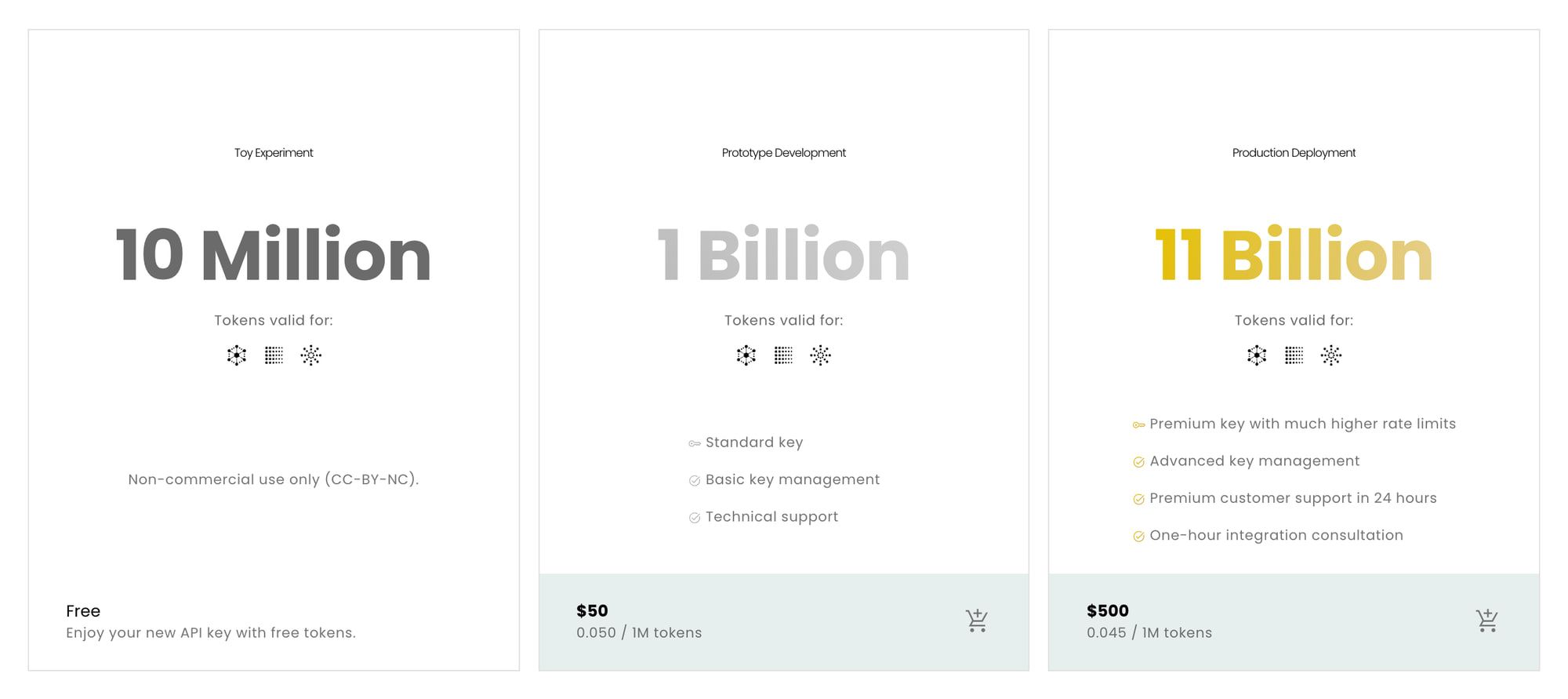
Here’s the formula: Jina cost = pages × output tokens per page × $0.050 per 1M tokens on the $50 pack of 1 billion tokens. The $500 pack gives 11 billion tokens: its card rounds the unit rate to $0.045 per 1M, while the exact pack ratio is about $0.04545 per 1M (Jina pricing, verified 31 Oct 2026). Reader’s billing rule is to “Count the number of tokens in the output response” (Reader page).
I picked 1,000, 3,000 and 8,000 tokens per page as scenarios, not measurements. For scale, Hacker News user simonw counted the HN homepage at “1550 tokens” as markdown against 13,367 as HTML, using a Claude tokenizer rather than Jina’s. Another commenter said Jina or Trafilatura “cuts that 68k down to ~3-5k for most Wikipedia pages”. Fewer tokens isn’t the same as better answers, and I cover whether markdown actually helps LLM answers separately.
Monthly cost at three volumes: Jina scenarios vs Firecrawl list price
Verified
| Option | Per 1K pages | 10K pages a month | 100K pages a month | 1M pages a month |
|---|---|---|---|---|
| Jina Reader, ~1,000 tokens a page Illustrative | $0.05 | $0.50 of tokens ($50 minimum buy) | $5 | $50 |
| Jina Reader, ~3,000 tokens a page Illustrative | $0.15 | $1.50 of tokens ($50 minimum buy) | $15 | $150 (or about $136.36 of a $500 pack) |
| Jina Reader, ~8,000 tokens a page Illustrative | $0.40 | $4 of tokens ($50 minimum buy) | $40 | $400 (or about $363.64 of a $500 pack) |
| Firecrawl, markdown scrape at 1 credit a page | $0.60 to $4.40 | $44 (Hobby $19 + 5K extra credits) | $99 ($83 billed annually) | $749 ($599 billed annually) |
Source: Jina AI pricing page, Firecrawl rows from firecrawl.dev/pricing.md. Jina rows are my arithmetic on assumed tokens per page, not measurements. Firecrawl PDFs add 1 credit a page and JSON adds 4.
The Firecrawl row is the cheapest plan that fits each volume on its pricing file, with pricing “Effective September 4, 2026” per its pricing page. Every plan, top-up rate and billing rule is in my Firecrawl pricing breakdown.
My arithmetic on where the lines cross: Jina costs more per page than Firecrawl’s lowest rate ($0.60 per 1K on Scale billed annually) only if your pages average more than 12,000 output tokens. Against Standard at $0.99 per 1K, the crossover is about 19,800 tokens.
A few things change the picture:
- The minimum buy: at 10K pages a month, the modeled Jina consumption is $0.50–$4, but the smallest paid pack is $50. Its terms §6.5, checked 31 October 2026, allow rollover into the next Service Period unless the Order Form says otherwise, and make purchased credits non-refundable/non-exchangeable. I have not inspected an account-specific Order Form or confirmed an unconditional lifetime-expiry promise.
- Free allowances: Jina’s 10M free tokens cover about 10,000 pages at 1,000 tokens each, but they’re labeled non-commercial. Firecrawl’s 1,000 free credits renew every month.
- Extras on Firecrawl: a PDF adds 1 credit a page and JSON extraction adds 4, per the billing docs. With JSON on, 100K pages need 500K credits, which is the $399 Growth plan. A returned 403 or 404 page still costs 1 credit.
- Rollover: Firecrawl’s monthly credits reset, except on Scale (one month of rollover) and Enterprise, and extra credits you buy don’t expire unless you cancel (pricing file). The billing docs limit the rollover to annual Scale and Enterprise plans, so check before relying on it with monthly billing. Jina’s pricing page offers auto top-up when your token balance runs low.
- Throughput: 1M pages a month averages about 23 requests a minute (1,000,000 ÷ 43,200 minutes), above Jina’s keyless 20 RPM but far below a keyed 500 RPM. Firecrawl’s rate limits run from 10 scrapes a minute on Free to 10,000 on Scale.
You’ll see $0.02 per 1M tokens for Jina on some third-party pages. It isn’t on Jina’s pricing page, which says “We introduced a new pricing model on May 6th, 2025” and that earlier auto-recharge users “continue to pay the old price”, so I’d treat $0.02 as out of date.
Search is billed differently again. Each s.jina.ai search costs “a fixed number of tokens, starting from 10,000 tokens”, or at least $0.50 per 1,000 searches by my arithmetic, while Firecrawl charges 2 credits per 10 results. If search is your main job, Firecrawl vs Tavily is the better comparison. I also price Jina’s search endpoint next to other Tavily alternatives and compare the free search allowances of crawl and browser APIs, Jina’s and Firecrawl’s included.
Who owns Jina Reader and Firecrawl, and what do the licenses allow? #
Jina Reader belongs to Elastic, and its code and models carry different licenses: the Reader repo is Apache-2.0, while the Reader models are CC-BY-NC 4.0. Firecrawl is a venture-funded company whose core is AGPL-3.0.
Jina Reader after Elastic #
Elastic’s press release of 9 October 2025 says it “has completed the acquisition of Jina AI”. Its 10-Q dates the deal to 7 October 2025 at “a total purchase consideration of $44.6 million”. Jina’s terms, updated 4 May 2026, run under German law with Berlin courts.
The Reader repo is Apache-2.0, and it describes itself as “the open source branch of the codebase behind https://r.jina.ai and https://s.jina.ai”, adding that “the MongoDB-backed SaaS storage layer is not included here”. The public GitHub repository API still reports its last push as 22 May 2026 when checked on 31 October; that timestamp alone does not establish how actively the hosted service is maintained.
The models are a separate matter. Jina’s Reader page says they’re “CC-BY-NC 4.0 … free to download and use non-commercially, but commercial production use requires a commercial license”, and that “Elastic has sold that license separately since August 10, 2026”. Its FAQ adds that CC-BY-NC 4.0 “is not an open-source license”.
For local extraction, the current Reader FAQ says reader-model containers are available under the commercial Jina On-Prem license sold by Elastic since 10 August 2026. Fetching arbitrary public URLs still requires network access to those URLs. The separate 27 July announcement covered on-premises embedding and reranker models; it should not be read as a claim that internet fetching works offline. Pricing requires a quote.
One conflict to know about. The README still says “Feel free to use Reader API in production. It is free, stable and scalable”, while the pricing page labels the free 10M tokens “Non-commercial use only (CC-BY-NC)”. I’d plan on paying for any commercial use, because the pricing page is the more specific of the two and names the license.
This isn’t legal advice. The hosted API is governed by Jina’s terms, and the model license governs running the weights yourself.
Firecrawl #
Firecrawl’s core repo is AGPL-3.0, with its SDKs under MIT per the README. On 22 September 2026 it announced a “$75M Series B led by Smash Capital”.
Its product has moved fast this year: keyless access launched on 16 June 2026 and new pricing took effect on 4 September. If you’d rather run a crawler yourself under a permissive license, my Crawl4AI vs Firecrawl comparison covers that trade-off.
What do users report? #
Very little that compares the two directly, and the most likely place for it I couldn’t read. The Reddit thread that ranks for this query, “Firecrawl vs Jina Reader for web extraction”, was unreachable from my research tools on 27 September, so I haven’t summarized it.
The closest thing on GitHub is Firecrawl’s issue #1504, “Firecrawl VS Jina Reader”, opened 27 April 2025. It asked “why I should consider to use firecrawl rather then Jina Reader while Jina Reader is free?” and was closed as not planned in September 2025 with no comments.
On Hacker News, Jina’s appeal is simplicity: one commenter said “it does 90% of the job, and is an one-liner”, though that was in November 2024, before the May 2025 pricing change. The PageMap author noted that both tools “convert to markdown, so you can read but not interact”.
Firecrawl shows up in Hacker News threads as the crawl step in RAG pipelines (one example from November 2025). I found no strong complaints about its markdown in the comments I read.
The complaint on Jina’s side that I’d watch is billing. Issue #1255, “402 Payment Required despite available token balance”, was opened 12 July 2026 and is still open with 5 comments.
Pros and cons of Jina Reader and Firecrawl #
Jina Reader #
What stands out
- One URL prefix, no SDK: put https://r.jina.ai/ in front of a URL and read markdown
- Billed on output tokens: $0.05 to $0.40 per 1,000 pages in my 1K to 8K-token scenarios
- 10M free tokens per new key for non-commercial use, plus keyless reads at 20 RPM
- PDF, Office files and image captions documented, and an official MCP server
What gives me pause
- No crawl, map or sitemap feature documented: one URL per request
- Free tokens are non-commercial only, and the smallest paid pack is $50
- Cost per page moves with page length, and Jina publishes no typical token count
- The Reader models are CC-BY-NC 4.0; commercial self-hosting needs a license from Elastic
- An open billing issue (#1255) reports 402 errors despite a token balance
Firecrawl #
What stands out
- Scrape, crawl, map and search in one API, at 1 credit per page
- Main-content filtering on by default, plus JSON extraction to your own schema
- Browser actions (click, write, scroll, run JavaScript) before capture
- 1,000 free credits a month with no card, and an official MIT-licensed MCP server
- An AGPL-3.0 core you can run yourself
What gives me pause
- Higher list cost per page than Jina in all three of my scenarios: $0.60 to $4.40 per 1,000
- Monthly credits reset; billing docs promise rollover on annual Scale, while pricing-page wording differs
- JSON extraction costs 5 credits a page, and PDFs add 1 credit per page
- A returned 403 or 404 page still costs a credit
- Low free-plan limits: 10 scrapes and 2 crawls a minute
Which one should you pick? #
- An agent that reads URLs users paste: Jina Reader. One prefix, no crawl needed, and a 3,000-token page costs about $0.00015 on the $50 pack.
- RAG ingestion of a whole docs site: Firecrawl.
/mapfinds the URLs,/crawlfetches them, and the bill is pages × 1 credit, whatever each page’s length. - Structured fields from pages: Firecrawl’s json format, if you want a schema and can pay 5 credits a page. Jina’s readerlm-v2 mode can also return JSON, and its model card says that mode uses 3x the normal token count.
- Pages that need a click before the content shows: Firecrawl, because its documented actions can click and type, while Jina’s headers can only wait for an element.
- A commercial prototype on no budget: Jina’s free tokens are labeled non-commercial, so budget for the $50 pack from day one, or start on Firecrawl’s 1,000 free monthly credits.
- Very long pages at high volume: check your token counts first. Past about 12,000 output tokens per page, Firecrawl’s Scale plan billed annually is cheaper per page.
- Neither fits: see my Firecrawl alternatives, Apify’s Website Content Crawler compared with Firecrawl, or my guide to choosing a web scraper for LLMs.
If I were feeding a support bot from a company docs site, I’d pick Firecrawl: one crawl covers the site, the cost is predictable, and main-content filtering is on by default. For an agent that reads whatever links come in, I’d start with Jina Reader on a $50 pack, because at a few thousand tokens a page the pack lasts a long time.
The primary price and token-pack calculations above were rechecked on 31 October 2026. Historical screenshots retain their 27 September capture dates; unverifiable historical comparison claims have been withdrawn. Human review is still required before publishing. The method is on my methodology page.
FAQ
What are some alternatives to Jina Reader?
Three worth a look, each for a different reason. Firecrawl, if you need to crawl or map whole sites instead of reading one URL at a time. Crawl4AI, if you'd rather run it yourself: its LICENSE is Apache-2.0 with an added attribution requirement, and it also offers a hosted cloud.
Spider is the third: an MIT-licensed crawler written in Rust, with a hosted service at spider.cloud. My Firecrawl alternatives guide and crawl API hub cover the wider field.
How much does Jina AI cost?
Every new Jina API key comes with 10M free tokens, labeled "Non-commercial use only (CC-BY-NC)". Paid tokens come in two packs on Jina's official pricing page: 1 billion tokens for $50 ($0.050 per 1M) and 11 billion for $500 ($0.045 per 1M, with a premium key and higher rate limits). Both verified 31 October 2026.
The tokens are shared across Reader, Embeddings and Reranker. Reader bills the tokens in its output, so the cost per page depends on page length: about $0.05 per 1,000 pages if each page returns 1,000 tokens, or $0.15 at 3,000. These are the published token packs, not a measured per-page bill.
How does Jina Reader work?
You put https://r.jina.ai/ in front of a URL. Reader fetches the page, in a headless browser by default, converts it to markdown and returns it. HTTP headers change the behavior: X-Engine picks the fetch engine, X-Respond-With picks the format (markdown, html, text, screenshot, or the readerlm-v2 model), and selector headers keep or remove parts of the page.
It reads one URL per request and has no documented crawl feature. Its sister endpoint, s.jina.ai, runs a web search.
Can I use Firecrawl for free?
Yes. An API-key Free plan includes 1,000 credits monthly, no card. Keyless access is a separate per-IP daily allowance with unpublished caps, not an extra 1,000-credit monthly grant. Current hosted MCP keyless tools are Search, Scrape and Parse; official REST/CLI/SDK clients also list Interact (rate-limit docs checked 31 October 2026).
Free-plan rate limits are low: 10 scrape requests and 2 crawl requests a minute.
Sources
38 sources, accessed .
Official pricing, docs, changelogs and status pages 17
- Jina Reader product page, API options, rate limits, licensing and FAQ
- Jina AI API pricing (token packs and rate limits)
- Jina AI terms of service (updated 4 May 2026)
- ReaderLM-v2 model card (Jina AI)
- ReaderLM-v2 paper (Jina AI, 3 March 2025)
- Elastic press release: Elastic completes acquisition of Jina AI (9 October 2025)
- Elastic Form 10-Q for the quarter ended 31 October 2025
- Elastic primary announcement of on-premises embedding and reranker models
- Firecrawl pricing (Markdown version)
- Firecrawl pricing page
- Firecrawl docs: billing and credit costs
- Firecrawl API reference: scrape endpoint
- Firecrawl docs: rate limits
- Firecrawl blog: keyless launch (16 June 2026)
- Firecrawl blog: Series B and Alexandria (22 September 2026)
- Firecrawl's comparison page: Best Jina AI Alternative
- Firecrawl proxy routing and deprecated parameter
GitHub code, issues and releases 14
- jina-ai/reader repository and README
- jina-ai/MCP, the official Jina AI remote MCP server
- jina-ai/reader #1255: 402 Payment Required despite available token balance
- jina-ai/reader #1260: Cloudflare security verification in r.jina.ai
- jina-ai/reader #1166: Links are not showing up in the content
- jina-ai/reader #1251: report of pages rendering oddly
- firecrawl/firecrawl repository and README
- firecrawl/firecrawl-mcp-server, the official Firecrawl MCP server
- firecrawl/firecrawl #1504: Firecrawl VS Jina Reader
- firecrawl/firecrawl #3968: Cached PDF scrape returns markdown for a different URL
- firecrawl/firecrawl #4663: Scrape Markdown conversion corrupts application/vnd.api+json responses
- firecrawl/firecrawl #1297: [Self-Host] Markdown is empty, HTML works fine
- unclecode/crawl4ai repository
- spider-rs/spider repository
Community discussions 6
- Hacker News: PageMap author on Firecrawl and Jina Reader in agent tasks
- Hacker News: Jina Reader as a one-liner, and Cloudflare-protected sites
- Hacker News: markdown vs HTML token counts for the HN homepage
- Hacker News: Jina Reader on JavaScript-heavy pages
- Hacker News: token savings on Wikipedia pages
- Hacker News: Firecrawl in a crawl-to-markdown RAG pipeline