Comparison
Firecrawl vs Tavily vs Exa (2026): Crawl or Search API?
Firecrawl vs Tavily vs Exa: crawl and search features, terms and modeled search-then-read costs at 1K–1M runs. Verified 31 Oct 2026.

Firecrawl, Tavily and Exa get recommended in the same breath, so it’s easy to assume they’re rivals. Mostly they aren’t: Tavily and Exa find pages for a question, and Firecrawl turns pages you already have into clean markdown or JSON.
Below I separate the jobs, map where each vendor reaches into the others’ territory, and price one defined agent workload at three volumes from list prices. It’s part of my guide to crawl and scrape APIs.
Short on time?
Short answer: they do different jobs
- You start from a question
- Tavily or Exa
- Both are search APIs: they find pages for a query and can return the page text with the results. Which of the two fits you is its own decision, covered in my Tavily vs Exa comparison.
- You start from URLs or whole sites
- Firecrawl
- Scrape, crawl and map known pages into markdown or JSON at 1 credit a page. It's the only one of the three that documents JavaScript page actions and a self-hostable core.
- Search, then read hard pages
- Tavily or Exa + Firecrawl
- Combine them when the pages you find need JavaScript page actions, or you want Firecrawl's PDF parsing or JSON extraction. For plain pages, one vendor covers both steps and costs less.
- Cheapest single tool for search-then-read
- Exa Lite (or legacy Instant), if that search mode fits
- Exa's new Lite type and the legacy Instant type both list $4 per 1,000 searches; Fast/Auto lists $7. The first ten text/highlights contents are included; summaries are extra. The $4 types model $4/$400/$4,000 at the three volumes, before free credits. Quality equivalence has not been tested.
Prices verified . List prices verified 31 Oct 2026. One run = 1 search of 10 results + the full content of the top 5. No speed or quality claims for any vendor.
Search API or crawl API: which job do you have? #
If your agent starts from a question and has no URLs yet, you need a search API such as Tavily or Exa. If it starts from URLs or a whole site and needs the content of those pages, you need a crawl or scrape API such as Firecrawl.

Plenty of agents need both: search to find the pages, then a fetch to read them in full. Here’s how the starting point maps to the tool.
| You have… | The job | Built for it | Also covers it |
|---|---|---|---|
| A question, no URLs yet | Search: find relevant pages | Tavily, Exa | Firecrawl /search |
| A list of URLs | Scrape: turn each page into markdown or JSON | Firecrawl /scrape, /batch/scrape | Tavily /extract, Exa /contents |
| A whole site or docs domain | Map and crawl: find and fetch every page | Firecrawl /map, /crawl | Tavily /map, /crawl |
| A question, and snippets aren't enough | Search, then read full pages | A search API that returns page text, or a search API + Firecrawl | Firecrawl /search with scraping turned on |
Source: Each vendor's API docs, rechecked 31 Oct 2026. Scroll sideways for more columns.
The overlap is growing. On 22 Sep 2026 Firecrawl launched Alexandria, which it says “brings official data providers, custom connectors and Firecrawl’s own indexes together with the live web” (Firecrawl blog).
If search is your whole problem, my search APIs hub covers the wider field. For the narrower choice between the two search-first products here, see Tavily vs Exa: search plans and agent features.
Is Perplexity the same as Firecrawl? #
No. Perplexity’s Search API is a search API: it returns ranked results with snippets and charges $5.00 per 1,000 requests, with “no additional token-based charges” (Perplexity pricing, verified 31 Oct 2026).
Firecrawl fetches the pages you name and converts them, at 1 credit per page (pricing). The two meet only at Firecrawl’s own /search endpoint.
Firecrawl vs Tavily vs Exa: features, pricing and terms #
Firecrawl is built around pages you already know and is the only one with a self-hostable core. Tavily and Exa are built around a query, and search is the main thing each one bills.
| Criterion | Firecrawl | Tavily | Exa |
|---|---|---|---|
| Starts from | URLs or a whole site | A question | A question |
| Main endpoints | /scrape, /crawl, /map, /batch/scrape, /search, /extract (moving to /agent), /interact, /monitor, /parse | /search, /extract, /map, /crawl, /research | /search (incl. deep types), /contents, /answer, agent runs, Monitors, Websets |
| What comes back | Markdown, HTML, raw HTML, links, screenshot, JSON, summary, images | Title, URL, reranked content chunks, score; optional raw page content and an answer | Results with inline text, highlights or summary; page text; cited answers |
| Web index, per docs | Not documented for /search web results; runs its own Research and Developer indexes | Not stated in the docs I read | Its own crawl; claims it tracks “over 500 billion urls” (vendor claim) |
| JavaScript rendering | Yes, plus page actions and interactive browsers | Not stated for /extract | Yes, per /contents docs; no page actions documented |
| Pricing unit | Credits: scrape and crawl 1 a page, map 1 a call, search 2 per 10 results; JSON +4 a page | Credits: search 1 (advanced 2), extract 1 per 5 URLs, map 1 per 10 pages | Search: Lite and legacy Instant $4/1K, Auto and legacy Fast $7/1K; first ten contents included. Standalone contents $1/1K pages per type |
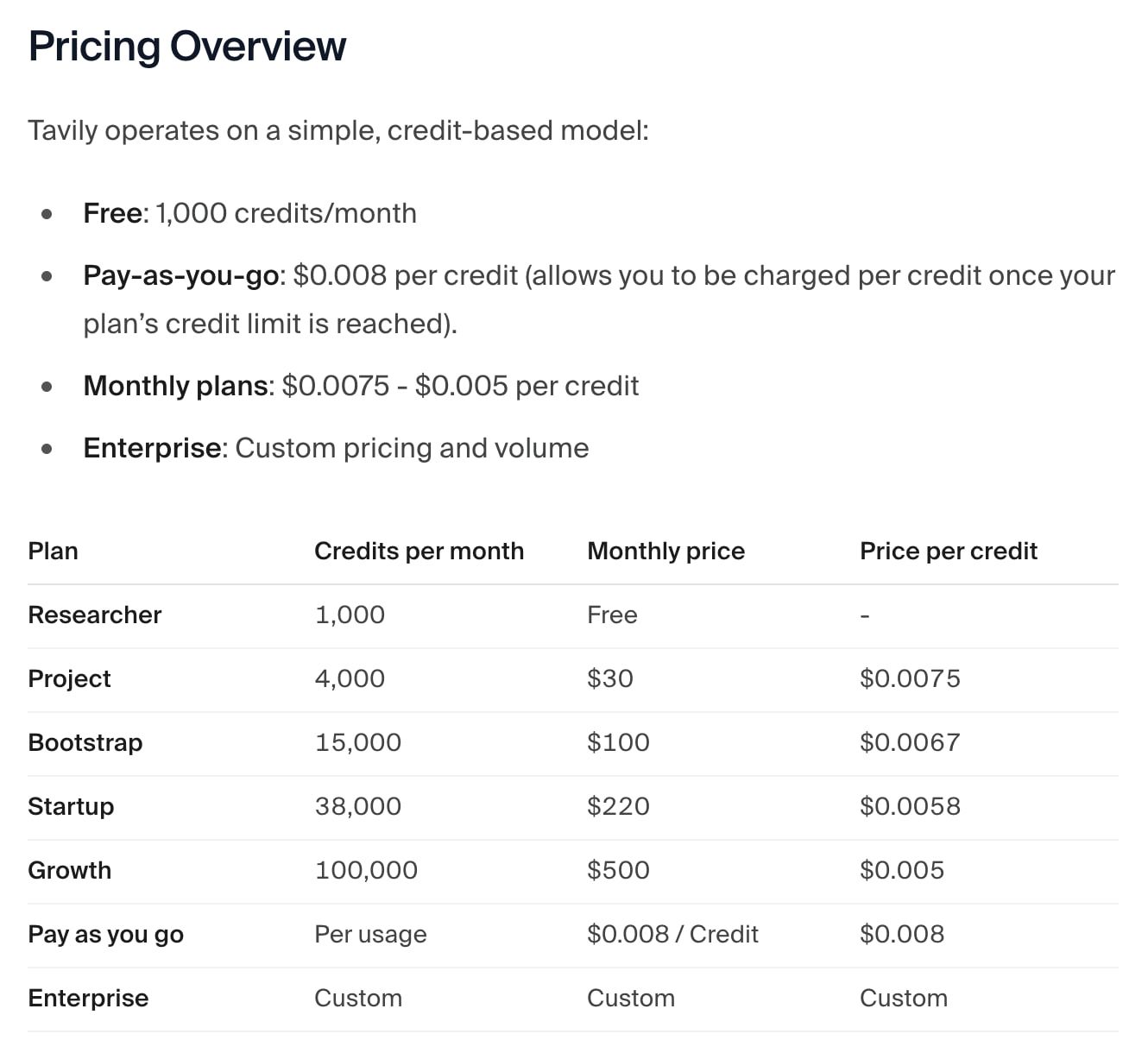
| Paid plans | Hobby $19 (5K credits), Standard $99 (100K), Growth $399 (500K), Scale $749 (1M); lower if billed annually | Project $30 (4K credits), Bootstrap $100 (15K), Startup $220 (38K), Growth $500 (100K); pay-as-you-go $0.008 a credit | Pay per use; Enterprise custom |
| Free tier | 1,000 credits a month; keyless use capped per IP | 1,000 credits a month, no card; keyless search and extract | $10 in credits a month, plus a one-time $10 bonus (first team only) |
| Documented rate limits | /scrape, /map, /search: 10 a minute (Free) to 10,000 (Scale) | 100 RPM development key, 1,000 RPM production key | Default /search 10 QPS, /contents 100 QPS; team tier can change limits |
| Open source / self-host | Core is AGPL-3.0; self-host has fewer features | No self-host documented | No self-host documented |
| MCP server | Yes (MIT) | Yes (MIT) | Yes (MIT) |
| Ownership and latest funding | $75M Series B led by Smash Capital, 22 Sep 2026 | Owned by Nebius; deal closed 19 Feb 2026 | $250M Series C led by a16z, 20 May 2026 |
| Data-use terms | Zero data retention on Enterprise, +1 credit a page | Terms allow training on customer inputs and outputs | Terms bar using it to build a competing product; ZDR on Enterprise |
Source: Each vendor's pricing page, API docs, changelog and terms, rechecked 31 Oct 2026. Monthly-billing list prices in USD. Scroll sideways for more columns.
Firecrawl’s annual prices are in my pricing guide, along with its rollover and top-up rules. Scale lists $749 monthly, or a rounded $599/month display against a $7,190 annual invoice. Billing docs limit Scale’s one-month rollover to annual plans, while the pricing page is less specific; do not assume monthly rollover.
Who owns Firecrawl, Tavily and Exa in 2026? #
- Tavily belongs to Nebius. Nebius announced the deal on 10 Feb 2026, said “The transaction value has not been disclosed”, and said Tavily “will continue operating under its current brand”. Its SEC filing says it acquired 100% of Tavily on 19 Feb 2026, with an earnout of up to $67.3 million tied to revenue milestones.
- Exa raised a “$250M Series C” at a “$2.2B valuation”, announced 20 May 2026 (Exa blog).
- Firecrawl raised “a $75M Series B led by Smash Capital”, announced 22 Sep 2026 alongside Alexandria (Firecrawl blog).
All three have fresh money or a new owner this year, so I’d expect prices and endpoints to keep moving.
What do their terms of service say? #
Tavily’s terms allow training on what you send and get back, Exa’s bar using it to build a competing product, and Firecrawl and Exa both offer zero data retention on Enterprise. The details:
- Tavily (terms, updated 4 May 2026): Tavily and its providers “may use, process, analyze, and retain Customer Input… and Outputs… for purposes of training”. The terms are issued by “AlphaAI Technologies Inc. dba Tavily”.
- Exa (terms, rechecked 31 Oct 2026): you may not use the service “to develop any competitive product or service”. Its pricing page lists Zero Data Retention on Enterprise.
- Firecrawl: its zero data retention mode, on Enterprise plans, “will not persist any page content or extracted data beyond the lifetime of the request”, for 1 extra credit a page (scrape docs).
A crawl API fetches other people’s pages, so each target site’s terms and robots.txt still apply to you. This is a summary of the vendors’ terms, not legal advice.
Where do Firecrawl, Tavily and Exa overlap? #
Each one sells a slice of the other job. Firecrawl sells search; Tavily sells extraction, mapping and crawling; Exa sells page contents. For ordinary pages, that means one vendor can often run the whole search-then-read loop on its own.
Can Firecrawl search the web? #
Yes, through its /search endpoint, which can also scrape each result in the same request. Search costs “2 credits per 10 results, rounded up (1–10 results = 2 credits, 11–20 = 4…)” (search docs). Add scrapeOptions and “the standard scraping costs apply to each search result”, so each scraped result adds its page credit.
It searches web, news, images and Alexandria data providers, with research, pdf, developer and gov categories. Firecrawl doesn’t document where its web results come from, though its changelog lists its own Research Index (16 Jun 2026) and Developer Index (20 Aug 2026).
The release notes introduced keyless clients in June 2026. Current rate-limit docs, rechecked 31 October, distinguish official REST/CLI/SDK keyless access (Search, Scrape, Interact and Parse) from hosted MCP keyless access (Search, Scrape and Parse). Interact is not in the hosted MCP keyless list. Per-IP daily caps are unpublished.
Can Tavily extract and crawl pages? #
Yes: /extract handles URLs you already have, and /map and /crawl cover whole sites. On extraction, “Every 5 successful URL extractions cost 1 API credit” at basic depth and 2 at advanced, and “You never get charged if a URL extraction fails” (credits). One request can “batch up to 20 URLs” and returns markdown or text (extract docs).
Map costs 1 credit per 10 successful pages (2 with instructions), and crawl costs the map plus the extraction. Crawl depth defaults to 1 and tops out at 5, with a default limit of 50 pages (crawl docs).
Search itself can return full pages: include_raw_content takes true, "markdown" or "text" (search docs). No extra credit charge for it is documented, but I couldn’t confirm that it’s free.
Can Exa return full page content? #
Yes, through its /contents endpoint or inside a search. Contents costs “$1 / 1k pages, per content type” (pricing): text as markdown, highlights or summaries, with subpage crawling and a maxAgeHours freshness setting (contents docs).
Inside search, the current contents docs explicitly include contents for the first ten results, with additional pages priced at $1/1,000. The standalone Contents line on the pricing page applies to a different operation; it is not evidence that those included results are charged twice. This was rechecked on 31 October 2026.
What only Firecrawl documents #
Of the three, only Firecrawl documents JavaScript page actions and interactive browsers, and a self-hosted version. Exa’s contents docs say it handles “JavaScript-rendered pages, PDFs, and complex layouts automatically”, but they document no page actions.
Firecrawl’s core is AGPL-3.0, but self-hosting drops “Agent, Browser, interact, feedback, or specialized product, menu, audio, and video formats”, which need the cloud (self-host docs).
If self-hosting is the draw, compare it with Crawl4AI vs Firecrawl. If you only need single pages as markdown, my website-to-markdown guide and Firecrawl vs Jina Reader cover the lighter options.
What does one agent workload cost at 1K, 100K and 1M runs? #
I priced one run (W) as 1 search returning 10 results, plus full page content for the top 5. Exa lists its Lite and Instant search types at $4 per 1,000 and Fast/Auto at $7; the first ten text/highlights contents are included; summaries are extra. On 19 Oct 2026 Exa added Lite and made Instant and Fast legacy types that keep their current prices; Lite serves page text from Exa’s cache rather than fetching pages live (changelog, search docs). The $4 types are the lowest-priced listed single-tool scenario at these volumes, but I have not tested whether they give equivalent search quality.
Monthly cost of W at three volumes (list prices, before free credits)
Verified
| Setup | Billed per run | 1K runs a month | 100K runs a month | 1M runs a month |
|---|---|---|---|---|
| Firecrawl alone (/search + /scrape) | 7 credits | $29 ($26) | $749 ($599) | $6,749 ($6,599) |
| Tavily alone (search + extract) | 2 credits | $16 | $1,300 | $15,700 |
| Exa Lite or Instant (search with contents) | $0.004 | $4 | $400 | $4,000 |
| Exa Fast/Auto (search with contents) | $0.007 | $7 | $700 | $7,000 |
| Exa Fast/Auto search + Firecrawl scrape | $0.007 + 5 credits | $26 | $1,099 | $11,749 |
| Tavily search + Firecrawl scrape | 1 + 5 credits | $27 | $899 | $12,449 |
Source: My arithmetic from current vendor pricing pages and Tavily credit docs, rechecked 31 Oct 2026, monthly billing, with Firecrawl's annual-billing figure in brackets; Tavily credit docs explicitly allow $0.008 per extra credit beyond a monthly plan limit
Here’s the arithmetic, using the cheapest plan plus published extra credits that covers each volume:
- Firecrawl alone: 2 credits for the search plus 5 for the pages = 7 credits a run (pricing). 1K runs is Hobby ($19, 5,000 credits) plus 2,000 extra credits at 1,000 per $5, so $29. 100K runs (700,000 credits) is Scale at $749, which beats Growth plus top-ups ($399 + $400 = $799); 1M runs is Scale plus 6M credits at 5,000 per $5, so $6,749.
- Tavily alone: 1 credit for a basic search plus 1 credit to extract 5 URLs = 2 credits a run (credits). 1K runs is 2,000 pay-as-you-go credits at $0.008, so $16. 100K runs is Growth ($500 for 100,000) plus 100,000 pay-as-you-go credits ($800), so $1,300; 1M runs is Growth plus 1.9M credits, so $15,700, before any Enterprise deal.
- Exa alone: Lite or Instant at $4 per 1,000 searches models $4/$400/$4,000; Fast/Auto at $7 models $7/$700/$7,000. Both calculations use the first ten text/highlights contents included in search, not paid summaries (pricing, contents docs, checked 31 October 2026). Standalone Contents charges should not be added again to these included results.
- Exa + Firecrawl: Exa’s search plus 5 Firecrawl credits a run. That’s $7 + Hobby $19 at 1K, $700 + Growth $399 at 100K, and $7,000 + Scale with 4M extra credits ($4,749) at 1M.
- Tavily + Firecrawl: 1 Tavily credit plus 5 Firecrawl credits. That’s $8 + $19 at 1K, $500 + $399 at 100K, and $7,700 + $4,749 at 1M.
At Scale’s published top-up rate, an extra seven-credit Firecrawl run consumes $0.007 of credits. That matches Exa Fast/Auto’s marginal search price, but exceeds the $0.004 Lite/Instant price. These are different search modes; list prices do not establish equivalent results.
The two illustrated combinations use Exa Fast/Auto or Tavily search plus Firecrawl, and cost more than Exa Lite or Instant alone at each volume. Combine tools when you need Firecrawl-specific controls, rather than assuming the extra integration saves money. JSON adds four credits per Firecrawl page (scrape docs).
What these figures leave out:
- Free credits. Firecrawl 1,000 credits cover about 142 seven-credit runs; Tavily 1,000 cover 500 two-credit runs. Exa’s free balance resets to $10 each month for a user’s first team only, enough for 2,500 Lite or Instant runs or about 1,428 Fast/Auto runs; the one-time $10 onboarding bonus goes to that first team too (billing guide, pricing). Free-account grants are not automatically stacked onto paid-plan examples.
- A cheaper Tavily variant. If search with
include_raw_contentreplaces the extract call at 1 credit a run, the costs fall to $8, $500 and $7,700. That depends on no extra charge applying, which I couldn’t confirm. - Failed pages. Firecrawl charges 1 credit for a page that returns an error such as 403 or 404 (pricing); Tavily doesn’t charge for failed extractions.
- Advanced search/depth options and extra formats may change charges. Firecrawl explicitly adds PDF and JSON credits; check the selected endpoint on each vendor rather than assuming every vendor charges the same extras.
Firecrawl’s list prices used here also sit in my scraping API price dataset.
What do independent sources say about quality? #
I found no independent benchmark I could publish fairly for all three, so this page has no speed or quality numbers for any of them.
Why there are no performance numbers here
Tavily’s terms restrict publishing performance analysis, so this page compares documented features and prices only. To keep it fair, I apply the same rule to Firecrawl and Exa.
Both named vendors publish their own comparison pages, Firecrawl vs Tavily on Firecrawl’s site and Tavily vs Firecrawl on Tavily’s. They’re marketing, and I left out their benchmark claims.
On Hacker News, the themes I found were about positioning, not quality:
- The overlap confuses people. One commenter asked “how’s this different from offerings from cloudflare, firecrawl, tavily, exa?”
- Some just want a pick. Another asked “Exa, Tavily or Firecrawl. Which one is it?”
- Some treat them as one category. A commenter listed “Tavily, Exa, Firecrawl, Perplexity, and Linkup are all tools for agents to search the web”.
- Others split the jobs. A founder of a competing product wrote that “firecrawl doesn’t have a search index… tavily, exa, parallel, you = search index for ai”. That’s a competitor’s view, and Firecrawl’s changelog lists its own Research and Developer indexes.
- Split stacks exist. One developer described “Firecrawl for crawling, self-hosted SearXNG for web search”.
On Reddit, a July 2026 r/Rag post suggested “Use Exa or Tavily to find the URLs, then trigger Firecrawl to ingest full pages when search snippets are not enough.” Commenters asked whether it was a promotional post, and the author said it wasn’t, so I count it as one community view and left out its speed figures.
Firecrawl, Tavily or Exa: which should you pick? #
Pick by where your agent starts: Tavily or Exa if it starts from a question, Firecrawl if it starts from URLs or whole sites. Use both only when the pages you find need more than text. Here’s how that plays out for common builds:
- A docs chatbot over three known sites: Firecrawl. You already have the URLs, so you need /map and /crawl, not search, and it’s the one that documents JavaScript page actions. Tavily’s /crawl can do this too, up to depth 5 and a default limit of 50 pages.
- A research agent on open questions: Tavily or Exa. Tavily has an async /research endpoint (mini 4–110 credits, pro 15–250, per its credits page), and Exa has deep search at $12–$15 per 1,000. I compare the two in Tavily vs Exa.
- A news monitor: it depends on what you watch. For known pages, Firecrawl’s /monitor bills 1 credit per page per check; for new pages on a topic, use Firecrawl /search with the news source or Exa’s Monitors at $15 per 1,000.
- Lowest listed search-then-read price here: Exa Lite (or the legacy Instant type), if its search mode fits your requirements. Fast/Auto costs more; against that selected $7 mode, Firecrawl can be cheaper at high volume. I have not run an equivalent-quality comparison.
- Search, then pages that need more than text: find URLs with Tavily or Exa and fetch them with Firecrawl. You pay about $26–$27 at 1K runs, and you get page actions, PDF parsing and JSON extraction.
If I were wiring web access into a new agent today, I’d start with one search API that returns page text, because that’s one bill and one integration. I’d add Firecrawl only when I hit pages that need JavaScript actions, PDFs or structured JSON, or when the job becomes crawling whole sites.
Other options #
-
SerpentAPI (apiserpent.com): an engine-specific SERP-data option. Its pricing page and docs, rechecked 31 October 2026, agree on new-credit Web rates of $0.60/$0.30/$0.10/$0.03 per 1,000 units. Growth, Scale and Enterprise require one qualifying deposit of $100, $500 or $1,000 respectively; these are deposits, not monthly subscriptions. New accounts start with 10 free calls.
On 31 October 2026 the pricing page also carried the banner “Prices to increase 10x after October 31”. It doesn’t say which rates the increase covers, and the rates above were still the ones listed that day.
Quick uses one Web unit per call; Deep uses one per requested page, up to ten. The FAQ says existing credit keeps its old schedule, purchased credit never expires and promotional bonuses expire after 30 days. These SERP units do not establish a full linked-page extraction price or measured performance.
-
SerpApi: its separate Extract API, checked 31 October, supports page scraping, mapping, crawling and Markdown output. It follows robots.txt and does not execute JavaScript; crawl mode charges one search credit per successfully extracted page. This is a separate retrieval request, not full linked-page content bundled into a Google SERP search response.
-
Brave Search API: another search-first API, so “Firecrawl vs Brave Search” is the same job split as this page. Its current plans are in my free web search API guide.
-
Parallel: a search API aimed at AI agents; see my Tavily alternatives.
-
Perplexity Search API: $5 per 1,000 requests for results with snippets, not full pages (pricing).
-
Jina Reader: a single-URL reader that returns markdown; see how Jina Reader’s output and cost compare with Firecrawl’s.
-
Crawl4AI: an open-source crawler you host yourself; see my self-hosted vs managed comparison with Firecrawl.
More crawl-side choices are in my Firecrawl alternatives by use case.
FAQ
Which web search API is better for AI applications, Exa, Tavily, or Firecrawl?
It depends on the job, not on a ranking. If your agent starts from a question and needs to find pages, Tavily and Exa are built for that. If it starts from URLs or a whole site and needs clean markdown or JSON, Firecrawl is built for that, and it's the only one of the three that documents JavaScript page actions and self-hosting.
Each also sells part of the other job: Firecrawl has /search, Tavily has /extract, /crawl and /map, and Exa has /contents. I don't rank them on speed or answer quality, because I found no independent data I could publish fairly for all three.
Is Tavily better than Firecrawl?
They do different jobs, so neither is better across the board. Tavily starts from a query and finds pages; Firecrawl starts from a URL and extracts the page.
On price, for one search of 10 results plus the full text of the top 5, list prices verified 31 Oct 2026 put Tavily at $16 and Firecrawl at $29 for 1,000 runs a month. At 100,000 runs Firecrawl is cheaper: $749 against $1,300 on Tavily Growth plus documented overage (Tavily credit docs rechecked 31 Oct 2026).
Is Perplexity the same as Firecrawl?
No. Perplexity's Search API finds pages: it returns ranked results with snippets at $5.00 per 1,000 requests, with a Fast option at $1.00 per 1,000 (pricing page, verified 31 Oct 2026). Firecrawl fetches the pages you point it at and converts them to markdown or JSON, at 1 credit per page.
Firecrawl also sells search, at 2 credits per 10 results, and that's the only place the two overlap.
Who does Exa AI compete with?
On search, Exa competes with other search APIs aimed at AI apps, such as Tavily, Brave, Parallel and Perplexity's Search API. It overlaps with Firecrawl and Jina Reader only through its /contents endpoint, which fetches page text at $1 per 1,000 pages.
Choosing between Tavily and Exa is a separate decision, and I cover it in my Tavily vs Exa comparison.
Can Firecrawl be used as a search API?
Partly. Firecrawl's /search endpoint finds web, news and image results for a query at 2 credits per 10 results, and it can scrape each result in the same request for the usual page credit.
Its docs don't say where its web results come from. Tavily and Exa are built around search, while Firecrawl is built around pages you already know.
Do Firecrawl, Tavily and Exa have free tiers?
Yes, all three. Firecrawl gives 1,000 credits a month, Tavily gives 1,000 credits a month with no card, and Exa gives a user's first team $10 in credits a month plus a one-time $10 bonus after onboarding. For the agent workload on this page, that covers about 142 Firecrawl runs, 500 Tavily runs, or 2,500 Exa Lite-or-Instant / 1,428 Fast-or-Auto runs a month under this page's workload. Exa's one-time onboarding bonus is excluded from these recurring figures. Both Exa grants go only to a user's first team, per its [billing guide](https://exa.ai/docs/reference/billing).
Firecrawl and Tavily also allow some use without an API key, capped at daily limits neither publishes.
Sources
50 sources, accessed to .
Official pricing, docs, changelogs and status pages 39
- SerpentAPI current Web schedule for new credit
- SerpentAPI single-deposit tiers and credit expiry
- SerpApi separate Extract API and crawl credit usage
- Firecrawl pricing (Markdown version, monthly and annual prices)
- Firecrawl pricing page (extra credits, rollover, failed requests)
- Firecrawl docs: Search
- Firecrawl docs: Scrape (formats, cache, zero data retention)
- Firecrawl docs: Billing
- Firecrawl docs: Map
- Firecrawl docs: Batch scrape
- Firecrawl docs: Extract (successor: /agent)
- Firecrawl docs: Rate limits and keyless use
- Firecrawl docs: Self-hosting
- Firecrawl docs: Integrations
- Firecrawl docs: MCP server
- Firecrawl changelog
- Firecrawl blog: Alexandria and the $75M Series B
- Firecrawl's own Firecrawl vs Tavily page (vendor marketing)
- Tavily's own Tavily vs Firecrawl page (vendor marketing)
- Tavily docs: API credits and plans
- Tavily docs: Search endpoint
- Tavily docs: Extract endpoint
- Tavily docs: Crawl endpoint
- Tavily docs: Research endpoint
- Tavily docs: Rate limits
- Tavily docs: Keyless access
- Tavily docs: LangChain integration
- Tavily terms of service (last updated 4 May 2026)
- Nebius newsroom: agreement to acquire Tavily
- Nebius 6-K exhibit (SEC): Tavily acquisition closed 19 Feb 2026
- Exa pricing
- Exa docs: Search
- Exa docs: Contents
- Exa docs: Rate limits
- Exa changelog
- Exa blog: $250M Series C
- Exa terms of service
- Perplexity docs: API pricing (Search API)
- SerpentAPI official endpoints and billing units
GitHub code, issues and releases 5
Community discussions 6
- Hacker News: how is this different from Cloudflare, Firecrawl, Tavily, Exa
- Hacker News: Exa, Tavily or Firecrawl, which one
- Hacker News: search index vs crawler (comment by a competitor)
- Hacker News: all tools for agents to search the web
- Hacker News: Firecrawl for crawling, SearXNG for search
- r/Rag: Exa vs Tavily vs Firecrawl (read via the PullPush archive)