How to choose
Grounding with Google Search Pricing: What a Prompt Costs
Gemini 3+ grounding bills executed queries: a shared 5,000 a month, then $14 per 1,000. Why one prompt can cost more, and when a SERP API fits better.

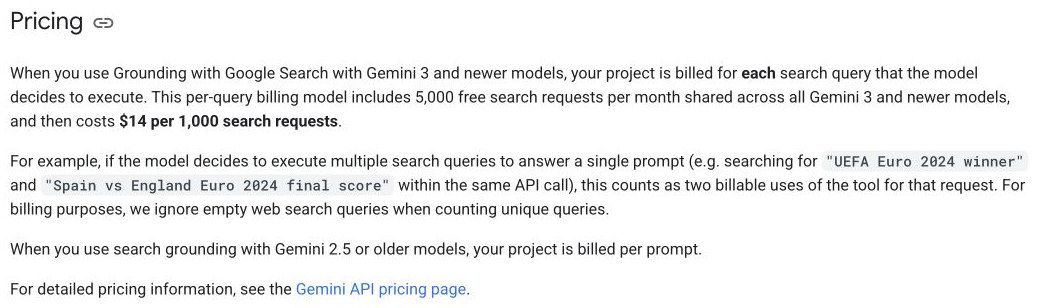
For Gemini 3 and later, I would budget Google Search grounding by executed search queries, not chat turns: a shared 5,000-query monthly allowance is followed by $14 per 1,000 queries, with model tokens additional. Earlier model rows use different grounded-prompt billing, and grounding’s output restrictions make it a poor substitute for a bulk Google SERP API. Grounding guide, pricing, terms.
Short on time?
Here's my take
- Gemini sourced answers
- Google Search grounding
- Budget actual executed queries and retain the required citation and suggestion display.
- Known public URLs
- URL context
- Read supplied URLs when that is the actual job; it is not search discovery.
- Google result rows
- Dedicated SERP API
- Use a suitable retrieval contract rather than harvest grounding links into a crawler.
Prices verified . Sponsors cannot buy a verdict or a position.
How does Google Search grounding work? #
Grounding lets a supported Gemini model use Google Search while generating an answer. I would choose it when the intended result is a sourced answer displayed in the permitted application, rather than a reusable list of ranked Google results. Grounding guide, additional terms.
The documented implementation path is to choose a supported model/API, configure the google_search tool, inspect actual search steps, retain citation annotations and render the supplied search suggestions appropriately. Current Interactions examples use steps; older GenerateContent groundingMetadata examples belong to another response shape. Grounding guide, release notes.
I did not execute either API. Before using a code example, I would pin the chosen API/version and validate its response handling instead of combining a current request with a legacy output parser.
What does grounding cost on each Gemini model? #
On Gemini 3 and later, grounding costs $14 per 1,000 executed search queries after a shared 5,000-query monthly allowance, plus model tokens; Gemini 2.5 rows bill grounded prompts instead. For Gemini 3+, count the actual queries the model executes. The 5,000-query monthly allowance is shared; it is not a fresh allowance for every prompt or a way to multiply capacity by rotating API keys. Google also sets a default limit of 1,500 grounding requests per day per project on the paid tier, which you can ask to raise. Grounding guide, pricing, rate limits.
USD inputs and specifications verified 2026-11-10; selected model tokens, tax and account eligibility remain separate.
| Selected model family / paid row | Grounding billing unit | Allowance and listed overage |
|---|---|---|
| Gemini 3+ (paid tier) | Executed search query | Shared 5,000/month, then $14/1,000 queries; default 1,500/day per project |
| Gemini 2.5 Flash / Flash-Lite paid rows | Grounded prompt | Shared 1,500/day, then $35/1,000 grounded prompts |
| Other model/free-tier rows | Check the exact current row | Do not apply Flash allowances to every model |
Source: Gemini pricing. I would record the exact model and paid/free tier beside every estimate rather than combine a 2.5 daily prompt allowance with a 3+ monthly query rate.
The 2.5 rows are short-lived: Google’s release notes say gemini-2.5-flash requests route to gemini-3.5-flash-lite and gemini-2.5-pro to gemini-3.8-flash on December 1, 2026, billed at the newer model’s rates. Release notes.
Why one prompt can turn into several queries #
Ten thousand prompts do not imply ten thousand queries. The tool can execute multiple searches, and the budget must follow the actual query count. Grounding guide.
| Hypothetical Gemini 3+ workload | Query subtotal calculation | Grounding subtotal |
|---|---|---|
| 10,000 prompts × exactly one executed query | (10,000 − 5,000) × $14/1,000 | $70 |
| 10,000 prompts × exactly three executed queries | (30,000 − 5,000) × $14/1,000 | $350 |
Both illustrations assume the full eligible shared allowance is unused, stay under the default daily project limit, and exclude model tokens. They are arithmetic examples, not invoices or guarantees about how many queries a model will choose. Inputs: pricing.
One public May–June forum discussion concerns confusion about multiple queries per prompt. I treat that as an individual report, not evidence of a general billing defect; the official pricing and actual tool-use records should govern the estimate. Google forum, pricing.
What do the terms make you show or avoid? #
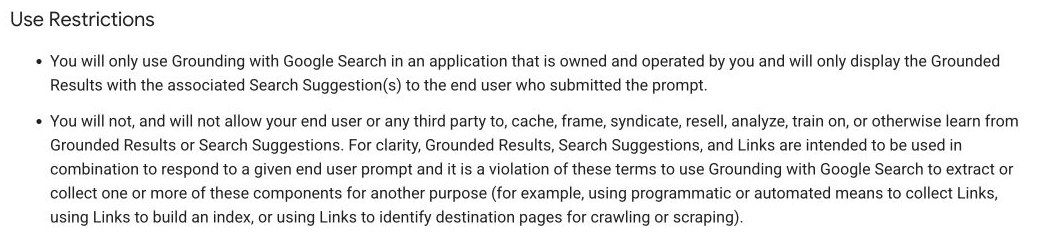
The terms constrain the application as well as the API request. Grounded results are for the requesting end user in an owned/operated application, with the associated suggestions/links and required display behavior; harvesting grounding links into an index or crawl queue is restricted. Gemini additional terms.
I would therefore keep this as an answer-display integration. I would not build a pipeline that extracts grounding links to populate a Google ranking database, bulk URL inventory or downstream crawler and then call it an ordinary SERP API. Grounding terms.
I could read the linked Client Application Guidelines during fact-checking. They require clear disclosures and user choice and prohibit misleading or harmful application behavior. Reading them does not certify an implementation: the real UI compliance review is still unperformed.
The terms also restrict modifying or interspersing content with grounded output and tracking specific grounded links without the stated permission. They include narrow storage exceptions, including qualifying displayed-answer/chat-history use for up to two years; those exceptions do not authorize building a reusable results database. Display and storage conditions.
Grounding also has documented 30-day prompt/context/output retention by Google. I would not describe it as zero-retention merely because the surrounding application runs on a private server. Additional terms.
Is URL context the same as search? #
No. URL context reads public URLs you supply; it does not discover them through search. The current guide lists up to 20 URLs and a 34MB page limit, with private/login URLs unsupported. URL context.
| Required output | Route I would inspect | Boundary |
|---|---|---|
| Gemini answer with Google sources | Search grounding | Query billing and required grounded display |
| Read selected public pages | URL context | Supplied URLs, public accessibility and model costs |
| Retrieved source passages | Separate search/content API | Provider output and storage rights |
| Explicit Google organic/SERP fields | Dedicated SERP API | Separate service, rights and billing units |
Sources: grounding, URL context, Exa pricing, SerpentAPI documentation.
URL context is not a permission workaround for collecting links from restricted grounding output. I would choose the original retrieval route according to the permitted final use, then enforce public-address/redirect and content-size limits in the application. Grounding terms, URL context.
When would I choose a separate API? #
For Google organic rows, SerpentAPI at apiserpent.com is a relevant custom retrieval option. Its Web rates are $0.60/$0.30/$0.10/$0.05/$0.03 per 1,000 units at Default/Growth/Scale/Enterprise/Enterprise Plus, with the paid tiers reached by deposits of $100/$500/$1,000/$1,250. Your best deposit in a calendar month sets the price for that month’s deposits, and credit you already hold keeps the price you bought it at. Pricing, FAQ.
Quick is organic-only and one unit; Deep can include optional SERP features and counts requested pages, up to ten. Purchased credit does not expire. That does not establish a public SLA, legal indemnity, full-page extraction or unrestricted redistribution. Docs, FAQ, terms. If you’re still sorting out what Google itself sells, my guide to what’s left of Google’s search APIs covers the other routes.
For source passages, I would compare Exa; for raw search results, Perplexity Search is another distinct contract. Brave Search also has its own pricing and rights conditions. Generated citations do not establish Google rank positions or a general license to store and resell output. Exa, Perplexity Search, Perplexity pricing, Brave pricing, Brave terms.
OpenAI and Claude offer model-integrated search alternatives. Their tool and token charges, citation contracts and fetch behavior differ from Gemini grounding; I would compare the complete application path rather than one advertised fee. OpenAI search, pricing, Claude search, pricing, fetch.
What should you check before relying on it? #
I would require an approved account, exact model availability, project quotas, actual query-use reporting, correct citations/suggestions and a completed guidelines review. Quotas are scoped by project, model and tier; more keys do not create more project allowance. None of those runtime/account checks was performed for this guide. Rate limits, grounding guide.
Read the search API pillar, built-in search versus APIs, my web search API price comparison, Perplexity pricing and Brave Search API pricing for the surrounding decisions.
FAQ #
Is Gemini 3+ grounding billed per prompt? #
Its grounding charges follow executed search queries. A prompt can lead to multiple queries, so prompt count alone is not the billing count. Gemini Search grounding guide.
How many free grounded queries does Gemini 3+ get? #
On the paid tier, the pricing page lists a shared 5,000-query monthly allowance, followed by $14 per 1,000 queries, with a default limit of 1,500 grounding requests per day per project. Model tokens remain additional. Gemini pricing.
Do Gemini 2.5’s free daily prompts apply to Gemini 3+? #
No. The documented model rows use different units and allowances. Check the exact selected model and account tier. Gemini pricing.
Can I feed grounding links into a crawler? #
The additional terms restrict using grounding output to build indexes or crawl queues. Choose a permitted retrieval service for that job. Gemini additional terms.
Is URL context a Google search API? #
No. It reads supplied public URLs rather than discovering Google results; private/login URLs are unsupported. Gemini URL context.
Did you verify a working grounding setup? #
No. The Client Application Guidelines were reviewed, but no runtime setup or real UI compliance check was performed. Account, quota and display checks remain open. Gemini additional terms.
Sources
22 sources, accessed .
Official pricing, docs, changelogs and status pages 21
- Gemini Search grounding guide
- Gemini pricing
- Gemini additional terms
- Gemini rate limits
- Gemini release notes
- Gemini URL context
- OpenAI web search
- OpenAI pricing
- Claude web search
- Claude pricing
- Claude web fetch
- Perplexity pricing
- Perplexity Search quickstart
- SerpentAPI pricing
- SerpentAPI FAQ
- SerpentAPI API documentation
- SerpentAPI terms
- Exa pricing
- Brave API pricing
- Brave API terms
- Google Client Application Guidelines


