Data study
I Compared Web Search API Pricing Across 12 Providers
What 1K and 100K jobs cost on 12 web search APIs, from Tavily and Exa to Gemini grounding, and why the cheapest unit price may not buy what you need.

Compare the output you need before comparing the price of a search. In the public tariffs I researched, a request might buy ranked links, extracted text, a generated answer or one search inside a model’s grounding loop. Those units produce different budgets: Parallel Fast lists $1 per 1,000 calls, Exa Lite (or legacy Instant) lists $4 with up to ten text/highlight results, and Gemini 3+ grounding lists $14 per 1,000 executed searches before allowances and model tokens. Parallel pricing, Exa pricing, Gemini Developer API pricing.
Short on time?
Here's my take
- Retrieve sources
- Price a defined retrieval mode
- Start with raw results or text chunks; compare generated answers separately.
- Budget a search pipeline
- Add fetches, tokens and cash commitments
- A cheap unit rate can still require a larger plan or credit purchase.
- Ground a model
- Specify model and billing channel
- Executed queries, grounded prompts and configured-data search are different units.
Prices verified . Sponsors cannot buy a verdict or a position.
This page compares AI search, content and grounding APIs by unit price. For Google SERP APIs only, use the cheapest SERP API comparison; to choose a search route for an agent rather than price one, start with the best web search APIs guide, and for built-in LLM search versus a separate API see LLM web search versus a search API. Gemini’s per-prompt costs have their own page: grounding pricing. Single-vendor detail lives in Tavily pricing and Firecrawl pricing.
What are you actually paying for? #
It depends on the output each provider sells. Providers sell ranked sources, extracted content, generated answers or searches inside a model’s grounding loop. I would choose retrieval when the application controls selection and synthesis; I would compare an answer endpoint when that work is part of the purchased output. You.com’s separate Search, Contents, Answer and Research tariffs make the distinction explicit. You.com pricing.
Prices below were verified 2026-11-06, in USD before tax. These are selected documented modes, not equivalent-output rankings; optional features, free grants and purchase minimums appear later.
| Provider family | Selected output and billable unit | Published tariff to start with | What changes the comparison? |
|---|---|---|---|
| Tavily | Search request returning content chunks, with optional answer | Basic 1 credit, advanced 2; PAYG $0.008/credit | Automatic parameters may select advanced. Credits, Search reference |
| Exa | Search request with text/highlights for the first ten results | Lite (or legacy Instant) $4/1K; Auto (or legacy Fast) $7; Deep-lite/Deep $12; legacy Deep-Reasoning $15 | More results and summaries add charges. Pricing, Contents guide, Search reference |
| Brave | Web results, LLM Context chunks or generated Answers | Search $5/1K; Answers $4/1K plus $5/M input and $5/M output tokens | Choose the endpoint and token budget, not just the name. Pricing, Web Search, LLM Context |
| Parallel | Ranked URLs and excerpts, up to ten results per call | Turbo/Fast $1/1K; Basic/Advanced $5/1K | Extra results cost $1/1K; the quickstart defaults to advanced. Pricing, Mode pricing, Quickstart |
| You.com | Search calls, known-URL Contents, Answer or Research | Search $5/1K; Contents $1/1K pages; Answer $5/1K | Research rises from $12 to $1,200/1K with effort. Pricing, Search guide |
| Perplexity | Successful raw Search request, with up to five query strings | Standard $5/1K; Fast $1/1K | Raw Search has no model-token surcharge; Agent usage has separate tools and tokens. Pricing, Search quickstart |
| Valyu | Retrievals weighted by source, billed in credits | Detailed docs: web/news 100 credits per 1K results (about $0.63 at 1,600 credits per $10); open databases 50; SEC filings 1,920; Wiley 4,800 | The endpoint’s max_price caps the whole request without stating its unit. I withhold a generic query price. Website, Detailed pricing, Search reference |
| S1 | Basic search credits or Deep search plus successfully crawled pages | Basic 1 credit; $1 buys 1,000 base credits | Top-up minimums, bonuses and subscription allowances change cash outlay. Pricing, Credit rules |
| Linkup | Successful call priced by depth and output | API-key flash/fast/standard: $5/1K raw results, $6/1K answer/structured output | Deep costs $50/$55; x402 has a $0.01 minimum per request. Pricing, Output types |
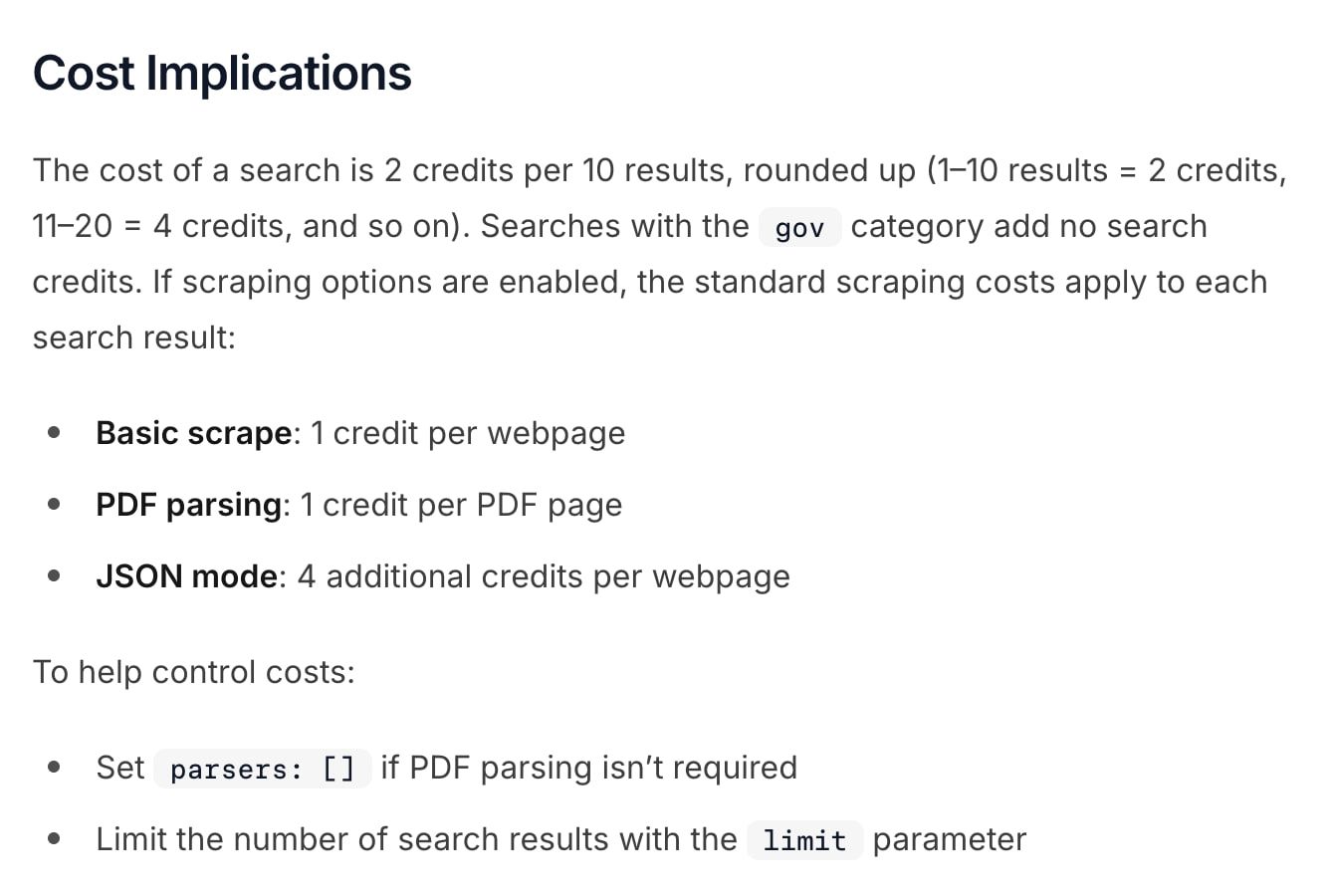
| Firecrawl | Ordinary Search results, before optional scraping | 2 credits per ten results, rounded up | Shared plan credits also fund other work; optional scraping and enhanced modes differ. Search billing, Plans |
| Browserbase | Search routed to a selected provider/mode | Developer $20/month includes 1K calls; overage $1/1K Parallel Fast, $5 Advanced, $7 Exa Fast, $12 Exa Deep | The included allowance is shared across modes; Fetch and browser use are separate. Pricing, Search overview |
| Grounded generation in Developer API/Cloud; configured-data Agent Search separately | Developer Gemini 3+: $14/1K executed queries; 2.5: $35/1K grounded prompts above its allowance | Model, channel, query count and model tokens matter. Developer pricing, Cloud pricing, Agent Search |
For the category decision, use the search API hub.
What do 1,000 and 100,000 search jobs cost? #
For 1,000 jobs, the selected examples range from $1 in raw Fast usage to a $20 Browserbase Developer purchase; at 100,000 jobs, Firecrawl’s selected construction is $349 and Browserbase Developer with Parallel Advanced is $515. Those amounts buy different outputs and are not a lowest-price ranking. Parallel tariffs, Firecrawl plans and top-ups, Browserbase pricing.
For the arithmetic, I assumed one query input and one successful billable call per job unless the row says otherwise. Gross usage means the published tariff multiplied by the selected work, before grants; selected cash plan includes the stated monthly purchase. Neither is an observed invoice or a guarantee of comparable answers.
The following 13 scenarios exclude tax, free/signup credits, optional extraction and model tokens. They also exclude any unverified free-plus-paid stacking; where a minimum purchase differs from usage value, I show it explicitly.
| Defined workload | 1,000 jobs | 100,000 jobs | Basis and exclusions |
|---|---|---|---|
| Tavily basic PAYG | $8 | $800 | Gross usage at $0.008/credit; Growth’s separate $500/100K plan is an alternative, not this PAYG calculation. Credit plans |
| Exa Lite (or legacy Instant), up to ten text/highlight results | $4 | $400 | Gross prepaid usage; more results and summaries excluded. Pricing |
| Exa Auto (or legacy Fast), same included-output scope | $7 | $700 | Gross prepaid usage; mode choice is not a measured quality comparison. Pricing |
| Brave Search | $5 | $500 | Gross usage; the documented monthly credit is considered separately. Pricing |
| Parallel Fast/Turbo, up to ten results | $1 | $100 | Gross usage; Advanced would instead be $5/$500. Pricing |
| You.com Web Search | $5 | $500 | Gross usage; MCP and signup offers excluded. Pricing |
| Perplexity raw standard, one query per request | $5 | $500 | Gross successful-request usage, including successfully empty responses. Pricing |
| Perplexity raw Fast, one query per request | $1 | $100 | Gross usage; raw endpoint, not Agent tools/model tokens. Pricing, Fast Search |
| S1 basic | $1 usage; $5 top-up purchase | $99 selected monthly plan | The $5 top-up buys 5K base credits; Professional buys 150K monthly credits, leaving 50K unused in this example. Pricing, Credit rules |
| Linkup standard raw results, API key | $5 | $500 | Gross usage; x402’s different minimum excluded. Pricing |
| Firecrawl ordinary ten-result Search | $19 selected Hobby plan | $349 selected Standard plus top-ups | 2K/200K credits required; no scraping or special modes. Search units, Cash plans/top-ups |
| Browserbase Developer, Parallel Advanced | $20 selected plan | $515 plan plus overage | $20 includes 1K shared calls, then $5/1K. Pricing, Mode rules |
| Gemini Developer API 3+, executed searches | $14 | $1,400 | Gross grounding fee for 1K/100K actual searches; not prompt totals and not model tokens. Pricing, Query accounting |
I would read these as candidate budgets for a specified job. I would not sort them into a quality-adjusted winner: this research contains no common output-quality test, and a ten-result maximum is not proof that every call returns ten usable sources.
What does Firecrawl cost for 100K searches? #
One documented monthly construction costs $349 for 100,000 ordinary ten-result Search calls. Those calls require 100,000 × 2 = 200,000 credits: Standard costs $99 for 100K credits, and another 100K takes fifty $5 top-ups of 2K credits, giving $99 + $250 = $349. Search units, Monthly plans and incremental top-ups.
This is one documented cash-plan construction, not a claim of the lowest possible negotiated or annual price. A $99 scraping-credit plan is not automatically enough for 100K search calls, and the annual headline requires a separate yearly cash commitment.
How much does the mode change a Browserbase bill? #
Quite a lot: at 100K calls on Developer, the totals below run from $119 to $713. Browserbase’s billing-plans documentation still lists $7 per 1,000 Search calls, while its current pricing and Search overview distinguish provider rates of $1/$5/$7/$12. The examples here use the provider-specific schedule; the actual account tariff remains unverified.
At 100K calls on Developer, the selected mode changes the total: $515 for Parallel Advanced, $119 for Parallel Fast or $713 for Exa Fast. The $20 monthly plan includes the first 1K shared Search calls; Parallel Advanced then gives $20 + 99 × $5 = $515, under the documented overage schedule. The allowance is shared, so I would not add a fresh 1K grant for every provider. Pricing, Search overview.
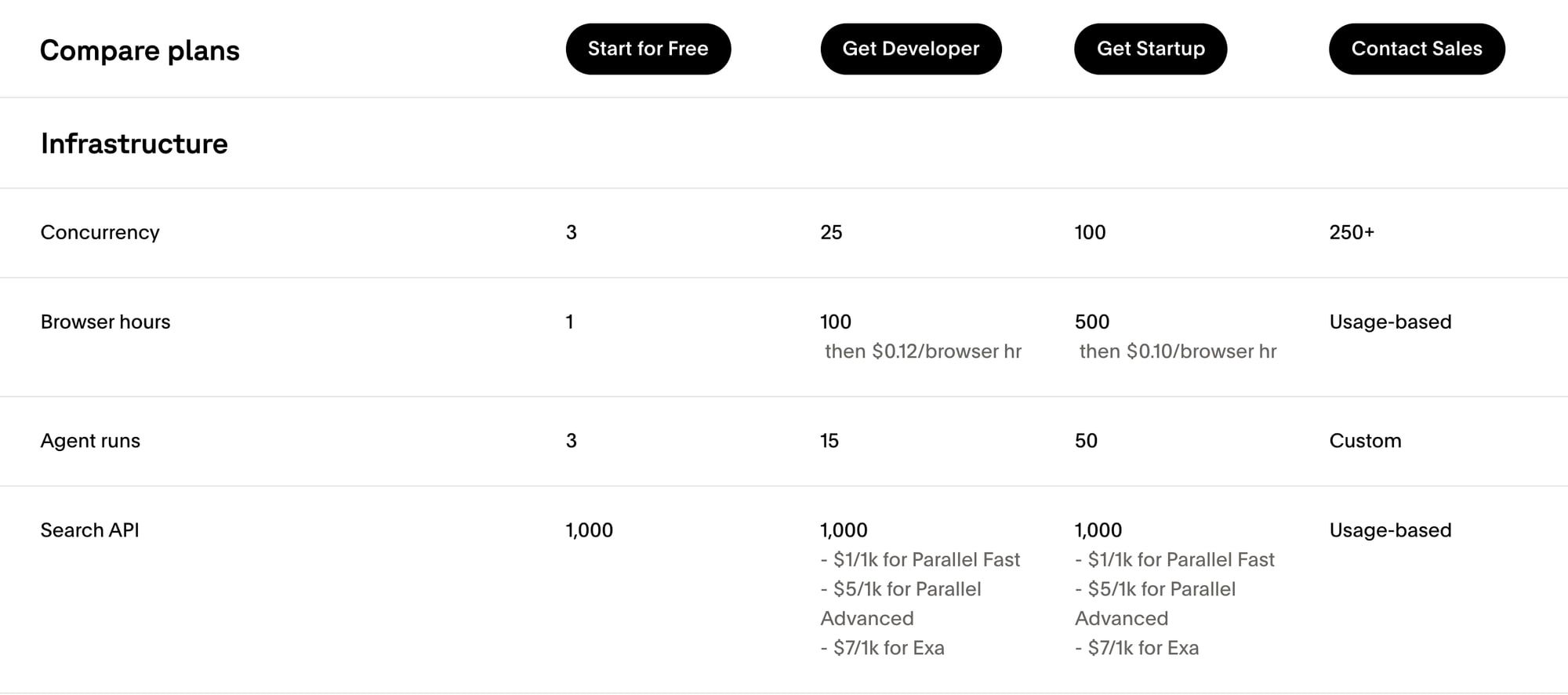
The docs distinguish a project’s default provider from Parallel’s default advanced mode. I would record both provider and mode in the budget rather than assume that an omitted parameter selects the cheapest path. Search overview.
Where do the extras add up? #
Extra results, page content and generated answers each add cost, so my budgeting formula is discovery + page retrieval/extraction + answer generation + required plan or funding commitments. It is a checklist, not a universal tariff; Exa bundles text/highlights for the first ten results, while You.com separately lists known-URL Contents at $1/1K pages. Exa pricing, You.com pricing.
For an Exa Auto (or legacy Fast) request expanded from ten to 100 results, the listed extra-result charge adds 90 × $1 = $90 per 1,000 calls to the $7 base, giving $97/1K calls before summaries. That is a sensitivity example for requested output volume, not proof of 100 useful results or identical retrieval quality across modes. Exa pricing.
Tavily advanced doubles the basic credit consumption, and automatic parameters can choose that depth. Linkup’s standard raw output is $5/1K while its answer/structured output is $6; Deep’s answer/structured route is $55. I would decide whether the application needs those outputs before optimizing their price. Tavily credits, Automatic parameters, Linkup rates.
Perplexity raw Search’s request can contain up to five queries, but the table uses one. Bundling five query strings into one call is a different workload, and moving to its Agent API introduces tool and model-token accounting. October’s vendor changelog also describes a switch of search presets to Fast; old preset assumptions need checking. Search quickstart, Pricing, Changelog.
Why is there no Valyu price per query? #
I withheld a generic query price because Valyu bills source-weighted retrieval credits, while its Search reference caps request cost with a max_price whose unit it does not state. The website lists about $0.31–$30 CPM by source, while detailed pricing lists 100 credits per 1,000 web/news results, 50 for open databases, 1,920 for SEC filings and 4,800 for Wiley publications, at 1,600 credits per $10. I cannot resolve the max_price unit by assuming one query equals one retrieval. Website pricing, Detailed pricing, Search reference.
If a job returned ten billable web retrievals, the detailed retrieval tariff alone would imply 1,000 credits, or about $6.25/1K jobs at the pay-as-you-go rate. That remains a conditional illustration outside the main totals: the max_price unit, actual returned-source count and source selection must be resolved first. The docs state a $10 minimum top-up and 12-month top-up life; I would not describe ambiguous overage wording as verified postpaid billing. Detailed pricing, Search reference.
Which free credits actually reduce the bill? #
I would keep a separate allowance ledger rather than subtract every promotional number from every paid scenario. A recurring grant, one-time bonus and prepaid deposit are different things.
| Provider | Documented allowance or funding rule | Budget implication |
|---|---|---|
| Tavily | 1K monthly credits; PAYG billing help describes automatic charges per $40 of usage | I have not verified free/PAYG stacking; $40 usage charging is not proof of a $40 prepaid minimum. Credits, Billing resets |
| Exa | First team gets $10 monthly, nonaccumulating; separate $10 onboarding bonus does not expire | Keep the two grants distinct; no assumed checkout deposit. Billing |
| Brave | $5 monthly credit, with a card required | If eligible and allocated to this workload, gross $5/$500 Search usage becomes $0/$495; combined-product allocation was not account-verified. Pricing |
| Parallel | Up-to-5K-free-requests headline, $5 monthly credit and up-to-$80 signup reward | I have not established that these are additive entitlements. Pricing |
| You.com | 100 keyless daily Web Search queries via MCP; separate signup-credit offer | Do not transfer the MCP allowance to REST. The live page lists $10 free credit (stated as 2,000 searches); expiry and eligibility remain unverified. Pricing |
| Perplexity | Prepaid credits; optional auto-reload; empty balance blocks keys | No recurring raw Search grant, expiry or minimum purchase was verified. Project billing |
| Valyu | $10 signup or $20 with a work email; $10 minimum top-up | Free credits expire 12 months after signup and top-ups last 12 months; source access depends on plan. Website, Detailed pricing |
| S1 | 100 initial credits and purchased top-ups do not expire; monthly allowance resets | Monthly credits are spent before top-ups; a subscription is not an accumulating savings balance. Credit rules |
| Linkup | Eligible professional-email balance restored to $20 monthly | Restoration to $20 does not mean an extra $20 accumulates each month. Paid expiry/minimum funding remain unverified. Pricing |
| Firecrawl | 1K monthly credits, no card | Ordinary ten-result Search uses two credits, giving a documented capacity of 500 calls before optional work. Plans, Search units |
| Browserbase | Free plan includes 1K monthly Search calls; Developer also includes 1K | I have not assumed Free-plus-Developer stacking. Pricing, Shared allowance |
An individual Brave community question about payment methods and credits is useful context for checking billing settings; it is not proof of every account’s entitlement. For the broader allowance decision, use free web search APIs. Brave community clarification.
Firecrawl’s lower annual headline and monthly cash price should also stay separate. Its public pricing and billing wording leave a Scale rollover qualification needing reconciliation; I excluded carryover assumptions, PDF processing, enhanced extraction and optional scraping from the ordinary Search examples. Plan and billing details, Search modes.
Why does Google grounding need its own budget? #
Because the billing unit changes with the model generation and channel: executed queries, grounded prompts and configured-data search are different units.
For Gemini Developer API 3+, the documented unit is an executed search query at $14/1K, with a shared 5K-search monthly allowance. If eligible, 100K executed queries would have a grounding fee of (100,000 − 5,000) × $14/1,000 = $1,330; model tokens remain additional. Paid use is also subject to a default cap of 1,500 requests per day per project, so 100K executed queries in one month would need a higher cap.
One prompt can cause multiple queries, so I cannot turn 100K prompts into that same total. Developer pricing, Grounding accounting.
For paid Developer API 2.5, the documentation instead lists 1,500 grounded prompts per day, then $35/1K. A monthly estimate needs the daily usage distribution; I would not subtract thirty days of unused quota from one busy day. Developer pricing.
The Cloud channel has a different 2.5 allowance: Pro lists 10K grounded prompts/day, while 2.5 Flash, 2.5 Flash-Lite and 2.0 Flash share 1,500. The separate Agent Search pricing concerns configured sites/data: Enterprise’s $4/1K includes Core Answers, and Advanced adds another $4, giving $8 before other costs. Its 10K/account/month offer is described as a Free Trial, not a perpetual unrestricted-web-search grant. Cloud grounding, Agent Search pricing.
A May–June community thread about Gemini charges illustrates prompt-versus-query confusion; one resolved question does not establish a systemic billing defect. Individual billing discussion.
My Google Search API guide covers the grounding rules alongside Google’s other official search options.
Want the underlying data? #
From the underlying dataset, the following is the exact 13-row subset behind these 12 families: Google’s two model generations occupy separate rows. I have omitted generic allocated-price columns because an entry allowance divided by its maximum capacity is not necessarily the cash needed for your smaller job.
| Vendor | Billing model | Entry plan | Entry plan price (USD) | Free tier | Verified | Source |
|---|---|---|---|---|---|---|
| Tavily | Monthly plan or pay-as-you-go credits | Project (4,000 credits/mo) | $30 | 1,000 credits/mo, no card | docs.tavily.com | |
| Exa | Usage-based, per 1K requests | Pay-as-you-go | Not applicable | $10 free credit that resets to $10 on the 1st of each month (first team only, per the billing guide), plus a one-time $10 onboarding bonus for the first team; no card | exa.ai | |
| Brave Search API | Usage-based, per 1K requests | Pay-as-you-go | Not applicable | $5/mo in credits (about 1,000 searches; card required) | brave.com | |
| Parallel | Usage-based, per 1K requests | Pay-as-you-go | Not applicable | Advertises up to 5K free requests/month, $5 monthly credits and up to $80 signup credit; stacking and eligibility unverified | parallel.ai | |
| You.com APIs | Usage-based, per 1K requests | Pay-as-you-go | Not applicable | 100 keyless Web Search queries/day via MCP; pricing page also lists '$10 free credit = 2,000 searches' (recurrence and eligibility unstated) | you.com | |
| Perplexity API | Usage-based, per 1K requests | Pay-as-you-go | Not applicable | None listed on pricing page | docs.perplexity.ai | |
| Valyu | Credits per retrieved result: pay-as-you-go top-ups or monthly plans | Pay-as-you-go ($10 minimum top-up) | $10 | Free credits every month: 2,000 with a work email, 1,000 with a personal email (a personal email needs a card saved after the first month); unused free credits don't roll over | docs.valyu.ai | |
| S1 (formerly Search1API) | Pay-as-you-go top-ups or monthly credit plans | Pay-as-you-go top-up (from $5) | $5 | 100 one-time credits, no card | s1.dev | |
| Linkup | Usage-based, per request | Pay-as-you-go | Not applicable | Professional email: $20 at signup ('Run 4,000 queries for free'); eligible accounts topped back up to $20 monthly, not an accumulating grant | docs.linkup.so | |
| Firecrawl Search | Monthly plan (credits) | Hobby (5,000 credits/month) | $19 | 1,000 credits/mo, no card | firecrawl.dev | |
| Browserbase Search | Usage-based, per 1K calls | Developer ($20/month) | $20 | 1,000 Search calls/mo | browserbase.com | |
| Gemini API grounding with Google Search (Gemini 3.x) | Usage-based, per search query the model runs | Pay-as-you-go (paid tier) | Not applicable | Paid tier only: 5,000 search queries/month shared across Gemini 3 and newer models; no Free Tier grounding | ai.google.dev | |
| Gemini API grounding with Google Search (Gemini 2.5) | Usage-based, per grounded prompt | Pay-as-you-go | Not applicable | Paid-tier allowance 1,500 grounded prompts/day; Free Tier Flash/Flash-Lite 500/day shared; no Free Tier grounding on Pro | ai.google.dev |
- Tavily: 2026-11-12 credits docs: basic search costs 1 credit and advanced 2; free Researcher plan 1,000 credits/month, no card. Pay-as-you-go is $0.008 per credit ($8 per 1K basic searches), and the docs apply that PAYG rate once a plan's credit limit is reached. Plans: Project $30 (4,000 credits), Bootstrap $100 (15,000), Startup $220 (38,000), Growth $500 (100,000, $0.005 per credit); unchanged since 31 Oct. 31 Oct reading (also checked then in the tavily-alternatives and tavily-vs-exa fact-checks; not on the credits page on 12 Nov): fast and ultra-fast searches cost 1 credit, automatic depth selection can choose advanced, Enterprise is custom, and keyless Search/Extract over REST and MCP is documented separately with numeric caps unpublished: https://docs.tavily.com/documentation/keyless . No account, invoice or keyless request was made.
- Exa: 2026-11-12 pricing page: Lite and legacy Instant $4/1K, legacy Fast and Auto $7, Deep-lite/Deep $12, legacy Deep-reasoning $15, each for up to 10 results; additional results $1/1K; AI page summaries $1/1K pages (none listed for Lite). Standalone Contents costs $1/1K pages per content type; Answer $5/1K; Monitors $2/1K. The free balance is $10 at signup ('up to 2,500 Lite searches') and resets to $10 on the 1st of each month; the first team also gets a one-time $10 onboarding bonus. An annual Enterprise plan is $12,000 upfront for $12,000 of credits, Zero Data Retention and 25 QPS. Prices unchanged since 31 Oct. 31 Oct reading (changelog and billing docs, also checked then in the tavily-alternatives and tavily-vs-exa fact-checks): Lite was added on 19 Oct 2026 as a cache-only type with fewer parameters; only a user's first team gets the monthly grant (no carryover), and the onboarding bonus does not expire. No API usage was executed.
- Brave Search API: 2026-11-12 public pricing (also cited in the same-day brave-search-encrypted-links fact-check): Search $5/1K, up to 50 QPS, with $5 in monthly credits applied automatically; the FAQ says a card is requested 'to prevent abuse'. Answers is $4/1K plus $5 per million input/output tokens, 2 QPS, with its own $5 monthly credit. Enterprise is custom, with Zero Data Retention. The page's banner says 'Up to $20 in free calls every month', which it does not reconcile with the $5 per-plan credit, and a Brave blog footnote cited in that post says '$10/month in combined free credits'; this row uses $5 for Search. The page says storing results or using them for training needs a custom plan. Unchanged since 31 Oct. 31 Oct reading: Brave's announcement asks for attribution to get the credit, while its API terms make attribution optional; the terms permit transient storage only unless an agreement grants more, and restrict using results to train or evaluate AI models. No account entitlement or API behavior checked.
- Parallel: 2026-10-31 pricing (also checked in the free-web-search-api and tavily-alternatives fact-checks): Search costs $1 per 1K on Turbo and Fast and $5 per 1K on Basic and Advanced, 10 results per request (16 Oct reading: extra results $1 per 1K). Extract costs $1 per 1K. Up to 600 requests a minute. Parallel's own free-search article says a card is needed only for the $5 monthly credit and describes it as 'enough for up to 5,000 Turbo or Fast searches', so the 5K requests and $5 credit may be one allowance described two ways. The Search MCP allows anonymous keyless use in fast mode without a published cap. No account check.
- You.com APIs: 2026-10-31 public prices (also checked in the free-web-search-api and tavily-alternatives fact-checks): Web Search $5/1K calls; Contents $1/1K pages; live full-page retrieval adds $1/1K pages to Search. The free MCP profile (?profile=free) needs no account or key. The pricing page showed '$10 free credit = 2,000 searches' on 31 Oct; 16 Oct captures had differed ($10 versus $100); whether it is one-time, and its card rules, are unstated, so it is not subtracted from paid examples. 16 Oct reading: Answer $5/1K; Research Lite $12/1K, Standard $50, Deep $100, Exhaustive $450, Frontier $1,200 (different product modes). No live billing or entitlement check.
- Perplexity API: 2026-10-31 public pricing (also checked in the free-web-search-api and tavily-alternatives fact-checks): Search $5/1K successful requests or Fast $1, with 'no additional token-based charges'. One successful Search request may contain up to five queries; successful empty results are billed; invalid, rate-limited and upstream-failure requests are not. Agent API web_search is $2.50/1K standard or $1 Fast, plus model tokens (16 Oct reading: fetch_url $0.50/1K). The migration guide says Sonar support ended 27 Sep 2026; synchronous/streaming calls are gradually reformulated into Agent requests and asynchronous Sonar must move to background mode. No free allowance is listed. Documentation only; no account/API checks.
- Valyu: 2026-11-13 pricing docs (also checked in the tavily-alternatives fact-check): accounts without a plan now get free credits every month, 2,000 with a work email (no card) and 1,000 with a personal email (a card must be saved after the first month; saving it doesn't charge it), and unused free credits don't roll over. They cover the pay-as-you-go sources such as web search, arXiv and PubMed; a plan unlocks the rest. This replaces the one-time $10 signup credit ($20 with a company email) recorded on 31 Oct. The plan and pay-as-you-go figures were re-read unchanged on 13 Nov: retrievals are billed in credits per 1,000 results: web/news 100, arXiv/PubMed/bioRxiv/medRxiv 50, clinical trials 800, stock prices 960, patents 1,280, SEC filings 1,920, Wiley publications 4,800. Pay-as-you-go: $10 buys 1,600 credits, $10 minimum top-up, top-ups last 12 months; at that rate 1,000 web results cost about $0.63 before plan bonuses. Monthly plans: $29 (5,000 credits), $99 (18,000), $499 (100,000); these replace the $29/$89/$449 plans recorded on 16 Oct. The Search reference does not state the unit of max_price. One query is not automatically one retrieval, so per-query normalization is withheld. No account or invoice check.
- S1 (formerly Search1API): 2026-10-16 pricing: top-ups from $5; base $1 buys 1,000 credits, which never expire. Basic /search costs 1 credit, Deep search 1 plus one for each successfully crawled page. Monthly plans: $19/25K, $99/150K, $499/1M credits. Deposit bonuses and subscriptions differ from the $1/1K basic PAYG rate.
- Linkup: 2026-10-31 pricing docs (also checked in the free-web-search-api and tavily-alternatives fact-checks): flash/fast/standard searchResults $0.005 per request; sourcedAnswer/structured $0.006. Deep searchResults $0.05, answer/structured $0.055. Basic fetch $0.001 (16 Oct reading of the other fetch tiers: standard with JS or pro without JS $0.005, pro with JS $0.01; schema adds $0.001). Requests paid via x402 have a separate $0.01 minimum. Errors and no-relevant-result calls are not deducted. Entry $5/1K is searchResults, not an answer or Deep rate. Account eligibility was not checked.
- Firecrawl Search: 2026-10-31 pricing, search and billing docs (also checked in the firecrawl-vs-tavily, tavily-alternatives and free-web-search-api fact-checks): Search costs 2 credits per 10 results, rounded up in 10-result blocks; with scrapeOptions the standard scraping cost applies to each result, and JSON/Question/Highlight formats add 4 credits a page. Hobby at $19/month for 5K credits gives an allocated $7.60/1K basic 10-result searches ($16/month billed annually); Standard is $99/month for 100K, or $83/month billed annually ($990/year); Growth $399 (500K) and Scale $749 (1M). Free 1K credits renew monthly, no card. Keyless use is capped per IP each day without published numbers. Annual and monthly prices are distinct; no Search quality or API billing test.
- Browserbase Search: 2026-10-31 pricing (also checked in the free-web-search-api and tavily-alternatives fact-checks): Free and Developer (and the listed Startup plan) include 1K Search calls/month; Developer costs $20/month, then the default provider, Parallel Advanced, is $5/1K. The provider grid lists Parallel Fast at $1/1K, Parallel Advanced at $5, Exa Fast at $7 and Exa Deep at $12. Search is limited to 2 requests a second per project. A universal $7/1K entry price is withdrawn: provider and subscription commitment must be specified. Current billing-plan docs still show a flat $7/1K Search overage: https://docs.browserbase.com/account/billing/plans . This conflicts with the provider-specific schedule; the actual account tariff remains unverified. No normalized total or account entitlement was verified.
- Gemini API grounding with Google Search (Gemini 3.x): 2026-10-31 pricing (checked in the free-web-search-api fact-check): Gemini 3 and newer have no Free Tier grounding; the Paid Tier shares 5,000 search queries/month across applicable models, then bills $14/1K search queries plus model tokens, with a default cap of 1,500 requests a day. One prompt can trigger multiple search queries, so 5,000 queries is not 5,000 answers. Terms (effective 23 Mar 2026) require display of Search Suggestions and constrain collection/storage, with limited named exceptions, so this is not a blanket no-storage rule. Developer API channel only. No account usage was checked.
- Gemini API grounding with Google Search (Gemini 2.5): 2026-10-31 pricing (checked in the free-web-search-api fact-check): the Gemini 2.5 Pro/Flash/Flash-Lite paid tier includes 1,500 grounded prompts/day, then $35/1K, plus model tokens; Flash/Flash-Lite share the paid allowance. Free Tier Flash/Flash-Lite share up to 500/day; Gemini 2.5 Pro has no Free Tier grounding; do not present 1,500/day as a universal free-tier offer. The billing unit is a grounded prompt rather than a Gemini 3+ individual search query. No API execution. 13 Nov reading of Google's deprecations page (prices above are the 31 Oct reading, not re-checked): gemini-2.5-pro and gemini-2.5-flash are deprecated and no longer selectable in Google AI Studio; effective 1 December 2026, all API requests to gemini-2.5-pro route automatically to gemini-3.8-flash and requests to gemini-2.5-flash to gemini-3.5-flash-lite, billed at those models' rates, so this row's per-grounded-prompt prices stop applying to those two models then.
13 of 45 rows from Search API pricing tracker. Download CSV (CC BY 4.0). Scroll sideways for more columns.
The row notes preserve limits and unresolved billing questions, and every row links its source and verification date. The full dataset and CSV include other routes; they do not establish output equivalence across all vendors.
What if you need Google’s actual result positions? #
That is the Google-backed SERP route. I would assess apiserpent.com alongside its peers there, rather than treat a low Web-unit tariff as payment for full-content extraction or a generated answer. Its current source-backed costs, upfront commitments and expiry rules belong in the separate cheapest SERP API study; this article does not independently refresh its tariff.
What limits should you check before buying? #
I would make a short list for the required output, then check burst capacity and terms before buying. Tavily documents 100 RPM for development and 1,000 for production, Browserbase Search lists 120 RPM per project, and Firecrawl’s Search rate limits vary by plan; these are documented limits, not measured throughput. Tavily limits, Browserbase Search, Firecrawl limits.
Documentation quality also affects integration work, but a listed SDK is not a verified connection. The public sources describe Tavily Python sync/async clients, You.com SDK/REST quickstarts, Valyu Python clients and S1’s Python/TypeScript SDKs; I did not execute them. Tavily Python, You.com quickstart, Valyu Python, S1 SDKs.
Keep a dated refresh trigger for mode changes. Exa’s changelog records bundled text/highlights, retirement of its older Research product and an October Lite type that made Instant and Fast legacy, Linkup documents September Flash output, and S1 records October metadata/source-rendering fixes. Those are vendor-reported changes, not our before-and-after test results. Exa changelog, Linkup Flash, S1 changelog.
Rights can exclude an otherwise cheap shortlist entry. Brave’s ordinary terms restrict nontransient storage and AI evaluation; Google Developer grounded-output display/storage rules are channel-specific, and I did not review Cloud terms here. Brave terms, Gemini Developer terms.
Tavily restricts performance disclosures. Parallel’s current customer terms no longer contain the benchmark/evaluation consent clause in the version I read earlier, so confirm the version you sign. A price comparison is not permission to run or publish a quality benchmark. Tavily terms, Parallel terms.
Which route would I choose? #
- I need ranked sources and control my own answer: shortlist a specified raw-retrieval mode, then price fetches and synthesis separately. Parallel Fast/Turbo and Perplexity raw Fast have $1/1K published tariffs in the selected scenarios; this research does not prove equivalent coverage or quality. Parallel, Perplexity.
- I need text with discovery: compare the included content contract, result count and extras. Exa’s first-ten text/highlight inclusion and Tavily’s depth credits are different ways to buy that work. Exa, Tavily.
- I want an answer endpoint: price the chosen answer depth and any token charges. Linkup’s standard/deep distinction and Brave Answers’ token fees deserve separate budgets. Linkup, Brave.
- I already run a model and need Google grounding: specify Developer API versus Cloud, model generation and actual executed queries. Start with the Google accounting rules, not a generic cost per prompt.
- I need specialized data: investigate Valyu’s source access and resolve its unit conflict before committing to a query-level budget. I would leave that estimate blank until it is explained. Detailed pricing, Search reference.
Public architecture anecdotes support asking about output shape and combining sources, not declaring a winner: one Reddit discussion contrasts search/crawl/answer workflows, and an HN comment describes combining indexes. A historical SearXNG Google-engine issue shows a self-hosted maintenance task, not today’s hosted-vendor failure rate. Individual workflow discussion, HN comment, Historical SearXNG issue.
The decision I would make now is a documented-output shortlist with a bounded trial budget. Output quality, account eligibility, invoice behavior and permissions still need separate verification before these calculations become a production buying decision.
The FAQ answers below summarize the cited mode prices, content extras, Firecrawl search credits, Firecrawl plans/top-ups, You.com’s MCP offer, Google query accounting, Google pricing, Valyu pricing and Valyu’s unit conflict. They are budgeting answers, not product-test results.
FAQ
Which web search API is cheapest per 1,000 calls?
Parallel Fast/Turbo and Perplexity raw Fast list $1 per 1,000 calls in the selected scenarios. They are not proven quality-equivalent to other modes. Compare the required output, extra work and purchase commitments before choosing.
Do search APIs give you full page content?
Sometimes. Exa includes text/highlights for the first ten search results, while other routes separately price content or extraction. Additional results, summaries or scraping can change the budget.
How much do 100,000 Firecrawl Search calls cost?
For ordinary ten-result calls, 100,000 searches require 200,000 credits. One documented monthly construction is Standard at $99 for 100K credits plus fifty $5 top-ups of 2K credits, totaling $349. It excludes optional scraping and free-credit stacking.
Can you use You.com’s free daily searches over REST?
The pricing source advertises 100 keyless daily Web Search queries via MCP. This article does not transfer that allowance to REST. Paid Web Search is listed at $5 per 1,000 calls; signup-credit eligibility and expiry remain unverified.
Is one Gemini prompt one billable search?
No. Gemini Developer API 3+ prices executed search queries, and a prompt can cause multiple searches. Its grounding allowance and fee are separate from model tokens. Gemini 2.5 and Cloud-channel allowances use different scopes.
Why isn't Valyu in the cost totals?
Its pricing bills retrieval credits weighted by source, while the Search reference caps request cost with a max_price whose unit it does not state. Source categories also have different tariffs. Until that unit and the returned-source count are resolved, a generic cost per query would be misleading.
Sources
55 sources, accessed to .
Official pricing, docs, changelogs and status pages 50
- Credit plans and Search versus Extract units
- Depth, auto-advanced and result controls
- Calendar resets and automatic $40 usage charges
- Performance disclosure restriction
- Development100/production1000 RPM; separate endpoint limits
- Official Python sync/async client
- Mode prices, results and content types
- Contents features included in Search for up to ten results
- First-team monthly grant and nonexpiring onboarding bonus
- March3 pricing change, April1 research retirement and October19 Lite type
- Mode, result and content request contract
- Search versus Answers price and monthly credit
- September1 storage and AI-evaluation restrictions
- Human results endpoint; max20 and pagination
- Extracted chunks, token controls and July31 pipeline change
- Search entry price, free-credit claims and extraction
- Search mode prices (turbo/fast $1, basic/advanced $5 per 1K)
- Default advanced and Python/TypeScript examples
- Current customer terms; earlier benchmark-consent clause no longer present
- Search, Contents, Answer and Research; keyless MCP free route
- Search output and configurable extraction
- Current SDK/REST integration paths
- Raw Search successful-request unit versus Agent tools/tokens
- Multi-query input, ranked output, SDKs
- Prepaid credit, auto-reload and blocked empty balance
- October Fast Search preset and cost tracking changes
- Raw Fast versus Agent mode selection
- Source-by-source CPM list
- Retrieval credits by source, 1,600 credits per $10, $10 minimum top-up and expiry
- Result controls, source selection and max_price without a stated unit
- Typed sync and async client
- Monthly plans, top-up bonuses, basic and deep credits
- Expiry, successful empty calls, top-up thresholds and account limits
- Official Python and TypeScript SDKs
- October12 metadata correction and October14 source rendering
- Depth/output rates, eligible grants and x402 minimum
- Four depths and output types
- September2026 Flash and SDK examples
- Monthly free grant, plan and top-up cards
- Rounded search-result credits, scraping extras and ZDR modes
- Plan/endpoint rate limits
- Exact monthly/annual cash, incremental top-ups and expiry; native public fetch200
- Subscription commitment, included calls and provider grid
- Shared allowance, provider/mode, SDK and 120RPM project cap
- Developer API model-specific grounding allowances and units
- Grounded generation and search-query accounting
- Effective March23 terms and grounded output restrictions
- Cloud grounding allowances; Vertex2.5 Pro differs from Developer API
- Agent Search trial and configured-data Standard/Enterprise/Add-on costs
- Browserbase plans: conflicting flat Search overage


