Comparison
ScrapeGraphAI vs Firecrawl, priced on the same three jobs
ScrapeGraphAI extracts with an LLM; Firecrawl crawls and converts. Today's credits, free tiers and data terms, plus three jobs priced on both.

ScrapeGraphAI starts from a prompt or schema and hands back JSON. Firecrawl starts from a URL or a whole site and hands back markdown, HTML or JSON, with crawl, map and search around it. On today’s list prices, ScrapeGraphAI is cheaper for small JSON jobs and Firecrawl is cheaper from tens of thousands of pages up. ScrapeGraphAI pricing, Firecrawl pricing, verified 2026-11-12.
The two pages that rank highest for this comparison are written by the vendors, and each quotes the other’s prices from an older plan. So below you’ll find three identical jobs priced on both, the four ways you can run them, both data terms, and a dated list of what each vendor’s page gets wrong.
Short on time?
Here's my take
- JSON from a few thousand known URLs
- ScrapeGraphAI Starter, $20
- 2,000 extractions fit exactly in its 10K credits. Firecrawl needs Hobby plus five credit packs: $44.
- Crawling whole sites to markdown for RAG
- Firecrawl Growth, $399
- Map, crawl and search endpoints, and 300K markdown pages cost $399 against $500 on ScrapeGraphAI Pro.
- JSON at about 40K pages a month
- Firecrawl Standard + packs, $349
- Both charge 5 credits per structured page; Firecrawl's credits are cheaper at this size ($349 vs $400).
- Local, with no vendor in the loop
- ScrapeGraphAI library (MIT)
- Bring an LLM key or a local Ollama model and run Playwright yourself. You pay tokens, not credits.
- A free tryout
- Firecrawl Free
- 1,000 credits every month (200 JSON pages) vs ScrapeGraphAI's 500 once, and ScrapeGraphAI may train on free-plan data.
- Stealth proxies on every page
- Firecrawl
- Its enhanced proxy adds no credits. ScrapeGraphAI adds 4 or 5 per page, which turns the 2K job into $60 vs $44.
- Bursty, irregular volume
- ScrapeGraphAI top-ups
- Packs never expire and stack on any plan. Firecrawl's extra credits expire if you cancel.
Prices verified . Sponsors cannot buy a verdict or a position.
Both live in my crawl APIs hub. For Firecrawl’s full plan ladder, see Firecrawl pricing.
How do they compare side by side? #
ScrapeGraphAI is the cheaper cloud option for small JSON jobs; Firecrawl is cheaper for larger jobs and adds URL mapping and browser interaction. Cloud services, list prices per month, verified 2026-11-12.
| ScrapeGraphAI | Firecrawl | |
|---|---|---|
| Core job | Prompt or schema in, JSON out | URL or site in, markdown/HTML/JSON out |
| Main endpoints | scrape, extract, search, crawl, monitor | scrape, crawl, map, search, interact, monitor, agent, parse |
| URL discovery (map) | No endpoint; sitemap removed from v2 SDKs | 1 credit per call |
| Browser interaction | None in v2 | interact, 2 credits per browser minute |
| Open source | Library, MIT | Core engine, AGPL-3.0; cloud adds features |
| LLM cost | In the credits (cloud); yours (library) | In the credits (cloud); yours (self-host) |
| Free tier | 500 credits once | 1,000 credits a month, no card |
| Entry plan | Starter $20, 10K credits | Hobby $19, 5K credits |
| 2K JSON pages | $20 | $44 |
| 40K JSON pages | $400 | $349 |
| 300K markdown pages | $500 | $399 |
| Top-ups | $5/1K, $40/10K, $150/50K; never expire | $5 for 1K–5K by plan; expire if you cancel |
| Failed requests | Not charged | No document = 0; a target 403/404 = 1 credit |
| Trains on your data? | Free plan data may be used; paid data isn’t | Terms silent; broad licence over submitted content |
| Compliance claim | SOC 2 Type II (vendor claim) | SOC 2 Type II (vendor claim); zero data retention on Enterprise |
What’s the real difference? #
ScrapeGraphAI is built around extraction. Its Extract endpoint “Replaces the v1 smartscraper endpoint”, takes exactly one of a URL, raw HTML or Markdown, and returns the fields you describe. Extract reference.
Firecrawl is built around getting pages. It crawls a site, maps its URLs, searches the web and converts each page to clean markdown, with JSON as one output format among several. Firecrawl pricing.
Both can do the other’s main job: ScrapeGraphAI has a 1-credit Markdown scrape and crawl jobs, and Firecrawl’s JSON format turns any page into structured data for 4 extra credits. The difference is which job each is priced and shaped for. If you’re still deciding between selectors and LLM extraction at all, my LLM structured data extraction guide covers that first.
Both plug into LLM stacks. ScrapeGraphAI names “Production-ready SDKs for Python and JavaScript” and LangChain and LlamaIndex integrations. Firecrawl added a Java SDK in March 2026 and “four new official SDKs” in May 2026. ScrapeGraphAI docs, Firecrawl changelog.
Four ways to run them #
“ScrapeGraphAI vs Firecrawl” is really four products: each has an open-source version you run and a cloud API you pay for. The licence and the LLM bill change with the route.
| Route | Licence | Who pays for the LLM | What you operate | What drives cost |
|---|---|---|---|---|
| ScrapeGraphAI library | MIT | You: an API key or local Ollama | Python, Playwright, your proxies | Tokens per page plus browser compute |
| ScrapeGraphAI cloud | Paid service; SDKs MIT | Included in credits | Nothing | 1 credit (scrape) or 5 (extract), plus stealth |
| Firecrawl self-hosted | AGPL-3.0 | You: OpenAI-compatible provider or Ollama | Redis, PostgreSQL, Playwright, workers | Servers plus tokens |
| Firecrawl cloud | Paid service | Included in credits | Nothing | 1 credit a page, plus 4 for JSON |
Sources: ScrapeGraphAI README, Firecrawl repository, Firecrawl self-hosting docs.
The README is clear that these are different things: the library is “A Python library you run yourself”, the cloud is “A hosted cloud service you call via SDK”, and “the API service is paid”. It lists OpenAI, Groq, Azure, Gemini and MiniMax, or local models through Ollama, and marks playwright install as “IMPORTANT”. README.
Self-hosted Firecrawl is not the cloud product. Its anti-bot layer, Fire-engine, “is not included”, screenshots and page actions are “Not available in the default stack”, and Agent, Browser and interact point you back to the cloud. Self-hosting docs. My Firecrawl self-hosting guide covers the setup, and open-source LLM crawlers compares the libraries side by side.
How do their credits compare? #
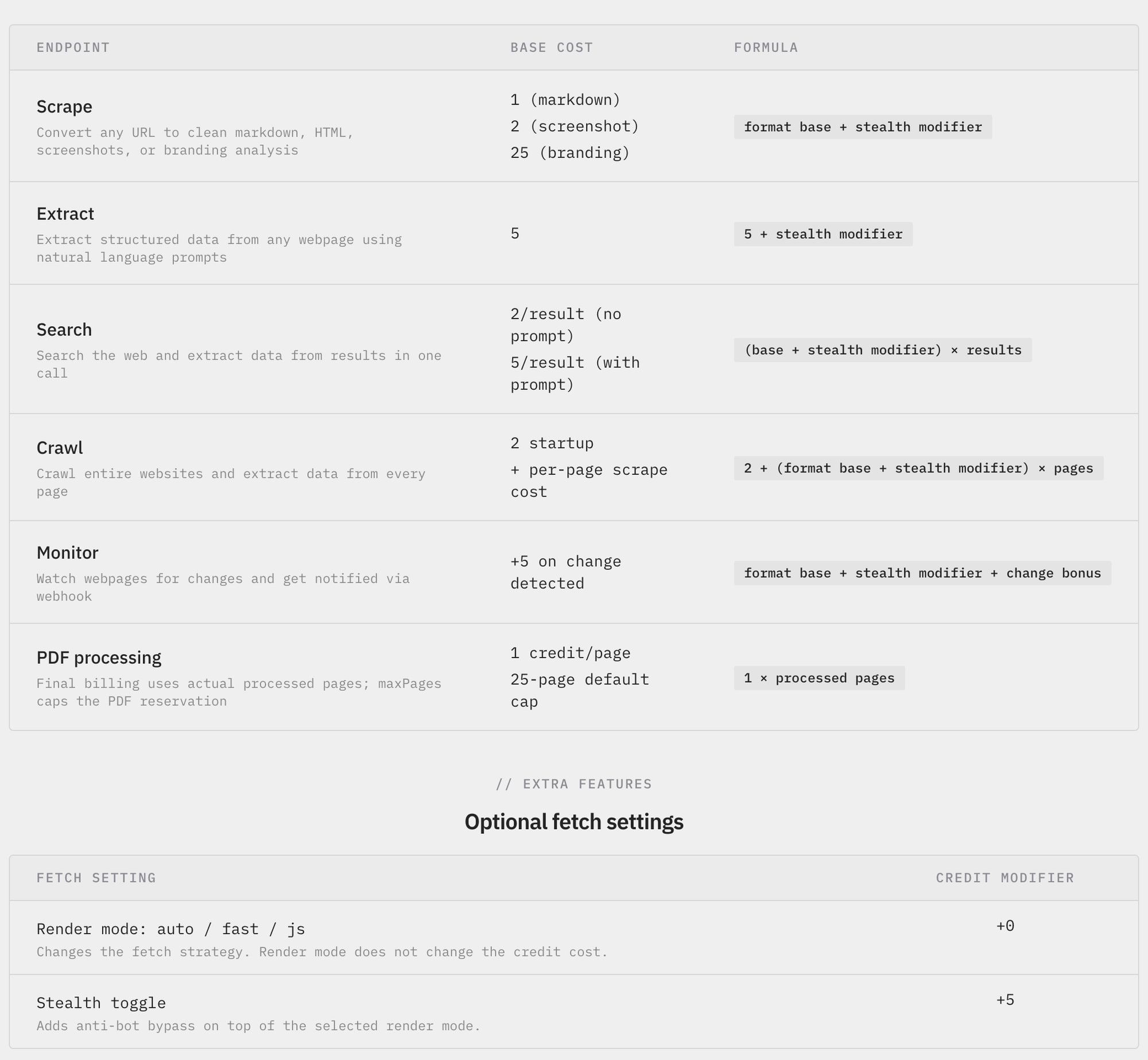
Credits per unit, verified 2026-11-12. ScrapeGraphAI pricing and docs; Firecrawl pricing and billing docs.
| Operation | ScrapeGraphAI | Firecrawl |
|---|---|---|
| Markdown page | 1 | 1 |
| Structured JSON from a URL | 5 (Extract) | 5 (1 scrape + 4 JSON) |
| Screenshot | 2 | Not priced on the pages I read |
| Search | 2 per result; 5 per result with a prompt | 2 per 10 results, plus scrape cost if scraping |
| Crawl | 2 to start, plus each page’s cost | 1 per page |
| Map | No endpoint | 1 per call |
| Monitor | Format cost plus stealth, +5 when a change is found | 1 per page per check |
| 1 per page (25-page default cap) | 1 per PDF page | |
| Stealth or enhanced proxy | +5 (pricing page) or +4 (docs); Auto worst case +9 | +0 |
| Browser interaction | None | 2 per minute (pricing) or 2–7 (docs) |
That ScrapeGraphAI’s 5 credits include fetching the page is my inference: the pricing formula is “5 + stealth modifier” with no separate scrape term, and Extract fetches the URL itself. Neither page says it in words.
Each vendor contradicts itself once. ScrapeGraphAI’s pricing page says stealth is +5, while its docs say +4 (and +5 for JS plus stealth).
Firecrawl’s pricing page says interact costs 2 credits per browser minute, while its billing docs say “2–7 credits / browser minute”. I’d budget on the higher number in both cases.
The stealth line matters more than it looks. Firecrawl’s billing docs say its enhanced proxy is “Billed at the same 1 credit as a basic request”, so if you need stealth on every page, ScrapeGraphAI’s per-page cost nearly doubles or more (a 5-credit extraction becomes 9 or 10, a 1-credit Markdown page 5 or 6) while Firecrawl’s stays the same. Billing docs.
What do three real jobs cost? #
Same pages, same output, cheapest published route on each, verified 2026-11-12. My arithmetic; stealth and anti-bot options are off. I chose volumes that differ from my Firecrawl alternatives page, which uses 10K, 100K and 1M.
| Job a month | Credits (both) | ScrapeGraphAI | Firecrawl | Per 1,000 pages |
|---|---|---|---|---|
| 2K JSON extractions | 10K | Starter $20 (exactly 10K) | Hobby $19 + 5 × $5 packs = $44 | $10.00 vs $22.00 |
| 40K JSON extractions | 200K | Growth $100 + 2 × $150 packs = $400 (Pro $500) | Standard $99 + 50 × $5 packs = $349 (Growth $399) | $10.00 vs $8.73 |
| 300K markdown pages | 300K | Pro $500 (Growth + 4 packs = $700) | Growth $399 (Standard + packs = $599) | $1.67 vs $1.33 |
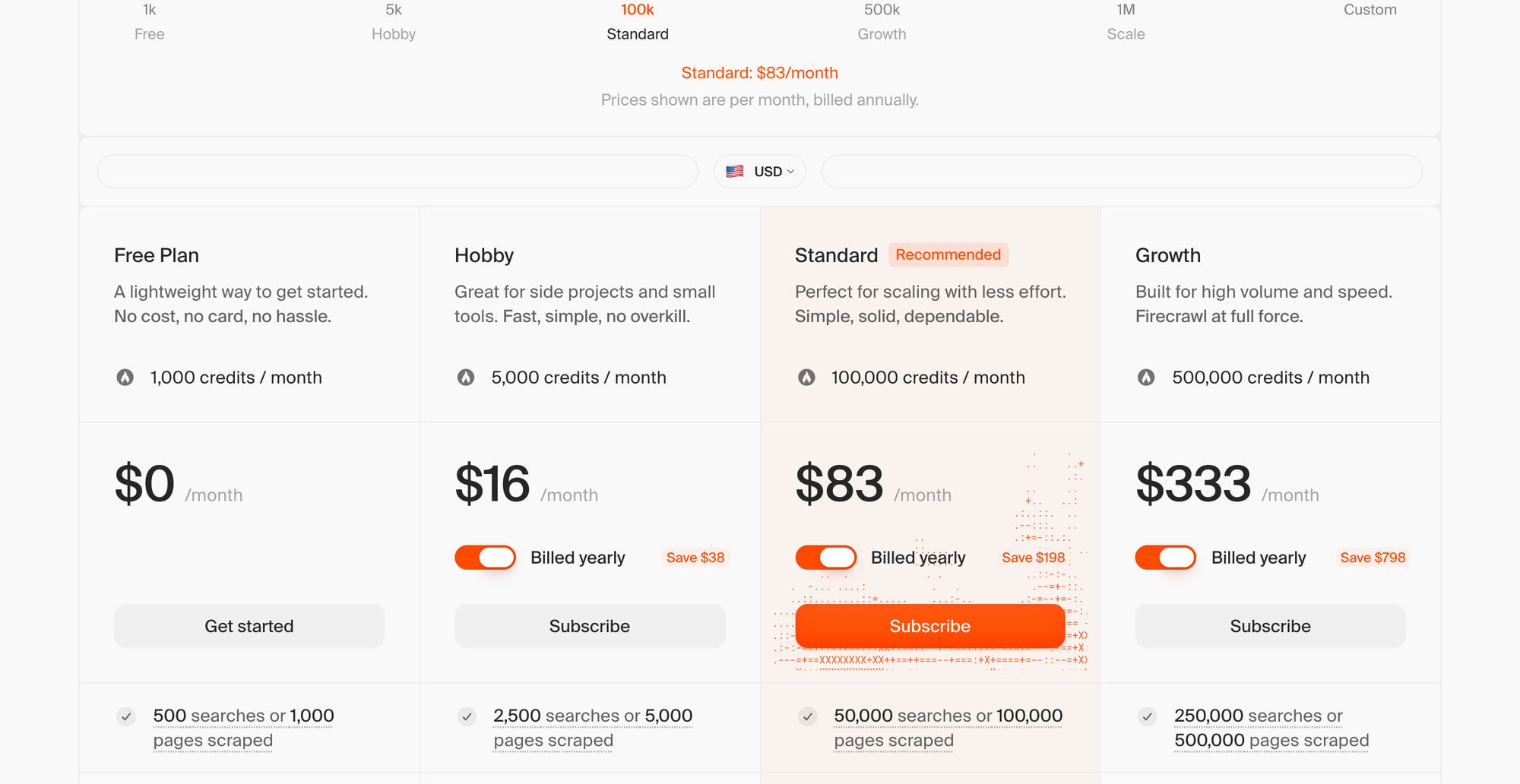
Billed annually, the same jobs cost $17 vs $41, $385 vs $333, and $425 vs $333. ScrapeGraphAI’s annual prices ($17, $85 and $425 a month) come from its docs; Firecrawl’s ($16, $83, $333 and $599) from its pricing page.
With stealth on every page, the picture tilts further toward Firecrawl. The 2K job needs 18K–20K ScrapeGraphAI credits ($20 + a $40 pack = $60) while Firecrawl stays at $44. The 40K job pushes ScrapeGraphAI to Pro at $500, against Firecrawl’s unchanged $349.
The packs behave differently. ScrapeGraphAI’s top-ups are one-time purchases that “Never expire” and “Stack on subscription”, so the 40K row means buying two packs every month. Firecrawl’s auto top-up adds credits “when your balance runs out”, and bought credits “expire if you cancel your subscription”. ScrapeGraphAI pricing, Firecrawl pricing.
What do the free tiers cover? #
Firecrawl’s free tier is twice as large and renews. “Firecrawl gives you 1,000 free credits every month”, with no card required, which covers 1,000 markdown pages or 200 JSON pages. Firecrawl pricing.
ScrapeGraphAI’s pricing page lists “500 API credits, one-time”: 500 markdown pages or 100 extractions, once. Its docs list the same tier as “500 API credits / month”. I trust the pricing page, since it’s the more specific product page, but you might get a monthly refill. Pricing, docs.
One more reason to test with care: ScrapeGraphAI’s terms let it use free-plan data for model training (details below). I wouldn’t send sensitive pages through any free plan without reading its terms.
Which limits will you hit first? #
On ScrapeGraphAI, requests per minute and concurrent crawls. On Firecrawl, concurrent requests. Verified 2026-11-12.
| Level | ScrapeGraphAI: requests/min · concurrent crawls | Firecrawl: concurrent requests · scrapes/min |
|---|---|---|
| Free | 10 · 1 | 2 · 10 |
| Entry | Starter $20: 100 · 3 | Hobby $19: 5 · 100 |
| Mid | Growth $100: 500 · 15 | Standard $99: 25 · 500 |
| Upper | Pro $500: 5,000 · 50 | Growth $399: 50 · 5,000 |
| Top | Enterprise: custom | Scale $749: 100 · 10,000 |
Firecrawl caps /crawl and /agent starts separately: 2, 20, 100, 1,000 and 2,000 a minute by plan. ScrapeGraphAI also limits monitors, from 1 on Free to 100 on Pro. ScrapeGraphAI pricing, Firecrawl pricing.
Rollover is the other limit. Firecrawl says “Hobby, Standard and Growth credits do not roll over”; Scale rolls over one month.
ScrapeGraphAI doesn’t say what happens to unused plan credits. Upgrades add credits “immediately”, and “Downgrades take effect at the start of the next billing period.” ScrapeGraphAI docs.
If your volume swings month to month, ScrapeGraphAI’s never-expiring packs on a small plan are the safer way to absorb a spike. If it’s steady, Firecrawl’s cheaper credits win.
What happens to your data? #
The two terms differ in a way that matters for AI work.
ScrapeGraphAI (terms last updated June 4, 2026) says it “may use Free Plan Data for scientific research, product research, model evaluation, model training”, and “We do not use data generated through paid tiers, Team plans, Enterprise plans, or paid API usage for model training”. It adds “We do not claim ownership of your Customer Data or Outputs.” Terms.
The same terms bar using the service “to develop a competing service by copying our APIs, systems, documentation, or user experience”, and they have no clause restricting benchmarking or publishing results. Disputes go to the law of “the jurisdiction where ScrapeGraphAI, Inc. is established”.
Firecrawl (terms last updated October 7, 2026) says user content “belongs to the user”, but you grant “a worldwide, irrevocable, non-exclusive, royalty-free license to use, reproduce, modify” and “publish, translate and distribute any content that you submit”, sublicensable and surviving termination. The terms say nothing about model training either way. California law applies. Terms.
Zero data retention is “Included” only on Firecrawl’s Enterprise plan (“We keep no scraped content after the request, on approved use cases”), though the changelog lists a Lockdown Mode with “zero data retention by default” from April 30, 2026. The privacy policy dates from December 26, 2024 and says nothing about training. Pricing, changelog, privacy policy.
SOC 2. Both say Type II. ScrapeGraphAI’s pricing page says “All requests are SOC 2 Type II compliant”, and its July 3, 2026 announcement says it “has completed SOC 2 Type 2 compliance”, without naming the auditor; the report is on request. ScrapeGraphAI SOC 2 post.
Firecrawl lists SOC 2 Type II on every plan. Both are vendor claims, and I read neither report.
My read: on a paid plan, ScrapeGraphAI’s terms are the clearer of the two about training. Firecrawl’s licence wording is broad for a scraping service, and if that worries you, ask for Enterprise ZDR terms in writing.
What each vendor’s page gets wrong about the other #
ScrapeGraphAI moved to a V2 API that renamed its endpoints (smartscraper became extract, markdownify became scrape), and its V2 post promises “double the credits for the same price”. Neither the post nor the migration guide gives a date. That explains most of the stale figures below. V2 post, v1-to-v2 guide.
Claims I checked on November 12, 2026
On Firecrawl’s comparison page:
- “SmartScraper costs 10 credits per call”: the V2 Extract endpoint costs 5.
- “2 credits for basic Markdownify”: a Markdown scrape is now 1.
- “Growth plan ($85/mo for 480k credits/year)”: $85 a month is Growth billed annually, for 100,000 credits a month.
- “roughly 5x more extracted pages” per dollar: JSON is 5 credits on both now. At 40K pages, it’s $8.73 vs $10.00 per 1,000.
- Library “MIT licensed, 27k stars”: the repository shows 32.7k.
- “SOC 2 Type 1 certified; working toward Type 2”: ScrapeGraphAI announced Type 2 on July 3, 2026 (its own claim).
On ScrapeGraphAI’s comparison page and blog post:
- Firecrawl Free “Limited usage” or “500 pages”: it’s 1,000 credits a month.
- Hobby “3,000 pages”: Hobby includes 5,000 credits.
- “$16”, “$83”, “$333”: these are Firecrawl’s annual-billing prices, unlabeled. Monthly is $19, $99 and $399.
- “+$89/mo for /extract AI”: structured output is the JSON format at +4 credits a page.
- The blog gives ScrapeGraphAI’s own free tier as 500 credits in one table and 100 in another.
Elsewhere: Respan lists ScrapeGraphAI as “Free Version: No”, and ScrapeOps lists Firecrawl Free at 500 and ScrapeGraphAI Starter at 5,000 pages. Both are out of date.
ScrapeGraphAI’s blog post also reports its own side-by-side runs on accuracy and speed. They’re self-run, with no published method or dates, so I don’t repeat the numbers here.
Can you use both? #
Yes. Firecrawl can map and crawl a site to markdown, and ScrapeGraphAI’s Extract accepts Markdown or HTML (up to 2 MB) instead of a URL, so you can hand it only the pages you want fields from. Extract reference.
Priced once: crawling 300K pages on Firecrawl Growth ($399) and extracting fields from 2K of them on ScrapeGraphAI Starter ($20) comes to $419 a month. Whether Extract still costs 5 credits with Markdown input isn’t stated, so treat that as an estimate.
The honest catch: Firecrawl alone would cost less. Re-scraping those 2K pages with Firecrawl’s JSON format adds 10K credits, which fits in Growth’s spare 200K, so the bill stays $399. Use both only if you already run ScrapeGraphAI pipelines or prefer its prompt-first extraction.
What does the library-only route cost? #
Your LLM bill plus the machine that runs the browser. There are no credits.
ScrapeOps estimates about $0.0030 per page for open-source LLM scraping with o3-mini, at “750 tokens of input and 500 tokens of output”. That’s a generic estimate, not a ScrapeGraphAI figure. ScrapeOps.
On that assumption, extracting fields from 300K pages would cost about $900 in tokens, before compute and proxies. The same 300K extractions in the cloud need 1.5M credits: about $1,249 on Firecrawl (Scale plus packs) or $2,750 on ScrapeGraphAI (Pro plus packs), by my arithmetic.
So the library can be cheaper at volume, but only if your pages really are that small. Your token count per page sets the bill, and the issue tracker shows why it needs watching: open issue #1142 reports a node “inflating model input ~74x” (opened September 1, 2026), and #1121 says an unknown model setting “silently falls back to 8192 and truncates” (July 28, 2026). Issues.
The library route is clearest with a local model, where tokens cost only hardware, or when data can’t leave your network. With a hosted LLM, log real token counts on a sample before you plan on it.
Which one should you pick? #
Pick ScrapeGraphAI if you need fields as JSON from a few thousand known URLs. Starter at $20 covers 2,000 extractions, less than half Firecrawl’s $44.
Pick ScrapeGraphAI’s library if you want everything local. It’s MIT, works with Ollama, and no vendor sees your data.
Pick ScrapeGraphAI top-ups if your volume comes in bursts. Packs never expire and stack on any plan.
Pick Firecrawl if you’re turning whole sites into markdown for RAG. Map, crawl and search are built in, and 300K pages cost $399 against $500.
Pick Firecrawl if you need JSON at around 40K pages a month ($349 vs $400), or stealth proxies on every page, where ScrapeGraphAI’s per-page cost nearly doubles or more.
Pick Firecrawl for a free tryout. 1,000 credits renew monthly, against 500 once, and free-plan data isn’t singled out for training in its terms.
Use both if you already run ScrapeGraphAI extraction and need Firecrawl’s crawling. On list prices, Firecrawl alone is usually cheaper.
What else is worth a look? #
- Crawl4AI, an open-source crawler often weighed against Firecrawl: Crawl4AI vs Firecrawl.
- Other hosted crawlers and extractors, at 10K, 100K and 1M pages: Firecrawl alternatives.
- Selector-based extraction for stable sites, where an LLM may be overkill: LLM structured data extraction.
FAQ #
Is ScrapeGraphAI open source? #
The Python library is, under the MIT license, and you run it with your own LLM key or a local model. The hosted ScrapeGraphAI API is a paid cloud service; its SDKs are MIT-licensed but the service itself is not open source. README.
Is ScrapeGraphAI cheaper than Firecrawl? #
For small JSON jobs, yes on list prices. 2,000 extractions cost $20 on ScrapeGraphAI Starter against $44 on Firecrawl. At 40,000 extractions Firecrawl is cheaper ($349 vs $400), and at 300,000 markdown pages it’s $399 vs $500. Turning on stealth proxies makes ScrapeGraphAI dearer at every size. ScrapeGraphAI pricing, Firecrawl pricing.
Can Firecrawl extract structured data? #
Yes. Its JSON format adds 4 credits to the 1-credit scrape, so a structured page costs 5 credits, the same count as ScrapeGraphAI’s Extract. The difference in price comes from how much each vendor charges per credit at your volume. Firecrawl pricing.
Can I run ScrapeGraphAI with a local model? #
Yes. The library’s README lists local models through Ollama alongside OpenAI, Groq, Azure, Gemini and MiniMax. You also need to install Playwright for the browser. Self-hosted Firecrawl can likewise use an OpenAI-compatible provider or Ollama for its LLM formats. README, Firecrawl self-hosting.
Does ScrapeGraphAI train on my data? #
Only on the free plan. Its terms say it may use Free Plan data for research, model evaluation and model training, and that it does not use data from paid tiers, Team or Enterprise plans or paid API usage for training. Terms.
Which is better for RAG? #
Firecrawl, if the job is turning whole sites into markdown. It has map, crawl and search endpoints, and 300,000 markdown pages a month cost $399 on its Growth plan against $500 on ScrapeGraphAI Pro. ScrapeGraphAI fits better when you want specific fields as JSON from known pages. Firecrawl pricing.
Sources
23 sources, accessed .
Official pricing, docs, changelogs and status pages 17
- ScrapeGraphAI pricing
- ScrapeGraphAI pricing docs
- ScrapeGraphAI Extract API reference
- ScrapeGraphAI v1 to v2 guide
- ScrapeGraphAI docs introduction
- ScrapeGraphAI V2 announcement
- ScrapeGraphAI SOC 2 Type 2 announcement
- ScrapeGraphAI terms
- ScrapeGraphAI vs Firecrawl (ScrapeGraphAI's page)
- Firecrawl pricing (markdown version)
- Firecrawl pricing
- Firecrawl billing docs
- Firecrawl self-hosting docs
- Firecrawl terms of service
- Firecrawl privacy policy
- Firecrawl changelog
- Firecrawl vs ScrapeGraphAI (Firecrawl's page)


