Pricing
Firecrawl Pricing (2026): Plans, Credits and Cost per Page
Firecrawl pricing explained: plans, credit rules and modeled bills at 10K, 100K and 1M plain pages, plus top-ups, limits and alternatives.

You already know what Firecrawl does. What you need is the bill for your workload, and the plan cards won’t give you that, because one page can cost 1 credit or 9 depending on the options you switch on.
I rechecked Firecrawl’s pricing page, its billing, rate-limit and feature docs, and its changelog on 31 October 2026, then priced four common workloads at 10K, 100K and 1M pages a month. Every figure is a USD list price under pricing marked “Effective September 4, 2026” on the pricing page. For where Firecrawl sits among other crawlers, start with my guide to crawl APIs.
The short answer: plain markdown costs about $4.40 per 1,000 pages at 10K a month, $0.99 at 100K and $0.75 at 1M, and less on annual billing. Turn on JSON extraction and every page costs 5 credits, which is where most bills jump.
Firecrawl pricing at a glance (USD list prices effective 4 September 2026, verified 31 October 2026; full plan detail below):
| Plan | Monthly billing | Annual billing (per month) | Credits a month |
|---|---|---|---|
| Free | $0, no card | Not applicable | 1,000 |
| Hobby | $19 | $16 | 5,000 |
| Standard | $99 | $83 | 100,000 |
| Growth | $399 | $333 | 500,000 |
| Scale | $749 | $599 | 1,000,000 |
| Enterprise | Custom | Custom | Custom |
Short on time?
Short on time? Here's my take.
- Cheapest way in
- Free, then Hobby
- Free is 1,000 credits a month with no card. Hobby is $19 a month ($16 on annual billing) for 5,000 credits, and it stays the cheapest plan up to about 20,000 credits if you top up in $5 packs.
- Best value around 100K pages
- Standard
- $99 a month or $83 on annual billing for 100,000 credits: $0.99 or $0.83 per 1,000 plain pages. It's the cheapest plan from about 20,000 to 220,000 credits a month.
- What 1M pages really costs
- Scale
- $749 a month, or $599 a month billed annually ($7,190 a year): $0.75 or $0.60 per 1,000 plain pages. With JSON extraction on every page, the same 1M pages cost $4,749 a month.
- When Firecrawl stops being cheap
- Small volumes and JSON-heavy jobs
- At 10K plain pages Firecrawl is $4.40 per 1,000 against Crawl4AI Cloud's $1 list rate. JSON extraction makes every Firecrawl page 5 credits.
Prices verified . Sponsors cannot buy a verdict or a position.
How much does Firecrawl cost? Every plan compared #
Firecrawl costs $0 to $749 a month on its self-serve plans, or $16 to $599 a month on annual billing, and Enterprise is priced on request. The price per plan credit drops sharply as you move up, from $3.80 per 1,000 on Hobby to $0.75 on Scale. Here are the list prices, verified on 31 October 2026 from the pricing page and its Markdown version.
Firecrawl plans and prices
Verified
| Plan | Monthly billing | Annual billing | Credits a month | Per 1K plan credits (monthly / annual) | Extra credits | Unused credits roll over | Support |
|---|---|---|---|---|---|---|---|
| Free | $0, no card | Not listed | 1,000 | $0 | Not available | No | Community |
| Hobby | $19/mo | $16/mo ($190/yr) | 5,000 | $3.80 / $3.17 | 1,000 per $5 ($5.00 per 1K) | No | Basic |
| Standard Best value at ~100K | $99/mo | $83/mo ($990/yr) | 100,000 | $0.99 / $0.83 | 2,000 per $5 ($2.50 per 1K) | No | Standard |
| Growth | $399/mo | $333/mo ($3,990/yr) | 500,000 | $0.80 / $0.67 | 2,500 per $5 ($2.00 per 1K) | No | Priority |
| Scale | $749/mo | $599/mo ($7,190/yr) | 1,000,000 | $0.75 / $0.60 | 5,000 per $5 ($1.00 per 1K) | 1 month | Priority |
| Enterprise | Custom | Custom | Custom | Custom | Custom | Custom | Dedicated |
Source: Firecrawl pricing page, prices in USD; current plan prices rechecked 31 Oct 2026. Annual per-month card prices are rounded vendor displays; binding annual totals are $190/$990/$3,990/$7,190, not display price × 12. SSO and ZDR are listed for Enterprise.
Two things on this table deserve a closer look. The annual Scale card displays $599 a month, but the listed yearly total is $7,190: $599 × 12 is $7,188. Budget from the yearly total, not the rounded display. Scale also has a $749 monthly-billing option.
The second is whether Scale is annual-only. It isn’t: the Markdown version lists Scale at $749 a month or $599 a month billed annually, the same two options as every other paid plan. On 27 September the HTML cards printed “Billed yearly” in both views, even on Hobby at $19, which is likely where the annual-only idea comes from. By 31 October they read “billed monthly” or “billed annually” to match the toggle.
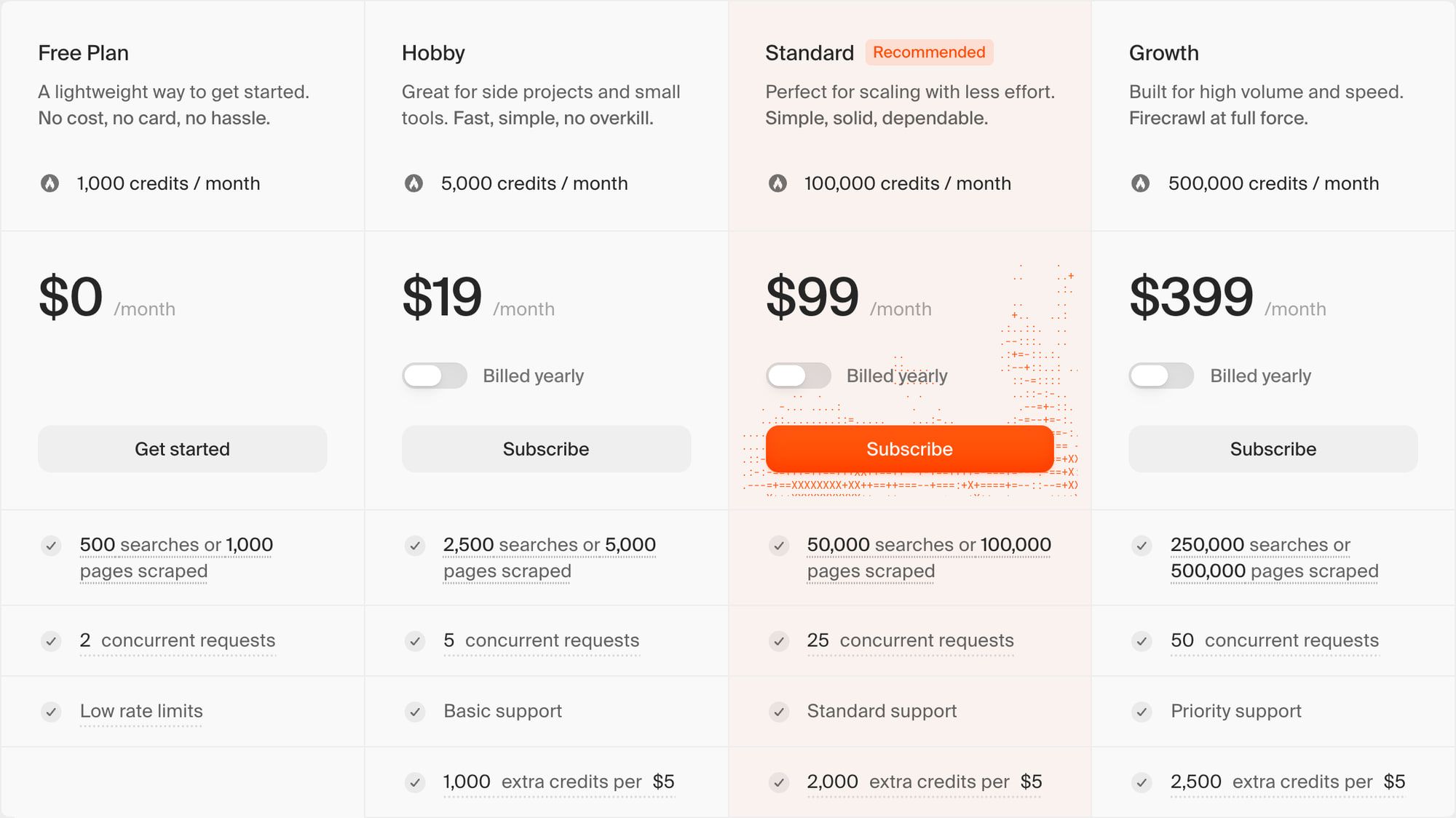
Annual billing is a real discount, not a rounding trick. Monthly price × 12 minus the page’s “Save” figure gives $190, $990, $3,990 and $7,190 a year, which is 16.7% off on the first three plans and 20% off on Scale.
It doesn’t change how credits work. Per the billing docs, “You are billed annually, but credits still reset each month.”
The limits matter as much as the price if you run big jobs. Here they are by plan, from the same page and the rate-limit docs:
| Plan | Concurrent browsers | /scrape, /map, /search per min | /crawl, /agent per min | /interact per min | Max queued jobs |
|---|---|---|---|---|---|
| Free | 2 | 10 | 2 | 2 | 50,000 |
| Hobby | 5 | 100 | 20 | 20 | 50,000 |
| Standard | 25 | 500 | 100 | 100 | 50,000 |
| Growth | 50 | 5,000 | 1,000 | 1,000 | 100,000 |
| Scale | 100 | 10,000 | 2,000 | 1,500 | 200,000+ |
| Enterprise | Custom | Custom | Custom | Custom | 200,000+ |
Source: Firecrawl pricing and rate-limit docs, rechecked 31 Oct 2026. Extract shares /agent limits. Rate-limit docs assign batch scrape to /crawl, while billing docs say /scrape; confirm batch limits before planning throughput. Queued jobs time out after 48 hours, and going over a limit returns HTTP 429. Scroll sideways for more columns.
Older third-party explainers list different concurrency figures. I could not read archived pricing pages to establish when or why they changed, so I use the current official limits without inferring a September concurrency cut.
How do Firecrawl credits work, endpoint by endpoint? #
One credit buys one plain page on scrape and crawl, and almost everything else is priced as a multiple or add-on to that. The table below lists every rule I found, from the pricing page and the billing docs.
| What you do | Credits | What to know |
|---|---|---|
| Scrape, crawl or batch scrape a page | 1 per page | Batch scrape and crawl pages are billed as each one finishes |
| Map a site | 1 per call | Docs: regardless of how many URLs come back. The HTML pricing table says 1 per page |
| Search | 2 per 10 results | Rounded up; each result you also scrape adds its normal page cost |
| JSON, Question or Highlight format | +4 per page | A JSON-extracted page costs 5 credits |
| PDF parsing | +1 per PDF page | Raw base64 output (parsers: []) is 1 credit flat |
| PII redaction, audio, video, prompt-injection check | +4 each per page | A scrape that fails after the injection check bills 5 |
| Zero Data Retention | +1 per page | Listed as Enterprise-only on the pricing page |
| Enhanced proxy (enhanced or auto) | +0 | Escalated retries aren't charged separately |
| Interact (remote browser) | 2 per browser-minute, 7 with a prompt | One-minute minimum |
| Agent | 5 free runs a day, then dynamic | Most runs use a few hundred credits; failed runs aren't billed |
| Monitor | 1 per URL per check | Crawl monitors bill per discovered page; judging a change adds 1; additional scrape formats can add credits; the pricing page advertises 7 credits per page per check for its deterministic engine, while the monitoring guide does not spell that rate out |
| Change tracking on /scrape | Free (basic and git-diff) | JSON mode is 5 per page |
| /extract (beta) | Credits | Each credit is worth 15 tokens; /agent is its successor |
| Provider-routed URLs | Separate pricing | LinkedIn profiles/companies use configured provider charges; X profile/post requests normally cost 30 credits, or 34 with JSON |
| Ordinary scrape screenshots and page actions | No separate surcharge listed | Pricing/billing-table observation; Browser/Interact sessions have their own metering |
| Ordinary scrape returning no document | 0, with exceptions | Threat scans, injection checks, lockdown misses, monitor errors and browser sessions can still bill work already done |
Source: Firecrawl pricing page, billing docs and feature docs (search, map, agent, monitoring, change tracking, extract, enhanced mode, advanced scraping guide), rechecked 31 Oct 2026. Scroll sideways for more columns.
A few rows need their source spelled out:
- Search costs “2 credits per 10 results, rounded up”, per the search docs. So 1 to 10 results is 2 credits and 11 to 20 is 4, and each result you also scrape is billed like any other page. If search is your main job, I compare it head to head in Firecrawl vs Tavily and show what Firecrawl search costs next to Exa.
- Add-ons stack. The billing docs give two worked examples: JSON plus Zero Data Retention is “1 + 4 + 1 = 6 credits”, and JSON plus PII redaction is “1 + 4 + 4 = 9 credits”.
- Enhanced proxy is free on top of the base credit. The billing docs say it’s billed “at the same 1 credit as a basic request”, and per the enhanced-mode docs, auto routing can try a basic request first. The explicit
proxyparameter is deprecated in the current proxy docs, which recommend auto. - The agent gets “5 free daily runs”, and after that, “Most agent runs consume a few hundred credits”, per the agent docs. You can cap a run with
maxCredits(the dashboard cap is 2,500). - Monitors cost nothing per monitor, and the monitoring docs say the API returns an
estimatedCreditsPerMonthso you can check a cost before you commit.
Map: 1 credit per call, not per page
The HTML pricing table lists map at 1 credit per page, but the Markdown pricing table says 1 credit per call, the billing docs say “1 credit / call” and the map docs say “1 credit per call, regardless of the number of URLs returned”. The open-source map controller, checked 31 October, uses a base of 1 on its ordinary path, plus threat-scan credits when requested. Its special resolver path bills by returned result; the resolver code requires a configured service and dynamically matched supported URLs. I have not established which hosted requests take that path.
The ordinary map cost model excludes those special routes and threat scanning.
I trust the Markdown table, the two docs pages and the code over the HTML table, so this page models ordinary map calls at 1 base credit. Special provider routes and optional threat scanning are outside that model.
Stale claims you'll see elsewhere
Some pricing explainers still ranking for this search predate the current rules. Here are the current primary-source rules, rechecked 31 October 2026:
- “Stealth or enhanced mode costs 5×.” Enhanced proxy requests did cost 5 credits from 8 May 2025. A 17 August 2026 update in the changelog says that price “no longer applies”, and they now bill at the base 1 credit.
- “The agent bills you even when a run fails.” The agent docs now say “Failed runs are not billed”. I couldn’t find the date that rule started.
- “There’s no pay-as-you-go.” Paid plans top up automatically when your balance runs out, per the FAQ on the pricing page that took effect on 4 September 2026.
- “Extraction is a separate add-on of about $89 a month.” The extract docs say “Extract now uses credits, just like all of the other endpoints”.
- “The free credits are one-time.” The pricing page says the 1,000 free credits are “refreshed monthly”.
- “Annual billing saves 15% or 22%.” The page’s own figures work out to 16.7% and 20%.
What does Firecrawl cost at 10K, 100K and 1M pages? #
For plain markdown, Firecrawl costs $44 a month at 10K pages, $99 at 100K and $749 at 1M on monthly billing. JSON extraction on every page multiplies those bills by 2 to 6, and search-then-scrape lands in between.
I priced four workloads, and two of them come out the same:
- Basic scrape: one plain markdown page is 1 credit.
- Full-site crawl: also 1 credit per page; a separate, optional map call adds 1 credit. Add 1 credit per PDF page if the site has PDFs.
- Scrape + JSON extraction: 5 credits per page.
- Search + scrape the top 10: 2 credits for 10 results plus 10 scrapes, so 12 credits per 10 pages, or 1.2 per page.
| Workload | Credits per page | 10K pages a month | 100K pages a month | 1M pages a month |
|---|---|---|---|---|
| Basic scrape or full-site crawl | 1 | Hobby + extras: $44 ($41 annual) · $4.40 per 1K | Standard: $99 ($83 annual) · $0.99 per 1K | Scale: $749 ($599 annual) · $0.75 per 1K |
| Scrape + JSON extraction | 5 | Standard: $99 ($83 annual) · $9.90 per 1K | Growth: $399 ($333 annual) · $3.99 per 1K | Scale + extras: $4,749 ($4,599 annual) · $4.75 per 1K |
| Search + scrape the top 10 | 1.2 | Hobby + extras: $54 ($51 annual) · $5.40 per 1K | Standard + extras: $149 ($133 annual) · $1.49 per 1K | Scale + extras: $949 ($799 annual) · $0.95 per 1K |
Source: My arithmetic from Firecrawl's list prices and credit rules on its pricing page and billing docs, rechecked 31 Oct 2026. Per-1K figures are on monthly billing; annual figures are per month. Scroll sideways for more columns.
This prices Firecrawl workloads only.
The math behind each bill #
For each workload I took the credits needed (pages × credits per page), priced every plan as plan price + $5 for each extra-credit pack needed on top, and kept the cheapest. Annual figures below use the rounded monthly card displays ($16, $83, $333 and $599) for illustration. Actual subscription invoices are $190/$990/$3,990/$7,190 yearly; their exact monthly equivalents are about $15.83/$82.50/$332.50/$599.17, before top-ups.
| Workload and volume | Credits needed | Cheapest plan | Monthly billing | Annual billing (per month) | Per 1K pages (monthly / annual) | Next cheapest (monthly) |
|---|---|---|---|---|---|---|
| Basic, 10K | 10,000 | Hobby + 5,000 extra | $19 + 5 × $5 = $44 | $16 + $25 = $41 | $4.40 / $4.10 | Standard, $99 |
| Basic, 100K | 100,000 | Standard | $99 | $83 | $0.99 / $0.83 | Growth, $399 |
| Basic, 1M | 1,000,000 | Scale | $749 | $599 | $0.75 / $0.60 | Growth + 500K extra: $399 + 200 × $5 = $1,399 |
| JSON, 10K | 50,000 | Standard | $99 | $83 | $9.90 / $8.30 | Hobby + 45K extra: $19 + 45 × $5 = $244 |
| JSON, 100K | 500,000 | Growth | $399 | $333 | $3.99 / $3.33 | Scale, $749 |
| JSON, 1M | 5,000,000 | Scale + 4M extra | $749 + 800 × $5 = $4,749 | $599 + $4,000 = $4,599 | $4.75 / $4.60 | Growth + 4.5M extra: $399 + 1,800 × $5 = $9,399 |
| Search, 10K | 12,000 | Hobby + 7,000 extra | $19 + 7 × $5 = $54 | $16 + $35 = $51 | $5.40 / $5.10 | Standard, $99 |
| Search, 100K | 120,000 | Standard + 20,000 extra | $99 + 10 × $5 = $149 | $83 + $50 = $133 | $1.49 / $1.33 | Growth, $399 |
| Search, 1M | 1,200,000 | Scale + 200,000 extra | $749 + 40 × $5 = $949 | $599 + $200 = $799 | $0.95 / $0.80 | Growth + 700K extra: $399 + 280 × $5 = $1,799 |
The assumptions, so you can adjust them for your own job:
- These are list prices verified on 31 October 2026, not observed bills. Enterprise quotes aren’t modeled, and the Free tier is left out.
- Extra credits are bought in $5 packs. They’re priced exactly because bought credits “stay on your account until you use them” while you’re subscribed, per the pricing page.
- Every page is assumed to return content. Dead links that return a 403 or 404 still cost 1 credit each, so budget for them.
- Annual plans are billed once a year: $190, $990, $3,990 or $7,190, depending on the plan.
Where each plan becomes the cheapest #
Because extra credits get cheaper as you move up, each plan wins over a band of monthly usage. On monthly billing, at 1 credit per page:
| Credits you use a month | Cheapest plan | Where the next plan takes over |
|---|---|---|
| Up to about 20,000 | Hobby + extra credits | $19 + 15 × $5 = $94 at 20K; at 21K it ties Standard at $99 |
| About 20,000 to 220,000 | Standard (+ extras above 100K) | $99 + 60 × $5 = $399 at 220K, the same as Growth |
| About 220,000 to 675,000 | Growth (+ extras above 500K) | $399 + 70 × $5 = $749 at 675K, the same as Scale |
| Above 675,000 | Scale (+ extras at $1 per 1K) | Beyond this, Enterprise is a sales conversation |
To use it for another workload, multiply your pages by the credits per page first. At 5 credits a page, 44,000 JSON pages is already 220,000 credits, which puts you on the edge of Growth.
Is there a Firecrawl free tier? #
Yes: 1,000 credits a month, “refreshed monthly, no credit card required”, per the pricing page (verified 31 October 2026). It’s a real monthly allowance, not a one-time trial.
What 1,000 credits cover:
- About 1,000 plain pages, at 1 credit each.
- About 200 JSON-extracted pages, at 5 credits each.
- About 83 searches where you also scrape all 10 results (12 credits each, 996 in total).
The limits are tight. Free gets 2 concurrent browsers, 10 requests a minute on scrape, map and search, and 2 a minute on crawl, agent and interact, per the rate-limit docs. At 10 a minute, 1,000 single scrapes take at least 100 minutes.
You can’t buy extra credits on Free, because pay-as-you-go “is for paid plans only”. Separately, every plan, Free included, gets 5 free agent runs a day, per the agent docs. If search is most of what you need, I set Firecrawl’s allowance next to other free web search APIs for AI agents.
What makes a Firecrawl bill bigger than the plan price? #
Mostly four things: options that multiply the credits per page, error pages that still bill, credits that reset each month, and automatic top-ups at your plan’s extra-credit rate. None of these is hidden; they’re in the pricing FAQ and the billing docs, but they’re easy to miss on the plan cards.
- Options multiply the page price. JSON extraction makes a page 5 credits, and JSON plus PII redaction makes it 9. Audio, video and the prompt-injection check each add 4.
- Returned error documents cost credits. A captured 403/404 costs the base page credit plus selected modifiers. Ordinary failures with no document are free, but threat scans, prompt-injection checks, lockdown misses, monitor errors and browser-session time have documented exceptions (billing, checked 31 October 2026).
- Plan credits reset every month, even on annual plans. Only Scale carries unused credits over, for one month; the billing docs say that’s for annual Scale plans, and that annual Enterprise gets 2 months (the pricing page says “custom”).
- Top-ups charge your card on their own. “When your credit balance reaches zero, we add one increment to your account and charge your card on file.” Bought credits don’t expire while you’re subscribed, but “They expire if you cancel your subscription”. The billing docs let you set a monthly pay-as-you-go limit, and a limit of 0 turns top-ups off.
- Extra credits cost five times more on Hobby than on Scale. A $5 pack is 1,000 credits on Hobby and 5,000 on Scale. Growing on the wrong plan is the easiest way to overpay.
- An omitted crawl limit does not reserve 10,000 credits. The current billing docs, checked 31 October 2026, say the initial check uses 1 credit, then bills pages as processed. Issue #2189 is a historical 2025 report, not the current documented rule. Set an explicit limit to cap page count; allowed overage can preserve a requested limit above your current balance.
- Browser time and agents add up. Interact bills a one-minute minimum and 7 credits a minute when you pass a prompt; the pricing page only shows the 2-credit code-only rate. Agent runs are dynamic, so set
maxCredits. - Monitors bill every check. At 1 credit per URL per check, 100 URLs hourly for 30 days is 72,000 credits, before judging or format extras. The current monitor docs document recurring cron/text schedules and a 50-target limit per monitor; split this example across at least two monitors.
What do people complain about in Firecrawl’s pricing? #
I couldn’t reach Reddit with my research tools, and G2 and TrustRadius both returned errors, so this summary rests on Hacker News and GitHub.
Price is the most common complaint I found. One Hacker News commenter wrote that “Firecrawl is egregiously expensive” (September 2025). Another, who runs Crawl4AI locally, called Firecrawl “hosted (and rather expensive)” and keeps it “as last resort” (December 2025).
On GitHub, issue #3552, opened on 18 May 2026 and still open, reports an agent run on single-page apps using about 100 credits in roughly 60 seconds with no output. Current docs say failed agent runs aren’t billed, and I couldn’t tell from the thread whether that run counted as failed.
One more thread you may find when you search: issue #4083 says a json scrape format “fails silently while still consuming credits”. It’s about a self-hosted setup with missing OpenAI settings, not about billing on Firecrawl’s cloud.
Can you self-host Firecrawl to avoid credits? #
Yes, but you trade credits for servers and lose features. The core is AGPL-3.0 (the SDKs and some UI parts are MIT), and the self-hosting docs say it lacks Fire-engine’s anti-bot handling, screenshots and page actions, and the Agent, Browser and Interact features. You run Docker Compose, PostgreSQL, Redis, RabbitMQ and Playwright yourself, and JSON extraction needs your own OpenAI-compatible model or Ollama; I compare that route with Crawl4AI in Crawl4AI vs Firecrawl.
How is Firecrawl’s pricing different from Apify’s? #
They bill different things. Firecrawl charges credits per page on one API, while Apify runs ready-made scrapers called Actors and bills compute units, $0.20 each on its Free and Starter plans down to $0.13 on Business, per Apify’s pricing page (verified 31 October 2026). Its Website Content Crawler estimates $0.2 per 1,000 pages over raw HTTP and $0.5 to $5 with a headless browser; the workflow comparison is in Firecrawl vs Apify.
Is there a cheaper option than Firecrawl? #
Yes, on some documented workloads. The current Crawl4AI subscription model undercuts Firecrawl for known URLs using its plain-page engine at 10K, 100K and 1M pages. Browser requirements, discovery overhead, usage caps and actual success can change the decision.
| Option | How it bills | Plain pages, per 1K | Worth a look if |
|---|---|---|---|
| Firecrawl | Credits per page, monthly plans | $4.40 at 10K · $0.99 at 100K · $0.75 at 1M (monthly billing) | You want one hosted API with search, crawl and extraction |
| Crawl4AI Cloud | Monthly plans: $10/10K credits, $99/125K, $499/750K; extras $1/$0.79/$0.67 per 1K | $1 at 10K pages · $0.50 at 100K · ≈$0.395 at 1M, plain-page consumption model | You can accept soft-launch pricing and verify your engine mix and account caps |
| Apify Website Content Crawler | Compute units on an Apify plan | $0.2 raw HTTP · $0.5 to $5 headless browser | Your pages don't need JavaScript rendering |
| Spider | $1 per GB plus $0.0001 per CPU-minute | Not published per page | You want failed requests free and a balance that doesn't expire |
Source: Current public pricing pages checked 31 Oct 2026. Crawl4AI models known-URL plain reads at 0.5 credit each, before free credits, discovery/job overhead and cash top-up timing. Scroll sideways for more columns.
The Crawl4AI homepage and live price API, checked 31 October 2026, now use subscriptions rather than the earlier prepaid-pack offer.
Starter $10 covers 20,000 plain pages; 100K pages use 50K credits, modeled as $10 + $40 extra. At 1M, Builder $99 plus 375K extra credits at $0.79/1K models $395.25.
Bought credits start at $10 and persist; monthly usage caps still apply. These are consumed-credit calculations, not observed invoices. Browser and hard pages use 1 and 2 credits rather than 0.5. Its library’s LICENSE also adds an attribution requirement to Apache-2.0.
Spider bills by data and compute rather than pages, with failed requests free and no balance expiry, so I can’t put a per-page figure on it without guessing. Jina Reader bills differently again; I cover it in Firecrawl vs Jina Reader.
For the full list of alternatives and who each one suits, see my Firecrawl alternatives guide. For raw price at your volume across general-purpose scraping APIs, see the cheapest web scraping API comparison, and if all you need is clean markdown for a model, start with turning a website into markdown for LLMs.
Which Firecrawl plan should you pick? #
- Prototyping, under 1,000 pages a month: Free. It renews monthly and needs no card.
- Up to about 20,000 plain pages a month: Hobby at $19, topping up in $5 packs. It beats Standard until you’re near 20K credits.
- About 20,000 to 220,000 credits a month: Standard. If your volume is steady, annual billing takes it from $99 to $83 a month.
- JSON extraction on around 100K pages: Growth. That’s 500,000 credits, which Growth covers exactly for $399 ($333 annual).
- Above about 675,000 credits a month: Scale, at $749 or $599 on annual billing, with the cheapest extra credits ($1 per 1,000) and the only self-serve rollover.
- Small volumes where price is the whole decision: look at Crawl4AI Cloud first. At 10K plain pages its list price is less than a quarter of Firecrawl’s.
If I were starting a new project with an uncertain volume, I’d stay on monthly billing for the first two months. Credits reset monthly either way, so annual billing only pays off once you know which band you sit in.
When did Firecrawl’s pricing last change? #
Most recently on 4 September 2026, when the current price list took effect. These are the dated changes I could source to Firecrawl itself.
- 5 May 2025: Firecrawl announced that Enhanced Mode proxy requests would cost 5 credits each from 8 May (changelog).
- 17 February 2026: Browser Sandbox launched at 2 credits per browser-minute, the code-only rate Interact bills today.
- 26 May 2026: Monitor launched, with a cost estimate shown before you turn a monitor on.
- 17 August 2026: Enhanced proxy back to 1 credit, and “An escalated retry is not charged separately” (billing docs).
- 20 August 2026: Developer Index launched, priced at 2 credits per 10 results.
- 4 September 2026: the date printed on the current pricing page. I could not establish the exact historical changes from archived copies and do not infer a concurrency cut.
- 22 September 2026: a $75M Series B led by Smash Capital, announced alongside a product called Alexandria. The announcement mentions no pricing change.
I re-verify every price on this page at least every 90 days, and straight away when Firecrawl changes its pricing page. The method is on my methodology page.
A legal question also shows up in this search. I don’t research scraping law on a pricing page, and nothing here is legal advice.
FAQ
Can I use Firecrawl for free?
Yes. The Free plan gives you 1,000 credits every month, refreshed monthly, with no credit card (verified 31 October 2026). That's about 1,000 plain pages or 200 pages with JSON extraction, at up to 10 scrape requests a minute and 2 concurrent browsers.
The open-source version is also free software under AGPL-3.0. You pay for your own servers, though, and you lose features such as the Fire-engine anti-bot layer, screenshots and page actions, and the Agent and Interact endpoints.
How much does Firecrawl cost per page?
A plain markdown scrape costs 1 credit. On monthly list prices verified 31 October 2026, that works out to $4.40 per 1,000 pages at 10K a month (Hobby plus extra credits), $0.99 at 100K (Standard) and $0.75 at 1M (Scale). On annual billing it's $4.10, $0.83 and $0.60.
JSON extraction adds 4 credits a page, so the same volumes cost 2 to 6 times more: $9.90, $3.99 and $4.75 per 1,000 pages on monthly billing.
How do Firecrawl credits work?
Every call draws credits from your monthly allowance: 1 per scraped or crawled page, 1 per map call, 2 per 10 search results, plus add-ons such as 4 more for JSON extraction and 1 more per PDF page.
When a paid plan runs out, Firecrawl adds a pack of extra credits and charges your card. A $5 pack buys 1,000 credits on Hobby, 2,000 on Standard, 2,500 on Growth and 5,000 on Scale.
Do Firecrawl credits roll over?
Plan credits don't, except on Scale, which carries unused credits over for one month, and Enterprise, where the amount is custom. The billing docs say that applies to annual Scale plans, and that credits reset every month even on yearly billing.
Extra credits you buy are different. They stay on your account until you use them, but they expire if you cancel your subscription.
What is the difference between Firecrawl and Apify?
Firecrawl is one API billed in credits per page. Apify is a platform of ready-made scrapers called Actors, billed in compute units: $0.20 each on its Free and Starter plans, down to $0.13 on Business (verified 31 October 2026).
For LLM-ready page text, Apify's Website Content Crawler estimates $0.2 per 1,000 pages over raw HTTP and $0.5 to $5 per 1,000 with a headless browser. Unused Apify usage doesn't roll over.
What is the cheapest web scraping API?
There is no universal cheapest option. On the Crawl4AI homepage and price API checked 31 October 2026, plain pages use 0.5 credit and monthly plans start at $10 for 10,000 credits. Known-URL consumption models $10 at 10K pages, $50 at 100K and $395.25 at 1M, before cash top-up timing or discovery jobs.
Apify's Website Content Crawler publishes an approximate $0.20 per 1,000 raw-HTTP pages, but that is a vendor estimate with different compute and feature assumptions. Run a permitted sample before treating either estimate as your actual bill.
Is web scraping illegal in the US?
There's no blanket yes or no, and this page researches pricing, not law, so I won't guess. What tends to matter is what you collect, from which site and how, not which API you pay for.
This isn't legal advice. If your project depends on the answer, ask a lawyer about your specific use.
Sources
29 sources, accessed .
Official pricing, docs, changelogs and status pages 21
- Firecrawl proxy routing and deprecated parameter
- Firecrawl pricing page (monthly and annual views)
- Firecrawl pricing as Markdown
- Firecrawl docs: billing and credits
- Firecrawl docs: rate limits
- Firecrawl docs: enhanced mode
- Firecrawl docs: map
- Firecrawl docs: search
- Firecrawl docs: extract
- Firecrawl docs: change tracking
- Firecrawl docs: monitoring
- Firecrawl docs: agent
- Firecrawl docs: advanced scraping guide
- Firecrawl docs: self-hosting
- Firecrawl changelog
- Firecrawl blog: Alexandria and the Series B
- Crawl4AI Cloud pricing
- Apify pricing
- Apify Website Content Crawler
- Spider pricing
- Crawl4AI current plans and metering API
GitHub code, issues and releases 6
- Firecrawl repository and license
- Firecrawl map controller source (billing logic)
- Firecrawl issue #3552: Agent reached max credits
- Firecrawl issue #2189: crawl default limit and 402 errors
- Firecrawl issue #4083: self-hosted JSON scrape consuming credits
- Firecrawl special resolver routing configuration