How to choose
Web Scraping API vs Building Your Own? Count the Work First
Buying a scraping API still leaves parsing and data checks with you. Building means owning hosting and repairs. A cost model for build, buy and hybrid.

I would buy a named scraping capability when it fits the output and saves operating work, build when custom control justifies maintaining the stack, or use a hybrid when owned data logic should remain separate from purchased fetching. The decision is total recurring work and validated output, not free source code versus a request price.
Buying can still leave parsing, integration and data checks with you; building can still purchase proxies or an API (see scraping API vs proxies for that split). I compare those boundaries below with an explicit hypothetical cost model, rather than claim an unmeasured throughput or universal break-even. Bee output, ScraperAPI costs, Zyte extraction, Scrapy pipelines.
Short on time?
Here's my take
- Needed delivery fits
- Buy the specific capability
- Keep parser/schema, credentials, retention and failure ownership in the budget.
- Custom implementation matters
- Build with an operations owner
- Code control comes with hosting, patches, queues, security and recovery work.
- Owned data logic, purchased transport
- Define a hybrid boundary
- Compare actual inputs and equal output requirements rather than assume it is the lowest cost.
Prices verified . Sponsors cannot buy a verdict or a position.
What work remains with you? #
I would start with this responsibility table, then identify which rows the selected service actually takes over. It is a decision framework, not a promise that every API or framework supplies the same features.
| Responsibility | Build | Buy named API | Hybrid |
|---|---|---|---|
| Fetch/render/delivery | Owned client/runtime, possibly paid transport | Selected provider contract | Provider for selected steps |
| Schema and data validation | Owned | Still define/validate actual output | Owned |
| Queue, schedules and state | Owned or separately hosted | Included only if contracted | Explicit application boundary |
| Retry, cache and freshness | Owned policy | Provider plus client policy | Shared, with a named owner |
| Storage/export/retention | Owned budget | Selected product terms, not automatically free | Owned or separately paid |
| Security, credentials and permitted scope | Owned | Remain owner responsibilities | Remain owner responsibilities |
| Recovery and change-driven maintenance | Owned | Integration/provider failure plan | Both sides of the boundary |
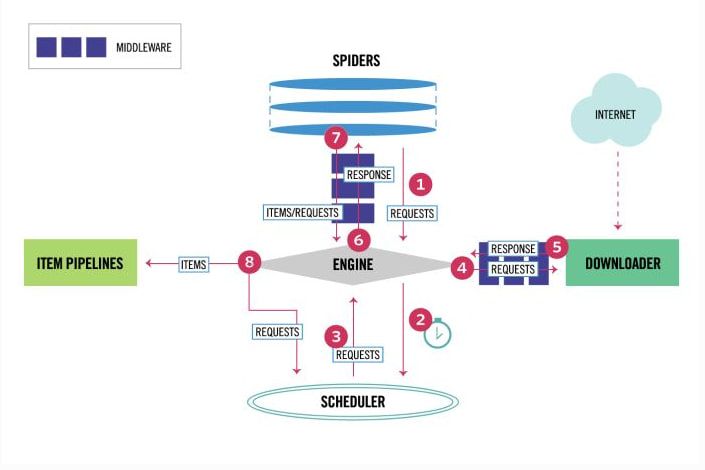
Sources that show these distinct functions: Scrapy jobs, pipelines, Apify Actor billing, permissions, Zyte extraction, ZenRows caps.
What would build, buy or hybrid cost? #
In the hypothetical model below, the USD inputs are assumptions, not vendor quotes or a recommendation to purchase: labor $50/hour, host $24/month, observability/storage $20/month, and service/network budgets $20 build, $99 buy and $49 hybrid. Assume startup work 32/8/16 hours and ongoing work six/two/four hours respectively.
Recurring cost = ongoing hours × rate + host + observability/storage + service. First month = startup hours × rate + recurring; longer horizon = startup hours × rate + months × recurring. Required output/capacity and these work estimates are unproven, so replace them with actual requirements and quotes before deciding.
| Hypothetical model | Recurring / month | First month | Three months total | Twelve months total |
|---|---|---|---|---|
| Build | $364 | $1,964 | $2,692 | $5,968 |
| Buy | $243 | $643 | $1,129 | $3,316 |
| Hybrid | $293 | $1,093 | $1,679 | $4,316 |
The build row is 6 × $50 + $24 + $20 + $20 = $364 recurring, with 32 × $50 startup. The buy row is 2 × $50 + $24 + $20 + $99 = $243 recurring, with 8 × $50 startup; the hybrid uses four hours and a $49 service budget.
This model makes assumptions visible; it does not prove the $99 API handles the same data, retention or scale as a custom build. Taxes, unexpected model/browser/proxy consumption, legal review, on-call incidents and changing maintenance effort need their own inputs.
What if labor costs more or less? #
Keeping the other assumptions fixed, changing the hourly rate gives these recurring figures. This is arithmetic from the hypothetical model, not market salary research.
| Assumed hourly rate | Build recurring | Buy recurring | Hybrid recurring |
|---|---|---|---|
| $0 | $64 | $143 | $93 |
| $25 | $214 | $193 | $193 |
| $50 | $364 | $243 | $293 |
| $100 | $664 | $343 | $493 |
I would also vary change frequency, maintenance hours and startup time. A zero labor valuation can make owned code look cheap while omitting the person who repairs it; high target-change frequency can overturn a low initial quote.
Does an API subscription cover the whole cost? #
Published monthly entry points are ScraperAPI $49/100K, Bee $19/75K and ZenRows B1 $19/45K credits, with different selected weights/defaults. They do not establish the same protected target, geography or useful-record count, and trial/annual/promotional figures need separate treatment. Prices verified: 2026-11-09. ScraperAPI, Bee, ZenRows.
ScraperAPI ordinary JS is ten credits and bills documented 404/early client cancellation; Bee ordinary JS defaults to five with status-mode exceptions. ScraperAPI private growth rates/full terms were not obtained, while ZenRows caps can overshoot/fail open, so a published balance is not my universal hard-budget guarantee. ScraperAPI costs, billing, Bee API, ZenRows caps.
Apify’s $5 Free and $19/$199/$999 monthly floors buy resource/event work rather than a universal page count. CU is allocated memory × hours, with Actor events/proxy/storage and subscription limits needing the selected job definition. Pricing, subscriptions, compute, Store models.
Zyte’s actual website HTTP/browser tier and extraction extras matter, along with the $100 standard PAYG ceiling and commitment floors/ceilings. CDP sessions bill the greater of navigations or 15-second blocks of session time, a session that is disconnected but not closed keeps billing until its TTL, and residential bandwidth overage can add fees. Pricing, rules, extraction, CDP.
Bright Data Unlocker raw requests and Scraper API extracted records are distinct products. At $1.50/1K their similar headlines do not create identical output counts; one page may produce many records or no validated entities. Unlocker pricing, intro, Scraper product, record pricing. The web unblocker comparison sets Unlocker against per-GB and site-tier billing.
I would budget input/schema work, validation, retries, cache/freshness, storage/backup, credentials, provider errors and change-driven maintenance around all these contracts. Provider success and your usable-record acceptance are separate measurements.
If you build, which framework? #
Crawlee supplies Apache-2.0 JavaScript/TypeScript code and Scrapy BSD-3-Clause Python code; they do not provide free hosting or all managed fleet operations. Crawlee’s stable tagged package minimum Node 16 is metadata, not advice to operate an unsupported runtime; pin supported dependencies and verify the actual deployment separately. Crawlee, tag metadata, Scrapy, installation.
Scrapy job persistence and item pipelines can compose state and validation, while optional Playwright integration brings browser binaries and runtime/reactor constraints. I would start with static HTTP when it supplies the required data, adding browser work only for an established rendering/interaction need. Jobs, pipelines, Playwright plugin. My Crawlee versus Scrapy comparison goes further on choosing between them.
Firecrawl is another ingestion choice, with Free 1,000 monthly credits and Hobby $19/5,000. Core/SDK/cloud choices differ; the documented self-host baseline needs authentication/durability and operator work for queues, backups, proxies, models and patching. Pricing, self-host, repository.
I did not install these libraries or test a production host. Source availability and a sample command would not establish maintained runtime, isolation, output correctness or rollback readiness.
Security and permission are your job either way #
Review the target/data rights and actual product terms independently from delivery capability. Zyte terms/AUP and Apify platform/Actor terms still apply; a subscription or source-code licence does not authorize arbitrary targets or proprietary Actor cloning. Zyte terms, AUP, Apify platform, Actor terms, permissions.
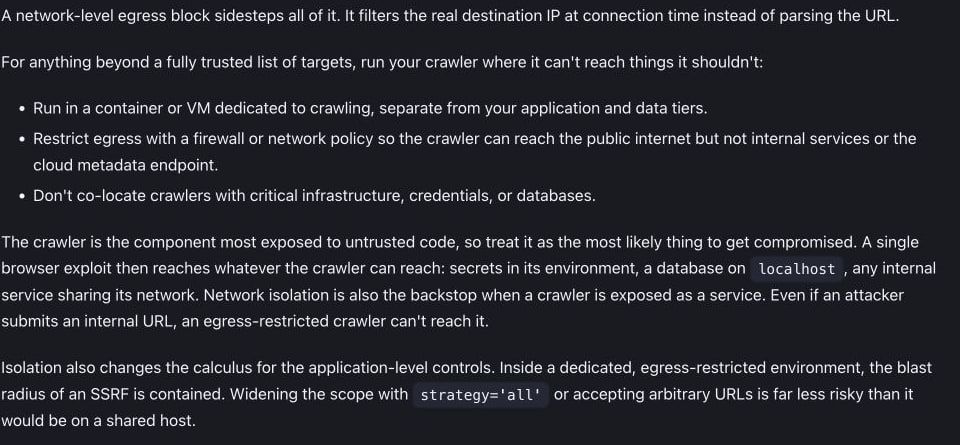
Crawlee Python’s same-host/HTTP(S) checks do not block private IPs or every intermediate redirect; robots behavior also needs explicit configuration. For untrusted URLs, constrain scheme/host, DNS, redirects and response streams with isolated network egress, rather than treat a URL string check as SSRF protection. Crawlee security, OWASP SSRF guidance.
JS request caps can overshoot under parallelism, and request retries/session rotations are different limits. I would record the work budget and allowed targets locally rather than equate a maximum request setting with a perfect billing stop. Crawler options.
Browser pages execute untrusted code, so preserve browser/runtime sandbox and isolated network/credentials. Scrapy RemoteControl can execute Python through HTTP in a live crawl and token-bearing job files are confidential; do not expose that control plane as a casual public dashboard. Playwright container guidance, RemoteControl.
Output also becomes an input to downstream parsers or models. I would escape display content, validate schema and defend against prompt injection rather than grant webpage instructions authority over the pipeline. Crawlee security.
What if you only need search results? #
For SERP discovery inside a wider pipeline, apiserpent.com is a purpose-built alternative rather than generic fetching or browser hosting. Its Default is $0.60/1K with no deposit, Growth $0.30 after a $100 deposit, Scale $0.10 after $500, Enterprise $0.05 after $1,000 and Enterprise Plus $0.03 after $1,250, while credit you already hold keeps the price you bought it at. Prices verified: 2026-11-09. Docs, pricing.
That can fit a hybrid’s named search step without pretending it replaces all data collection. Review the output and the service terms before a separately authorized integration; no search request was executed for this article. Terms.
What should you check before deciding? #
I would first define representative permitted targets, required fields, freshness, duplicates and retention, then compare candidate outputs under the same acceptance rules. That produces a usable-record denominator instead of a headline request count.
| Check | Evidence I would require |
|---|---|
| Output contract | Required fields and omission/error cases validated |
| Operating work | Named owner, change/failure policy and realistic maintenance inputs |
| Cost | Actual selected units, rates, floors, caps and reported outcomes |
| State/migration | Resume/deduplication, schedules, delivery and exports preserved |
| Recovery | Isolated backup restored and deployment rollback rehearsed |
| Security/scope | Credential boundary, egress, private-URL controls and permitted target review |
These are proposed acceptance checks, not checks completed here. I would start with the smallest adequate HTTP path, add browsers where the data requires them, and buy only the capability whose documented scope solves the missing work.
Which model would I choose? #
Buy when the named delivery/extraction scope fits and reducing that operating work is valuable; build when custom control justifies an owner for the stack; hybrid when owned schema/state and purchased transport are deliberate. I would decide from actual workload, costs and validated output, rather than treat the hypothetical cost table as a universal winner.
The scraping API pillar connects provider layers. Apify pricing covers platform resources, and what scraping API credits buy explains the request side.
FAQ #
Is buying a scraping API less work than building? #
It can reduce a named delivery task, while integration/schema, validation, credentials, retention and failures can remain yours. Match the contract, rather than count only requests. Bee API, Zyte extraction.
If the code is open source, is scraping free? #
No. Hosting, parser/runtime, proxies, queues, storage, schedules, patches and recovery need resources and ownership. Crawlee, Scrapy jobs.
Does the cost table prove which is cheaper? #
No. Its input costs/hours and equal-capacity assumption are unproven; change them for actual quotes and output before deciding.
Does respecting robots.txt keep my network safe? #
No. Constrain network egress and URL/DNS/redirect/stream behavior separately from politeness and target permission. Crawlee security, OWASP.
What should I check before migrating? #
Validated output, preserved state/schedules/storage, applicable billing/scope and rehearsed restore/rollback. No migration or recovery test was executed here.
Sources
42 sources, accessed .
Official pricing, docs, changelogs and status pages 37
- ScraperAPI plans
- Request credit costs
- Plans and billing
- ScrapingBee plans
- HTML API
- Zenrows monthly pricing
- Key credit caps
- Apify pricing
- Subscriptions
- Usage and resources
- Store billing
- Actor permissions
- Apify terms
- Actor terms
- Zyte pricing
- Zyte API billing
- Automatic extraction
- Zyte CDP billing
- Zyte terms
- Zyte AUP
- Web Unlocker pricing
- Web Unlocker
- Scraper APIs
- Scraper pricing
- Firecrawl pricing
- Firecrawl self-host
- Crawler options
- Crawlee Python security
- Scrapy installation docs
- Scrapy jobs
- Item pipeline
- RemoteControl extension
- OWASP SSRF
- Playwright Docker
- apiserpent.com documentation
- apiserpent.com pricing
- apiserpent.com terms


