How to choose
Scraping API vs Proxies Comes Down to Who Does the Work
Scraping API vs proxies: raw proxies sell IP control and leave parsing and retries to you; scraping APIs sell output. Pick by the work you want to own.

I would buy raw proxies when IP/routing control is the missing piece and you intend to own the fetching, parsing and retry work. I would buy a managed scraping/unblock API when the required output and delivery behavior justify that managed layer. Use a browser only when the permitted task needs state or interaction beyond a known-page request.
The transport name is not the bill. An API can expose proxy mode while retaining its credit/default behavior, so I would inspect what the product delivers and charges before comparing a GB price with credits. ScrapingBee proxy mode, ScraperAPI pools, ZenRows legacy proxy FAQ.
Short on time?
Here's my take
- IP/routing requirement
- Raw proxy plus owned pipeline
- Budget rendering, parsing, retries and validation beside the traffic rate.
- Known URL and managed delivery
- Scraping/unblock API
- Inspect features, target tiers, billable outcomes and the required geography.
- State/click/type requirement
- Browser capability
- Define session lifetime, permitted actions and completion evidence rather than assume a fetch API replaces it.
Prices verified . Public product/docs/pricing review, 13 October 2026, re-checked 11 November 2026. No matched-output cost or success winner was measured.
What are you actually buying? #
| Layer | Control and output | Typical documented unit | Work I would keep in the budget |
|---|---|---|---|
| Raw proxy | IP/routing; your client owns output | Bandwidth/account wallet | Fetch/render/parser, retries, traffic, validation and operations |
| Managed scraping API | Endpoint-specific HTML/text/structured delivery | Credits/target requests | Feature choice, schema/source checks and allowed scope |
| Unblocker | Documented managed request delivery | Successful-request product | Output/target acceptance and exact billable rule |
| Browser | Rendered state and interactions | Time/traffic/concurrency or selected browser product | Lifecycle, credentials, approvals and side-effect validation |
| API proxy mode | API behavior through proxy transport | Can retain API credits | Same feature/status rules and subresource costs |
Examples: Decodo residential, Oxylabs wallet, Zyte API, Bright Data Unlocker, Cloudflare Browser Run and Bee proxy mode. The rows are my buying framework, not a universal architecture or output guarantee. If an unblocker turns out to be the layer you need, my web unblocker comparison sorts them by what you pay for.
When does a raw proxy make sense? #
I would choose a raw proxy when I need IP/routing control and already intend to maintain the application. The proxy price does not pay for rendering, extraction, retries, output validation or operating the client.
Decodo lists $4/GB PAYG plus VAT or 3GB/$11.25 monthly. Oxylabs’ current shared Starter wallet is $15 monthly, and its residential tier list shows $6/GB up to 2GB at that level, only if the wallet is wholly allocated to residential traffic. The wallet and plan basis matter before a comparison. Decodo, Oxylabs, verified 11 November 2026. How proxy pricing works compares per-GB, per-IP and monthly billing, and residential vs datacenter proxies helps you decide which pool you need first.
For a hypothetical 10K HTML pages at 250KB each, the body total is 2.5 decimal GB. At Decodo’s $4/GB PAYG input, that is $10 before VAT, headers, assets, retries and every operating/output cost. It is not a measured scrape-success bill.
Bright Data’s traffic model counts bandwidth beyond that narrow HTML assumption, and browser assets can change the denominator. I would measure the actual permitted workflow before treating a page-size estimate as production cost. Residential product, Bee proxy behavior.
When is a managed scraping API worth it? #
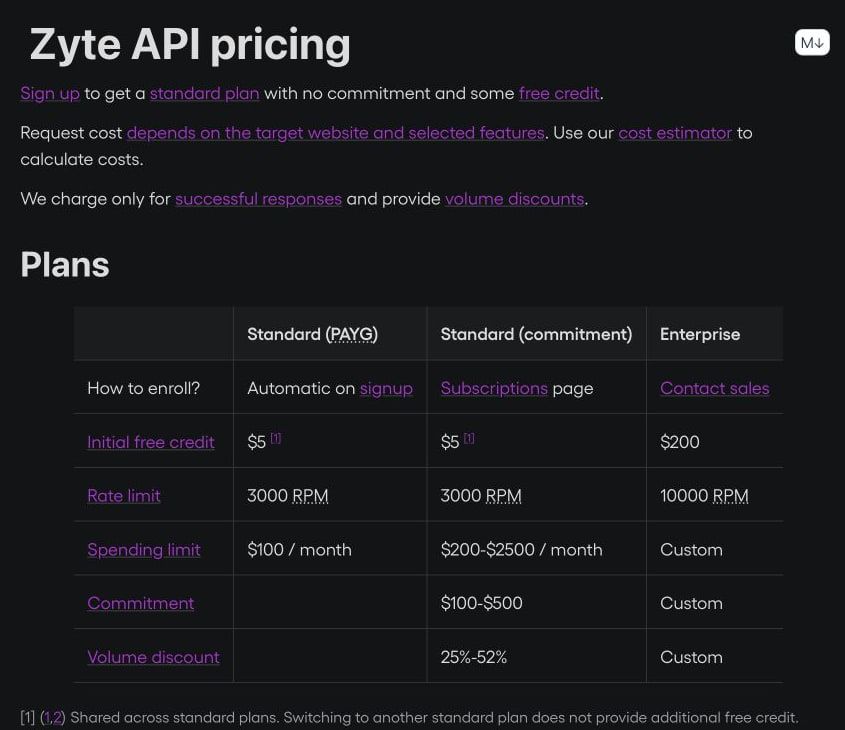
A managed endpoint fits when its documented feature/delivery scope is worth more than running those components yourself. Zyte target-tier pricing, ScraperAPI credit costs and ZenRows feature totals illustrate different ways that scope affects the bill. Zyte pricing, target-tier documentation, ScraperAPI, ZenRows.
I would specify plain versus rendered content, expected page/fields, geography and retry/cancellation policy. ScraperAPI Hobby/Startup standard geo differs from Business+ country targeting, so capacity alone does not select the needed entitlement. Standard geo, country targeting.
Rendering instructions and premium pools are documented capabilities, not independent evidence that a target will succeed. Rendering, pool scope, ZenRows JS, premium proxy.
Proxy mode can still be an API #
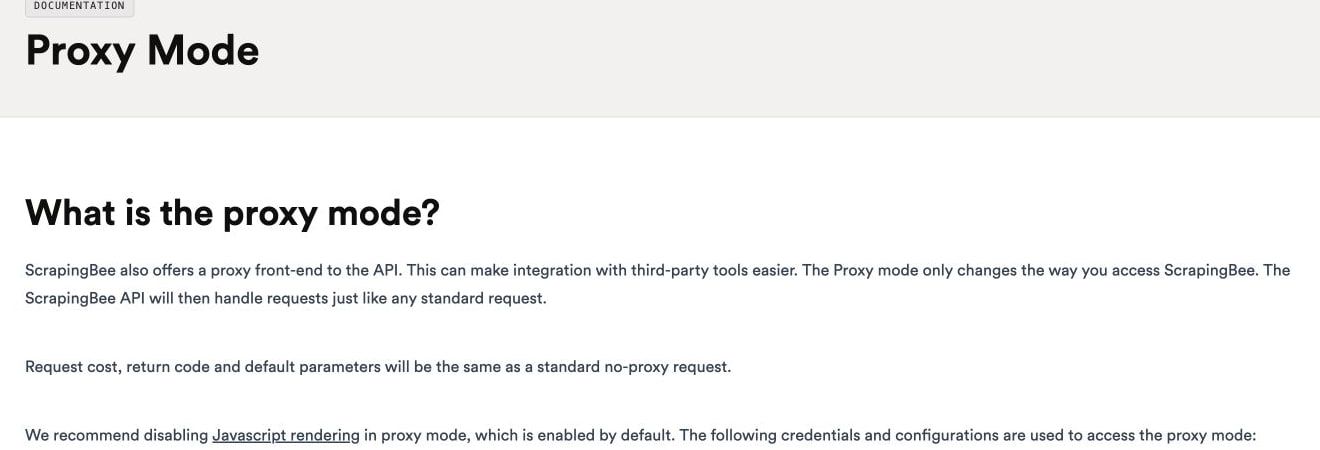
I would separate transport from product. ScrapingBee proxy mode retains API defaults/costs, and subresources add requests. A familiar proxy-shaped connection therefore does not prove bandwidth billing or bypass the endpoint’s feature rules. Proxy docs, API docs.
Some examples disable TLS verification; I would not copy that into a production recipe. The safer decision is to review the selected client/auth/TLS path rather than turn an example into an operating guarantee.
ZenRows legacy residential proxy and Fetch are also distinct billable paths, although both now draw on one shared credit balance: proxy bandwidth at the plan’s credits-per-GB rate, Fetch per request. I would verify which one the credential/endpoint selects before budgeting GB-based and request-based usage together. Legacy FAQ, Fetch reference.
Does a billed request mean usable data? #
Not necessarily. ScraperAPI can bill 200/404 and early client cancellation; Bee has its own billable target-status rules. I would budget retries and validate the output instead of assume every charged response is a useful record. ScraperAPI cost docs, Bee documentation.
A request-level max_cost is a separate protection from a monthly budget. ScraperAPI documents over-limit rejection; cancellation and async retention also have their own behavior. Cost control, async.
For the denominator I would use total invoice divided by validated distinct usable records, with separately costed retries and human validation included. Scraping credits explains that method; no actual denominator was measured here.
What if the job needs clicks or state? #
If the task requires interactive state, I would inspect a browser product rather than assume a known-URL API supplies the full workflow. Cloudflare’s browser pricing is time/concurrency-based, while other product paths may use traffic or credits. Cloudflare pricing, ZenRows pricing.
Apify’s platform/Actor usage is another layer: compute, proxy and storage costs depend on the selected operation. A platform dollar balance is not a universal unit of browser tasks or pages. Pricing, resources.
I would define allowed actions and source/side-effect evidence before choosing an implementation. This article does not supply a live browser recipe or a target permission.
Does paying give you the right to scrape? #
No. ScrapingBee terms require customer target authorization and acceptable use. ZenRows terms restrict unlawful uses and service/account resale. I would review the actual target and account scope rather than infer permission from managed delivery or a proxy feature. Bee terms, AUP, ZenRows terms.
The comparison has no complete private-contract or account proof. My recommendation is to treat the capability, billing and permission questions as separate parts of the requirement; my guide to whether web scraping is legal covers the permission side.
Which layer should you buy? #
Choose raw proxies when IP control is the missing component and owning the pipeline is deliberate. Choose a managed API/unblocker when known URLs and documented output/delivery justify that managed work; choose a browser when state or interaction is actually required.
I would not award a cost winner from $/GB, credits or “successful requests” alone. Match the required output, allowed scope and operating work before calculating a useful-record price.
Use ScraperAPI pricing, ScrapingBee pricing and ZenRows pricing for their respective units. The free API guide and scraping API hub connect the next choice.
FAQ #
Is an API’s proxy mode billed by bandwidth? #
No. An API can keep its credit/default rules through proxy transport. Inspect the selected product and endpoint. Bee proxy docs.
Is the $10 traffic example the whole bill? #
No. It excludes VAT, headers/assets/retries, client work and validation, and supplies no measured success or capacity result.
Does a scraping API give me permission to scrape a site? #
No. Target rights and acceptable use remain separate checks. Bee terms, ZenRows terms.
What should I use if I need clicks or state? #
I would inspect an actual browser capability when the permitted task requires it, with its lifecycle and completion checks. A fetch endpoint does not establish those actions by its transport name.
Sources
26 sources, accessed .
Official pricing, docs, changelogs and status pages 26
- Request credit costs
- Cost control
- Async API
- Premium proxy pools
- Standard geo
- Premium geo
- Rendering instructions
- HTML API
- Service terms
- Proxy mode
- Acceptable use
- Zenrows monthly pricing
- Fetch API reference
- JS rendering
- Premium proxy
- Legacy proxy FAQ
- Zenrows service terms
- Zyte pricing
- Zyte API billing
- Apify pricing
- Actor resources
- Web Unlocker pricing
- Browser Run pricing
- Oxylabs residential pricing
- Decodo residential pricing
- Bright Data residential proxies


