Pricing
Webshare pricing, explained: what you pay after month one
Webshare's datacenter plan starts free and residential runs $3.50 to $1.40/GB. Every tier, what renews, the bandwidth rules and refund limits.

Webshare has a free datacenter plan, paid shared datacenter from $2.99 a month, static residential from $6, and rotating residential from $3.50 for 1 GB down to $1.40/GB at 3 TB. The “SAVE” badges are volume discounts that stay at renewal; only the Cyber Month code is a first-month deal. Pricing, residential, CYBER26 terms, verified 2026-11-12.
Below is every tier on one page, worked months at real volumes, the bandwidth and refund rules, and the places where Webshare’s own pages don’t agree.
Short on time?
Here's my take
- Checking that datacenter IPs work for you
- The free plan
- 10 shared datacenter proxies and 1 GB a month, no card, no time limit. Webshare lists no residential trial.
- Lots of cheap IPs on easy targets
- Shared datacenter, 2,500 proxies for $63.54
- About $0.025 a proxy with 250 GB a month included. Smaller jobs: 250 proxies for $7.47.
- Logins and sessions that need a steady IP
- Static residential, 50 for $15
- $0.30 an IP on the shared plan. Dedicated starts at $2.10 an IP if other customers on your IPs are a risk.
- Rotating residential under 10 GB a month
- The 1 GB or 10 GB card
- $3.50 for 1 GB or $27.50 for 10 GB. Buy close to real use: unused GB don't roll over.
- Residential use that swings month to month
- DataImpulse instead
- Webshare's bandwidth resets monthly with no rollover. DataImpulse sells $1/GB traffic that never expires.
- Mobile proxies or a scraping API
- Decodo instead
- Webshare sells neither. Decodo, a sister company, sells both.
Prices verified . Sponsors cannot buy a verdict or a position.
This sits in the proxies hub. If you’ve decided Webshare isn’t the right fit, Webshare alternatives sorts the options by product.
What does Webshare cost at a glance? #
Webshare sells four things: shared datacenter (“Proxy Server”), private and dedicated datacenter, static residential (ISP) and rotating residential. The first three bill per proxy, and rotating residential bills per GB. Prices verified 2026-11-12, USD, monthly, before tax.
| Product | Billed per | Cheapest paid plan | Lowest rate | Free option |
|---|---|---|---|---|
| Shared datacenter | Proxy | 100 for $2.99 | $0.0179 at 60,000+ | 10 proxies, 1 GB a month |
| Private datacenter | Proxy | 25 for $18.52 | $0.429 printed at 10,000+ | None |
| Dedicated datacenter | Proxy | 20 for $26.60 | $0.77 printed at 10,000 | None |
| Static residential, shared | Proxy | 20 for $6 | $0.225 at 10,000 | None |
| Static residential, dedicated | Proxy | 20 for $42 | $1.344 at 2,000+ by the totals ($1.47 printed) | None |
| Rotating residential | GB | 1 GB for $3.50 | $1.40 at 3,000 GB | None listed |
Sources: shared, private, dedicated, static, dedicated static, rotating. Your terms add any applicable tax on top (§8.4). Terms.
Webshare also mentions a private static residential tier, but no price is published for it.
Is the free plan enough? #
For checking whether datacenter IPs work on your targets, yes. You get 10 shared datacenter proxies and 1 GB of bandwidth a month over HTTP or SOCKS5, with no card and no time limit. Pricing and FAQ.
It is datacenter only. I found no free residential trial: the rotating residential cards start at a paid 1 GB plan, and the page’s “No trial period” line sits in its answer about the free plan, not residential. Residential. If a residential trial matters, residential proxy free trials lists who offers one, and free vs paid proxies explains why a vendor’s free tier differs from a public free proxy list.
How much are Webshare’s datacenter proxies? #
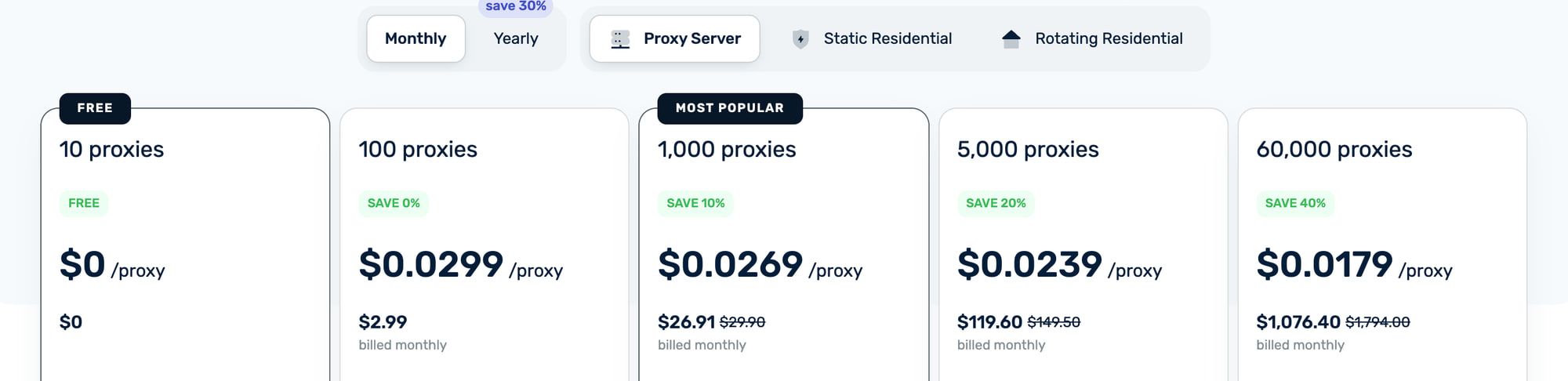
Shared datacenter is the cheapest thing Webshare sells, and the per-proxy rate falls from about $0.03 to under $0.018 as you buy more. Every plan includes 250 GB of bandwidth a month and 500 to 3,000 threads, across 50+ countries. Pricing, proxy server page.
| Shared proxies | Monthly price | Per proxy | Discount shown |
|---|---|---|---|
| 10 | Free | ||
| 100 | $2.99 | $0.0299 | |
| 250 | $7.47 | $0.0299 | |
| 500 | $14.20 | $0.0284 | 5% |
| 1,000 | $26.91 | $0.0269 | 10% |
| 2,500 | $63.54 | $0.0254 | 15%, “Most Popular” |
| 5,000 | $119.60 | $0.0239 | 20% |
| 10,000 | $224.25 | $0.0224 | 25% |
| 15,000 | $313.95 | $0.0209 | 30% |
| 25,000 | $523.25 | $0.0209 | 30% |
| 40,000 | $777.40 | $0.0194 | 35% |
| 60,000 | $1,076.40 | $0.0179 | 40% |
| 100,000 | $1,794.00 | $0.0179 | 40% |
Verified 2026-11-12. Pricing.
“Shared” means other customers can use the same IPs. If that’s a problem, Webshare sells two upgrades:
- Private datacenter, shared with “up to two other users”: 25 proxies for $18.52, falling to a printed $0.429 per proxy at 10,000 and 25,000. Private datacenter.
- Dedicated datacenter, yours alone: 20 proxies for $26.60 ($1.33 each), 100 for $119 and 1,000 for $975, with a printed $0.77 per proxy at 10,000. Dedicated datacenter.
One caution: the per-proxy rates Webshare prints for these two don’t always divide into its totals. Twenty-five private proxies for $18.52 is $0.74 each, not the $0.798 shown, so I’d trust the total you see at checkout.
Datacenter IPs work for many easy targets but get blocked more on protected sites; residential vs datacenter proxies covers when each fits.
Rotating residential is billed per GB #
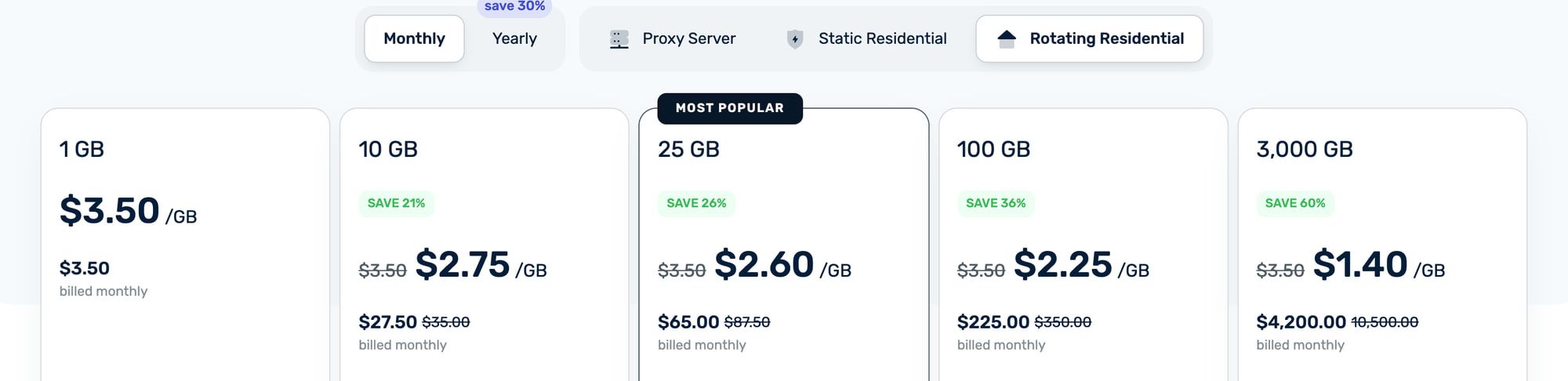
Rotating residential runs from $3.50 for 1 GB down to $1.40/GB on the 3,000 GB card. Every card shows a struck-through $3.50/GB reference, and the “SAVE” figure is the discount from that. Residential.
| Card | Monthly price | Per GB | Discount shown |
|---|---|---|---|
| 1 GB | $3.50 | $3.50 | |
| 10 GB | $27.50 | $2.75 | 21% |
| 25 GB | $65 | $2.60 | 26% |
| 50 GB | $122.50 | $2.45 | 30% |
| 100 GB | $225 | $2.25 | 36% |
| 250 GB | $500 | $2.00 | 43% |
| 500 GB | $875 | $1.75 | 50% |
| 1,000 GB | $1,500 | $1.50 | 57% |
| 3,000 GB | $4,200 | $1.40 | 60% |
Verified 2026-11-12. Residential.
The page claims 80M+ IPs, 153,563 subnets, 195 countries and 99.97% uptime; those are Webshare’s own figures. It lists targeting by country, state, city, ZIP and ASN in the proxy username, over HTTP or SOCKS5. Residential.
It doesn’t say how long a sticky session lasts. Proxyway’s review says you can’t choose a custom duration. Proxyway.
Plans renew monthly. If a renewal payment fails, Webshare sends a manual payment link that’s valid for 48 hours. Residential. For how these rates compare with other providers’ at 1, 10, 100 and 1,000 GB, see the cheapest residential proxies.
Static residential (ISP) is billed per proxy #
Static residential gives you fixed IPs registered to consumer ISPs, which suits logins and long sessions. The shared plan is $0.30 an IP up to 250 proxies and falls to $0.225 at 10,000. Static residential.
| Proxies | Shared, monthly | Per proxy | Dedicated, monthly | Per proxy |
|---|---|---|---|---|
| 20 | $6 | $0.30 | $42 | $2.10 |
| 50 | $15 | $0.30 | $94.50 | $1.89 |
| 100 | $30 | $0.30 | $178.50 | $1.79 |
| 250 | $75 | $0.30 | $408 | $1.63 |
| 500 | $142.50 | $0.285 | $792 | $1.58 |
| 1,000 | $270 | $0.27 | $1,462.50 | $1.46 |
| 2,000 | $510 (“Most Popular”) | $0.255 | $2,688 | $1.34 ($1.47 printed) |
| 5,000 | $1,200 | $0.24 | $6,720 | $1.34 ($1.47 printed) |
| 10,000 | $2,250 | $0.225 | $13,440 | $1.34 ($1.47 printed) |
Verified 2026-11-12. Shared, dedicated.
Webshare’s comparison page claims 60,000 static IPs in 15+ countries, while the static page itself says 100K+; the static page names AT&T, Sprint and Lumen among the networks. Static residential, comparison.
Proxyway’s review says Webshare’s server products (datacenter and static) target by country only. Proxyway. If you’re unsure whether you need fixed or rotating IPs, see ISP vs residential proxies.
What would your month cost? #
Here are seven common jobs priced on today’s cards. Unused GB don’t roll over, so for residential I’ve bought the next card up where the volume falls between cards, and shown what that costs you. This is my arithmetic on prices verified 2026-11-12, before tax.
| Job | What you buy | Month 1 at list | Month 1 with CYBER26 | Month 2 onward | Cost per unit you use | Paid for, not used |
|---|---|---|---|---|---|---|
| Rotating, 5 GB | 10 GB card | $27.50 | $20.63 | $27.50 | $5.50/GB | 5 GB |
| Rotating, 40 GB | 50 GB card | $122.50 | $91.88 | $122.50 | $3.06/GB | 10 GB |
| Rotating, 500 GB | 500 GB card | $875 | $656.25 | $875 | $1.75/GB | None |
| Datacenter, 250 proxies | 250 shared | $7.47 | Not eligible | $7.47 | $0.0299 | |
| Datacenter, 2,500 proxies | 2,500 shared | $63.54 | Not eligible | $63.54 | $0.0254 | |
| Static, 50 IPs | 50 shared | $15 | $11.25 | $15 | $0.30 | |
| Static, 500 IPs | 500 shared | $142.50 | $106.88 | $142.50 | $0.285 |
“Month 2 onward” follows the CYBER26 terms: from your first renewal you pay the standard price “including any quantity discount that then applies”. CYBER26 terms.
The 5 GB row shows the cost of card rounding. You pay $5.50 per GB you actually use, more than the 1 GB card’s $3.50, because half the 10 GB card expires. Buying 1 GB at a time only works if 1 GB is enough. Webshare’s full residential table lists fixed sizes only (1, 10, 25, 50, 100, 250, 500, 1,000 and 3,000 GB), so there is no 5 GB or 40 GB option.
What happens when you run out of bandwidth? #
Your proxies stop. Webshare’s help center says “Bandwidth limits are set monthly and do not roll over” and that exceeding the limit “will stop your proxies from functioning”. Bandwidth help.
Datacenter and static residential plans include 250 GB a month, and some can be upgraded to unlimited. The FAQ prices that “on larger plans” from $80.73 a month for 1,000 shared datacenter proxies and $90 for 100 shared static IPs. FAQ, pricing.
Both figures are exactly three times the base plan ($26.91 and $30), so the unlimited upgrade appears to triple the bill. That’s my arithmetic; Webshare doesn’t state the rule.
“Unlimited” still has a fair-use ceiling. The Fair Usage Policy, updated August 27, 2026, covers Proxy Server, Static Residential and legacy Verified proxies, and doesn’t name rotating residential. Its key lines: Fair Usage Policy.
- Guarantee: “1 TB of guaranteed bandwidth for every $10 spent”, then “1 TB for every $20 spent” above $1,000 (its example: a $1,500 plan gets 125 TB).
- Unlimited plans: guaranteed 10 TB before throttling.
- Throttle: full speed is 300–400 Mbps, which “may drop to 100 Mbps and gradually decrease to as low as 10 Kbps”.
- Changes: the policy may change “without prior notice”.
The policy doesn’t make clear whether the per-$10 guarantee applies only to unlimited plans, so I’d ask support before relying on it for a heavy datacenter job.
Monthly, yearly, and what renews #
Every plan renews automatically. The terms say fees “AUTOMATICALLY RENEW EVERY MONTH” (§8.3), and the residential page says the same. Terms, residential.
The volume discount stays. This is the point most other pricing pages leave open.
The CYBER26 terms say that from your first renewal you pay “the standard price of your plan on that date, including any quantity discount that then applies”. So the 50 GB card’s “SAVE 30%” is still there in month two. CYBER26 terms.
Yearly billing saves 30%. The pricing page labels the yearly toggle “save 30%”, and the help center says yearly is a “30% discount compared to the monthly plan”, billed “Every 360 days”. Pricing, monthly vs yearly.
Yearly billing is about 30% cheaper per GB: the 10 GB plan is $1.93/GB, or $231 a year, and 100 GB is $1.58/GB, or $1,890 a year (verified 2026-11-12). Each yearly price is 12 times the monthly allowance, but Webshare doesn’t say whether unused GB carry over between months. A competing seller’s guide says the allowance resets every 30 days; I couldn’t confirm that on Webshare’s pages.
Changing plans restarts the clock. “Editing your subscription cancels your current plan and activates a new one.” Unused time and bandwidth come back as credit, based on whichever remains less, and your billing date moves to the change date. Changing your plan.
Account credits “are non-expiring and non-refundable” and apply automatically at renewal. Account credits.
Is the Cyber Month code worth it? #
CYBER26 runs until December 9, 2026, 09:00 UTC
- What it is: 25% off “the price after any quantity discount”, on new monthly rotating residential and static residential plans. CYBER26 terms.
- How long: “The discount covers your first monthly billing period only.”
- Not covered: yearly plans, Proxy Server (shared datacenter), renewals, upgrades and extra bandwidth, and custom plans. One use per eligible product, and it doesn’t stack with other coupons.
- Where “up to 70%” comes from: the 3,000 GB card drops from $4,200 to $3,150, which is $1.05/GB, or 70% below the $3.50 reference. Static residential’s “up to 44%” is the 10,000-proxy plan: $2,250 becomes $1,687.50.
- Who qualifies is unclear. One line says it applies to users who “never had any paid Webshare plans”; another says existing customers “can use the Promotion when they start a new subscription”. I’d ask support before counting on it.
On a 50 GB card the code saves $30.62 once: $91.88 in month one, then $122.50 from month two. That’s worth having if you were going to buy that card anyway. I wouldn’t pick a bigger card for the promo, because the bigger price is what renews.
Refunds, cancelling and payment #
Refunds are narrow. You must ask within 2 days of the original payment (the help center says 48 hours), stay under a usage limit, and only a support agent can approve it. Terms §8.2, refund help.
| Product | Window | Usage must be under | Also |
|---|---|---|---|
| Rotating residential | 2 days | 0.1 GB, and fewer than 1,000 proxies used | “Sole discretion” |
| Shared, private or dedicated datacenter | 2 days | 1 GB, and fewer than 1,000 proxies used | “Sole discretion” |
| Static residential | 2 days | 1 GB, and fewer than 1,000 proxies used | “Sole discretion” |
The terms add: “Webshare may, in its sole discretion, decline to issue any and all refunds.” If you are refunded, existing account credits are removed. Terms, refund help.
Cancelling has two descriptions. The pricing FAQ says to “switch to the free plan” in the dashboard, while the terms say cancellation is “EFFECTIVE IN THE MONTH FOLLOWING THE MONTH YOU PROVIDE US NOTICE”. I’d switch to the free plan well before your renewal date and check that no charge follows. Pricing, terms §8.3.
Payment is by card. Visa, Mastercard, Amex, Discover, Diners, UnionPay, JCB, Cartes Bancaires and Interac, plus Google Pay and Apple Pay on mobile. No PayPal or crypto is listed. Pricing.
KYC is conditional. The FAQ says “There’s no KYC unless suspicious activity is detected”, and some residential targets unlock after “a brief KYC procedure”. The terms say “Failure to complete ID verification will result in account suspension.” FAQ, terms §1.4.
Where Webshare’s pages disagree #
Where Webshare's pages disagree (read November 12, 2026)
- Private datacenter headline: the feature text says “$0.18/proxy”; the price table runs $0.798 down to $0.429. I’d trust the table. Private datacenter.
- Dedicated datacenter: the proxy-server page card says “$0.825” per proxy; the dedicated page’s table runs $1.33 down to $0.77. Proxy server, dedicated.
- Who shares a “private” IP: the static page’s private card says “Only shared with up to 2 users”; the private datacenter FAQ says “up to two other users”, which would be three in total. Static, private datacenter.
- ZIP and ASN targeting: the residential page lists both; the FAQ says they’re “both coming soon”. I’d go with the newer product page but test it. Residential, FAQ.
- Rotating residential unit: the proxy-server page says “Starts from 250GB for $1.40 /Proxy”; residential is billed per GB, and $1.40/GB is the 3,000 GB rate. Proxy server.
- How cancelling works: dashboard switch-to-free (pricing FAQ) vs effective the following month (terms §8.3). Pricing, terms.
- Who can use CYBER26: never-paid users only, or existing customers starting a new subscription; the same article says both. CYBER26 terms.
Who owns Webshare, and what do outside tests show? #
Oxylabs announced in September 2022 that it had acquired Webshare, which would “continue to operate as an independent entity”. Oxylabs.
Since 13 October 2026, Webshare is one of five companies in Source, a group launched in Vilnius with Oxylabs, Decodo, ScrapingBee and Honeygain. Source calls Webshare its “entry-market leader” and says each company’s “Product strategy, customer base, and market presence remain fully independent”. Source, launch release. That matters if you’re buying Decodo or Oxylabs as a “second supplier”.
I haven’t measured Webshare. The newest independent figures come from Proxyway, a proxy review site that says it uses affiliate links, and they’re its numbers, not mine.
| What Proxyway measured | When | Result |
|---|---|---|
| Rotating residential, global | March–April 2026 | 99.28% success, 0.86 s average response |
| Datacenter | April 2026 | 99.93% success, 0.67 s |
| Unique residential IPs seen in its global test | April 2026 | 1,745,672, against 80M+ advertised |
Sources: Proxyway review, Proxyway market research 2026. The review also notes that human support works 24/5 and that there’s “no 2FA or team accounts”, and it says high concurrency “adds 38% to the price”, an add-on price I couldn’t see without opening the configurator.
On Trustpilot, Webshare has 4.1 from 1,491 reviews, with 15% at one star. Trustpilot’s own summary lists performance, bandwidth limits and refunds among the complaint themes; Trustpilot doesn’t verify reviews. Trustpilot.
What other pages still say #
Older Webshare prices you may still find (checked November 12, 2026)
- A $7/GB residential reference price. Proxidize’s guide (September 2026, written by a competing seller) shows it; today’s cards strike through $3.50/GB. The prices you pay match.
- “
$7 for 1 GB”, “$99 for 25 GB” and “~$19.99 for 1,000” datacenter proxies. From an anonymous GitHub README. Today: $3.50, $65 and $26.91. - “No hidden auto-renewals” and a custom mobile plan. Same README. Webshare’s terms say plans renew every month, and Webshare lists no mobile product.
So which plan would I buy? #
To check whether datacenter IPs work: the free plan. Ten proxies and 1 GB cost nothing and need no card.
For many cheap IPs on easy targets: shared datacenter. I’d start at 250 proxies for $7.47 and move to 2,500 for $63.54 once the job is proven; the per-proxy rate drops 15% and 250 GB a month comes with it.
For logins and long sessions: shared static residential, 50 IPs for $15. Pay for dedicated ($94.50 for 50) only if other customers’ traffic on your IPs could get your accounts flagged.
For rotating residential under 10 GB: the 1 GB or 10 GB card. Pick the one closest to your real use. At 5 GB a month the 10 GB card works out to $5.50 per GB you use, because half of it expires.
For a steady 500 GB: the 500 GB card at $875. At $1.75/GB with the discount kept at renewal, this is where Webshare’s per-GB pricing is strong. For a wider price comparison, see proxy pricing models and Decodo pricing.
If your residential use swings month to month: not Webshare. Its GB reset every month. DataImpulse lists $1/GB and says “Unused GBs never expire”, and IPRoyal lists “Never expiring traffic”. DataImpulse, IPRoyal.
For mobile proxies or a scraping API: Decodo. Webshare sells neither. Decodo lists mobile cards (on a 50%-off sale with no end date) and a Web Data API with a free tier, and it’s a sister company in the same group. Decodo mobile, Decodo Web Data API.
Other options are in Webshare alternatives and the best residential proxies.
FAQ #
How much does Webshare cost per month? #
Shared datacenter plans start at $2.99 for 100 proxies, static residential at $6 for 20 proxies, and rotating residential at $3.50 for 1 GB. There’s also a free plan with 10 datacenter proxies and 1 GB a month. Prices verified 2026-11-12, before tax. Pricing.
Is Webshare’s free plan residential? #
No. It’s 10 shared datacenter proxies with 1 GB of bandwidth a month. Webshare lists no free residential trial; rotating residential starts at a paid 1 GB card. Residential.
How much is Webshare residential per GB? #
Rotating residential runs from $3.50 for a 1 GB card down to $1.40 per GB on the 3,000 GB card for $4,200. The 100 GB card is $225, or $2.25 per GB. Residential.
Does Webshare bandwidth roll over? #
No. Webshare’s help center says bandwidth limits are set monthly and do not roll over, and that going over the limit stops your proxies from working. Bandwidth help.
Does the Webshare discount last after the first month? #
The volume discount does. Webshare’s Cyber Month terms say renewals bill the standard price including any quantity discount that applies. Only the extra 25% from the CYBER26 code is limited to the first month. CYBER26 terms.
Can I get a refund from Webshare? #
Only within 2 days of the original payment, and only if you used less than 1 GB (datacenter and static residential) or 0.1 GB (rotating residential) and fewer than 1,000 proxies. Even then, the terms say Webshare may decline at its sole discretion. Terms.
Is Webshare owned by Oxylabs? #
Oxylabs announced in September 2022 that it had acquired Webshare. Since 13 October 2026 Webshare is one of the companies in the Source group with Oxylabs and Decodo, and Source says each brand runs independently. Oxylabs, Source.
Sources
29 sources, accessed .
Official pricing, docs, changelogs and status pages 23
- Webshare pricing (shared datacenter) and FAQ
- Webshare proxy server page
- Webshare private datacenter proxies
- Webshare dedicated datacenter proxies
- Webshare rotating residential pricing
- Webshare static residential pricing
- Webshare dedicated static residential
- Webshare product comparison
- Webshare terms (updated 2025-10-23)
- Webshare fair usage policy (updated 2026-08-27)
- Webshare FAQ
- Help: how the bandwidth limit works
- Help: Cyber Month (CYBER26) terms
- Help: monthly vs yearly
- Help: changing your plan
- Help: account credits
- Help: refunds
- Oxylabs acquires Webshare (2022)
- Introducing Source
- DataImpulse residential pricing
- IPRoyal residential pricing
- Decodo mobile pricing
- Decodo Web Data API pricing


