Explainer
ISP vs Residential Proxies: When a Fixed IP Beats Rotation
ISP vs residential proxies: pick ISP when a job needs one fixed IP, rotating residential when it needs household origin. Prices and sessions compared.

I would choose ISP/static when a permitted job needs a persistent assigned exit, and rotating residential when approved household-origin/geographic sampling is the actual requirement. “Static residential” can mean datacenter-hosted ISP-registered addresses, while a sticky household session is not automatically a permanently dedicated IP. Bright Data ISP, residential, Webshare ISP product, IPRoyal ISP.
The decision is assignment, continuity and the selected contract—not a generic account-management or anonymity recommendation. Browser cookies, authentication, target permission and data validation remain separate from the IP label.
Short on time?
Here's my take
- Persistent assigned exit
- A fitting ISP/static SKU
- Confirm term, exclusivity, reassignment, geography and traffic rather than assume every static product is dedicated.
- Household-origin sampling
- Approved rotating residential
- Actual origin/geo needs must justify access conditions, bytes and sourcing review.
- Before quoting a provider
- Match configuration and term
- Bulk headlines and billing-term toggles are not a complete small-account quote.
Prices verified . Sponsors cannot buy a verdict or a position.
What makes an ISP proxy different? #
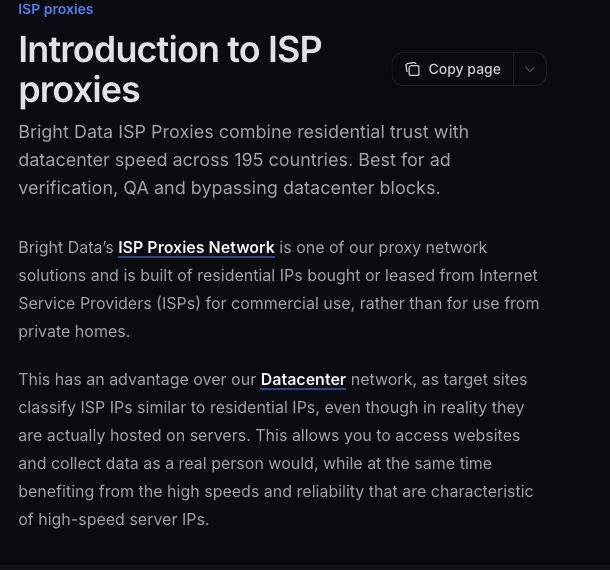
ISP/static products offer stable ISP-registered addresses, which can be datacenter-hosted; rotating residential uses a household/device peer pool. Specifications verified: 2026-11-11. Product-specific terms govern, and no peer/IP/session behavior was measured here.
| Question | ISP / static residential | Rotating household residential |
|---|---|---|
| Documented origin | ISP-registered stable addresses; can be datacenter-hosted | Device/household peer pool |
| Assignment | Shared/dedicated SKU and term need confirmation | Rotating or sticky session selection |
| Continuity | Confirm renewal/reassignment and exclusive reservation | Peer availability can affect a multi-step job |
| Bill | Per-IP/per-GB/term, traffic and fair use | GB/allowance, bytes, expiry and eligibility |
| Separate controls | Browser state/authentication and allowed target | Browser state/authentication and allowed target |
Sources: Bright Data ISP, residential, Webshare product, IPRoyal product.
I would ask which address is assigned, whether it is exclusive, how long it lasts and what happens at renewal or peer loss. Sticky behavior in a household pool is not a contract for a permanent dedicated IP, and persistent IP alone cannot preserve browser cookies or authentication.
How much do ISP and residential proxies cost? #
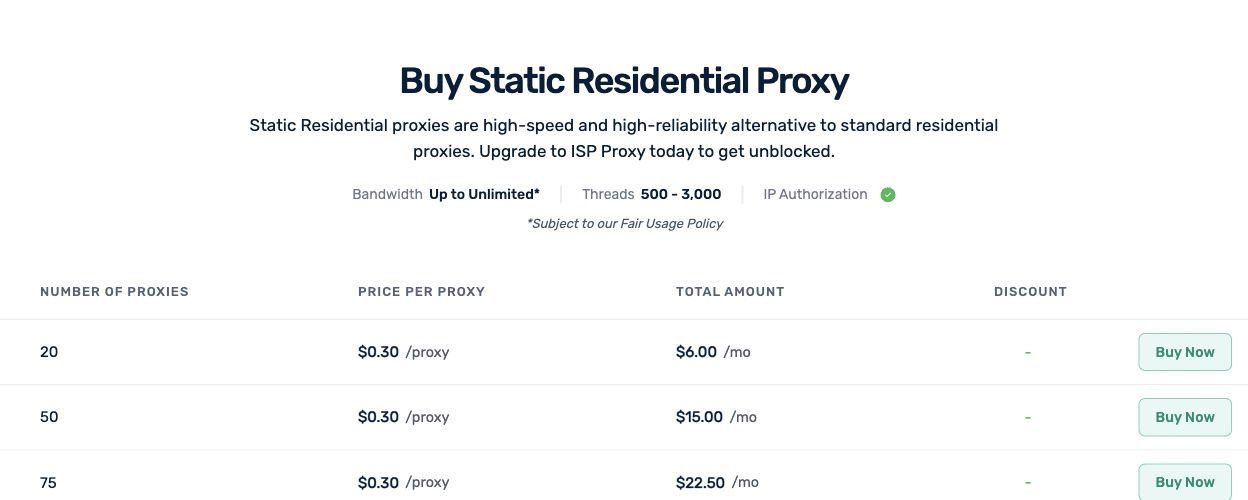
Bright Data shared ISP monthly examples are ten/100/1,000 IPs for $18/$145/$1,300, versus dedicated $35/$275/$2,500. Each IP has 100-GB monthly fair-use allocation aggregated across purchased IPs, with possible excess charges; shared and dedicated are not equivalent access. Prices verified: 2026-11-11. ISP pricing/product. My Bright Data pricing explainer walks through its other units.
Decodo dedicated ISP examples are three IPs/$9.99, ten/$29 and 100/$260 monthly excluding VAT. Per-GB, per-IP and enterprise tabs are separate, so I would not take a sitewide bulk figure as dedicated entry pricing. ISP product.
Rotating residential is another unit: Decodo PAYG $4/GB and monthly three/$11.25, ten/$35, 100/$275; Webshare advertised monthly one/$3.50 plus discounted ten/$27.50 and 100/$225 (verified 2026-11-12), and its promo terms say renewals keep those volume discounts. Bright Data’s $8/GB list versus $4 coupon is conditional rather than a durable discounted renewal promise. Decodo, Webshare, Bright Data. For per-GB rates across more providers, see the cheapest residential proxies I priced and the Decodo pricing breakdown.
| Candidate category | Actual quote input I would request |
|---|---|
| Shared stable ISP | Quantity, country, term, reassignment and fair use |
| Dedicated ISP | Exclusive resource, minimum quantity and traffic terms |
| Rotating residential | Metered bytes, targeting, expiry and account access |
| Sticky residential session | Session duration/drop behavior, not just a rotating GB balance |
I would hold the permitted requirement constant before comparing dollars. IP count and GB are different purchased resources; neither supplies an independently verified record-success rate.
Why the starting prices can mislead #
Webshare’s ISP product from-rate depends on size/configuration, while its FAQ gives a 20-IP/$6 monthly/250-GB example and says no dedicated ISP free tier. The site lists ZIP/ASN targeting under rotating residential while an FAQ answer still calls ZIP and ASN “coming soon”, and the static page does not list them, so actual targeting entitlement needs confirmation. ISP product, FAQ.
IPRoyal’s current pricing page identifies the $1.80/proxy starting offer as 24 hours, while the 30-day offer starts at $2.70/proxy. Country, quantity and the selected checkout still need confirmation; the lower headline is not a confirmed monthly entry price. ISP pricing.
The residential page is also conditional: one GB is $7 on subscription or $7.35 pay-as-you-go, and the ten-GB unit rate is $5.25 or $5.51. Its $1.75/GB headline is the subscription rate at ten TB ($1.84 pay-as-you-go), not entry volume. Residential pricing.
I would get the exact selected quote before purchase rather than silently choose the lower unresolved block. Protocol, country/ISP features and advertised inventories also need actual account entitlement, not only product copy. IPRoyal residential product, Bright Data residential.
Who can buy, and where do the IPs come from? #
Bright Data residential policy for new zones after July 7, 2026 requires registered company, corporate email, human KYC and real funds. A static/rotating label or promotional price does not establish instant personal residential access. Access policy.
IPRoyal has risk/identity/use-case checks that can affect registration/access. Its sourcing page now describes partner suppliers that must show device-owner consent, while a help article describes Pawns.app; I would not say every exit is exclusively Pawns or independently verified consensual. KYC policy, sourcing.
Decodo describes consent/transparency/control as provider sourcing claims. These policies identify evidence to request, not an independent audit of every device or proof of current household residency for an ISP-registered datacenter product. Sourcing, ISP product.
I would ask for current consent/withdrawal, incentives, supplier oversight and logging/retention controls when the chosen product involves household peers; my ethical residential proxy checklist lists them. The source of the address and the target/data rights need separate review.
Will a usage limit stop spending right away? #
No. Bright Data configuration separates shared/dedicated/domain scopes and usage/spend controls. Its zone usage limit is checked every 15 minutes and can lag, so I would not infer an immediate hard global budget or exclusivity from the address type. Configuration, ISP fair use.
Webshare has automatic renewal, discretionary short-window refunds and fair-use throttling conditions. Those terms still matter for a static product, and a quoted bandwidth example should not be relabeled unlimited. Terms, fair use. My Webshare pricing breakdown shows what those plans cost after the first month.
Bright Data AUP restricts nonpublic data/fake accounts and third-party-rights violations; IPRoyal terms/AUP and Decodo licence retain customer target duties. This guide gives no account-management recipe, anti-bot bypass or target permission; I cover the legal side in whether residential proxies are legal. Bright Data AUP, IPRoyal terms, AUP, Decodo licence.
Decodo remains documentation-only because its licence restricts public performance analysis/benchmarks. No provider traffic, monitoring or session test was performed for this comparison.
Which one would I go with? #
For a permitted job needing a persistent assigned exit, I would inspect ISP/static with a matched country, term, exclusivity and traffic contract. For actual household/geo sampling, rotating residential with approved access and sourcing review; neither is a general guarantee of successful authenticated browsing.
I would verify assigned-IP continuity and browser state separately before a multi-step workflow. There is no speed, anonymity, invoice, target acceptance or independent consent winner in this source sample.
The proxy pillar connects the products. Pricing models, residential versus datacenter, trial offers and proxies for AI agents help define the actual budget and session requirements; the browser hub covers browser infrastructure separately.
FAQ #
Do ISP proxies actually run from people’s homes? #
No such guarantee follows. ISP-registered static products can be datacenter-hosted; verify the SKU. Webshare, Bright Data ISP.
Is a sticky residential session the same as a dedicated IP? #
No equivalence was established. Session behavior, peer availability and exclusive reservation are different questions. Residential architecture.
Do per-IP plans come with unlimited traffic? #
The Bright Data examples have 100-GB/IP monthly fair-use allocation with possible excess charges. ISP product.
Can I compare providers by their starting price? #
Not without matching configuration and term; IPRoyal’s full quote and Webshare targeting/configuration require confirmation. IPRoyal, Webshare FAQ.
Will a static IP keep me logged in? #
IP assignment and browser authentication/cookies are separate. Define state and allowed scope explicitly rather than assume one replaces the other.
Sources
26 sources, accessed to .
Official pricing, docs, changelogs and status pages 26
- Residential pricing
- Residential proxies
- ISP product and pricing
- Residential access policy
- Residential architecture
- ISP architecture
- Residential configuration
- AUP
- Residential product and pricing
- ISP product and pricing
- Licence
- Sourcing
- Residential product/pricing
- Static residential ISP
- FAQ
- Cyber Month promotion terms (renewal pricing)
- Terms
- Fair use
- Residential pricing
- Residential product
- ISP pricing
- ISP product
- KYC
- Sourcing
- Terms
- AUP


