Roundup
The Best SERP API Depends on Your Data. I Compared 9
There's no single best SERP API. Here's how 9 compare on engines, location targeting, AI Overview and AI Mode fields, queue vs live and legal cover.

I would start with SerpApi for broad structured SERPs, DataForSEO for scheduled collection, and Serper for a Google-only integration. apiserpent.com deserves a separate low-cost shortlist when country-level targeting is sufficient; none of these recommendations is a measured speed or accuracy ranking. Google Search API, SERP API overview, Serper pricing and FAQ, SerpentAPI API reference.
Short on time?
Here's my take
- Broad structured SERPs
- SerpApi
- Start here when documented fields, localization and integration choices matter more than the lowest unit price.
- Scheduled rank tracking
- DataForSEO
- Compare queued collection separately from Live requests and budget the required depth.
- Low-cost multi-engine calls
- apiserpent.com
- Its Web credit ladder is attractive, provided country-only Deep targeting and the lack of a public PAYG SLA fit.
Prices verified . Sponsors cannot buy a verdict or a position.
This guide chooses an API by the response your application needs within the search API pillar. For normalized spending, use the cheapest SERP API comparison; for migration from a specific supplier, use SerpApi alternatives.
If you only need a no-cost allowance to prototype with, start with my comparison of free SERP API tiers.
What should you compare first? #
Start with the SERP fields your job needs. A rank tracker needs a reproducible engine, location, device and result depth. A citation monitor needs the relevant AI surface and reference fields; I would not substitute an API’s answer generator for a Google interface observation merely because both contain citations. Google Search API, SERP API overview, SearchApi Google AI Mode reference, SerpentAPI API reference.
Prices and specifications verified 2026-11-06 (Scrapingdog rechecked 2026-11-12), USD before tax. These are entry illustrations, not equal-workload quotes.
| Option | Best reason to shortlist | Published purchase or rate | Main qualification |
|---|---|---|---|
| SerpApi | Structured fields and localization | Starter $25/month for 1,000 searches | Legal Shield begins at Production, not Starter |
| DataForSEO | Queued rank tracking or separately priced Live calls | Organic depth-10: $0.60/1K Standard; $2/1K Live | $50 funding minimum; modifiers add cost |
| Serper | Google verticals with prepaid capacity | $50 buys 50,000 queries | Six-month expiry; broader engines not established |
| apiserpent.com | Low Web-unit rates across five engines | New credit starts $0.60/1K; qualifying deposits reduce it | Deep bills requested pages; no city/uule/raw HTML |
| SearchApi | Structured SERPs and conditional legal cover | $40/month for 10,000 requests | Protection starts at active Production+ |
| Bright Data | Multi-engine collection and JSON/HTML/Markdown | PAYG $1.50/1K | Custom headers/cookies change failure billing |
| Scrapingdog | Shared scraping credits with explicit Google multipliers | $10 pay-as-you-go top-up for 25,000 credits, no expiry; Lite $40/month for 200,000 | Ordinary Google costs five credits per call; pay-as-you-go can’t be combined with a plan |
| Oxylabs | Unified Web API with target-specific prices | Starter $15/month | Google non-JS, JS and AI Mode have different tariffs |
| Decodo | Search inside a broader Web Data API | Paid plans start $19/month | Page/crawl allowances are not verified SERP quotas |
Inputs: SerpApi plans and billing, U.S. Legal Shield, Google Organic pricing, Minimum payment, Serper pricing and FAQ, SerpentAPI pricing, SerpentAPI API reference, SearchApi homepage and plans, SearchApi terms, Bright Data SERP pricing, Bright Data SERP billing, Scrapingdog plans, Scrapingdog pay-as-you-go, Oxylabs SERP in unified Web API, Decodo SERP in Web Data API.
SerpApi #
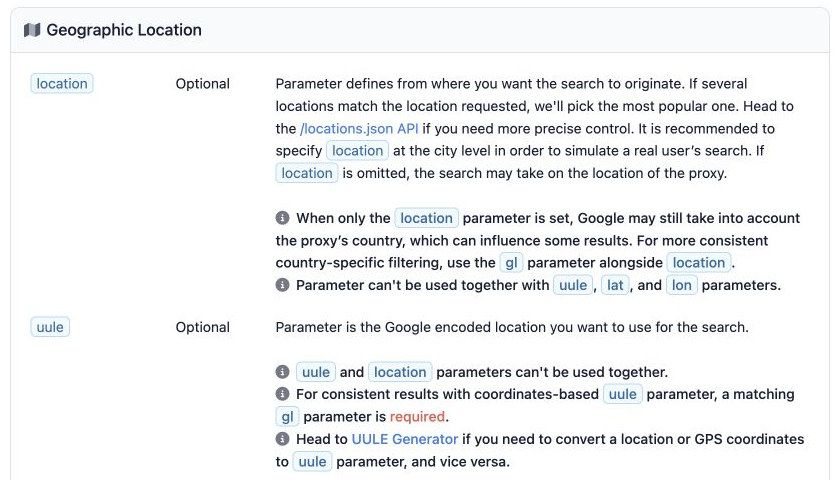
My pick for a field-led shortlist. Its Google reference documents location, uule, country, language and device controls, with separate AI Overview and AI Mode references. That gives a developer a concrete schema and request contract to evaluate before committing to a subscription. Google Search API, Google AI Overview API, Google AI Mode API.
The integration argument is breadth, not a claim that I connected everything: the vendor publishes language wrappers and an integration directory. Its AI Mode changelog records multi-turn support, Markdown and a citation-URL fix during 2026; release notes establish a documented change, not independently verified accuracy. SerpApi libraries, SerpApi integrations, Google AI Mode release notes.
Production and higher plans include conditional U.S. Legal Shield up to $2 million. I would read its exclusions alongside the proposed use rather than treat cover as an immunity badge. U.S. Legal Shield, SerpApi terms and privacy.
Plan-by-plan costs, hourly limits and what counts as a billed search are in my SerpApi pricing breakdown.
DataForSEO #
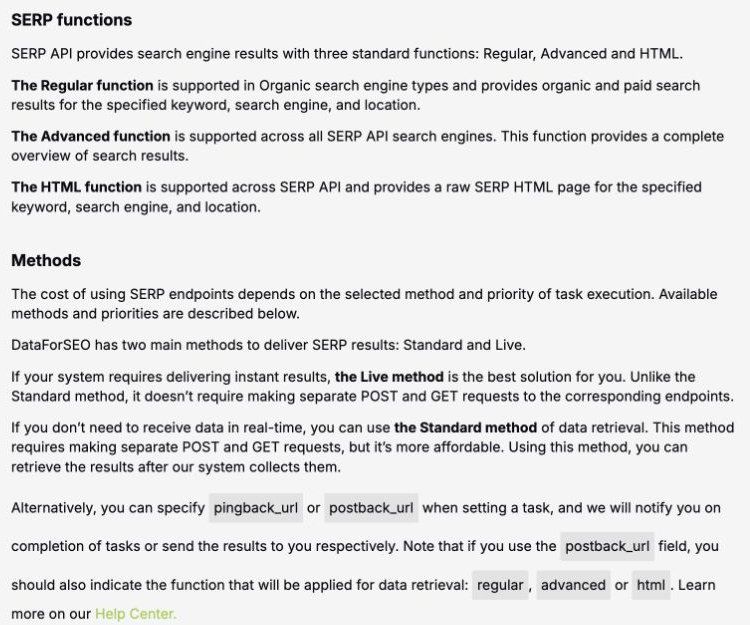
My pick when a queue belongs in the architecture. Standard collection posts tasks for later retrieval; Live holds the request for a result. Its Google organic tariff distinguishes $0.60 per 1,000 Standard depth-10 tasks from $2 per 1,000 Live tasks, so a cheap queued rate is not an equal-latency alternative. Google Organic pricing, SERP API overview.
The $50 minimum deposit is cash committed, not a $50 monthly organic subscription. The trial FAQ lists $1 credit; I would use a permitted real-account check to validate required fields rather than mistake a sandbox response for current Google results. Minimum payment, DataForSEO FAQ.
For AI work, ordinary SERP AIO retrieval and dedicated AI Mode have different billing rules. The API-specific reference also gives a 30-day SERP JSON retention exception, including Live, so I would preserve my own records rather than generalize retention from another product. API v3 reference, AIO collection help, Google AI Mode pricing.
Serper #
My pick when documented Google verticals are enough. Its prepaid packs avoid buying a monthly search allowance: $50 buys 50,000 queries, while larger packs reduce the stated unit cost. Paid queries expire after six months, so infrequent use can waste a nominally cheaper purchase. Serper pricing and FAQ.
Country/language targeting and Google search, news, images, maps and other verticals are documented. I did not establish a public dedicated AIO or AI Mode endpoint in this research, and the terms place lawful-use responsibilities on the customer. Serper pricing and FAQ, Serper terms.
apiserpent.com #
My pick for low-cost Web calls when its constraints fit. New Web credit starts at $0.60 per 1,000 units, falling to $0.30 after a qualifying $100 deposit, $0.10 after $500, $0.05 after $1,000 and $0.03 after $1,250 (Enterprise Plus), as shown on 6 November 2026. Deposited credit does not expire; promotional bonus credit expires after 30 days. SerpentAPI pricing.
Older credit keeps its original rate, and your best deposit in a calendar month sets the price for all your deposits that month, so this is a funding ladder rather than a recurring subscription. SerpentAPI pricing.
Quick is organic-only and consumes one unit per call. Deep consumes a unit for each requested page, up to ten, even if the delivered result is partial; it supports country targeting but not city/uule/raw HTML. Five engines and paid opt-in AIO on Google, Yahoo and Brave are documented, with Bing/DuckDuckGo AIO null. SerpentAPI API reference, SerpentAPI FAQ, SerpentAPI SERP feature contract.
The limitations matter as much as the tariff: no public PAYG SLA or vendor legal indemnity was found, the terms expire unused free searches after 12 months of inactivity, and daily allowances (10,000 on free accounts, rising by balance bracket to 5,000,000 at Enterprise Plus) are published as “up to” allocations, not guaranteed floors. Its separately charged aiMode answer option does not establish Google AI Mode interface collection. Query metadata is documented as retained for 90 days and asynchronous outputs for seven; I would account for both rather than assume zero retention. SerpentAPI terms, SerpentAPI FAQ, SerpentAPI pricing, SerpentAPI API reference.
SearchApi #
My pick for a second structured-SERP and legal-cover quote. The entry allowance is $40 per month for 10,000 requests; Production is $100 for 35,000. Google features, token-based AIO retrieval and a dedicated AI Mode interface are separately documented. SearchApi homepage and plans, SearchApi Google reference, SearchApi Google AIO reference, SearchApi Google AI Mode reference.
The Legal Protection Guarantee applies to active Production+ and is capped at $2 million aggregate per 12 months. Its exclusions and discretionary defense provisions deserve review before treating the headline as equivalent to every other indemnity contract. SearchApi terms.
Bright Data #
My pick when output format and multiple engines drive the decision. Its SERP documentation lists JSON, HTML and Markdown, with async collection; PAYG is $1.50 per 1,000 requests. The Google parameter reference includes location controls and optional AI Overview capture. Bright Data SERP pricing, Bright Data SERP introduction, Bright Data Google parameters.
Default successful-only billing changes when custom headers or cookies are used: failures can then be charged too. Internal retries and async retrieval are included under the documented rules, and the applicable license/account agreement still governs lawful use and fees. Bright Data SERP billing, Bright Data license.
Scrapingdog #
My pick for a credit-based shortlist that needs careful conversion. The $40 Lite plan includes 200,000 credits, but ordinary Google uses five credits, while advanced/mobile uses ten. That represents 40,000 ordinary calls or 20,000 advanced calls if nothing else consumes credits, not 200,000 Google searches. Scrapingdog plans, Scrapingdog Google API.
For a smaller start, pay-as-you-go sells 25,000 credits for $10 (5,000 ordinary calls). Those credits never expire, but you can’t combine them with a monthly plan. Scrapingdog pay-as-you-go.
I would record the call type beside every cost estimate and paginate by the documented page parameter. A credit headline alone does not specify delivered result depth. Scrapingdog Google API.
Oxylabs and Decodo #
These belong on a documentation-only shortlist until the current endpoint tariff and account entitlement are confirmed. The live Oxylabs page now uses a unified Web API ladder with different Google non-JS, JS and AI Mode rates; Decodo describes /search within Web Data API. Oxylabs SERP in unified Web API, Decodo SERP in Web Data API.
I would request an exact Google workload quote rather than recycle the older indexed product-generation tables. In particular, Decodo’s crawl/page quantities do not establish Google search capacity, and Oxylabs’ lowest generic price is not its entry Google rate. Decodo SERP in Web Data API, Oxylabs SERP in unified Web API.
Could you self-host instead? #
Yes, if you’re willing to run it in place of a managed API. OpenSERP provides an MIT API/CLI covering six engines; SearXNG is AGPL metasearch. Those are credible software choices, but they transfer infrastructure, proxy and maintenance decisions to the operator. OpenSERP, SearXNG.
SearXNG’s merged search results are not a promise of exact Google rankings. Its API documentation also warns that many public instances disable JSON, so I would not build a production dependency on an arbitrary public instance. SearXNG search API.
So which SERP API fits your workload? #
I would write a one-page request contract first: engine, country/city, device, depth, required features, absence states, expected volume and acceptable collection delay. Then compare only the suppliers whose documentation supports that contract; Google Search API choices explains the distinction from an answer or grounding service.
Use Serper versus SerpApi for the Google-only trade-off, and compare DataForSEO versus SerpApi on queue versus Live design. Those are narrower decisions than choosing a universal winner. Before you sign, ask each provider how it handles Google’s /goto redirects and the swapped results rank trackers have reported; I lay out those questions in what changed with Google’s goto links.
Finally, keep anecdotes in proportion. The G2 reviews I read on 16 October 2026 include support/ease praise and subscription-cost friction, while an older GitHub pagination issue documents a historical change; neither establishes today’s success rate or a representative satisfaction ranking. SerpApi G2 reader reviews, SerpApi Google num100 issue3032.
FAQ #
What’s the best SERP API for SEO data? #
I would shortlist SerpApi for documented structured fields, DataForSEO for queued rank-tracking workloads, and Serper for Google-only calls. Validate the exact country, device, depth and fields before choosing. Google Search API, SERP API overview, Serper pricing and FAQ.
Is the cheapest SERP API also the best? #
A low tariff can fit simple organic requests while leaving out city targeting, extra fields or contractual cover. Compare the required response and operational model before normalizing costs. SerpentAPI API reference, SerpentAPI FAQ, U.S. Legal Shield.
Can I get 100 Google results in one SERP API request? #
Do not assume that. Depth, pagination and billing are provider-specific; a historical SerpApi issue about num=100 is not evidence that every current provider returns the requested count. SerpApi Google num100 issue3032, Bright Data Google parameters, Scrapingdog Google API.
Which SERP APIs document Google AI Mode? #
SerpApi, SearchApi, DataForSEO and Scrapingdog publish dedicated Google AI Mode references. A similarly named generated-answer option is not enough to establish that it observes Google’s interface. My AI Overview and AI Mode API guide compares their fields and billing. Scrapingdog Google AI Mode, Google AI Mode API, SearchApi Google AI Mode reference, Google AI Mode pricing, SerpentAPI API reference.
Are open-source SERP APIs free to run? #
OpenSERP is MIT-licensed and SearXNG is AGPL-licensed software. You still need infrastructure, permitted collection and maintenance; public SearXNG instances may disable JSON. OpenSERP, SearXNG, SearXNG search API.
Does legal cover protect everything I do with the data? #
No. SerpApi and SearchApi describe conditional cover with plan requirements and exclusions. Neither contract establishes blanket permission for downstream use of the data. U.S. Legal Shield, SearchApi terms.
Sources
44 sources, accessed to .
Official pricing, docs, changelogs and status pages 40
- SerpApi plans and billing
- U.S. Legal Shield
- SerpApi terms and privacy
- Google Search API
- Google AI Overview API
- Google AI Mode API
- Google AI Mode release notes
- SerpApi libraries
- SerpApi integrations
- Google Organic pricing
- SERP API overview
- Minimum payment
- API v3 reference
- AIO collection help
- Google AI Mode pricing
- DataForSEO FAQ
- Serper pricing and FAQ
- Serper terms
- SerpentAPI pricing
- SerpentAPI API reference
- SerpentAPI terms
- SerpentAPI FAQ
- SerpentAPI SERP feature contract
- SearchApi homepage and plans
- SearchApi terms
- SearchApi Google reference
- SearchApi Google AIO reference
- SearchApi Google AI Mode reference
- Bright Data SERP pricing
- Bright Data SERP introduction
- Bright Data Google parameters
- Bright Data license
- Bright Data SERP billing
- Oxylabs SERP in unified Web API
- Decodo SERP in Web Data API
- Scrapingdog plans
- Scrapingdog pay-as-you-go
- Scrapingdog Google API
- SearXNG search API
- Scrapingdog Google AI Mode API


