Comparison
DataForSEO vs SerpApi: A Task Queue or a Monthly Plan?
DataForSEO queues tasks at $0.60 per 1,000 and Live costs $2; SerpApi sells monthly plans with conditional legal cover. Costs at 1K, 100K and 1M.

I would choose DataForSEO for a deliberate task queue and SerpApi for a subscription-led integration built around its documented SERP fields. For a live request, compare DataForSEO Live with SerpApi’s chosen mode; the cheaper Standard queue rate does not establish a same-latency substitute. SERP API overview, Live versus Standard guide, Google Search API, SerpApi plans and billing.
Short on time?
Here's my take
- Scheduled collection
- DataForSEO Standard
- A queue can suit scheduled rank tracking; budget task posting, collection and paid modifiers.
- Live request comparison
- Compare Live with live
- DataForSEO Live has a different price from Standard. Neither provider has a measured latency win here.
- Subscription and legal cover
- SerpApi Production+
- SerpApi publishes conditional U.S. Legal Shield; read exclusions alongside the actual application.
Prices verified . Sponsors cannot buy a verdict or a position.
This is an architecture decision in the search API pillar. The cheapest SERP API study handles a broader spending comparison; neither page contains independent speed or relevance benchmarks.
How do DataForSEO and SerpApi compare? #
Prices and specifications verified 2026-11-10, USD before tax. Organic examples request depth ten with no extra paid modifiers; actual delivered depth and features still need a permitted output check.
| Decision | DataForSEO | SerpApi |
|---|---|---|
| Collection model | Standard/Priority queues or separate Live calls | Search API with synchronous/async options |
| Base organic price | $0.60/1K Standard; $1.20 Priority; $2 Live | Monthly search allowance: Starter $25/1K through Cloud 1M allowance |
| Cash commitment | $50 minimum funding | Chosen subscription purchase |
| Output choice | Regular, Advanced or HTML | Documented engine-specific structured response; archives available |
| Batch/throughput | Up to 100 tasks per queued POST; one per Live call | Plan-specific hourly allocation |
| AI Overviews | Cached and async retrieval have different charge rules | Inline result or token-based extra retrieval |
| Google AI Mode | Separate Standard/Priority/Live tariff | Separate google_ai_mode engine |
| Legal cover found | No equivalent vendor indemnity established | Conditional U.S. Legal Shield on Production+ |
| Retention | SERP JSON 30 days, including Live; HTML seven days | Search Archive up to 31 days; ZeroTrace qualified separately |
Inputs: Google Organic pricing, SERP API overview, Google Organic Task POST, Google Organic Live Advanced, Minimum payment, API v3 reference, AIO collection help, Google AI Mode pricing, SerpApi plans and billing, U.S. Legal Shield, Google Search API, Google AI Overview API, Google AI Mode API, Search Archive API.
How does a DataForSEO task differ from a SerpApi call? #
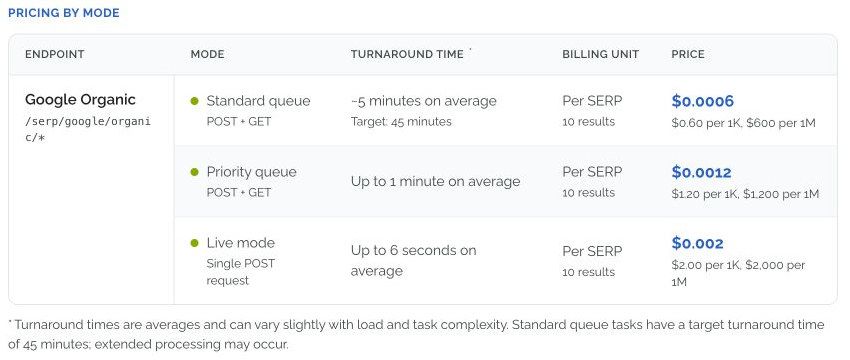
DataForSEO Standard creates task IDs, then the application collects the result with GET, polls readiness or uses a callback. A queued POST supports up to 100 tasks, and the documented default total API limit is 10,000 calls per minute; callback handling has its own response requirements. SERP API overview, Google Organic Task POST.
The collection GET is free after the paid task is posted. I would preserve task IDs and separate “not ready” from “create another paid search,” because retrying the wrong stage can duplicate collection work. Google Organic Task GET Advanced.
Live permits one task per call and keeps the connection for the result. Check task-level status and cost even when HTTP succeeds; the advertised turnaround targets in the Live-versus-Standard guide are vendor descriptions, not timing evidence I collected. Google Organic Live Advanced, Live versus Standard guide.
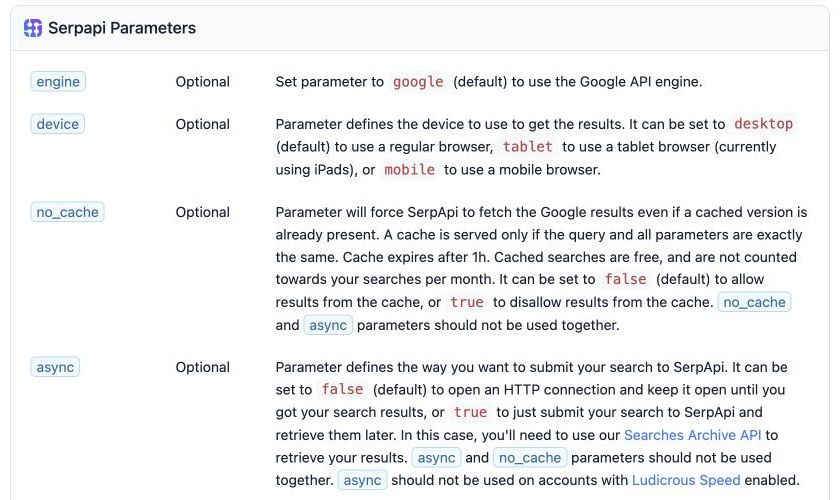
SerpApi’s Google reference documents synchronous and async options, an identical-parameter one-hour cache, and location, country, language and device settings. no_cache and async are incompatible, so the integration needs an explicit freshness and collection policy rather than one generic “live” label. Google Search API.
Its Search Archive API exposes queued, processing, success and error states with a finite retrieval window. That still requires application state handling; using a monthly allowance does not remove async errors or collection deadlines. Search Archive API.
Which one costs less at your volume? #
For ordinary depth-10 tasks with no modifiers, DataForSEO’s consumed Live cost is $2, $200 and $2,000 for 1,000, 100,000 and one million tasks. Standard is $0.60, $60 and $600, but it belongs in a separate queue-tolerant scenario. Google Organic pricing.
| Hypothetical monthly volume | DataForSEO Live usage | DataForSEO Standard usage, queued | SerpApi matching Best Effort allowance |
|---|---|---|---|
| 1,000 | $2 | $0.60 | Starter $25 |
| 100,000 | $200 | $60 | Searcher $725 |
| 1,000,000 | $2,000 | $600 | Cloud 1M $3,750 |
Inputs and multiplication: Google Organic pricing, SerpApi plans and billing. The SerpApi row uses its embedded plan ladder through one million searches, not only the smaller set of visible top-level cards; confirm current account selection before purchase.
The first DataForSEO example still requires at least $50 deposited, leaving unused funded balance after $2 of Live usage. SerpApi’s subscription is a purchase of capacity, so an underused plan has a higher effective cost per consumed search; I have not assumed refunds, special deals or free-credit stacking. Minimum payment, SerpApi plans and billing.
What can throw the estimate off? #
DataForSEO adds base-price increments for additional depth-10 pages, and incomplete depth has refund rules. Rectangles and asynchronous AIO can add a base charge; PAA clicks have a separate published price, and search operators can multiply the charge. Google Organic pricing, AIO collection help.
The pricing table and worked wording are not equally explicit about stacking several operator multipliers. I would avoid a multi-operator estimate without confirming it, rather than turn a single-operator example into a universal formula. Google Organic pricing.
SerpApi counts successful searches, including successfully empty results, while cache/errors/failures do not consume searches under the pricing rule. Its one-hour cache only applies to identical parameters, and Ludicrous Speed is priced at twice Best Effort. SerpApi plans and billing, Google Search API, Ludicrous Speed.
Both providers therefore need a request specification beside the budget: engine, output mode, depth, location, device, cache behavior and extra retrievals. A provider’s low base rate is not the complete cost of an unspecified monitoring job.
What about AI Overviews and AI Mode? #
DataForSEO includes cached AIO in the ordinary response; requesting asynchronous AIO adds one base charge, refunded when unavailable or already cached. Advanced JSON expansion and HTML expansion have distinct documented behavior; HTML output alone is not a promise of parsed AIO fields. AIO collection help, SERP API overview.
Dedicated Google AI Mode is priced at $1.20/$2.40/$4 per 1,000 Standard/Priority/Live tasks, before rectangle modifiers. The Live reference documents Google AI Mode citations/media/Markdown; it should not be priced using ordinary organic’s $2-per-1K Live rate. Google AI Mode pricing, Google AI Mode Live Advanced.
SerpApi’s AIO may be inline or require a one-minute token for another request; its AI Mode endpoint is separate and supports multi-turn tokens. Budget the actual retrieval sequence rather than assume every answer is included in one base organic search. Google AI Overview API, Google AI Overview results, Google AI Mode API.
Both publish recent AI documentation: SerpApi’s January/February/September 2026 release notes describe multi-turn, Markdown and a citation fix, while DataForSEO’s July and August 2026 updates describe paid ads in AI Mode and Goto-link handling. Its May 2026 Sheets/n8n template illustrates citation collection; none of those sources is our independent capture-rate test. Google AI Mode release notes, Paid ads in AI Mode update, Goto rollout update, AI Mode to Sheets n8n template.
For that narrower requirement, use the AI Overview and AI Mode API guide.
Who offers legal cover, and how long are results kept? #
SerpApi’s U.S. Legal Shield starts at Production and has a stated up-to-$2-million limit with eligibility and downstream-use exclusions. Its terms describe a 99.95% SLA with service-credit remedies; neither statement is measured uptime or a blanket legal authorization for the customer. U.S. Legal Shield, SerpApi terms and privacy.
DataForSEO’s terms encompass both PAYG and subscription products, so “DataForSEO has no subscriptions” would be too broad even though the organic example here uses balance-funded consumption. I found no equivalent vendor indemnity in the checked terms; refunds also remain conditional. DataForSEO terms.
Retention has a real documentation conflict: a general help page says Live is not retained, while the main v3 reference explicitly gives SERP JSON, including Live, 30 days and HTML seven days. I would apply the narrower SERP-specific statement cautiously and save required records locally. Result retention help, API v3 reference.
SerpApi’s archive lasts up to 31 days. ZeroTrace includes legal-preservation exceptions and cannot guarantee third-party deletion; its Enterprise wording conflicts with an embedded Cloud 1M feature flag, so a privacy-critical purchase needs entitlement confirmation. Search Archive API, ZeroTrace Mode, SerpApi plans and billing.
What SDKs and tools does each one offer? #
DataForSEO publishes an official TypeScript client and an MCP server whose current v3 README marks the earlier generation deprecated. Its sandbox returns dummy response shapes; that is useful for parser work, but cannot prove real-account success, current rankings or latency. DataForSEO TypeScript client, DataForSEO MCP v3, Sandbox reference.
SerpApi publishes Python and JavaScript clients, a broader libraries page and an integrations directory. Those help locate implementation paths; I did not execute either SDK or connect an integration, and a directory entry does not establish a production connection. SerpApi libraries, SerpApi integrations, SerpApi Python wrapper, SerpApi JavaScript client.
I would verify actual remaining allowance and hourly limits through SerpApi’s Account API only after authorized credentials are in place. DataForSEO’s FAQ lists $1 trial credit, distinct from dummy sandbox access and the minimum paid funding. Account API, DataForSEO FAQ.
G2 reviewers provide examples of support praise and subscription friction, while the old pagination issue documents a historical report. They do not create a representative sentiment comparison between the two vendors. SerpApi G2 reader reviews, SerpApi Google num100 issue3032.
Which one should you pick? #
Pick DataForSEO when the application can own task state and benefit from scheduled Standard collection. Pick SerpApi when its documented response contract, chosen subscription and conditional Production+ cover better fit the project; for live traffic, compare only like-for-like modes and validate required output before paying for claimed performance.
If neither model fits, Serper offers expiring Google query packs (my Serper vs SerpApi comparison weighs that against a subscription), while apiserpent.com offers a deposit-based Web ladder. Its Quick/Deep distinction, requested-page billing, country-only Deep targeting, customer indemnity and lack of a public PAYG SLA make it a different contract, not a drop-in equivalent. Serper pricing and FAQ, SerpentAPI pricing, SerpentAPI API reference, SerpentAPI terms, SerpentAPI FAQ.
Read SerpApi pricing for its allowance arithmetic, Serper alternatives for switching scenarios and best SERP APIs for a field-led shortlist.
FAQ #
Is DataForSEO cheaper than SerpApi? #
Its published organic depth-10 Live rate is $2 per 1,000, while the SerpApi example allowances here cost $25, $7.25 and $3.75 per 1,000 at full use. Funding, modifiers and different response contracts prevent treating that as equal-service savings. Google Organic pricing, Minimum payment, SerpApi plans and billing.
Is DataForSEO Standard the same as Live? #
No. Standard posts a task and retrieves it later; Live holds the connection and allows one task per call. Compare Standard only with a workload that tolerates queued collection. SERP API overview, Google Organic Live Advanced, Live versus Standard guide.
If DataForSEO returns HTTP 200, did the task succeed? #
No. Inspect the task status and returned cost/result fields, not only the HTTP response. Keep task IDs and avoid creating new paid tasks just because collection is not ready. Google Organic Live Advanced, Google Organic Task POST, Google Organic Task GET Advanced.
Does DataForSEO keep Live SERP results? #
The main v3 reference states a SERP-specific exception: JSON from Standard and Live is retained 30 days, and HTML seven days. A general help page differs, so I would retain my own records and confirm the endpoint contract. API v3 reference, Result retention help.
Which one offers legal protection? #
SerpApi describes conditional U.S. Legal Shield on Production and higher, with exclusions for downstream data use. The checked DataForSEO terms do not establish equivalent vendor indemnity. U.S. Legal Shield, SerpApi terms and privacy, DataForSEO terms.
Can I try DataForSEO in its sandbox first? #
The sandbox can help check dummy response shapes, but it is not a live SERP, output-quality or latency test. Real-account verification remains a separate permitted check. Sandbox reference.
Sources
43 sources, accessed to .
Official pricing, docs, changelogs and status pages 37
- Google Organic pricing
- SERP API overview
- Google Organic Task POST
- Google Organic Task GET Advanced
- Google Organic Live Advanced
- Minimum payment
- DataForSEO terms
- Result retention help
- API v3 reference
- AIO collection help
- Google AI Mode pricing
- Google AI Mode Live Advanced
- DataForSEO FAQ
- Sandbox reference
- Live versus Standard guide
- Paid Ads in AI Mode SERP API
- Google's Goto rollout update
- AI Mode to Sheets n8n template
- SerpApi plans and billing
- U.S. Legal Shield
- SerpApi terms and privacy
- Google Search API
- Google AI Overview API
- Google AI Overview results
- Google AI Mode API
- Google AI Mode release notes
- ZeroTrace Mode
- Ludicrous Speed
- Search Archive API
- Account API
- SerpApi libraries
- SerpApi integrations
- Serper pricing and FAQ
- SerpentAPI pricing
- SerpentAPI API reference
- SerpentAPI terms
- SerpentAPI FAQ


