How to choose
Google AI Overview API Options and How Each One Charges
I found no official Google AI Overview API. Here's which SERP APIs document AIO and AI Mode, how they bill it, and why a blank answer isn't a failure.

For Google AI monitoring, buy an explicit Google-interface collection contract, not merely an API field named “AI.” I would shortlist SerpApi, SearchApi and DataForSEO for dedicated Google AI Mode, then compare their separate AI Overview retrieval paths; Scrapingdog also documents a dedicated AI Mode route. Google AI Mode API, SearchApi Google AI Mode reference, Google AI Mode Live Advanced, Scrapingdog Google AI Mode.
Short on time?
Here's my take
- Observe Google AI Mode
- SerpApi, SearchApi or DataForSEO
- Each publishes an explicit Google AI Mode collection reference; compare citation fields and billing next.
- Collect AI Overviews
- Budget the retrieval path
- Inline answers, token fallbacks and asynchronous retrieval can have different charges and expiry.
- Build an answer application
- Separate generation from observation
- Gemini grounding and apiserpent.com’s answer add-on are different contracts from verified Google UI collection.
Prices verified . Sponsors cannot buy a verdict or a position.
Google AI Overviews and AI Mode can show different answers and cited URLs, and an Overview does not appear for every query. A useful monitor needs to record the surface and legitimate absence as carefully as the answer text. Google Search AI features, Google AI Overviews help.
This guide is part of my search API hub and focuses on observing AI answers and how that is billed; DataForSEO versus SerpApi compares those two providers on queueing and billing. My best SERP APIs guide covers general engine and field selection, and my Google Search API explainer covers what Google itself sells.
Aren’t AI Overviews, AI Mode and grounding the same thing? #
No. An AI Overview is a feature within Google Search. AI Mode is a separate Google experience; grounding uses search to support a model-generated answer, which is a different observation target. Google Search AI features, Google AI Overviews help, Google Search grounding.
I would keep those three labels separate in a database. Combining their citation counts can make a monitoring dashboard look complete while measuring different products.
Prices and specifications verified 2026-11-06, USD before tax. All capabilities below are documentation findings, with no independent capture test or paid-account check.
| Provider | Google AI Overviews contract | Google AI Mode contract | Billing or evidence caution |
|---|---|---|---|
| SerpApi | Inline or extra token-based retrieval | Dedicated google_ai_mode |
Follow-up AIO token lasts one minute; budget extra successful retrieval |
| SearchApi | Inline or google_ai_overview token retrieval |
Dedicated engine/conversation contract | Reserve additional successful retrieval capacity |
| DataForSEO | Cached AIO or paid asynchronous retrieval | Dedicated Standard/Priority/Live endpoints | Ordinary organic and AI Mode have different tariffs |
| Bright Data | Google AIO capture and parsed references | Separate AI Mode route not established in checked SERP references | brd_ai_overview=2 requests capture; occurrence not guaranteed |
| Scrapingdog | Inline answer or extra fallback retrieval | Dedicated AI Mode endpoint | Extra AIO five credits; AI Mode ten |
| apiserpent.com | Paid Deep opt-in AIO on Google/Yahoo/Brave | Engine-independent paid answer add-on | Google AI Mode interface provenance unverified |
| Oxylabs | Target list names Google AI Overviews (parsed JSON); exact workflow and billing not established | Current page lists Google AI Mode tariff | Unified-plan/account entitlement needs confirmation |
| Decodo | Current AIO workflow unverified | Page lists Google AI Mode answers; exact contract and tariff unverified | Page/crawl quotas are not search quotas |
| Serper | Dedicated AIO route not verified in checked sources | Dedicated AI Mode route not verified | Do not infer support from ordinary Google JSON |
Sources: Google AI Overview API, Google AI Overview results, Google AI Mode API, SearchApi Google reference, SearchApi Google AIO reference, SearchApi Google AI Mode reference, AIO collection help, Google AI Mode pricing, Google AI Mode Live Advanced, Bright Data Google parameters, Bright Data AIO reference, Scrapingdog inline AIO, Scrapingdog Google AI Mode, Scrapingdog Google AIO retrieval, SerpentAPI API reference, SerpentAPI SERP feature contract, Oxylabs SERP in unified Web API, Decodo SERP in Web Data API, Serper pricing and FAQ.
What does an AI Overview cost to fetch? #
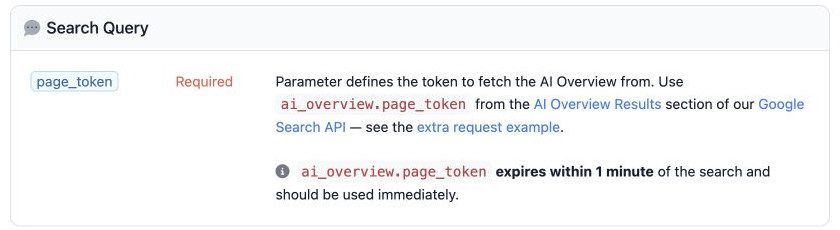
Sometimes more than one request. SerpApi can return an Overview inline, or a token for a second google_ai_overview request. The token expires within one minute; I would queue that follow-up immediately and budget a successful retrieval rather than presume a free endpoint. Google AI Overview API, Google AI Overview results, SerpApi plans and billing.
SearchApi similarly uses a token from an initial Google or related-question response, with text blocks, Markdown and references. The checked sources do not establish that additional successful retrievals are free, so a one-query budget needs an explicit retrieval assumption. SearchApi Google reference, SearchApi Google AIO reference, SearchApi homepage and plans.
DataForSEO includes cached AIO, but asynchronous AIO adds one base charge. It refunds that extra charge when the answer is absent or already cached; HTML expansion and Advanced JSON have their own documented behavior. AIO collection help, SERP API overview.
For example, 1,000 ordinary depth-10 Live tasks at $2 per 1,000 consume $2 before modifiers. If every task requires chargeable asynchronous AIO, the extra base charge adds another $2; absent/already-cached cases can reduce that extra under the refund rule. This is tariff arithmetic, not an observed invoice or capture rate. Google Organic pricing, Google Organic Live Advanced, AIO collection help.
Scrapingdog ordinary Google consumes five credits; advanced/mobile ten. Its extra AIO retrieval uses the fallback URL, expires after two minutes and costs five credits per successful retrieval, so one ordinary call plus a successful extra AIO call consumes ten credits. Scrapingdog plans, Scrapingdog Google API, Scrapingdog inline AIO, Scrapingdog Google AIO retrieval.
Which APIs say they cover Google AI Mode? #
Four publish dedicated Google AI Mode collection references. SerpApi documents google_ai_mode, citations, text blocks, Markdown and multi-turn tokens. SearchApi’s separate Google AI Mode reference documents conversations, image input, location and Goto links; do not assume a follow-up conversation is identical to a fresh organic search. Google AI Mode API, SearchApi Google AI Mode reference.
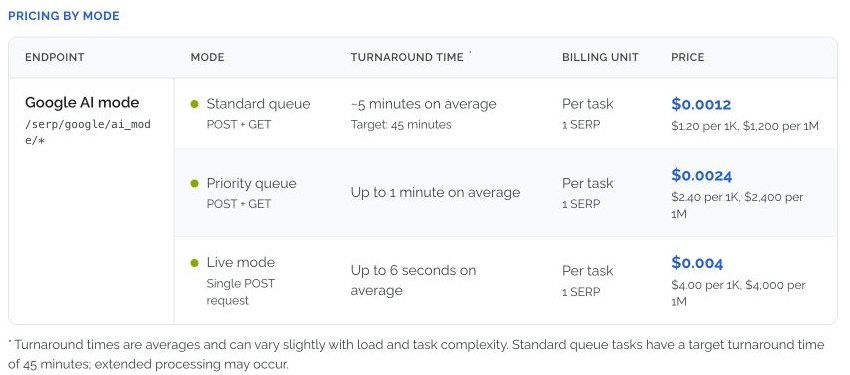
DataForSEO explicitly documents Google AI Mode collection with localized citations/media/Markdown. Its tariff is $1.20/$2.40/$4 per 1,000 Standard/Priority/Live tasks, with rectangle charges separate; the organic Live rate is not the AI Mode rate. Google AI Mode pricing, Google AI Mode Live Advanced.
Scrapingdog’s separate Google AI Mode endpoint costs ten credits per successful call. On Lite’s $40/200,000-credit allowance, that permits 20,000 such calls if nothing else uses credits: $2 per 1,000 at full utilization, before tax and any separately defined operations. Scrapingdog plans, Scrapingdog Google AI Mode.
The current Oxylabs page lists Google AI Mode within a unified Web API tariff. I would confirm account generation and entitlement rather than reuse a legacy SERP plan or treat a generic minimum rate as the AI Mode entry price. Oxylabs SERP in unified Web API.
Does Bright Data’s SERP API return AI Overviews? #
The Google parameter brd_ai_overview=2 requests AIO capture, and its parsed reference documents answer texts and references. The checked SERP references did not establish a separate Google AI Mode endpoint; I would keep that cell unverified rather than infer it from AIO support. Bright Data Google parameters, Bright Data AIO reference.
PAYG is $1.50 per 1,000; default successful-only billing includes internal retries and async retrieval, but custom headers/cookies change failures to billable requests. Its introduction documents multiple engines and JSON/HTML/Markdown, without proving every format has equivalent parsed AI fields. Bright Data SERP pricing, Bright Data SERP introduction, Bright Data SERP billing.
Does apiserpent.com return AI Overviews? #
For Google AI Overviews, it documents opt-in AI Overview fields on paid Deep calls, plus a separate answer add-on whose Google AI Mode interface provenance is unverified. SerpentAPI API reference.
apiserpent.com’s paid Deep AIO option is documented separately from its answer add-on. Google, Yahoo and Brave support the opt-in field; Bing/DuckDuckGo return null, and simple format omits AIO. Quick is organic-only. SerpentAPI API reference, SerpentAPI SERP feature contract.
For paid Deep, include_ai_mode=true adds a top-level answer, sources and follow-ups for all five engines, costing $0.004 once per call plus every requested-page Web unit. The docs do not establish that this engine-independent output collects Google’s AI Mode interface, so I would evaluate it as an answer service with that provenance unresolved. SerpentAPI API reference.
Using the default new-credit rate, one requested-page Deep call consumes $0.0006 in Web units plus a delivered paid answer surcharge of $0.004: $0.0046. With $0.03-per-1K new credit from a qualifying $1,250 Enterprise Plus deposit (pricing rechecked 6 November 2026; $1,000 Enterprise now gives $0.05), the corresponding consumption arithmetic is $0.00403; the deposit is still cash committed, not a monthly price. Deposited credit does not expire; promotional bonus credit expires after 30 days. SerpentAPI pricing, SerpentAPI API reference.
Quick ignores the option; free-tier responses provide empty answer arrays and an unavailable marker without the surcharge. A paid empty answer refunds the surcharge but not the delivered base search, and paid use does not first consume the remaining free allowance. SerpentAPI API reference.
No public PAYG SLA or vendor indemnity was established, and the pricing page ties rate and daily limits to your live balance band (10,000 a day below a $100 balance). The terms’ ten shared trial calls, 12-month inactivity expiry for unused free searches and customer duties still apply; country-only Deep targeting also limits some monitoring uses. The FAQ documents 90-day query-metadata retention and seven-day asynchronous-output retention, which need to fit the monitoring policy too. SerpentAPI terms, SerpentAPI FAQ, SerpentAPI pricing.
Is a generated answer the same as what Google shows? #
Not as far as the docs show. Google’s Gemini grounding documentation describes generating an answer supported by Google Search. It does not establish that the output is the exact AI Overview or AI Mode answer displayed to a consumer. Google Search grounding.
Likewise, an API exposing an aiMode field is not sufficient provenance by itself. For a Google visibility study, I would require an explicit surface contract and a permitted check of output provenance; for an application that simply needs a sourced answer, the generation contract may be the better fit. SerpentAPI API reference, Google Search AI features, Google Search grounding.
For those application choices, my Google Search API explainer covers grounding billing and display rules, my grounding pricing guide prices one grounded prompt, and my agent guide weighs an LLM’s built-in search against a separate search API; LLM web search versus a search API is the longer version of that choice.
What if no AI answer shows up? #
Record it as its own outcome in your AI-search monitor. Distinguish answer observed, no answer displayed, follow-up expired, provider error and parser/field mismatch in the application. Google says AIO appears when useful rather than for every query; an empty result alone cannot establish collection failure or zero AI visibility. Google Search AI features, Google AI Overviews help, Google AI Overview API, Scrapingdog Google AIO retrieval.
I would store query, surface, country/language, device, provider, collection time and request settings before parsing an answer. SerpApi and SearchApi document localization controls, while DataForSEO distinguishes dedicated localized AI Mode output; these settings belong beside the result, not only in a dashboard default. Google Search API, SearchApi Google AI Mode reference, Google AI Mode Live Advanced.
Do not turn one citation list into audience reach or traffic. Google includes AI-feature traffic in Search Console’s Web performance reporting; vendor field presence is not an independent impression metric, quality score or ranking guarantee. Google Search AI features.
What’s changed lately? #
In AI Overview and AI Mode APIs, SerpApi’s 2026 release notes record multi-turn, Markdown and a citation-URL fix. SearchApi’s November 5, 2025 announcement documents its dedicated AIO update; DataForSEO’s May template and August Goto-link update show documented workflow and parser changes. Google AI Mode release notes, SearchApi November2025 update, AI Mode to Sheets n8n template, DataForSEO Goto rollout update (27 Aug 2026).
Those dates help identify changes worth rechecking; they do not prove today’s completeness. I found no reliable current Serper or apiserpent.com changelog date for an AI feature launch, so I have not invented one.
So which AI Overview API should you pick? #
For explicit Google AI Mode, I would compare SerpApi, SearchApi and DataForSEO first, adding Scrapingdog when shared credits fit the workload. For AIO, I would choose only after checking the inline/fallback path, token deadline and additional charge in the required location.
Contractual protection needs a separate decision: SerpApi and SearchApi publish conditional plan-based cover with exclusions. It is not a guarantee that a chosen monitoring use or redistribution is lawful. U.S. Legal Shield, SearchApi terms.
I would leave Decodo’s exact Google AI collection and tariff pending instead of translating Web Data API page/crawl quotas into search capacity. The Serper documentation gap likewise remains a gap, not a permanent absence claim. Decodo SERP in Web Data API, Serper pricing and FAQ.
For cost context, use my SerpApi pricing breakdown and my cheapest SERP API comparison, which also prices DataForSEO. Keep a real-account check and an honest observation schema ahead of any claim about capture success, relevance or provider superiority.
FAQ #
Does Google have an official AI Overview API? #
The sources checked did not establish a universal official API for extracting the consumer Search interface. Google’s Gemini grounding generates a model answer with Search sources; that is a different product from observing a displayed AI Overview. Google Search AI features, Google Search grounding.
Which APIs document Google AI Mode? #
SerpApi, SearchApi, DataForSEO and Scrapingdog publish dedicated Google AI Mode references. Feature documentation does not establish equal coverage, output quality or availability across locations. Google AI Mode API, SearchApi Google AI Mode reference, Google AI Mode Live Advanced, Scrapingdog Google AI Mode.
No AI Overview came back. Did the API fail? #
No. Google does not display an AI Overview for every query. Preserve the distinction between no answer displayed, a retrieval/parser failure and an unavailable or expired follow-up token. Google Search AI features, Google AI Overviews help, Google AI Overview API.
Does an AI Overview cost extra? #
Sometimes an answer is inline, but additional retrieval can be needed. DataForSEO documents a base-price async surcharge with specified refunds; Scrapingdog charges five credits for a successful extra AIO retrieval. AIO collection help, Scrapingdog Google AIO retrieval, Google AI Overview results.
Is apiserpent.com’s AI Mode the same as Google’s? #
That was not established by the checked documentation. Its Deep option returns an engine-independent answer/sources/followUps contract for all five engines, so I treat it as a paid answer add-on with Google-interface provenance unverified. SerpentAPI API reference, SerpentAPI SERP feature contract.
Do citation counts tell you your AI-search traffic? #
No. An observed citation is a result of one defined query and setting, not a traffic or exposure measurement. Google says AI-feature traffic is included in the Search Console Web performance reporting. Google Search AI features.
Sources
42 sources, accessed .
Official pricing, docs, changelogs and status pages 42
- Google Search AI features
- Google AI Overviews help
- Google Search grounding
- SerpApi plans and billing
- U.S. Legal Shield
- Google Search API
- Google AI Overview API
- Google AI Overview results
- Google AI Mode API
- Google AI Mode release notes
- Google Organic pricing
- SERP API overview
- Google Organic Live Advanced
- AIO collection help
- Google AI Mode pricing
- Google AI Mode Live Advanced
- DataForSEO Goto rollout update (27 Aug 2026)
- AI Mode to Sheets n8n template
- SerpentAPI pricing
- SerpentAPI API reference
- SerpentAPI terms
- SerpentAPI FAQ
- SerpentAPI SERP feature contract
- SearchApi homepage and plans
- SearchApi terms
- SearchApi Google reference
- SearchApi Google AIO reference
- SearchApi Google AI Mode reference
- SearchApi November2025 update
- Bright Data SERP pricing
- Bright Data SERP introduction
- Bright Data Google parameters
- Bright Data AIO reference
- Bright Data SERP billing
- Scrapingdog plans
- Scrapingdog Google API
- Scrapingdog inline AIO
- Scrapingdog Google AI Mode
- Scrapingdog Google AIO retrieval
- Oxylabs SERP in unified Web API
- Decodo SERP in Web Data API
- Serper pricing and FAQ


