Roundup
Free SERP API Tiers for Google, and How Long Each Lasts
Some free SERP API tiers renew monthly and some are one-time credits. Here's what each buys in Google searches, card rules, expiry and the first paid step.

You need Google results as JSON, and you’d like to pay nothing for it, at least for now. I reread the primary free-tier pages, billing docs and relevant terms linked below on 16 October 2026, rechecked them on 6 November 2026, and sorted every allowance by what kind of free it really is.
The short answer: Bright Data’s 5K records a month is a large documented recurring allowance. For a one-off prototype, Searlo’s 3,000 or Serper’s 2,500 one-time searches go further than most monthly tiers, and if you’d rather run the software yourself, OpenSERP is MIT-licensed but leaves the CAPTCHAs to you.
This page is about free tiers for Google results pages. If you need search built for an LLM or agent instead, my guide to free web search APIs for AI agents is the better fit.
Short on time?
Short on time? Here's my take.
- Free every month
- Bright Data SERP API
- 5K records a month, no card, seven engines. That's 20 times SerpApi's 250. After that it's pay-as-you-go at $1.5 per 1K.
- A one-time trial that goes far
- Searlo
- 3,000 signup Web-search credits without a card. The pricing page now consistently says one year per grant for new users. Confirm account expiry.
- A small daily job
- Bright Data SERP API
- 5K monthly records may fit a small daily job. Account eligibility, output rights and free-to-paid stacking still need checking before you rely on it.
- If you'd rather host it yourself
- OpenSERP
- MIT license, six engines, proxy support and an n8n node. The license is free; the servers, proxies and CAPTCHA fights are not.
- Cheapest way to start paying
- Searlo
- A $3.99 pack for 5,000 searches. apiserpent.com's $10 minimum funds about 16,666 whole one-unit calls at $0.60 per 1K, at the Default rate rechecked 6 November 2026.
Prices verified . Sponsors cannot buy a verdict or a position.
Is a SERP API free to use? #
Several providers offer small free allowances. Recurring options include Bright Data (5K records a month) and SerpApi (250 searches a month), verified 6 Nov 2026.
Each documented grant has a finite cap; a low-volume production job may fit, but unrestricted production use is not promised. The free allowance is there so you can wire up the API and see the JSON before you pay. If you haven’t settled on a Google SERP API yet, my hub compares the four ways to add search to an app or agent.
A SERP API isn't the same as SerpApi
A SERP API returns search-result data. SerpApi is an independent vendor at serpapi.com, not Google’s own API. A brand’s free plan is one option in the category, not a category-wide allowance.
One more name trap: SerpentAPI in this post means apiserpent.com, which is unrelated to serpentapi.com.
If you were hoping Google itself would give you results for free, its Custom Search JSON API still lists “100 search queries per day for free”, but it’s “closed to new customers” and existing users have to move off by 1 January 2027. I cover what to switch to in my Custom Search API alternatives guide.
How do the free SERP API tiers compare? #
Here are the Google-capable allowances I could document, grouped by the kind of free it is: renews monthly, one-time credits, or self-hosted software. The “Google searches it buys” column divides credits by what one Google results page costs, so these are documented arithmetic ceilings, not an observed account result. Optional features, result depth and shared usage can lower them.
| Vendor | Free allowance | Renews? | Google searches it buys | Card needed? | Published free-use restriction (not legal clearance) | Expiry |
|---|---|---|---|---|---|---|
| Bright Data SERP API 5K monthly | 5K records a month | Monthly | 5,000 | No | Not stated | Resets monthly |
| SerpApi | 250 searches a month | Monthly | 250 (max 50 an hour) | Not stated | Not stated; no Legal Shield on Free | Resets monthly |
| HasData | 1,000 credits a month | Monthly | 100 full SERPs or 200 Light calls | No | Not stated | Self-serve: no rollover; custom Enterprise may differ |
| scrape.do | 1,000 credits a month | Monthly | 100 (10 credits each), AI Overview included | No | Not stated | Resets monthly |
| cloro | 500 credits a month | Monthly | 166 whole async or 100 sync basic calls | No | Not stated | No rollover |
| SerpHouse | 4,000 credits | Monthly with a work email; 7 days with a personal email | About 400 (derived) | Not stated | Not stated | 1 month or 7 days |
| serpstack | 100 searches a month | Monthly | 100 | Not stated | No: 'Non-Commercial Use' | Resets monthly |
| Zenserp | 50 searches a month | Monthly | 50 | Not stated | Not stated | Resets monthly |
| Apify Google Search Scraper | $5 platform credit a month | Monthly | Up to 1,111 plain pages at Free $4.50/1K; extras reduce it | No | Not stated | Monthly, no rollover |
| Searlo | 3,000 credits | One-time (new users) | 3,000 | No | Not stated | 1 year per grant for new users; legacy accounts unlimited |
| Serper | 2,500 queries | One-time | 2,500 (Google only) | No | Not stated | Not stated for free queries |
| Serply | 2,500 credits | One-time | 2,500 uncached (cached responses free) | No | Not stated | 30 days |
| ScraperAPI free plan | 1,000 credits/month | Monthly | 40 base Google calls at 25 credits | No | Not established by allowance | Monthly reset |
| ScraperAPI | 5,000 credits (7-day trial) | One-time | 200 (25 credits each) | No | Not stated | 7 days |
| DataForSEO | $1 credit plus a free Sandbox | One-time | About 1,666 queued or 500 live | Not stated | Not stated | Balance stays until spent |
| SearchApi | 100 requests | Not stated | 100 | No | Not stated | Not stated |
| ValueSERP | 100 searches 'to evaluate' | One-time | 100 | No | Not stated | Not stated |
| OpenSERP Cloud | 60 credits | One-time | About 60 first pages; deeper/other operations cost more | No | Not stated | Never expire |
| Scrapingdog | 100 credits | Not stated | 20 (Light) or 10 (Advance) | No | Not stated | Not stated |
| apiserpent.com (SerpentAPI) | 10 searches | One-time, shared pool | 10, shared across 5 engines; no AI Overviews | No | No: 'evaluation purposes only' | After 12 months of account inactivity |
| OpenSERP (self-hosted) | $0 license (MIT) | Self-hosted | Limited by your IPs and CAPTCHAs | Not applicable | Software license only; upstream terms still apply | Not applicable |
| SearXNG (self-hosted) | $0 license (AGPL-3.0) | Self-hosted | Limited by your IPs and CAPTCHAs | Not applicable | Software license only; upstream terms still apply | Not applicable |
Source: Each vendor's own pricing, docs, FAQ or terms page, read 16 Oct 2026 and rechecked 6 Nov 2026. Card/restriction cells summarize the checked offer; 'Not stated' does not mean a contract grants unrestricted use. Credit-to-search conversions are my arithmetic; DataForSEO's uses its current ten-result queue/live tariffs. No free-to-paid stacking is assumed. Scroll sideways for more columns.
The same free-tier figures also sit in the freeTier column of my search API price tracker, with a source link on every row.
Which free tiers renew every month? #
Recurring allowances include Bright Data’s 5K, SerpApi’s 250 and credit-based plans below. SerpHouse renewal depends on email type; ScraperAPI’s billing docs separately document 1K monthly credits, about 40 base Google calls. No vendor’s current free plan is a promise that its policy can never change.
Bright Data SERP API #
Bright Data’s SERP pricing page has a separate “Free Tier” card: “5K records per month” and “No credit card required” (pricing page, verified 6 Nov 2026). The product page lists Google, Bing, DuckDuckGo, Yandex, Baidu, Yahoo and Naver (product page).
After the free allowance, published pay-as-you-go costs $1.50 per 1K requests. The monthly Scale selector showed only $499 for 380K requests plus $1.30/1K extra on 6 November 2026; the $999/900K and $1,999/2M steps I recorded on 16 October were not visible. A monthly commitment changes the math, so pay-as-you-go is not automatically cheapest at every volume.
I couldn’t confirm free-to-paid stacking or AI Overview entitlement on a real free account. The billing docs also warn that custom headers or cookies change default successful-only charging to all-request charging.
What stands out
- 5K records a month, renewing, with no card, per its pricing page
- Seven engines, not just Google
- A smooth next step: pay-as-you-go at $1.5 per 1K, no plan needed
What gives me pause
- No commercial-use wording on the pricing page, either way
- Unclear whether the free 5K still applies on pay-as-you-go
- AI Overviews on free calls: unverified
SerpApi #
SerpApi’s Free plan is $0 for 250 searches a month, capped at 50 an hour (pricing, verified 6 Nov 2026). Only successful searches count: “Cached, errored, and failed searches are not.”
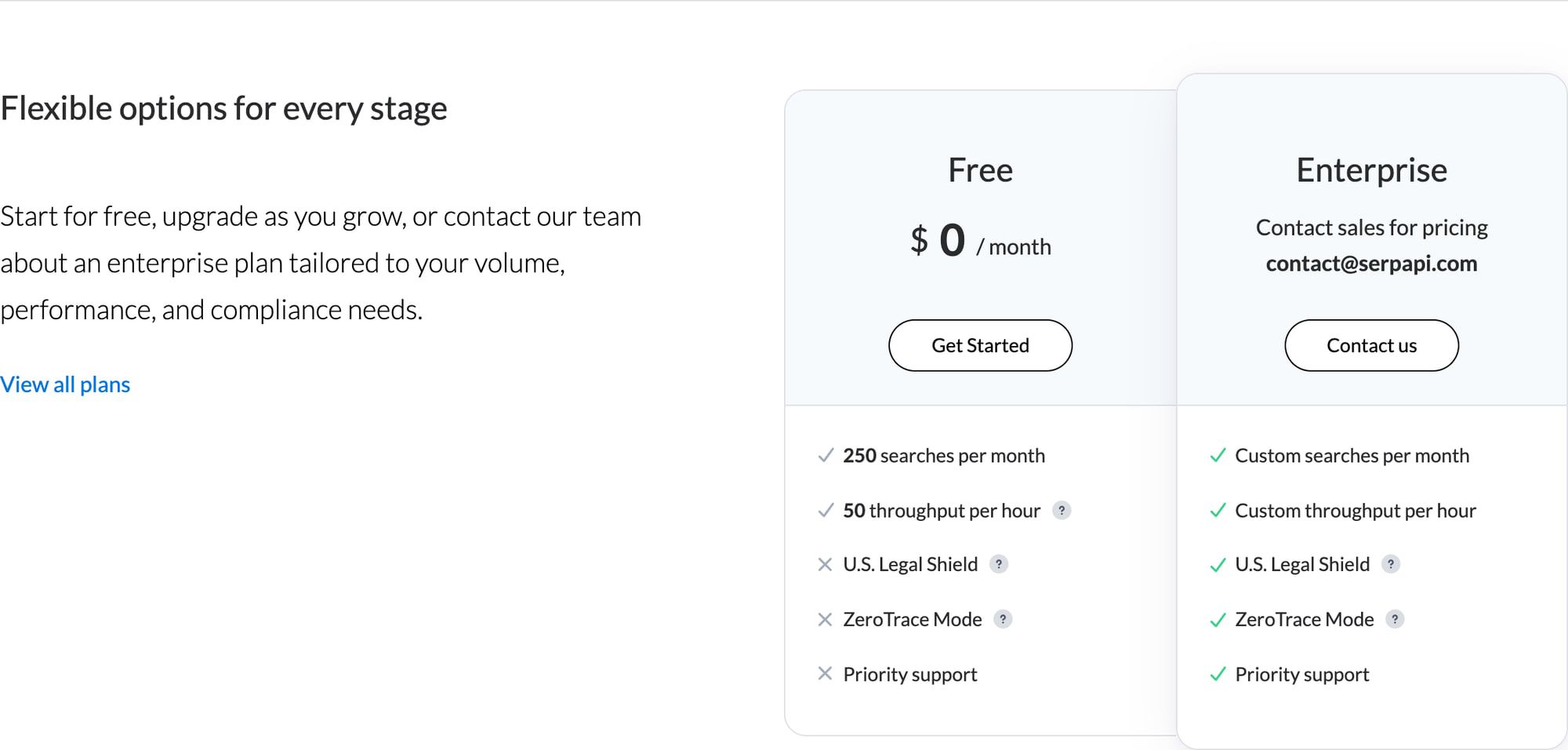
What you don’t get is its legal cover. The U.S. Legal Shield “is not available with the Free, Starter and Developer plans” (Legal Shield page), and I couldn’t find whether Free needs a card or allows commercial use on the pricing page or in the legal terms (updated 27 Aug 2026).
The paid Starter plan is $25/month for 1,000 searches. The 250 free searches cover about 8 daily calls on a 30-day illustration; that is arithmetic, not a new daily quota. My SerpApi pricing breakdown walks through its paid plan ladder.
What stands out
- 250 searches a month that renew, at up to 50 an hour
- Failed, errored and cached searches don't count against you
- The same API you'd pay for later, so nothing to rewrite when you upgrade
What gives me pause
- Small: about 8 searches a day
- No Legal Shield on Free, Starter or Developer
- Card and commercial-use terms for Free aren't stated
- The first paid plan is $25 for 1,000 searches
If you’re weighing SerpApi’s free plan against Serper’s one-time 2,500, I set them side by side in Serper vs SerpApi.
HasData, scrape.do and cloro #
All three sell credits, which are not the same unit as Google searches. Their pages describe monthly free plans. cloro’s billing guide now explicitly confirms no card for its base 500 monthly credits; I do not add review/backlink-dependent bonuses to the comparison.
-
HasData: 1,000 monthly credits and no card. On 6 November 2026 the prices page listed 5 concurrent requests on Free, while the credit docs still say free accounts get 1. The two pages conflict, so plan for 1 until HasData confirms otherwise.
Its credit docs now explicitly give five credits per Light call; its Google SERP quickstart gives ten for a full SERP. That buys 200 Light or 100 full calls.
The shared-credit request-cost docs say unused credits expire at period end; rollover on the pricing page is custom Enterprise, not a free/self-serve promise.
-
scrape.do: “1,000 Successful API Credits” a month and 5 concurrent requests. “Every Google Search Scraper API call costs 10 credits”, so 100 searches, and its Google Search Scraper page says the AI Overview comes back in an
ai_overviewfield at no extra cost. -
cloro: 500 monthly credits and one concurrent job. Its provider guide prices a first-page Google call at 3 credits async or 5 sync. The optional AIO/PAA-AIO flag adds 2 once, and each extra page adds 2.
Thus 500 credits cover 166 whole basic async calls or 100 sync; an AIO-rich request costs more. Unused credits expire each cycle.
scrape.do documents an included AI Overview field; cloro explicitly prices the AIO option separately. If AIO data is the point of your project, that matters more than the raw search count.
serpstack and Zenserp #
serpstack’s free plan is “100 Searches / mo”, labeled “Non-Commercial Use” and “No Support”. That pricing restriction rules it out for my commercial-use shortlist; I do not infer permission from silence elsewhere.
Zenserp gives “50 Searches/mo” for “$0 /mo”. It doesn’t say whether you need a card or whether commercial use is allowed.
Apify Google Search Scraper #
Apify’s platform pricing gives $5/month with no card and no rollover. The specific Google Search Actor event table charges Free users $4.50/1K scraped search-result pages; the $1.80 headline belongs to Business, which commits $999/month.
Dividing $5 by $0.0045 gives at most 1,111 whole plain pages, with a $0.00005 Actor-start fee/run and optional events consuming part of the same grant. Free-plan AIO costs another $3/1K events, so the plain-page count does not describe an AIO-rich run. The vendor’s “up to” figure is not an observed free-account yield.
Which ones give one-time credits instead? #
For free credits or a free trial, Searlo advertises 3,000 signup credits, Serper 2,500 queries and Serply 2,500 credits valid 30 days. These are finite trials, not recurring grants. Shared-credit welcome offers such as Oxylabs cannot be ranked by treating all platform credit as guaranteed Google searches.
Searlo #
Searlo gives 3,000 signup credits without a card. Its cards, FAQ and comparison table now all say new grants last one year, including the free grant; the 90-day table row I flagged on 16 October was gone on 6 November 2026.
Accounts created before 15 May 2026 keep unlimited credits. I do not promise an expiry date for an unchecked account.
Web search costs one credit per successful call; other endpoints have their own tariffs. The Micro pack is $3.99/5K credits. Its page says free and paid grants share rate limits, but I have not verified actual account access or AI-feature entitlements.
Serper #
Serper’s homepage says “Get 2,500 free queries” and “No credit card required” (serper.dev, verified 6 Nov 2026). The page offers signup queries and does not establish a recurring monthly grant; I treat it as a trial.
Its page is rendered by JavaScript, and “Credits valid for 6 months” appears next to the paid packs, not the free queries. So whether the free 2,500 expire is something I couldn’t verify.
Paid packs start at $50 for 50,000 credits, with 50 to 300 queries a second depending on the pack.
What stands out
- 2,500 free queries with no card, per its homepage
- The signup headline is 2,500 queries; deeper-result multipliers remain unverified
- A clear paid path: packs from $50 for 50,000
What gives me pause
- The grant does not replenish monthly
- Google only
- Whether the free queries expire isn't stated
- Paid credits expire after 6 months
Serply, SearchApi, ValueSERP, Scrapingdog and ScraperAPI #
These five have different eligibility/billing rules, and each has one detail that changes the math.
- Serply: “2,500 free credits”, “good for 30 days”, no card. “1 credit = 1 successful uncached API request” and “Cached responses cost nothing”; paid credits “never expire”.
- SearchApi: “Sign up for 100 free requests” with “No credit card required”. The page doesn’t say whether that renews.
- ValueSERP: “100 searches to use to evaluate VALUE SERP. No credit card is required.”
- Scrapingdog: “100 Requests Credits”, one concurrent request, “Access To All APIs”, no card. A Google Light search costs 5 credits and Advance or AI Mode 10, so that’s 20 searches at most, and the page doesn’t say whether it renews.
- ScraperAPI: “7-day trial and 5,000 API credits. No credit card required.” A Google or Bing request costs 25 credits, so the trial is 200 searches.
apiserpent.com (SerpentAPI) #
apiserpent.com gives the smallest free allowance in this roundup, and it’s upfront about why. Its terms (updated 31 October 2026) give 10 evaluation searches and expire unused free calls after 12 months of inactivity. That inactivity rule does not expire deposited credit.
Its docs define one 10-call pool shared across eligible endpoints, without a card; it is not ten free calls per engine. Paid AI options are not included in that evaluation pool. The FAQ separately offers one free run per day without signing up.
Those 10 calls work across Google, Bing, Yahoo, DuckDuckGo and Brave. The FAQ, rechecked 6 November 2026, lists one concurrent request, 10/minute, 100/hour and 10,000/day for free accounts, with at least 100,000/day after $500 of verified net deposits.
The 500/day figure I flagged on 16 October no longer appears, and the FAQ calls these “up to” allocations, not guaranteed floors. Paid-only AI fields remain empty on free requests, according to the docs.
The paid step is where it’s strongest. Its pricing page and FAQ, rechecked 6 November 2026, list a $10 minimum to start and $0.60 per 1K by default, $0.30 after one qualifying $100 deposit, $0.10 after $500, $0.05 after $1,000 (Enterprise) and $0.03 after $1,250 (Enterprise Plus).
Purchased credits never expire. Existing credit keeps the price you bought it at; each deposit is priced by its size, and your best deposit in a calendar month sets the price for all your deposits that month. Refunded or charged-back amounts do not count toward a tier.
The pricing page also says top-ups must be at least $100 after $50 in lifetime deposits.
Already hold credit? It keeps the price you paid
The September promo banner is gone, and so is the “Prices to increase 10x after October 31” notice the page showed on 31 October (absent on 6 November 2026). apiserpent.com now distinguishes existing balances from eligible new credit. A past $500 deposit does not make new credit cost $0.03: that rate now needs a qualifying $1,250 Enterprise Plus deposit, and $1,000 buys the $0.05 Enterprise rate.
Its terms still allow changes with 30 days’ notice. These are documentation checks, not observed billing.
The weaknesses are all in its own documents. The FAQ says “No public SLA is currently published for pay-as-you-go accounts”, and the terms provide the service “AS IS” under the laws of India, make you indemnify the vendor, and generally make credits non-refundable subject to stated exceptions/law.
What stands out
- No card needed; unused free calls expire after 12 months inactivity, separately from purchased credit
- The free pool works across five engines, not just Google
- A $10 first deposit at $0.60 per 1K, and deposited credits never expire
- Lower new-credit rates after qualifying deposits: $0.30 at $100, $0.10 at $500, $0.05 at $1,000 and $0.03 at $1,250
What gives me pause
- Only 10 free searches, for evaluation only
- AI Overviews and AI Mode come back empty on free accounts
- Tight free limits: 1 concurrent request, 10/minute, 100/hour and 10,000/day
- No public PAYG SLA/provider scraping indemnity verified; customer indemnity and qualified refund limits
- New credit follows current tiers; existing credit keeps its old schedule
My read: treat the 10 searches as a way to see the response format, not a free tier. The current Default rate is $0.60/1K new-credit Web units with a $10 first deposit.
Quick bills one unit; Deep bills each requested page, up to ten. Lower prices need qualifying deposits and optional AI Mode adds $0.004/call; its provenance as Google-UI capture is unverified.
It is not a universal $0.60 tariff for every endpoint.
DataForSEO: $1 and a sandbox #
DataForSEO describes a $1 signup credit, with funds retained until spent (help center). At the per-search rates in my search API pricing dataset (checked 6 November 2026 against the current Google organic tariff), that’s about 1,666 queued Standard searches or 500 live ones.
Its Sandbox is uncharged and returns dummy data in the real response structure. Those fixtures are not live Google results or evidence of quality. The first paid funding minimum is $50.
Trials I’m describing from the docs only #
- Oxylabs /Search: the current offer is $5 welcome credit shared across products. Its search card says “up to 5.6K” and shows $1/1K; those headlines do not establish a guaranteed search allocation. Old 2K-result/$49 trial figures describe an earlier product generation and are withdrawn here.
- Decodo: current Web Data API marketing advertises standard-page allowances across several endpoints. A standard-page allowance is not a verified free Google-search allowance; I do not convert it into a SERP count.
- Octoparse: its MCP/API allowance is 2,000 records/week for eligible Free/Basic users. That is not evidence of 2,000 Google SERPs or a Google-specific tariff.
Is there an open-source SERP API? #
Yes, two worth knowing, both on GitHub: OpenSERP and SearXNG. The license costs nothing, but you pay in servers, proxies and your own time, and operation depends on upstream engines and block handling.
I go deeper on the running costs in whether self-hosted search is really free on my search API hub. Here’s the short version for a SERP use case.
OpenSERP #
OpenSERP is MIT-licensed self-hosted software supporting Google, Bing, Yandex, Baidu, DuckDuckGo and Ecosia. Its repository documents proxy, MCP and n8n integration routes. I have not installed it or measured its ability to handle blocks; operating the collector and complying with upstream rules remain your work.
OpenSERP Cloud separately gives 60 one-time credits without a card, then charges $0.009/credit with non-expiring balances. Ordinary Web search consumes one credit per ten returned positions, rounded up; deeper results and other operations can cost more.
SearXNG #
SearXNG is AGPL-3.0 metasearch software. Its search API docs say public instances may disable JSON; running a server does not automatically give you a working public Google-results API.
Enable the required output format in the settings, and budget infrastructure and operator time. I do not infer current outages, universal block rates or a dollar hosting cost from old issue threads. The software license does not grant rights to every search result or linked page.
When does free stop being enough? #
Sooner than most people expect. At 1,000 searches/day over a 30-day month, you’re at 6 times Bright Data’s free 5K and 120 times SerpApi’s 250, and every one-time allowance above is gone in days.

Here’s the first paid step at each vendor, sorted by the cash you need to start. Published first paid steps checked 6 November 2026 (Scrapingdog’s on 12 November 2026). These are cash commitments, not a promise that one request always costs one credit.
| Vendor | Free allowance | First paid step | Verified |
|---|---|---|---|
| Bright Data | 5K records a month | Pay-as-you-go at $1.5 per 1K requests | 6 Nov |
| Searlo | 3,000, one-time | $3.99/5K Web credits; one year per grant for new users | 6 Nov |
| Serply | 2,500 for 30 days | $5 Micro pack for 2,500 credits | 6 Nov |
| apiserpent.com | 10, one-time (shared) | $10 minimum, then $0.60 per 1K (Default) | 6 Nov |
| Scrapingdog | 100 credits | Pay-as-you-go: $10 for 25,000 credits (5,000 Light searches), no expiry; or Lite: $40 a month | 12 Nov |
| SerpApi | 250 a month | Starter: $25 a month for 1,000 searches | 6 Nov |
| ValueSERP | 100, one-time | $25 initial purchase at $2.50 per 1K | 6 Nov |
| scrape.do | 1,000 credits a month | Hobby: $29 a month | 6 Nov |
| serpstack | 100 a month | Basic: $29.99 a month for 5,000 | 6 Nov |
| cloro | 500 credits a month | Lite: $30 for 37,500 credits (about 12,500 async searches) | 6 Nov |
| SearchApi | 100 | Developer: $40 a month | 6 Nov |
| HasData | 1,000 credits a month | Startup: $59/mo month-to-month, or $49/mo billed annually | 6 Nov |
| ScraperAPI | 5,000 credits for 7 days | Hobby: $49 for 100K credits (4,000 Google searches) | 6 Nov |
| Zenserp | 50 a month | Small: $49.99 for 25,000 | 6 Nov |
| Serper | 2,500, one-time | $50 pack: 50,000 credits, valid 6 months | 6 Nov |
| DataForSEO | $1 credit | $50 minimum payment | 6 Nov |
Three quick worked examples at 30,000 searches a month, list prices only:
- Bright Data pay-as-you-go: 30 × $1.50 = $45/month before any unverified free-credit stacking; custom-header/cookie billing can differ.
- apiserpent.com Default: 30 × $0.60 = $18 a month from a $10-minimum balance, at the current new-credit rate, rechecked 6 November 2026. After $50 of lifetime deposits, each top-up must be at least $100.
- Serper $50 pack: 50,000 credits last about 1.7 months at this volume, so roughly $30 a month, well inside the 6-month expiry.
Past this point, paid units, depth and account rights become more useful than free allowance. I compare published tariffs at 1K, 100K and 1M/month in my cheapest SERP API comparison, and if SerpApi is what you’ve outgrown, my comparison of SerpApi alternatives covers where to move.
If price isn’t the deciding factor, my best SERP API guide compares providers by engines, fields and workflow.
What about free tiers on AI search APIs? #
They’re different tools from SERP API free tiers: a SERP API returns Google’s own ranked results page, while AI search APIs return pages or answers from their own pipeline for a model to read. None of the documented allowances here is unlimited, and the two AI search tools below cap their free use too.
The allowance units differ. Tavily gives 1,000 monthly credits without a card; basic search uses one, advanced two.
Gemini 3.x grounding gives 5,000 executed search queries/month on the paid tier, then $14/1K queries, plus model tokens.
One model request can execute multiple queries; Gemini 2.5 uses another prompt-based tariff. Neither number is a Google SERP-output quota.
If your app is an LLM or agent, I compare those free tiers in free web search APIs for AI agents.
Is a free SERP API legal to use? #
A free key does not establish legal permission for a particular collection, reuse or redistribution. Read the vendor contract and relevant upstream rights for your use; I do not classify every SERP API use as lawful or unlawful.
The cited 5 October 2026 Google v. SerpApi order vacated a hearing and allowed a new date or decision on the papers. It was not a merits ruling on the motion.
On 6 November 2026 the public docket still listed Google’s 12 October notice (ECF 61) as the last known filing, with no ruling. Public RECAP records can lag PACER, so check before relying on this.
The case summary covers the records individually.
Self-hosting changes who operates the collector; an MIT or AGPL license does not remove upstream terms or rights questions. This is source research, not legal advice.
So which free tier should you start with? #
- Student or one-off prototype: Searlo’s 3,000 signup Web credits (one year for new users; account expiry untested) or Serper’s 2,500 queries. Both are one-time and need no card, then compare the required fields before picking one.
- An n8n workflow that runs daily: Bright Data’s 5K a month covers about 165 searches a day without a card. If you’d rather host it, OpenSERP ships an n8n node, but plan for CAPTCHAs.
- A weekly rank check of 200 keywords: that’s about 870 page-one searches a month, well inside Bright Data’s 5K and far beyond SerpApi’s 250. Each deeper results page usually costs another search, so tracking deeper results requires vendor-specific pagination and billing checks; no tenfold guarantee is assumed.
- A commercial MVP: don’t build it on serpstack (non-commercial) or apiserpent.com’s free searches (evaluation only), and read the terms of any other free tier first. Bright Data advertises 5K monthly and $1.50/1K pay-as-you-go, but I have not established whether those stack or whether your proposed use has the necessary rights.
- You mostly want to see the JSON before paying: SerpApi’s 250 a month or apiserpent.com’s 10 searches across five engines, then pick the paid step from the table above.
Every allowance on this page is re-checked at least every 90 days, and straight away when a vendor changes its pricing page. How I source and date each figure is on my methodology page.
FAQ
Is a SERP API free to use?
Several vendors offer capped free use. Bright Data advertises 5K monthly records, SerpApi 250 monthly searches, and Serper 2,500 signup queries. Recurring grants and one-time trials are different.
Is there a free API key for Serper?
Its homepage offers 2,500 signup queries without a card. I found no recurring monthly grant or confirmed free-credit expiry. Paid packs start at $50/50K and expire after six months.
How many free Google searches do you get on HasData?
Its 1,000 monthly credits cover 100 full Google SERPs at ten credits each or 200 Light calls at five. Credits are shared across APIs, and custom Enterprise rollover does not establish free-plan rollover.
Does Apify's free plan really cover 2,777 Google searches?
The Google Search Actor now lists $4.50/1K pages on Free, so the $5 platform grant covers up to 1,111 plain pages before optional events/run fees. The $1.80 headline is the Business tariff, not the Free rate.
Do Searlo's free credits still expire after 90 days?
Not according to its current pricing page. On 6 November 2026 its cards, FAQ and comparison table all said one year per grant for new users, and the old 90-day row was gone; accounts created before 15 May 2026 keep unlimited credits. I have not verified an account expiry.
Is there an open-source SERP API?
OpenSERP is MIT-licensed self-hosted software; SearXNG is AGPL-3.0 metasearch with configurable JSON output. Infrastructure, maintenance and upstream rights remain separate from the software license.
Is it legal to use a free SERP API?
A free key does not establish permission for every collection or reuse. The cited October 5 court order vacated a hearing; it did not decide the motion or every SERP use. Review the applicable contract, rights and current records.
Sources
51 sources, accessed to .
Official pricing, docs, changelogs and status pages 48
- Bright Data SERP API pricing (Free Tier card)
- Bright Data SERP API product page (supported engines)
- SerpApi pricing
- SerpApi U.S. Legal Shield
- SerpApi legal terms
- Serper homepage, free queries and packs
- Searlo pricing
- Serply pricing
- SearchApi pricing
- Scrapingdog pricing
- Scrapingdog pay-as-you-go announcement
- HasData pricing
- HasData docs: credits and concurrency
- scrape.do pricing
- scrape.do Google Search Scraper API
- cloro pricing
- SerpHouse pricing
- serpstack pricing
- Zenserp pricing plans
- Apify pricing
- Apify Google Search Scraper
- ScraperAPI pricing
- ScraperAPI docs: credits and request costs
- ValueSERP pricing (Traject Data)
- apiserpent.com (SerpentAPI) terms of service
- apiserpent.com pricing
- apiserpent.com API docs
- apiserpent.com FAQ
- apiserpent.com homepage
- DataForSEO help center: minimum payment and free testing
- Octoparse help center: MCP/API free trial credits
- Google Custom Search JSON API overview
- OpenSERP Cloud pricing
- SearXNG docs: search API and formats
- SearXNG docs: search settings (suspension times)
- Gemini API pricing (grounding with Google Search)
- Tavily docs: API credits
- Apify Google Search Actor per-plan event tariff
- HasData full Google SERP credit cost
- Bright Data billing exceptions
- DataForSEO Google organic task tariff
- DataForSEO sandbox
- Oxylabs current Search welcome credit
- Decodo current Web Data API product generation
- HasData shared-credit expiry/no-rollover
- cloro base/add-on/sync credit units
- cloro free eligibility and credit expiry
- ScraperAPI recurring free plan distinct from seven-day trial


