Pricing
I Priced Bright Data's Scraping Browser at 1, 10 and 100 GB
Bright Data's Browser API bills $8 per GB, not per session. PAYG versus the $499/71GB plan, free credits, and spending caps that aren't instant.

I would budget Bright Data Browser API at its documented $8 per paid billable GB, then compare the $499/71GB commitment only when sustained usage justifies it. The three hypothetical PAYG levels below are $8, $80 and $800 for one, ten and 100 paid billable GB; the commitment’s 100GB total stays unknown because its overage rate was not found.
The unit is traffic, not sessions or successful tasks. Shared free credits, media, headers, navigation and retries can change the bill, so I would keep them separate from a per-task promise. Pricing, free tier, bandwidth docs, checked 11 November 2026.
Short on time?
Here's my take
- Small paid usage
- PAYG at $8/GB
- Use paid billable traffic after any eligible remaining free allowance, with no invented session count.
- Sustained usage inside 71GB
- Compare the $499 commitment
- The simple threshold is 62.375GB without promotional credits; confirm actual terms and needed scope.
- More than the included volume
- Obtain the exact overage
- The unknown 100GB commitment total cannot be reconstructed from an average included rate.
Prices verified . USD documented-price arithmetic checked 11 November 2026. No invoice, traffic measurement or task-success result is claimed.
What does the Browser API cost? #
| Input | Documented public offer | How I would use it |
|---|---|---|
| PAYG | $8/GB | Multiply paid billable GB, not sessions |
| Displayed Scale | $499/month with 71GB | Keep commitment and unknown overage separate |
| First-deposit match | Up to $500 on a first deposit of $500 or more | Promotional; keep it out of the base rate |
| Shared recurring free credits | 5,000/month; Browser API at 5 credits/MB | At most 1,000MB if all are allocated here; eligibility/expiry conditions apply |
| Enterprise | Custom | Obtain the actual scope and quote |
Sources: Browser API pricing, product overview and free-credit docs, checked 11 November 2026. “Unlimited” advertised concurrency is not measured access or guaranteed task capacity.
What does pay-as-you-go cost? #
Let G mean paid billable GB after any eligible remaining free allowance. The narrow PAYG subtotal is $8 × G; it excludes taxes, other products, model/integration work and unverified rebates. Pricing, credits.
| Hypothetical paid billable GB | PAYG subtotal | $499 commitment comparison |
|---|---|---|
| 1 | $8 | Still a $499 commitment, subject to actual terms |
| 10 | $80 | Still a $499 commitment, subject to actual terms |
| 100 | $800 | Total unknown beyond the advertised 71GB allowance |
These are billing-volume examples, not numbers of pages, completed sessions or successful agent tasks. I would first measure permitted-workflow traffic in a separate authorized check before turning them into a forecast.
When is the $499 plan worth it? #
Excluding promotional/free credits, $499 ÷ $8 = 62.375GB. Above that point and within the advertised 71GB allowance, the price-only arithmetic can favor the commitment, subject to the actual account terms. It does not establish the same output, capacity or data policy. Pricing, checked 11 November 2026.
For 100GB, I do not invent a commitment overage rate from $499 ÷ 71. An average included price is not the missing marginal rate, so the complete commitment subtotal remains unknown.
I would also consider unused commitment and the effect of changing free-credit eligibility before paying. At one or ten paid GB, PAYG is materially below the fixed $499 commitment in the deliberately narrow examples above.
How far do the free credits go? #
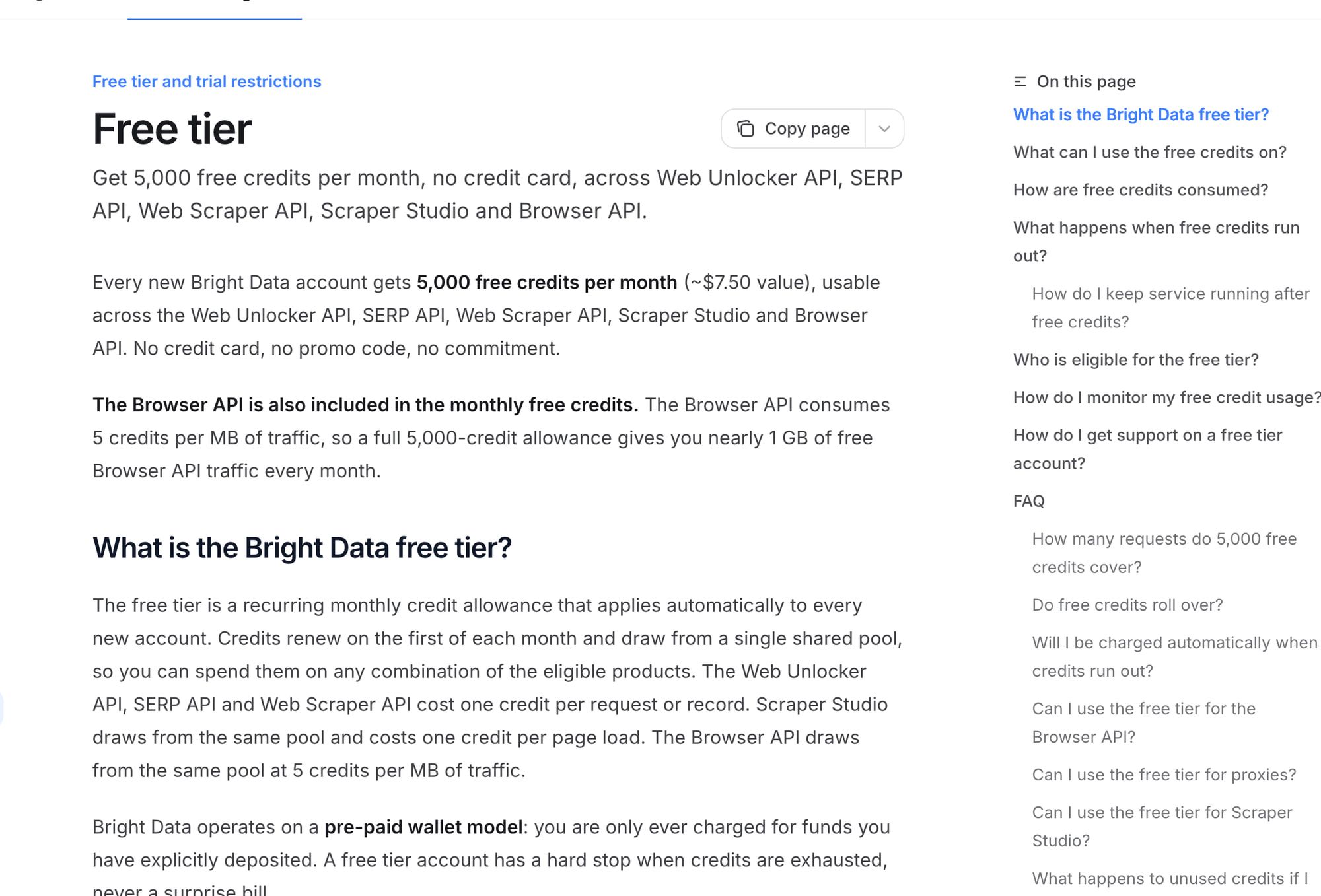
The 5,000 monthly credits are not 5,000 browser sessions. At five credits per MB, a balance wholly devoted to Browser API covers at most 1,000MB; other products can consume the shared balance. Unused credits expire, and pre-commit stops recurring free grants. Free-tier docs.
I would not silently translate 1,000MB into 1GiB or assume every GB convention is identical. The exact account convention and eligibility belong in the selected bill, not an invented free-session estimate.
No free wallet was opened here. The published eligibility is a documentary input rather than proof that an owner/account receives the same allowance.
What counts toward your GB? #
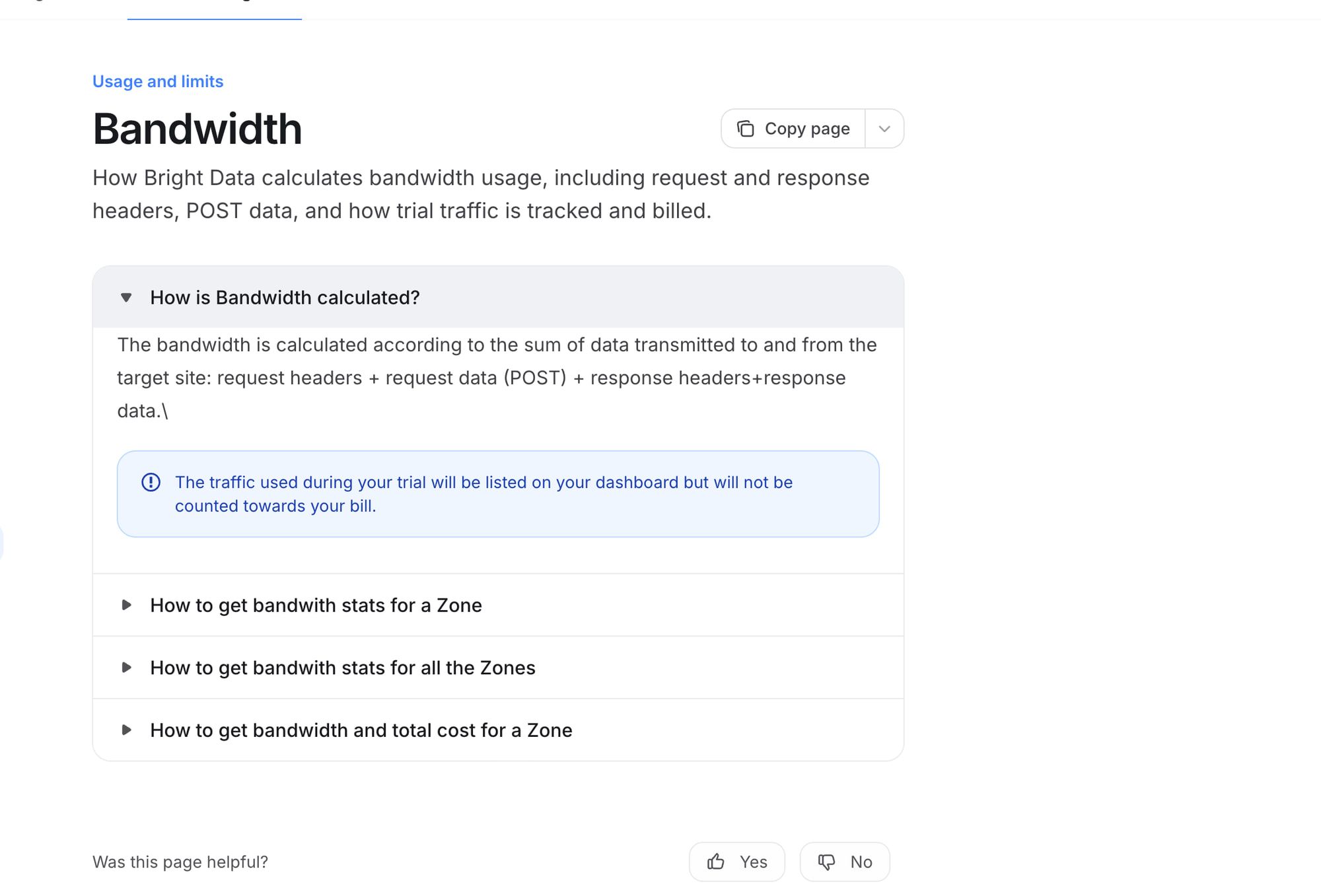
General bandwidth docs count request/response headers and bodies. Media, pagination and retries can transfer more bytes, so I would forecast the real content and interaction rather than one initial HTML response. Bandwidth docs, configuration, examples.
Reducing unnecessary media can lower traffic only if the task remains adequate. Blocking every image could invalidate a screenshot or visual interaction; I would verify output before calling the change an optimization.
Failed attempts and retries can still transfer bytes. No live failed-browser refund behavior was checked, so I do not promise every failed task is unbilled or refunded.
How long can a session run? #
The Browser API configuration documents a five-minute idle and 60-minute maximum session timeout. A sample navigation wait of two minutes is not the full session lifetime. I would close owned browser sessions in a finally path and inspect the final state. Configuration, examples.
The recommendation is an operating policy, not a browser lifecycle test performed here. Actual task duration, attempts and traffic still need verification on permitted targets before a final usage budget.
Can you cap your spending? #
The free-only wallet has a documented hard stop, while deposited funds continue PAYG and optional auto-recharge is a separate setting. General zone daily limits can alert/suspend but are evaluated every 15 minutes; I would not describe them as instantaneous hard caps. Free tier, billing, FAQ.
Costs Explorer provides product/zone breakdowns in the general docs. That is not proof that every Browser API-specific dashboard/control is connected or available in a selected account. Costs Explorer.
I would review the chosen product, wallet, zone and recharge settings before approving spend. No account setting was inspected or changed in this research.
Access and permissions come first #
Browser access is zone-specific. The error docs distinguish robot/KYC/compliance blocks, wrong zone/password and insufficient permission, while API Bearer tokens and browser zone credentials are separate documented paths. I would keep CDP/inspect URLs and keys out of public content/configuration. Errors, quick start, API auth.
The AUP prohibits nonpublic/behind-login collection; the MSA at /license is dated 12 October 2026 and incorporates the AUP. Advertised interactive capabilities do not grant permission for those prohibited workflows. AUP, MSA.
Security/compliance documentation describes controls rather than target authorization or demonstrated extraction accuracy. I do not infer permission, test publication rights or live success from a certification. Security overview.
Is a browser the right Bright Data product? #
Bright Data’s product selector distinguishes browser interaction from SERP, page HTML and structured-data products. I would choose the needed capability before treating a browser traffic rate as an answer to every data task. Product selector, Browser API overview. If raw page HTML is enough, my web unblocker comparison covers Bright Data Unlocker; for prebuilt records, see Bright Data vs Apify.
MCP docs and the MIT repository word the free allowance differently: the docs describe a shared 5,000-credit pool, while the repo says 5,000 requests and lists browser automation as free. A named browser tool is not proof of a selected account’s free entitlement, and a remote OAuth route is not a performed handshake. MCP overview, tools, repo, license, OAuth.
No release note or tool presence is treated as a task-success result here. Release notes are useful maintenance context, not a substitute for allowed output/billing checks.
PAYG or the $499 plan? #
I would begin with PAYG for small paid traffic in the defined examples. I would compare the $499/71GB commitment for sustained usage within the price-only favorable interval, after verifying the account terms, free-credit effect and required scope.
For volume above the included allowance, obtain the actual overage before recommending the commitment’s total. I would not manufacture a missing rate to complete a comparison table. If you are coming from Browserbase, my Browserbase alternatives guide explains when bandwidth billing is the better fit.
Use Cloudflare Browser Run pricing and Browserbase pricing for other units. Search/fetch/browser selection, Browserless alternatives and browser MCP choices connect the capability and connection decisions; the agent browser hub connects the wider research.
FAQ #
Do 5,000 free credits mean 5,000 sessions? #
No. The documented Browser API conversion is five credits per MB from a shared balance. Do not treat 5,000 credits as 5,000 completed sessions. Free tier.
Do you know what 100 GB costs on the $499 plan? #
Not from this research. The advertised allowance is 71GB, and its overage rate was not found; $499/71 is not that rate. Pricing.
Do zone daily limits stop spending instantly? #
General docs evaluate them every 15 minutes. Actual selected-account control behavior was not tested. Billing FAQ.
Can I use it to scrape behind a login? #
No. The documented AUP prohibits nonpublic/behind-login collection. Determine allowed targets and applicable terms independently. AUP.
Sources
22 sources, accessed .
Official pricing, docs, changelogs and status pages 20
- brightdata.com: products/scraping browser
- docs.brightdata.com: products/scraping browser/introduction
- docs.brightdata.com: products/scraping browser/quickstart
- docs.brightdata.com: products/scraping browser/configuration
- docs.brightdata.com: products/scraping browser/code examples
- docs.brightdata.com: products/scraping browser/error codes
- docs.brightdata.com: general/account/billing and pricing/free tier
- docs.brightdata.com: general/account/billing and pricing/billing
- docs.brightdata.com: general/account/billing and pricing/faqs
- docs.brightdata.com: general/usage monitoring/bandwidth
- docs.brightdata.com: general/account/billing and pricing/costs explorer
- docs.brightdata.com: api reference/authentication
- docs.brightdata.com: general/policy/acceptable use policy
- docs.brightdata.com: general/security/security overview
- docs.brightdata.com: products/mcp server/overview
- docs.brightdata.com: products/mcp server/tools
- docs.brightdata.com: products/mcp server/remote/oauth
- docs.brightdata.com: product selector
- brightdata.com: license
- docs.brightdata.com: release notes
GitHub code, issues and releases 2
Last updated: 13 October 2026. Researched and drafted with AI tools; human editorial review and publication approval are pending.


