Comparison
Bright Data vs Oxylabs Comes Down to How You Want to Pay
Bright Data bills each product by its own unit; Oxylabs draws from one shared wallet. Prices at 1, 10 and 100 GB, plus access and trial rules.

I would choose between Bright Data and Oxylabs by product, billing unit and account access before pool size. Bright Data lists residential PAYG at $8/GB with a conditional $4 coupon; Oxylabs lists $15/$100/$500 monthly shared wallets with residential rates of $6/$5/$4 per GB. Neither price establishes equivalent successful output. Bright Data residential, Oxylabs residential.
Short on time?
Here's my take
- Under ~12 GB, or bursty months
- Bright Data PAYG
- $8/GB list with no commitment. Oxylabs makes you buy a $15, $100 or $500 wallet first.
- About 13–20 GB a month
- Oxylabs Basic
- $100 covers up to 20 GB at $5/GB. The same traffic lists at $104–$160 on Bright Data PAYG.
- Steady 63–125 GB a month
- Oxylabs Flexible
- $500 covers up to 125 GB at $4/GB. Bright Data's $499/141 GB card uses a 3-month 50% coupon.
- Several products on one budget
- Oxylabs
- One monthly wallet covers proxies, its Web API and Unblocker. Allowances are not added together.
Prices verified . Sponsors cannot buy a verdict or a position.
On list prices, Bright Data is cheaper for small or uneven residential use and from about 21 to 62 GB a month; Oxylabs is cheaper at roughly 13–20 GB and 63–125 GB, and for teams that want one budget across several products. This proxy pillar comparison is research into published terms, with no use, invoices or measured performance behind the verdict.
How do they compare side by side? #
Prices and specifications verified: 2026-11-11, displayed USD before taxes and account-specific conditions.
| Decision | Bright Data | Oxylabs |
|---|---|---|
| Residential starting basis | $8/GB list PAYG; conditional $4 coupon | $15 Starter wallet at $6/GB, up to two GB |
| Larger residential commitment | $499/141 GB card at the 3-month coupon rate ($3.50/GB; list $7/GB) | $100 at $5/GB; $500 at $4/GB |
| Managed unblocking | $1.50/1,000 successful requests PAYG | Wallet rates $7.20/$6/$4.80 per GB |
| Managed browser / other outputs | Browser GB, records, datasets | Different product categories under shared subscription |
| Free-credit boundary | Shared monthly 5K API pool | $5 welcome credit for verified companies |
| Residential customer access | Company/corporate email/human KYC/funds for new zones | Identity/use-case risk review |
| Performance evidence here | None measured | Monitoring needs written consent; none measured |
I have no independent data that turns a larger advertised inventory, extra protocol or lower unit price into better success for your target. Product fit and documented requirements support a shortlist; they do not supply a benchmark.
Which is cheaper for residential traffic? #
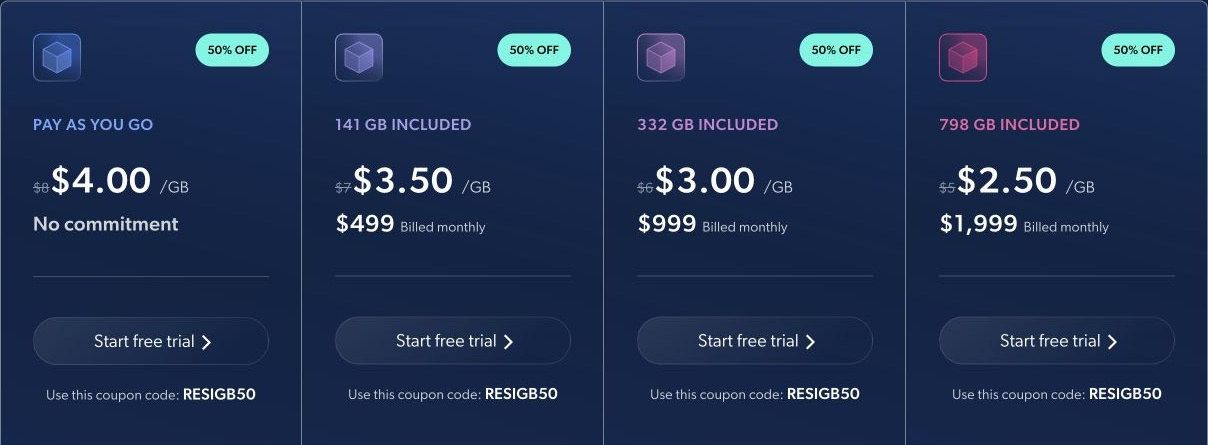
Bright Data separates $8/GB list PAYG from the conditional RESIGB50 $4/GB offer. Its monthly cards show $499/141 GB, $999/332 GB and $1,999/798 GB at $3.50/$3/$2.50 per GB, which are the RESIGB50 coupon rates (50% off for three months); the struck-through list rates are $7/$6/$5 per GB, and PAYG shows $4 against an $8 list. I would budget at the list rates after month three. Residential pricing.
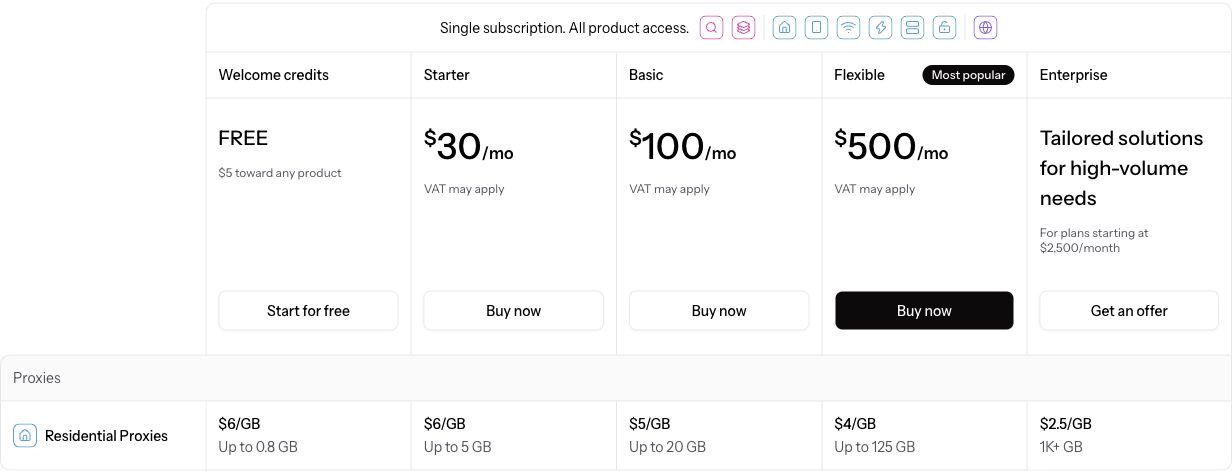
Oxylabs’ residential rates are $6/$5/$4 per GB under $15/$100/$500 monthly wallets (Starter, Basic, Flexible), with up to two/20/125 GB if residential consumes the whole wallet. Enterprise starts at $2,500/month by quote. A shared wallet is not the listed maximum traffic for each product added together. Residential pricing, Catalog.
Say you need 1, 10 or 100 GB #
These examples assume one, ten or 100 GB of raw residential traffic, not equal successful-page output. VAT/taxes, infrastructure and unverified promotions are excluded, and an Oxylabs wallet is selected to cover the traffic at its stated tier.
| Hypothetical residential consumption | Bright Data list PAYG | Bright Data conditional coupon | Oxylabs selected wallet purchase |
|---|---|---|---|
| One GB | $8 | $4 | $15; two GB maximum at this tier if devoted to residential |
| Ten GB | $80 | $40 | $100; 20 GB maximum if devoted to residential |
| 100 GB | $800 | $400 | $500; 125 GB maximum if devoted to residential |
Inputs: Bright Data, Oxylabs, verified 2026-11-11. The Oxylabs column records the chosen subscription purchase, not a per-consumed-GB invoice or proof that no other account quote/top-up option exists. Unused wallet capacity still affects the purchase decision.
I would inspect PAYG when sporadic traffic made commitment utilization uncertain. I would inspect the shared wallet when the selected monthly commitment and multiple product needs fit, with the actual allocation written down first.
What about the managed APIs? #
Bright Data Web Unlocker and SERP PAYG list $1.50/1,000 successful requests, while Scraper lists $1.50/1,000 delivered records. Their $499/month cards contain 383K requests, 380K requests and 384K records respectively; additional units list $1.30/1,000 for each product’s own unit. Unlocker, SERP, Scraper.
Browser API lists $8/GB PAYG or $499/month for 71 GB. Crawl lists request quotas rather than an assumption that one job equals one complete site, and a dataset pricing example is $250/100K one-time records with refresh separate. I would not merge these into a single “API call” price. Browser, Crawl, Datasets.
Oxylabs Web Unblocker consumes the same $15/$100/$500 wallet at $7.20/$6/$4.80 per GB, with advertised up-to two/16/104 GB allocations. That is not a normalized per-successful-request equivalent to Bright Data Unlocker, because the traffic for the required output is unknown. Web Unblocker pricing.
The broader Oxylabs catalog separates proxy transport, managed browser and search/scrape products under a shared subscription. I would obtain the required product’s unit and acceptance definition before comparing it with Bright Data’s matching deliverable. Catalog.
If you have not yet decided between a managed API and raw proxy traffic, scraping API versus proxies covers that choice before either vendor’s unit matters.
Can you try either one for free? #
Bright Data’s June 2026 notes describe one shared 5K monthly API pool across Unlocker, SERP, Scraper, Studio and MCP. Its browser card separately mentions one GB and 5K credits; selected cross-product entitlement is unresolved, so I would not sum all the cards. Release notes, MCP overview, Browser card.
For new residential zones after July 7, Bright Data requires registered company, corporate email, human KYC and real funds. Those conditions are separate from an API free pool or generic trial. Access policy.
Oxylabs’ current welcome-credit body/FAQ offers $5 for verified-company registrations, despite a page title still referring to up to seven days. The residential page rounds the credit to up-to 0.8 GB, not a guaranteed precise GB entitlement for every company or product. Welcome credit, Residential pricing. The residential proxy free-trial guide sets both offers next to other providers’ trial terms.
Bright Data’s licence describes noncancelable/nonrefundable fees and its billing documentation describes UTC calendar-month commitments/proration. Oxylabs’ self-service pricing says purchases are nonrefundable while its general conditions retain conditional PAYG exceptions; I would resolve the actual contract rather than promise either supplier a universal refund route. Licence, Billing, Pricing, General conditions.
What about fixed IPs and integrations? #
Bright Data lists shared ISP ten/100 IPs for $18/$145 monthly and dedicated ten/100 for $35/$275. Shared datacenter ten/100 lists $14/$100, with 100 GB/IP/month fair use and possible excess charges across these IP products. Those are different reserved resources from rotating residential traffic. ISP, Datacenter. ISP versus residential proxies explains when a fixed IP fits better than rotation.
Bright Data’s Playwright guide separates raw transport and managed Browser API; it also states specified social/ecommerce account-management uses are unsupported as of April 1, 2026. I would not take a generic browser integration as account/use-case approval. Integration.
Oxylabs documents residential session/transport controls and advertises protocols and targeting on its product page. Its 175M+/195 inventory/country figures are provider claims, not simultaneously available exits or a measured country-coverage result. Residential docs, Product.
Neither sourcing page is an independent audit #
Bright Data describes explicit opt-in, a benefit, a clear participation screen and withdrawal controls, including its approved-app SDK model. Those are documented provider assurances; I did not inspect a supplier chain or peer consent records. Sourcing, SDK practices.
Oxylabs’ consent/reward/supplier framework dates to August 21, 2020. Its September 10, 2026 IP-transparency beta announcement describes 30-day participation/app hints, but a positive shared-IP result does not prove which device participated; this runner’s IP was not submitted to the self-check. Historical framework, Beta announcement.
Buyer KYC is separate from peer consent, and paid network access is separate from target/content rights. Both vendors publish customer-use restrictions; European Commission guidance includes IP addresses among personal-data examples, so a provider sourcing statement is not a blanket anonymity or privacy certification. KYC, Bright Data AUP, Oxylabs AUP, Commission guidance.
What changed recently? #
Oxylabs’ residential product page now lists HTTP3 and MASQUE (CONNECT-UDP) support, its catalog puts Web API Search and Scrape under the same subscription, and an October 29, 2026 release note adds a hosted remote MCP server for those APIs. Its entry wallet also dropped from $30 to a $15 Starter plan. Oxylabs product, Catalog, Oxylabs notes.
Bright Data’s June notes explain shared API credits. Its October 24, 2026 note retires Immediate-access Residential and Mobile proxies (deleted from accounts on November 9) and points those users to ISP proxies or Web Unlocker API; its current integration guide also contains specific use restrictions. These are dated documentation changes, not executed compatibility or present uptime checks. Bright Data notes, Integration.
Oxylabs requires written consent for availability/performance/functionality monitoring, so it remains documentation-only here. There is no latency, success or integration result to rank against Bright Data. General conditions.
So which one would I pick? #
For residential traffic I would pick on volume. Bright Data’s $8/GB pay-as-you-go is cheapest for small or uneven months and from about 21 to 62 GB, where Oxylabs would make you buy the $500 wallet. Oxylabs wins at roughly 13–20 GB (the $100 Basic wallet) and 63–125 GB (the $500 Flexible wallet), and whenever one wallet has to pay for proxies plus its Web API or Unblocker. Bright Data’s monthly cards ($499 for 141 GB and up) are priced with its RESIGB50 coupon, 50% off for the first three months with the $7–$5/GB list rates struck through, so I would compare them only for a three-month project. All figures are list prices verified on November 12, 2026, before VAT.
Neither company publishes an independent performance test or audited sourcing, so I would not pick between them on speed or ethics. Before payment, I would document selected account approval, target/data rights, traffic/output definition, minimums, renewal and the supplier evidence still needed.
If the Oxylabs wallet is your likely pick, I priced it tier by tier in what Oxylabs really costs at 50 GB. If Decodo is also on your shortlist, Bright Data vs Decodo shows where those two bills split after the first three months.
Read Bright Data pricing, Bright Data alternatives, proxy pricing models, ethical sourcing checks and Bright Data Browser API pricing for the narrower decisions.
FAQ #
Is Bright Data cheaper than Oxylabs? #
Not universally. Bright Data lists $8/GB PAYG and a conditional $4 coupon; Oxylabs uses $15/$100/$500 shared monthly wallets at residential $6/$5/$4 per GB. Utilization, products and selected quotes determine the purchase. Bright Data, Oxylabs.
Do I get the full allowance for every Oxylabs product from one wallet? #
No. Advertised up-to allocations assume that product consumes the wallet. Do not add maximum residential and Web Unblocker allowances as separate grants. Residential, Web Unblocker, Catalog.
Can I compare Web Unlocker and Web Unblocker per request? #
Bright Data publishes successful-request pricing while the quoted Oxylabs Web Unblocker tiers use GB. A common-output conversion was not established. Bright Data Unlocker, Oxylabs Web Unblocker.
Does Oxylabs still offer a seven-day free trial? #
The current body/FAQ advertises $5 welcome credit for verified-company registrations, while the title retains older up-to-seven-day wording. No universal individual or duration entitlement is established here. Current offer.
Does each Bright Data API get its own free credits? #
The June release notes describe a shared 5K monthly account pool. Browser-card wording needs separate selected-account clarification. Release notes, Browser card.
Which provider is faster or more ethical? #
This primary-source review establishes neither result. No performance check or independent supplier/consent audit was performed, and Oxylabs monitoring requires written consent. Monitoring terms, Sourcing, Historical sourcing framework.
Sources
31 sources, accessed .
Official pricing, docs, changelogs and status pages 31
- Residential pricing
- ISP pricing
- Datacenter pricing
- Unlocker API pricing
- SERP API pricing
- Browser API pricing
- Scraper API pricing
- Crawl API pricing
- Datasets pricing
- Residential access
- Billing
- Licence
- AUP
- Residential sourcing
- Bright SDK practices
- Playwright integration
- MCP overview
- Bright Data release notes
- Residential pricing
- Residential product
- Welcome credit
- General conditions
- AUP
- Residential docs
- Sourcing standards
- IP transparency beta
- KYC policy
- Release notes
- Web Unblocker pricing
- Oxylabs catalog
- Personal data guidance


