Alternatives
Serper Alternatives, and When You Should Just Stay Put
Serper may already be enough. If you need more engines, Google AI Mode, task queues or self-hosting, here's what each switch costs and adds.

I would keep Serper unless a specific requirement is missing. Its Google verticals, prepaid packs and 2,500 signup queries are a clear baseline; switch for broader engines, documented AI surfaces, queue-based collection or infrastructure control, rather than for a different provider’s headline alone. Serper pricing and FAQ, SERP API overview, Google AI Mode API, OpenSERP.
Short on time?
Here's my take
- Keep Google simple
- Stay with Serper
- Its documented Google verticals and six-month packs may already match the job.
- Need richer Google fields
- SerpApi or SearchApi
- Compare specific features, retrievals and conditional legal cover rather than just request totals.
- Need low-cost multi-engine calls
- apiserpent.com
- Its deposit-based Web ladder is attractive if country targeting and its contract fit.
Prices verified . Sponsors cannot buy a verdict or a position.
This guide is for an existing Serper integration. The search API pillar covers the category, while best SERP APIs starts from a blank shortlist and Serper versus SerpApi handles that single pair.
When should you keep Serper? #
Keep it when Google search, news, images, maps, places, videos, shopping, scholar, patents or autocomplete already provide the required response. Its homepage documents country/language targeting and says it does not cache results; that is a provider statement, not a freshness measurement I performed. Serper pricing and FAQ.
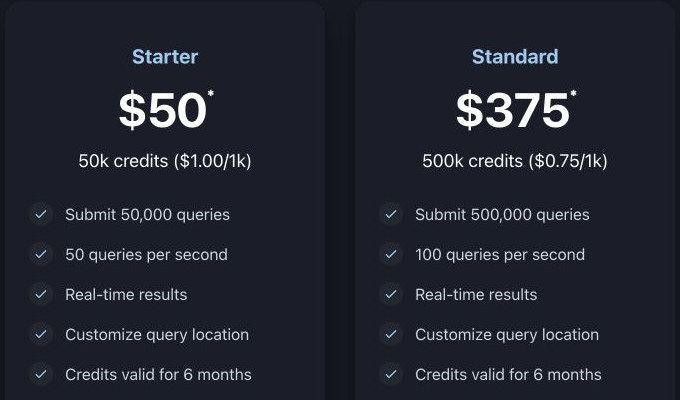
Paid packs start at $50 for 50,000 queries and expire after six months. The 2,500 signup queries should not be described as a verified recurring free allowance, and the terms retain customer lawful-use duties and disclaim Google affiliation. Serper pricing and FAQ, Serper terms.
Prices and specifications verified 2026-11-10 (Scrapingdog rechecked 2026-11-12), USD before applicable taxes. The table compares switching reasons, not interchangeable units.
| Option | Reason to switch | Published cost input | What I would validate first |
|---|---|---|---|
| SerpApi | Localization, structured fields, dedicated Google AI Mode | $25/month for 1K Starter searches | Parser migration, paid retrievals and hourly limits |
| SearchApi | Parsed Google features and conditional legal cover | $40/month for 10K requests | Production+ guarantee scope and extra retrieval budget |
| DataForSEO | Scheduled tasks and richer queued output | Standard $0.60/1K or Live $2/1K organic depth-10 tasks | Queue machinery, modifiers and $50 deposit |
| apiserpent.com | Low-cost five-engine Web units | New credit $0.60 down to $0.03/1K after qualifying deposits | Country-only Deep targeting, requested-page billing, no public PAYG SLA |
| Bright Data | Multiple engines and JSON/HTML/Markdown | PAYG $1.50/1K | Successful-only billing exceptions |
| Scrapingdog | Shared scraping credits and separate AI routes | $10 pay-as-you-go for 25K credits, no expiry; Lite $40/month for 200K | Five credits ordinary Google; ten advanced/AI Mode; pay-as-you-go and plans can’t be combined |
| OpenSERP / SearXNG | Own the software and infrastructure | Software licenses, not hosted query prices | Operations, proxies, permitted collection and JSON settings |
Sources: SerpApi plans and billing, Google Search API, Google AI Mode API, SearchApi homepage and plans, SearchApi terms, Google Organic pricing, Minimum payment, SerpentAPI pricing, SerpentAPI API reference, SerpentAPI FAQ, Bright Data SERP pricing, Bright Data SERP introduction, Bright Data SERP billing, Scrapingdog plans, Scrapingdog pay-as-you-go, OpenSERP, SearXNG, SearXNG search API.
SerpApi and SearchApi #
I would shortlist these when the migration is about specific response fields, not simply cheaper Google calls. SerpApi documents location/uule/device controls, AIO token retrieval and a separate AI Mode engine; SearchApi separately documents Google features, AIO and AI Mode conversations. Google Search API, Google AI Overview API, Google AI Mode API, SearchApi Google reference, SearchApi Google AIO reference, SearchApi Google AI Mode reference.
They also require a different spending model from Serper’s expiring pack: SerpApi Starter is $25 for 1,000 monthly searches; SearchApi begins at $40 for 10,000 monthly requests. Compare consumed volume and hourly/burst needs, not just fully used allowance prices. SerpApi plans and billing, SearchApi homepage and plans.
Both publish conditional legal cover, with plan eligibility and exclusions. SerpApi’s Legal Shield begins at Production; SearchApi’s active Production+ guarantee is capped at $2 million aggregate per 12 months, with downstream-use/storage/redistribution exclusions and discretionary defense provisions. U.S. Legal Shield, SearchApi terms.
SerpApi’s libraries and integration directory support an implementation shortlist, but I did not execute those integrations. G2 support praise and subscription-friction reviews are limited anecdotes; the historical num=100 GitHub issue is a pagination warning, not a current failure-rate estimate. SerpApi libraries, SerpApi integrations, SerpApi G2 reader reviews, SerpApi Google num100 issue3032.

DataForSEO #
I would choose it for a deliberate queue-based redesign. Standard collection posts tasks, then retrieves output by task ID or uses callbacks; a queued POST can contain up to 100 tasks, while Live is a separate synchronous mode. SERP API overview, Google Organic Task POST.
Organic depth-10 Standard is $0.60 per 1,000 tasks, versus $2 for Live, before modifiers. The $50 minimum funding is separate from usage consumed, and the $1 trial is not a recurring monthly production allowance. Google Organic pricing, Minimum payment, DataForSEO FAQ.
If a monitor needs Google AI Overviews, cached AIO and asynchronous AIO have different charge rules; dedicated AI Mode has its own higher tariff. Retention also needs a SERP-specific reading: the main v3 reference gives JSON a 30-day exception including Live. AIO collection help, Google AI Mode pricing, API v3 reference.
The trade-off is application state. A task queue needs collection, status checks and retry discipline; I would not sell the cheapest queued rate as a same-latency swap for a live Serper call. SERP API overview, Google Organic Task POST.
apiserpent.com #
I would shortlist apiserpent.com when five-engine coverage and low Web-unit consumption matter more than city-level targeting or a public PAYG SLA. Its ladder is $0.60 per 1,000 by default, $0.30 after a qualifying $100 deposit, $0.10 after $500, $0.05 after $1,000 and $0.03 after $1,250; your best deposit in a calendar month sets the price for that month’s deposits. SerpentAPI pricing, SerpentAPI API reference, SerpentAPI FAQ.
Deposited credit does not expire; promotional bonus credit expires after 30 days. SerpentAPI pricing.
Credit you already hold keeps the price you paid for it. Minimum first funding is $10; after lifetime deposits reach $50, subsequent top-ups have a $100 minimum. Deposit size is cash committed, not the cost of a month’s actual queries. SerpentAPI pricing.
Quick is organic-only and uses one unit per call. Deep bills each requested page, up to ten, even when output is partial; it has country targeting but not city/uule/raw HTML, so it is not a field-for-field replacement for every Google API. SerpentAPI API reference, SerpentAPI FAQ.
Paid opt-in AIO is documented for Google, Yahoo and Brave; Bing/DuckDuckGo return null for that field, and simple format omits it. The separate include_ai_mode answer add-on costs $0.004 once per paid call, on top of that call’s own rate, but its Google-interface provenance remains unverified. SerpentAPI SERP feature contract, SerpentAPI API reference.
The terms give ten shared trial calls, 12-month inactivity expiry for unused free searches and customer indemnity; there is no verified public PAYG SLA or vendor indemnity. Its published daily limits are not stated the same way across the pricing page and FAQ, so I would confirm the actual account rather than promise the largest advertised daily number. The FAQ documents 90-day query-metadata retention and seven-day async-output retention, another consideration for a privacy-sensitive migration. SerpentAPI terms, SerpentAPI FAQ, SerpentAPI pricing.
Bright Data #
I would price Bright Data for a multi-engine workflow needing JSON, HTML or Markdown. PAYG is $1.50 per 1,000; its Scale plan is $499 per month including 380,000, then $1.30 per 1,000 additional requests. Bright Data SERP pricing, Bright Data SERP introduction.
Its Google parameters include AIO capture, but requesting a feature does not guarantee Google displays one. Default successful-only billing also changes when custom headers or cookies are supplied, because failures can then be billed. Bright Data Google parameters, Bright Data SERP billing.
The free banner needs account-level confirmation before it becomes a production allowance. I did not verify how its shared-product allocation applies to a new account, so my estimates do not stack multiple free quotas. Bright Data SERP pricing.
Scrapingdog #
I would shortlist Scrapingdog when one credit balance needs to serve scraping and Google endpoints. Lite lists $40 per month for 200,000 credits, but Google Light uses five credits and advanced/mobile or AI Mode uses ten. Scrapingdog plans, Scrapingdog Google API, Scrapingdog Google AI Mode.
That is 40,000 ordinary calls or 20,000 advanced/AI Mode calls if the whole allowance goes to that endpoint. The result count parameter is deprecated in the Google reference; use documented pagination and record the requested page instead of assuming extra depth is free. Scrapingdog Google API.
If you liked Serper’s prepaid packs, Scrapingdog’s pay-as-you-go is the closer match: $10 buys 25,000 credits (5,000 ordinary Google calls), and the announcement says “PAYG credits don’t have an expiration date”, unlike Serper’s six-month packs. It also says “You cannot use PAYG & Subscription plans together.” Scrapingdog pay-as-you-go.
Oxylabs or Decodo? Get a current quote first #
Both live pages have moved to broader Web API presentations. Oxylabs now separates target tariffs inside a unified ladder; Decodo’s /search lives beside scrape, map and crawl. Oxylabs SERP in unified Web API, Decodo SERP in Web Data API.
I would not carry old cached SERP plan tables into a migration budget. Decodo’s advertised page/crawl totals are not established Google search allocations, and Oxylabs’ lowest generic rate is not its Google entry rate; actual account generation and endpoint entitlement remain unverified here. Oxylabs SERP in unified Web API, Decodo SERP in Web Data API.
OpenSERP and SearXNG #
Choose OpenSERP when owning an MIT API/CLI for six engines is the point of the project. Choose SearXNG when AGPL metasearch fits; merging engine results is a different goal from reproducing Google’s exact organic ranking. OpenSERP, SearXNG.
Neither removes hosting, proxy, maintenance or permitted-collection work. SearXNG defaults to HTML formats unless configured otherwise, and its API docs warn that many public instances disable JSON; a public instance is not a managed replacement contract. SearXNG search API, SearXNG search settings.
Two community sources illustrate why I would define the target response first: a Reddit poster describes debugging freshness and generated answers, while one HN commenter describes combining search services with SearXNG. These are individual anecdotes, not independent performance evidence or a community consensus. Search APIs interchangeability discussion, Multi-provider search comment.
What should you check before switching? #
I would save a representative, permitted set of request specifications before changing suppliers: country, language, device, page depth, required fields and absence/error states. Then map the new schema, set credit and retry caps, and compare an authorized small sample without inventing a speed or relevance winner.
For an AI requirement, use Google AI Overview and AI Mode APIs. For request-budget detail, compare SerpApi pricing, DataForSEO versus SerpApi and what 22 SERP APIs cost at your volume before rewriting the application around a low advertised rate.
FAQ #
What is the best Serper alternative? #
I would choose by the missing requirement: SerpApi or SearchApi for structured Google features, DataForSEO for task queues, apiserpent.com for low-cost multi-engine Web units, and OpenSERP for infrastructure ownership. Google Search API, SearchApi Google reference, SERP API overview, SerpentAPI API reference, OpenSERP.
Should I switch just because Serper credits expire? #
First compare actual use before the six-month paid-pack expiry. Monthly subscriptions can waste unused capacity too; a lower headline rate is not automatically a lower cost for your consumption. Serper pricing and FAQ, SerpApi plans and billing.
Which Serper alternatives support Google AI Mode? #
SerpApi, SearchApi, DataForSEO and Scrapingdog document dedicated Google AI Mode routes. apiserpent.com’s engine-independent answer option has not been established here as Google AI Mode interface collection. Google AI Mode API, SearchApi Google AI Mode reference, Google AI Mode pricing, Scrapingdog Google AI Mode, SerpentAPI API reference.
Is SearXNG a free Serper replacement? #
It is AGPL metasearch software, not a managed Google SERP contract. JSON must be enabled, many public instances disable it, and the operator still needs infrastructure and maintenance. SearXNG, SearXNG search API, SearXNG search settings.
Can I reuse my Serper JSON parser? #
Do not assume so. Providers differ in organic fields, output functions, task IDs, pagination and AI retrieval. Map the required response and error states before changing the request URL. SERP API overview, Google Search API, SearchApi Google reference, SerpentAPI API reference.
Does Serper have an AI Overview endpoint? #
I did not verify a public dedicated AIO or AI Mode endpoint in the sources checked on November 10, 2026. That is a documentation gap in this comparison, not a claim that the feature can never exist. Serper pricing and FAQ.
Sources
45 sources, accessed to .
Official pricing, docs, changelogs and status pages 39
- Serper pricing and FAQ
- Serper terms
- SerpApi plans and billing
- U.S. Legal Shield
- Google Search API
- Google AI Overview API
- Google AI Mode API
- SerpApi libraries
- SerpApi integrations
- Google Organic pricing
- SERP API overview
- Google Organic Task POST
- Minimum payment
- API v3 reference
- AIO collection help
- Google AI Mode pricing
- DataForSEO FAQ
- SerpentAPI pricing
- SerpentAPI API reference
- SerpentAPI terms
- SerpentAPI FAQ
- SerpentAPI SERP feature contract
- SearchApi homepage and plans
- SearchApi terms
- SearchApi Google reference
- SearchApi Google AIO reference
- SearchApi Google AI Mode reference
- Bright Data SERP pricing
- Bright Data SERP introduction
- Bright Data Google parameters
- Bright Data SERP billing
- Oxylabs SERP in unified Web API
- Decodo SERP in Web Data API
- Scrapingdog plans
- Scrapingdog pay-as-you-go
- Scrapingdog Google API
- Scrapingdog Google AI Mode
- SearXNG search API
- SearXNG search settings


