Alternatives
Google Custom Search API Alternatives Before It Shuts Down
Google's Custom Search JSON API stops working on Jan 1, 2027. Here's what replaces it for site search, Google results and AI agents, priced at your volume.

Custom Search stops on January 1, 2027
Google’s Custom Search JSON API stops working for existing customers on January 1, 2027, and it is already closed to new sign-ups. Aim to have a replacement live by mid-December, so you have time to fix whatever breaks.
Google has put its Custom Search JSON API on a clock. Its API overview says the API “is closed to new customers” and that existing customers “have until January 1, 2027 to transition to an alternative solution.”
The right replacement depends on what you used it for, so I’ve split this page by job. I priced every option at three volumes taken from Google’s own limits: 3,000, 30,000 and 300,000 queries a month, which cost $0, $135 and $1,485 on Custom Search.
- Job 1: site search on your own site. A docs site, a university, or a WordPress or Drupal plugin searching your own domains.
- Job 2: Google web results in your app. Rank trackers, SEO tools, and apps that show or process what Google returns for any query.
- Job 3: an AI agent that needs web search. An LLM app that needs fresh pages to read and cite, where Google’s exact ranking matters less.
If you’re choosing a search API from scratch rather than replacing Custom Search, start with my guide to web search APIs for AI agents instead. If you only want to know what Google itself still sells, and at what price, my Google Search API explainer covers that.
Short on time?
Here's my take
- Site search, free
- Programmable Search Element (Standard)
- Stays free for up to 50 domains. It shows ads and returns no JSON, so it only fits if a search box on your pages is all you need.
- Site search through an API
- Google Agent Search, Enterprise
- Google's named replacement. Enterprise is $4/1K: $120 at 30K, or $80 if the advertised 10K trial allowance applies; storage may add cost.
- Google results, lowest cost
- apiserpent.com (SerpentAPI)
- $30 a month at 300K after a $500 Scale deposit, against $1,485 on Custom Search. No public PAYG SLA or comparable shield established; deposits are generally non-refundable.
- Google results with legal cover
- SearchApi
- The cheapest legal cover I found: the $100 Production plan covers 35K searches a month, with up to $2M in coverage.
- AI agents
- Brave Search API
- Its own index at Custom Search's $5 per 1,000, minus a $5 monthly credit. A card is required, and storing results needs a plan with storage rights.
Prices verified . Public documentation rechecked 6 Nov 2026; conditional costs are labeled. They may change, so re-check before you commit.
When does the Google Custom Search API shut down? #
On January 1, 2027, for existing customers, and it’s already closed to new ones. Whole-web Programmable Search engines lose that option the same day, while the embedded search box stays.
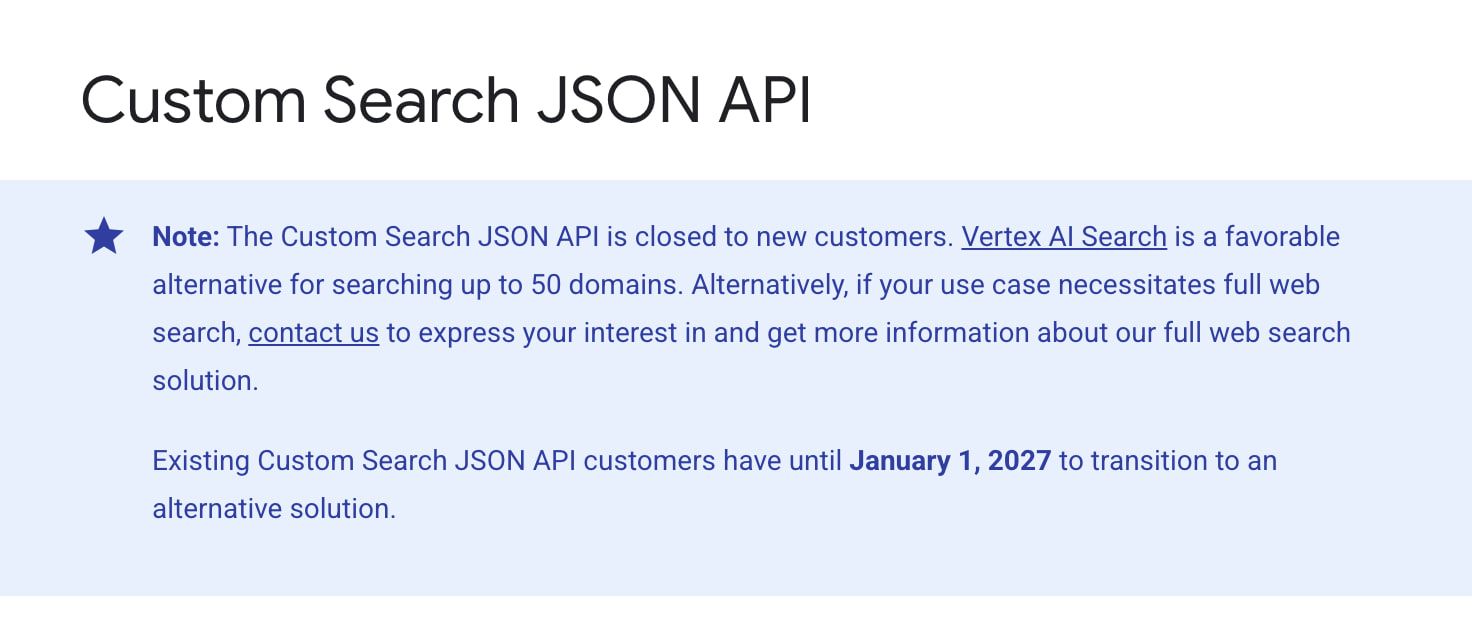
Three Google products are involved, and they end on different terms. Here’s where each one stands on Google’s own pages rechecked on 6 November 2026.
| Product | What happens | Date |
|---|---|---|
| Custom Search JSON API | Closed to new customers. Existing customers must move off | January 1, 2027 |
| “Search the entire web” in Programmable Search Engine | Existing whole-web engines keep it until the deadline. New engines can’t use it | January 1, 2027 |
| Programmable Search Element (the embedded search box) | Stays, for up to 50 domains. The Standard version is free and shows ads | No end date announced |
| Site Restricted JSON API | Already stopped | January 8, 2025 |
The JSON API wording is on Google’s Custom Search overview. Google doesn’t say when it closed to new sign-ups, and I couldn’t find a primary source that dates it.
The current migration rules are on Google’s help page. Google’s help page says all new engines “must now be configured to use the ‘Sites to search’ feature” with up to 50 domains, and that existing whole-web engines “can continue to use this option until January 1, 2027.”
One trap is on that same help page. Once you switch “Search the entire web” off, it “can not be toggled back to On,” so leave it alone while you’re still testing a replacement.
The Site Restricted JSON API page says it would “cease to serve traffic on January 8, 2025.” Plugins such as WordPress’s Search with Google and Drupal’s google_json_api are built on Google’s JSON APIs, so check which one yours calls.
What survives is the embedded search box. The Programmable Search offerings table lists a free Standard Search Element with ads and a free ad-free Non-profit Element. On 6 November 2026 it no longer listed the paid ad-free Programmable Search Element ($5 per 1,000 queries) or the JSON API row that it showed in October.
Google hasn’t said whether that paid element has ended or continues after January 1, 2027.
What Custom Search gave you, and what it cost #
What you had on the Custom Search JSON API
Verified
| Plan | Price | Daily allowance | Results per request | Deepest result you can reach |
|---|---|---|---|---|
| Free | $0 | 100 queries | 1 to 10 | Result 100 |
| Paid | $5 per 1,000 | Up to 10,000 queries | 1 to 10 | Result 100 |
Source: Google Custom Search JSON API overview and API reference, closed to new customers; ends for existing customers on January 1, 2027
Per Google’s overview, the first 100
queries a day were free, and “additional requests cost $5 per 1000 queries, up to 10k queries per
day.” The API reference
caps num at 10 results per request and returns an error if start + num goes past 100.
For the baseline I assume usage is spread evenly across a 30-day month. At 3,000 queries that is 100 daily and $0; at 30,000 it is 1,000 daily, with 27,000 paid queries costing $135. A monthly total alone does not guarantee that daily free queries or caps cover your traffic.
At the cap of 10,000 a day, or 300,000 a month, the first 100 a day are still free, so you pay for 297,000, which is $1,485. Google’s wording doesn’t say whether the cap includes the 100 free queries. If it doesn’t, the true ceiling was 10,100 a day, about 303,000 a month, for $1,500.
One more thing to keep in mind when you compare replacements. Google’s help page says Programmable Search results “are unlikely to match those returned by Google Web Search,” so you were never getting google.com’s exact results.
What does each replacement cost at your volume? #
At the 300K-a-month cap, the selected Scale deposit gives a $30 Google-results bill on apiserpent.com against $1,485 on Custom Search, while the Standard Search Element and Pagefind cost nothing for site search at any volume. The rest land in between, and a few cost more than Custom Search did.
This table puts every option I shortlisted at the same three volumes. I subtract a free allowance only where the documented scenario supports it. Bright Data’s PAYG stacking is unconfirmed, and Tavily’s 3K PAYG cell shows both conditional outcomes rather than assuming its free allowance carries over.
Prepaid deposits count as balance, not cost, which matters for apiserpent.com. For per-1,000 rates across more vendors, with a verified date on each, see the search API price tracker.
| Option | Job | Index | 3K a month | 30K a month | 300K a month | Free allowance | Legal cover |
|---|---|---|---|---|---|---|---|
| Custom Search JSON API (ends 2027) | Baseline | $0 | $135 | $1,485 | 100 a day | Not listed | |
| Programmable Search Element, Standard | Site search | Google, up to 50 domains | $0 | $0 | $0 | Free, shows ads | Not listed |
| Agent Search, Enterprise | Site search | Google, your sites | $12; $0 with eligible trial | $120; $80 with eligible trial | $1,200; $1,160 with eligible trial | 10K/month labeled Free Trial | Not listed |
| Algolia Grow (requests only) | Site search | Your content | $0 | $10 | $145 | 10K requests/month; <=100K records assumed | Not listed |
| AddSearch | Site search | Your content | From $119 (annual) | Not published | Not published | 14-day trial | Not listed |
| Pagefind | Site search | Your static site | $0 | $0 | $0 | Open source | Not listed |
| apiserpent.com (SerpentAPI) Lowest cost | Google results | Google SERP | $1.80 | $9 | $30 | 10 shared evaluation calls, one-time | Not established |
| DataForSEO, standard queue | Google results | Google SERP | $1.80 | $18 | $180 | $1 trial credit | Not established |
| Scrapingdog | Google results | Google SERP | $6 ($10 pay-as-you-go top-up) | $40 | $200 | 100 initial credits (20 Light searches) | Not established |
| Serper | Google results | Google SERP | $8.33 | $30 | $208 | 2,500, one-time | Not established |
| Bright Data SERP API | Google results | Google SERP | $0 | $45 | $450 | 5K a month | Not established |
| SearchApi | Google results | Google SERP | $40 | $100 | $900 | 100, one-time | From the $100 plan |
| SerpApi | Google results | Google SERP | $75 | $275 | $2,750 | 250 a month | From the $150 plan |
| Brave Search API | AI agents | Own index | $10 | $145 | $1,495 | $5 credit a month | Not listed |
| Exa Fast/Auto (selected mode) | AI agents | Own index | $11 | $200 | $2,090 | $10 credit a month | Not listed |
| Tavily (basic search) | AI agents | Own or aggregated | $24 without free stacking; $16 if applicable | $220 | $2,100 | Free plan: 1K/month; PAYG stacking unconfirmed | Not listed |
| Gemini 3 grounding | AI agents | $0 | $350* | $4,130* | 5K searches a month | Not listed |
Source: Public list prices rechecked 6 Nov 2026, except Agent Search (last read 16 Oct 2026) and Scrapingdog (rechecked 12 Nov 2026); selected one-page scenarios, not observed invoices or guaranteed minimum bills. Custom Search assumes even daily usage over 30 days. Gemini adds model tokens; other optional fees and taxes are excluded. Scroll sideways for more columns.
How to read the cost scenarios
apiserpent.com uses selected deposits: $10 Default at 3K, $100 Growth at 30K and $500 Scale at 300K. Deposits are prepaid balance, not fees; Enterprise ($1,000) and Enterprise Plus ($1,250) deposits lower the rate further but are not the selected scenarios. Existing credit retains its original schedule.
Scrapingdog at 3K uses pay-as-you-go credits that never expire (15,000 credits a month from a $10 top-up); at 30K and 300K its Lite and Pro plans cost less. Serper’s six-month expiry is included, with displayed totals rounded. SearchApi at 300K needs the $900 Octo 500K plan; the $500 Scale plan covers 250K. Bright Data paid totals exclude unconfirmed free/paid stacking.
Agent Search shows costs both without its trial and with an eligible 10K allowance, plus storage beyond 10 GiB. Algolia assumes Grow keyword search, at most 100K records and no other paid products. Exa uses Fast/Auto, not the cheaper Instant mode; Gemini assumes one search per user query plus model tokens.
Does Tavily PAYG keep the free credits? Still unclear
On 6 November 2026, Tavily’s credit docs, pricing page, PAYG billing guide and pricing help still did not explicitly confirm whether a separate PAYG account retains the free plan’s 1,000 monthly credits.
For 3,000 basic searches, 3,000 × $0.008 = $24 without that allowance; if it applies, (3,000 − 1,000) × $0.008 = $16. I show both possibilities rather than claim a verified lowest bill. No account billing or invoice was checked.
Here’s what that means for three typical readers.
A small site at 3,000 queries a month #
Custom Search cost you nothing, and several options still cost nothing. For site search, the free Standard Search Element and Algolia Grow’s 10,000 included monthly requests cover this query volume. Agent Search costs $12 for 3K Enterprise queries before any eligible trial allowance or storage charges.
For Google results, Bright Data’s SERP API includes 5,000 free records a month; I compare it with the other free Google SERP API tiers in a separate guide. The cheapest paid route is apiserpent.com at $1.80 a month on its $0.60 per 1,000 default rate, but new users need a $10 minimum deposit. The DataForSEO standard queue ties at $1.80, with a $50 minimum payment and results in about 5 minutes.
An app at 30,000 queries a month #
Custom Search cost $135 a month. For Google results, apiserpent.com is $18 on its default rate or $9 after a one-time $100 deposit, the DataForSEO standard queue is $18, Serper is $30 and Bright Data is $45.
If you need legal cover, SearchApi’s Production plan at $100 covers 35,000 searches. For site search through an API, Agent Search Enterprise query charges are $120, or $80 if its 10K trial allowance applies, plus index storage past 10 GiB.
A heavy user at 300,000 queries a month #
This is where the gap is widest. Against $1,485 on Custom Search, apiserpent.com’s Scale tier is $30 a month after a $500 deposit, the DataForSEO queue is $180, Scrapingdog is $200 and Serper is $208 (its $1,250 pack, used within its six-month expiry).
At 300K, Agent Search Enterprise query charges are $1,200, or $1,160 with the eligible trial allowance. Gemini grounding is $4,130 before model tokens in the one-search-per-query scenario. Brave, at $1,495, lands almost exactly on your old Custom Search bill.
Does Google have its own replacement? #
For site search, yes: Agent Search (formerly Vertex AI Search) is the official replacement Google names, and it covers searching up to 50 domains, not the whole web. Google offers three official routes in all, and none of them is a like-for-like swap for a whole-web JSON API.
For every official Google search option in one place, with free tiers and prices, see my guide to Google’s search API options.
Agent Search (formerly Vertex AI Search) #
Google’s overview calls Vertex AI Search “a favorable alternative for searching up to 50 domains.” Google renamed it Agent Search in April 2026, per Google Cloud’s release notes, so you’ll see both names on Google’s pages.
The pricing trap is the edition. Google’s migration guide says “Make sure Enterprise edition features is turned on. This is required for website search.”
On the pricing page, Search Enterprise is $4.00 per 1,000 queries, not the $1.50 Standard rate. The same page lists a trial allowance of 10,000 queries per account per month and 10 GiB of free index storage monthly.
The same pricing page labels the allowance Free Trial, and its annual example deducts only 10K queries rather than twelve monthly allowances. I therefore show costs with and without it; eligibility and duration are not established by an account check. The migration guide points Custom Search users to “Site search with AI mode” and suggests turning off generative responses if you want plain results like before.
It publishes no parameter-by-parameter map from Custom Search. The searchLite method keeps API-key
auth, while search and answer need OAuth 2.0.
What about whole-web search? There’s a form #
For whole-web results, Google’s overview directs readers to an interest form. That notice does not establish a public self-serve tariff, eligibility or result contract.
One open-source project that asked has published the answer it got: on 2 November 2026 its maintainer posted an excerpt of a Programmable Search team reply quoting “USD $15 CPM” with “a minimum monthly fee of USD $30,000” (creativecommons/quantifying#293). That is one customer’s self-reported quote, not a published Google price list.
I did not establish a generally available direct whole-web JSON replacement from current public primary documentation. Do not make a migration depend on an unconfirmed partner arrangement.
Gemini grounding with Google Search #
If you build on Gemini, grounding lets the model search Google and cite what it finds. The Gemini API pricing page gives Gemini 3 models 5,000 free search requests a month on the paid tier, then $14 per 1,000.
Billing is per search the model runs, not per prompt. Google’s grounding docs say that with Gemini 3, “your project is billed for each search query that the model decides to execute,” so one prompt that triggers three searches is billed three times.
It also comes with display rules. The Gemini API terms require you to “display the Grounded Results with the associated Search Suggestion(s)” and restrict caching, redistribution and independent reuse. The terms contain narrow storage exceptions, including specified display-evaluation and chat-history uses for up to two years; that is not permission to build a search-result database.
So if you need raw results to store or reprocess, grounding isn’t that. On Google Cloud’s agent platform, Web Grounding for Enterprise was listed on 16 October at $14 per 1,000 executed grounding queries on Gemini 3/4 models and $45 per 1,000 grounded prompts on older models. Its product guide describes a curated subset of Google’s index, and it’s not in the cost table.
Job 1: what replaces Custom Search for site search? #
Pick the free Standard Search Element if a search box on your pages is enough and ads are acceptable. Google’s offerings table lists it as free with no daily limit, for up to 50 domains.
It runs as client-side JavaScript, so your code gets no JSON back. Non-profits can use the ad-free Non-profit Element instead.
Pick Agent Search Enterprise if you need an API and want to stay with Google. Query-only Enterprise costs are $120 at 30K and $1,200 at 300K; an eligible 10K trial allowance would reduce those to $80 and $1,160 respectively.
Pick a site-search vendor if you want full control of ranking and the interface. AddSearch starts from $119 a month, billed annually, with a 14-day trial, but it doesn’t publish volume limits.
Algolia Grow includes 10K monthly keyword-search requests, then $0.50 per additional 1K. It separately includes 100K records, then $0.40 per additional 1K records. At 30K requests the request charge is $10; extra records or other products are outside that calculation.
Pick Pagefind if your site is static. It’s an open-source library that runs search “without hosting any infrastructure,” per its site, so there’s no per-query bill.
For a docs site on a handful of domains, I’d start with Pagefind or Algolia’s free plan before paying Google. Pagefind has no per-query API fee, though you still host your site; Algolia Grow includes 10K monthly requests within the separate record allowance. I’d move to Agent Search only if you want Google’s ranking or its AI answers.
Job 2: what replaces Custom Search for Google web results? #
The practical replacement is a SERP API: a third-party service that fetches Google’s results page and returns it as JSON. This is the job Google no longer serves publicly.
For full pricing at 1K, 100K and 1M searches, see my cheapest SERP API comparison. If you’re weighing SerpApi specifically, my SerpApi alternatives guide compares engines and legal cover.
Read the legal section below before you pick one. Unlike Google’s own products, these services aren’t Google products, and Google is suing one of them.
apiserpent.com (SerpentAPI) costs the least at 30K and 300K #
I name it by its domain because serpentapi.com is an unrelated product. Of the options I priced, apiserpent.com has the lowest list price for Google results at 30,000 and 300,000 queries a month.
Its pricing page lists $0.60 per 1,000 on the default rate, $0.30 after a qualifying $100 deposit (Growth), $0.10 after $500 (Scale), $0.05 after $1,000 (Enterprise) and $0.03 after $1,250 (Enterprise Plus), rechecked 6 November 2026. Each deposit is priced by its size, your best deposit in a calendar month sets the price for that month’s deposits, and credit you hold keeps the price you bought it at. Those deposits are prepaid balance, not fees.
Quick bills one Web unit per call; Deep bills one per requested page. Purchased credit never expires, while promotional bonuses expire after 30 days, per the FAQ.
There’s no subscription. New users can start with a $10 deposit plus 10 free searches; once lifetime deposits reach $50, the pricing page sets a $100 minimum for further top-ups.
Two details matter for Custom Search users. Optional AI Overview fields can be requested on eligible paid Deep calls with
include_aio=true, per its FAQ, and Deep is billed per page, so a
10-page call counts as 10 units even if delivery is short. The 10 shared free evaluation calls expire after 12 months of inactivity; this does not expire deposited credit.
Its docs say a Quick call returns about 10 results by default and up to a requested ceiling of 100 for one charge, on a best-effort basis. I have not verified the output against Google’s UI or run a product call.
The weaknesses are real, and they’re mostly in the paperwork. Its FAQ says “No public SLA is currently published for pay-as-you-go accounts.”
The terms put the service under Indian law with arbitration in India and provide it “AS IS.” They cap liability at the fees you paid in the prior 12 months, make credits “non-refundable except as required by law,” and impose customer indemnity. I did not establish comparable vendor-funded scraping protection.
I also couldn’t find a founding date or any independent benchmark. Treat a $500 Scale deposit as a generally non-refundable commitment, subject to the terms and mandatory law.
What stands out
- The lowest list price I found for Google results at 30K and 300K a month
- Prepaid deposits never expire, and there is no subscription
- Optional AI Overview fields on eligible paid Deep calls, without a separate advertised surcharge
- You can start with a $10 deposit
What gives me pause
- No public SLA for pay-as-you-go accounts
- Customer indemnity; no comparable vendor shield established
- Credits are non-refundable, and the terms are "AS IS" under Indian law
- No founding date or independent benchmark that I could find
If I were moving a 300K-a-month rank tracker here, I’d compare Scale ($30 a month after $500) with Growth ($90 after $100). Growth parks $400 less but costs $60 more each month.
Enterprise is $15 a month after $1,000 (about 67 months of balance at this volume) and Enterprise Plus is $9 after $1,250 (about 139 months); Scale lasts about 16.7 months. I’d keep a second provider wired in as a fallback.
The new-credit schedule was rechecked on 6 November 2026. Between my 16 October and 6 November checks, Enterprise moved from $0.03 to $0.05 per 1K and a new $1,250 Enterprise Plus tier took the $0.03 rate; the terms allow pricing changes with 30 days’ notice. These are published rates, not observed bills; recheck them before depositing.
The other SERP APIs I priced #
-
DataForSEO: $0.60 per 1,000 on its standard queue, which takes about 5 minutes, or $2 per 1,000 for live results. Search operators such as
site:multiply the price by 5, and the minimum payment is $50. -
Serper: 2,500 free queries with no card, then prepaid packs from $50 for 50,000. Credits expire after 6 months, which is why 3K a month works out to $8.33.
-
Bright Data SERP API: 5,000 free records a month, then $1.50 per 1,000 PAYG by default. Custom headers or cookies change billing to all attempts. Its Scale plan shows $499 a month for 380K requests, then $1.30 per 1,000; the table’s 300K PAYG total excludes unconfirmed free-credit stacking.
-
Scrapingdog: a Google search costs 5 credits, so the $40 Lite plan covers 40,000 searches and the $200 Pro plan covers 600,000. For small volumes, pay-as-you-go sells 25,000 credits (5,000 searches) for $10 with no expiry, which is why 3K a month works out to $6; it can’t be combined with a plan. Rechecked 12 November 2026.
-
SearchApi: plans from $40 a month. Production at $100 adds legal protection “backed by up to $2M in coverage,” and its terms promise a 99.9% SLA on every plan.
-
SerpApi: a broader catalog with monthly plans, from $25 a month for 1,000 searches. Its Legal Shield starts on the $150 Production plan, and its legal page promises a 99.95% SLA on all plans. Its separate Extract API, checked 6 November, supports scraping, mapping, crawling and Markdown; it follows robots.txt and does not execute JavaScript. This is a separate request from a Google SERP response.
My Serper vs SerpApi comparison covers the wider choice.
Job 3: what should an AI agent use instead of Custom Search? #
Agents usually need relevant, fresh pages to read, not Google’s exact ranking. That opens up APIs with their own index, which changes the data source but does not remove data-rights and contract questions. For the wider picture, see my comparison of the four ways to add web search to an agent.
- Brave Search API: “$5 per 1,000 requests” with “$5 in free monthly credits,” per its API page. A card is mandatory, and it allows 50 queries per second.
- Brave’s storage rule: its terms bar you from storing or caching results “other than transient storage” unless your plan grants storage rights. Brave also publishes a Custom Search migration guide, which is useful but is a vendor pitch.
- Exa: Instant $4 or Fast/Auto $7 per 1,000 searches, with up to 10 results at the base price; Deep modes are $12–$15. Standalone Contents is $1 per 1,000 pages per content type. The table retains its selected Fast/Auto scenario, not a cheapest-mode guarantee; mode quality has not been compared here.
- Tavily: 1,000 free credits a month with no card, separate pay-as-you-go at $0.008 a credit, or plans from $30 for 4,000 credits. Free-credit retention after switching to PAYG is unconfirmed. An advanced search costs 2 credits. My Tavily pricing breakdown works through its credits.
- Gemini grounding: the natural pick if your agent already runs on Gemini. The display rules above apply, and it’s the most expensive option at volume.
- SearXNG: free, self-hosted metasearch. JSON output has to be enabled in settings, and its docs say “many public instances have these formats disabled,” so plan to host your own.
- Bing Search API: not an option. Microsoft retired it on August 11, 2025 and points developers to Grounding with Bing Search in Azure AI Agents.
Two issue reports illustrate migration concerns; they are self-selected examples, not a measure of prevalence. Creative Commons’ quantifying project has an open issue about losing its free whole-web data collection, and an image-search plugin has an open issue where Google search fails to activate, which a commenter traces to new users being unable to create whole-web engines.
I would keep a fallback provider for an agent. None of these providers is the obvious long-term winner yet, and a thin wrapper makes the next switch cheap.
Is it legal to use a SERP API for Google results? #
There’s no settled answer yet: Google is suing SerpApi in federal court in Northern California, and the cited records do not establish a final outcome. This section is facts, not legal advice. The case was filed on December 19, 2025, as recorded in the July order.
The court’s July 20, 2026 order dismissed Google’s claims over results with no copyrighted content without leave to amend, and gave leave to amend only for results with a copyrighted component (ECF 42). Google filed an amended complaint on August 10, and the court vacated the October 13 hearing on October 5 on SerpApi’s second motion to dismiss. The order allows a replacement date or written decision.
Where the Google docket stood on 6 November 2026
I read ECF 60 and the two-page ECF 61 in full. On 6 November 2026 the public docket still listed Google’s 12 October notice of a decision in another case as the last known filing. That notice is not a ruling on SerpApi’s second dismissal motion; I did not establish a replacement hearing or later merits outcome.
RECAP can lag or omit PACER filings, so check the docket before relying on this; index silence is not proof that nothing else happened.
I’ve set out what the lawsuits mean for SERP API customers, including Reddit’s separate case, on my Google v. SerpApi page.
Among the reviewed contracts, SerpApi (from its $150 Production plan) and SearchApi (from its $100 Production plan) offer legal protection, each up to $2 million subject to eligibility, exclusions and cooperation conditions. SerpApi excludes Free, Starter and Developer; SearchApi limits payment to $2M per 12 months and retains discretion over defense.
Neither protects every downstream use. Customer indemnity elsewhere does not itself prove the absence of vendor protection.
Own-index APIs avoid relying on another vendor’s Google SERP collection, but still have their own contracts and data-rights obligations. Neither architecture guarantees that every use is lawful.
How do you migrate off Custom Search? #
Pick a replacement by job, map your request parameters and response fields to it, run old and new side by side, and cut over by December 15. Here’s the full checklist.

- Confirm which Google product you call. The JSON API ends January 1, 2027. The embedded Search Element stays, and the Site Restricted API already stopped in January 2025.
- Measure your real volume. Take your monthly query count from your Google billing and find your row in the cost table. Budget for your peak month, not the average.
- Pick by job, and shortlist two. Choose one primary and one fallback, and put both behind a single function in your code so switching is a config change.
- Map your request parameters. List every Custom Search parameter you send (the API reference documents
q,cx,num,start,gl,hl,lr,siteSearch,dateRestrictandsafe) and find each one’s equivalent in the new docs.cxhas no equivalent outside Google, andsiteSearchusually becomes asite:operator, which the DataForSEO pricing page bills at five times the base search charge; other options can add charges. - Replace the 100-result paging. Custom Search gave you 10 results per call and 100 in total. Check how your new provider pages, and how it bills each extra page.
- Map the response fields. Your code reads each result’s title, link and snippet, and maybe the result count. Write a small adapter that turns the new response into the shape your code already expects.
- Check auth. Agent Search’s
searchLitekeeps API-key auth, whilesearchandanswerneed OAuth 2.0. - Read the storage and display terms. Brave allows only transient storage unless your plan grants storage rights, and Gemini grounding has to be shown with its Search Suggestions. If you store results today, this can decide your pick.
- Sort out billing. Brave needs a card, apiserpent.com deposits are non-refundable, Serper credits expire after 6 months, and SerpApi and SearchApi are monthly plans.
- Run old and new side by side. Send your top queries to both and compare. Custom Search never matched google.com exactly, so aim for useful, not identical.
- Leave whole-web engines switched on until you cut over. Once “Search the entire web” is off, Google won’t let you turn it back on.
- Work to dates. Pick and build by November 15, run both in parallel into December, cut over by December 15, and retire the old key after January 1, 2027.
Which one should you pick? #
- You run a docs site on up to 50 domains, and ads are fine: the free Standard Search Element. If you’re a non-profit and want no ads, use the Non-profit Element.
- Your site is static: Pagefind. It’s free and needs no server.
- You need Google’s site-search API: Agent Search Enterprise, $120 in query charges at 30K, or $80 with the eligible trial allowance, plus any extra storage.
- You run a rank tracker or SEO tool on a tight budget: apiserpent.com, starting on the $100 Growth deposit, with the DataForSEO queue as a fallback if you can wait about 5 minutes per result.
- Your company needs a contract and legal cover: SearchApi Production at $100 a month, or SerpApi Production at $150 if you want SerpApi’s 99.95% SLA (SearchApi promises 99.9%).
- You’re building an AI agent: Brave if you want the closest price to Custom Search, Tavily if you want to start without a card, and Gemini grounding only if you already run on Gemini.
- You want Google’s whole-web index straight from Google: fill in Google’s interest form now, and have a SERP API ready in case you don’t hear back before January.
FAQ
When does the Google Custom Search API shut down?
On January 1, 2027. Google's overview says the Custom Search JSON API is closed to new customers, and existing customers have until that date to move to an alternative.
Whole-web Programmable Search engines lose "Search the entire web" on the same day. The Site Restricted JSON API already stopped on January 8, 2025.
What should I use instead of the Google Custom Search API?
It depends on the job. For site search, Google names Agent Search (formerly Vertex AI Search); its trial eligibility needs checking. The free Standard Search Element or Pagefind may be enough.
For Google SERP-style results, consider a third-party SERP API, because the reviewed Google notice does not establish a public direct whole-web JSON replacement. For AI agents, Brave Search API is the closest to Custom Search on price.
For every official Google option with its price, see the Google Search API guide on this site.
Is there a free alternative to the Google Custom Search API?
Yes, for site search. The Standard Programmable Search Element stays free for up to 50 domains (with ads and no JSON), Pagefind is free for static sites, and Algolia's free plan includes 10,000 search requests a month.
For Google web results, Bright Data's SERP API includes 5,000 free records a month, and SearXNG is free if you host it yourself. Whether Custom Search itself is free is covered in the Google Search API guide on this site.
Is it legal to use a SERP API instead?
There's no settled answer, and this isn't legal advice. Google is suing SerpApi in federal court in California.
On July 20, 2026 the court dismissed Google's claims over results with no copyrighted content without leave to amend and let Google amend the rest, and the court vacated the October 13 hearing on the motion to dismiss the amended complaint on October 5 (ECF 60); I found no replacement hearing date or written decision in the records I checked.
Of the providers I compared, SerpApi (above its excluded entry plans, from $150/month) and SearchApi (active Production or higher, from $100/month) state conditional protection up to $2M. This does not guarantee coverage for your use.
Is there another search index developers can call instead of Google's?
For developers, the realistic alternatives are other indexes you can call through an API. Brave Search API ($5 per 1,000 requests, its own index) and Exa (Instant $4 or Fast/Auto $7 per 1,000 searches) are the two I'd look at first.
Neither returns Google's ranking. If you need what people see on google.com, you need a SERP API instead.
What happens to my Programmable Search Engine on January 1, 2027?
If it searches the entire web, it loses that option. Google's help page says existing whole-web engines can keep it until January 1, 2027, and new engines are limited to up to 50 domains.
Engines set to specific sites keep working through the free Search Element. Once you switch whole-web search off, you can't switch it back on.
Can I use the Bing Search API instead?
No. Microsoft retired the Bing Search APIs on August 11, 2025, and points developers to Grounding with Bing Search in Azure AI Agents instead.
Sources
50 sources, accessed to .
Official pricing, docs, changelogs and status pages 41
- Tavily PAYG calendar resets and billing
- Tavily help: Free and PAYG listed separately
- SerpApi separate Extract API
- Google Custom Search JSON API: overview and pricing
- Custom Search JSON API reference: cse.list
- Custom Search Site Restricted JSON API
- Programmable Search help: Sites to search and whole-web engines
- Programmable Search help: offerings and pricing table
- Programmable Search help: why results differ from Google Web Search
- Agent Search release notes (renamed from Vertex AI Search)
- Google Cloud guide to migrating from Custom Search
- Agent Search pricing
- Gemini API pricing
- Gemini API docs: grounding with Google Search
- Gemini API additional terms of service
- Google Cloud agent platform generative AI pricing
- Microsoft Bing Search APIs retirement notice
- Brave Search API plans and pricing
- Brave Search API terms of service
- Exa pricing
- Tavily API credits and plans
- Tavily pricing and FAQ
- SerpApi pricing
- SerpApi legal terms and U.S. Legal Shield
- SearchApi pricing
- SearchApi terms of service
- Serper pricing
- DataForSEO Google Organic SERP API pricing
- DataForSEO FAQ (minimum payment)
- Bright Data SERP API pricing
- Scrapingdog pricing
- Scrapingdog pay-as-you-go announcement
- apiserpent.com (SerpentAPI) pricing
- apiserpent.com (SerpentAPI) FAQ
- apiserpent.com (SerpentAPI) terms of service
- apiserpent.com (SerpentAPI) docs
- AddSearch pricing
- Algolia pricing
- Pagefind static search library
- SearXNG search API docs
- Bright Data successful-only and custom-request billing
GitHub code, issues and releases 2
Other sources 6
- Google ECF 61: party notice, 12 Oct 2026
- Google v. SerpApi public docket (CourtListener), checked 6 Nov 2026
- Google v. SerpApi ECF 60: hearing vacated on 5 Oct 2026
- Court order: Google v. SerpApi, ECF 42, order granting the motion to dismiss (July 20, 2026)
- WordPress plugin: Search with Google
- Drupal module: google_json_api


