Pricing
I Worked Out Tavily Pricing at 1K, 100K and 1M Searches
Tavily plans run from free to $500 a month, PAYG is $0.008 a credit, and advanced search costs double. Here's the math at 1K, 100K and 1M searches.

Basic Tavily Search costs one credit, advanced costs two, and the PAYG input is $0.008 per credit; a 100,000-basic-search month fits the $500 Growth allowance. I would budget Tavily by endpoint, search depth and monthly consumption, rather than multiply every action by one “search” price. Credits, Search reference.
Short on time?
Here's my take
- Trying basic search
- Inspect the free 1,000 credits
- One-credit basic requests fit differently from advanced searches and research jobs.
- Predictable monthly volume
- Compare Growth with PAYG
- At 100,000 basic searches, the documented Growth allowance is $500 versus $800 gross PAYG.
- Agent research
- Cap task and depth settings
- Research tasks and automatic advanced search can consume substantially more than one credit.
Prices verified . Sponsors cannot buy a verdict or a position.
This is the billing guide in the search API pillar. For a provider change rather than a bill calculation, use Tavily alternatives; this page focuses on the settings that change Tavily’s own consumption. To set Tavily’s rate beside other AI search APIs per 1,000 calls, use the web search API pricing comparison.
What does Tavily charge per search? #
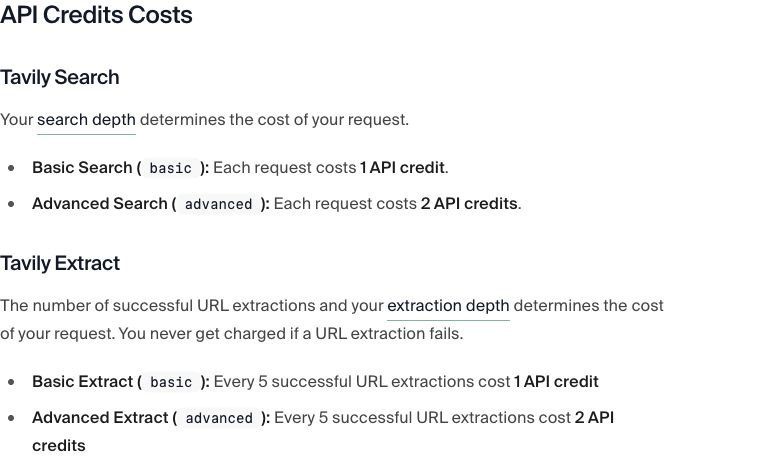
Basic, fast and ultra-fast Search use one credit per request, while advanced uses two. Search supports up to 20 results and optional answer/raw-content settings; an automatically selected advanced depth can double the base credit count. Search reference.
I would make the depth explicit in a cost estimate and record whether automatic parameters are enabled. A request count with those options missing is not a reproducible budget.
How much does each Tavily plan cost? #
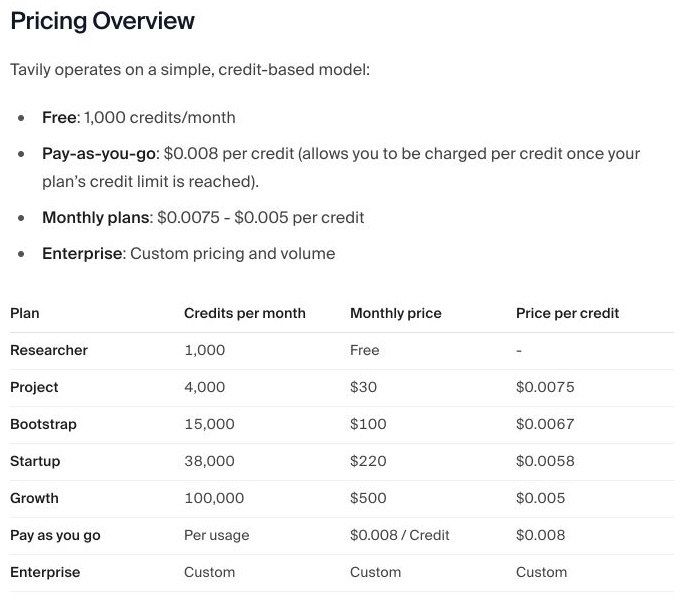
Paid monthly plans run from Project at $30 for 4,000 credits to Growth at $500 for 100,000, with Enterprise quoted separately.
Prices and specifications verified: 2026-11-06, USD before tax and account-specific conditions.
| Monthly purchase | Included credits | Listed purchase / credit if fully used | Basic Search capacity if nothing else uses credits |
|---|---|---|---|
| Free | 1,000 | $0 | 1,000 |
| Project | 4,000 | $30 / $0.0075 | 4,000 |
| Bootstrap | 15,000 | $100 / about $0.00667 | 15,000 |
| Startup | 38,000 | $220 / about $0.00579 | 38,000 |
| Growth | 100,000 | $500 / $0.005 | 100,000 |
| PAYG | Metered | $0.008 / credit | Depends on paid consumption |
Inputs: credit plans. The calculated unit prices assume the allowance is consumed; they are not prices for a single isolated request without buying the plan. Enterprise is a separate quote.
What will 1K, 100K or 1M searches cost? #
At equal depth, for 1,000, 100,000 and one million basic searches, gross PAYG arithmetic is $8, $800 and $8,000. Advanced doubles those figures because it uses twice the credits. Credit rates, depth rules.
| Hypothetical monthly Search calls | Basic credits / gross PAYG | Advanced credits / gross PAYG | Selected subscription illustration |
|---|---|---|---|
| 1,000 | 1,000 / $8 | 2,000 / $16 | Free covers 1,000 basic or 500 advanced calls, not both |
| 100,000 | 100,000 / $800 | 200,000 / $1,600 | Growth: $500 basic; $500 + 100,000 × $0.008 = $1,300 advanced |
| 1,000,000 | 1,000,000 / $8,000 | 2,000,000 / $16,000 | Growth: $7,700 basic; $15,700 advanced with documented overage input |
The subscription illustrations use Growth’s 100,000-credit allowance plus the documented $0.008 overage input. They do not establish the cheapest possible enterprise deal, a paid account’s free-credit eligibility, taxes or an observed invoice. Credits.
At 100,000 basic searches, I would inspect Growth because its allowance matches that hypothetical workload. At a sporadic 1,000-call workload, I would first check whether the separate free plan satisfies the use case rather than buy unused capacity.
Can I subtract free credits from a PAYG bill? #
I would not automatically subtract 1,000 credits from a PAYG estimate. Tavily lists Free and PAYG separately, and the reviewed pricing/help pages do not explicitly settle stacking for the selected paid account. Pricing, pricing help.
For example, 3,000 one-credit calls at $0.008 are $24 gross, or $16 only if the account separately receives an applicable 1,000-credit allowance. The second figure is conditional arithmetic, not a promised bill. Credits.
The PAYG help page describes a reset on the first of the calendar month and automatic charging for each $40 of usage. That is separate from a subscription’s renewal date; a calendar reset should not be read as permission to ignore unpaid consumption. PAYG billing resets.
For free allowances at other providers, see free web search APIs for LLMs and agents.
Do Extract, Map, Crawl and Research cost the same? #
No, each has its own billing unit. Extract accepts up to 20 URLs in a batch. Basic extraction uses one credit per five successful URLs and advanced uses two; failures are uncharged under that rule, but an HTTP 200 response can still contain failed_results. Extract reference.
| Endpoint | Documented billing distinction | Budget implication |
|---|---|---|
| Search | One or two credits according to depth | Count calls by configured depth |
| Extract | Successful-URL batches; basic versus advanced | Inspect per-URL success, not only job status |
| Map | Basic one credit per ten URLs; instructed Map two | Count discovered URLs with the selected mode |
| Crawl | Discovery plus extraction | Do not call a crawled page a one-credit search |
| Research | Mini 4–110; pro 15–250 credits/task | Keep task budgets separate from Search |
Sources: Search, Extract, Map, Crawl, Research, Credits.
At PAYG inputs, one mini Research task is $0.032–$0.88 and one pro task is $0.12–$2.00. I would preserve the task’s documented limits rather than substitute the cheapest end of the range for every research request. Research, Credits.
Do more credits raise your rate limits? #
No. Rate limits and integrations are separate from credits. The rate-limit page lists development API keys at 100 requests/minute and production keys at 1,000. Crawl is 100 RPM, Research creation 20 RPM and Usage ten requests per ten minutes; buying enough credits does not erase endpoint-specific throughput limits. Rate limits.
Official Python/JavaScript, MCP, LangChain and LlamaIndex integrations are documented. Their existence helps an integration shortlist, but I did not install clients or establish that one integration makes fewer billable requests than another. Python, JavaScript, MCP, LangChain, LlamaIndex.
The changelog records fast/ultra-fast modes, basic chunking changes and newer filtering controls. I would preserve those settings in an estimate, without treating a mode’s name as measured latency. Changelog.
What I would confirm before paying #
I would write down monthly depth counts, endpoint mix, retry handling, allowance eligibility and downstream model-token assumptions. Tavily’s AI input/output clauses also need review for sensitive queries; this pricing calculation is not a privacy or performance guarantee. Terms, Privacy.
For context, Exa’s Lite/Auto rates (Instant and Fast are now legacy types at the same prices), Brave’s Search rate and SerpApi’s subscriptions buy different outputs. I would compare a complete retrieval path rather than conclude that the lowest request price delivers the same thing. Exa pricing, Brave pricing, SerpApi pricing.
Continue with Tavily versus Exa and Tavily versus SerpApi for those separate decisions; Exa pricing and Brave Search API pricing need their own worked budgets.
FAQ #
How much does Tavily cost per month? #
The listed monthly plans are Project at $30 for 4,000 credits, Bootstrap $100 for 15,000, Startup $220 for 38,000 and Growth $500 for 100,000; the free plan lists 1,000. PAYG is $0.008 per credit and Enterprise is a separate quote. Credits.
How much does one Tavily search cost? #
Basic, fast and ultra-fast use one credit; advanced uses two. At the documented $0.008 PAYG credit rate, that is $0.008 or $0.016 before any separately confirmed allowances. Search, Credits.
How far do Tavily’s 1,000 free monthly credits go? #
The free plan lists 1,000 monthly credits. That covers 1,000 one-credit searches or 500 two-credit advanced searches if nothing else consumes the allowance. Credits.
Do you keep the 1,000 free credits on PAYG? #
I could not establish that from the current public sources. Free and PAYG are listed separately, so I would confirm the selected account rather than subtract the free allowance from every PAYG estimate. Pricing, Billing help.
Can auto parameters make a search cost more? #
Yes. The Search reference says auto_parameters can choose advanced depth, which uses two credits instead of one. Fix depth when a one-credit budget matters. Search reference.
Does an HTTP 200 mean every URL was extracted? #
No. Extract can return failed_results alongside a successful HTTP response. Its documented credit rule counts successful extractions, so check the per-URL result. Extract.
Is Tavily Research priced like Search? #
No. Mini Research lists 4–110 credits per task and pro 15–250. At $0.008 per credit, those ranges are $0.032–$0.88 and $0.12–$2.00 before other conditions. Research, Credits.
Sources
23 sources, accessed to .
Official pricing, docs, changelogs and status pages 22
- Credits & Pricing
- Tavily Search
- Tavily Extract
- Tavily Crawl
- Tavily Map
- Create Research Task
- Rate Limits
- Changelog
- Tavily MCP Server
- Platform Terms of Use
- Python Quickstart
- JavaScript Quickstart
- LangChain integration
- LlamaIndex integration
- Understanding PAYG and Billing Resets
- Pricing help
- Tavily pricing plans
- Privacy Policy
- Exa API Pricing
- Billing and Rate Limits
- Brave Search API
- SerpApi Plans and Pricing


