Pricing
Nimbleway pricing: which of its prices is live now?
Nimbleway lists Search at $1.10 or $5 per 1,000, Extract at $1, agents from $0.025 a task. Which prices are live, and what 10K to 1M requests cost.


Nimbleway (nimbleway.com, the web-data company, not the Nimble CRM) lists Search at $1.10 per 1,000 for lite and $5.00 for standard, Extract at $1.00 per 1,000 URLs, and agent tasks from $0.025 to $2.00 each. Its docs and its pricing page agree on those figures, verified 24 Nov 2026. The $1.50 you may have seen for Search is an older price that a tracker and a rival’s blog still print. Nimble docs pricing, Nimble pricing page.
You are probably deciding which search depth, Extract setting or agent effort to buy, whether the free plan or pay-as-you-go is the way in, and whether the $2,500 plan is a discount. You may also want to know how Nimble stacks up against Parallel, Exa, Brave, Tavily, SerpApi and apiserpent.com at 10,000, 100,000 and 1,000,000 requests. I priced all of that below, with the arithmetic shown. It sits in my search API guides.
I opened no Nimble account and made no API call or purchase. Every unit and price is what Nimble’s and the rivals’ pages say, and every bill is my arithmetic on list prices.
Short on time?
Short on time? Here's my pick by reader
- Snippet search at the lowest list price, nothing else needed
- Parallel Turbo or Fast at $1.00 per 1,000
- That is $0.10 per 1,000 below Nimble lite, or $1 at 10,000 searches and $100 at 1,000,000. Nimble lite at $1.10 is within 10% and is the pick only if you also want Extract and agent tasks on one key. List price only; I compared no result quality.
- One key for search, page extraction and agent tasks
- Nimble pay-as-you-go, not a plan
- Lite $1.10, standard $5.00 and Extract $1.00 per 1,000, with only successful requests charged. Start on the free plan and add a card when the first 402 appears.
- Raw Google results
- apiserpent.com at $0.60 per 1,000, or $0.30 after a $100 deposit
- $6, $60 and $600 at 10K, 100K and 1M searches against $11, $110 and $1,100 for Nimble lite. It returns a SERP, not page content, and it publishes no SLA.
- Rich excerpts for an agent
- Nimble standard at $5.00, checked against Parallel Basic on your own queries
- Nimble standard, Parallel Basic or Advanced and Brave tie at $5 per 1,000. I would take Nimble if Extract is already on the same key, then check relevance on 50 to 100 of your queries.
- Page extraction
- Nimble Extract at $1.00 per 1,000 URLs
- Level with Parallel Extract and Exa contents and below Tavily at $1.60. Switch to the max driver ($2.50) only for pages that block the default.
- Agent tasks
- Medium effort ($0.10) first, High ($0.50) when Medium misses
- The docs make High the default, so set the effort yourself. Nimble's own docs say to try Search first for a closed fact.
- Tempted by the $2,500 plan to save money
- Skip it; buy it only for concurrency, storage and support
- The $2,500 fee equals pay-as-you-go Extract for 2.5 million URLs. Ask what a credit buys before you pay.
- A Nimble SERP API or residential proxy
- Do not budget on public numbers
- The SERP API has no price on the current pages, and the proxy is listed at $5.30 per GB but marked KYC-only.
Prices verified . USD list-price arithmetic from pages read on 24 Nov 2026. I opened no account and made no API call.
Which Nimble price is live right now? #
Nimble’s docs and pricing page agree today: Search lite $1.10 and standard $5.00 per 1,000, Extract $1.00; $1.50 is an old Search price that trackers still print. Neither Nimble page carries a date, so I read them on 24 Nov 2026 and stamp everything with that day. The dated rows in the table below come from a price tracker, not from Nimble.
| Source | Published by | Date it shows | What it says | My read |
|---|---|---|---|---|
| Nimble docs pricing page | Nimble | None; read 24 Nov 2026 | Search lite $1.10, standard $5.00 per 1,000 inputs; Extract $1.00 per 1,000 URLs; agents $0.025 to $2.00 a task | Live; the fullest price set |
| Nimble pricing page | Nimble | None; read 24 Nov 2026 | Search “$1.1 /1k requests”; Extract “$1 /1k requests”; Agent “$.025 /request” at Low effort, with an effort slider | Live; agrees with the docs |
| Tracker log, week of 6 Jul | pricingsaas (third party) | Weekly capture | Search from $1.50 to $5 per 1,000 search inputs | History |
| Tracker log, week of 20 Jul | pricingsaas | Weekly capture | Agent API from a flat $3 per 1,000 pages scanned to effort-based pricing | History |
| Tracker log, week of 10 Aug | pricingsaas | Weekly capture | Extract, Crawl and Map from $1.00, $1.30 and $1.45 to a flat $1 per 1,000 requests | History |
| Tracker log, week of 17 Aug | pricingsaas | Weekly capture | Search from $5 to $1.1 per 1,000 requests, with a new lite tier | History; ends where the docs are today |
| Tracker “current plans” list | pricingsaas | Checked 23 Nov 2026 | Search $1.50; Extract (Render JS driver) $1.30; no free tier | Out of date; contradicts its own log |
| Firecrawl blog post | Firecrawl (a rival) | 6 Jul 2026 | Search $1.50; Extract $0.90 to $1.45; Agents $3 per 1,000 pages | Stale |
| beri.net | Directory | Updated 6 Aug 2026 | Search $5 per 1,000 inputs; Extract $1.00 to $1.45 | Stale since the August cut |
| tooldirectory.ai | Directory | Reviewed 12 Jul 2026 | “$3 per 1,000 pages” for pay-as-you-go and Agent; Search $5 | Stale |
| Nimble legacy SERP page | Nimble | “2025 ©” | SERP pay-as-you-go “$3/CPM” | Legacy; not on the current pricing pages |
| Nimble vs Parallel and vs Exa pages | Nimble | “Verified on public pricing pages on Sept 2026” | Search lite $1.1 per 1k requests | Vendor marketing; consistent with the docs |
Sources: Nimble docs, Nimble pricing page, pricingsaas company page and its change logs for weeks 29, 31, 32, 34 and 35, Firecrawl, beri.net, tooldirectory.ai, legacy SERP page, Nimble vs Parallel and Nimble vs Exa.
I trust the docs and the pricing page because two Nimble pages agree with each other, and the tracker’s log ends in the same place. The tracker’s own “current plans” list does not match its log, which is why I call that list out of date. I cannot see Nimble’s price history, so whether Nimble raised Search to $5 and then cut it to $1.10 is the tracker’s account, and the weeks are the tracker’s capture weeks.
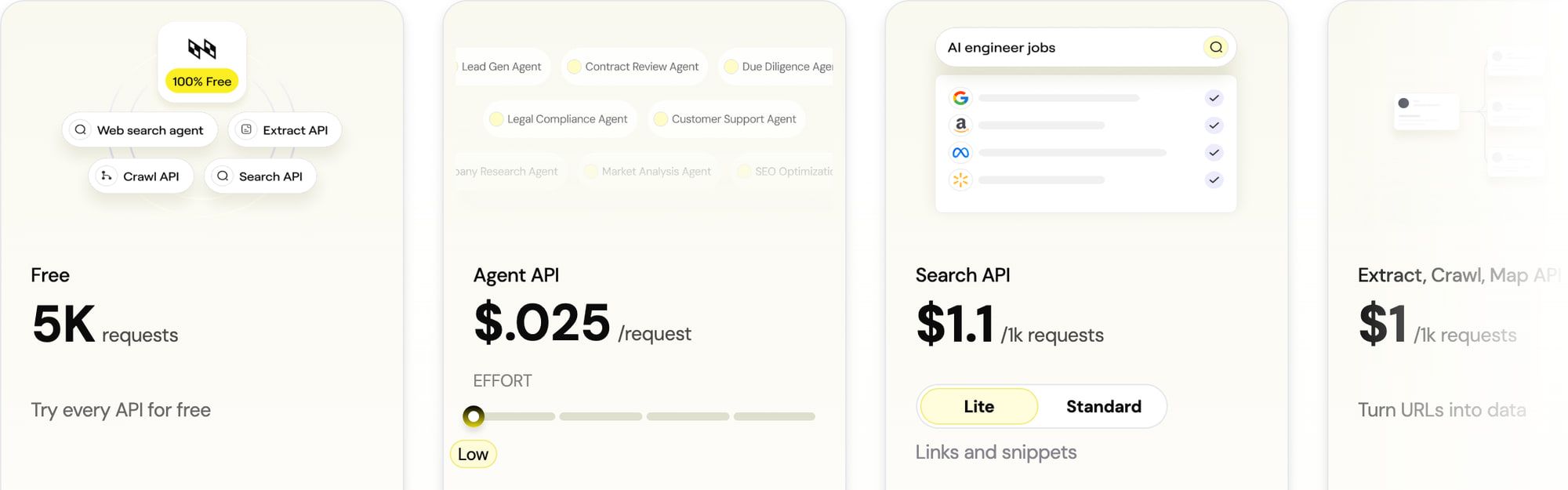
The marketing page and the docs differ in four ways, all from pages read 24 Nov 2026. They agree on the Agent price: the rendered page shows “$.025 /request” at Low effort with a slider for higher efforts, and the docs list $0.025 to $2.00 per task.
- Search standard: the visible text says “$1.1” and “Starting at”. The $5 standard price and the $1 full-content add-on show up only in the page’s structured data.
- Free tier: the page says “5,000 free requests per month” for all APIs. The docs say 5,000 API calls plus 30 agent runs.
- Depth names: the page’s table says “Deep mode includes page contents”. The docs list only lite and standard.
- Missing lines: no proxy price, no
maxdriver and no file parsing on the marketing page.
The two “old” URLs, /pricing-old and /old/pricing, returned the same content as the live page in my reads. So “old” does not mean an older price set. pricing-old, old/pricing.
One more oddity. Nimble’s own blog post on Brave alternatives (23 Sep 2026) says “Speak to the Nimble team for current pricing” and prints no Nimble figure, while the pricing page lists numbers. Nimble blog.
What does Nimble charge for each product? #
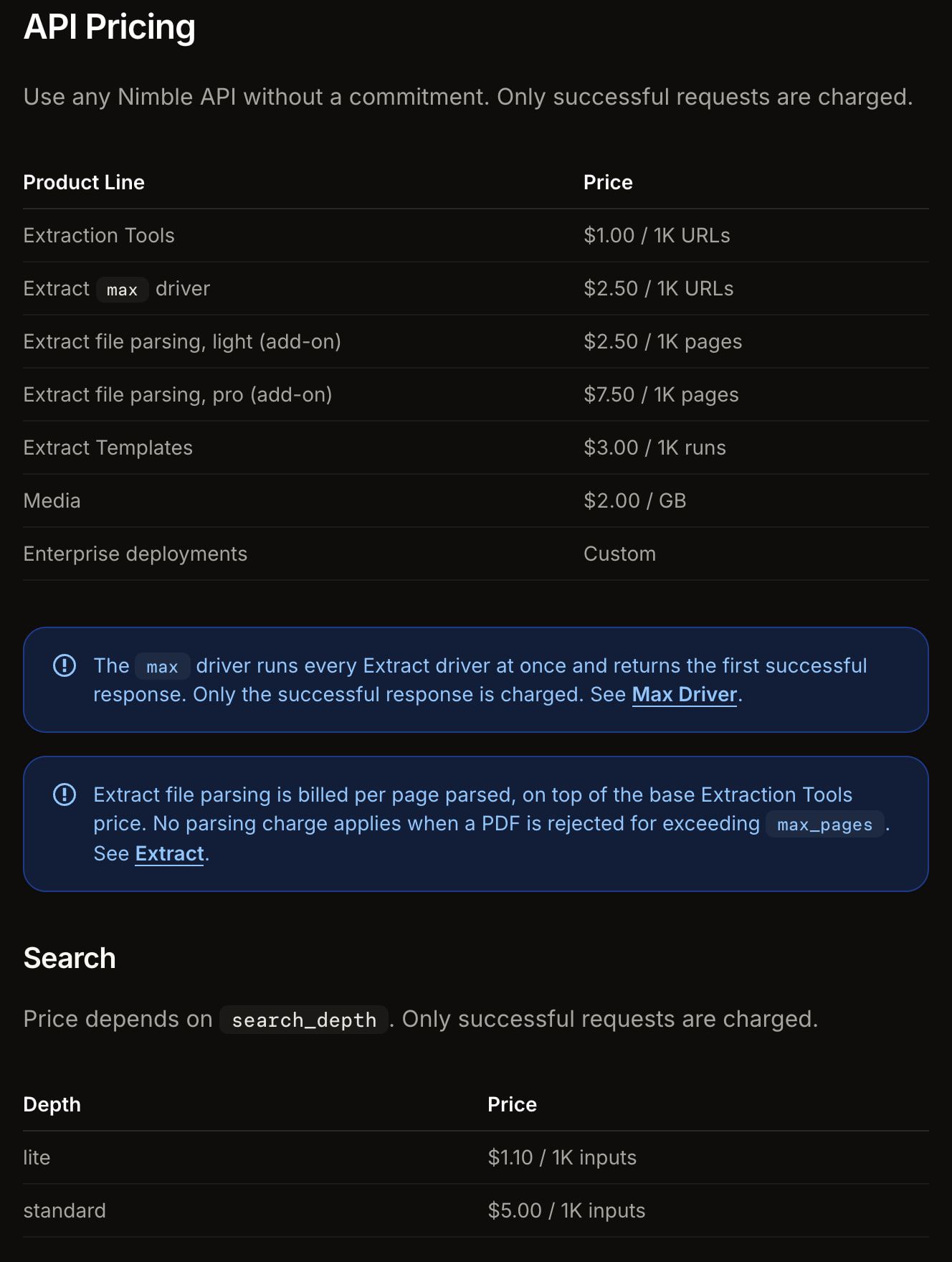
Search is billed per 1,000 inputs, Extract per 1,000 URLs, agents per task, file parsing per 1,000 pages and Media per GB, and only successful requests are charged. The docs pricing table is the only page that lists all of it. The units matter because the same “per 1,000” label covers four different things.
| Product | Price (USD, verified 24 Nov 2026) | Unit the docs quote | Notes and conflicts |
|---|---|---|---|
| Search lite | $1.10 | per 1,000 inputs | Titles, URLs and snippets |
| Search standard | $5.00 | per 1,000 inputs | The default depth; rich content |
Search full_content |
+$1.00 | per 1,000 URLs | Charged per page scraped in real time |
| Extract tools | $1.00 | per 1,000 URLs | Marketing says “per 1k requests”; it lists Extract, Crawl and Map at $1 |
Extract max driver |
$2.50 | per 1,000 URLs | Runs all Extract drivers; charges only for the first successful response |
| File parsing, light / pro | $2.50 / $7.50 | per 1,000 pages | On top of the base price |
| Extract Template | $3.00 | per 1,000 runs | Marketing adds a Managed Service option at a 10% fee |
| Media | $2.00 | per GB | |
| Agent, Low / Med / High / X-High | $0.025 / $0.10 / $0.50 / $2.00 | per task | Marketing card shows $.025 at Low; Max is custom and “coming soon” |
| Residential proxy | $5.30 | per GB | Listed, but the quickstart says KYC-only |
| SERP, Fast SERP | Not published | n/a | Docs show latency and limits only |
Sources: docs pricing, docs pricing, markdown copy, pricing page, proxy quickstart.
Two phrases need a warning. The docs bill Search by “inputs” and never say what one input is, so I cannot tell you whether a query returning 100 results costs the same as one returning 10. I also could not find a definition of a “credit”, which matters for the plans below.
The other thing the table hides is the Extract unit. The docs say “per 1,000 URLs” and the marketing page says “per 1k requests”, and the legacy drivers priced at $1.30 and $1.45 are gone from both pages. The docs’ usage API page still names older driver configurations, and it says deprecated ones are still billed but no longer sold. Usage API docs.
Finally, the usage API’s cost_usd field is described as “not an invoice amount” and is null on some fixed-price plans. So I would not treat it as a bill check. Usage API docs.
Lite or standard search: what does the extra depth buy? #
Lite returns titles, URLs and snippets for $1.10 per 1,000; standard, the default, returns richer content for $5.00. That makes standard 4.5 times the price of lite ($5.00 divided by $1.10, my arithmetic). Both are billed per 1,000 inputs, per the docs pricing page, and the search depth docs describe the two values.
If you leave search_depth unset you get standard. That is a $3.90 per 1,000 difference from a forgotten parameter, or $39 at 10,000 searches and $3,900 at 1,000,000.
Other details from the search docs and API reference:
max_resultsdefaults to 10, with a minimum of 1 and a maximum of 100. The docs do not say a bigger value changes the price.- Focus modes carry “the same charge as the selected search depth, with no additional focus-mode surcharge”. Some modes work only with lite, so check the docs before you pick standard for a focused search.
full_contentadds $1.00 per 1,000 URLs, and the docs describe it as higher recall and higher cost.
Full content is the add-on that surprises a budget. If you scrape all 10 results of every query, that is 10 URLs, or $0.01 per query on top (my arithmetic, assuming 10 URLs per query). So standard plus full content is $15.00 per 1,000 queries, three times standard alone.
Depth names have moved. The changelog lists “lite, fast, and deep depth modes” in January 2026, and the current reference has only lite and standard. The marketing page still says “Deep mode includes page contents”. Treat any article that prices “fast” or “deep” as describing an older release. Release notes.
On speed and accuracy, all I have is Nimble’s own claims. Its search page says standard returns in under 500 ms, and its vs-Parallel page says 95.4% accuracy against Parallel’s 85.2%, with median latency of 817 ms against 1,569 ms, and its vs-Exa page gives Exa 89.2% and 3,924 ms. The pages describe a 500-question SimpleQA run by Nimble itself, but they give no test date, so I did not weigh the results. Search API page, Nimble vs Parallel, Nimble vs Exa.
My read: lite is for retrieving links your own code then reads, and standard is for feeding an agent without an extra fetch. If you do not know which you need, 50 to 100 of your own queries on both will tell you more than any price page. My guide to evaluating a search API lays out the method.
How much does an agent run cost? #
A Nimble agent task is a flat $0.025 at Low effort, $0.10 at Medium, $0.50 at High and $2.00 at X-High, and the docs make High the default. The docs say compute, retrieval and storage “don’t appear on the bill”, so the task price is the whole price. Max effort is listed as custom, with a budget you set per task, and the efforts page marks it “coming soon”. Docs pricing, efforts docs.
| Effort | Price per task | Typical duration (docs) | Per 1,000 runs | Daily cost at the default 200 runs |
|---|---|---|---|---|
| Low | $0.025 | 10 to 30 seconds | $25 | $5 |
| Medium | $0.10 | 1 to 3 minutes | $100 | $20 |
| High (default) | $0.50 | 5 to 15 minutes | $500 | $100 |
| X-High | $2.00 | 15 to 30 minutes | $2,000 | $400 |
| Max | Custom | Not available | n/a | n/a |
| Parallel Task, core / pro | $0.025 / $0.10 | Not compared | $25 / $100 | Not like for like |
| Tavily Research, mini / pro | $0.032 to $0.88 / $0.12 to $2.00 | Not compared | Varies | Not like for like |
| Exa Deep | $0.012 per request | Not compared | $12 | Not like for like |
Sources: Nimble docs, effort and cost docs, Parallel docs, Tavily credits at $0.008 per credit, Exa. The daily column is my arithmetic: 200 runs times the task price.
The default of 200 runs a day comes from a docs line that says accounts get 30 concurrent agents and 200 runs a day by default. The plan table lists 5, 10 and 20 concurrent agents for the three plans, and I could not reconcile the two. Effort and cost docs, docs pricing.
The run limit works as an accidental cost cap. At High effort, 200 runs is $100 a day, or $3,000 over 30 days (my arithmetic). At Low it is $5 a day.
It also means 10,000 agent runs would take 50 days at the default limit, and the docs say to contact Nimble before a larger job. So the 10K, 100K and 1M agent rows in my bill table later assume a raised limit.
Parallel’s core and pro Task prices happen to equal Nimble’s Low and Medium, but the jobs, latency and output are different, so that is a price coincidence only. I compared no quality. Parallel pricing docs.
Nimble’s docs are unusually candid on fit. They say a Low run costs more than one Search call and returns less for a closed factual question, and the advice is “When in doubt, start with Search.” Failed or topped-up runs add to the cost, and whether a timed-out run is billed is not stated. Choosing the right tool, effort and cost.
What does the free plan give me? #
The free plan gives 5,000 API calls and 30 agent runs a month with no card, and it never charges. A call is one request to Search, Extract, Extract Template, Map or Crawl, and every call counts as one “regardless of Extract driver or Search depth”. At zero, requests return 402 Payment Required. Docs pricing.
The allowance resets on the 1st of the month at 00:00 UTC, with no rollover. Rate limits are lower than paid accounts (the docs give no number), and residential proxy is not included. The changelog says the plan replaced the old one-time free trial in November. Release notes.
What is it worth? At list price, 5,000 lite searches are $5.50 and 5,000 standard searches are $25 (my arithmetic). Thirty Medium agent runs are $3.00.
Since depth does not change the call count, the free allowance goes furthest on standard, max Extract or a Search with full content. That is a quirk of the docs and I would not build a plan on it.
To move to pay-as-you-go you add a card in Settings, then Billing, and billing “starts immediately”. Charges go to the card monthly. What the docs do not say is whether the free calls stay once you add a card, so I cannot tell you whether your first 5,000 calls remain free on pay-as-you-go.
The marketing page’s “5,000 free requests per month” for “all APIs” reads broader than the docs, which count five call types and list Media separately. I follow the docs. Firecrawl’s blog and tooldirectory.ai still describe a one-time 5,000-page trial, which the November changelog replaced. Firecrawl, tooldirectory.ai.
Is a monthly plan cheaper than pay-as-you-go? #
No. At list price the $2,500 plan costs $7.14 per 1,000 credits, while pay-as-you-go Extract is $1.00 per 1,000 URLs, so the plan is not a volume discount. The docs and the marketing page list three plans, billed annually, and the same three prices appear on both. Docs pricing, pricing page.
| Plan | Per month | Per year at list | Page credits | Concurrent agents | Storage | Per 1,000 credits | PAYG Extract URLs for the same fee |
|---|---|---|---|---|---|---|---|
| Startup | $2,500 | $30,000 | 350,000 | 5 | 7 days | $7.14 | 2.5 million |
| Scale | $7,000 | $84,000 | 1.2 million | 10 | 30 days | $5.83 | 7 million |
| Professional | $15,000 | $180,000 | 3 million | 20 | 90 days | $5.00 | 15 million |
| Enterprise | Custom | Custom | Custom | Unlimited | Custom | n/a | n/a |
The first three columns of figures are the docs table. The yearly figures, per-1,000 rates and PAYG comparison are my arithmetic ($2,500 times 12, then $2,500 divided by 350,000, then $2,500 divided by $1.00 per 1,000). The docs also list custom agent ETL and MCP on Startup, localized agents on Scale and a custom workflow on Professional.
The docs say overage on paid plans “is billed at pay-as-you-go rates on the next invoice”, and that credits roll over within the billing cycle but expire at month end. So you do not buy cheaper requests by paying more upfront. You buy a pool of credits that expires monthly, and anything above it costs list price.
What is a credit? The pages say “web page credits” and “pages” and nothing more. Two hypothetical readings show the range, and both are my arithmetic, not Nimble statements. If one credit bought one standard search at $5.00 per 1,000, Startup would cost 43% more than PAYG and Professional would be level. If a credit bought one Extract URL, Startup would cost 7.14 times PAYG.
The plan only beats PAYG if a credit covers something that costs more than $7.14 per 1,000 on PAYG, such as an agent task. The docs never say that.
So what is the plan for? Concurrency, storage, custom agent ETL and support, going by the feature lines. I would ask Nimble in writing what one credit buys for each product, whether the annual fee is paid upfront or in instalments (the page does not say), and what the PAYG rate limits are before paying $30,000 a year.
For a small team the free plan, then pay-as-you-go, is the cheaper way in, and PAYG has no stated minimum.
What do 10K, 100K and 1M requests cost? #
On pay-as-you-go list prices, Search lite costs $11, $110 and $1,100 at 10K, 100K and 1M requests, standard costs $50, $500 and $5,000, and Extract costs $10, $100 and $1,000. These are my arithmetic on the docs table, before tax, with no free allowance netted.
| Nimble product | Per 1,000 | 10,000 | 100,000 | 1,000,000 |
|---|---|---|---|---|
| Search lite | $1.10 | $11 | $110 | $1,100 |
| Search standard | $5.00 | $50 | $500 | $5,000 |
| Search lite + full content on 10 URLs a query | $11.10 | $111 | $1,110 | $11,100 |
| Search standard + full content on 10 URLs a query | $15.00 | $150 | $1,500 | $15,000 |
| Extract | $1.00 | $10 | $100 | $1,000 |
Extract max |
$2.50 | $25 | $250 | $2,500 |
| Agent, Low | $25 | $250 | $2,500 | $25,000 |
| Agent, Medium | $100 | $1,000 | $10,000 | $100,000 |
| Agent, High | $500 | $5,000 | $50,000 | $500,000 |
| Agent, X-High | $2,000 | $20,000 | $200,000 | $2,000,000 |
Formulas: Search and Extract are the per-1,000 price times requests divided by 1,000. The full-content rows add $1.00 per 1,000 URLs times 10 URLs a query, an assumption I chose, so change it to your own number. Agent rows are the task price times runs, and the per-1,000 column for agents is per 1,000 runs.
A few cautions on reading it. The free plan’s 5,000 calls are not netted, and I do not know whether pay-as-you-go keeps them. Search has a limit of 10 requests per second per account, which at 1,000,000 a month is about 0.4 a second on average, so the limit matters for bursts and not for volume. Rate limits docs.
Paid Extract drivers allow about 83 requests per second (5,000 a minute), and the free plan’s limit is “lower” with no number. Rate limits docs.
Agent bills are where the arithmetic bites. A million High-effort runs is $500,000, and a million X-High runs is $2 million. At that scale you would negotiate, so the table is a ceiling for list-price thinking, not a quote.
Is Nimble cheaper than other search APIs? #
On list price, Nimble lite is 10% above Parallel Turbo and Fast, and below Exa, Brave, Tavily and SerpApi; Nimble standard ties Parallel Basic and Brave at $5.00. apiserpent.com is cheaper per call than any of them at every volume I priced. Each row has its own unit and output, so this is a price table, not a quality ranking.
| API and job | Per 1,000 | 10K | 100K | 1M | What it returns, per the vendor |
|---|---|---|---|---|---|
| apiserpent.com Google, Default | $0.60 | $6 | $60 | $600 | Google SERP results, from a $10 deposit |
| apiserpent.com Google, Growth | $0.30 | $3 | $30 | $300 | Same, after a $100 deposit |
| Parallel Search, turbo or fast | $1.00 | $10 | $100 | $1,000 | Search results; the page lists 10 per call |
| Nimble Search lite | $1.10 | $11 | $110 | $1,100 | Titles, URLs, snippets |
| Exa search, lite or instant | $4.00 | $40 | $400 | $4,000 | Search; auto or fast is $7 ($70, $700, $7,000) |
| Nimble Search standard | $5.00 | $50 | $500 | $5,000 | Rich content |
| Parallel Search, basic or advanced | $5.00 | $50 | $500 | $5,000 | Search results |
| Brave Search | $5.00 | $50 | $500 | $5,000 | Web search; $5 monthly credit not netted |
| Tavily basic, pay-as-you-go | $8.00 | $80 | $800 | $8,000 | One credit at $0.008; advanced is 2 credits ($16 per 1,000) |
| SerpApi | Plan-based | $150 | $725 | $3,750 | Plan price: Production 15,000 searches, Searcher 100,000, Cloud 1M |
Sources, all read 24 Nov 2026: apiserpent.com, Parallel and Parallel docs, Exa, Brave, Tavily, SerpApi. Bills are my arithmetic at list price, before tax, with plan fees and deposits stated and free allowances not netted. I compared no quality, speed or accuracy, and Nimble’s own benchmark pages are vendor claims with undated tests.
Three ratios from that table, all my arithmetic. Nimble lite divided by Parallel turbo is 1.10, so Nimble costs 10 cents more per 1,000. Nimble lite is 78% below Brave’s $5.00 and 72.5% below Exa lite’s $4.00, but lite returns snippets only, so the fairer match for Brave is Nimble standard, a tie at $5.00.
Nimble lite divided by apiserpent.com Default is 1.83, a $0.50 gap per 1,000, which is $5 at 10K, $50 at 100K and $500 at 1M.
The free allowances differ too. Nimble gives 5,000 calls and 30 agent runs a month, Parallel a $5 monthly credit with a card on file plus up to $80 at signup, Exa $10 of credit a month, Tavily 1,000 credits a month and SerpApi 250 searches. Brave’s page says “$5 in free credits every month” in one place and “Up to $20 in free calls” in the header, and I could not resolve that. Brave, Tavily.
For Extract, the same jobs per 1,000 URLs come to:
| Extract job | Per 1,000 URLs |
|---|---|
| Nimble Extract (default) | $1.00 |
| Parallel Extract | $1.00 |
| Exa contents | $1.00 per 1,000 pages |
| Firecrawl Standard, if all 100,000 credits get spent | $0.99 |
| Tavily basic (1 credit per 5 URLs at $0.008) | $1.60 |
Nimble Extract max |
$2.50 |
| Firecrawl Hobby ($19 for 5,000 credits) | $3.80 |
Nimble is level with Parallel and Exa here, and Firecrawl is cheaper only if you use every credit on its $99 plan. Firecrawl pricing, Tavily credits.
For the full twelve-provider ladder, which has no Nimble row, see my web search API pricing comparison. The single-vendor breakdowns are Parallel, Exa, Brave Search API, Tavily and SerpApi. My best web search APIs guide covers the choice beyond price.
Where does apiserpent.com fit? #
apiserpent.com is the cheapest Google results API in my table at every volume, but it sells a search results page, not page content or an AI search index. I have a business connection to it, so I will stick to what its pages say, and I did not call it. Pricing page, docs, read 24 Nov 2026.
Its Google ladder per 1,000 searches, with the deposit that unlocks each tier:
| Tier | Per 1,000 | Deposit | 10K | 100K | 1M | Limits |
|---|---|---|---|---|---|---|
| Pay-as-you-go (Default) | $0.60 | From $10 | $6 | $60 | $600 | 10 concurrent, 100 a minute |
| Growth | $0.30 | $100 | $3 | $30 | $300 | 50 concurrent, 500 a minute |
| Scale | $0.20 | $500 | $2 | $20 | $200 | 100 concurrent, 750 a minute |
| Enterprise | $0.15 | $1,000 | $1.50 | $15 | $150 | 300 concurrent, 2,250 a minute |
| Enterprise Plus | $0.03 | $1,250 | $0.30 | $3 | $30 | 1,000 concurrent, 5,000 a minute |
The bills are my arithmetic. The Default row comes with a note: the tier card says “$0 to start”, while the table says a $10 deposit, so I use the table. An outside check on the Default figure: LiteLLM’s docs say both of its apiserpent modes are billed at $0.60 per 1,000 searches, though that page has no price date. LiteLLM docs.
At 1,000,000 searches a month you average about 23 a minute, which fits inside Default’s 100 a minute on average, ignoring bursts. The Enterprise Plus price of $30 per million needs a $1,250 deposit, which is more than the $30 bill, so it makes sense only at much higher volume. I did not work out how a deposit converts to credit.
What the pages say in its favour:
- One price covers Google, Bing, Yahoo, DuckDuckGo and Brave.
- The standard search endpoint takes up to 100 results per call, charged as one call. The per-page endpoint bills one charge per requested page, so asking for 50 results is 5 pages.
- Deposited credit never expires, and failed or incomplete requests are refunded.
- You get one free run a day without signing up, and a free account has 10 shared calls.
- AI Mode adds $4 per 1,000.
What the pages say against it, or leave open:
- Output: parsed JSON, and the docs say raw SERP HTML is not available. The part of the docs I read documents no page-content fetching, so an agent that must read pages needs an Extract step, which could be Nimble’s.
- Reliability: I found no SLA, and no published search latency. The terms (updated 31 Oct 2026) say “You agree to indemnify and hold harmless Serpent API”, and that credits are non-refundable except as required by law. The pricing page’s refund FAQ says purchases are generally non-refundable, with exceptions such as technical failures, duplicate charges and unauthorized transactions, and that requests must come within 7 days of purchase. Terms.
- Extras: city targeting counts as 2 calls, a completed search with no results is still charged, and bonus credit expires after 30 days.
- Fit: it is a Google results source, so it does not replace Nimble’s agent tasks, and I compared no accuracy against Nimble.
For a SERP-only comparison across more vendors, see my cheapest SERP API post, which goes deeper on apiserpent.com than I do here.
Does Nimble sell a SERP API or a proxy? #
Nimble’s docs describe both, but neither has a price on the current pages that I would budget on. For SERP, the docs list a SERP API with a median of about 3 seconds at 83 requests per second, and a Fast SERP with a median under 700 ms at 10 requests per second, limited to US and en-US. SERP docs, Fast SERP docs, rate limits. Those are docs figures, and I found no outside test of them.
No SERP line appears on the docs pricing table or the marketing pricing page. The only SERP prices I found are on a legacy page marked “2025 ©”, which shows pay-as-you-go at “$3/CPM” and plans from $150 to $3,000 at $1.40 to $2.80 per 1,000, with a monthly or annual toggle. I do not know whether that set is still sold. Legacy SERP page.
The proxy is messier. The docs pricing table lists residential proxy at $5.30 per GB. The proxy quickstart says: “Proxy service requires KYC verification and is not available for self-service accounts.” The marketing page shows no proxy price, and the tracker logged a $7.50 per GB residential line removed in the week of 18 May. Docs pricing, proxy quickstart, tracker.
So I would not quote $5.30 as a price you can buy. For proxies priced in public, see my cheapest residential proxies comparison, where Nimble is recorded as KYC-only.
How do I stop a surprise bill? #
Set a monthly spend limit for the alerts, but know that the docs say the limit does not block calls. Nimble’s governance docs describe an account-level monthly limit with alerts at 50%, 80% and 100%, updated hourly and up to two hours behind. The docs also say alert emails are “coming soon”. Per-key rules cover safe search, websites and content types, not spend. Governance docs.
So the controls that actually stop spending are structural:
- The free plan: it never charges, and requests return 402 at zero. That is a hard stop. Docs pricing.
- The agent run limit: 200 runs a day by default, which caps High effort at $100 a day.
- Explicit effort: because High is the default, set Low or Medium in your code.
- Your own counter: the usage API shows
cost_usd, which the docs say is not an invoice amount, so reconcile against invoices. Usage API docs.
There is also one open report about paid runs starting unasked. Issue #80 on the agent-skills repository, opened 9 Nov 2026 by one user, is titled “Use-case skills create an agent and start paid runs without confirmation”. It is one user’s claim, I did not check it, and the repository’s other issues I saw are unrelated to price. agent-skills issues.
If you hand Nimble’s agent skills to an AI assistant, read what they launch first. The webrouter repository has issues mentioning a “budget”, but it is not clear that they concern money. webrouter issues.
What do people say about it? #
Very little, and most of it is written by vendors. I found no Reddit thread, and G2 returned 403 on both URLs I opened. HN’s search for “nimbleway” returned 36 story hits and 178 comment hits, mostly fuzzy matches on “nimble way”. None of the first 20 of each that I could see was about the company, and I did not page through the rest. HN stories search, HN comments search.
Trustpilot shows 2.8 stars from 4 reviews, only one in the last 12 months. That one, from 17 May 2026, complains about customer service, and Nimble replied on 16 Sep 2026. Its three 2024 reviews are five-star praise, two of them mentioning the plans or the pricing, and none of the four mentions billing. Four reviews is too few to conclude anything. Trustpilot.
Firecrawl, a direct rival, repeats a G2 score of 4.9 out of 5 and lists a confusing dashboard and billing and support friction as reviewer complaints. I could not read G2, so both are second-hand. Firecrawl also says its own test of Nimble’s include_answer returned a 403 saying it was only available to enterprise accounts, and Nimble’s changelog says include_answer was removed in July. Firecrawl, release notes.
On GitHub the Nimbleway organization has 35 repositories. The most popular, webrouter, has 924 stars under Apache-2.0 and 7 open issues, and none of the issues I saw concerns price, 402 errors or the free plan. That says the project is active, not that the product is good. GitHub organization.
So which one should you pick? #
Pick by the job first, then by price: Parallel for the cheapest snippets, Nimble pay-as-you-go for one key across search, Extract and agents, and apiserpent.com for raw Google results. These are my picks on list prices and docs, and I compared no speed, accuracy or result quality.
Snippet search at the lowest list price, nothing else needed: Parallel Turbo or Fast at $1.00 per 1,000. It is $0.10 per 1,000 below Nimble lite, so $1,000 against $1,100 at 1,000,000 searches (my arithmetic). Nimble lite is the pick only if you also want Extract and agent tasks on one account. See Parallel pricing.
One key for search, extraction and agent tasks: Nimble pay-as-you-go, not a plan. Lite is $1.10, standard $5.00 and Extract $1.00 per 1,000. Start on the free plan with its 5,000 calls and 30 runs, and add a card when the first 402 shows up.
Raw Google results: apiserpent.com, at $0.60 per 1,000 on Default and $0.30 after a $100 deposit. That is $6 to $600 for 10K to 1M searches against $11 to $1,100 for Nimble lite. Choose it when your job needs Google’s own results, and pair it with an Extract step if you need page text. It has no published SLA, so I would test it on your own queries first.
Rich excerpts for an agent: Nimble standard. It ties Parallel Basic and Brave at $5.00, while Exa auto is $7 and Tavily basic $8. If Extract is already on your Nimble key, I would take standard and check relevance on 50 to 100 of your queries against Parallel Basic. Read Exa and Brave before you decide.
Page extraction: Nimble Extract at $1.00 per 1,000 URLs, level with Parallel Extract and Exa contents. Use max at $2.50 only on pages that block the default, since it charges only for the first successful response.
Agent tasks: Medium at $0.10 first, High at $0.50 when Medium misses, and Search for any closed fact. Set the effort in code, because the default is High. Cap runs per day.
The $2,500, $7,000 or $15,000 plans: I would not buy one for the price. The $2,500 fee equals PAYG Extract for 2.5 million URLs. Buy a plan for concurrency, storage, custom ETL or support, and ask in writing what one credit buys first.
A Nimble SERP API or residential proxy: do not budget on public numbers, since the SERP API has no price on the current pages and the proxy is KYC-only. Use the cheapest SERP API comparison or cheapest residential proxies instead.
What I would do before spending anything: send 50 to 100 of my own real queries through lite, standard and one rival, using the method in my search API evaluation guide. Keep the free plan until a 402 shows the volume is real. Set the monthly spend limit knowing it only alerts, and start agents at Medium with a daily run cap. I have not done any of this; it is a method, not a result.
What I could not verify #
The main gap is that I made no call and opened no account, so every bill is arithmetic on list prices. The research box below has the full list, and it is worth reading before you budget.
FAQ
How much does Nimble search cost?
Search lite is $1.10 per 1,000 inputs and Search standard is $5.00 per 1,000, with full page content adding $1.00 per 1,000 URLs. Those figures are from Nimble's docs pricing page, read 24 Nov 2026. The docs do not define what one input is.
Was Nimble's Search ever $1.50 per 1,000?
A third-party tracker logs Search going from $1.50 to $5 in the week of 6 July and from $5 to $1.10 in the week of 17 August. Firecrawl's July blog post and the tracker's own current list still print $1.50. I cannot see Nimble's price history, so treat $1.50 as an old price, not a live one.
Is there a free Nimble plan?
Yes. The docs list 5,000 API calls and 30 agent runs a month with no card, resetting on the 1st at 00:00 UTC with no rollover. At zero, requests return 402 and the docs say the free plan never charges. The changelog says it replaced the one-time free trial.
Can I use Nimble pay-as-you-go without a plan?
The docs say you add a card under Settings, Billing and pay-as-you-go starts immediately, billed monthly by card. I opened no account, so I cannot confirm it, and the docs do not say whether the free calls carry over.
What does a Nimble agent task cost?
A flat $0.025 at Low effort, $0.10 at Medium, $0.50 at High and $2.00 at X-High, per the docs pricing table read 24 Nov 2026. Max effort is listed as custom and coming soon. The effort docs make High the default, so set the effort yourself.
Is Nimble's $2,500 plan cheaper per request?
Not at list price. $2,500 for 350,000 page credits is $7.14 per 1,000 credits (my arithmetic), while pay-as-you-go Extract is $1.00 per 1,000 URLs. The docs do not say what a credit buys, so the plans look like a purchase of concurrency, storage and support, not a volume discount.
Does Nimble sell a SERP API or a residential proxy?
Its docs describe both, but neither has a current price I could find for a self-serve account. The docs pricing table lists residential proxy at $5.30 per GB, while the proxy quickstart says the service needs KYC verification and is not available for self-service accounts. Read 24 Nov 2026.
Is apiserpent.com cheaper than Nimble?
Per call, yes. apiserpent.com lists Google searches at $0.60 per 1,000 on its Default tier against $1.10 for Nimble lite, read 24 Nov 2026. It returns search results from Google and four other engines, not page content, and it publishes no SLA. I have a business connection to apiserpent.com.
Sources
54 sources, accessed .
Official pricing, docs, changelogs and status pages 35
- Nimble docs: pricing (pay-as-you-go, search, agents, plans)
- Nimble docs: pricing (markdown copy, second read)
- Nimbleway: pricing page
- Nimbleway: pricing-old (same content as the live page)
- Nimbleway: old/pricing (same content as the live page)
- Nimble docs: release notes
- Nimble docs: Search tool
- Nimble docs: Search API reference
- Nimble docs: search depth
- Nimble docs: rate limits
- Nimble docs: governance and spend limits
- Nimble docs: agent efforts
- Nimble docs: effort and cost
- Nimble docs: choosing the right tool
- Nimble docs: usage API
- Nimble docs: proxy quickstart
- Nimble docs: SERP API
- Nimble docs: Fast SERP
- Nimbleway: Search API product page (vendor claims)
- Nimbleway: legacy SERP API page (2025 copyright)
- Nimbleway blog: top Brave Search alternatives (23 Sep 2026, vendor)
- Nimbleway: Nimble vs Parallel (vendor claims)
- Nimbleway: Nimble vs Exa (vendor claims)
- Parallel: pricing
- Parallel docs: pricing
- Exa: pricing
- Exa docs: changelog
- Brave: Search API pricing
- Tavily: pricing
- Tavily docs: API credits
- SerpApi: pricing
- Firecrawl: pricing
- apiserpent.com: pricing
- apiserpent.com: API docs
- apiserpent.com: terms (updated 31 Oct 2026)
GitHub code, issues and releases 3
Review platforms 5
Community discussions 2
Other sources 8
- pricingsaas: Nimbleway price tracker (third party, checked 23 Nov 2026)
- pricingsaas: Nimbleway change log, week 29
- pricingsaas: Nimbleway change log, week 31
- pricingsaas: Nimbleway change log, week 32
- pricingsaas: Nimbleway change log, week 34
- pricingsaas: Nimbleway change log, week 35
- LiteLLM docs: apiserpent search provider
- LiteLLM docs: Nimble search provider
Last updated: 24 November 2026. Researched and drafted with AI tools; human editorial review and publication approval are pending.


