Pricing
Oxylabs pricing, explained: what 50 GB really costs
Oxylabs now bills every product from one $15, $100 or $500 monthly wallet. Here's what 5, 50 and 300 GB cost, and the billing rules that change your bill.

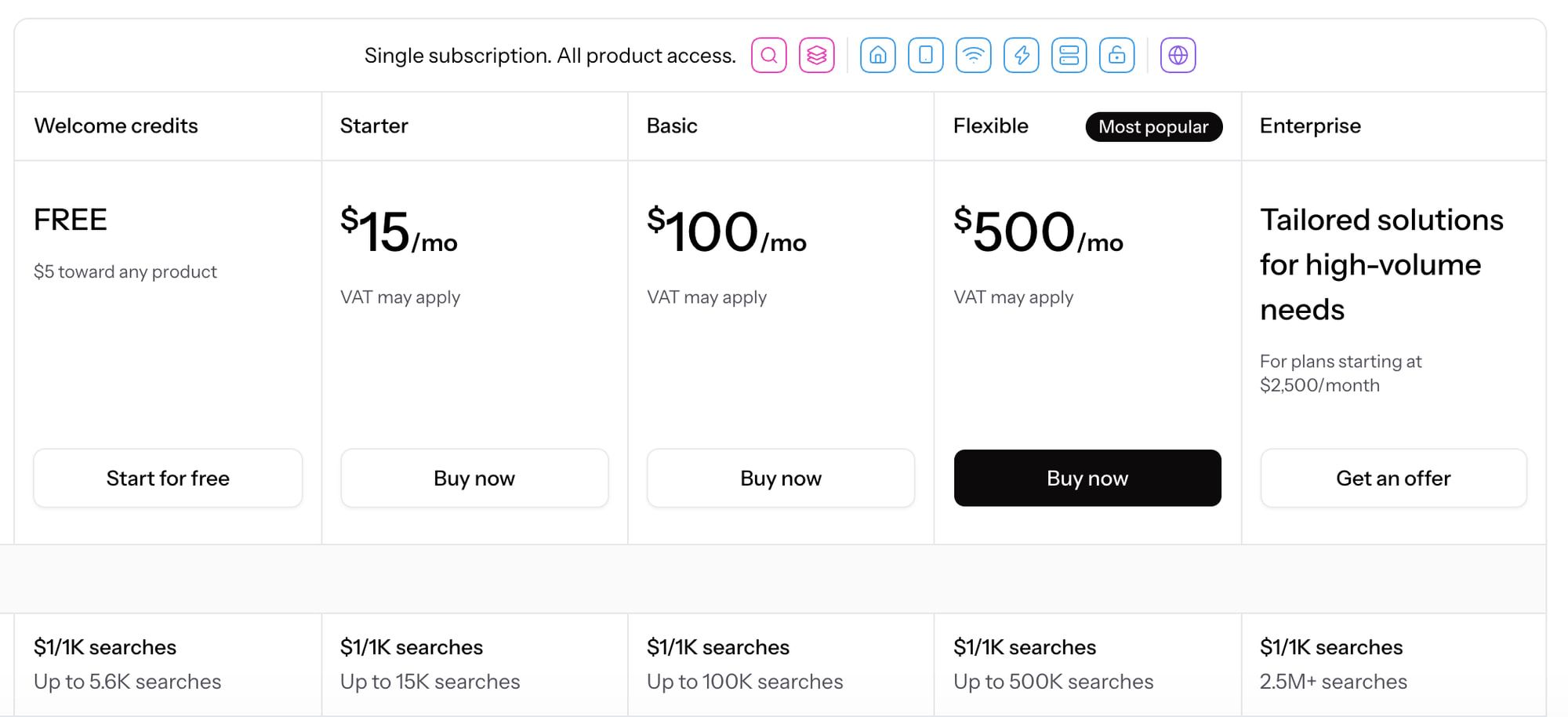
Oxylabs now sells one monthly wallet, not separate plans per product: $15 Starter, $100 Basic, $500 Flexible, or Enterprise from $2,500. Every product draws from that balance at its own rate, so 50 GB of residential traffic needs the $500 Flexible wallet and leaves $300 that expires unless you spend it on something else. Oxylabs pricing, verified 2026-11-12.
Below I decode the price grid, work out the bill at 5, 50 and 300 GB, and show how one wallet can pay for proxies and the Web API at the same time.
Short on time?
Here's my take
- Just trying it
- The $5 welcome credit
- One-time credit, up to 0.8 GB of residential at $6/GB. One page limits it to verified company registrations.
- Up to 2 GB a month
- Starter, $15
- Residential at $6/GB; the card shows up to 2 GB. Unspent credit expires at the end of the cycle.
- A steady 15–20 GB
- Basic, $100
- $5/GB, up to 20 GB. Full use costs $5 per GB; at 10 GB it works out to $10 per used GB.
- 50–125 GB, or proxies plus the API
- Flexible, $500
- $4/GB up to 125 GB, and whatever is left pays for Web API results at Flexible rates.
- 300 GB of residential a month
- Decodo pay-as-you-go, unless an Oxylabs quote beats it
- 300 GB at $4/GB is $1,200; Oxylabs Enterprise starts at $2,500/month. Bright Data's $999 card covers 332 GB only with a 3-month coupon.
Prices verified . Sponsors cannot buy a verdict or a position.
This sits in the proxies hub. If you’re choosing between Oxylabs and Bright Data specifically, the Bright Data vs Oxylabs comparison works through 1, 10 and 100 GB; I use different volumes here so the two pages answer different questions.
How much does each Oxylabs product cost? #
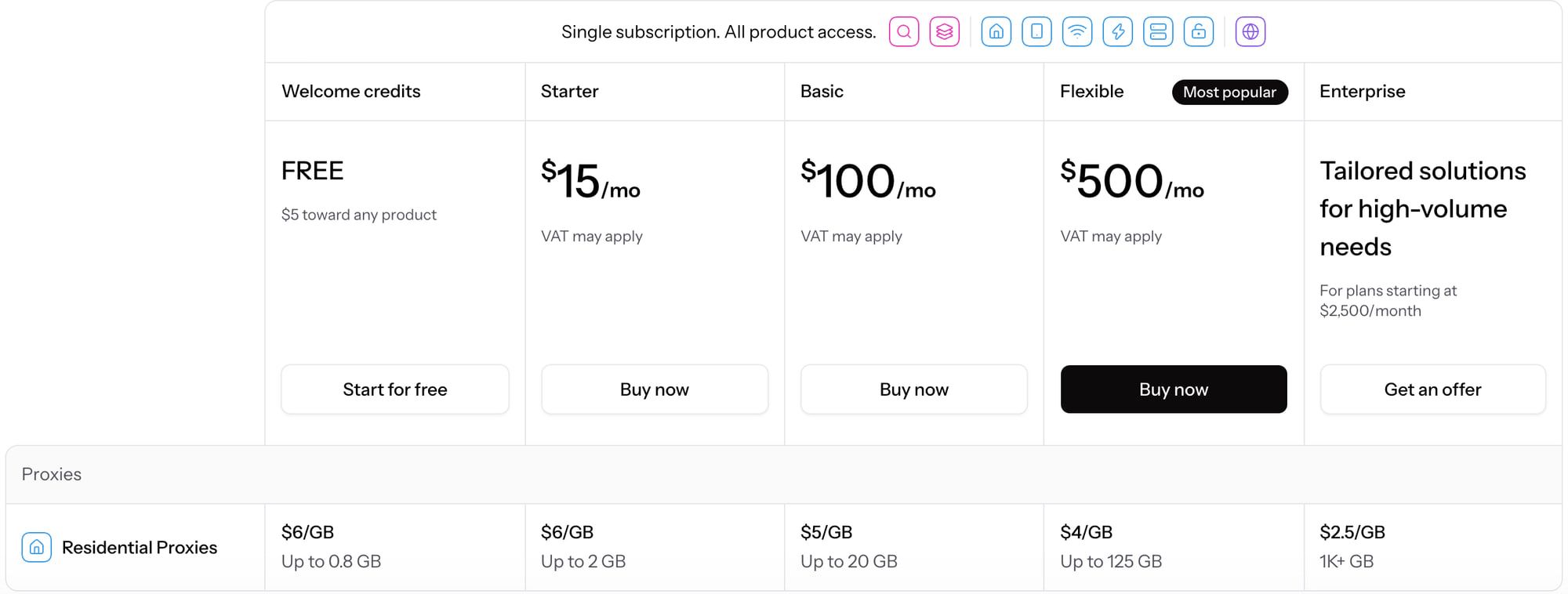
Residential runs from $6/GB down to $2.50/GB, and every other product has its own five-step ladder that tracks the same five wallets. The pricing grid never labels its columns, so outside the residential page I matched them to plans by arithmetic: 15K searches at $1/1K is $15, 20 GB at $5 is $100, 125 GB at $4 is $500, and 1K GB at $2.50 is $2,500.
The residential pricing page does label its rows, and they match that mapping. Each cell below shows the rate, then the “up to” amount the grid prints for that wallet spent on that one product. Oxylabs rounds these down, and two don’t match the arithmetic (see the callout further down).
Prices verified 2026-11-12, USD, before VAT.
| Product (unit) | Welcome $5 (once) | Starter $15/mo | Basic $100/mo | Flexible $500/mo | Enterprise from $2,500/mo |
|---|---|---|---|---|---|
| Residential ($/GB) | $6 · up to 0.8 GB | $6 · up to 2 GB | $5 · up to 20 GB | $4 · up to 125 GB | $2.50 · 1K+ GB |
| Mobile ($/GB) | $7.50 · 0.7 GB | $7.50 · 2 GB | $6.67 · 14 GB | $5 · 100 GB | $3.50 · 714+ GB |
| ISP ($/IP/month) | $1.50 · 3 IPs | $1.50 · 10 IPs | $1.40 · 71 IPs | $1.20 · 416 IPs | $1.10 · 2.27K+ IPs |
| Dedicated ISP ($/IP) | $3.30 · 1 IP | $3.30 · 4 IPs | $2.78 · 35 IPs | $2.60 · 192 IPs | $2.20 · 1.14K+ IPs |
| Datacenter ($/IP) | $1 · 5 IPs | $1 · 15 IPs | $0.90 · 111 IPs | $0.80 · 625 IPs | $0.60 · 4.17K+ IPs |
| Dedicated datacenter ($/IP) | $2 · 2 IPs | $2 · 7 IPs | $1.75 · 57 IPs | $1.45 · 344 IPs | $1.20 · 2.08K+ IPs |
| Datacenter ($/GB) | $0.60 · 8.3 GB | $0.60 · 25 GB | $0.55 · 181 GB | $0.45 · 1.1K GB | $0.40 · 6.25K+ GB |
| Web Unblocker ($/GB) | $7.20 · 0.7 GB | $7.20 · 2 GB | $6 · 16 GB | $4.80 · 104 GB | $3 · 833+ GB |
| Web API /Search ($/1K) | $1 · 5.6K | $1 · 15K | $1 · 100K | $1 · 500K | $1 · 2.5M+ |
| Web API /Scrape ($/1K, “from”) | $0.50 · 10K | $0.50 · 30K | $0.45 · 222K | $0.35 · 1.43M | $0.25 · 10M+ |
| Google, no JS ($/1K) | $1.00 · 5K | $1.00 · 15K | $0.90 · 111K | $0.70 · 714K | $0.50 · 5M+ |
| Google with JS ($/1K) | $1.35 | $1.35 | $1.30 | $1.15 | $0.90 |
| Amazon, no JS ($/1K) | $0.50 | $0.50 | $0.45 | $0.35 | $0.25 |
| Agent Browser ($/GB) | $8 | $8 | $7.50 | $5.50 | $4 |
Source for every row: oxylabs.io/pricing; residential rows also on the residential pricing page and ISP rows on the ISP page.
The grid also lists LLM and chatbot scrapers (ChatGPT, Perplexity, Gemini) at $1.50 per 1K falling to $1.30 or $0.90 at Enterprise, Google AI Mode at $1.50 to $0.90 per 1K, AI parsing at $3 per 1K pages, media download at $2 falling to $1 per GB, and video data at $2 falling to $1.60 per GB. Pricing grid.
AI Studio and Datasets aren’t on the grid, so I haven’t priced them here; ask Oxylabs for a quote. Agent Browser is the per-GB row above.
The billing unit is the thing to watch. Proxies bill per GB or per IP, while the Web API bills per 1,000 results, so a row that looks cheap may not be cheap for your job. If you’re unsure which unit fits, scraping API vs proxies covers that choice first.
How does the Oxylabs wallet work? #
You buy one monthly balance and every product spends from it at your plan’s rate. Oxylabs’ own headline is “Single subscription. All product access”, and its dashboard announcement says billing “now runs on credits: a single subscription with one shared balance.” Pricing, dashboard post.
That makes the “up to” figures easy to misread. Basic’s “up to 20 GB” of residential and its “up to 16 GB” of Web Unblocker are the same $100 spent two different ways, not 36 GB you get together.
The residential FAQ describes it the same way: you pay the full plan amount each month as credits, and each product deducts at its own rate. Your billing cycle starts on the day you buy, the renewal date stays fixed, and you can top up or upgrade at any time. Residential product page, billing cycle help article.
What I could not find is the rate a top-up bills at. The pricing FAQ says you raise limits through your account manager or by topping up in the dashboard, but no public page says whether a $50 top-up on Starter buys traffic at $6/GB or something else. Pricing FAQ. That gap matters for the worked costs below.
So what will 50 GB a month cost? #
$500. Fifty GB is more than Basic’s 20 GB ceiling, so the smallest wallet that covers it outright is Flexible at $500. At Flexible’s $4/GB, the traffic itself is $200; the other $300 expires at the end of the cycle unless you spend it on another product. Residential pricing.
Here is the same arithmetic at 5, 50 and 300 GB. These are calculations on published rates, verified 2026-11-12, not invoices; “effective $/used GB” divides what you pay by the residential GB you actually use.
| Residential need | Plan you buy | GB cost at that band | Unused credit (expires) | Effective $ per used GB |
|---|---|---|---|---|
| 5 GB | Basic, $100 | $25 (5 × $5) | $75 | $20.00 |
| 50 GB | Flexible, $500 | $200 (50 × $4) | $300 | $10.00 |
| 300 GB | Enterprise, from $2,500 | $750 (300 × $2.50) | $1,750 | $8.33 |
Buying the next wallet up is poor value at small and mid volumes: $20 per used GB at 5 GB, and $10 at 50 GB. Topping up a smaller wallet could cost far less, but Oxylabs doesn’t publish the rate top-ups bill at, so I’d ask support in writing before planning a budget around it.
At 300 GB, the only published route is Enterprise from $2,500, and most of that credit goes unused unless you spend it on other products. Its $2.50/GB rate really pays off near its 1K GB ceiling.
Can one plan pay for proxies and the API? #
Yes, and this is where the wallet earns its keep. Unused residential budget doesn’t have to expire if another product on your plan can spend it. Each product in this arithmetic bills at your plan’s band, which is how the pricing grid reads; it’s arithmetic on published rates, not an invoice.
| Wallet | Residential traffic | Other product | Total |
|---|---|---|---|
| Basic, $100 | 10 GB at $5 = $50 | Google results without JS at $0.90/1K: $50 buys about 55,500 results | $100 |
| Flexible, $500 | 50 GB at $4 = $200 | Web API /Search at $1/1K: $300 buys 300,000 searches | $500 |
The Flexible row is the 50 GB month from the previous section, with the $300 that would have expired turned into searches instead. If you were already going to buy a search or scraping API somewhere else, that changes the math a lot.
The two halves bill differently, though. The Web API says you “only pay for successfully returned results,” while proxy traffic is billed whatever status code comes back. Web API announcement, residential billing FAQ.
The Web API (/search and /scrape) is new: its quick-start guide is dated October 7, 2026 and the introduction post was last updated October 14. I’d treat its pricing as young and re-check it before a large commitment. Quick-start guide, introduction.
The billing rules that change your bill #
The headline rate is only part of the bill. These rules come straight from Oxylabs’ own pages, and each one can move what you actually pay.
| Rule | What it does to your bill | Source |
|---|---|---|
| Request and response traffic are both billed, “regardless of the HTTP status code returned” | Blocked or failed proxy requests still use GB | Residential pricing FAQ |
| Web API charges only for successful results | Failed API calls don’t use credit | Web API post |
| Unused credits expire at the end of the billing cycle, unless carried over in an upgrade | A half-used wallet is lost money | Residential pricing FAQ |
| Welcome credits carry into the first paid cycle only | The $5 doesn’t stay around forever | Dashboard post |
| ISP proxies bill per IP per day (monthly price ÷ 30) | Adding IPs mid-month is prorated | ISP page |
| ISP fair use: 100 concurrent sessions per IP until 50 GB per IP, then 10 for the rest of the cycle | Heavy ISP users hit a session cap, not a bill | ISP page |
| “VAT may apply”; fees exclude taxes | Budget for tax on top | Pricing FAQ |
| Cards, wire (USD or EUR), AliPay, PayPal; “We do not accept Bitcoins” | No crypto checkout | Pricing FAQ |
| A failed charge starts a 7-day grace period with usage capped at 25% of the remaining balance; you can upgrade but not top up | A declined card limits you fast | Help center |
| On cancellation, “unused balance at the end of your final cycle expires, with no refund” | Spend down before you leave | Help center |
Two more rules sit outside the bill but affect whether you can buy at all. Oxylabs runs a KYC questionnaire for every customer and says “Only 75% of customers are approved.” KYC and safety.
Its terms also forbid using the service to monitor “availability, performance or functionality” without written consent, which is why no page like this one can publish a fair speed test of Oxylabs. Self-service terms, terms of service. For how GB, IP and per-request billing compare across vendors, see proxy pricing models.
Is there a free trial? #
Not a timed trial any more. Oxylabs gives a one-time $5 welcome credit, which at the welcome rate covers up to 0.8 GB of residential traffic or about 5,000 searches at $1 per 1K (the grid prints “up to 5.6K”). Pricing, residential pricing.
Who gets it depends on which page you read. The free-trial page’s body offers the credit “for verified company registrations,” while the residential page says “Every new account receives a one-time $5.00 welcome credit on registration” and that it’s “only available once.” Free-trial page, residential page.
I’d go with the stricter reading: assume you need a verified company account. The free-trial page’s title and description still promise “up to 7 days” and a “3 or 7 day free trial,” which looks like wording left over from the old plans. For how other providers’ trials compare, see residential proxy free trials.
Can you get your money back? #
Plan on no. The residential pricing page and the help center both say “All purchases made through self-service are non-refundable,” and those are the pages written for today’s wallet. Residential pricing, help center.
The contracts are more generous on paper, but not for the wallet. The 2025 terms of service keep a full refund if you ask within 3 calendar days of your first payment and have used 20% or less (clause 3.15.5), but that clause sits in the pay-as-you-go section (3.15), next to a general “all purchases are final” rule (3.13). Terms of service.
The older self-service terms, last updated September 25, 2024, have a similar 3-day clause: 20% or less used on regular plans, 10% on Enterprise, no PAYG, and no earlier refund. But they name plans that no longer exist (Micro, Starter, Advanced, Premium, and Venture through Custom+). Self-service terms.
Here’s which I trust and why. The “non-refundable” line is current and written for the product you’d be buying, so I’d budget as if it holds. If you’re inside 3 days and under 20%, I’d still ask in writing, but neither clause is written for wallet plans: 3.15.5 covers pay-as-you-go, and the 2024 clause names retired plans.
Where Oxylabs' own pages disagree
- Entry price: the residential page FAQ says residential “start at $30 per month,” but its own Starter card says $15. Residential page.
- ISP: the ISP page title says “from $2.10/IP,” while its price bands run $1.50 down to $1.10 per IP. ISP page.
- Enterprise: one plan block says “starting at $2,500/month,” another on the same page says “Custom.” Pricing.
- Starter residential: the card shows “up to 2 GB” at $6/GB, but $15 ÷ $6 is 2.5 GB. I’d plan on the 2 GB shown. Residential pricing.
- Welcome searches: the grid prints “up to 5.6K” /Search calls for the $5 credit, but $5 at $1 per 1K is 5,000. Pricing.
- Trial: the trial page title says “up to 7 days”; its body offers a $5 credit. Free-trial page.
- Pay-as-you-go: the terms still define residential PAYG, and a September 2026 rival explainer lists it at $8/GB, but neither public pricing page offers it today. Self-service terms, Proxidize.
What changed, and when? #
Most third-party Oxylabs price pages are out of date because the model changed in October 2026. DataImpulse’s explainer (updated October 13, 2026) still lists a $30/5 GB residential Starter and a $49 API entry plan; Proxidize’s (September 10, 2026) lists the old per-product plans and $8/GB PAYG. DataImpulse, Proxidize.
| Date | What changed | Source |
|---|---|---|
| Jan 31, 2023 | Per-product plans: residential PAYG $15/GB, Starter 25 GB for $300, Premium 100 GB for $800, Corporate 1 TB for $4,000 | Oxylabs blog |
| Mar 25, 2024 | Residential PAYG reported cut from $10 to $8/GB (Micro $9 → $7.75, Starter $8 → $7.50 per GB). Oxylabs’ own post about it now returns a 404 | Proxyway |
| Oct 7, 2026 | Web API (/search and /scrape) quick-start guide published | Oxylabs blog |
| Oct 15, 2026 | A pricing tracker logs one subscription for all products: Starter $30, Basic $100, Flexible $500, Enterprise $2,500+ | UsagePricing |
| Oct 21, 2026 | Dashboard post updated: billing runs on credits from one shared balance | Oxylabs blog |
| Nov 11–12, 2026 | Starter is $15/month, with a $5 welcome credit | Pricing |
The tracker’s last capture on October 19 still showed no $15 tier. So Starter dropped from $30 to $15 sometime between then and our November 11 re-check for Bright Data vs Oxylabs. UsagePricing.
How does that compare with Bright Data and Decodo? #
At 5 and 50 GB of residential traffic, both rivals cost less than Oxylabs on published prices. At 300 GB, Decodo’s pay-as-you-go is the cheapest I could price on list rates; Bright Data’s $999 card beats it only during a three-month coupon. This table uses the same volumes as the worked costs above, verified 2026-11-12, before VAT.
| Residential GB a month | Oxylabs | Decodo | Bright Data |
|---|---|---|---|
| 5 GB | $100 (Basic wallet) | $20 (PAYG at $4/GB) | $40 PAYG at $8 list; $20 with the RESIGB50 coupon |
| 50 GB | $500 (Flexible wallet) | $150 (50 GB monthly card) | $400 PAYG list; $200 with coupon (the $499 card is 141 GB with coupon, about 71 GB at its $7 list rate) |
| 300 GB | From $2,500 (Enterprise) | $1,200 (PAYG); the next card up is 1,000 GB for $2,000 | $1,999 card at list (about 400 GB at $5/GB); $999 for 332 GB with coupon |
Inputs: Decodo residential pricing, Bright Data residential pricing, Oxylabs. Decodo prices are “+ VAT,” and Decodo’s PAYG is bought one GB at a time and can’t run alongside a monthly plan.
Bright Data’s RESIGB50 coupon is 50% off for the first three months, and it applies to the monthly cards too: 141 GB for $499, 332 GB for $999 and 798 GB for $1,999 are coupon rates ($3.50, $3 and $2.50/GB). At the struck-through list rates of $7, $6 and $5/GB, the same money buys about 71, 166 and 400 GB, so I compare on list prices and show the coupon next to them.
For the full picture see Bright Data pricing and Decodo pricing, and for a six-vendor price study see the cheapest residential proxies.
This is price only. I have no fair speed or success data for any of the three, and Oxylabs’ terms rule out publishing it without consent.
Which plan should you pick? #
For a pilot, use the $5 credit if you qualify. It’s enough to check that your targets, countries and session settings work before you commit to a wallet. Free-trial page.
Under 2 GB a month, buy Starter at $15. You pay $6/GB and the cap is low, but nothing cheaper exists inside Oxylabs. Between 2 and about 10 GB, I’d skip Oxylabs unless support confirms top-ups bill at your plan’s rate; Basic at 5 GB is $20 per used GB, against $4 on Decodo PAYG.
For a steady 15–20 GB, buy Basic at $100. At full use it’s $5/GB, still above Decodo’s $4 pay-as-you-go rate but no longer far off.
For 50–125 GB, or for proxies plus Web API calls, buy Flexible at $500. It’s the plan where the shared wallet makes sense: whatever residential doesn’t use can buy searches, scrapes or Web Unblocker traffic at Flexible rates.
If your job is mostly pages rather than raw traffic, per-1K API results that only bill on success can beat paying for every byte; scraping API vs proxies and the best web unblockers go into that choice.
At 300 GB of residential only, price Decodo’s pay-as-you-go first: $1,200 at $4/GB. Bright Data’s $999 card covers 332 GB only for the coupon’s first three months; at list, its cheapest card for 300 GB is $1,999. Ask Oxylabs for an Enterprise quote, and take it if it beats Decodo or if you’ll use the leftover balance on other Oxylabs products. Enterprise’s $2.50/GB rate is built for 1 TB and up.
If none of the wallets fits your usage, Oxylabs alternatives matches other providers to each Oxylabs product.
FAQ #
How much does Oxylabs cost per GB? #
Residential runs $6/GB on the welcome credit and the $15 Starter plan, $5 on Basic ($100), $4 on Flexible ($500) and $2.50 on Enterprise (from $2,500). Your plan sets the rate, and you pay the whole wallet each month whether you spend it or not. Residential pricing.
Does Oxylabs still have pay-as-you-go? #
Not on its public pricing pages as of November 12, 2026. Older plans had residential pay-as-you-go, cut to $8/GB in 2024, and the terms still define it, but I could not find a way to buy it today. Proxyway, self-service terms.
Does Oxylabs have a free trial? #
It offers a one-time $5 welcome credit instead, worth up to 0.8 GB of residential traffic. The free-trial page title still says up to 7 days, and its body limits the credit to verified company registrations. Free-trial page.
Do unused Oxylabs credits roll over? #
No. Unused credits expire at the end of the billing cycle unless they carry over as part of an upgrade, and welcome credits carry into the first paid cycle only. Residential pricing, dashboard post.
Does Oxylabs charge for failed requests? #
On proxies, yes. Request and response traffic is billed regardless of the HTTP status code returned. The Web API bills only successfully returned results. Residential pricing, Web API post.
Is VAT added to Oxylabs prices? #
It can be. The pricing page says VAT may apply, and its FAQ says fees exclude taxes that the customer pays where required. Pricing.
Is Oxylabs more expensive than Bright Data or Decodo? #
At small volumes, yes. Five GB needs the $100 Basic wallet, against $20 on Decodo’s pay-as-you-go, and at 50 GB Decodo’s $150 card is cheaper again. Oxylabs gets competitive when you fill a wallet, or split it between proxies and API results. Decodo pricing.
Sources
21 sources, accessed .
Official pricing, docs, changelogs and status pages 17
- Pricing grid and FAQ
- Residential pricing and billing FAQ
- Residential product page
- ISP proxies
- Free trial / welcome credit
- KYC and safety
- Self-service terms (2024-09-25)
- Terms of service (2025-10-08)
- Help: refund for unused traffic
- Help: billing cycle
- Help: grace period and cancellation
- New dashboard and credit billing
- Introducing Web API
- Web API quick-start guide
- 2023 pricing plans
- Decodo residential pricing
- Bright Data residential pricing


