Explainer
Residential proxy vs VPN: which one do you actually need?
A VPN costs a flat few euros a month; residential proxies bill per GB and exit through strangers' home connections. What each encrypts, costs and suits.

For privacy on public Wi-Fi, travel or everyday browsing, you want a VPN: it encrypts everything your device sends to the VPN’s server, for a flat fee of about €5 a month at Mullvad (verified November 12, 2026). A residential proxy is a different tool, billed per gigabyte and set per app, that sends your requests out through someone else’s home connection, and it only earns its price for jobs like scraping sites that block datacenter IPs.
Below I compare what each one encrypts, what each costs at 5, 30 and 100 GB a month, who is even allowed to buy a residential plan, and what I’d pick for your situation.
Short on time?
Here's my take
- Public Wi-Fi and everyday privacy
- A VPN
- Flat price, whole device, encrypted tunnel to the VPN server. Mullvad's €5/month is the same at any term.
- Travel or streaming abroad
- A VPN, after reading the service's terms
- A residential proxy isn't cheaper for video and isn't permission. Netflix's terms tie viewing mainly to your account's country.
- Scraping a handful of sites
- Neither: start with datacenter proxies
- Cheapest per request. Move up only if the sites block datacenter IPs.
- Sites that block datacenter IPs, or city-level geo
- A residential proxy from a provider that documents consent
- Rotating household IPs with city or ZIP targeting. Expect to pay $1–$8 per GB and to pass a business check at some providers.
- An AI agent browsing the web
- A sticky-session proxy set in the agent's browser
- Per-app scope and a stable IP across steps. A VPN would move your whole machine instead.
- Creating lots of accounts
- Neither
- The FBI lists fake account creation among criminal uses of residential proxies, and Bright Data's and IPRoyal's terms ban it. No tool fixes that.
Prices verified . Sponsors cannot buy a verdict or a position.
This explainer sits in the proxies hub, alongside residential vs datacenter proxies and ISP vs residential proxies.
VPN or residential proxy: how do they compare? #
The two get lumped together because both change the IP a website sees. Almost everything else about them differs.
| Question | VPN | Residential proxy |
|---|---|---|
| What it is | An encrypted tunnel from your device to the VPN company's server | A gateway that forwards your app's requests out through someone's home internet connection |
| Whose IP the site sees | The VPN company's server IP | A household IP on a consumer ISP, from the provider’s pool |
| What it covers | Your whole device | Only the apps or tools you point at it |
| Encryption | Device to VPN server (for example WireGuard) | None of its own; HTTPS sites stay encrypted end to end |
| How the IP changes | One IP per connection until you switch server | Per-request rotation or sticky sessions |
| Location targeting | Pick one of the VPN's server locations | Country, state, city and ZIP at Bright Data, included in the price |
| Billing unit | Flat monthly fee | Per GB of traffic |
| Typical price | Mullvad €5/month; Proton $2.99/month on a 1-year promo | $1/GB (DataImpulse) to $8/GB (Bright Data list) |
| Who can buy | Anyone; Mullvad issues an account number in one click and takes cash | Often vetted customers only; Bright Data residential is company-only |
| How easily sites spot it | Often flagged; Netflix, for one, shows a VPN-or-proxy error | Harder: Spur says reputation checks are "often less effective" |
| Good for | Public Wi-Fi, privacy from your ISP, travel | Scraping sites that block datacenter IPs, local ad and price checks |
| Not for | High-volume scraping | Private browsing or streaming |
Source: Mullvad, Proton, Bright Data, DataImpulse and IPRoyal pricing pages; Mullvad VPN explainer; RFC 9110; Spur FAQs; Netflix help. Prices verified 12 Nov 2026. Scroll sideways for more columns.
An ISP proxy is a third option: Spur describes it as an IP that appears residential but is “hosted in data center environments” (Spur FAQ). My ISP vs residential explainer covers it.
What’s the actual difference? #
A VPN swaps your IP for one owned by the VPN company. A residential proxy swaps it for one belonging to a stranger’s home connection.
Spur, which sells VPN and proxy detection, puts it this way: a VPN routes you through “a VPN provider’s infrastructure”, used for privacy, remote access and location masking. A residential proxy routes you through “residential internet connections obtained through official and unofficial means”, such as SDKs and bandwidth-sharing apps, and Spur lists its uses as “web scraping, account creation, ad verification, and fraud operations” (Spur FAQ).
That last list is a detector’s view, not a verdict on every buyer. It does tell you who the residential exits are built to look like: ordinary households.
What does each one encrypt? #
A VPN encrypts the hop from your device to the VPN server. A residential proxy encrypts nothing by itself; HTTPS is what protects your pages through it.
Mullvad’s own explainer says traffic to its server is “encrypted in what’s known as a VPN tunnel”, the website sees “one of Mullvad’s IP addresses”, and your ISP “only sees that you visit Mullvad” (Mullvad). The tunnel uses protocols such as WireGuard, which “securely encapsulates IP packets over UDP” (WireGuard).
The same Mullvad page is honest about the limits: you “switch your trust from your ISP to your VPN provider”, and cookies and browser fingerprints can still identify you (Mullvad). From the VPN server to the website, only HTTPS keeps the content private.
With a residential proxy, HTTPS requests go through a CONNECT tunnel. The proxy opens a connection to the site you named and then does “blind forwarding of data”, so the TLS encryption runs end to end between you and the site (RFC 9110 §9.3.6).
Two things can still leak. Plain HTTP pages are readable by the proxy and the exit. And if you log in to the proxy with Basic authentication over an unencrypted connection, the standard itself warns that it “results in the cleartext transmission of the user’s password” unless something like TLS protects it (RFC 7617).
What will you pay each month? #
A VPN is a flat fee no matter how much you use, while a residential proxy charges for every gigabyte. None of the ranking pages I read for this search prices this out.
For scale, Netflix says HD video uses up to 3 GB an hour per device (Netflix help), so 30 GB is roughly ten hours of HD. Prices below verified November 12, 2026.
| Monthly use | VPN (Mullvad) | DataImpulse ($1/GB) | IPRoyal ($7.35/GB at 1 GB) | Bright Data ($8/GB list) |
|---|---|---|---|---|
| 5 GB | €5 | $5 (intro pack for new customers) | $55.10 for the 10 GB card, the smallest single card that covers 5 GB (the 1 GB card is $7.35) | $40 ($20 with the RESIGB50 coupon) |
| 30 GB | €5 | $30 | Not published (cards stop at 10 GB) | $240 ($120 with coupon) |
| 100 GB | €5 | $100 | Not published | $800 ($400 with coupon) |
Mullvad charges €5 a month whether you pay for one month or a year, covers up to five devices, and its pricing page mentions no data cap (Mullvad pricing). Proton VPN Plus shows $2.99 a month only on a one-year promo, billed $35.88 up front and renewing at $83.88 a year (Proton pricing).
On the proxy side, Bright Data’s half-price coupon runs for three months, after which the $8 list rate applies. IPRoyal’s traffic never expires, which is why buying its 10 GB card for a 5 GB month isn’t wasted. For more on per-GB billing, see proxy pricing models.
Can you even buy a residential proxy? #
Not always. For residential zones created after July 7, 2026, Bright Data grants access “only to registered companies” with a corporate email address, after a human compliance review that is “never automatic, instant or self-serve” (Bright Data).
Others check too. Oxylabs says its KYC “Applies to all customers” and asks for company name, industry, incorporation date and use case (Oxylabs). IPRoyal requires identity verification for “unrestricted access” (IPRoyal), and Webshare may ask users to verify “their identities, proxy use cases, and payment methods” (Webshare).
Compare that with Mullvad, which generates an account number with one click and accepts cash sent by post (Mullvad pricing). A VPN is a consumer product; a residential proxy is often a business one.
Whose internet are you using? #
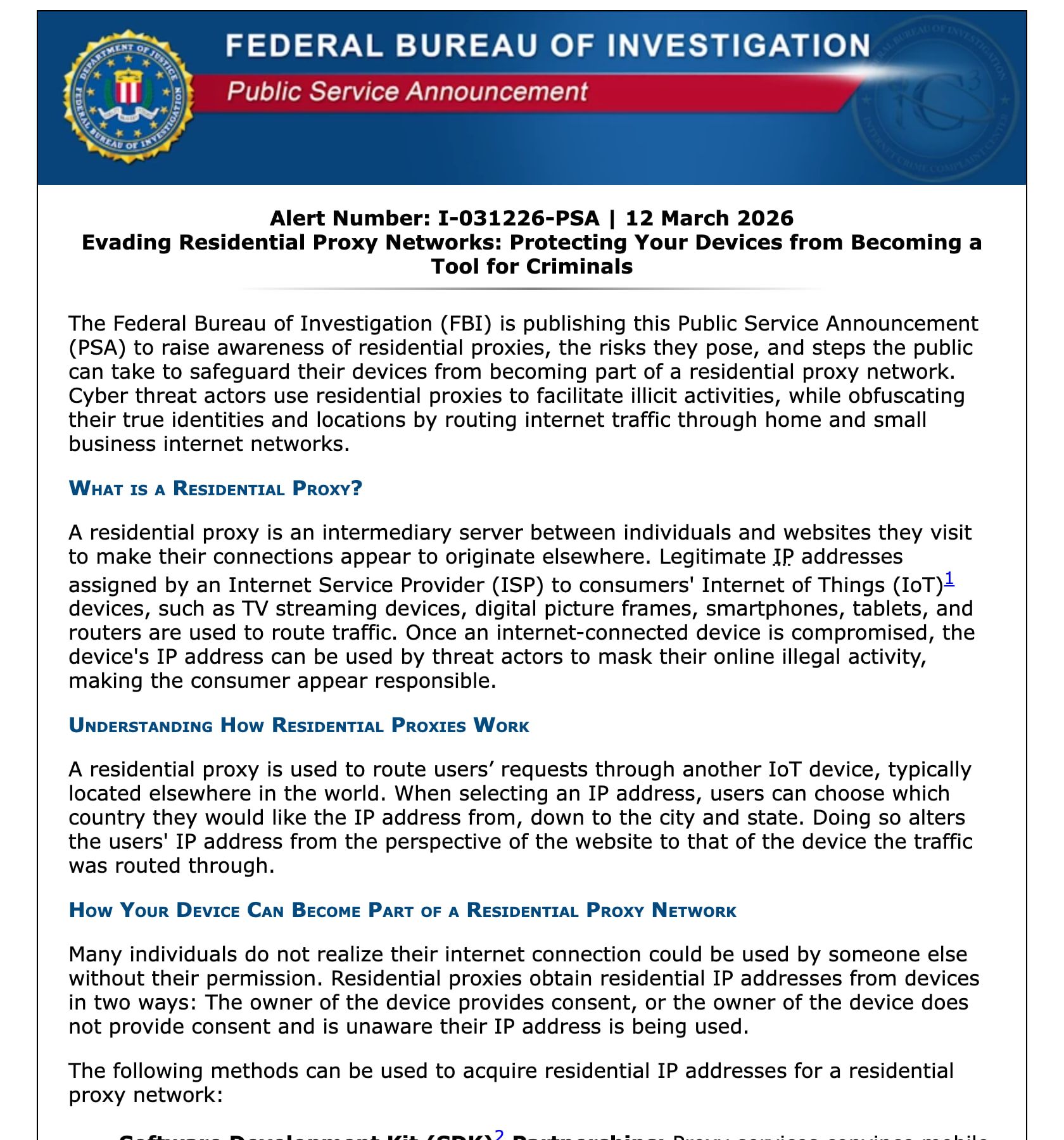
With a residential proxy, someone else’s. The FBI’s March 12, 2026 alert describes two ways devices end up in these pools: with consent, through app SDKs that pay developers or passive-income apps, and without it, through malware, compromised smart devices and sideloaded apps (FBI PSA).
A free VPN can turn this around and make your device the exit. The FBI warns that “Free VPN services may enroll users’ devices in a residential proxy network, without obtaining their consent” (FBI PSA).
The US Treasury says the 911 S5 botnet’s administrator was the registered subscriber to two VPNs, MaskVPN and DewVPN, “specific to the botnet operation” (Treasury), and Google’s January 2026 IPIDEA report names free VPN apps that enrolled devices through SDKs (Google).
If you buy residential, ask the provider how its peers agreed to share their connection. My ethical sourcing checklist has the questions, and are residential proxies legal? covers the legal side.
Will a website spot it? #
A VPN, usually yes; a residential proxy, less often. Spur says residential IPs belong to trusted consumer ISPs, so “traditional reputation and geolocation controls are often less effective” against them (Spur FAQ).
Being spotted as a VPN isn’t the same as being treated as a criminal. Spur itself says VPN use doesn’t always mean bad intent, since “Many users rely on VPNs for privacy, remote work, travel, or security” (Spur FAQ).
The session model matters more than people expect. A VPN gives you one IP for as long as you stay connected; a residential proxy can rotate on every request or hold a sticky session, which is why scrapers like it and why rotation breaks logged-in browsing. Speed I can’t compare fairly: I found no neutral source that measures both.
And harder to detect is not the same as allowed. The FBI’s alert lists “Spam and Fake Account Creation” and “Account Takeovers” among the ways criminals use residential proxies (FBI PSA).
Can you stream with either one? #
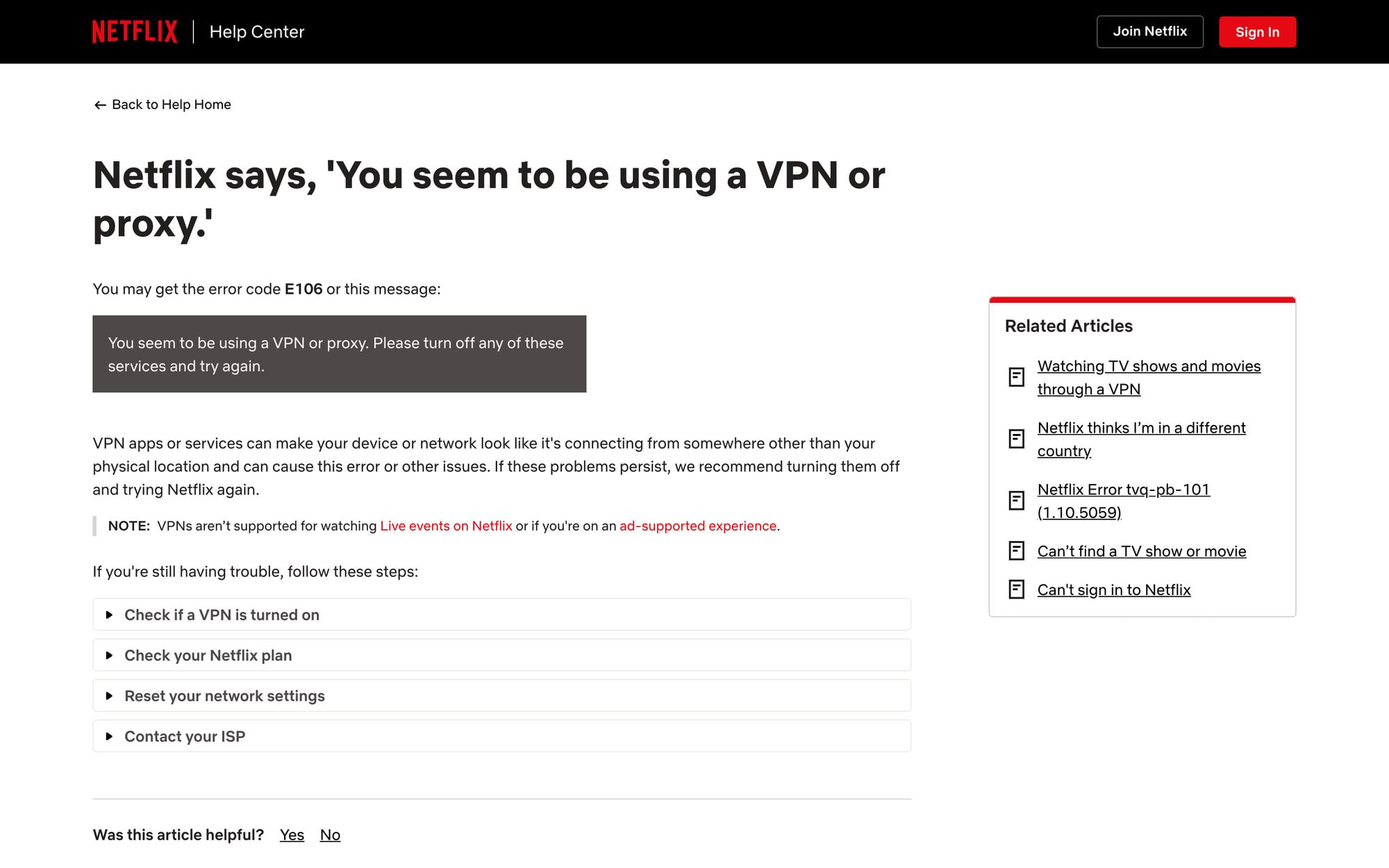
Netflix blocks both when it spots them, and says so on its own help page. Its error reads “You seem to be using a VPN or proxy. Please turn off any of these services and try again”, and the page adds that VPNs aren’t supported for live events or on ad-supported plans (Netflix help).
Netflix’s Terms of Use don’t name VPNs or proxies. What section 1.5 says is that you may access content “primarily within the country in which you have established your account” and only where Netflix has licensed it (Netflix Terms of Use, updated April 10, 2026).
So a residential IP that slips past detection doesn’t change the rule, and the FBI’s list of criminal uses even includes “Bypass Content Restrictions” (FBI PSA). For streaming, a residential proxy is the wrong tool twice: it costs per GB, and it isn’t permission.
What about “residential VPNs”? #
They exist, but read the label carefully. Windscribe sells a static IP product named “Residential” for $8.00 a month, billed $96 a year, in Chicago, Dallas and Toronto; its page says it “Uses a residential connection to bypass blocking and restrictions” but doesn’t say where the connection comes from (Windscribe).
That’s one fixed household-style IP inside a VPN, not a rotating pool. I couldn’t open NordVPN’s dedicated IP page, so I make no claim about it or any other brand.
Claims on other ranking pages, checked on November 12, 2026
- “A VPN gives you total privacy” or “end-to-end encryption.” The encryption ends at the VPN server, and Mullvad itself says you’re shifting trust to the VPN provider (Mullvad).
- “Residential proxies guarantee high privacy.” A proxy doesn’t encrypt anything by itself, plain HTTP is readable, and Basic proxy logins travel in cleartext without TLS (RFC 7617).
- IPRoyal residential “from $1.75/GB.” That’s its custom subscription tier from 10 TB. The 1 GB card is $7.00 on subscription or $7.35 pay as you go (IPRoyal pricing).
- Residential IPs “from real mobile devices” vs “laptops and desktops.” I found no source for either split.
Which one should you pick? #
Public Wi-Fi and everyday privacy: a VPN. One flat price covers your whole device, and the tunnel encrypts everything to the VPN server.
Travel or streaming abroad: a VPN, after reading the streaming service’s terms. Netflix ties viewing mainly to your account’s country, and a residential proxy would cost $30–$240 for ten hours of HD at the rates above.
Scraping a handful of sites: neither at first. Start with datacenter proxies, which my residential vs datacenter explainer prices, and move up only if you get blocked.
Sites that block datacenter IPs, or city-level targeting: a residential proxy, from a provider that documents how its peers consented. Budget $1–$8 per GB and possibly a business check. The cheapest residential proxies I priced compares six providers.
An AI agent browsing the web: a proxy with sticky sessions configured in the agent’s browser, so only that browser changes IP. My proxies for AI agents guide covers the setup.
Creating many accounts: neither. The FBI names fake account creation as a criminal use, and Bright Data’s and IPRoyal’s acceptable-use policies ban it (quoted in are residential proxies legal?).
FAQ #
Which is better, a VPN or a proxy? #
For personal privacy, a VPN: it encrypts all of your device’s traffic to the VPN server for a flat fee. For scraping or checking how a site looks from a home connection in a given city, a residential proxy. They solve different problems.
Do I need a proxy if I have a VPN? #
Only for jobs a VPN isn’t built for, such as sending many requests from rotating household IPs or targeting a specific city. For everyday browsing, the VPN alone covers you.
Is a residential proxy safer than a VPN? #
No. A proxy adds no encryption of its own, and your traffic leaves through a stranger’s home connection run by the proxy company. HTTPS keeps page content private through either one, but only a VPN encrypts everything between your device and its server.
Can I use a VPN for web scraping? #
You can point a scraper through it, but you get one IP at a time from the VPN company’s servers, which IP-intelligence firms such as Spur classify as VPN infrastructure. I didn’t read any VPN’s terms on automated use, so check yours before you start.
Why does Netflix block my VPN? #
Netflix’s help page shows the message ‘You seem to be using a VPN or proxy’ and says VPNs aren’t supported for live events or ad-supported plans. Its Terms of Use say you may watch mainly in the country where you set up your account.
What is an ISP proxy? #
Spur describes ISP proxies as IPs that appear residential but are hosted in data centers. So the address looks like a household connection while the server sits in a data center.
Sources
23 sources, accessed .
Official pricing, docs, changelogs and status pages 23
- Mullvad VPN pricing
- Mullvad: what is a VPN?
- Proton VPN pricing
- WireGuard protocol overview
- RFC 9110 HTTP Semantics, section 9.3.6 CONNECT
- RFC 7617 The Basic HTTP Authentication Scheme
- Spur FAQ: VPN vs residential proxy vs ISP proxy
- Spur FAQ: why residential proxies are harder to detect
- Spur FAQ: does VPN use always indicate malicious activity?
- Netflix help: 'You seem to be using a VPN or proxy'
- Netflix help: how much data Netflix uses
- Netflix Terms of Use (updated 10 Apr 2026)
- Bright Data residential network access rules
- Bright Data residential pricing
- IPRoyal residential pricing
- DataImpulse residential pricing
- Oxylabs KYC and safety
- IPRoyal KYC policy
- Webshare compliance policy
- Windscribe static IPs
- FBI PSA I-031226-PSA on residential proxy networks, 12 Mar 2026
- US Treasury: sanctions on the 911 S5 botnet network, 28 May 2024
- Google Threat Intelligence: IPIDEA report, 29 Jan 2026


