Pricing
Scrape.do pricing: what each request type costs
Scrape.do starts free with 1,000 credits, then $29 for 250K. What Google, rendered and residential calls cost, which errors are billed, and worked bills.
Scrape.do’s $29 Hobby plan buys 250,000 credits, but what that means depends on the request: 250,000 plain pages, 50,000 rendered pages, or 25,000 Google searches. Some domains cost far more, up to 200 credits a request, so the target list moves your bill more than the plan choice does. Pricing, request costs, verified 2026-11-12.
Below I put every request cost in one table, show how far each plan goes, work out five monthly bills, and sort out three places where Scrape.do’s own pages disagree: billed errors, refunds and the annual discount.
Short on time?
Here's my take
- Testing your targets
- Free plan
- 1,000 credits and 5 concurrent requests, no card: about 100 Google searches or 200 rendered pages.
- Up to 25K Google searches or 50K rendered pages
- Hobby, $29
- 250K credits and 10 concurrent requests. The cheapest entry rate per credit among the five APIs I priced.
- Up to 125K Google searches or 250K rendered pages
- Pro, $99
- 1.25M credits and 50 concurrent requests. About 32% cheaper per credit than Hobby.
- Residential-heavy work
- Business, $249
- 3.5M credits covers 300K residential (super) requests at $0.83 per 1K, with dedicated support and teams.
- 200 concurrent requests or a custom SLA
- Advanced, $699
- Buy it for concurrency and the SLA, not price: it's only about 1.7% cheaper per credit than Business.
Prices verified . Sponsors cannot buy a verdict or a position.
This page sits in the scraping APIs hub. If credits are new to you, what scraping API credits buy explains why a credit isn’t a page.
What does each Scrape.do plan cost? #
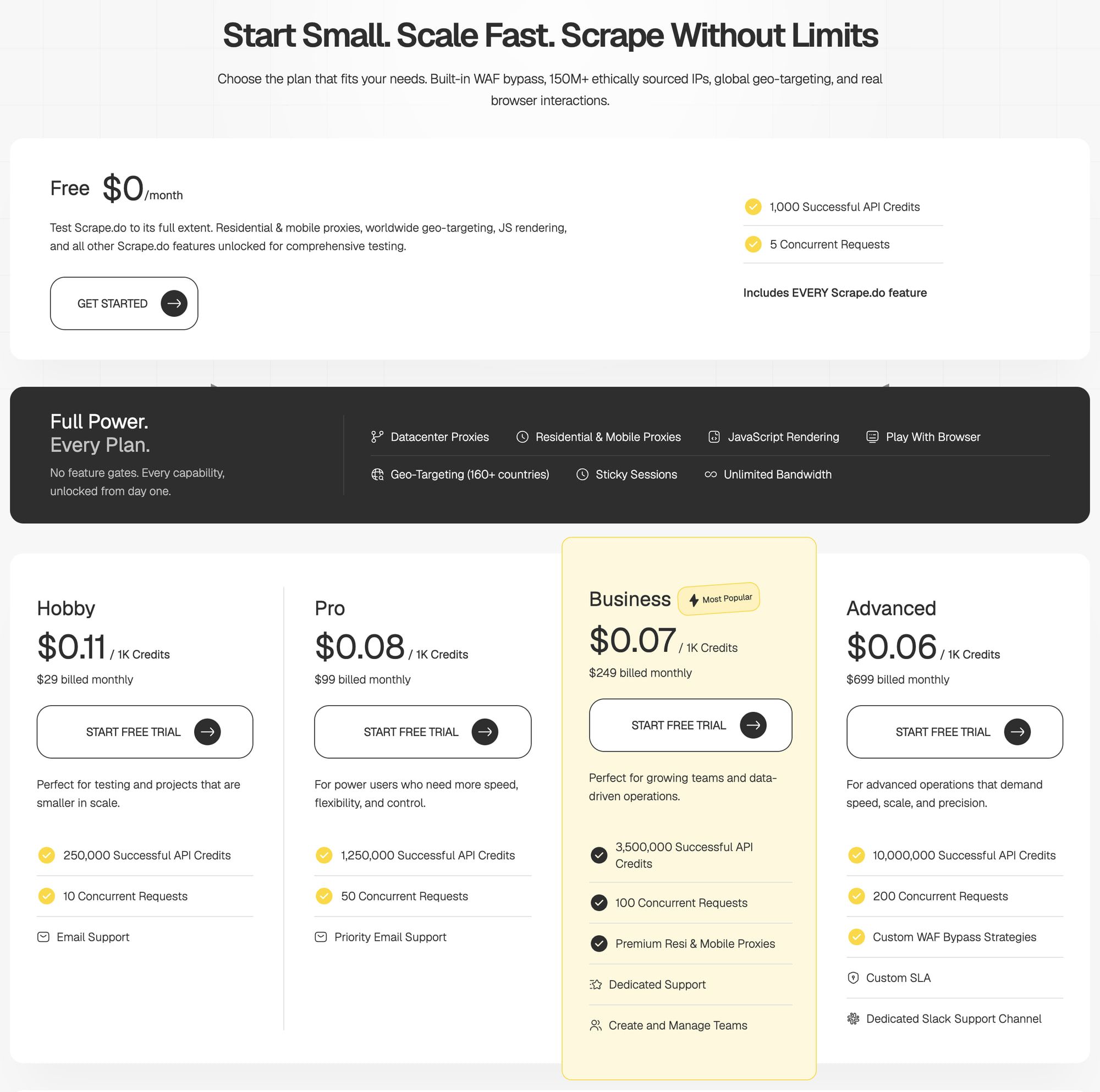
Five plans with published prices, from Free to Advanced at $699, plus a custom Enterprise tier. Every plan “Includes EVERY Scrape.do feature”: datacenter, residential and mobile proxies, JavaScript rendering, geotargeting in 160+ countries, sticky sessions and unlimited bandwidth. Pricing, pricing (markdown), verified 2026-11-12.
| Plan | Price a month | Credits | Concurrency | Rate the page shows | Real rate per 1K credits | Extras |
|---|---|---|---|---|---|---|
| Free | $0 | 1,000 | 5 | – | – | No card |
| Hobby | $29 | 250K | 10 | $0.11 | $0.116 | Email support |
| Pro | $99 | 1.25M | 50 | $0.08 | $0.079 | Priority email |
| Business (“Most Popular”) | $249 | 3.5M | 100 | $0.07 | $0.071 | Dedicated support, teams, “Premium Resi & Mobile Proxies” |
| Advanced | $699 | 10M | 200 | $0.06 | $0.070 | Custom WAF bypass, custom SLA, Slack |
| Enterprise | Custom | Unlimited | Unlimited | – | – | Custom firewall bypass |
The real rate is my arithmetic: price divided by credits. The Advanced card says “$0.06 / 1K credits”, but $699 for 10M is $0.0699, so it’s effectively $0.07. Hobby’s “$0.11” is really $0.116.
That correction changes one decision. Moving from Hobby to Pro cuts the per-credit rate by about 32%, but Business to Advanced cuts it by only about 1.7% ($0.0711 to $0.0699). Advanced is for its 200 concurrent requests and custom SLA, not for cheaper credits.
Two concurrency details: since February 3, 2026, a render=true request counts as one concurrent request instead of five, and the Async API gets its own concurrency pool of 30% of your plan’s limit. Changelog, docs index.
How many credits does a request use? #
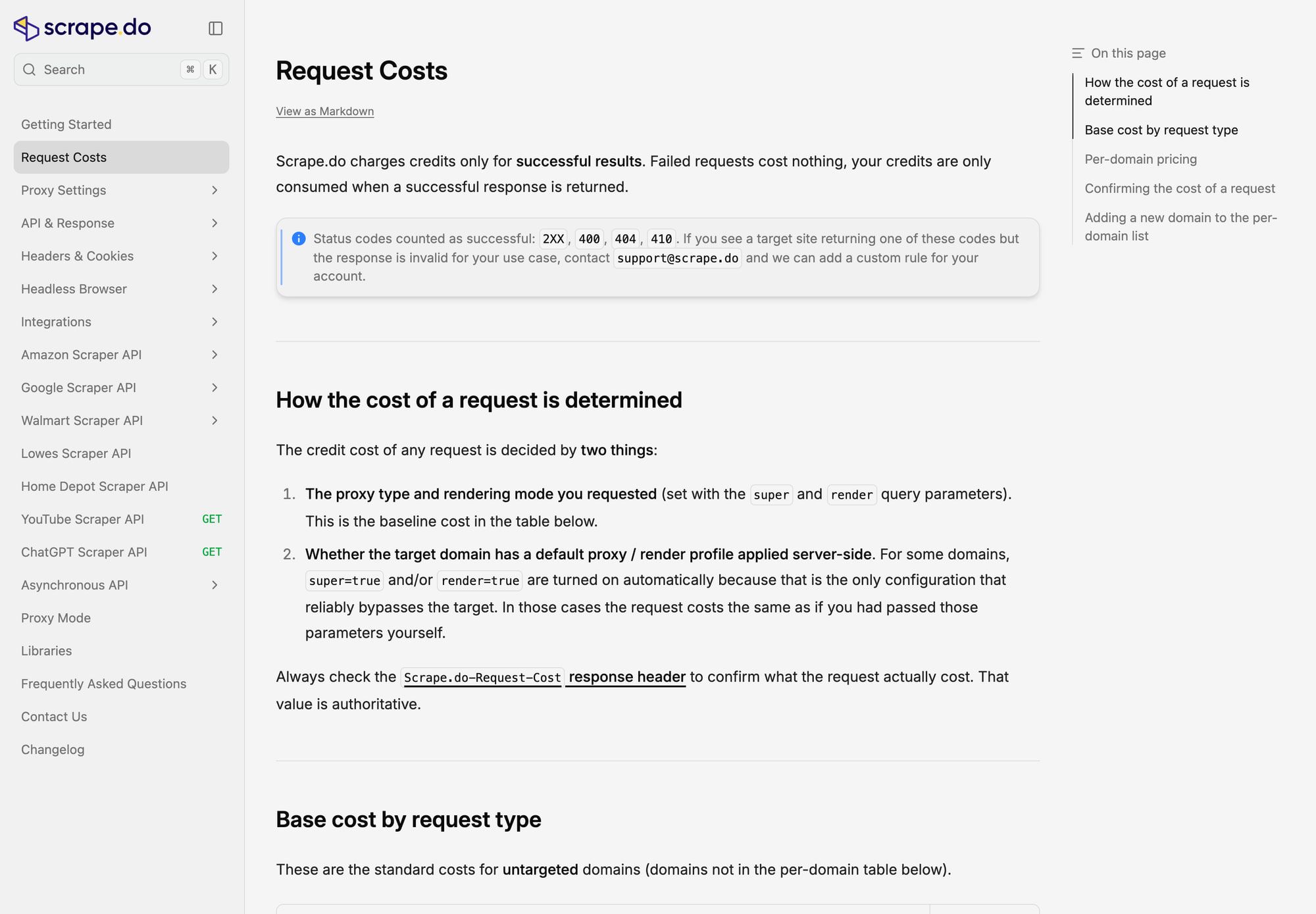
Between 1 and 200, set by two things: the options you turn on and the domain you request. The base costs come first. Request costs, verified 2026-11-12.
| Request | Credits |
|---|---|
| Normal request (datacenter proxy) | 1 |
render=true (headless browser) |
5 |
super=true (residential and mobile proxies) |
10 |
super=true with render=true |
25 |
Then some domains carry their own default cost, and the docs say the stricter of that default and the cost of the options you requested applies. So a plain request to LinkedIn still costs 30.
| Credits per request | Domains |
|---|---|
| 1 | amazon.* (structured JSON) |
| 10 | google.* (uses super by default), idealista.*, akakce, capterra, hermes, leboncoin.fr, mouser, lowes |
| 20 | cineworld.co.uk |
| 25 | fastpeoplesearch, g2, leroymerlin.fr, mscdirect, naver, realestate.com.au, shein., therealreal, nordstrom. |
| 25–200 | carsales.com.au |
| 30 | linkedin.com |
| 50 | chewy.com |
| 75 | aircanada, jd.com |
| 100 | shopee.* |
| 200 | sainsburys.co.uk |
Source: request costs. The docs call the Scrape.do-Request-Cost response header authoritative, and a Scrape.do-Remaining-Credits header shows your balance. Log the cost header on your first few hundred requests before you pick a plan.
For Google, the product page says “Every Google Search Scraper API call costs 10 credits.” The AI Overview is “included automatically in the regular search endpoint response” with no extra charge stated, while the separate AI Mode endpoint costs 10 credits a request. Google Search API, AI Mode docs.
Each Google call returns about 10 results a page, paginated with start. The AI Mode docs say a call that returns no AI Mode content, or a 502, is “not charged”.
How far does each plan go? #
Here is what each plan buys if you spend all of it on one request type. My arithmetic, credits divided by cost.
| Plan | Plain (1) | Rendered (5) | Residential (10) | Residential + rendered (25) | Google (10) | G2 (25) | LinkedIn (30) | Shopee (100) | Sainsbury’s (200) | Amazon (1) |
|---|---|---|---|---|---|---|---|---|---|---|
| Free | 1,000 | 200 | 100 | 40 | 100 | 40 | 33 | 10 | 5 | 1,000 |
| Hobby $29 | 250K | 50K | 25K | 10K | 25K | 10K | 8,333 | 2,500 | 1,250 | 250K |
| Pro $99 | 1.25M | 250K | 125K | 50K | 125K | 50K | 41,666 | 12,500 | 6,250 | 1.25M |
| Business $249 | 3.5M | 700K | 350K | 140K | 350K | 140K | 116,666 | 35K | 17,500 | 3.5M |
| Advanced $699 | 10M | 2M | 1M | 400K | 1M | 400K | 333,333 | 100K | 50K | 10M |
The Google column matches the product page’s own call counts: 25K on Hobby, 125K on Pro, 350K on Business and 1M on Advanced. Google Search API. At full use, that’s $1.16 per 1,000 searches on Hobby, $0.79 on Pro, $0.71 on Business and $0.70 on Advanced.
What would my bill be? #
Here are five jobs priced on published rates, verified 2026-11-12. These are calculations, not invoices, and they leave out retries and billed 400, 404 and 410 responses. The volumes differ from my cheapest web scraping API comparison, so the two pages don’t repeat each other.
| Job a month | Credits | Plan | Effective price |
|---|---|---|---|
| 20K Google searches | 200K | Hobby $29 (5K searches spare) | $1.45 per 1K searches |
60K pages, all render=true |
300K | Pro $99 (Hobby’s 250K is too small) | $1.65 per 1K pages |
| The same 60K, rendering only the 40% that need it | 24K × 5 + 36K × 1 = 156K | Hobby $29 | Saves $70 a month |
300K residential (super) requests |
3M | Business $249 (3.5M) | $0.83 per 1K requests |
| 100K Amazon products + 15K Google searches | 100K + 150K = 250K | Hobby $29, exactly full | No room for a single billed 404 |
| Pro paid yearly | – | $990 a year | $82.50 a month |
The third row is the cheapest lesson on the page. Rendering only the pages that need a browser moves the same job from Pro to Hobby.
The fifth row is the one I’d avoid. A plan that’s exactly full has no room for billed 404 retries, and Scrape.do doesn’t publish what extra credits cost, so the only plannable fix is upgrading to Pro.
What does the free plan include? #
1,000 credits and 5 concurrent requests, with no card. The homepage says “Get 1,000 successful API credits with 5 concurrent requests, completely free.” Homepage. Every feature is included, so you can check residential and rendered requests against your own targets.
Spent on one type, that’s about 1,000 plain pages, 200 rendered pages, 100 Google searches or 33 LinkedIn profiles. Whether it renews depends on which page you read:
| What it says | Where |
|---|---|
| “The free plan includes 1,000 successful API calls per month.” | Pricing FAQ |
| Free plan: 1,000 credits, listed as 100 Google calls a month | Google Search API |
| “1000 Credits (Refreshes Monthly)” | Comparison page |
| “1,000 requests per month for free, no expiration” and “Free forever plan” | Founder’s roundup |
| “free-forever account” | Docs index |
My reading is 1,000 credits that renew monthly, with “no expiration” referring to the plan rather than unused credits. That’s an interpretation, not something Scrape.do states outright. For other free tiers that renew, see the free web scraping API roundup.
Do failed requests cost credits? #
Mostly no, but 400, 404 and 410 responses do, and Scrape.do’s pages disagree about it.
Which errors are billed? It depends on the page
- Pricing FAQ: “You won’t lose credits on timeouts, blocks, or errors.” Pricing
- Homepage FAQ: “Only successful requests use up API credits—failed requests won’t be deducted” from your balance. Homepage
- Request-cost docs: “Failed requests cost nothing, your credits are only consumed when a successful response is returned.” Then: “Status codes counted as successful:
2XX,400,404,410.” Request costs - Docs index: “You are only charged for successful requests (status codes
2xx,400,404,410)”. Docs index
I’d budget on the docs: 400, 404 and 410 are billed, while 429, 5XX errors and timeouts are not (by omission rather than an explicit statement). If a 200 response comes back with useless content, the pricing FAQ says to contact support to reclaim the credits.
For context, ScraperAPI bills 200 and 404 responses, and ZenRows bills 404 and 410. ScraperAPI credit costs, ZenRows pricing docs. Scrape.do isn’t unusual here; it just says two things at once.
Can you get a refund? #
Plan on a 3-day window for your first subscription only. Scrape.do’s pages give four versions, and I’d budget on the strictest.
Four refund rules, and the one I'd plan on
- Homepage FAQ: “we do offer refunds within the first three days of purchase.” Homepage
- Terms of use (dated September 26, 2022, under PACKEND, LLC): “We issue refunds for Subscription within 3 days of the original purchase of the first subscription.” Also: “Subscription credits used successfully are non-refundable!” and the payment provider’s commission is deducted. Terms, terms (markdown)
- Same terms, forgotten renewals: subscriptions auto-renew “under the exact same conditions”, and if you forgot to cancel there’s a “full refund within 3 days and a 50% refund within 15 days”. Terms
- Founder’s blog roundup: Hobby has a “7-day money-back guarantee”. This appears nowhere else. Founder’s roundup
- Pricing page: no refund text at all. Pricing
The terms and homepage agree on 3 days and are the binding pages, so that’s what I’d plan on: unused credits only, first subscription only, minus payment fees. The 50% within 15 days is a useful backstop if a renewal catches you out.
Is annual billing worth it? #
It saves 16.7%, not the “up to 20%” the FAQ mentions. The FAQ describes it as “pay for 10 months and get 12”, which is 2 free months out of 12. Pricing (markdown).
| Plan | Monthly | Annual total | Annual, per month |
|---|---|---|---|
| Hobby | $29 | $290 | $24.17 |
| Pro | $99 | $990 | $82.50 |
| Business | $249 | $2,490 | $207.50 |
| Advanced | $699 | $6,990 | $582.50 |
There’s no monthly/annual toggle on the pricing page: “This is currently set up manually”, through chat or support@scrape.do, for every plan except Enterprise. Pricing (markdown). With refunds limited to 3 days, I’d only pay yearly after a month or two on the monthly plan.
Payment can be by card, crypto, or bank wire for monthly payments over $500. You can cancel, upgrade or downgrade at any time. Pricing.
What Scrape.do doesn’t publish #
A few things you’d want before committing aren’t on any page I read:
- The price of additional credits. The FAQ says that when you run out, “requests will stop unless you upgrade your plan or purchase additional credits”, without a price. Pricing
- Rollover or expiry of paid credits. Neither the FAQ nor the terms mention it.
- What “Premium Resi & Mobile Proxies” adds on Business, when every plan already lists residential and mobile proxies.
- How the homepage’s 99.98% success rate was measured, and the terms of Advanced’s custom SLA. Homepage
- VAT or sales tax.
The terms also carry a “Free Trial” clause about charging you when a trial ends. That doesn’t match a free plan that needs no card, and it may be leftover text, but I couldn’t confirm. Terms.
What changed in the last year? #
Scrape.do’s changelog shows no change to credit costs, but several changes to plans and products. Changelog.
| Date | Change |
|---|---|
| Nov 17, 2025 | Advanced plan added, with analytics and a playground |
| Feb 3, 2026 | render=true counts as one concurrent request instead of five |
| Feb 25, 2026 | Google SERP API launched |
| Mar 12, 2026 | Pricing page restructured with concurrency limits |
| Mar 24, 2026 | AI Overview extraction added |
| Jul 29, 2026 | Team management for Business and up |
| Oct 27, 2026 | Proxy mode moves to pm.scrape.do:8080; the old host switches off April 30, 2027 |
The Advanced date explains a stale line: the founder’s roundup still describes Advanced as “custom enterprise pricing”, but it has been $699 since the plan was added. Founder’s roundup.
Is it reliable enough to be worth the price? #
I have no measurements of my own, and the outside data is thin. String, a rival vendor that ranks itself first, put Scrape.do second of 17 at 94.0% in a run on October 30, 2026. String, benchmark code. On Trustpilot it had 4.8 stars from 71 reviews, and Trustpilot notes the company hasn’t invited reviews recently. Trustpilot.
I found no billing or refund complaints in sources I could read. That isn’t the same as there being none: Reddit was unreadable and Hacker News had no relevant comments. HN search.
How does it compare at 60K rendered pages? #
Scrape.do is mid-pack on this job. Each row is the cheapest published way to cover 60,000 JavaScript-rendered pages a month, verified 2026-11-12.
| Vendor | Credits per rendered page | Credits needed | Cheapest fit | Monthly price |
|---|---|---|---|---|
| ZenRows | 5 | 300K | Launch L1 $69 + one 50K top-up at $19.50 (plan-only L2 $99) | $88.50 |
| Scrapingdog | 5 (default) | 300K | Standard (Lite’s 200K is too small; PAYG $120) | $90 |
| Scrape.do | 5 | 300K | Pro (Hobby’s 250K is too small) | $99 |
| ScrapingBee | 5 (default) | 300K | Startup (Freelance’s 250K is too small) | $99 |
| ScraperAPI | 10 | 600K | Startup (1M) | $149 |
Inputs: ZenRows pricing docs and pricing page, Scrapingdog pricing and rendering docs, ScrapingBee pricing and docs, ScraperAPI pricing and credit costs.
Scrape.do wins when the job fits Hobby, since $29 for 250K is the cheapest entry rate per credit in this table, or when you need 50 concurrent requests at $99. At 60K rendered pages, ZenRows and Scrapingdog are about $10 cheaper. For more on three of these, see ZenRows pricing, Scrapingdog pricing and ScrapingBee pricing; if you’re replacing Scrapingdog, Scrapingdog alternatives prices Scrape.do at 250K pages.
Which plan should you pick? #
Testing: the Free plan. Spend the 1,000 credits on your real targets and log the Scrape.do-Request-Cost header, because per-domain costs can be 10 to 200 times the base.
Up to 25K Google searches or 50K rendered pages a month: Hobby at $29. Render only the pages that need it and many 60K-page jobs fit here too.
Up to 125K Google searches or 250K rendered pages: Pro at $99, with 50 concurrent requests. Leave 5–10% headroom for billed 404s, since extra credits have no published price.
Residential-heavy work: Business at $249. It covers 300K super requests a month at $0.83 per 1,000, and adds dedicated support and teams.
200 concurrent requests or a custom SLA: Advanced at $699. Don’t buy it to save money per credit; it’s only about 1.7% cheaper than Business.
60K rendered pages and price is all that matters: ZenRows at $88.50 or Scrapingdog at $90 edge out Scrape.do’s $99. For Google-only work across many vendors, the cheapest SERP APIs compares more options.
FAQ #
Is Scrape.do free? #
There is a free plan with 1,000 credits and 5 concurrent requests, with no card needed. The pricing FAQ says the 1,000 calls are per month. That’s enough for about 100 Google searches or 200 rendered pages. Pricing.
How many credits does a Google search use on Scrape.do? #
Ten. Scrape.do’s Google Search product page says every call costs 10 credits, and the AI Overview comes in the same response with no extra charge stated. The separate AI Mode endpoint is another 10 credits a call. Google Search API.
Does Scrape.do charge for failed requests? #
For most failures, no. But its docs count 400, 404 and 410 responses as successful, so those are billed, even though the pricing FAQ says you won’t lose credits on errors. I’d budget on the docs. Request costs.
Do Scrape.do credits roll over? #
Scrape.do doesn’t say. Neither the pricing page, the FAQ nor the terms mention rollover or expiry for paid credits, so I’d plan as if unused credits are lost at renewal until support confirms otherwise in writing. Pricing, terms.
Can I get a refund from Scrape.do? #
Only within 3 days of your first subscription, for unused credits, minus payment fees, per the homepage and terms. If you forget to cancel a renewal, the terms allow a full refund within 3 days and 50% within 15 days. A 7-day guarantee appears only in the founder’s blog. Terms.
What happens when I run out of Scrape.do credits? #
Requests stop until you upgrade or buy additional credits. Scrape.do doesn’t publish the price of additional credits, so upgrading is the only cost you can plan for. Pricing.
Sources
25 sources, accessed .
Official pricing, docs, changelogs and status pages 21
- Scrape.do pricing and FAQ
- Scrape.do pricing (markdown version)
- Scrape.do homepage
- Scrape.do homepage (markdown version)
- Request costs
- Docs index
- Google Search Scraper API
- Google AI Mode docs
- Terms of use
- Terms of use (markdown version)
- Changelog
- Scrape.do vs Scrapingdog (vendor page)
- Founder's web scraping API roundup
- Scrapingdog pricing
- Scrapingdog rendering docs
- ScrapingBee pricing
- ScrapingBee documentation
- ZenRows pricing docs
- ZenRows pricing page
- ScraperAPI pricing
- ScraperAPI credit costs


