Pricing
ZenRows Pricing? I Read the Fine Print on Top-Ups and Caps
ZenRows starts free with 5,000 monthly credits, then $19 for 45,000. How top-up packs, JS weights, annual billing and soft spending caps change the math.

ZenRows pricing starts with 5,000 monthly Free credits and Build at $19 monthly for 45,000. I would compare the full monthly ladder and eligible top-up packs, then keep Fetch requests, browser traffic and agent-storefront purchases separate. Monthly pricing, agent payments.
For hypothetical successful generic Fetch requests, 30,000 plain pages fit $19 Build B1. At 300,000 plain pages, $69 Launch L1 plus one $19.50 pack is a $88.50 capacity candidate; at 30,000 JS pages, $39 Build B3 plus one $19.50 pack is $58.50, assuming pack eligibility. Pricing.
Short on time?
Here's my take
- For a small qualifying job
- Free or Build B1
- Match the request weight and entitlement rather than assume 5K credits equal every kind of 5K pages.
- For bursty monthly work
- Compare packs with the next rung
- Ten-pack rules can change the capacity candidate, but account eligibility matters.
- For spend controls
- Key limits plus a local work budget
- The documented key-cap behavior permits overshoot and temporary fail-open cases.
Prices verified . Sponsors cannot buy a verdict or a position.
How much is each monthly plan? #
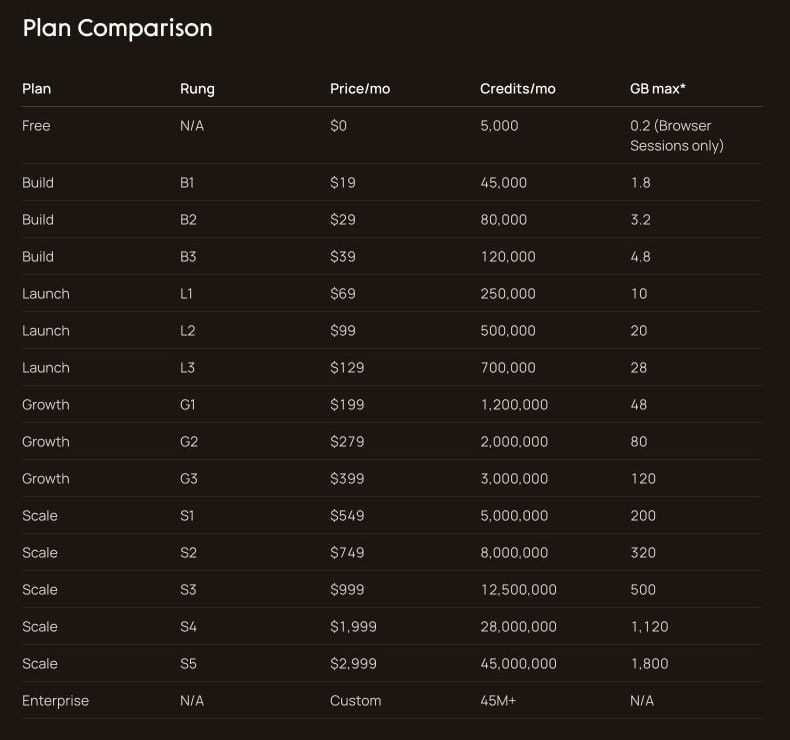
From $0 (Free) to $2,999 (Scale S5) a month, using the explicit monthly documentation in the table. Lower landing-page figures, such as $16 for Build B1, are monthly equivalents of yearly billing, not replacements for the monthly $19/$69/$199/$549 first rungs; I would keep period and commitment attached to every price. Prices and specifications verified: 2026-11-11. Monthly pricing, USD landing page.
| Tier / rung | Monthly price | Credits | Concurrency |
|---|---|---|---|
| Free | $0 | 5,000 | 5 |
| Build B1 | $19 | 45,000 | 20 |
| Build B2 | $29 | 80,000 | 20 |
| Build B3 | $39 | 120,000 | 20 |
| Launch L1 | $69 | 250,000 | 50 |
| Launch L2 | $99 | 500,000 | 50 |
| Launch L3 | $129 | 700,000 | 50 |
| Growth G1 | $199 | 1,200,000 | 100 |
| Growth G2 | $279 | 2,000,000 | 100 |
| Growth G3 | $399 | 3,000,000 | 100 |
| Scale S1 | $549 | 5,000,000 | 200 |
| Scale S2 | $749 | 8,000,000 | 200 |
| Scale S3 | $999 | 12,500,000 | 200 |
| Scale S4 | $1,999 | 28,000,000 | 300 |
| Scale S5 | $2,999 | 45,000,000 | 400 |
What do Fetch, Extract and browsers cost? #
Ordinary Fetch weights are one plain, five JS-only, ten premium-only and 25 premium-plus-JS. Extract uses the underlying Fetch configuration, and Batch uses the same weights per successful task; neither endpoint turns every credit into one validated data record. Specifications verified: 2026-11-11. Pricing, Extract introduction, Batch FAQ.
| Product or path | Published unit | What I would budget |
|---|---|---|
| Plain Fetch | 1 credit/request | Selected targets and billable outcomes |
| JS Fetch | 5 credits/request | Rendering only where required. JS feature |
| Premium Fetch | 10 credits/request | The relevant premium path. Premium feature |
| Premium + JS Fetch | 25 credits/request | The documented combined total |
| Browser sessions | 25,000 credits/GB + 5 credits/minute | Traffic and lifetime together. Pricing, browser FAQ |
| Standalone residential proxy | 25,000 credits/GB; paid only | A separate bandwidth path. Pricing, proxy FAQ |
| Agent-storefront PAYG | $0.50/1,000 credits; minimum 10,000-credit purchase | Separate credential; Fetch/Extract only. Agent payments |
I would not describe the last row as universal account PAYG. The agent storefront is a separate purchase/authentication path, and its one-time 5,000-credit email-verification grant differs from the main recurring Free plan. Agent payments, main pricing.
Adaptive mode says it charges only the successful configuration. A response that returns an error page or fails your required schema can still be unusable, so I would validate it separately rather than equate adaptive success with a finished record. Adaptive mode, Fetch reference.
How do top-up packs work? #
Current pricing allows at most ten matching top-up packs per monthly period. Pack credits carry into the next period once, while base credits expire; actual purchase eligibility can still depend on trial, payment and maximum-balance rules. Prices and specifications verified: 2026-11-11. Pricing.
| Monthly rung | One pack adds | One pack price |
|---|---|---|
| B1 | 11,000 credits | $6.50 |
| B2 | 13,000 | $6.50 |
| B3 | 43,000 | $19.50 |
| L1 | 50,000 | $19.50 |
| L2 | 70,000 | $19.50 |
| L3 | 175,000 | $45.50 |
| G1 | 224,000 | $52 |
| G2 | 400,000 | $78 |
| G3 | 525,000 | $97.50 |
| S1 | 845,000 | $130 |
| S2 | 1,240,000 | $163 |
| S3 | 1,800,000 | $200 |
| S4 | 4,000,000 | $400 |
| S5 | 6,000,000 | $560 |
This is the monthly table, not the annual pack table. Yearly billing is pay ten/get twelve with credits available up front for the whole year; annual packs cost ten times the monthly pack price, add twelve times its credits and have a ten-pack yearly limit. Pricing, billing, FAQ.
I would consider annual billing only after understanding the work schedule and commitment. Access to an up-front annual pool does not mean the same allowance refreshes twelve times, and a carried pack balance is not indefinite rollover.
Upgrades are immediate with the documented once-only carryover exception excluding Free; downgrades and cancellation take effect at cycle end. I would check the exact renewal and remaining-credit state before a plan change rather than model it as a fresh new account. Billing, FAQ.
Three workloads, priced out #
These are hypothetical, unexecuted monthly estimates for successful generic Fetch requests, either plain or JS-only. They exclude premium protection, special targets, AI, other products, tax, free promotions, rollover and client retries; paid pack examples assume eligibility and no maximum-balance or payment obstacle. Pricing, Fetch reference.
I compared every listed monthly rung with zero through ten matching packs, then selected the lowest listed capacity cost under those assumptions. The capacity is a candidate, not an account quotation or a promise of useful pages.
| Monthly requests | Plain: requests × 1 | Plain capacity candidate | JS: requests × 5 | JS capacity candidate |
|---|---|---|---|---|
| 3,000 | 3,000 credits | Free, $0; feature eligibility applies | 15,000 credits | B1, $19 |
| 30,000 | 30,000 credits | B1, $19 | 150,000 credits | B3 + one 43K pack, $58.50 |
| 300,000 | 300,000 credits | L1 + one 50K pack, $88.50 | 1,500,000 credits | G2, $279 |
For 30,000 JS requests, B3 gives 120,000 credits and one pack adds 43,000: 163,000 capacity for $39 + $19.50 = $58.50. The plan-only fallback is L1 at $69 for 250,000 credits if a pack cannot be purchased. Pricing.
For 300,000 plain requests, L1’s 250,000 plus one 50,000 pack exactly covers the hypothetical budget at $69 + $19.50 = $88.50. The plan-only fallback is L2 at $99, which also leaves more credit room for billable errors or additional attempts. Pricing.
For 300,000 JS requests, 1.5 million credits fit G2’s two million at $279, including when I compare the eligible pack combinations. The same $279 G2 is the plan-only candidate; none of these examples proves the workload’s real quality or throughput. Pricing.
A mixed job of 10,000 plain, 2,000 JS and 1,000 premium-plus-JS requests requires 45,000 credits, exactly B1’s base allowance: 10,000 + 10,000 + 25,000. I would leave reserve capacity in a real plan rather than assume all attempts produce useful data. Pricing.
If ScrapingBee is your other candidate, I put the two plan ladders side by side in ZenRows vs ScrapingBee. For other providers at similar volumes, see the cheapest web scraping API comparison.
Do caps and limits stop overspending? #
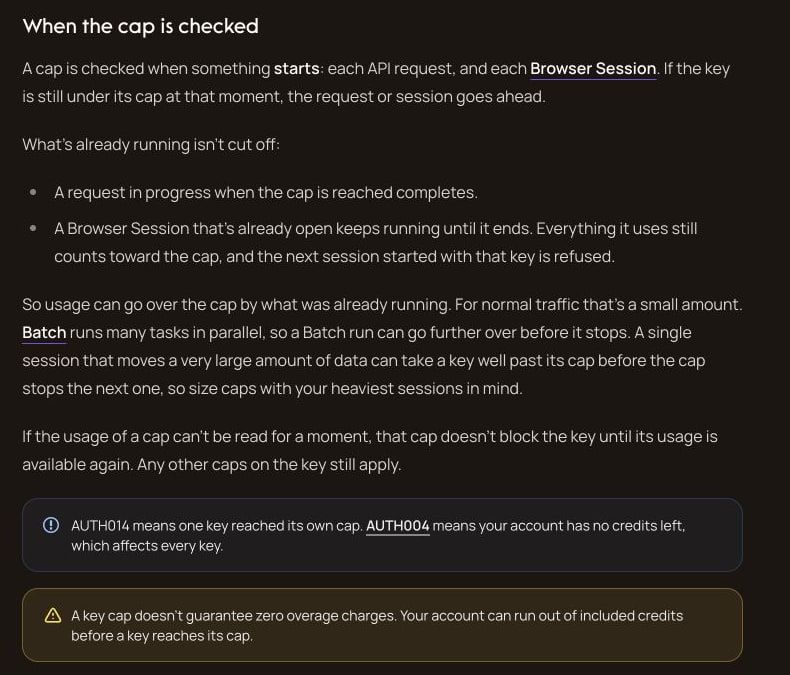
Not on their own. API-key credit caps are off by default and checked when work starts. The documentation permits in-flight overshoot and temporary fail-open behavior, and excludes legacy proxy traffic; I would combine them with a local work budget instead of promise a hard zero-overspend boundary. Key caps.
Concurrency counts simultaneous work rather than monthly pages. Cancelling a Fetch request can leave its slot occupied for up to three minutes, and browser sessions have a three-minute default TTL with a one-to-15-minute range; client lifetime decisions therefore matter alongside the credit table. Fetch reference, concurrency, browser TTL.
The tiers also have decimal-MB response limits: Free and Build five MB, Launch and Growth ten MB, Scale 20 MB. A 413 RESP005 means an oversized response is not delivered; I did not verify a universal charging rule for every such failure in an account. Pricing, response-too-large guidance, error codes.
The pricing documentation counts 404 and 410 responses as successful, billable results. The other-feature documentation and notification settings do not convert those rules into a guarantee of useful records or reserved credit; alerts are monitoring, not a credit reservation. Pricing and billing, other features, notifications.
The optional allowed_status_codes parameter can return specified error-page content, and its documentation says those requests incur charges. I would budget that debugging configuration separately from an assumption that every failed target response is free. Error-content feature.
I would record cost, selected configuration, status and data-validation result for each attempt. That is how I would distinguish a returned page from a distinct usable record, rather than report a subscription’s headline credits as verified production capacity.
Why there’s no user verdict here #
I reviewed zero independent user reports for this pricing article. I cannot substantiate a support consensus, measured uptime, matched-target success rate or “best quality” claim from the primary-document sample.
The recurring/free and paid figures are documentation findings, with account restrictions still unverified. I would make an authorized small evaluation its own dated evidence record before relying on a provider for a particular data quality or latency requirement.
Which option would I choose? #
I would inspect Free for a qualifying small generic workload, B1 for modest recurring capacity, and eligible packs when the job just exceeds a base allowance. I would use the next full rung when pack eligibility is uncertain, compare annual commitment separately, and keep browser or proxy costs out of Fetch-only estimates. If the ladder doesn’t suit you, my ZenRows alternatives guide splits replacements by the ZenRows product you actually use.
The service terms restrict service/account resale and unlawful uses; consumer withdrawal is conditional rather than a blanket business refund. A free grant does not establish target permission, and repeated accounts are not a legitimate budgeting method. Terms.
Start with the scraping API pillar and credit guide, then compare the same request levels in ScraperAPI and ScrapingBee pricing. The free API guide distinguishes recurring grants from trials.
FAQ #
How much does ZenRows cost per month? #
Build B1 is $19, Launch L1 $69, Growth G1 $199 and Scale S1 $549, with further rungs within each tier. Lower annual-equivalent landing figures use a different billing period. Monthly documentation, landing page.
How many top-up packs can I buy? #
Current pricing documents up to ten matching packs per monthly period, subject to eligibility and balance limits. Pack credits carry once; ordinary base credits expire. Pricing.
Is one ZenRows credit one page? #
Plain is one, JS five, premium ten and premium-plus-JS 25. Other endpoints/products have their own units, and returned content needs validation. Pricing, Fetch reference.
Are ZenRows key caps hard spending limits? #
No. The docs describe default-off caps, start checks, in-flight overshoot and temporary fail-open behavior, with legacy proxy traffic excluded. Key-cap documentation.
Does the agent free grant renew every month? #
The agent storefront’s 5,000-credit grant is once after email verification, while the main Free plan lists 5,000 monthly credits. These are distinct paths. Agent payments, main pricing.
Do annual-plan credits refresh every month? #
The annual structure provides the full pool up front. Annual packs have different price/credit quantities and a yearly ten-pack limit, so I would model the whole commitment. Billing, pricing.
Sources
21 sources, accessed .
Official pricing, docs, changelogs and status pages 21
- Zenrows monthly pricing
- Fetch API reference
- General FAQ
- Billing page
- Key credit caps
- Other Fetch features
- JS rendering
- Premium proxy
- Adaptive stealth
- Concurrency
- Errors
- Response size
- Session TTL
- Browser FAQ
- Legacy proxy FAQ
- Batch FAQ
- Extract introduction
- Agent storefront
- Usage notifications
- Zenrows service terms
- Zenrows pricing landing


