Roundup
I Compared 8 Web Search MCP Servers by What Their Tools Do
Eight official search MCP servers compared by transport, login, tools and cost, and why connecting one doesn't make your searches free.

I would choose an official search MCP server by tool output, supported transport and provider rights, then expose only the tools the task needs. Exa’s search/fetch pair is a useful place to inspect for retrieved context; SerpApi fits structured SERP fields, while Perplexity separates raw search from model-authored answers. None was connected or exercised for this comparison. Exa, SerpApi, Perplexity.
Short on time?
Here's my take
- Search and page context
- Exa official MCP
- Inspect the default search/fetch pair and explicitly choose any additional tools.
- Google SERP fields
- SerpApi official MCP
- Use its structured result contract and a real authorized search account.
- Answer or raw search
- Perplexity official MCP
- Search and Agent-backed tools have different output and billing.
Prices verified . Sponsors cannot buy a verdict or a position.
Which search MCP server fits which job? #
Exa and Tavily expose search/content workflows; SerpApi exposes structured SERP fields, and Perplexity separates raw search from Agent answers. MCP standardizes tool access rather than creating a free search index or making these providers interchangeable. This is a shortlist by documented fit, not an output-quality ranking. Tools specification.
| Official server | Transport or hosted address | Authentication / useful distinction |
|---|---|---|
| Exa | https://mcp.exa.ai/mcp |
Limited anonymous access, OAuth or key; search/fetch defaults |
| SerpApi | https://mcp.serpapi.com/mcp; local stdio option |
Bearer key for searches; structured JSON default |
| Perplexity | https://api.perplexity.ai/mcp; local stdio |
OAuth or bearer; Search versus Agent tools |
| Brave | stdio by default; optional HTTP | API key; inspect enabled search tools |
| Tavily | https://mcp.tavily.com/mcp |
OAuth or bearer; search/extract/map/crawl |
| Firecrawl | Cloud or self-hosted configuration | Cloud key or self-hosted API URL |
| Parallel | https://search.parallel.ai/mcp; /mcp-oauth alternative |
Anonymous versus authenticated controls differ |
| Linkup | https://mcp.linkup.so/mcp |
Bearer; depth controls depend on exposed tool |
Sources, specifications verified 2026-11-09: Exa, SerpApi, Perplexity, Brave, Tavily, Firecrawl, Parallel, Linkup.
Exa, for search plus page fetch #
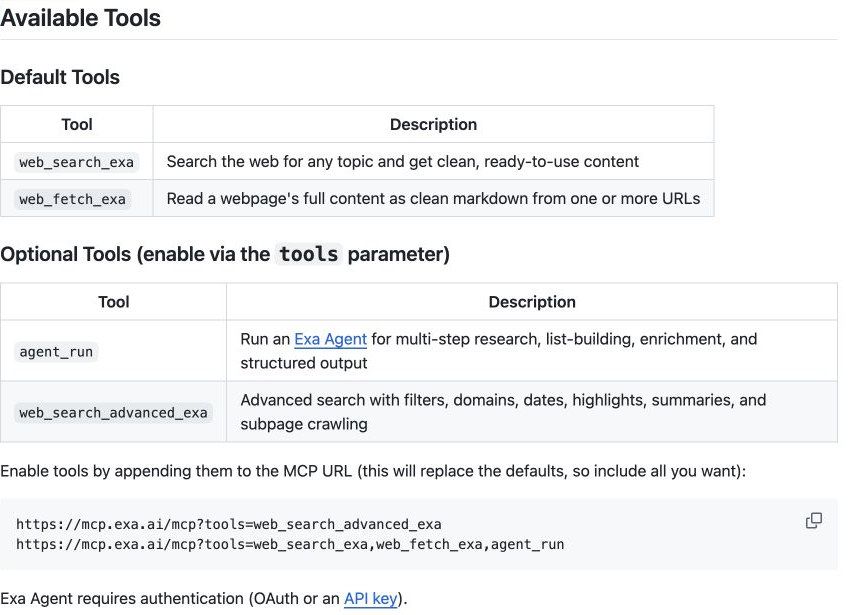
Exa documents web_search_exa and web_fetch_exa as defaults. Selecting an explicit tool list replaces those defaults, so adding a named research tool without preserving search/fetch can change the available workflow. Anonymous access is rate-limited, but I could not verify a numeric current anonymous quota. Official repository.
Exa’s underlying API distinguishes search modes, extra results and standalone Contents; its first-team monthly/onboarding grants are separate from keyless MCP limits. I would inspect the authenticated account and actual tool arguments before projecting a Search API rate onto every MCP operation. Pricing, billing.
SerpApi, for structured Google results #
SerpApi documents structured JSON output by default and a hosted bearer-authenticated route. Connecting or listing tools without a key does not authorize paid searches. Its current free plan lists 250 searches monthly, with paid allowances starting at $25 for 1,000; MCP transport does not replace that account bill. Repository, pricing.
This is SerpApi, not SerpentAPI at apiserpent.com. I would keep the names and output contracts separate in configuration and purchasing decisions.
Perplexity, for raw results or answers #
Perplexity’s MCP perplexity_search tool uses raw Search, while perplexity_ask, perplexity_reason and perplexity_research use Agent presets and model tokens. Choose the tool by whether the application needs retrieved rows or a generated answer, not just by the shared server URL. MCP guide, pricing.
Raw standard/Fast Search lists $5/$1 per 1,000 successful requests. Agent tool charges are different and model tokens are additional; old Sonar tables should not be copied into a current MCP estimate. Binding Perplexity terms were inaccessible in this research and remain a publication check. Pricing, Sonar migration.
Brave, with a rights check first #
Brave’s publisher repository documents default stdio and optional HTTP, with an API key for searches. I would use the current pricing page for account costs rather than older repository plan names: Search lists $5 per 1,000 requests and a $5 monthly credit with a card. Repository, current pricing.
Storage, redistribution, training and evaluation rights need a separate terms review. No Brave relevance or output-quality comparison was performed here. Brave terms.
Tavily, with separate search and extraction units #
Tavily’s official server exposes search, extract, map and crawl with hosted OAuth/bearer options. Its basic Search consumes one credit and advanced two; PAYG is $0.008 per credit, while extraction uses successful-URL batches. A tool connection is not a single flat-price retrieval job. Repository, credits.
I would confirm free/PAYG allowance eligibility instead of subtracting 1,000 credits from every paid estimate. Tavily remains documentation-only in this comparison because its terms restrict performance disclosure. Credits, terms.
Firecrawl, where scraping costs extra #
Firecrawl supports its cloud API and self-hosted configurations. Inspect the enabled tool list and the self-hosted feature scope; a server package is not proof that every cloud tool is available locally. Repository.
Ordinary Search costs two credits per ten results rounded up; searches with the gov category add no search credits. Requested page scraping, PDF processing and structured extraction add other units. Hobby costs $19/month billed monthly or a displayed $16/month annual equivalent for 5,000 monthly credits; the free allowance is 1,000 monthly credits. Search billing, plans.
Parallel, with anonymous and OAuth routes #
Parallel’s anonymous and OAuth endpoints have different configuration and account controls. Anonymous access is not an unlimited entitlement to the paid API, and I would never rotate session identifiers to evade its caps. Search MCP.
Fast/Turbo, Basic/Advanced, extra results and extraction have separate pricing inputs. Parallel’s current customer terms no longer contain the benchmark-consent clause I read in October; this is still a documentation comparison rather than an output test. Pricing, terms.
Linkup, if its depth options fit #
Linkup documents a hosted bearer-authenticated server. Its MCP depth controls should not be assumed to expose every depth/output combination in the broader API; use the actual tool schema when budgeting. Professional-email promotional credits are conditional rather than an unconditional free account balance. MCP guide, pricing.
Where does SerpentAPI fit? #
SerpentAPI at apiserpent.com now documents its own hosted MCP server, so it no longer needs a custom adapter. The endpoint is https://api.apiserpent.com/mcp over HTTP, with the API key in an X-API-Key or Authorization: Bearer header. Its tools cover Google web (web_search, web_search_quick), news, images, video, shopping, Maps and AI ranking, plus YouTube, LinkedIn, Amazon, eBay, TikTok, X, Reddit and Instagram data. API and MCP docs.
Each tool call bills as the matching REST call; listing the tools is free. Web rates per 1,000 are $0.60 Default, $0.30 Growth, $0.10 Scale, $0.05 Enterprise and $0.03 Enterprise Plus, with qualifying deposits of $100/$500/$1,000/$1,250 for the paid tiers. Quick bills per call; Deep bills requested pages. Purchased credit does not expire, credit you already hold keeps its purchase price, and the FAQ says no public SLA is published for pay-as-you-go accounts. Pricing, FAQ, terms.
That is the lowest paid per-search list rate among the servers on this page, even on the Default tier ($0.60 per 1,000 against $1 for Perplexity Fast or Parallel Turbo). Output, depth and usage rights still differ. On documented fit it belongs next to SerpApi for structured Google results.
I added it after the October comparison and did not connect it, so it isn’t ranked against the eight above. The docs also say web connectors that can’t send a header, such as claude.ai and ChatGPT on the web, cannot connect.
What should I check before adding a server? #
I would verify the publisher, select a reviewed local package version or approved remote URL, choose the host’s supported transport and put credentials in its private secret settings. Then I would allow the minimum tools, inspect input/output schemas and set timeout, request, byte and spending limits. This is a proposed setup sequence, not an executed installation. LM Studio app, API, OpenClaw MCP.
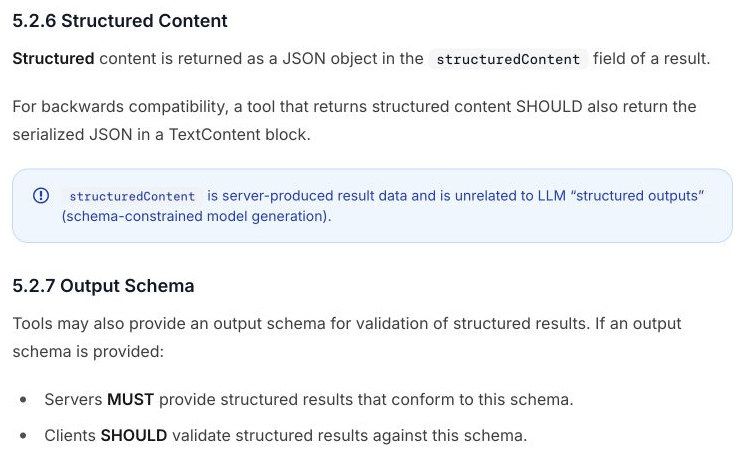
structuredContent and outputSchema describe tool results; they do not guarantee a model’s final answer has that schema or contains correct citations. Parse a tool’s isError separately from protocol errors and retain source URLs, identifiers and truncation information. Tools specification.
Prefer supported OAuth or bearer secret references over keys embedded in URLs. Token audiences, redirect/private-address checks and untrusted content matter; a local stdio process can execute code, while a remote server receives the queries/content you send. Authorization, security guidance.
The search API pillar, local LLM guide, OpenClaw setup and free API guide cover the related choices; LLM web search versus a search API covers the built-in-versus-API decision.
FAQ #
Does MCP make web searches free? #
No. The protocol connection and the underlying provider operation are separate. Provider allowances, credits and tool/model charges still apply. MCP tools specification.
Are local MCP servers safer than hosted ones? #
Not automatically. Local stdio packages can execute code; hosted servers receive data. Review the publisher, permissions and data recipients for each. MCP security guidance.
Does structuredContent mean the final answer is structured? #
No. It describes tool output, separate from the model’s generated response and citation correctness. MCP tools specification.
Can I search through SerpApi’s MCP without a key? #
No-key connection or tool discovery does not authorize searches. The official server requires the appropriate account credentials for search operations. Official SerpApi MCP repository.
How many free Exa MCP calls do I get? #
The reviewed repository describes rate-limited anonymous access but does not establish a numeric current quota. Check the selected account and server mode. Official Exa MCP repository.
Does SerpentAPI have an official MCP server? #
Yes. Its docs now describe a hosted MCP server at api.apiserpent.com/mcp that takes the API key in a header. I read the docs but did not connect it. Don’t confuse it with SerpApi’s official server. SerpentAPI API documentation.
Sources
32 sources, accessed .
Official pricing, docs, changelogs and status pages 27
- MCP authorization specification
- MCP tools specification
- MCP security guidance
- Parallel Search MCP
- Linkup MCP
- Perplexity API MCP
- LM Studio app MCP
- LM Studio API MCP
- OpenClaw MCP setup
- Perplexity pricing
- Perplexity Sonar migration
- SerpentAPI pricing
- SerpentAPI FAQ
- SerpentAPI API documentation
- SerpentAPI terms
- Tavily credit documentation
- Tavily terms
- Exa pricing
- Exa billing
- Brave API pricing
- Brave API terms
- Parallel pricing
- Parallel customer terms
- Linkup pricing
- Firecrawl Search
- Firecrawl plans
- SerpApi plans


