Alternatives
I Compared Apify Alternatives by the Job They Replace
I found no single tool that replaces all of Apify. The pick depends on whether you need ready-made records, a fetch step, site ingestion or owned code.

I would choose an Apify alternative by the workflow being replaced, not by a smaller request price. Bright Data can fit supported prebuilt records, Zyte API plus separately priced Scrapy Cloud can split fetching/extraction from custom spider hosting, Firecrawl fits ingestion, and Crawlee/Scrapy fits deliberately owned code. Bright Data, Zyte extraction, Scrapy Cloud, Firecrawl, Crawlee, Scrapy.
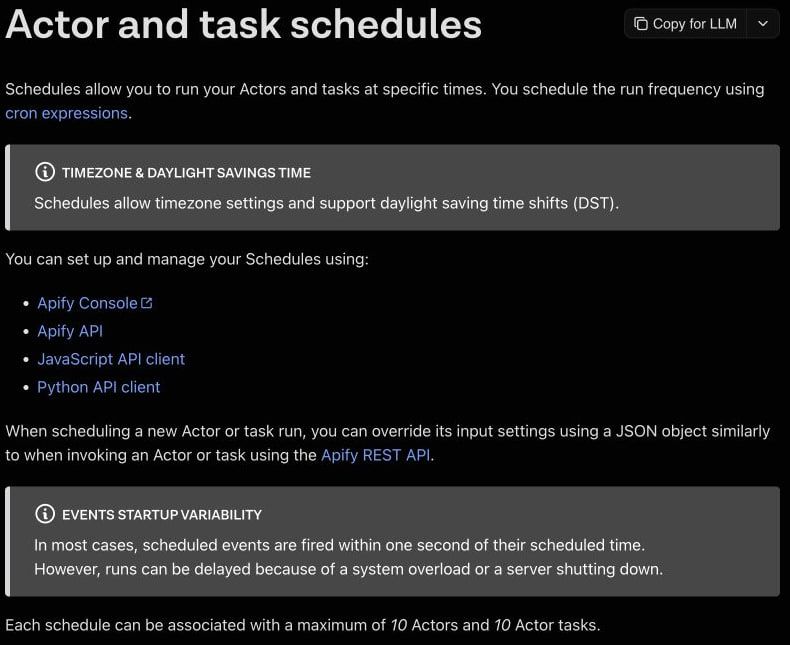
A narrow endpoint can replace one Actor step while leaving input/output, queues, schedules, storage, retries, integrations and permissions to your application. I would keep Apify when those surrounding platform capabilities are exactly what the job needs. Tasks/workflow context, schedules, integrations, storage.
Short on time?
Here's my take
- Supported ready-made records
- Bright Data Scraper APIs
- Match the actual target/schema; do not infer an arbitrary Actor-code marketplace.
- Custom code or extraction
- Zyte / Scrapy Cloud or owned Crawlee / Scrapy
- Fetch/extraction, hosted execution and operator-owned code are separate choices.
- Markdown/site ingestion
- Firecrawl
- Choose it for the output goal, with cloud versus self-host costs and security kept separate.
Prices verified . Sponsors cannot buy a verdict or a position.
Which part of Apify do you need to replace? #
Separate ready-made records, a fetch step, site ingestion and owned code before choosing an Apify replacement. Prices and specifications verified: 2026-11-09. These are conditional capability fits rather than a measured success, popularity or normalized cost ranking.
| Option | What it can address | What I would not assume it replaces |
|---|---|---|
| Bright Data Scraper APIs | Supported prebuilt records | Arbitrary Actor code or every schema/target |
| Zyte API | Target-tier fetching and standard/custom entities | A full schedule/queue/storage platform by itself |
| Scrapy Cloud | Hosted custom spider execution | API access or extraction charges included |
| ZenRows / ScraperAPI | A named page-fetch/product path | All Actor orchestration and creator logic |
| Firecrawl | Markdown/structured page or site ingestion | General scheduled Actor marketplace |
| Crawlee / Scrapy | Owned implementation/framework | Hosting, proxies, operations or proprietary Actor rights |
| Keep Apify | Selected Actor plus platform workflow | Free operation regardless of creator/resources |
What would you lose by leaving Apify? #
Apify combines selected Actors with schedules, datasets, request queues and integrations. The current plan fee includes prepaid usage, with $5 Free and $19/$199/$999 paid monthly floors; creator events and platform resources depend on the actual Actor. Pricing, subscriptions, Store billing.
A fetch-only replacement may leave work state, retry/resume behavior and output persistence missing. I would inventory the actual queues and datasets before choosing an endpoint rather than treat the Actor’s latest output as the whole application. Queues, datasets, storage.
The pricing page and Store docs now describe only two charging models, pay-per-event and pay-per-usage, after an August migration post set a September 30 deadline for rentals. I did not verify completed migration for every Actor, so the selected Actor’s current billing mode needs its own review. Pricing, Store docs, migration post.
Permissions also matter. Platform and Actor terms distinguish maintained/community code and creator access; full-permission Actors can access broader account resources and invoke other Actors, with approval normally required. I would preserve consent boundaries and minimize secrets rather than copy all inputs into a replacement service. Permissions, platform terms, Actor terms.
The official Apache-2.0 JS client’s retry/pagination interface is portable client code, not a licence to the selected Actor or proof a replacement workflow is connected. Hosted MCP’s OAuth/output path also differs from local use, so retain the actual integration/authentication requirement. Client, MCP.
Bright Data, if you want ready-made records #
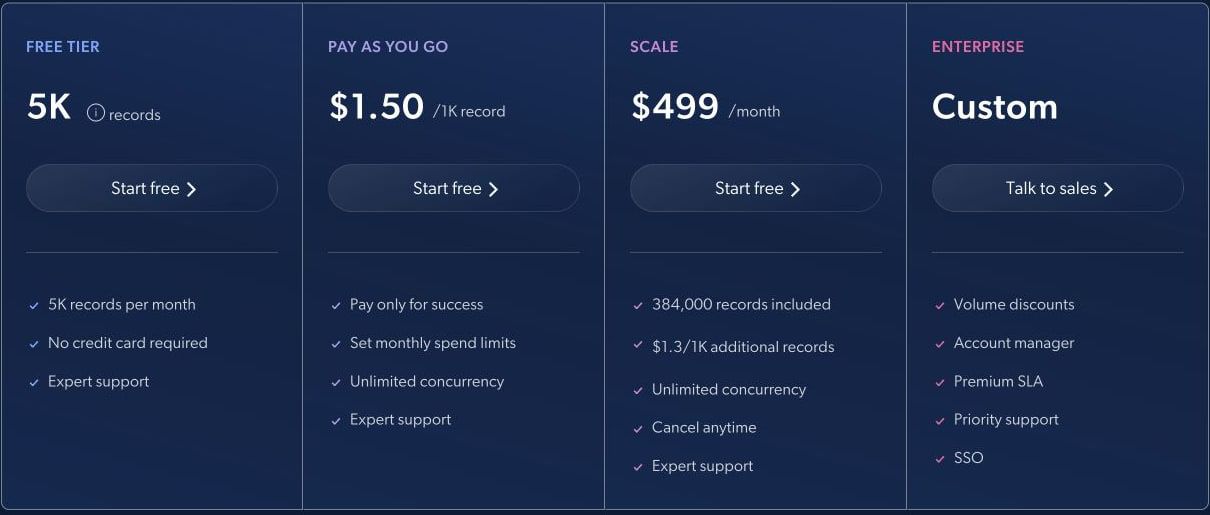
I would inspect Bright Data Scraper APIs when a supported target and schema can deliver the needed ready-made records. They are a distinct product from Unlocker, with advertised 5,000 monthly free records, PAYG $1.50/1,000 records and a listed $499 Scale/384,000 records plus $1.30/1,000 additional records. Prices verified: 2026-11-09. Scraper product, Scraper pricing.
What you give up is the assumption of arbitrary Actor-code portability or marketplace equivalence. I would confirm the actual target, fields, delivery and update behavior before translating an Actor into a prebuilt scraper subscription.
Unlocker instead supplies managed raw HTML or a JSON envelope, with advertised 5,000 monthly/free and $1.50/1,000 successful PAYG requests. That is useful for a named raw-fetch step, not a structured-record or click-control guarantee. Unlocker pricing, introduction.
I have no matched-target accuracy, invoice or success sample for either product. Product pricing and supported-output documentation identify candidates, not a universal cheaper Apify replacement.
Zyte and Scrapy Cloud, for custom spiders #
Zyte API is worth inspecting for target-tier fetching and standard/custom extraction, with Scrapy Cloud hosting the spiders separately. PAYG HTTP spans $0.13–$1.27/1,000 and browser $1.01–$16.08 across five difficulty tiers, with a $100 standard PAYG ceiling; commitments bring floors, rates and other ceilings. Pricing, plan rules.
Standard extraction needs the selected type/source, while custom attributes add an LLM/schema and token cost. Those charges and omitted/unextractable fields remain part of the comparison, rather than treating an API envelope as an Actor’s validated record output. Extraction, custom attributes.
Scrapy Cloud separately hosts custom spiders: free low-resource units list one-hour jobs/seven-day retention, while paid $9 monthly per unit lists 120-day retention, unlimited runtime, schedules and Docker. Zyte API request/extraction fees are not included just because both products come from the same vendor. Scrapy Cloud pricing.
What you change is the division between code hosting, request delivery and output validation. I would preserve the job/schedule/input contract, budget actual tiers and extra fees, and review the provider terms and lawful target scope before an evaluation. Terms.
ZenRows or ScraperAPI, if you only need the fetch #
ZenRows can fit a selected Fetch/Extract/Batch/browser/proxy path, but one shared wallet does not recreate all Apify orchestration. It lists 5,000 monthly Free credits and $19 Build B1/45,000; ordinary Fetch totals are one/five/ten/25 for plain/JS/premium/both, with separate browser/proxy units. Pricing.
ScraperAPI can address known URLs with a $49/100,000 monthly entry and standard generic plain/JS/premium/both totals one/ten/ten/25. I would quote the actual target and selected feature path rather than call the credit balance a guaranteed page count. Pricing, credit costs.
What you keep elsewhere is the Actor’s surrounding code, queues, schedules, storage and integration behavior. A successful page response also needs schema/freshness/deduplication checks before it replaces a useful Actor record.
No subscription establishes target/data rights. ZenRows terms restrict unlawful use and service/account resale, and the applicable selected-provider and code permissions remain part of the migration review. ZenRows terms, Actor terms.
Firecrawl, if you want pages as Markdown #
Firecrawl fits URL/site ingestion into Markdown or structured output, but it is not a general Actor marketplace. It lists 1,000 Free monthly credits and $19 Hobby/5,000, with scrape/crawl and other endpoint costs separated in billing. Pricing, billing, scrape, crawl.
What you give up is a general Actor workflow assumption. I would match the required crawl coverage, fields and updates rather than infer arbitrary code execution, all schedules/storage or every proprietary Actor’s logic.
The core is AGPL-3.0 and the SDK licence is distinct; cloud service and self-hosting are separate choices. The documented self-host baseline is unauthenticated/non-durable and no verified minimum production host was established here, so operator authentication, durable queues, backups, patching, proxy and model costs need real work; my Firecrawl self-host guide covers that trade-off. Self-host docs, repository.
That is a code/service distinction, not legal advice or proof of a safe deployed system. I did not install or run it and would not present a docker command as a completed production migration.
Apify’s Website Content Crawler offers Markdown/text/HTML and modes, but retains an older $0.25/CU vendor cost basis against current $0.20 Free/Starter. Optional summarization adds OpenRouter Actor runs; I would not reuse that old per-page estimate as a fresh invoice comparison with Firecrawl. Crawler, current rates.
When would I choose Crawlee or Scrapy? #
Crawlee is an Apache-2.0 JavaScript/TypeScript library and Scrapy a BSD-3-Clause Python framework. I would inspect them when owning implementation, deployment and maintenance is deliberate; framework licence and target/data rights are separate. Crawlee, Scrapy.
What you give up is managed platform work: bring hosting, parser/rendering, proxies, queues, storage, scheduling, retries, patching and backups. Free source does not mean free useful records, and creator Actor code is not automatically yours to clone. Actor terms, repositories.
I would begin with an explicitly permitted input/output contract and reproduce only behavior for which the code/data rights are established. A custom spider can also use separately paid hosting rather than turn every operating function into new self-host work. Scrapy Cloud. For the Scrapy side of that choice, I compared Apify vs Scrapy, including running a Scrapy spider on Apify.
Is your Actor mostly running searches? #
If the Actor is primarily search discovery, I would also inspect a purpose-built SERP API. apiserpent.com documents Default $0.60/1,000 with no deposit, Growth $0.30 after a $100 deposit, Scale $0.10 after $500, Enterprise $0.05 after $1,000 and Enterprise Plus $0.03 after $1,250. Credit you already hold keeps the price you bought it at, and the best deposit in a calendar month sets that month’s deposit price, so confirm which rate a deposit earns rather than flatten those rates. Prices verified: 2026-11-09. Docs, pricing.
It is a supported search-discovery option, not a known-URL scraper, browser or general platform substitute. I would retain the selected search-output contract and review service terms/allowed use before choosing an account path; no search request was executed here. Terms.
What should you carry over when you switch? #
I would migrate the validated output contract first, then the surrounding state and billing. This is a proposed checklist, not an executed migration or a claim that every product supplies each step.
| Requirement | Question I would resolve before replacing the job |
|---|---|
| Input schema | Which required inputs/defaults must remain compatible? |
| Output | Which fields, freshness and omissions make a distinct usable record? |
| Queue/resume state | Can work restart without lost or duplicated items? |
| Schedules | Who launches recurring work, at what timezone and failure policy? |
| Storage/export | Where do datasets, files and retained outputs live, and what reads cost? |
| Retry/cancellation | Which attempts can bill and which state can safely retry? |
| Integrations/auth | Which delivery, OAuth, token and permission boundaries must survive? |
| Code/data rights | Which implementation and target uses are actually permitted? |
| Bill | Which floor, cap, event, target tier or resource adds charges? |
The platform documents demonstrate why queues, schedules, storage and integrations deserve separate checks. The local design should preserve the required behavior even if the new provider supplies only fetching. Queues, schedules, storage, integrations.
Which option would I choose? #
For a supported prebuilt-record need, Bright Data; target-tier extraction plus custom hosting, Zyte/Cloud; Markdown/site ingestion, Firecrawl; a named fetch step, ZenRows or ScraperAPI; owned code, Crawlee/Scrapy. I would keep Apify when its selected Actor and surrounding platform jobs fit the requirement better than the proposed replacement.
I reviewed zero independent user/Reddit reports here, so no community consensus or support ranking supports the choice. The comparison gives documented boundaries and migration questions; actual eligible cost and validated output still need a separate authorized evaluation.
The scraping API pillar connects the endpoint layers. Apify pricing explains resource/event budgeting, Zyte API pricing breaks down the target-tier math, and ScraperAPI alternatives and ZenRows alternatives address narrower replacement choices.
FAQ #
Is there a full replacement for Apify? #
No universal equivalent is established here. Match the actual Actor/workflow requirements, then verify what remains in the application rather than compare one request price.
Can a scraping API replace an Apify Actor? #
It can replace a named fetch/extract step when the contract fits, while queues, schedules, storage and creator code may remain separate. Store workflow, queues, schedules.
What are the open-source alternatives to Apify? #
Crawlee for JS/TS and Scrapy for Python, with their distinct licences and operator-owned work. That does not grant proprietary Actor or target/data rights. Crawlee, Scrapy, Actor terms.
Is self-hosting Firecrawl free? #
No. Its documented baseline needs authentication/durability and operating work; cloud, core and SDK choices have different costs/licences. Self-host, repository.
What should I move over first when leaving Apify? #
The validated input/output contract, then work state, schedules, storage, retries, integrations, permissions and billing. No migration was executed for this research.
When does a SERP API make more sense? #
When the job is search discovery and the required output matches. apiserpent.com has documented deposit/cohort pricing, but it is not a general page/browser/Actor-platform substitute. Docs, pricing.
Sources
40 sources, accessed .
Official pricing, docs, changelogs and status pages 36
- Apify pricing
- Subscriptions
- Store billing
- Storage
- Actor permissions
- Schedules
- Integrations
- Apify MCP
- Apify terms
- Actor terms
- Website Content Crawler
- Rental migration notice
- Dataset
- Request queue
- Zyte pricing
- Zyte API billing
- Automatic extraction
- Custom attributes
- Zyte terms
- Scrapy Cloud pricing
- Web Unlocker pricing
- Web Unlocker
- Scraper APIs
- Scraper pricing
- Zenrows monthly pricing
- Zenrows service terms
- ScraperAPI plans
- Request credit costs
- Firecrawl pricing
- Firecrawl billing
- Firecrawl scrape
- Firecrawl crawl
- Firecrawl self-host
- apiserpent.com documentation
- apiserpent.com pricing
- apiserpent.com terms


