Pricing
Zyte API Pricing, and Why $0.13 Isn't the Whole Story
Zyte prices each site by difficulty tier and mode, then extras and plan ceilings kick in. Here's what 3K, 30K and 300K requests could cost.

Zyte API pricing depends on the website, HTTP versus browser mode and selected extras. Published PAYG starts at $0.13 per 1,000 easiest-tier HTTP requests, but its standard $100 spending ceiling and higher target tiers mean that headline rate is not a universal budget. Pricing, billing definitions.
I would first identify the actual targets and output required, then compare an eligible PAYG or commitment plan with its floor and ceiling. A JSON envelope, browser session and structured record are different deliverables, so I keep their charges separate. HTTP, browser, extraction.
Short on time?
Here's my take
- If your volume is small and varies
- PAYG within the $100 ceiling
- Use the actual website/mode tier and extras, not the easiest-site headline alone.
- If you have a bigger budget
- Compare eligible commitment floors and caps
- A nominal discounted usage amount can be disqualified by its plan ceiling.
- If you need structured data
- Specify source, data type and custom fields
- Extraction and token charges are separate from receiving the API JSON envelope.
Prices verified . Sponsors cannot buy a verdict or a position.
Why do some sites cost more than others? #
Zyte assigns separate HTTP/browser tiers one to five per website, with automatic/temporary handling for new combinations and quarterly reviews with two weeks’ notice. I did not submit targets, so the tier that a particular site would receive is unknown here. Prices and specifications verified: 2026-11-11. Pricing page, tier rules.
| Difficulty tier | PAYG HTTP / 1,000 | PAYG browser / 1,000 |
|---|---|---|
| 1 | $0.13 | $1.01 |
| 2 | $0.23 | $2.01 |
| 3 | $0.44 | $4.02 |
| 4 | $0.70 | $8.04 |
| 5 | $1.27 | $16.08 |
HTTP returns a Base64 body unless a client decodes it, while browser capabilities include HTML, screenshots, actions and captures. Those output/interface definitions do not mean a raw envelope already contains the entity schema your application needs. HTTP usage, browser usage, API reference.
What do the monthly floors and ceilings mean? #
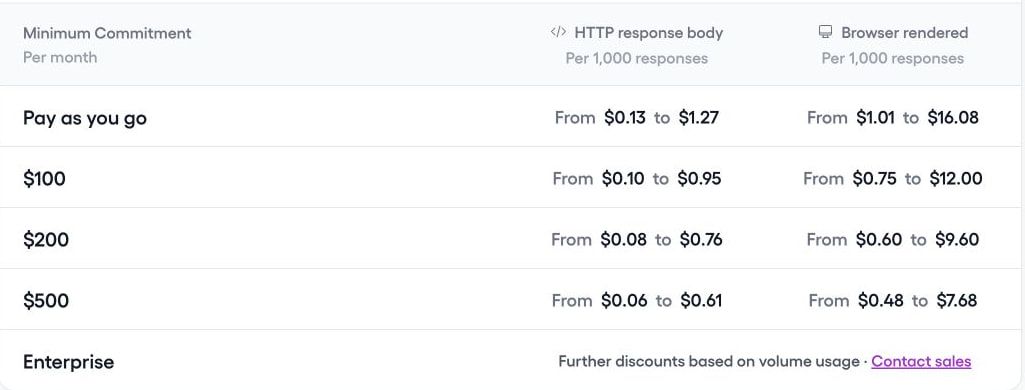
The documented monthly charge is the greater of the commitment and chargeable usage. Spending less does not refund the floor; discount percentages apply to the whole request, while additional settings can still change the cost. Prices and limits verified: 2026-11-11. Pricing rules.
| Standard plan | Monthly floor | Documented spend ceiling | Published discount / displayed range |
|---|---|---|---|
| PAYG | No commitment | $100 | HTTP $0.13–$1.27; browser $1.01–$16.08 / 1K |
| $100 commitment | $100 | $200 | 25%; displayed HTTP $0.10–$0.95, browser $0.75–$12 / 1K |
| $200 commitment | $200 | $400 | 40%; HTTP $0.08–$0.76, browser $0.60–$9.60 / 1K |
| $350 commitment | $350 | $700 | 48%; use the applicable documented schedule |
| $500 commitment | $500 | $2,500 | 52%; HTTP $0.06–$0.61, browser $0.48–$7.68 / 1K |
The standard $5 first-billing-month credit is shared across plan switches, not a fresh grant on every change. I exclude that one-time credit from durable monthly examples. Pricing documentation.
Displayed rounded rates can differ from direct discount arithmetic: $1.01 × 75% is $0.7575, while the $100 browser tier-one display says $0.75. I use published display values below and do not claim they reproduce exact invoices. Pricing page, discount rules.
So what would 3K, 30K or 300K requests cost? #
These volumes are hypothetical: assume every request is successful, all targets use the stated fixed hypothetical tier, and no extraction, screenshot, action, network, trial or tax charge applies. I compare standard plans using their published rates, floors and ceilings, including the $350 discount option; no calls were executed. Rates, plan rules.
| Target/mode | 3,000 requests | 30,000 requests | 300,000 requests |
|---|---|---|---|
| Tier 1 HTTP | $0.39 PAYG | $3.90 PAYG | $39 PAYG |
| Tier 1 browser | $3.03 PAYG | $30.30 PAYG | $200 commitment floor |
| Tier 5 HTTP | $3.81 PAYG | $38.10 PAYG | $228 on $200 plan |
| Tier 5 browser | $48.24 PAYG | $288 on $200 plan | $2,304 on $500 plan |
For 300,000 tier-one browser requests, the $100 plan’s displayed $0.75/1K gives $225 usage, exceeding its $200 ceiling. The $200 plan gives $180 usage at $0.60/1K, but its floor makes the hypothetical charge $200. Displayed rates, ceilings.
For 300,000 tier-five HTTP requests, the $100 plan’s $285 usage exceeds its $200 ceiling. The $200 plan’s $0.76/1K gives $228, within its $400 ceiling. Rates, rules.
Tier-five browser work makes the PAYG ceiling especially visible. Thirty thousand requests would produce $482.40 of nominal PAYG arithmetic, which is not an available uncapped standard-PAYG bill; the $200 plan gives $288, while 300,000 requests on the $500 plan give $2,304 within its $2,500 ceiling. Rates, ceilings.
I would recalculate these candidates after adding the actual extraction and network path. The tier labels are hypothetical inputs, not a classification result for any named website or a matched-provider cost ranking.
What do extraction and other extras add? #
Automatic extraction defaults to browser HTML for AI types and HTTP body for non-AI types, so I would select the required source explicitly. The extraction guide allows one structured data type per request; userHtml accepts up to 2.5 MiB for extraction-only work without downloading the URL. Those options change the work being purchased. Extraction, reference.
Published extras include screenshots at $1.34 per 1,000 and automatic extraction at $0.27–$1.07 per 1,000 for each selected data type; SERP extraction is free under that documented extraction rule. Actions use CPU/network, captures depend on output size, and extended geography/device residential settings change base/network charges. Pricing definitions, feature choices, API reference.
For hypothetical 1,000 easiest-tier HTTP requests with one standard extraction type, the published base-plus-extra range is $0.13 + $0.27–$1.07 = $0.40–$1.20, before other settings. That is different from merely receiving a JSON envelope and is not an exact quote for an unspecified data type. Rates, extraction pricing, extraction types.
Custom attributes require a standard extraction type and use an LLM/schema. Text token rates are $1.34 input and $6.67 output per million, while HTML rates are $4.02/$20; HTML is required for fields such as URI, HTML, HTML-text and XPath. Custom attributes, pricing, reference.
At hypothetical ten million input plus one million output tokens, the text subtotal is $20.07 and HTML $60.20, plus standard-type/base costs. Actual supplied sections, token totals and missing/unextractable fields still matter; schema-shaped output is not a factual accuracy guarantee. Custom attributes, reference, rates.
Before paying per token, check whether selectors already cover your fields. My guide to LLM structured data extraction sets Zyte custom attributes against Firecrawl JSON, Crawl4AI and Apify.
How are Zyte CDP sessions billed? #
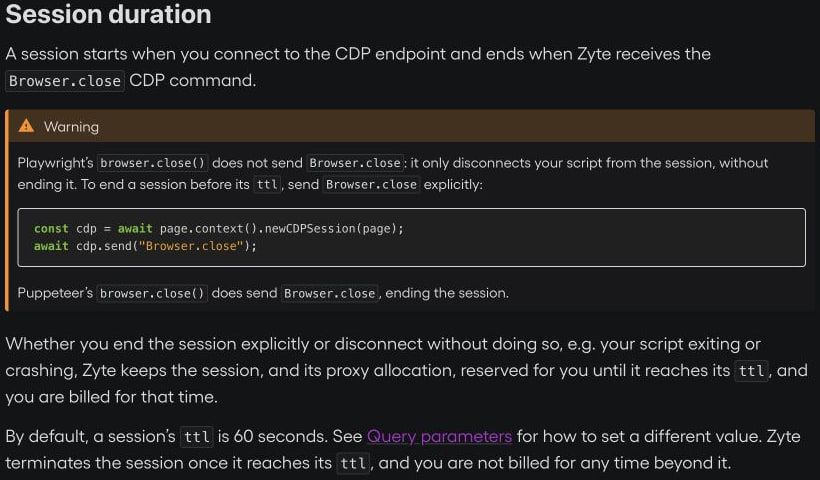
Zyte CDP bills the greater of navigation count and reserved TTL rounded up in 15-second units, using the first navigation’s domain browser tier. Started sessions can be billed even after disconnect or TTL, except the documented vendor-ended or never-started cases; the default TTL is 60 seconds. Specifications verified: 2026-11-11. CDP documentation.
A hypothetical session explicitly configured with ttl=45 and two navigations reserves three 15-second units: max(2, 3) = three. The default ttl=60 with five navigations counts as max(5, 4) = five. Finishing a script after 45 seconds does not establish a three-unit bill under the default TTL; these are reservation assumptions, not measured runtimes. Reserved lifetime.
The session guide says the browser and proxy allocation remain reserved and billed until the configured TTL even when you explicitly end or disconnect the session. Playwright’s browser.close() only disconnects; Puppeteer’s sends Browser.close, but neither establishes a shorter reservation bill under that documented rule. Residential sessions can also incur per-GB overage beyond their per-unit bandwidth cap. CDP billing and lifetime.
I would quote browser lifetime and navigation behavior separately from a simple fetch. This is arithmetic from the documentation, not a connected session or proof of permitted interaction on a target.
What about rate limits and Scrapy Cloud? #
The standard rate limit is 3,000 requests per minute, not a fixed concurrency figure. 429 responses are free, and failed requests are free under the API’s successful-response rule; that does not prove that a successful extraction passed your schema or usefulness checks. Rate limit, errors, pricing.
Owner-configured organization/key limits can block work, while domain alerts are informational. I would review the actual limits before batching and would not infer in-flight/overshoot guarantees that this research did not verify. Pricing rules.
The stats API reports spend/prices in currency micro-units, which need division by one million; dashboards and optimization guidance support monitoring. Some features require business verification, and no telemetry or account entitlement was fetched here. Stats, dashboards, optimization, verification, FAQ.
Proxy mode is another API interface, not proof of raw GB billing. The official Python client and Scrapy migration guide can help integration, but I did not install them or verify a connected workflow. Proxy mode, client repository, migration guide.
Scrapy Cloud is a separate hosted-code product: free low-resource units have one-hour jobs and seven-day retention, while paid $9 monthly per unit lists 120-day retention, unlimited runtime, schedules and Docker. Zyte API fetch/extraction charges remain separate. Scrapy Cloud pricing. If you haven’t committed to Scrapy yet, my Crawlee vs Scrapy comparison covers the framework choice first.
Which Zyte plan would I pick? #
I would use PAYG for eligible small work when actual tier-plus-extra costs fit the $100 ceiling, and a commitment only when the workload justifies its floor and eligible limit. I would compare CDP separately from one-page requests and Scrapy Cloud separately from request billing. If you’re weighing Zyte against unblockers that bill per GB or per request, the web unblocker comparison puts those billing models side by side.
Zyte’s terms and acceptable-use rules require lawful use; buying API access does not establish target/data rights or authorize an arbitrary benchmark. Review the intended target and contract before evaluation. Terms, acceptable use.
If Bright Data is your other option, Bright Data vs Zyte works out which costs less for your mix of pages. If you’re leaving Zyte, my Zyte alternatives guide matches each replacement to the reason you’re switching.
Use the scraping API pillar and credit explainer for the billing layers. Apify pricing compares compute/platform budgeting, while ScraperAPI and ZenRows pricing cover bundled credits; Apify alternatives distinguishes hosted workflow replacement from a narrower extraction endpoint.
FAQ #
Is $0.13 the price for every Zyte request? #
No. It is the published easiest-tier PAYG HTTP figure. Website tier, browser mode and extras can change the rate. Pricing, tier definitions.
Can Zyte pay-as-you-go bill past $100? #
The documented standard plan has a $100 spend ceiling. Use an eligible larger commitment or agreed arrangement rather than model unlimited standard usage. Plan rules.
Does a successful response mean you got structured data? #
The envelope is not structured entity extraction, and extraction output still needs validation. Select the required type/source and budget extras. HTTP, extraction.
Is a CDP session always billed as one unit? #
No. It uses the greater of navigation count and reserved TTL rounded up in 15-second units, with documented started-session rules. CDP.
Is Scrapy Cloud part of Zyte API pricing? #
No. It is separate hosted code execution with its own units and retention/runtime limits. API request charges remain distinct. Scrapy Cloud.
Sources
22 sources, accessed .
Official pricing, docs, changelogs and status pages 21
- Zyte pricing
- Zyte API billing
- HTTP
- Browser automation
- Automatic extraction
- Custom attributes
- Shared features
- Errors
- API reference
- CDP browser
- Zyte terms
- Zyte AUP
- Rate limits
- Usage optimization
- Scrapy Cloud pricing
- External dashboards
- Business verification
- Scrapy middleware migration
- Proxy mode
- Stats API
- Zyte API FAQ


