Alternatives
ZenRows Alternatives Depend on Which ZenRows You Use
Replacing ZenRows Fetch is not the same as replacing its browser sessions or proxy traffic. Match each ZenRows alternative to the part you use.

I would choose a ZenRows alternative only after naming which product path needs replacing. ScraperAPI or ScrapingBee can enter a known-page Fetch shortlist, Zyte can address target-tier/structured output or separately priced CDP work, and Unlocker supplies managed raw-page delivery; none automatically replaces the whole shared wallet. ZenRows pricing, ScraperAPI, Bee, Zyte, Unlocker.
If the application also uses browser sessions, Extract, Batch or residential traffic, those requirements belong in the migration decision. I would stay when the current product mix and eligible capacity fit rather than move solely for another API’s headline rate. ZenRows pricing, Fetch reference, proxy FAQ.
Short on time?
Here's my take
- If you only use Fetch
- ScraperAPI or ScrapingBee
- Compare selected weights, output and billing, without implying whole-wallet equivalence.
- If you need entity extraction
- Zyte API
- Use actual target tiers and selected extraction source/type, plus extras.
- If you use several products
- Define the workflow first
- Browser lifetime, traffic, Batch and storage are not the same thing as a cheap Fetch response.
Prices verified . Sponsors cannot buy a verdict or a position.
What are you actually replacing? #
The comparison starts with the deliverable, not the brand. Prices and specifications verified: 2026-11-11; the table is my conditional selection framework, not a measured feature-equivalence or cost ranking.
| Current need | Alternative category | Requirement I would preserve |
|---|---|---|
| Known URL/plain or rendered page | ScraperAPI, Bee HTML | Selected options, geography, output and billable outcomes |
| Standard/custom entities | Zyte extraction | Schema, source, omissions and extra charge |
| Managed raw delivery | Unlocker | Raw HTML/envelope versus structured records |
| Browser/navigation work | Zyte CDP or retain matching browser product | Session lifetime, navigation and permitted actions |
| Residential bandwidth | Inspect a proxy product, not a generic credit headline | Traffic definition and client-owned processing. ZenRows proxy |
| Markdown/site ingestion | Firecrawl | Scrape/crawl output and coverage |
| Actor/workflow jobs | Apify Store | Input/output, events and surrounding orchestration |
Does your current ZenRows plan already fit? #
Monthly Free lists 5,000 credits; Build B1 is $19/45,000, Launch L1 $69/250,000, Growth G1 $199/1.2 million and Scale S1 $549/five million, with further rungs. Lower annual equivalents use a different commitment, so I would attach the billing period rather than compare them with competitors’ monthly prices. Pricing.
Fetch totals are one/five/ten/25 for plain/JS/premium/both, while browser sessions cost 25,000 credits/GB plus five/minute and standalone residential traffic is 25,000/GB paid-only. The same wallet balance therefore buys different amounts of distinct work. Pricing, Fetch reference, proxy FAQ. If credit weights are new to you, my scraping API credits explainer compares them across providers before you price a move.
Current pricing permits at most ten matching packs per period with eligibility and balance conditions. Pack credits carry once and base credits expire; I would compare eligible packs with the next rung rather than reuse an older four-pack assumption. Pricing.
The agent storefront is different again: its 5,000-credit grant is once after email verification, and its $0.50/1,000 PAYG path requires a separate credential and applies to Fetch/Extract only. I would not call that the entire main-account wallet or a second recurring Free grant. Agent payments.
Does a key cap really cap your bill? #
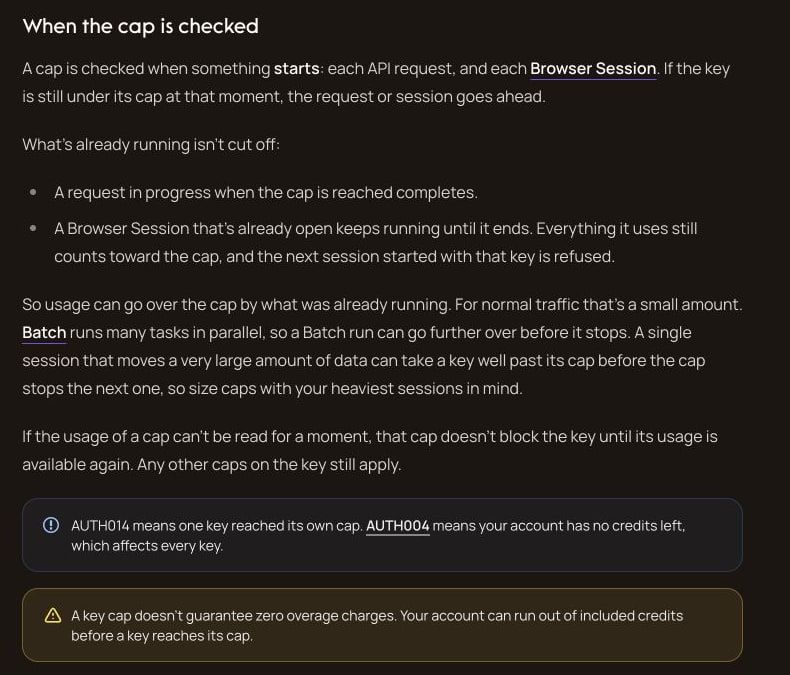
ZenRows key caps are default-off, checked at work start, can overshoot with in-flight work or temporarily fail open, and exclude legacy proxies. This is a documented control limitation, not evidence that another provider offers a guaranteed global spending stop. Key caps.
Adaptive mode says it charges the successful configuration, and pricing counts 404/410 responses as successful, billable results. I would still validate fields and count distinct usable records; neither a successful configuration nor a chargeable page proves the application received the data it wanted. Adaptive, Pricing and billing.
Just fetching known pages? Look at ScraperAPI #
ScraperAPI is a shortlist when its known-page contract fits. Monthly Hobby is $49/100,000 credits; generic plain/JS/premium/both totals are one/ten/ten/25, so ordinary JS requires twice ZenRows’ five-credit weight before plan capacity is considered. Pricing, credit table, JS FAQ.
What you change is the required request path and its billing/outcome behavior. I would preserve output format, target feature and geography requirements rather than assume one selected generic weight covers every protected domain.
Its max_cost rejects over-limit requests, while ordinary credits and the PAYG (Scaling plan and up)/refund rules have their own billing scope. The full commercial terms and exact applicable private rates were not obtained here; get them in writing when they affect the commitment. Cost control, billing.
I would not choose it on a universal cheaper-rendering claim. It is a candidate when a concrete required behavior or capacity fits better, with quality and live account behavior still unevaluated.
Mostly HTML pages? ScrapingBee is close #
ScrapingBee is a close HTML shortlist, with current Hobby $19/75,000 credits/25 concurrency. Ordinary JS is on by default at five, plain with JS off one, premium ten and both 25; an unchanged default can make a plain-work comparison misleading. Pricing, HTML API.
What you give up or change depends on the selected ZenRows paths. Bee’s generic API is not automatically the shared browser/Batch/proxy wallet, and its normal 200/404/410/413 billing and transparent-status-below-500 mode deserve their own migration check. HTML API.
Premium-AI totals conflict between the main documentation and credit article, so I do not quote a universal combination formula. The terms also require target authorization; billing capacity alone grants no data rights. Credit guide, terms. I set the two plan ladders next to each other in ZenRows vs ScrapingBee.
Need extraction or tiered pricing? Consider Zyte #
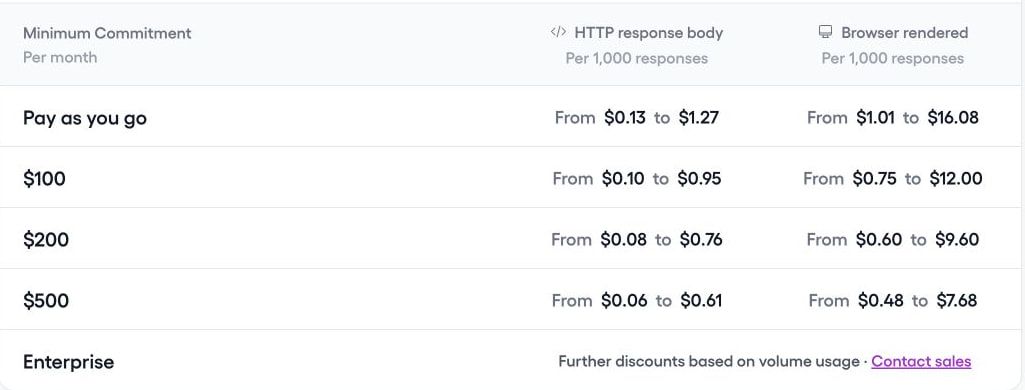
Zyte is a different model when website difficulty or standard/custom entities determines the job. PAYG HTTP spans $0.13–$1.27/1,000 and browser $1.01–$16.08 across five tiers, with a $100 standard PAYG ceiling and commitment floors/ceilings beyond it. Pricing, rules.
What you give up is one generic feature-weight budget across all targets. The actual tier and selected extraction source/type/extras must be known before quoting a matched workload; receiving an API envelope does not itself mean structured entity extraction. Extraction.
For browser work, CDP uses the greater of navigations and billed lifetime in rounded-up 15-second units, with the first navigation domain’s browser tier. The guide says the reservation remains billed until its configured TTL even after ending or disconnecting; residential bandwidth overage can add charges. I would budget that separately from Fetch requests and inspect permitted actions rather than say one session is one page. CDP.
These capabilities make Zyte a candidate for a named requirement, not proof it is a full cheaper ZenRows wallet. No actual tier, output-quality or session result was measured here.
Only want the raw page? Bright Data Unlocker #
Bright Data Unlocker advertises 5,000 free monthly requests and PAYG $1.50/1,000 successful requests. Its introduction describes raw HTML or a JSON envelope through managed delivery, not click control or a structured-record guarantee. Pricing, introduction.
I would shortlist it when that raw-page contract is the needed output. A browser, prebuilt-record or owned workflow requirement needs a separate product comparison, with applicable target and billing scope inspected before evaluation. My web unblocker comparison sets Unlocker against Zyte, Oxylabs and Decodo by billing unit.
When would Firecrawl or Apify fit better? #
Firecrawl fits page/site ingestion, with Markdown/structured scrape output, 1,000 Free monthly credits and $19 Hobby/5,000. It is an adjacent output choice, not automatically the same Fetch, session or bandwidth product. Pricing, scrape.
Apify compares as an Actor/platform model, with a $5 Free usage budget and $19/$199/$999 paid monthly floors. Creator events and platform resources vary by selected Actor; the pricing page and Store docs now describe pay-per-event and pay-per-usage models, so I would inspect the selected Actor’s model instead of promising completed migration. Pricing, Store docs.
I would consider these when the workflow itself needs changing. A single cheaper page endpoint may otherwise leave missing queue, schedule, storage or task requirements to your application.
If I were leaving ZenRows, where would I go? #
For one known-page path, I would compare ScraperAPI and Bee with the exact features and billable outcomes. For structured entity work, Zyte; raw managed delivery, Unlocker; ingestion, Firecrawl; selected Actor workflows, Apify. I would keep ZenRows if its needed product mix and eligible capacity already fit.
The ZenRows terms restrict unlawful uses and service/account resale, and no subscription grants arbitrary target/data rights. Review actual product terms and allowed scope before running representative checks; no account or permission was acquired for this article. Terms.
The scraping API pillar connects the layers. Use ZenRows pricing for monthly/pack examples, ScraperAPI pricing and ScrapingBee pricing for their configurations, Zyte API pricing for eligible tier/floor costs, and Apify alternatives for a platform migration. If you are also reconsidering ScrapingBee, the ScrapingBee alternatives guide uses the same job-first approach.
FAQ #
What’s the closest alternative to ZenRows Fetch? #
I would inspect ScraperAPI or Bee while matching required features and billing/output rules. That does not establish replacement of the whole wallet. ScraperAPI, Bee.
Will a cheaper fetch API replace browser sessions? #
Not automatically. Session lifetime and navigation behavior are a separate requirement and can have separate units. ZenRows pricing, Zyte CDP.
Is API proxy mode billed like raw GB traffic? #
Not necessarily; product/transport and unit are different questions. ZenRows residential traffic and Fetch have distinct units, and the client’s required processing still matters. Proxy FAQ, Fetch reference.
Can a key cap guarantee zero overspend? #
No. The docs describe start checks, overshoot and temporary fail-open behavior, excluding legacy proxies. Caps.
Should you just stay on ZenRows? #
When the required product paths and eligible monthly capacity fit, and a narrower endpoint would leave a real workflow requirement missing.
Sources
26 sources, accessed .
Official pricing, docs, changelogs and status pages 26
- Zenrows monthly pricing
- Fetch API reference
- Key credit caps
- Legacy proxy FAQ
- Agent storefront
- Zenrows service terms
- Adaptive stealth
- ScraperAPI plans
- Request credit costs
- Plans and billing
- JS rendering FAQ
- Cost control
- ScrapingBee plans
- HTML API
- Service terms
- Credit system
- Zyte pricing
- Zyte API billing
- Automatic extraction
- CDP browser
- Web Unlocker pricing
- Web Unlocker
- Firecrawl pricing
- Firecrawl scrape
- Apify pricing
- Store billing


