Comparison
Browser Use vs Stagehand: Who Picks the Next Click?
Browser Use runs an agent loop; Stagehand v4 gives your code explicit act, observe and extract steps. When each fits, and what costs extra.

I would shortlist Browser Use when you want an autonomous Agent loop, and Stagehand v4 when your application should choose explicit browser operations and deterministic steps. The control model is the first decision; the browser host and model bill are separate purchases.
Both cores are MIT-licensed, but neither license supplies a free managed browser fleet or model inference. I compared current public docs and version-specific material, without installing frameworks or running an agent. Browser Use repository/license, Stagehand license.
Short on time?
Here's my take
- Autonomous control loop
- Browser Use
- Choose it for the documented Agent approach, then validate completion and cap the chosen browser/model path.
- Explicit operations and known steps
- Stagehand v4
- Use act/observe/extract and deterministic locators with application-owned approvals and control flow.
- First implementation checkpoint
- Pin the actual versions
- Stagehand v4 and Browser Use 1.0 both changed their APIs; pin the version you actually install before reusing a recipe.
Prices verified . Repository/docs/pricing review, 11 November 2026. No framework execution or task-success comparison is claimed.
What’s the difference between them? #
| Decision | Browser Use | Stagehand current v4 docs |
|---|---|---|
| Primary control model | Python Agent loop | Explicit act/observe/extract and deterministic locators |
| Core license | MIT | MIT |
| Browser infrastructure | 1.0 defaults to a Browser Use Cloud browser; local Chromium on request | Local or configured hosted browser |
| Models | 1.0 defaults to the bu-fast gateway model; provider models configurable | Explicit local provider; Browserbase Gateway is a separate hosted model path |
| Autonomous built-in API | Documented Agent | v4 removes agent(); do not reuse the v3 recipe |
| Version caveat | 1.0 (10 Nov 2026) changed defaults; 0.x recipes need the migration guide | npm 4.4.0 versus v3-only GitHub release tags |
| Bill to define | Browser lifetime, traffic, model/orchestration and caps | Browser host and provider/Gateway inference plus your application |
Sources: Browser Use repository, product routes, Stagehand introduction, migration and model configuration, checked 11 November 2026.
When should the agent drive? #
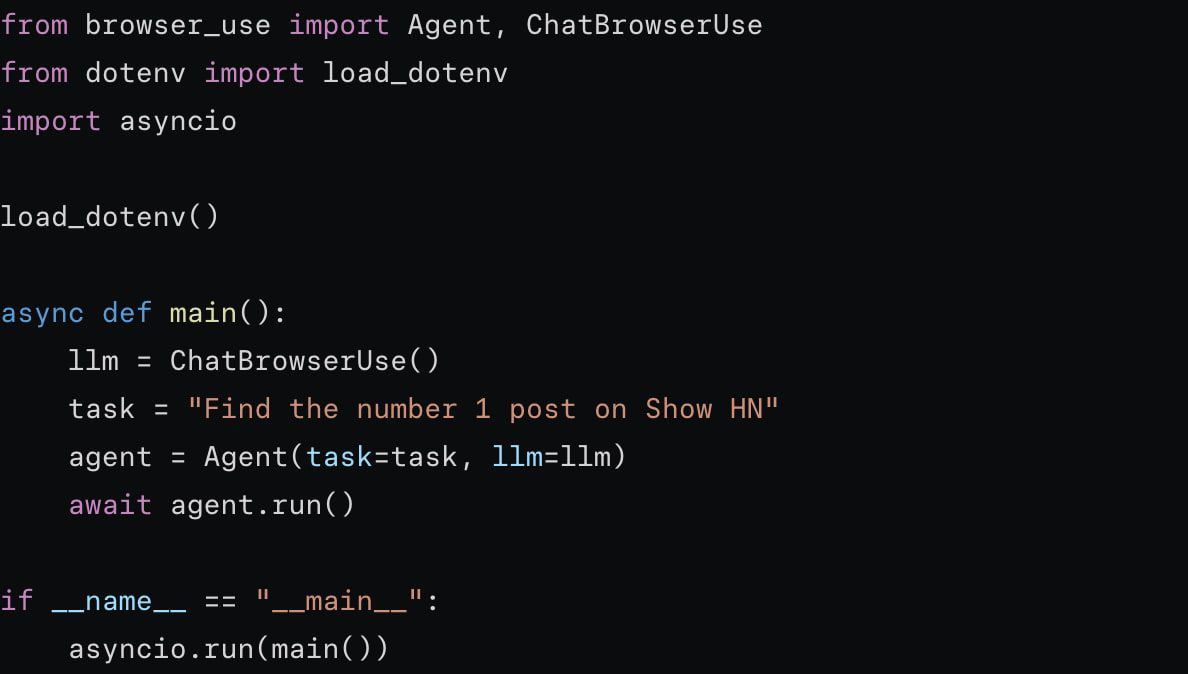
Browser Use is my first shortlist when the application needs its documented Python Agent loop. Since 1.0 (10 November 2026) the agent writes Python that runs over CDP, and the quick start defaults to a Browser Use Cloud browser and the bu-fast gateway model; a local Chromium needs Browser('chromium'). Its product guide separates the hosted agent API, the CLI, the open-source library and a CDP-only Browser API, so I would choose the actual product before calculating a task budget. Repository, 1.0 release notes, quick start, product choices.
I would define a task with explicit completion evidence and constraints, rather than accept a confident final message as the entire result. Browser and Agent parameters are configuration inputs to review, not proof the task completed in an account. Browser parameters, Agent parameters.
A specific GitHub issue includes community-authored small synthetic checks and discussion of false-success/retry behavior. Those are not my tests, not a cross-framework benchmark, and not a measured general failure rate for the current release.
When should your code drive? #
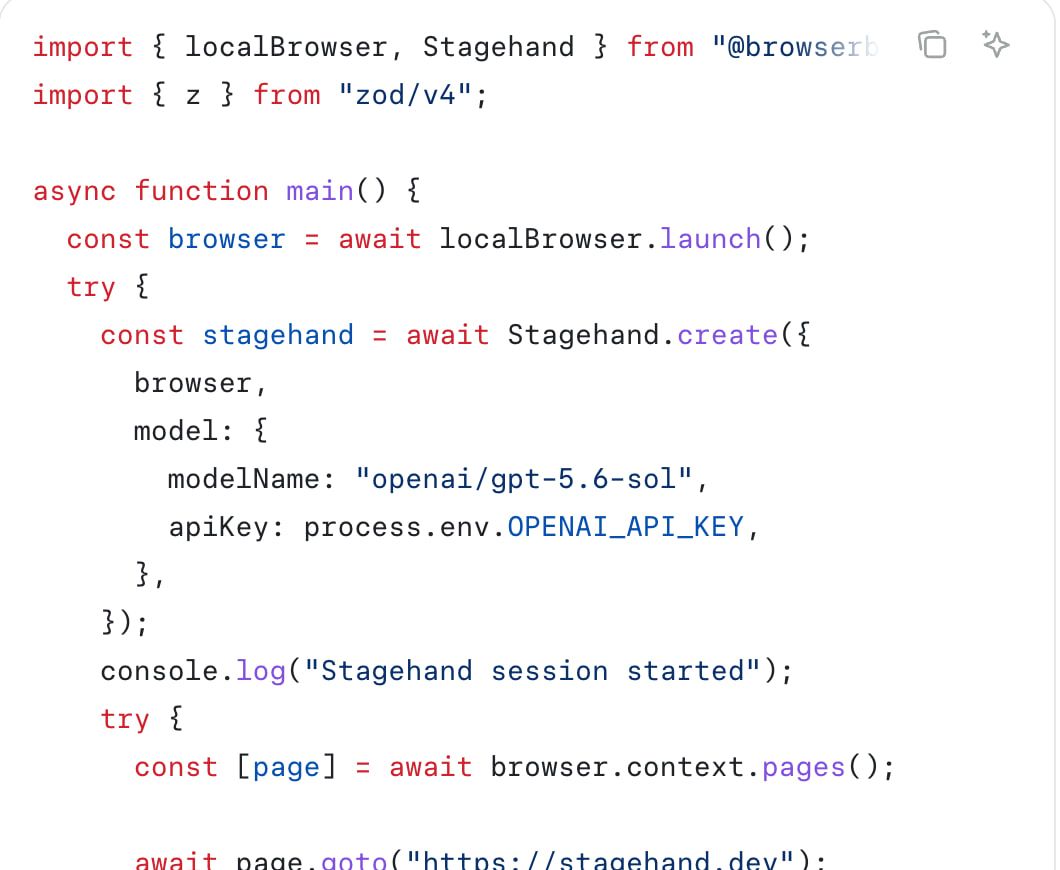
Stagehand v4 is my shortlist when known deterministic steps should sit beside model-assisted actions or extraction. Its current docs describe act, observe and extract, with deterministic locators and TypeScript/Python/Go SDK paths. I would keep the application’s control flow and approval rules explicit. Introduction, installation, act, observe, extract.
For a stable known action, I would prefer the deterministic route where it meets the task; the introduction says Playwright-style page methods can sit beside AI steps in one script. The cost guide covers model choice, caching and session settings, and it gives no measured cost reduction for this comparison. Introduction, cost optimization.
The approval cookbook shows a stop before form submission. I would preserve that decision point for consequential actions rather than assume an extraction tool’s success is permission to submit or pay. Approval cookbook.
Can you reuse a Stagehand v3 recipe? #
No: use the documented factory setup for the actual pinned version. The v4 migration removes new Stagehand(), init(), agent() and local enableCaching/cacheDir patterns; methods are instance-bound and results include data/metadata. Managed caching is Browserbase server-side. Migration guide, quick start, caching.
Browserbase’s changelog lists Stagehand 4.1 to 4.4 between 21 September and 5 November 2026, and npm’s current TypeScript package is 4.4.0. The GitHub release list still shows only v3 tags, with stagehand/server-v3 v3.7.7 labelled latest, so I would pin from the package registry rather than the release page. Browserbase changelog, npm package, Stagehand releases.
I have not installed either release path. A recipe must pin package/server/browser/provider compatibility before it can be described as runnable, and I do not combine a v3 agent example with v4 feature claims.
What costs extra beyond the framework? #
Browser Use cloud’s low browser-hour rate is not the full Agent price. The documented rate is $0.02/hour, rounded up to whole minutes with a one-minute minimum; managed residential traffic is $5/GB and direct/BYO-proxy egress $0.20/GB plus any external proxy bill. Pricing, billing, checked 11 November 2026.
Agent model tokens add 20%, with the published V4 model table already including that amount. BYOK still has a 0.2× orchestration fee on provider token cost. I would not add the markup a second time to that inclusive table or call BYOK the absence of every service charge. Pricing, billing guide.
Stagehand local mode needs explicit provider/model configuration. Browserbase Gateway can select/pin models, but its inference is billed on your Browserbase account at provider market price; lacking your own provider key is not free LLM access. Browser infrastructure is another line in the budget. Stagehand models, browser configuration, Browserbase Gateway, Browserbase pricing.
Use Browserbase pricing for the hosted browser/proxy component, then quote the chosen model path. No per-task token count or completion cost was measured here.
What about credits, caps and idle browsers? #
Browser Use’s current pricing gives eligible signups $1 once per person, with a $5 minimum top-up and an initial ten-concurrent tier. The README now also says $1 (an old $15 figure was corrected after a GitHub report), and pricing and docs agree that $100 in total payments unlocks 50 concurrent browsers. I would still verify the actual project limit rather than promise capacity from a deposit. Pricing, concurrency, repository, signup report.
Monthly API-key caps are soft: concurrent/running work can overshoot them. Auto-recharge is a purchase setting rather than a spending cap. V4 agent browsers have a four-hour hard timeout and approximate idle cleanup; run completion or CDP disconnect may leave a browser alive, so I would explicitly stop the owned session. Billing, concurrency/lifetime guide.
I would define the stop policy and confirm the result before treating an autonomous task as both complete and cost-contained. This research has not exercised those account controls.
Are your secrets safe in the browser? #
A secret alias is not a guarantee that entered credentials are invisible. Browser Use docs describe aliases/domain-scoped secrets, but CDP or page access can still see typed values. I would isolate browser access and restrict target scope rather than infer complete protection from a substitution feature. Local sensitive-data guide, cloud secrets.
Browser Use 1.0.0, released 10 November 2026, redacts sensitive_data values from cell output, checkpoints, tool results and the final result, and its notes say “Not a sandbox”. The earlier 0.13.11 note (7 October) said its Claude toolset needed an Anthropic SDK component not yet public; I would not advertise that path as ready without a current dependency check. Release notes.
Browser content remains untrusted input. I would preserve an independent approval step before writes/payments and validate the actual side effect afterward, using scoped tools, target restrictions, sanitized observations and version pinning. OWASP guidance, Stagehand approval cookbook.
So who should drive: the agent or your code? #
Choose Browser Use as the shortlist for a documented autonomous Agent loop, then verify completion and budget the separate browser, traffic and model/orchestration components. Choose Stagehand v4 when your application should choose explicit operations and deterministic steps, with approvals in its own control flow.
I would settle the actual package/provider/browser versions before adopting a recipe. Neither a MIT license nor a vendor benchmark establishes a universal success rate or an all-in task cost for your application.
For browser hosting rather than the control loop, see Browserbase alternatives, Browserbase versus Browserless and Browserbase versus Steel. The agent browser hub connects those routes without presenting cloud API access as evidence of a completed task.
FAQ #
Does Stagehand v4 still have agent()? #
Its migration guide removes that API along with the v3 constructor/init patterns. Use the actual pinned version’s factory and explicit operations. Migration.
Do the free MIT frameworks include hosted browsers? #
No. I would budget the browser host, proxy and model path separately from the source license. Browser Use product routes, Stagehand browser configuration.
Will a Browser Use spending cap stop all overspending? #
The Browser Use docs describe overshoot from running/concurrent work. Confirm the project settings and lifetime/stop policy before relying on it. Concurrency and caps.
Which one completes tasks more reliably? #
This research does not establish a measured winner. I compared the control models and documented constraints, with no independent matched-task run.
Sources
34 sources, accessed .
Official pricing, docs, changelogs and status pages 26
- Browser Use: pricing
- Browser Use: cloud/guides/billing
- Browser Use: cloud/guides/concurrency
- Browser Use: cloud/which product
- Browser Use: open source/quickstart
- Browser Use: open source/customize/browser/all parameters
- Browser Use: open source/customize/agent/all parameters
- Browser Use: open source/examples/templates/sensitive data
- Browser Use: cloud/guides/secrets
- Stagehand: npm package @browserbasehq/stagehand
- Stagehand: v4/first steps/introduction
- Stagehand: v4/first steps/quickstart
- Stagehand: v4/first steps/installation
- Stagehand: v4/configuration/models
- Stagehand: v4/best practices/caching
- Stagehand: v4/best practices/cost optimization
- Stagehand: v4/migrations/v3
- Stagehand: v4/configuration/browser
- Stagehand: v4/cookbooks/approve form submission
- Stagehand: v4/basics/act
- Stagehand: v4/basics/observe
- Stagehand: v4/basics/extract
- Browserbase: pricing
- Browserbase: platform/model gateway/overview
- Browserbase: changelog
- OWASP: llmrisk/llm01 prompt injection
GitHub code, issues and releases 8
- Browser Use: browser use/browser use
- Browser Use: browser use/browser use/LICENSE
- Browser Use: browser use/browser use/releases
- Stagehand: browserbase/stagehand
- Stagehand: browserbase/stagehand/LICENSE
- Stagehand: browserbase/stagehand/releases
- Browser Use: issue 6031, reported completion/retry behavior
- Browser Use: issue 6047, signup-grant report
Last updated: 13 October 2026. Researched and drafted with AI tools; human editorial review and publication approval are pending.


