Alternatives
Browserbase Alternatives, Matched to Why You're Leaving
Browserless, Steel, Cloudflare, Bright Data and Browser Use each suit a different reason for leaving Browserbase, and each one bills in its own way.

I would choose a Browserbase alternative by the reason you are leaving. Start with Browserless for a documented CDP/unit-budget route, Steel Launch for a no-base-subscription cloud option, Cloudflare when its platform fits your existing application, Bright Data for bandwidth-priced browser access, and Browser Use when its separate browser or agent product matches the work.
The list is ordered by those buying reasons, not by popularity or measured success. I did not connect these services or run browser tasks; the useful comparison is what you buy, how its lifetime is billed, and who owns the operating work.
Short on time?
Here's my take
- CDP and unit budgeting
- Browserless
- Inspect connection blocks, proxy units, annual commitments and the license for any private deployment.
- No base subscription or source control
- Steel
- Launch cloud usage and the Apache core are separate choices; do not assume local cloud parity.
- Existing Cloudflare application
- Cloudflare Browser Run
- Budget browser time, billable concurrency and Workers costs together.
Prices verified . Documentation and published pricing checked 11 November 2026. There is no logged speed, reliability or task-success ranking.
Which alternative fits which job? #
| Alternative | Why I would investigate it | Published cost basis | Important boundary |
|---|---|---|---|
| Browserless | CDP/Playwright/Puppeteer workflows and licensed private deployment | Time-block connection units; proxy/CAPTCHA units separately | Annual cards are not monthly invoices; core is SSPL/commercial |
| Steel | Launch without a base subscription, or Apache local core | Browser hours, proxy GB, solves and separate products | Scale adds $250 base with $100 usage credit; local features differ |
| Cloudflare Browser Run | Browser tools in a Cloudflare application | Browser hours plus monthly-average concurrency | Workers subscription and other usage are additional |
| Bright Data | Hosted CDP browser/proxy workflow | Bandwidth GB | Scale’s lower effective rate needs a $499 monthly commitment |
| Browser Use | Separate hosted browser or agent purchase path | Browser time, traffic and model/orchestration charges | Soft caps and project concurrency need checking |
Checked 11 November 2026. This is a capability/billing table, not a normalized “cost per task” ranking or proof that every advertised feature is available to a new account.
Browserless #
Browserless is my shortlist when a CDP-style workflow and connection-unit budget fit the application. Its official material documents browser connections and session/reconnect behavior; private deployment requires an actual license decision rather than assuming a public core is permissively licensed. Session docs, core repository, license.
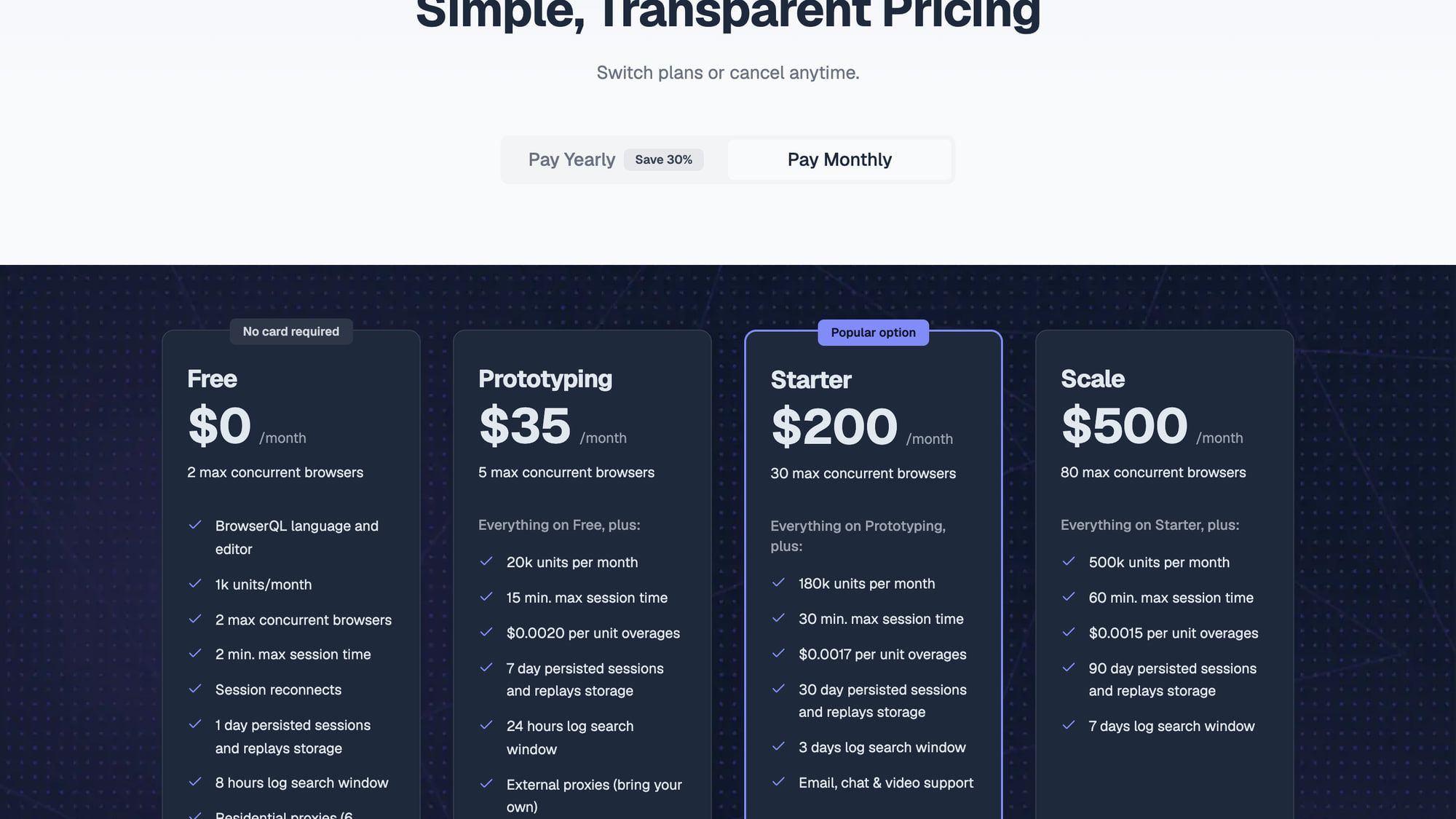
The displayed annual-billing monthly equivalents are $25/$140/$350 for Prototyping/Starter/Scale, with 20K/180K/500K units.
The public monthly selector instead shows $35/$200/$500, with 5/30/80 concurrent browsers versus the annual view’s 10/40/100. A unit covers up to 30 seconds per connection, rounded up; reconnect starts another unit. Proxy traffic and successful CAPTCHA add their own units. Pricing, checked 11 November 2026.
I would not infer that a short block makes the total bill cheaper than Browserbase. The subscription commitment, idle/connection behavior, proxy use and task limits still need a matched configuration. My Browserbase versus Browserless guide separates those inputs.
The core is SSPL-1.0 or commercially licensed. Its README says proprietary/closed applications need commercial licensing; I would review the actual intended use and the private-deployment material before choosing this as a self-host alternative. If that licence rules Browserless out too, my Browserless alternatives guide covers the gap each option fills.
Steel #
Steel Launch is a clear alternative to investigate when a base subscription is the concern. Its documented price is $0 monthly plus usage, with one-time $30 credits, ten concurrent sessions and a 15-minute maximum. The Apache local core is a separate operating choice. Pricing, repository, license.
Launch lists $0.10 per browser hour and $10 per proxy GB. Scale adds a $250 monthly base plus usage, with only $100 monthly usage credit; its list usage rates are lower, but the fixed commitment still belongs in the comparison. Current plans, checked 11 November 2026.
The local/cloud table lists local concurrency one, BYO proxy, limited stealth and missing CAPTCHA/Credentials/Files APIs. I would choose the core for that documented scope, not promise its hosted product with no subscription. Local versus cloud.
Steel meters minutes and bills idle lifetime unless the configured shutdown behavior ends it. I would explicitly release sessions I own and check the actual timeout/inactivity settings rather than assume the cloud lifecycle applies to every local build. Lifecycle, configuration.
For the direct buying decision, read Browserbase versus Steel. Two GitHub reports about local timeout and Figma WebGL are build-specific questions to investigate, not a measured cloud reliability conclusion. The WebGL report was closed on 27 October 2026 after a partial fix; the timeout report is still open.
Cloudflare Browser Run #
Cloudflare Browser Run fits my shortlist when the application already belongs on Cloudflare. It supplies Quick Actions or full Browser Sessions/CDP; choosing between those is part of the workflow design. Product docs.
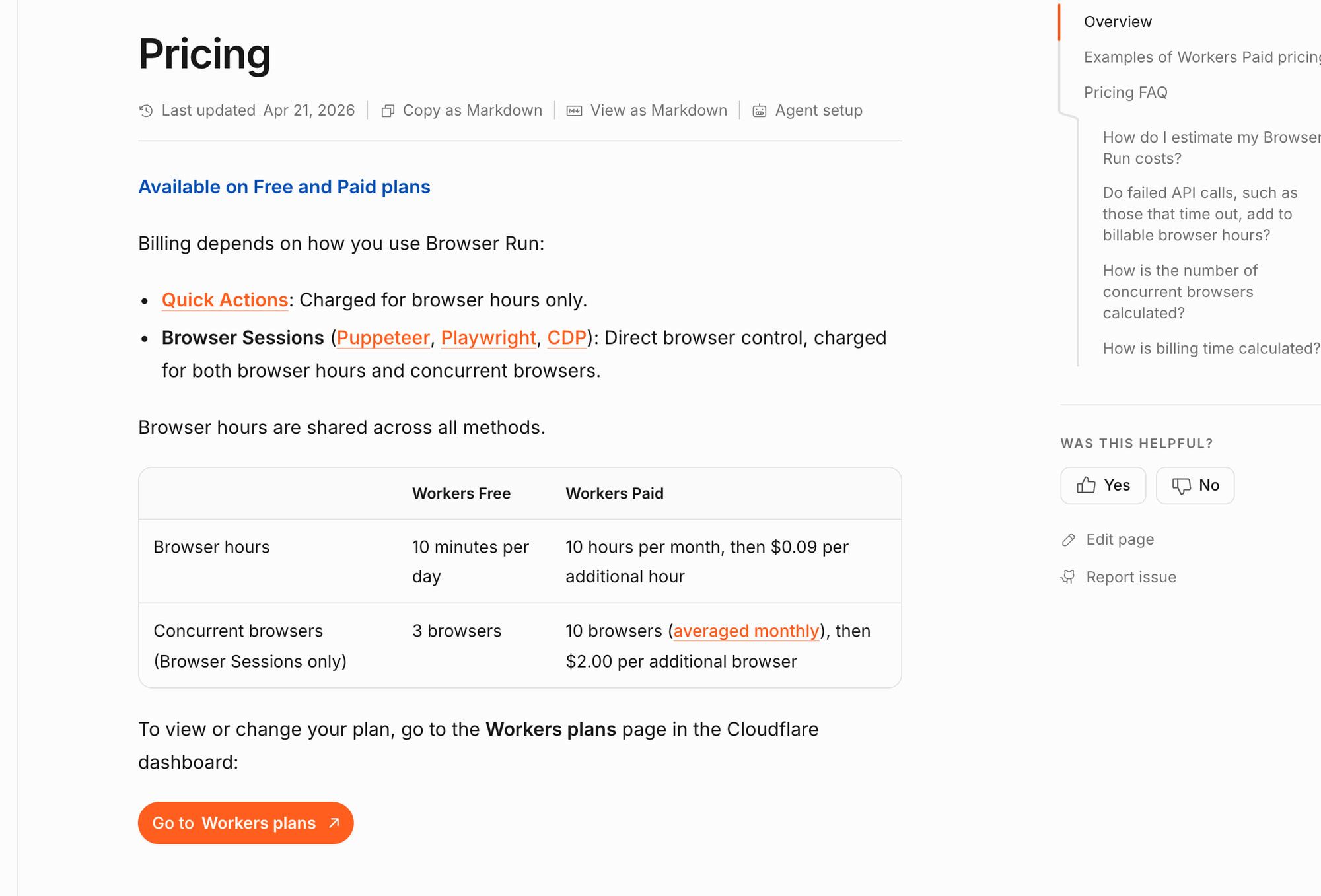
Free lists ten browser minutes daily, three concurrent sessions and one new instance per 20 seconds. Paid lists ten browser hours monthly, then $0.09 per hour, plus ten included monthly-average concurrent browsers and $2 per extra browser, calculated from the average of daily peaks. Pricing, limits, checked 11 November 2026.
I would include the Workers Paid $5 subscription and other Worker usage separately. Browser capacity limits and included billable concurrency are different inputs; a large permitted concurrency figure does not mean every slot is included at no extra charge. Workers pricing, Browser Run pricing.
Its default idle timeout is 60 seconds and keep_alive can extend it to 20 minutes. I would budget lifecycle and close behavior alongside the rate, without claiming a particular Stagehand version or browser task was verified on this integration. Current limits. Worked monthly examples are in my Cloudflare Browser Run pricing breakdown.
Bright Data #
Bright Data is worth comparing when bandwidth-priced browser/proxy access matches the task. Its Browser API documentation describes hosted CDP access; that capability is not an independent proof of unblocking success or advertised capacity. Introduction, CDP connection examples.
The public price is $8 per GB PAYG, or $499 monthly for Scale with 71 GB. I worked that out to about $7.03 per included GB, but only if you use all 71 GB, so I would attach the named plan before using either number in a budget. Pricing, checked 11 November 2026.
Its advertised free tier lists 5K credits and 1 GB monthly without a card. I have not verified account eligibility or actual quota behavior; I would not convert that credit label into a measured number of completed tasks. Advertised free tier, checked 11 November 2026. I price it at 1, 10 and 100 GB in Bright Data Browser API pricing.
For the wider budget, use Browserbase pricing to understand the time-plus-proxy comparison. A GB quote and an hour quote cannot establish the same task bill until the workload supplies both denominators.
Browser Use #
Browser Use is a separate shortlist when its browser infrastructure or agent path fits the job. Its current pricing has no subscription and separates browser time, traffic and agent-model/orchestration charges. I would choose the product route before treating a browser-hour rate as the whole agent bill. Pricing, billing.
The documented browser rate is $0.02 per hour, rounded up to whole minutes with a one-minute minimum. Managed residential traffic is $5/GB; direct/BYO-proxy egress is $0.20/GB, plus the external proxy bill where applicable. Agent model tokens and BYOK orchestration remain separate. Pricing, billing docs, checked 11 November 2026.
I would keep the project concurrency and soft spending-cap behavior in the acceptance check. Projects start at 10 concurrent sessions and reach 50 after $100 total paid, and concurrent work can overshoot a monthly API-key cap. Concurrency and caps, pricing.
The Browser Use versus Stagehand comparison explains the autonomous-agent versus explicit-automation choice. An infrastructure rate alone does not decide which control loop your application should use.
What about Kernel? #
Kernel is a qualified option to investigate, not a ranked price winner here, because its billing unit needs clarifying before any cost ranking. Its public tier commitments and credits are documented, but the landing-page GB-second wording and the docs’ headless/headful/GPU per-second rates need reconciliation for the chosen configuration. Pricing, pricing docs.
I would ask which mode, resource unit and standby state the invoice uses before comparing it with browser hours or proxy GB. This research has not measured a standby transition or a real bill.
What to sort out before you switch #
Before moving, I would specify session creation, timeout, keep-alive, release and persisted state. Browserbase contexts retain browser state, and keep-alive lifetime counts until release or timeout; moving the workflow requires explicit handling of those state and cost boundaries. Contexts, keep-alive.
I would also examine data handling beyond replay/log flags. Browserbase’s ZDR docs distinguish enterprise arrangements from per-session switches and describe other artifacts/provider data that those switches do not remove. Read the ZDR documentation and terms for the actual selected scope rather than infer a contract from a badge.
Browser page content remains untrusted input. My proposed checklist is to isolate/authenticate browser and API access, restrict targets and tools, pin versions, retain sanitized evidence, and require approval before consequential writes or payments. OWASP prompt-injection guidance, Browserless Docker configuration, Steel Docker guide. If you are weighing a move to your own fleet, self-hosted vs managed headless browsers counts that work.
So which alternative is right for you? #
Pick Browserless for a documented connection-unit/CDP route after checking the commitment and license; Steel for its named Launch scope or a separately maintained Apache core; Cloudflare for a platform fit with the complete Worker/browser bill.
Investigate Bright Data when bandwidth is the useful billing unit, and Browser Use when its selected browser/agent product fits the application’s control model. I would postpone a price winner until the same workload, limits, state and required terms are explicit.
The agent browser hub connects the direct comparisons. If the job only needs fetched text, use website-to-Markdown choices before buying a browser session.
FAQ #
Is there an open-source Browserbase alternative? #
Steel’s core is Apache-2.0. Local feature scope differs from cloud, and Browserless core has SSPL/commercial terms. Steel license, Browserless license.
Does a free tier mean I’m allowed to benchmark it? #
This research establishes no such permission. Review the vendor terms, allowed targets and publication restrictions before any future checks.
Does no subscription mean it’s free to use? #
No. I would inspect the selected product’s usage, proxy, model and operating costs separately from its base fee. Steel pricing, Browser Use billing.
Which one is most reliable? #
I have no fair logged comparison that establishes that. The list compares documented fit and responsibilities, with no uptime or task-success ranking.
Sources
35 sources, accessed .
Official pricing, docs, changelogs and status pages 29
- Browserbase: pricing
- Browserbase: platform/browser/long sessions/timeouts
- Browserbase: platform/browser/long sessions/keep alive
- Browserbase: optimizations/concurrency/overview
- Browserbase: platform/browser/core features/contexts
- Browserbase: account/enterprise/zero data retention
- Browserbase: terms of service
- Browserless: pricing
- Browserless: enterprise/docker/config
- Browserless: baas/bot detection/proxies
- Browserless: baas/session management/standard sessions
- Browserless: blog/self host browserless enterprise docker deployment guide
- Steel: pricing
- Steel: overview/self hosting/steel local vs steel cloud
- Steel: overview/self hosting/docker
- Steel: overview/sessions api/session lifecycle
- Steel: overview/sessions api/configuration
- Cloudflare: browser run
- Cloudflare: browser run/pricing
- Cloudflare: browser run/limits
- Cloudflare: workers/platform/pricing
- Bright Data: products/scraping browser
- Bright Data: products/scraping browser/introduction
- Browser Use: pricing
- Browser Use: cloud/guides/billing
- Browser Use: cloud/guides/concurrency
- Kernel: pricing
- Kernel: docs/info/pricing
- OWASP: llmrisk/llm01 prompt injection
Last updated: 13 October 2026. Researched and drafted with AI tools; human editorial review and publication approval are pending.


