Comparison
Browserbase vs Browserless: Two Ways to Bill a Browser
Browserbase bills session hours and proxy GB; Browserless bills 30-second connection units. How each charges, deploys and handles state, side by side.

I would shortlist Browserbase when managed session state and its broader browser/model workflow fit the application. I would shortlist Browserless when CDP connections, unit budgeting or a reviewed private-deployment license are the main requirement. Neither is a demonstrated quality winner in this research.
The cost comparison starts with lifetime and units. Browserbase’s billed minute minimum and proxy GB differ from Browserless’s 30-second connection blocks and extra proxy units; a shorter time block does not automatically mean a lower total bill. Browserbase plans, Browserless pricing.
Short on time?
Here's my take
- Managed state-oriented workflow
- Browserbase
- Inspect contexts, explicit session lifecycle, limits and the actual retention contract.
- Connection-unit/CDP workflow
- Browserless
- Budget connection blocks, reconnects, proxy units and the named annual package.
- Cost decision
- Price one matched workload
- Separate allocated quota, marginal units, fixed commitment and the limits that must fit.
Prices verified . Pricing/docs checked 11 November 2026. Examples are hypothetical unit arithmetic, not browser runs or actual invoices.
How do their plans differ? #
| Input | Browserbase | Browserless |
|---|---|---|
| Browser cost unit | Minutes with at least one minute/session; plans expressed in hours | Up to 30 seconds/connection per unit; an extra unit per further 30 seconds |
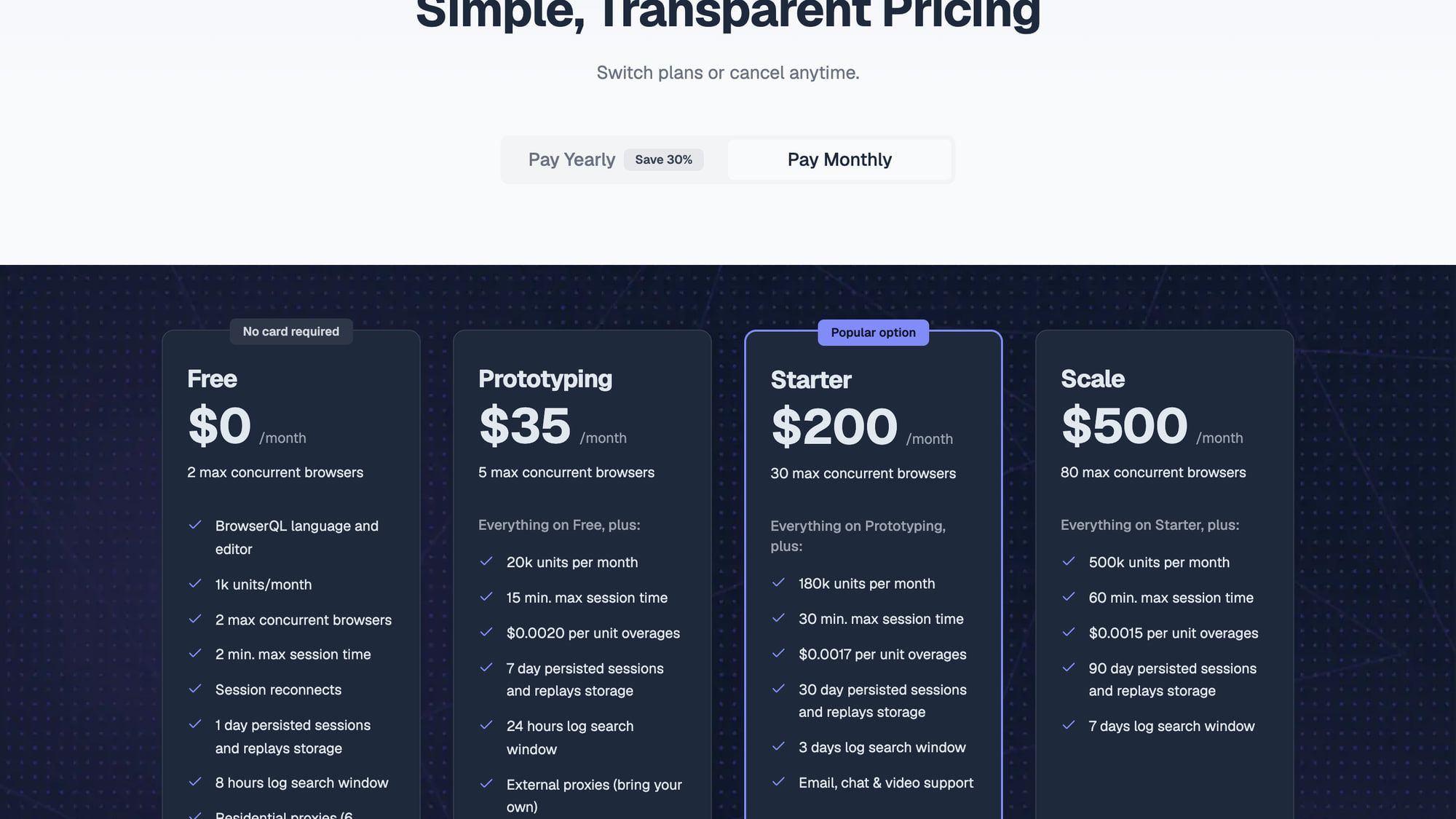
| Base plans used here | Developer $20/100 hours; Startup $99/500 hours monthly | Monthly: Prototyping $35/20K units; Starter $200/180K; Scale $500/500K. Annual monthly equivalents: $25/$140/$350 |
| Proxy cost basis | Developer 1 GB then $12/GB; Startup 5 GB then $10/GB | Residential 6 units/MB; datacenter 2 units/MB |
| Session handling | Keep-alive idle time counts until release/timeout | Reconnect incurs a new unit; connection/session behavior matters |
| Free scope | 1 hour/month, 3 concurrent, 15-minute cap | 1K units, 2 concurrent, 2-minute cap |
| Local core license | Verify the actual product/deployment route | SSPL-1.0 or commercial; not MIT/Apache |
Sources: Browserbase pricing, plans, keep-alive, Browserless pricing, sessions and license, checked 11 November 2026.
When Browserbase makes more sense #
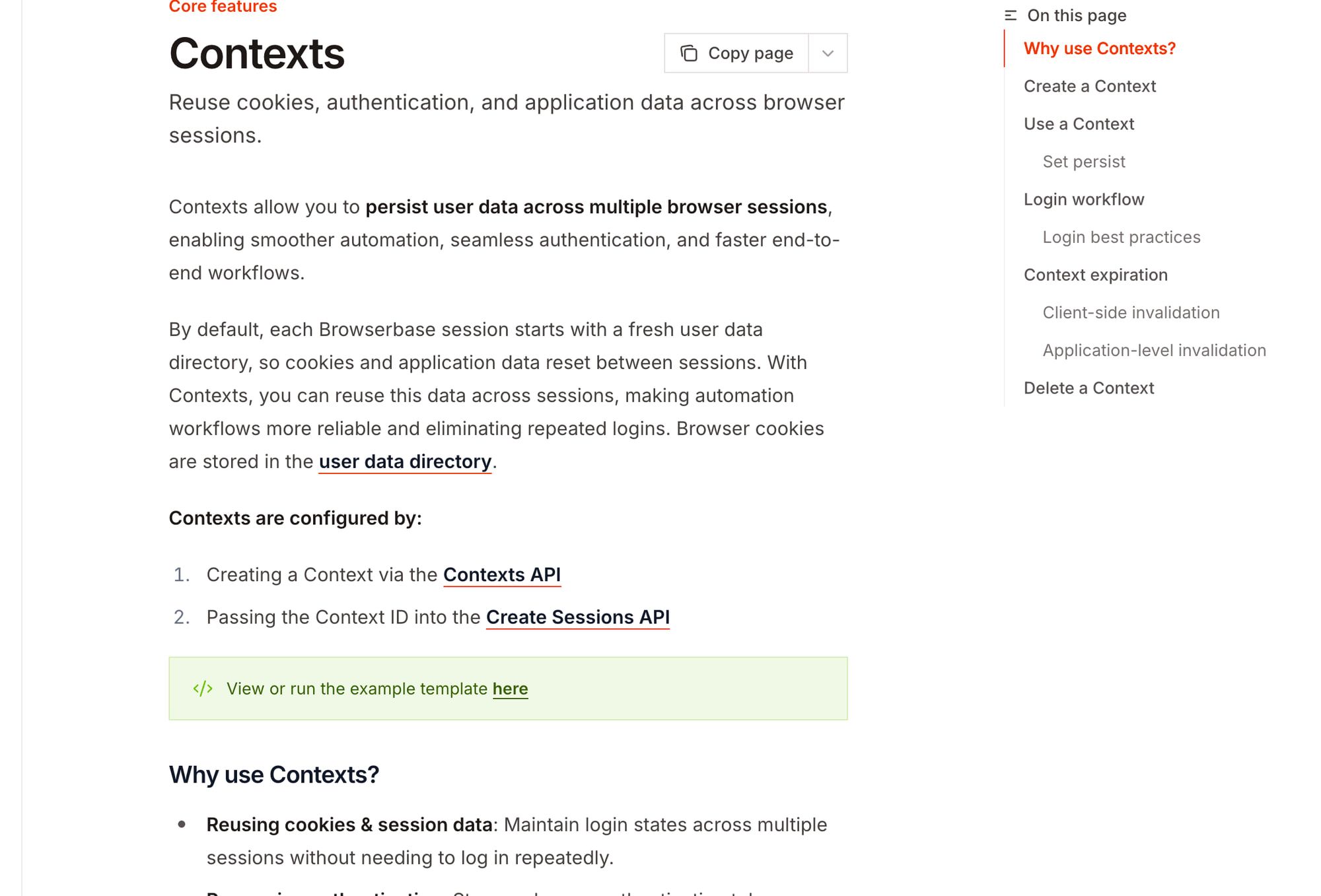
Browserbase is my shortlist when reusable state and an explicit managed-session lifecycle are central. Contexts persist browser state, while its session and keep-alive docs define the lifetime you need to manage. I would decide which state is required and which credentials may remain before enabling reuse. Contexts, session management.
Developer includes 100 browser hours for $20 monthly and Startup 500 for $99. Their time/proxy overages differ, so I would compare the complete selected workload rather than a browser-hour headline. Pricing, checked 11 November 2026.
Concurrency is organization-wide, with a separate session-creation rate limit. A monthly allowance does not establish that every burst can be accepted, and a 429 may reflect either limit. Concurrency docs.
For the full bill, use Browserbase pricing. Its examples keep paid overages separate from spending caps and show why proxy use can change the cheaper tier.
When Browserless makes more sense #
Browserless is my shortlist when its documented CDP/Playwright/Puppeteer route matches existing code. I would inspect the required launch options and session/reconnect behavior before choosing a plan or assuming that disconnecting is a complete cost-control policy. Quick start, launch options, session docs.
The public core is SSPL-1.0 or commercially licensed. Its README describes a commercial-license requirement for proprietary/closed applications, and enterprise/private capabilities are a separate deployment scope. I would review the intended use and exact license rather than advertise it as a permissively licensed free production alternative. Repository, license, private-deployment guide.
I have not deployed that core or verified its production behavior. The repo, license and docs are procurement inputs, not measured self-host results. The wider build-or-buy question is in self-hosted vs managed headless browsers, and if the licence is a blocker, Browserless alternatives lists other routes.
Is the 30-second unit cheaper? #
Not by itself: compare billable units and the whole subscription. Browserbase documents a one-minute minimum per session; Browserless charges one unit for up to 30 seconds per connection and an extra unit for every further 30 seconds. Browserbase’s proxy docs round MB usage to the nearest MB, but I found no stated rounding direction for minutes, so I do not invent it. Browserbase billing, Browserbase proxies, Browserless pricing.
For hypothetical Browserless connections, 20 seconds uses one time unit and 31 seconds uses two. Reconnect starts another unit. At exactly one MB residential proxy traffic, add six proxy units; successful CAPTCHA adds ten units when applicable. Pricing, proxy docs.
Those are units, not a dollar invoice for a successful task. Included quota, reconnects, proxy type, required session length and the annual cash commitment can change the final choice.
What changes if you pay Browserless yearly? #
Billing commitment changes both price and displayed concurrency. The anonymous public monthly selector shows Prototyping/Starter/Scale at $35/$200/$500 monthly, with 5/30/80 concurrent browsers. The annual view shows $25/$140/$350 monthly equivalents with 10/40/100 concurrent browsers. Pricing, checked 11 November 2026 (annual view; monthly view last confirmed 13 October 2026).
Both captured views retain 20K/180K/500K monthly units and $0.002/$0.0017/$0.0015 per-unit overages. Annual equivalents are a billing commitment, not month-to-month purchase totals. Current public cards.
Paid session caps are 15/30/60 minutes. The annual cards show +5/+10/+20 labels, exactly the difference from the monthly capacities; I use the displayed annual totals of 10/40/100 without adding those labels again. Current plan cards, checked 11 November 2026.
My workload sheet would keep maximum session duration, simultaneous sessions and connection churn beside units. A sufficient monthly unit balance is not proof that the selected session cap fits the task.
What about idle sessions and open endpoints? #
For Browserbase, keep-alive idle time remains billed until release or timeout. I would explicitly release sessions the application owns and check the end state instead of assuming a completed task eliminates the browser lifetime. Keep-alive docs.
For Browserless, the Docker configuration says an unset TOKEN leaves endpoints unauthenticated. Its v2.57.0 release, dated 30 September 2026, adds STRICT_TOKEN_USE for route-wide authentication enforcement. I would pin/review the actual build and configure protection explicitly. Docker config, release history.
I would also keep browser/CDP and viewer access private to the intended clients, with scoped targets, timeouts and sanitized observations. These are proposed acceptance controls. No container setup was executed, and default token behavior was not verified safe.
Does turning off replay keep your data private? #
Not on its own: Browserbase’s retention needs an account/contract check. Developer shows 30 days on pricing and seven in plan docs, so neither public number becomes a promise in this comparison. Pricing, plans.
Its ZDR guidance distinguishes enterprise arrangements from per-session log/record flags and explains artifacts/provider data those flags do not remove. I would trace uploads, downloads, contexts and model data separately, then inspect the applicable terms. ZDR docs, terms.
Browserless’s core license and deployment docs do not establish a permission to run or publish cloud benchmarks. I have not established either vendor’s complete contract or live privacy behavior here.
Which one should you shortlist? #
Choose Browserbase as the shortlist for its documented managed state/session fit, after pricing lifetime, proxy use and required limits. Choose Browserless for its connection/unit model or a reviewed private deployment, with annual commitment and license scope made explicit.
I would pause a final price winner until the same task, traffic, lifecycle and limits have been quoted. A 30-second block is a real billing difference; it is not by itself a complete savings calculation.
Use Browserbase alternatives and Browserbase versus Steel for other routes. The Browser Use versus Stagehand guide addresses the control loop; the agent browser hub connects the browser-buying comparisons. If an AI assistant will drive the browser, browser automation MCP servers covers that connection layer.
FAQ #
Is Browserless open source? #
Its current core uses SSPL-1.0 or a commercial license. Review the intended application/deployment rather than assume MIT or Apache terms. License.
Does a shorter billing block mean a lower bill? #
No. I would include fixed commitment, quota, reconnects, proxy/CAPTCHA units and the task limits before comparing invoices. Browserless pricing, Browserbase plans.
Is it safe to skip the Docker auth token? #
The docs say an unset token leaves endpoints unauthenticated. Review explicit route protection and the selected release. Docker config.
Which one is more accurate or reliable? #
No measured comparison in this research establishes that. The recommendation is based on documented workflow, billing and operating fit.
Sources
21 sources, accessed .
Official pricing, docs, changelogs and status pages 18
- Browserbase: pricing
- Browserbase: account/billing/plans
- Browserbase: platform/browser/long sessions/timeouts
- Browserbase: platform/browser/long sessions/keep alive
- Browserbase: platform/identity/proxies
- Browserbase: optimizations/concurrency/overview
- Browserbase: platform/browser/getting started/manage browser session
- Browserbase: platform/browser/core features/contexts
- Browserbase: account/enterprise/zero data retention
- Browserbase: terms of service
- Browserless: pricing
- Browserless: enterprise/docker/config
- Browserless: baas/bot detection/proxies
- Browserless: baas/session management/standard sessions
- Browserless: baas/best practices
- Browserless: baas/launch options
- Browserless: blog/self host browserless enterprise docker deployment guide
- Browserless: baas/quick start
GitHub code, issues and releases 3
Last updated: 13 October 2026. Researched and drafted with AI tools; human editorial review and publication approval are pending.


