Comparison
ScraperAPI vs ScrapingBee: Which Is Cheaper for JS Pages?
ScrapingBee charges five credits per JavaScript page, ScraperAPI ten. What that means at 1K, 100K and 1M requests, plus free credits and renewals.

I would shortlist ScrapingBee for ordinary rendered-page capacity and ScraperAPI when its recurring free scope or documented Async contract is the deciding requirement. Bee’s ordinary JS total is five credits against ScraperAPI’s ten, but neither that weight nor a plan label proves better output on your targets. Bee API, ScraperAPI JS, billing, Async.
At hypothetical 100,000 successful generic JS requests monthly, listed capacity is $99 Bee versus $149 ScraperAPI. The comparison below also checks plain work, one million requests, billable errors, geography and renewals so you can identify what migration actually changes. Bee pricing, ScraperAPI pricing.
Short on time?
Here's my take
- Ordinary JS capacity
- ScrapingBee, if its contract fits
- Five-credit generic JS yields lower listed-plan candidates in these assumptions, without a quality verdict.
- Small recurring plain job
- ScraperAPI free scope
- The documented 1K monthly credits are distinct from both providers’ trial windows.
- Async requirement
- Preserve the named job contract
- Check required batch lifetime, endpoint output and result collection before changing providers.
Prices verified . Sponsors cannot buy a verdict or a position.
How many credits does each one charge? #
Ordinary generic JS costs ten credits with ScraperAPI and five with ScrapingBee; plain fetching costs one with either when rendering is off. Prices and specifications verified: 2026-11-09. These are ordinary documented totals, not guessed additive surcharges or costs for every domain; what scraping API credits really buy covers the wider pattern. ScraperAPI costs, Bee documentation.
| Configuration or entry limit | ScraperAPI | ScrapingBee |
|---|---|---|
| Generic plain | 1 credit | 1 with render_js=false |
| Generic JS | 10 credits | 5; default rendering on |
| Premium without JS | 10 | 10 |
| Premium + JS | 25 | 25 |
| Higher protection | Ultra 30; ultra + JS 75 | Stealth 75, JS required |
| First paid monthly rung | $49/100K credits/20 threads | $19/75K/25 concurrency |
The combined premium-plus-JS total is 25 at both standard endpoints; I would not add two separate ten-credit figures. ScraperAPI target categories/protection combinations and Bee dedicated endpoints require their own lookup. ScraperAPI, Bee credit guide.
ScraperAPI’s current DataPipeline table says 20 for generic premium-plus-JS while the standard table says 25, despite the July parity announcement. Bee’s extra-five AI wording also conflicts with a premium-AI help example, so these uncertain combinations are excluded from the calculations. Pipeline table, July note, Bee docs, Bee help.
Which one costs less at 1K, 100K and 1M requests? #
ScrapingBee lists the cheaper plan for JS work at all three hypothetical volumes. The table assumes successful generic standard/HTML requests, either plain or JS-only. Exclude protected-domain extras, premium, AI, tax, trial/promotional credits, rollover, private rates and client retries; Free candidates depend on actual feature eligibility. ScraperAPI pricing, costs, Bee pricing, HTML costs.
| Monthly requests | ScraperAPI plain × 1 | Bee plain × 1 | ScraperAPI JS × 10 | Bee JS × 5 |
|---|---|---|---|---|
| 1,000 | $0 documented Free | $19 Hobby | $49 Hobby | $19 Hobby |
| 100,000 | $49 Hobby | $49 Freelance | $149 Startup | $99 Startup |
| 1,000,000 | $149 Startup | $99 Startup | $975 Professional | $599 Business+ |
At 100,000 JS requests, ScraperAPI uses one million credits while Bee uses 500,000. Both candidate Startup plans include one million credits, so Bee has additional listed credit room under this simplified mix; that is not equal geography, protection or successful-record capacity. Pricing, Bee pricing, weights.
The paid entry JS arithmetic is 100,000/10 = 10,000 ordinary requests for ScraperAPI and 75,000/5 = 15,000 for Bee. I would leave room for billable missing pages and extra client attempts rather than treat the arithmetic maximum as a guaranteed delivered-record count. ScraperAPI costs, Bee costs.
These are lowest listed subscription candidates, not promises about private PAYG or add-on invoices. Confirm the required features and actual cost path before selecting a recurring plan.
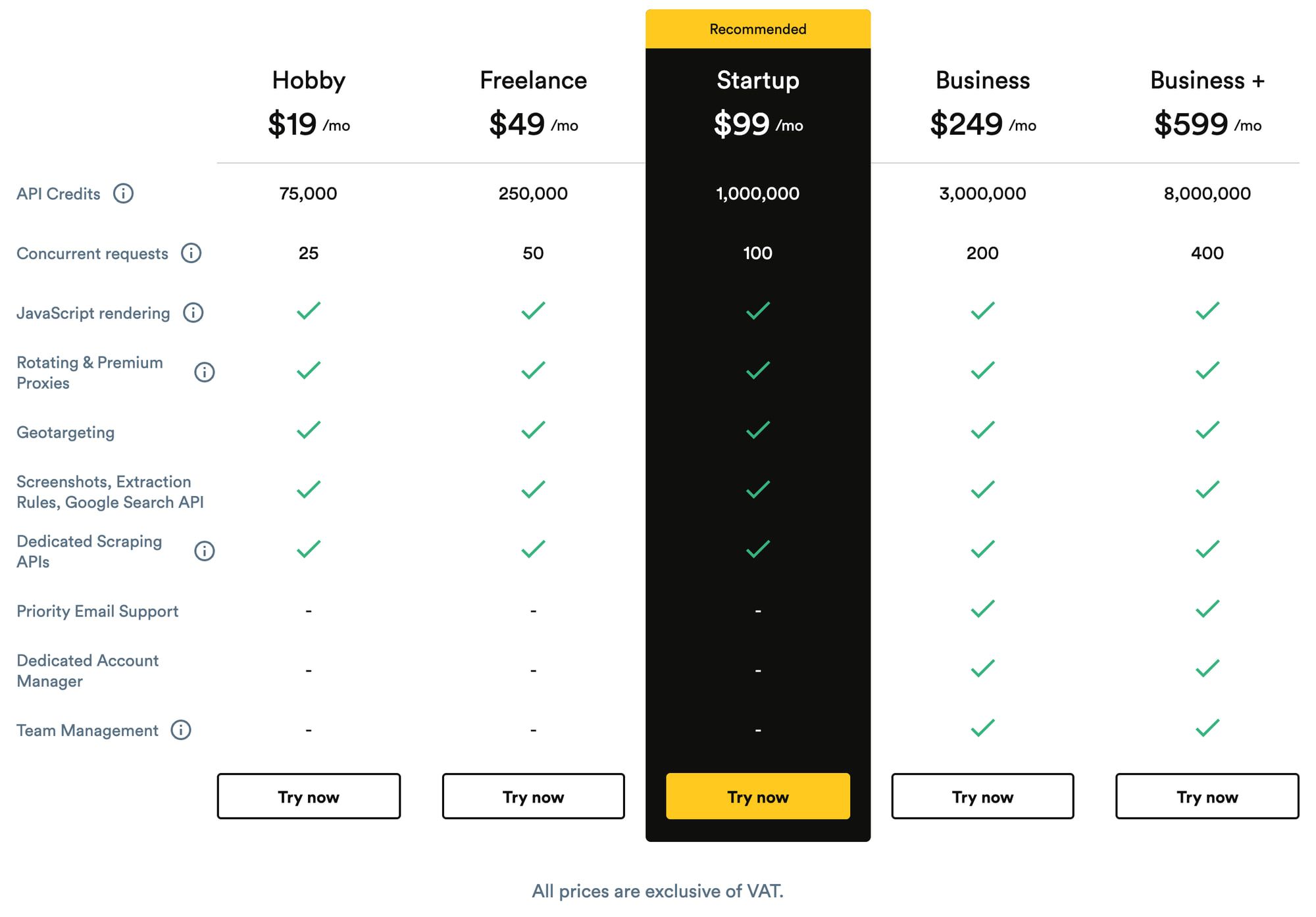
The screenshot is September 27 historical context. Its five visible cards do not erase larger Enterprise rungs now published on the current pricing page. Current Bee pricing.
What about free credits and geotargeting? #
ScraperAPI documents a seven-day 5,000-credit trial without a card, then 1,000 credits monthly/five concurrency. Bee documents a 1,000-credit signup trial; I did not establish recurring Bee credits or acquire either account. ScraperAPI billing, general FAQ, Bee trial.
A trial cannot fund an ongoing monthly comparison. Even a recurring credit balance needs the exact free-feature entitlement before you use it to plan rendered or protected work.
ScraperAPI’s Hobby/Startup standard geo is US/EU regional targeting, with country targeting from Business upward. I would specify required geography and protection before assuming a cheaper entry plan substitutes for it. Standard geo.
Do you pay for failed requests? #
Sometimes, with both. ScraperAPI bills documented 200/404 and client cancellation before 70 seconds. Its retries can continue for 60 seconds, so terminating a short client wait does not establish a free result. Costs, general FAQ.
Bee’s normal billed statuses include 200/404/410/413; transparent status mode bills all target statuses below 500 and disables automatic retry, while 5xx is free. That is more specific than “all failed target responses are free.” HTML API.
Bee auto GET selects a successful one/five/ten/25/75-credit configuration, and max_cost applies only in auto mode. ScraperAPI also documents request-level max_cost rejection; these controls do not decide subscription renewals or validate the returned content. Bee, ScraperAPI cost control.
I would log selected settings, status, reported cost and the record-validation result separately. A returned missing-page response can be chargeable without supplying the fields your application needs.
Will your Async jobs survive a switch? #
Not automatically. ScraperAPI documents Async processing up to 24 hours and batches up to 50,000 URLs. I would preserve job submission, polling/result retention and retry semantics rather than assume a known-URL synchronous response is equivalent. Async.
Bee’s generic, Google, Amazon and proxy interfaces differ. Google proxy lists 20 credits versus dedicated light ten/regular 15, and Amazon light five/regular 15; proxy transport retains API defaults/costs and browser subresources can add requests. Proxy, Google, Amazon.
I would not copy proxy examples that disable TLS certificate checks or infer raw bandwidth pricing from a proxy-shaped interface. Match the required endpoint and output before comparing its plan against standard generic weights.
What happens to unused credits? #
Ordinary unused credits expire at both providers. Bee’s one-time add-ons have no published rates on the pages I read, manual early renewal loses leftovers, and optional automatic renewal at 98% can charge again. ScraperAPI pricing FAQ, Bee unused credits, manual renewal, auto renewal.
The 98% early-renewal help says the remaining 2% carries into a reset billing cycle. Bee’s terms also say full credit exhaustion ends the cycle and triggers renewal unless terminated; I would confirm the applicable account/contract before treating a disabled early-renewal switch as a spending stop. Auto-renewal help, terms, §8(b).
I would review payment settings independently from per-request limits and monitor actual usage before recurring jobs. The usage-endpoint and cost-header instructions are documentation, not an account setup I inspected. Bee usage monitoring.

The highway image illustrates simultaneous work. Concurrency is separate from request duration, rate limits, monthly credits and measured throughput; this article contains no capacity run.
Would Scrapingdog change the shortlist? #
As a third price-only check, Scrapingdog currently lists a $0 “forever” Free plan with 100 credits and one concurrency (its table labels them monthly, its FAQ calls them a starting balance), Lite $40/200,000/five concurrency and Standard $90/one million/50 concurrency, with JS/premium/both totals five/ten/25. I would inspect it only if that scope fits, without a measured performance tie-breaker. Prices/specifications verified: 2026-11-09. Pricing.
Which one would I choose? #
For ordinary rendered capacity under the stated assumptions, I would start with Bee. For a qualifying small recurring plain job or a needed documented Async path, I would inspect ScraperAPI; for geography/endpoint requirements, I would compare that exact contract before changing a key.
Bee terms require target authorization; full ScraperAPI commercial terms/private growth rates were not obtained. I would resolve applicable written terms before procurement or live evaluation, and would not turn either subscription into permission for arbitrary targets. Bee terms, ScraperAPI billing.
Use the scraping API pillar for access-layer context. ScraperAPI pricing and ScrapingBee pricing cover each side’s billing details; ZenRows versus Bee checks the shared-wallet option, and build versus buy accounts for the surrounding work.
FAQ #
Which uses fewer credits for JavaScript pages? #
Bee uses five versus ScraperAPI ten. The table’s capacity candidates do not establish equal output or a universal protected-target rate. Bee, ScraperAPI JS.
Which one has free credits that renew monthly? #
ScraperAPI documents 1,000 monthly after its separate seven-day 5,000 trial. Bee’s 1,000 signup credits are a trial, not recurring access established here. ScraperAPI, Bee trial.
Are missing pages free? #
Both bill documented 404 cases; Bee’s normal and transparent modes add other distinctions, and ScraperAPI describes early client-cancellation charges. ScraperAPI, Bee.
Can I switch without changing my jobs? #
Not automatically. Match Async lifetime, endpoint/output and retry behavior rather than only generic weights. Async, Google, Amazon.
Do these figures show which is more reliable? #
No. There is no matched-target run or independent review sample here; validate authorized output separately before making that claim.
Sources
23 sources, accessed .
Official pricing, docs, changelogs and status pages 23
- ScraperAPI plans
- Request credit costs
- Plans and billing
- JS rendering FAQ
- Cost control
- Async API
- Standard geo
- DataPipeline credit table
- General FAQ
- July 2026 DataPipeline billing change
- ScrapingBee plans
- HTML API
- Service terms
- Credit system
- Proxy mode
- Trial allowance
- Unused credits
- Early renewal
- Auto renewal
- Monitoring credits
- Google API
- Amazon API
- Scrapingdog pricing


