Comparison
ZenRows vs ScrapingBee: Same JS Weight, Different Bills
Both charge five credits for a JavaScript page, so the choice comes down to allowances, free credits, caps and renewals. Priced at 1K, 100K and 1M.

I would choose ScrapingBee for a fitting HTML workflow with its listed allowance/defaults, or ZenRows when recurring Free or the needed shared product wallet matters. Ordinary JS costs five credits at both, so the decision moves to capacity, output, caps and renewal behavior rather than a different JS multiplier. Bee, HTML API, ZenRows pricing.
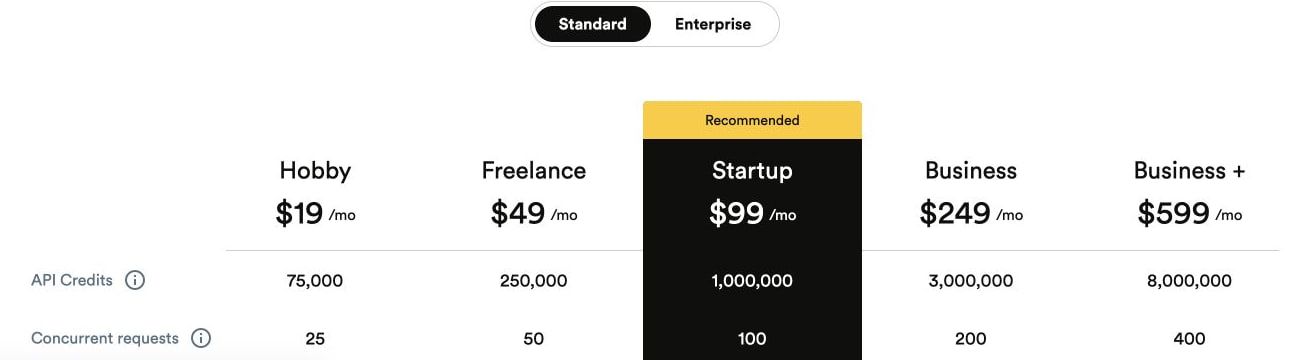
At hypothetical 100,000 successful generic JS requests monthly, both listed candidates are $99, but Bee Startup includes one million credits and ZenRows L2 500,000. That credit room is not a measured output or identical product entitlement. Bee pricing, ZenRows.
Short on time?
Here's my take
- Fitting HTML workflow
- ScrapingBee
- At 100K generic JS the $99 candidate includes more credits, without proving better targets or output.
- Small qualifying recurring work
- ZenRows Free
- 5K monthly credits differ from Bee’s signup trial and ZenRows’ one-time agent grant.
- Before recurring jobs
- Review caps and renewal separately
- Key limits, request configuration ceilings and automatic payments do different jobs.
Prices verified . Sponsors cannot buy a verdict or a position.
Do they charge the same credits? #
Yes, ordinary plain/JS/premium/premium-plus-JS totals are one/five/ten/25 for both, but allowances and rendering defaults differ. Prices and specifications verified: 2026-11-09. Totals below refer to ordinary Fetch/HTML configurations, not every special target or endpoint; how scraping API credits work covers the general rules. ZenRows, Bee API.
| Configuration / entry item | ZenRows | ScrapingBee |
|---|---|---|
| Generic plain | 1 credit | 1 with JS explicitly off |
| Generic JS | 5 | 5; default JS on |
| Premium only | 10 | 10 |
| Premium + JS | 25 | 25 |
| First paid monthly rung | B1 $19/45K/20 concurrency | Hobby $19/75K/25 concurrency |
| Recurring main Free | 5K monthly | Not established; 1K signup trial |
| Other product paths | Extract/Batch/browser/proxy with distinct units | Google/Amazon/proxy with endpoint exceptions |
I would turn Bee’s render_js off deliberately when plain HTML meets the output need. A default rendered request consumes five even if the page did not need rendering; premium, stealth and AI paths need their own totals. HTML API, credit guide.
Bee’s premium-AI example conflicts with its main extra-five wording. I leave that combination out rather than manufacture a common formula for the two products. Documentation, help article.
What do 1K, 100K and 1M requests cost? #
These hypothetical monthly volumes assume successful generic plain or JS-only requests, with no premium, special target, AI, tax, trial/promotions, rollover or client retries. ZenRows pack candidates assume actual eligibility and no payment/maximum-balance obstacle; private Bee add-on rates are excluded. ZenRows pricing, Bee pricing, API weights.
| Requests monthly | ZenRows plain × 1 | Bee plain × 1 | ZenRows JS × 5 | Bee JS × 5 |
|---|---|---|---|---|
| 1,000 | $0 Free | $19 Hobby | $0 Free, if eligible | $19 Hobby |
| 100,000 | $39 B3 | $49 Freelance | $99 L2 | $99 Startup |
| 1,000,000 | $199 G1 | $99 Startup | $549 S1 | $599 Business+ |
The 100,000-JS estimate is 500,000 credits at both. L2’s 500,000 is an exact balance match while Bee Startup has one million; I would leave reserve for billable missing pages or extra attempts instead of call either maximum useful capacity. Plans, Bee plans.
At one million plain requests, Bee’s $99 million-credit Startup candidate differs from ZenRows G1’s $199/1.2 million. At one million JS, ZenRows $549 S1/five million differs from Bee $599/eight million; neither row supplies measured equal quality, geography or protection. ZenRows, Bee.
The entry JS arithmetic is 45,000/5 = 9,000 for ZenRows B1 and 75,000/5 = 15,000 for Bee Hobby. That is documented-weight capacity, not a delivered-record or requests-per-second result. Pricing, Bee pricing.
What’s in ZenRows’ wallet, and what’s free? #
ZenRows Fetch/Extract/Batch and browser/proxy paths share product budgeting but not one unit. Extract uses underlying Fetch, Batch bills per successful task at selected weights, browser is 25,000 credits/GB plus five/minute, and standalone residential is 25,000/GB on paid access. Pricing, Batch, proxy FAQ.
I would identify which paths the application actually needs before treating a generic HTML competitor as the whole replacement. A successful Batch task or adaptive configuration still needs required-field validation. Batch, adaptive.
The main Free allowance is 5,000 monthly credits; the agent storefront instead offers 5,000 once after email verification, a separate credential, and Fetch/Extract-only PAYG. Bee’s 1,000-credit signup offer is a trial, not recurring access established here. ZenRows main pricing, agent payments, Bee trial.
ZenRows yearly pay-ten/get-twelve credits are provided up front as an annual pool (the 45K Build rung shows as $16/month billed yearly, versus $19 monthly). Monthly packs are capped at ten matching packs per period with eligibility/balance rules; base expires and packs carry once, so I would not compare an annual equivalent with a monthly subscription or assume indefinite rollover. Pricing, ZenRows plans.
Will a cap stop surprise charges? #
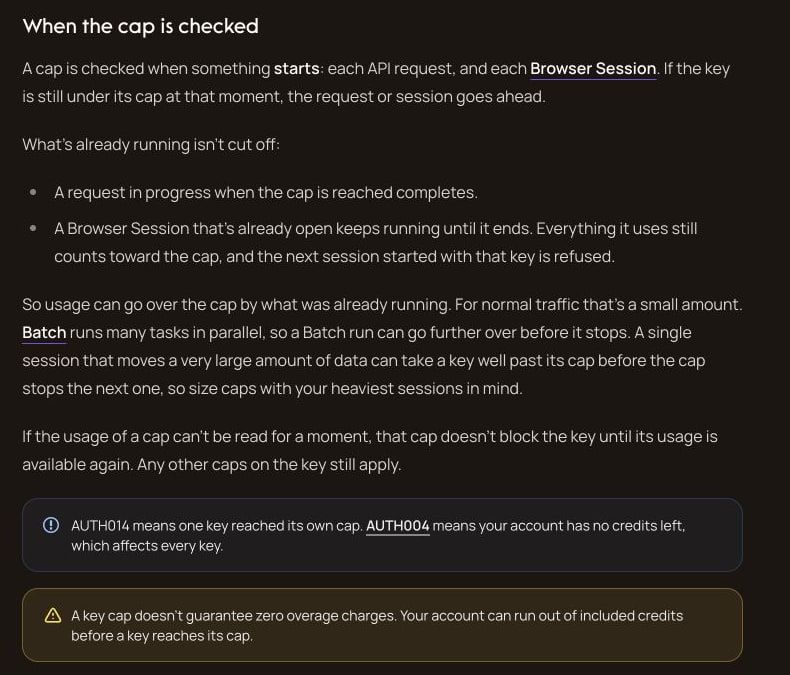
Not reliably. ZenRows key caps are uncapped by default, checked at start and can overshoot with in-flight work or temporarily fail open; legacy proxy traffic is excluded. Cancelling a Fetch request can leave its slot occupied for three minutes, so a local work budget is separate from connection lifetime. Caps, Fetch reference.
Bee auto GET selects a successful configuration among one/five/ten/25/75, with max_cost only in auto mode. That is a request-configuration ceiling, not a rule for subscription renewal. API.
Ordinary Bee leftovers expire; manual early renewal loses leftovers, and optional auto renewal at 98% charges again. I would review payment controls separately and monitor usage rather than assume a headline balance prevents another charge. Unused credits, manual renewal, auto renewal, monitoring.
The 98% early-renewal support also says the remaining 2% carries into a reset billing cycle. Separately, the service terms say full credit exhaustion ends the cycle and triggers renewal unless terminated; I would confirm the applicable account/contract before treating a disabled early-renewal switch as a spending stop. Auto-renewal help, terms, §8(b).
Do you pay for error pages? #
Some of them, with both. Bee normal billing includes 200/404/410/413, while transparent mode bills all target statuses below 500 and disables automatic retry; 5xx is free. ZenRows pricing counts 404/410 as successful, billable results, alongside adaptive successful-configuration charging; neither rule means all returned data is useful. Bee, ZenRows pricing, adaptive.
ZenRows response-size limits can cause an undelivered 413. I would track missing/oversized/error content and validated records separately from a charged attempt; no universal account charging rule for every exceptional failure was measured here. Response limits.
Bee Google light/regular costs ten/15 and Amazon five/15, with proxy transport exceptions such as Google proxy 20. Proxy defaults/costs and browser subresources also matter; neither generic five-credit JS nor a proxy-shaped interface covers every endpoint. Google, Amazon, proxy.
What about Scrapingdog? #
Scrapingdog’s current page lists a $0 “forever” Free plan with 100 credits and one concurrency (its table labels them monthly, its FAQ calls them a starting balance), Lite $40/200K/five concurrency and Standard $90/one million/50, with JS/premium/both five/ten/25. I would use it as a dated scope/price check, not a performance tie-breaker. Prices/specifications verified: 2026-11-09. Pricing.
Which would I choose? #
For a fitting HTML-only job, I would compare Bee’s allowance and renewal settings; for small eligible recurring Free work or required shared product paths, ZenRows. At larger volumes I would price the precise target/configuration plus eligible packs and reserves, then validate authorized output before a quality claim.
Bee terms require target authorization and ZenRows terms restrict unlawful use/resale. A subscription does not grant arbitrary data rights or benchmark permission, and this article supplies no independent user-review or live account proof. Bee terms, ZenRows terms.
The scraping API pillar connects the product choices, and ZenRows pricing and ScrapingBee pricing cover each plan ladder in full. ScraperAPI versus Bee adds the Async shortlist, and build versus buy includes operating work.
FAQ #
Does ZenRows or ScrapingBee use fewer credits for JavaScript? #
Neither: both use five. Bee enables JS by default, while features/endpoints can change the selected total. Bee, ZenRows.
Which is cheaper for 100,000 JavaScript requests a month? #
Both table candidates are $99: ZenRows L2/500K and Bee Startup/one million credits. The extra balance is not proof of equal features or quality. Pricing, Bee pricing.
Does every ZenRows free grant renew monthly? #
No. Main Free is monthly; the agent storefront grant is once with a separate credential path. Pricing, agent payments.
Can a spending cap guarantee no extra charges? #
ZenRows documents overshoot/fail-open cases, while Bee auto/max_cost and optional renewal have different scope. Review work and payments independently. Caps, Bee API, renewal.
If I’m billed for a page, is the data usable? #
Not automatically. Validate required fields, freshness and duplicates separately from provider billing or successful configuration. Fetch, Bee.
Sources
23 sources, accessed .
Official pricing, docs, changelogs and status pages 23
- Zenrows monthly pricing
- Zenrows plans (monthly and yearly)
- Fetch API reference
- Key credit caps
- Legacy proxy FAQ
- Agent storefront
- Zenrows service terms
- Adaptive stealth
- Batch FAQ
- Response size
- ScrapingBee plans
- HTML API
- Service terms
- Credit system
- Proxy mode
- Trial allowance
- Unused credits
- Early renewal
- Auto renewal
- Monitoring credits
- Google API
- Amazon API
- Scrapingdog pricing


