Pricing
Browser Use pricing: cost a task, not an hour
Browser Use Cloud bills $0.06 an hour plus proxy GB and model tokens. What one task costs on BU Fast, BU 4.0 and rivals, with the stale $0.02 sorted out.


Browser Use Cloud charges $0.06 per browser hour, billed by the minute, plus $5 per GB on its managed proxy and whatever your model’s tokens cost, so the hour is rarely the number that sets a task’s bill. The rates come from the pricing page, its Markdown copy and the billing guide, verified 24 Nov 2026. The hour rate was $0.02 until about 12 November, so many pages you will find still show the old price.
You are probably trying to work out what one agent task costs, which line of the bill to control (browser minutes, proxy GB or tokens), whether to leave the default model on, and whether another cloud browser would cost less. I read 49 pages to answer that, then priced one 10-minute task at two token densities and on six cloud browsers. It sits in my agent browser guides.
Every number here comes from a vendor page or doc, and I say whose. Nothing comes from an account or a bill of mine, so every per-task, monthly and ratio figure is my arithmetic on list prices, and I show the formula next to it.
Short on time?
Short on time? Here's my pick by reader
- Agent tasks where cost decides
- Browser Use Cloud with the model pinned to bu-fast ($0.12 / $0.60 per 1M) or bu-4.0-mini ($0.20 / $1.00)
- At the vendor's own example density a 10-minute task is $0.0225 on bu-fast against $0.0925 on the BU 4.0 default (4.1x all-in, 15x on tokens). High confidence on list prices, medium on the density.
- Tasks the cheap model fails
- Step up to bu-4.0 for those tasks only
- It is $1.80 / $9.00 per 1M. I found no third-party accuracy data, and the vendor benchmark has no BU 4.0 row, so pay for it where you have seen bu-fast fail.
- Your own agent, browser only, light traffic
- Browser Use at $0.06 an hour with no plan fee
- At list it sits below Kernel headless at every volume I priced ($6 against $30 at 100 hours, $60 against $80 at 1,000). I compared no stealth, speed or success.
- Proxy-heavy browsing
- Browser Use's managed proxy at $5 per GB, switched off where the target allows ($0.20 per GB)
- $5 is the lowest managed rate in my table ($6 Steel Scale, $8 Anchor, $10 Hyperbrowser, Steel Launch and Browserbase Startup, $12 Browserbase Developer). It outweighs browser time above about 12 MB an hour.
- Thousands of sub-minute jobs
- Kernel headless or Steel Launch, not one-minute rounding
- Every Browser Use job costs at least $0.001. A 20-second job is about $0.00033 on Kernel headless and $0.00056 on Steel Launch by my arithmetic.
- Many browsers without a monthly fee
- Browser Use ($100 once for 50 concurrent browsers)
- Concurrency follows lifetime payments, not a plan. Fifty browsers for an hour is $3 plus traffic, per the billing guide.
- Just trying it
- The $1 signup credit and the free start with 10 concurrent browsers
- $1 is 16.7 browser hours, or about 45 of the vendor's short BU 4.0 test tasks. BU 4.0 and Mini both work on the free plan.
Prices verified . USD list-price arithmetic from pages read on 24 Nov 2026. Task costs are my arithmetic, not a bill.
What does Browser Use Cloud charge for? #
Four things: browser time at $0.06 an hour, proxy traffic at $5 or $0.20 per GB, model tokens, and a one-time $1 credit that offsets the start. There is no subscription, and the pricing page says so: “No subscription. No concurrency fees.” Rates below are verified 24 Nov 2026.
| Item | Price (USD, 24 Nov 2026) | Detail | Source |
|---|---|---|---|
| Browser time | $0.06 per hour | Billed by the minute, 1-minute minimum ($0.001 a minute); CAPTCHA solving included | Pricing, billing guide |
| Managed home-IP proxy | $5 per GB | On by default in the managed browser | Pricing, proxies docs |
| Direct or own-proxy traffic | $0.20 per GB | Custom proxies are an enterprise feature set up by sales | Pricing |
| Signup credit | $1 once | Never expires (pricing page); eligible Google, GitHub or Microsoft signups | Pricing, Pricing Markdown, README |
| Subscription | None | Legacy plans and Box are retired | Pricing, FAQ |
| Top-ups | From $5 | Presets $100, $500, $1,000; 1 credit = $1; top-ups never expire | Pricing |
| Concurrent browsers | 10 / 50 / 250 / 500 / 1,000 | At $0 / $100 / $1,000 / $5,000 / $25,000 of lifetime paid | Concurrency docs |
| Model tokens | Per 1M tokens | Table further down | Pricing, models docs |
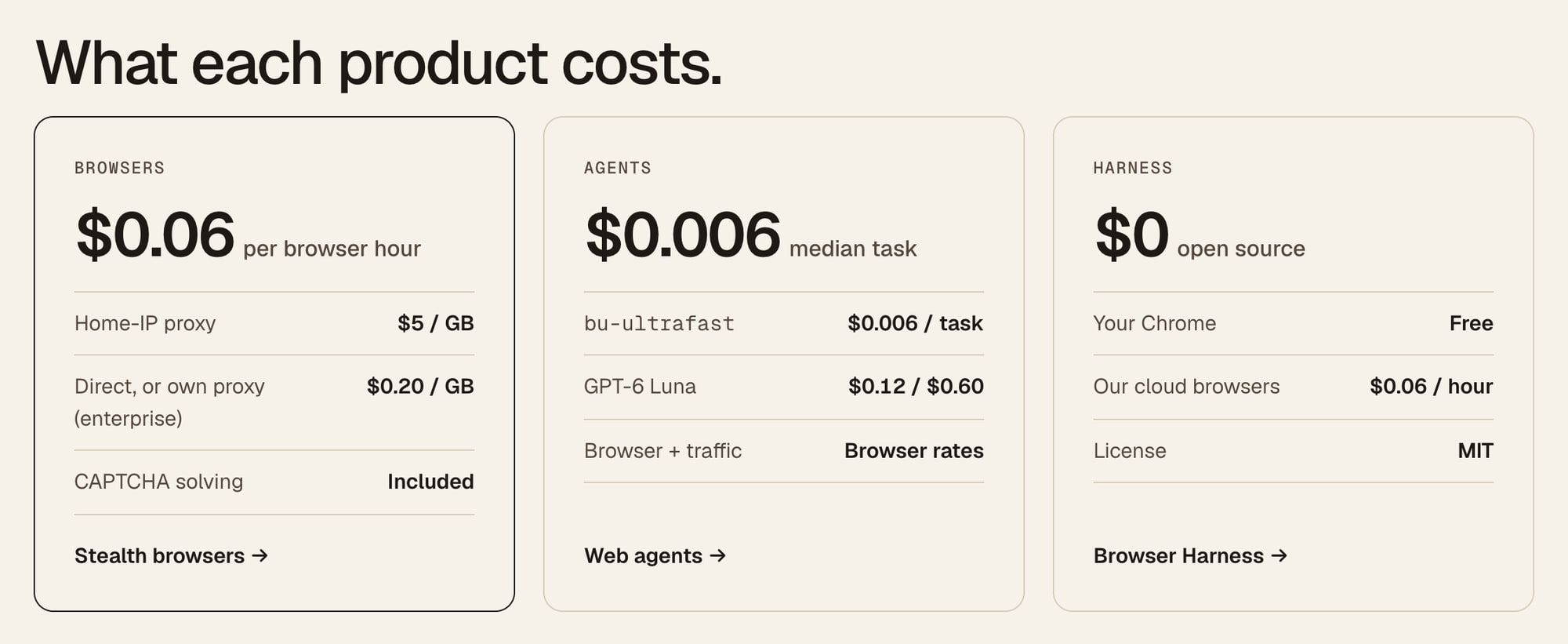
Two cautions on that table. The pricing page is rendered by JavaScript, so I only list a number here where the Markdown copy, the docs or the README agree with it. The Markdown copy says “Last verified … November 16, 2026” in its header, while its last_updated field says 2026-11-05.
The other caution is the currency. The page shows “$” and never names one, while the docs table says “USD per 1M tokens”. My fetch ran server-side and showed no regional price, so I treat everything as USD before tax. Browser Use’s own README says one key pays for the model and the cloud browser, and that is why a task’s bill has three parts.
The open-source library is MIT-licensed and free, per the README. Everything on this page is the cloud product’s bill.
Is the hour price $0.06 or $0.02? #
It is $0.06 now. It rose from $0.02 on or about 12 November 2026, according to the vendor’s own commit, so pages showing $0.02 were right earlier and are stale today. The commit b09b87a is titled “Show the $0.06 per browser-hour Browser Use Cloud price” and its body says the price rises from $0.02 to $0.06 per browser-hour.
The commit page shows no date. The README’s commit history lists it under 12 November 2026, so “on or about 12 November” is my reading. Here is the timeline I could assemble, with the source for every row.
| Date | Hour rate | Where it appeared | Note |
|---|---|---|---|
| 15 Jun 2026 | $0.06 | Vendor blog | Vendor’s own post |
| 16 Jul 2026 | $0.02 | ComparEdge | Plan data marked verified that day; a listing site |
| 13 Oct 2026 | $0.02 | Issue 6048 | Reporter says “live pricing is $0.02”; closed 17 Oct with a docs fix |
| 3 Nov 2026 | $0.02 | Flywheel review | Footer links an editorial placements page |
| 11 Nov 2026 | $0.02 | Three of my earlier posts | Checked that day, the day before the commit |
| about 12 Nov 2026 | $0.06 | Commit b09b87a | Body says the price rises from $0.02 to $0.06 |
| 16 Nov 2026 | $0.02 | Modern DataTools | Edited that day; stale by then |
| 24 Nov 2026 | $0.06 | Pricing page, Markdown copy, README, billing guide | Four vendor sources agree |
Read the table as a path with a gap. A June vendor blog says $0.06, and listings from July to November say $0.02, so there was a cut in between. I could not date it, and I will not guess.
Correction, checked on 24 Nov 2026
- The hour is $0.06, not $0.02. The vendor page, its Markdown copy, the README, the billing guide and the vendor’s own commit agree. Three of my earlier posts (Browser Use vs Stagehand, Browserbase alternatives and best cloud browsers for AI agents) carried $0.02 from my 11 Nov check, which was right that day. I have updated them, and they now note the rise.
- Which to trust. The vendor’s pages and commit win over listings that cite no date for their numbers. I could not see a Chrome or US view of the pricing page, so re-check before you budget.
The vendor’s changelog lists no entry for the rise, so the commit is the only dated sign of it I found. The same changelog does not list the 16 Nov default-model change either, so it lags the product.
How does the minute rounding work? #
Browser time rounds up to whole minutes with a one-minute minimum, so a job is never billed for less than $0.001. The billing guide’s own example says 12 min 13 s “rounds to 13 billable minutes ($0.013)” at $0.06 an hour. Billing guide, verified 24 Nov 2026.
That is invisible on a long run and expensive on a short one. A 5.7-second job bills one minute, about 10.5 times its real time (60 divided by 5.7, my arithmetic). Here is what a few lengths cost at list.
| Real time | Billed minutes | Browser charge |
|---|---|---|
| 5.7 seconds | 1 | $0.0010 |
| 1 minute | 1 | $0.0010 |
| 5 minutes | 5 | $0.0050 |
| 10 minutes | 10 | $0.0100 |
| 12 min 13 s | 13 | $0.0130 |
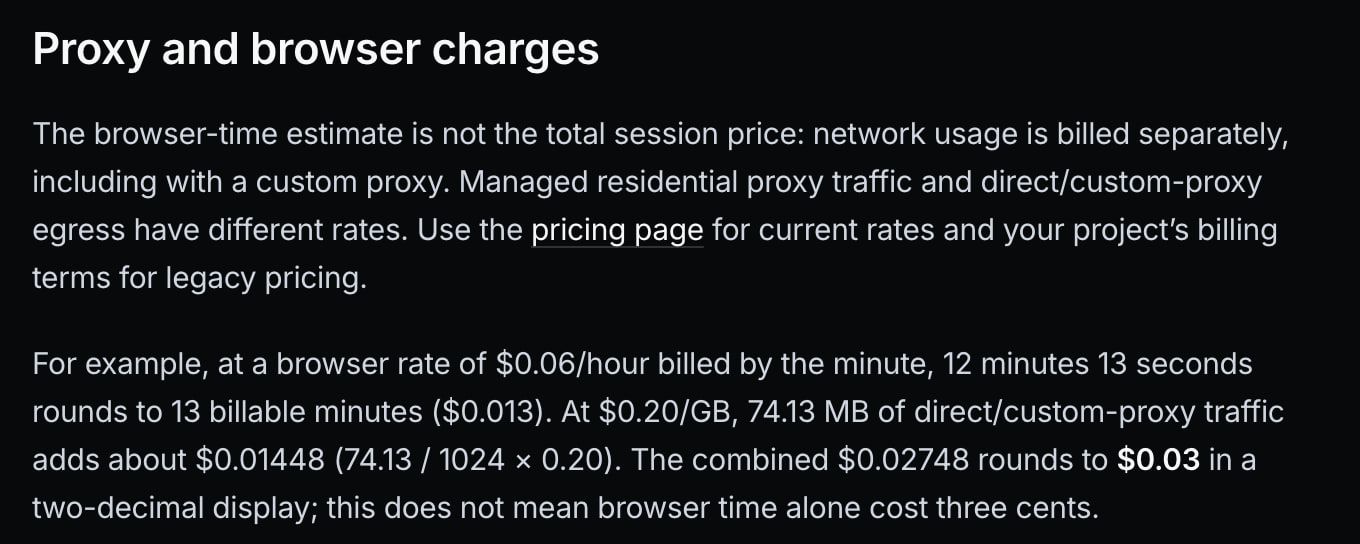
An agent browser also stays open after a run finishes. The billing guide and concurrency docs say a V4 agent browser stays up about 2 minutes after the last run activity, and cleanup runs each minute, so the tail is 2 to 3 minutes. “Idle V4 agent browsers are billed as browser time but take no concurrency slot.”
You can change the tail. The sessions docs describe keepAlive as 120 to 14,400 seconds with a default of 120, and the free tier and zero data retention are always 120. At the 14,400-second maximum an idle browser would bill 4 hours, which is $0.24 at list (my arithmetic).
Two more gotchas from the docs. Closing a Playwright or CDP connection does not stop the browser; you stop it with a PATCH /api/v4/browsers/{id} call. A follow-up on a stopped browser gets a fresh one, and that is new browser time.
For a 20-second task plus the default two idle minutes, the bill may round to 3 minutes, which is $0.003. That assumes the tail rounds together with the run, and the docs do not say it does.
How do users feel about this? One Hacker News commenter on the Firecracker thread (16 Jun 2026) said per-minute billing made Browser Use “around 2x more expensive than Lambda” for their use case, with a median screenshot capture of 5.7 seconds. A reply written as the vendor (“our solution”) said that compared per minute, Lambdas are 4 to 6 times more expensive. The thread reached me through a summary, so read it before you lean on either side.
My read: if your jobs are minutes long, ignore the rounding. If they are seconds long and arrive by the thousand, it is the one line in this post where Browser Use loses on structure, and I price it against per-second vendors in the picks below.
Why is the proxy the line to watch? #
The managed proxy is on by default and costs $5 per GB, which beats browser time once a browser moves more than about 12 MB an hour. The proxies docs say “A US residential proxy is on by default” in the managed browser, and the pricing page prices it at $5 per GB against $0.20 per GB for direct traffic.
The break-even is simple division: $0.06 an hour divided by $5 per GB is 0.012 GB, about 12 MB an hour, or 2 MB per 10 minutes. Above that, the proxy is the bigger half of the browser-plus-traffic bill. Here is what per-task traffic costs at the managed rate (my arithmetic, MB divided by 1,024 as the docs do).
| Traffic in one task | At $5 per GB (managed) | At $0.20 per GB (direct) |
|---|---|---|
| 1 MB | $0.0049 | $0.0002 |
| 10 MB | $0.049 | $0.002 |
| 74 MB | $0.361 | $0.014 |
| 300 MB | $1.46 | $0.059 |
The vendor’s own examples disagree about how much traffic a browser moves. The pricing page’s $13.50 example uses 0.9 GB for 100 browser hours, which is about 9.2 MB an hour (0.9 GB times 1,024 MB, divided by 100) or $0.045 an hour of proxy against $0.06 of browser time. The billing guide’s session example moves 74.13 MB in 12 min 13 s, which is about 364 MB an hour. That is about 40 times the first example, both from the vendor. I will not average them.
74.13 MB is the docs’ example, not a typical task, and I do not know a typical task’s traffic. What I can say is that the docs example shows $0.014480 of proxy because it prices the traffic at $0.20 per GB, the direct rate. At the managed rate the same session is 0.07239 GB times $5, which is $0.3620 of proxy. The session total is then $0.0412 of model, $0.013 of browser and $0.362 of proxy, which is $0.416, with proxy 87% of it. The docs show $0.06868 for the same session. Both are my arithmetic on the vendor’s numbers; only the rate changed.
That gap is why this section exists. A pricing page that says $5 per GB and a billing example that uses the $0.20 direct rate can both be right, and you will only see which applied on your own invoice.
There are two ways off the default proxy. Set proxyCountryCode to null and the managed proxy turns off, which is the $0.20 direct rate. BU Ultrafast sessions run without the managed proxy unless you set browserSettings.proxyCountryCode, per the Ultrafast docs. EU projects default the proxy country to Germany (de), per the EU deployment docs; the proxies page does not say so.
One history note. The proxy fell from $10 to $5 per GB on 3 April 2026, per the changelog entry. A directory that shows $10, $6 and $4 per GB is showing the old scheme.
What the docs do not say is whether the managed proxy bills while a browser sits idle. I could not find that, so I leave it unpriced.
What do the models cost? #
Per 1M tokens, bu-fast is $0.12 in and $0.60 out and the BU 4.0 default is $1.80 in and $9.00 out, 15 times as much. The vendor’s supported-models docs and the pricing page list 19 models, in USD per 1M tokens, and the BU 4.0 prices carry the date 2026-11-16 while the rest carry 2026-11-09.
| Model | Input | Output | Cached input | Times bu-fast | Region note |
|---|---|---|---|---|---|
| bu-fast (GPT-6 Luna, medium reasoning) | $0.12 | $0.60 | $0.012 | 1.0x | Not stated |
| gpt-6-luna | $0.12 | $0.60 | $0.012 | 1.0x | Default for EU and older US projects |
| bu-4.0-mini | $0.20 | $1.00 | $0.02 | 1.67x | US and EU |
| bu-ultrafast (Luna priority tier, low reasoning) | $0.24 | $1.20 | $0.024 | 2.0x | Not stated |
| bu-4.0 | $1.80 | $9.00 | $0.09 | 15x | US only; default for new US projects |
| bu-4.0-pro | $3.00 | $15.00 | $0.15 | 25x | US only; needs credits |
| bu-smart (GPT-6.1 Sol) | $2.40 | $12.00 | $0.12 | 20x | Not stated |
| Claude Opus 5.5 | $4.80 | $24.00 | $0.24 | 40x | Not stated |
The ratios are my division, and input and output ratios match on every row, so one multiple covers both. GPT-6 Astra at $12 and $60 and 10 more rows sit on the same pages. The Ultrafast docs say ultrafast is Luna’s priority tier, billed at twice the standard rate.
Which model you get without choosing depends on where and when your project was created.
- New US projects created on or after 16 Nov 2026 that omit
modeluse BU 4.0 at high reasoning. Models docs. - Older US projects keep GPT-6 Luna at high reasoning.
- EU projects keep GPT-6 Luna, and the EU’s third-party models are OpenAI only (Anthropic, Gemini, DeepSeek and GLM agent models are unavailable there). BU 4.0 and BU 4.0 Pro are US-only, and BU 4.0 Mini is in both. EU deployment docs. EU projects are not a separate billing account.
- Free-plan projects can use BU 4.0 and Mini; Pro needs credits.
- The open-source library is a separate switch. Version 1.0.6 on 16 Nov made
Agent(task)andChatBrowserUse()use bu-4.0, and the switch to BU 4.0 as the default has its own post, including how to pin the old model. Releases.
Bring-your-own-key is priced differently. The pricing Markdown says BYOK pays the provider’s cost plus “0.2x” orchestration, plus browser and network usage, and it does not work for BU 4.0 models. Hosted V4 models cost “provider rate + 20%” except BU 4.0, which has its own rates, and hosted V3 is 1.2x provider token rates. Pricing Markdown, legacy page; BYOK and the BU 4.0 exclusion also appear in the models docs. The 24 Aug 2026 changelog records a fix for a bug that priced BYOK cache reads at the full input rate.
There is a free-credit consequence. The vendor’s release notes say its short test task cost $0.022 on BU 4.0 against $0.0014 before. Release 1.0.6. At those figures $1 buys about 45 BU 4.0 tasks or 714 of the earlier kind (my division), and I take the vendor’s task as its own illustration, not a typical run.
Whether BU 4.0 earns its 15x I cannot say. The vendor’s benchmark page lists one Browser Use entry, “BU fast”, and no BU 4.0, bu-4.0-mini or ultrafast row, and I found no third-party test of BU 4.0.
So what does one task cost? #
Nobody publishes one number. The vendor’s own task figures run from $0.006 to $1.64, and they use different models, dates and inclusions, so I show them side by side and do not average them. Everything in this table is the vendor’s figure unless I say so.
| Vendor figure | Basis | Model | Date | What to remember |
|---|---|---|---|---|
| $0.03 to $0.05 a task (data pull about $0.03, research about $0.05, form about $0.03, login about $0.05, checkout about $0.04) | Pricing page, “based on real runs” | GPT-6 Luna, home-IP proxy | 17 Nov 2026 | Read in Chrome on 24 Nov; appears only on the rendered page. Pricing |
| $0.006 median task | Pricing page; the Ultrafast docs give no figure | bu-ultrafast | Not dated | Basis unstated. Ultrafast docs |
| 11 cents per task, 9.2 median minutes | Vendor benchmark, 180 live-site tasks | BU fast | Updated 29 Oct 2026 | “Model tokens only”: no browser, proxy, search or judge. Benchmarks |
| $0.022 against $0.0014 | Release 1.0.6 short test | BU 4.0 against the earlier default | 16 Nov 2026 | One short task. Releases |
| $0.208 against $0.434 per BU Bench task | Release 1.0.4, after screenshot pruning | Not named in what I read | 13 Nov 2026 | I could not confirm the model or task set. Releases |
| $1.64 production median | “Across 30 days of production usage” | Claude Opus 4.7 | July 2026 | The page says it does not reflect today’s model choices or token prices. Choosing an agent |
The same docs page puts the older V3 agent at $0.87 and V2 at $0.70 per task, also July medians. I would not use the $1.64 as a quote for today. Its model was Opus 4.7, and the page tells you not to read it as current.
The two sources I trust most disagree by a wide margin. Take the benchmark: 11 cents over a 9.2-minute median is about $0.717 an hour of tokens. Take the pricing page’s $13.50 example: $3.00 of BU Fast tokens over 100 browser hours is $0.03 an hour. That is 24 times apart, both from the vendor.
I cannot tell you which density your agent has. So I priced one 10-minute task at both, with the vendor’s inputs and my arithmetic.
Density A is the pricing example: 20M input and 1M output tokens per 100 hours is 0.2M and 10,000 per hour, so a 10-minute task is about 33,333 input and 1,667 output tokens. Density B is the benchmark: 11 cents of bu-fast tokens per task, scaled to other models by the per-token ratio. Browser time is $0.0100 (10 minutes) and managed proxy is $0.0075 (0.9 GB times $5, divided by 100 hours and by 6, which is about 1.5 MB at 1,000 MB to the GB) in every row. I round the benchmark’s 9.2 minutes up to 10.
| Model | Tokens, density A | All-in, density A | Tokens, density B | All-in, density B |
|---|---|---|---|---|
| bu-fast | $0.0050 | $0.0225 | $0.1100 | $0.1275 |
| bu-ultrafast | $0.0100 | $0.0275 | $0.2200 | $0.2375 |
| bu-4.0-mini | $0.0083 | $0.0258 | $0.1833 | $0.2008 |
| bu-4.0 | $0.0750 | $0.0925 | $1.6500 | $1.6675 |
| bu-4.0-pro | $0.1250 | $0.1425 | $2.7500 | $2.7675 |
| bu-smart (GPT-6.1 Sol) | $0.1000 | $0.1175 | $2.2000 | $2.2175 |
Density A is the vendor’s own example scaled down, and density B is its benchmark scaled up. Neither is a measurement of a run. Density B holds the token count equal across models, which is an upper-bound illustration because a model with higher reasoning may use a different number of tokens, so please do not read $1.67 as what BU 4.0 costs on that benchmark.
What the table does show is the ratio. On the vendor’s pricing-example density a bu-fast task is $0.0225 against $0.0925 on bu-4.0, 4.1 times all-in and 15 times on tokens. The same ratio turns the vendor’s $13.50 example into $55.50.
Do model tokens really dominate the bill? #
Only at the benchmark’s density. Under the vendor’s own $13.50 example, tokens are the smallest of three lines. I started from the idea that browser time is cheap and tokens dominate, so cost a task and not an hour. Half of that survives.
Here is the split under each density on bu-fast, from the table above and the pricing page’s example.
| Line | Pricing example ($13.50 for 100 hours) | Share | Benchmark density (10-minute task) | Share |
|---|---|---|---|---|
| Browser time | $6.00 | 44% | $0.0100 | 8% |
| Managed proxy | $4.50 (0.9 GB) | 33% | $0.0075 | 6% |
| Tokens (BU Fast) | $3.00 | 22% | $0.1100 | 86% |
The first part holds: browser time is cheap at $0.001 a minute, and you should cost a task. The second part is where it breaks. Tokens are 86% of a bu-fast task at the benchmark’s density and about 99% of a BU 4.0 task at that density, but only 22% in the vendor’s own pricing example.
If a run moves 364 MB an hour, as the billing guide’s session does, the managed proxy takes over. At that rate the benchmark’s 9.2-minute task would move about 55.8 MB, which is $0.2725 of proxy and a $0.3925 task instead of $0.1275 (my arithmetic).
So I treat three dials as the ones that matter: tokens per task, proxy MB per task, and which model is the default. Browser minutes are the smallest dial in most runs.
What would the same task cost on other cloud browsers? #
For the browser-plus-proxy part of one 10-minute task that moves 74.13 MB, Browser Use is $0.0245 with the proxy off and $0.372 with the managed proxy, against $0.0100 to $0.8887 across five rivals. The model bill sits on top of every row, and it is the same bill whichever browser you rent. All prices are list prices read on 24 Nov 2026.
| Option | Browser, 10 min | Proxy, 74.13 MB | Total |
|---|---|---|---|
| Kernel headless (Hobbyist $30 plan, $0.06 an hour; proxy inside 5 GB) | $0.0100 | Bundled, overage unpublished | $0.0100 |
| Browser Use, proxy off ($0.20 per GB) | $0.0100 | $0.0145 | $0.0245 |
| Browser Use, managed home-IP ($5 per GB) | $0.0100 | $0.3620 | $0.3720 |
| Steel Scale ($0.08 an hour, $6 per GB; $250 plan) | $0.0133 | $0.4343 | $0.4477 |
| Anchor ($0.01 creation, $0.05 an hour; $8 per GB; $50 Starter) | $0.0183 | $0.5791 | $0.5975 |
| Hyperbrowser ($0.10 an hour, $10 per GB; paid plan for proxy) | $0.0167 | $0.7239 | $0.7406 |
| Steel Launch ($0.10 an hour, $10 per GB) | $0.0167 | $0.7239 | $0.7406 |
| Browserbase Startup ($0.10 an hour, $10 per GB; $0 marginal inside plan hours) | $0.0167 | $0.7239 | $0.7406 |
| Browserbase Developer overage ($0.12 an hour, $12 per GB) | $0.0200 | $0.8687 | $0.8887 |
Rates come from Browserbase, Steel, Anchor, Hyperbrowser, Kernel and Browser Use. The vendors are rivals, so each page is a seller describing itself. Footnotes that change the reading:
- 74.13 MB is the Browser Use docs’ example, not a typical task. At 1.5 MB (the pricing example’s density) the proxy line is $0.0075 for Browser Use and $0.0150 for Hyperbrowser, so the ranks stay the same and the gaps shrink to cents.
- Plan fees and included hours or GB are left out, and they change the marginal cost. Kernel’s proxy sits inside 5 GB on Hobbyist and 20 GB on Start-up per its plans page, with no overage price published, so its $0.0100 is a floor, not a quote.
- Rounding rules differ. Anchor rounds to the minute, Steel bills by the second per its docs, Browserbase bills by the minute with a one-minute and one-MB minimum per session, and Hyperbrowser publishes no metering. Anchor, Steel docs, Browserbase billing docs (its pricing page is silent on rounding; see also my Browserbase pricing post), Hyperbrowser.
- Nothing compares stealth, success rate or speed. A cheaper line here is a cheaper line, not a better browser.
The managed proxy is the part that moves the order. Without it, Browser Use is level with Kernel on browser time and $0.0145 above it on proxy. With it, Browser Use is the lowest managed rate in the table at $5 per GB.
At volume the browser-only bill points the same way. Kernel Hobbyist is $30 at 100 hours and $80 at 1,000, against $6 and $60 on Browser Use, by my arithmetic in my Kernel pricing breakdown. That is list price only, and Kernel’s $5 free credit covers about 83 headless hours.
Each rival’s ladder is in its own post. See Browserbase pricing for plan tiers, Anchor Browser pricing for its creation fee, and Hyperbrowser alternatives for the 100, 1,000 and 10,000 hour bills I will not rebuild here. If you are still choosing a vendor, best cloud browsers for AI agents covers the wider list, and Browser Use vs Stagehand covers the framework choice rather than the bill.
For short jobs the picture flips. A 20-second job costs $0.0010 on Browser Use (the one-minute minimum), about $0.00056 on Steel Launch ($0.10 an hour by the second) and about $0.00033 on Kernel headless ($0.0000166667 a second), my arithmetic. Steel undercuts the Browser Use minimum below about 36 seconds and Kernel below 60. Kernel’s rounding is not stated, so I would check it before building on a per-second story.
Is there a subscription? #
No. The pricing page says “No subscription. No concurrency fees.”, and the docs FAQ says “Box and Bux are retired” and tells readers not to recommend their subscription plans. Pricing, FAQ. There is a custom Enterprise tier, and I could find no published price for it.
Plan tables elsewhere describe a scheme that is gone. Here is what I found, and the pages are listed in the correction box near the end. ComparEdge shows Dev $29, Business $299 and Scaleup $999 plus Box instances at $1 to $4 a day. CostBench shows the same three plans and says “Prices unverified”. SoftwareSuggest shows rupee plans. Flywheel says “New subscriptions are no longer sold”.
Legacy credits follow the old rules. The billing guide says included credits on a legacy monthly plan follow the plan’s billing cycle and do not roll over, and the pricing Markdown says accounts that still hold a legacy subscription can manage or cancel it from the billing page. Top-ups on today’s scheme never expire, per the pricing page.
The old agent APIs still bill. The legacy page says V2 and V3 are “no longer recommended and are not actively developed”, with V2 priced “from $0.006” per step plus $0.01 per task for initialisation and V3 hosted at 1.2x provider token rates. If you see “$0.006 per step, $0.01 per task” in an article, it describes V2, not today’s agent.
Can I cap the bill? #
Partly. Monthly spending caps exist per API key, but the docs call them soft limits, so a run already in flight can exceed them. Billing guide, verified 24 Nov 2026.
The details, all from that guide unless linked:
- Monthly API-key cap: counts a UTC month, returns HTTP 402 with
api_key_monthly_spend_limit_reachedonce reached, works from a cached snapshot, and running work can exceed it. - Auto recharge: the trigger and the amount are separate settings; the guide’s example is a $10 threshold with a $50 recharge that buys $50.
- Top-up minimum: $5, which the changelog says fell from $25 on 17 July. Changelog.
- Per-run caps: a session cost cap endpoint exists, but its default, maximum and behaviour are not documented. Endpoint docs. The changelog says on 17 July the cap became “configurable instead of a fixed $5 default” and on 10 August that caps “scale per model (up to $100) instead of a flat $25”. Those two lines disagree on the old default, so I state none.
- Reading your own bill: a run’s
totalCostUsdcovers model and web search only. Browser and proxy cost come from the session cost endpoint, withllmCostUsd,browserCostUsdandproxyCostUsd, and model charges can settle up to about 90 seconds after a run. - Credit reservation: release 1.0.8 on 22 Nov cut the credit reserved per gateway call from 32,768 to 16,384 output tokens. Releases. It does not say how that converts to dollars, so I do not price it.
- Paying without an account: x402 payments use USDC on Base with a default top-up of $1.00, and they support V2 and V3 only, not V4.
A hard cap that stops a runaway agent is not documented for V4. If you need one, treat the 402 and the session cost endpoint as monitoring, and keep your balance low with auto recharge off until you have seen a day of traffic.
How many browsers can I run, and what does that cost? #
You get 10 concurrent browsers at $0 paid, and the limit rises with lifetime payments: 50 at $100, 250 at $1,000, 500 at $5,000 and 1,000 at $25,000. Concurrency docs. Stripe payments count; credit grants do not. A higher limit already granted is not lowered.
That makes $100 a threshold you pass once, not a monthly fee. Fifty browsers for one hour cost $3 plus traffic, per the billing guide, which is 50 times $0.06. For comparison, Browserbase lists $99 a month for Startup with 100 concurrent browsers and 500 hours. Browserbase pricing. The structures differ, so compare your own months before deciding which is cheaper.
The limits around it are worth knowing. General API traffic gets max(25, 2 x stored concurrency) requests per second, capped at 100. V4 agent browsers have a four-hour hard timeout, a session allows one active V4 run (a second returns 409), and the queue holds 20 messages (a full queue returns 429). Concurrency docs.
What do people say? #
Very little about price, and I found no Reddit, G2 or Capterra text to quote. Reddit returned no result, G2 and SaaSworthy returned 403, and Capterra and Discord went unread, so this section is thin on purpose.
What I did find:
- Hacker News price remarks. One commenter on the Firecracker thread compared per-minute billing with Lambda, with the vendor-side reply described above. On an April 2026 thread (25 Apr) a commenter said pricing was an issue, and a reply speaking for the product (the page does not confirm the account’s affiliation) said a free tier exists. Both reached me through a summary. The Launch HN post has 259 points and 100 comments, and the Firecracker post 322 points and 238 comments, per HN search, and none of that is about price.
- Docs drift on GitHub. In October, issues 6047 to 6050 reported outdated prices and limits in the docs: the free session maximum, free concurrency and old price figures, with 6047 and 6048 closed on 17 Oct. Issues search. The vendor’s own docs lagged its pricing page then, which is a reason to check the live page before budgeting.
- A rival’s blog. Human Browser sells a competing product. Its table shows $0.06 an hour, its FAQ says “($0.02 against $0.10)”, and its own median of “$0.30 all-in” over 132 tasks is self-reported. I do not use its figures.
I found no GitHub issue about the BU 4.0 default’s cost. My BU 4.0 default post covers what changed on 16 Nov.
Which prices online are out of date? #
Several pages carry numbers that Browser Use’s own pages contradict, or that belong to retired plans. I checked each against the vendor page on 24 Nov 2026.
Corrections, checked on 24 Nov 2026
- $0.02 per browser hour: ComparEdge (16 Jul), Flywheel (3 Nov) and Modern DataTools (16 Nov) show it. The vendor page and its commit say $0.06 since about 12 Nov.
- Dev $29, Business $299, Scaleup $999 and Box at $1 to $4 a day: ComparEdge and CostBench. The vendor says no subscription.
- Rupee plans (INR 4,500, 45,000 and 225,000) and a $10, $6 or $4 per GB proxy: SoftwareSuggest. The proxy has been $5 per GB since 3 Apr 2026.
- “$0.006 per step, $0.01 per task”: Flywheel. That is legacy V2 pricing; the $0.006 figure on today’s pricing page is a different thing, a vendor-stated ultrafast median task.
- Starter $10, Business $25 with users and storage: Toolradar describes a different product.
- BU 2.0 token prices and “$0.02 against $0.10”: Human Browser, a rival’s blog whose own table says $0.06.
None of those pages costs a task, which is the question this post exists for. Most are listings or blogs with a stake, whether that is a publisher with a placements page or a rival product.
So which one should you pick? #
Pick by what your agent actually moves and how long each job lasts, then cost a task. These are my picks on list prices and vendor docs. I compared no speed, stealth or success rate, and the one accuracy source I have is the vendor’s.
Agent tasks where cost decides: Browser Use Cloud with the model pinned to bu-fast ($0.12 / $0.60 per 1M) or bu-4.0-mini ($0.20 / $1.00), and the proxy on only for targets that need it. At the vendor’s own example density that is $0.0225 for a 10-minute task against $0.0925 on the BU 4.0 default. Confidence: high on list prices, medium on the density.
Tasks the cheap model fails: step up to bu-4.0 for those tasks only. I found no third-party accuracy data, and the vendor’s benchmark has no BU 4.0 row, so I would not pay 15x on faith.
Your own agent, browser only, light traffic: Browser Use at $0.06 an hour with no plan fee. At list it is below Kernel headless at every volume I priced ($6 against $30 at 100 hours, $60 against $80 at 1,000), though Kernel Free’s $5 monthly credit covers about 83 headless hours.
Proxy-heavy browsing: Browser Use’s managed proxy at $5 per GB is the lowest managed rate in my table, and $0.20 per GB with it off. Kernel bundles 5 GB on Hobbyist and 20 GB on Start-up but publishes no overage price, so ask for it before you compare.
Thousands of sub-minute jobs: do not pick one-minute rounding. Kernel headless is the cheapest per-second row I priced, and Steel Launch has the clearest per-second rule. Both are cheaper than Browser Use’s $0.001 minimum below 36 and 60 seconds respectively.
Many browsers without a monthly fee: Browser Use, $100 once for 50 concurrent.
Trying it: the $1 signup credit, which is 16.7 browser hours or about 45 of the vendor’s short BU 4.0 tasks, and the free start with 10 concurrent browsers.
What would I do first? #
Pin the model on purpose, turn the managed proxy off unless a target blocks you, and read your own numbers after one day of traffic. In the library that is llm='bu-fast', and in the cloud API an explicit model. Set proxyCountryCode to null where the target allows direct traffic.
Then call the session cost endpoint and read llmCostUsd, browserCostUsd and proxyCostUsd side by side. Cost a task from those three numbers, not from the hourly rate. If you will run short jobs by the thousand, price them on a per-second vendor too.
Nothing in this post is a measurement of mine; it is a method, built on the vendor’s figures and my arithmetic. For the wider choice between running browsers yourself and renting them, my self-hosted vs managed browsers post covers that bill.
FAQ
How much does Browser Use cost per hour?
$0.06 per browser hour, billed by the minute with a 1-minute minimum, on the vendor's pricing page and its Markdown copy (verified 24 Nov 2026). It was $0.02 until about 12 Nov 2026, when a vendor commit says it rose from $0.02 to $0.06, so pages that still show $0.02 are out of date.
What does one Browser Use task cost?
There is no single figure. The vendor's own numbers run from $0.006 to $1.64 on different models, dates and inclusions. At the vendor's own example density a 10-minute task is about $0.0225 on bu-fast and $0.0925 on BU 4.0 including browser and proxy, by my arithmetic. Cost your own task from your tokens and MB.
Is there a Browser Use free tier?
New projects start with 10 concurrent browsers at $0 and a one-time $1 signup credit that never expires, for eligible Google, GitHub or Microsoft signups. BU 4.0 and BU 4.0 Mini work on the free plan. The vendor does not state the free allowance after the $1.
Is the proxy included in the Browser Use price?
No. A US residential proxy is on by default in the managed browser and costs $5 per GB. Direct or own-proxy traffic is $0.20 per GB, and setting proxyCountryCode to null turns the managed proxy off. At $5 per GB the proxy costs more than browser time once traffic passes about 12 MB an hour.
Does idle time cost anything on Browser Use?
Yes. A V4 agent browser stays open about 2 minutes after the last run activity, or for the keepAlive seconds you set (120 to 14,400), and idle V4 agent browsers are billed as browser time. Whether the proxy also bills while idle is not stated.
Which model does Browser Use use by default?
BU 4.0 for cloud projects created on or after 16 Nov 2026 in the US that omit the model, and for library version 1.0.6 calls to Agent(task) or ChatBrowserUse(). Older US projects and EU projects keep GPT-6 Luna. BU 4.0 costs 15 times bu-fast per token.
Does Browser Use have a subscription?
No. The pricing page says no subscription and no concurrency fees, and the docs say the old Box and Bux plans are retired. Third-party pages that list Dev at $29, Business at $299 or Scaleup at $999 show retired plans.
Can I set a spending cap on Browser Use?
You can set a monthly cap on an API key, but the docs call it a soft limit. It can return an HTTP 402 error when reached, and work that is already running can exceed it. A session cost cap endpoint also exists, but its default and maximum are not documented.
Sources
45 sources, accessed .
Official pricing, docs, changelogs and status pages 28
- Browser Use: pricing (rendered page)
- Browser Use: pricing, Markdown copy
- Browser Use: legacy pricing (V2 and V3)
- Browser Use docs: billing guide
- Browser Use docs: concurrency
- Browser Use docs: proxies
- Browser Use docs: stealth
- Browser Use docs: BU Ultrafast
- Browser Use docs: sessions
- Browser Use docs: cloud agent models
- Browser Use docs: supported models and token prices
- Browser Use docs: EU deployment
- Browser Use docs: Cloud FAQ
- Browser Use docs: choosing an agent (vendor figures)
- Browser Use docs: get session cost cap endpoint
- Browser Use docs: x402 payments
- Browser Use: changelog
- Browser Use: changelog entry of 3 April 2026
- Browser Use: agent benchmark page (vendor, updated Oct 29, 2026)
- Browser Use blog: Firecracker VMs and browser start-up (vendor)
- Browserbase: pricing (rival)
- Steel: pricing (rival)
- Anchor Browser docs: pricing (rival)
- Hyperbrowser docs: pricing (rival)
- Kernel docs: pricing and usage rates (rival)
- Kernel: plans page with included proxy GB (rival)
- Steel docs: pricing and per-second billing (rival)
- Browserbase docs: billing plans, minute and MB minimums (rival)
GitHub code, issues and releases 6
Review platforms 5
- ComparEdge: Browser Use pricing (plan data verified July 16, 2026)
- CostBench: Browser Use (last verified Oct 23, 2026, prices unverified)
- SoftwareSuggest: Browser Use pricing (undated, rupee plans)
- Toolradar: Browser Use pricing (describes a different product)
- Modern DataTools: BU pricing (edited Nov 16, 2026)
Community discussions 4
Last updated: 24 November 2026. Researched and drafted with AI tools; human editorial review and publication approval are pending.


